Overview
Ratios are one of the most frequently tested concepts in GRE Quantitative Reasoning, appearing in approximately 10-15% of all quantitative questions. A ratio expresses the relationship between two or more quantities, showing how many times one value contains or is contained within another. Understanding ratios is fundamental to solving problems involving proportions, rates, mixtures, scaling, and comparative relationships—all of which are staples of the GRE exam.
Mastering GRE ratios requires more than memorizing formulas; it demands the ability to translate word problems into mathematical relationships, manipulate these relationships algebraically, and recognize when additional constraints allow you to solve for actual values. Ratios bridge multiple areas of Quantitative Reasoning: they connect to fractions (since ratios can be expressed as fractions), percentages (which are special ratios), algebra (through setting up equations), and even geometry (where ratios appear in similar figures and scale factors).
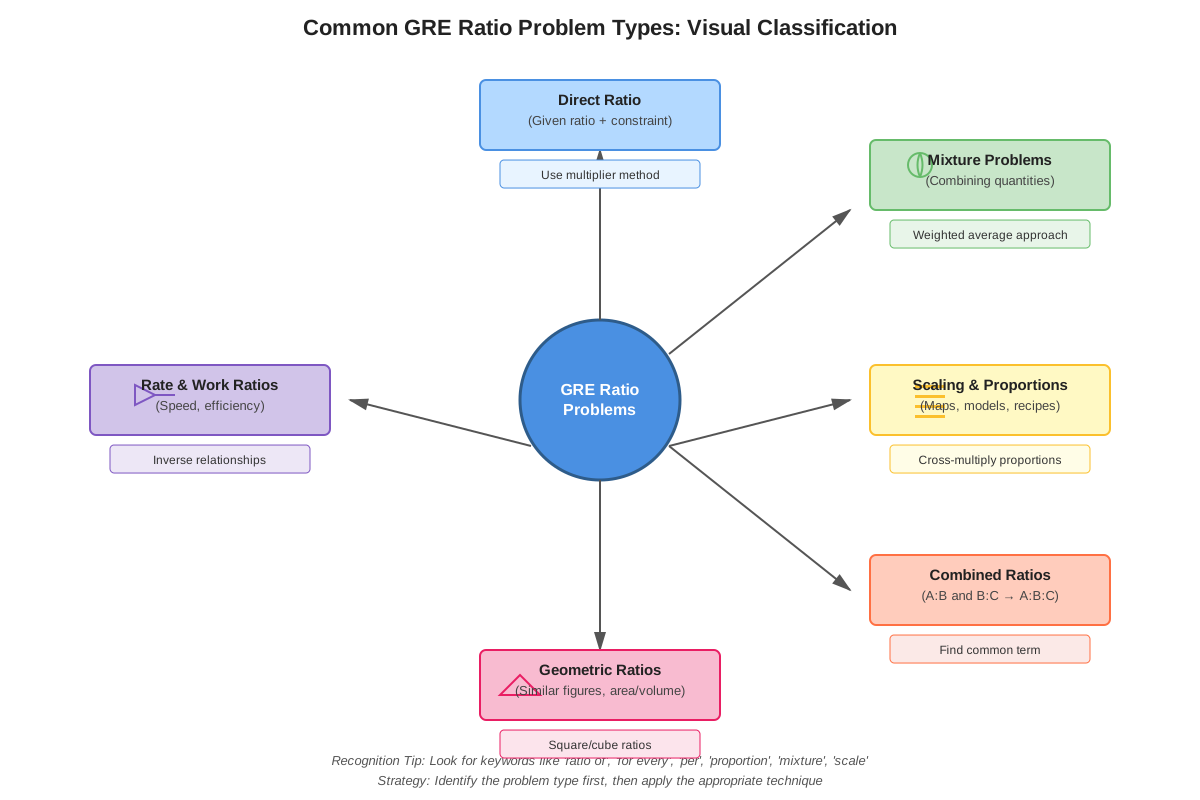
The GRE tests ratios in diverse contexts: comparing quantities in data interpretation, solving mixture problems, working with part-to-part and part-to-whole relationships, and applying scaling principles. Questions may present ratios directly or disguise them within word problems about recipes, populations, investments, or geometric figures. Success on ratio questions requires recognizing the underlying structure, setting up the correct mathematical representation, and systematically working toward the solution while avoiding common algebraic errors.
Learning Objectives
- [ ] Identify when Ratios is being tested
- [ ] Explain the core rule or strategy behind Ratios
- [ ] Apply Ratios to GRE-style questions accurately
- [ ] Distinguish between part-to-part and part-to-whole ratios and convert between them
- [ ] Solve multi-step ratio problems involving scaling and combining ratios
- [ ] Recognize when additional information allows determination of actual quantities from ratios
- [ ] Apply ratio concepts to mixture problems, rate problems, and geometric scaling
Prerequisites
- Basic fraction operations: Ratios are often expressed and manipulated as fractions, requiring comfort with simplification, multiplication, and division of fractions
- Linear equation solving: Most ratio problems require setting up and solving algebraic equations to find unknown quantities
- Proportional reasoning: Understanding that equal ratios form proportions is essential for solving ratio problems through cross-multiplication
- Basic arithmetic operations: Facility with multiplication, division, and working with whole numbers and decimals ensures efficient problem-solving
Why This Topic Matters
Ratios appear throughout quantitative reasoning because they represent fundamental relationships in mathematics, science, business, and everyday life. In real-world applications, ratios help compare investment returns, analyze financial statements, adjust recipes, interpret maps and scale models, understand demographic data, and make informed decisions based on comparative information. The ability to work with ratios is essential for data analysis, resource allocation, and any field requiring proportional reasoning.
On the GRE, ratio questions appear in multiple formats: Problem Solving questions (both multiple-choice and numeric entry), Quantitative Comparison questions, and Data Interpretation questions involving charts and graphs. Approximately 3-5 questions per exam directly test ratio concepts, with many additional questions incorporating ratios as part of more complex problems. The GRE particularly favors questions that combine ratios with other concepts—such as ratios with percentages, ratios in geometric figures, or ratios requiring algebraic manipulation.
Common GRE question types include: comparing two quantities given in ratio form; finding actual values when given ratios and total amounts; solving mixture problems where different ratios must be combined; working with changing ratios when quantities are added or removed; and applying ratios to geometric scaling problems. The exam frequently tests whether students understand the difference between part-to-part and part-to-whole ratios, and whether they can recognize when a ratio alone is insufficient to determine actual values without additional constraints.
Core Concepts
Definition and Notation
A ratio is a comparison of two or more quantities measured in the same units. Ratios can be written in several equivalent forms:
- Using a colon: 3:4
- As a fraction: 3/4
- Using the word "to": 3 to 4
- In reduced form: 6:8 = 3:4
When working with ratios, always reduce them to simplest form by dividing all terms by their greatest common divisor. The ratio 12:18:24 simplifies to 2:3:4 by dividing each term by 6. This simplification makes calculations easier and helps identify equivalent ratios.
Part-to-Part vs. Part-to-Whole Ratios
Understanding the distinction between these two types is crucial for GRE success:
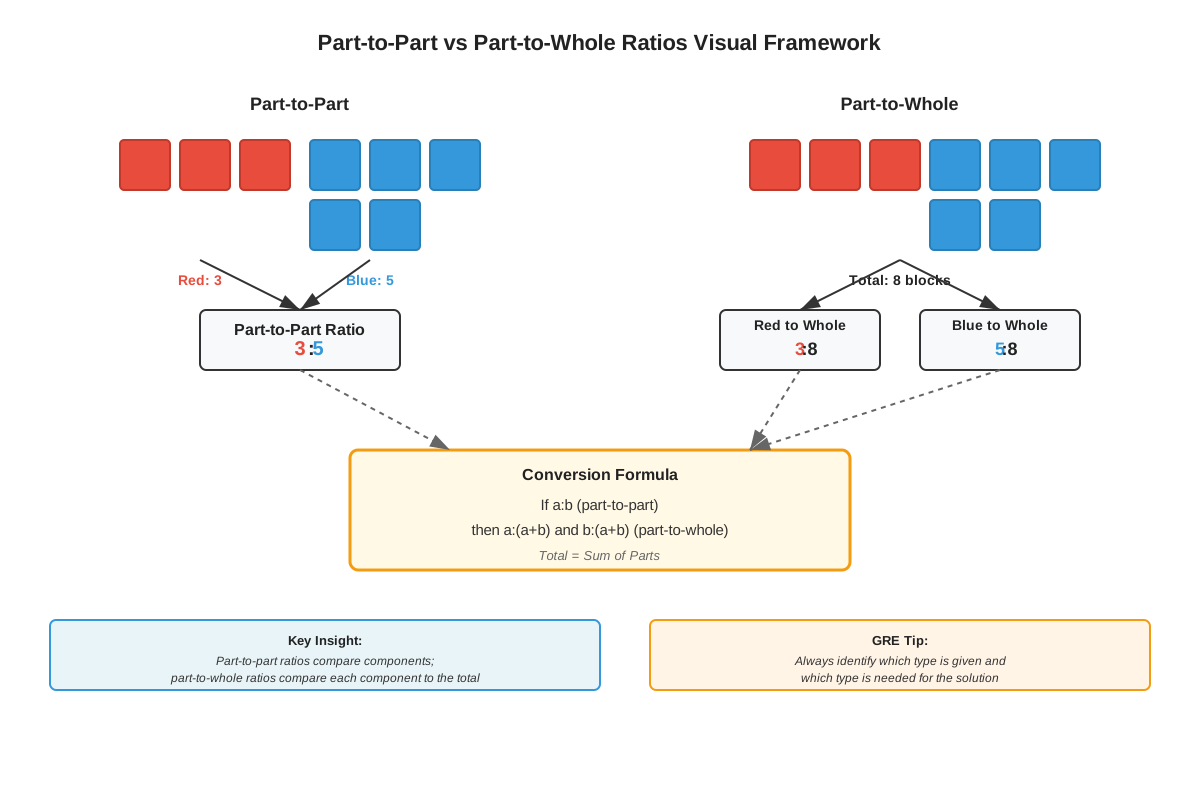
Part-to-part ratios compare different components of a whole. If a classroom has boys and girls in the ratio 3:5, this means for every 3 boys there are 5 girls. The parts are being compared to each other.
Part-to-whole ratios compare one component to the entire set. Using the same classroom, the ratio of boys to total students would be 3:8 (3 boys out of 3+5=8 total students), and girls to total would be 5:8.
| Ratio Type | Example | Interpretation |
|---|---|---|
| Part-to-part | 3:5 (boys:girls) | For every 3 boys, there are 5 girls |
| Part-to-whole | 3:8 (boys:total) | Boys represent 3/8 of the total |
| Part-to-whole | 5:8 (girls:total) | Girls represent 5/8 of the total |
Converting between these forms is essential: if given a part-to-part ratio of a:b, the part-to-whole ratios are a:(a+b) and b:(a+b).
The Ratio Multiplier Method
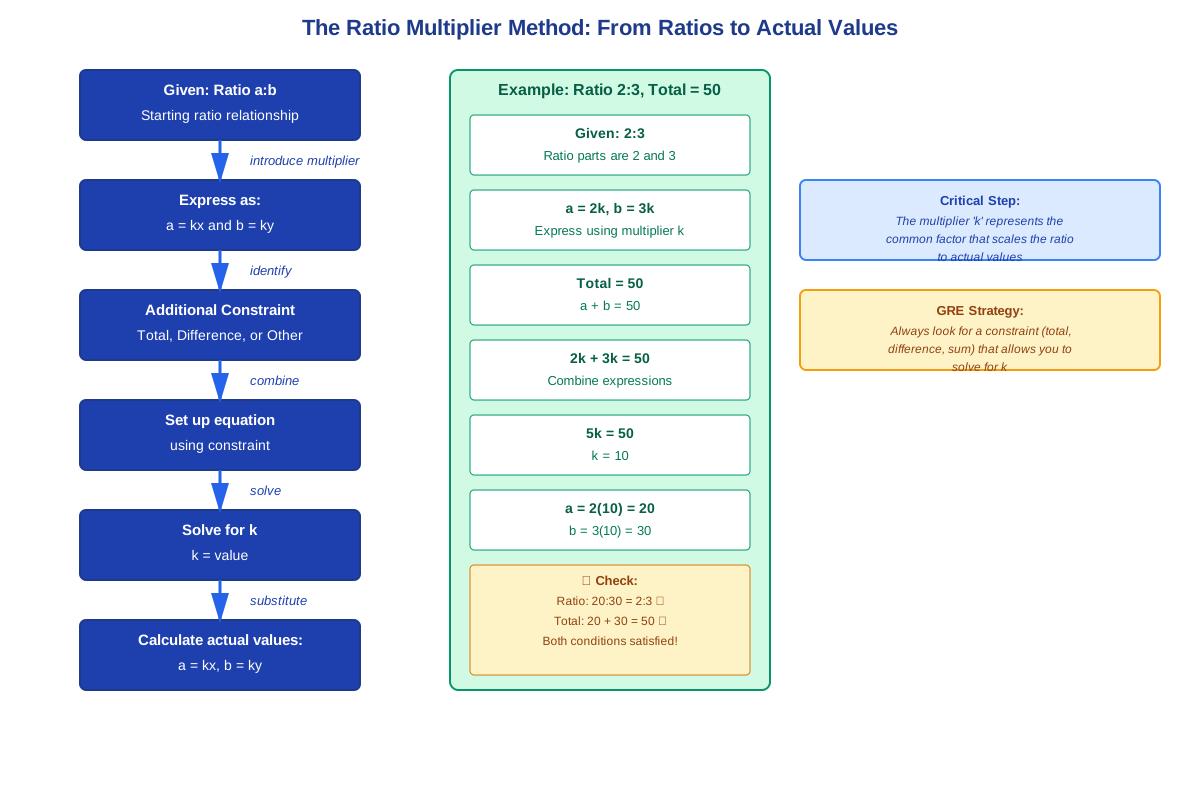
The most powerful technique for solving ratio problems involves the ratio multiplier (also called the common factor). If two quantities are in the ratio a:b, then the actual quantities can be expressed as ax and bx, where x is the multiplier.
For example, if the ratio of cats to dogs is 2:3, then:
- Number of cats = 2x
- Number of dogs = 3x
- Total animals = 2x + 3x = 5x
This method transforms ratio problems into algebra problems. Once you have an equation involving x (such as "the total is 40"), you can solve for x and then find the actual quantities.
Scaling Ratios
Ratios remain equivalent when all terms are multiplied or divided by the same non-zero number. This property allows us to:
- Scale ratios up to find equivalent ratios with larger numbers
- Scale ratios down to simplest form
- Find common denominators when combining ratios
For instance, 2:3 = 4:6 = 6:9 = 8:12. All these ratios represent the same relationship. When combining ratios or comparing them, scaling to a common term is often necessary.
Combining Ratios
When given multiple ratios that share a common term, you can combine them into a single extended ratio. This technique is essential for problems involving three or more quantities.
Example: If A:B = 2:3 and B:C = 4:5, find A:B:C.
Solution: The common term is B. Scale the ratios so B has the same value in both:
- A:B = 2:3 (multiply by 4) → 8:12
- B:C = 4:5 (multiply by 3) → 12:15
- Combined: A:B:C = 8:12:15
Ratios with Constraints
A ratio alone does not determine actual quantities—it only shows the relationship between quantities. To find actual values, you need an additional constraint such as:
- The total of all quantities
- The difference between quantities
- The value of one specific quantity
- A relationship involving sums or differences
Example: If x:y = 3:5 and x + y = 64, find x and y.
Using the multiplier method: x = 3k and y = 5k
Therefore: 3k + 5k = 64, so 8k = 64, giving k = 8
Thus: x = 3(8) = 24 and y = 5(8) = 40
Changing Ratios
Some GRE problems involve ratios that change when quantities are added or removed. These require careful setup:
- Express initial quantities using the ratio multiplier
- Add or subtract the specified amounts
- Set up an equation using the new ratio
- Solve for the multiplier
Example: A solution contains alcohol and water in ratio 2:5. After adding 3 liters of alcohol, the ratio becomes 1:2. Find the original amount of alcohol.
Solution:
- Original: alcohol = 2x, water = 5x
- After adding: alcohol = 2x + 3, water = 5x (unchanged)
- New ratio: (2x + 3)/5x = 1/2
- Cross-multiply: 2(2x + 3) = 5x
- Solve: 4x + 6 = 5x, so x = 6
- Original alcohol = 2(6) = 12 liters
Concept Relationships
The concepts within ratios build hierarchically: understanding basic ratio notation and simplification → distinguishing part-to-part from part-to-whole ratios → applying the ratio multiplier method → scaling and combining ratios → solving problems with changing ratios. Each level requires mastery of the previous concepts.
Ratios connect deeply to fractions since any ratio a:b can be expressed as the fraction a/b. This connection allows ratio problems to be solved using fraction operations and cross-multiplication. The relationship flows: Ratios ↔ Fractions → Proportions → Cross-multiplication.
Ratios also link to percentages, which are special ratios comparing a quantity to 100. Converting between ratios and percentages is common on the GRE: Ratios → Part-to-whole ratios → Fractions → Percentages. For example, a 3:5 part-to-part ratio means one part is 3/8 = 37.5% of the whole.
In algebra, ratios create systems of equations through the multiplier method: Ratios → Algebraic expressions → Equations → Solutions. This connection makes ratio problems accessible through algebraic techniques students already know.
Geometrically, ratios appear in similar figures where corresponding sides are in constant ratio (the scale factor), in trigonometric ratios, and in coordinate geometry: Ratios → Scale factors → Similar figures → Proportional sides.
High-Yield Facts
⭐ A ratio alone does not determine actual quantities; you need an additional constraint (total, difference, or one actual value) to solve for specific amounts
⭐ If quantities are in ratio a:b, they can be expressed as ax and bx where x is the common multiplier
⭐ Part-to-part ratio a:b converts to part-to-whole ratios a:(a+b) and b:(a+b)
⭐ Ratios remain equivalent when all terms are multiplied or divided by the same non-zero constant
⭐ To combine ratios with a common term, scale them so the common term has the same value in both ratios
- When a ratio problem involves "adding" or "removing" quantities, set up equations for both before and after states
- The sum of parts in a ratio equals the total: if a:b = 2:3, then total = 2x + 3x = 5x
- Ratios must compare quantities in the same units; convert if necessary before setting up the ratio
- In Quantitative Comparison questions, ratios often provide insufficient information to determine which quantity is larger without additional constraints
- Reciprocal ratios reverse the comparison: if A:B = 2:3, then B:A = 3:2
Quick check — test yourself on Ratios so far.
Try Flashcards →Common Misconceptions
Misconception: A ratio of 2:3 means there are 2 of one item and 3 of another.
Correction: A ratio of 2:3 means for every 2 of one item, there are 3 of another, but actual quantities could be 4 and 6, or 20 and 30, or any multiple of 2 and 3. The ratio shows the relationship, not necessarily the actual counts.
Misconception: If the ratio of boys to girls is 3:4, then boys represent 3/4 of the total.
Correction: Boys represent 3/(3+4) = 3/7 of the total. The denominator must be the sum of all parts, not just one part. The 3/4 fraction represents boys compared to girls only (part-to-part), not boys compared to everyone (part-to-whole).
Misconception: You can add ratios directly: if A:B = 2:3 and C:D = 1:4, then (A+C):(B+D) = 3:7.
Correction: Ratios cannot be added this way. Each ratio applies to its own set of quantities with potentially different multipliers. You cannot combine ratios unless they share a common term that can be scaled appropriately.
Misconception: When a ratio problem says "the ratio increases," you can simply add to the ratio terms.
Correction: When quantities change, you must add or subtract from the actual quantities (expressed using the multiplier), not from the ratio terms themselves. If the ratio is 2:3 (meaning 2x and 3x), and you add 5 to the first quantity, it becomes (2x+5):3x, not 7:3.
Misconception: Ratios and rates are the same thing.
Correction: While related, ratios compare quantities in the same units (boys to girls, both counted in people), while rates compare quantities in different units (miles per hour, dollars per item). Rates are a special type of ratio, but not all ratios are rates.
Misconception: If two ratios are equal, their cross-products are equal, so you can always cross-multiply.
Correction: While this is true for proportions (equations stating two ratios are equal), you cannot cross-multiply when comparing ratios in Quantitative Comparison questions unless you know the denominators are positive. Cross-multiplication can reverse inequality signs if denominators are negative.
Worked Examples
Example 1: Finding Actual Quantities from Ratios
Problem: In a jar, the ratio of red marbles to blue marbles to green marbles is 2:3:5. If there are 60 marbles in total, how many blue marbles are there?
Solution:
Step 1: Identify the type of problem
This is a classic ratio problem with a constraint (total quantity given). We need to find one specific quantity.
Step 2: Apply the ratio multiplier method
Let the common multiplier be x.
- Red marbles = 2x
- Blue marbles = 3x
- Green marbles = 5x
Step 3: Set up an equation using the constraint
Total marbles = 2x + 3x + 5x = 60
10x = 60
Step 4: Solve for the multiplier
x = 6
Step 5: Find the requested quantity
Blue marbles = 3x = 3(6) = 18
Answer: There are 18 blue marbles.
Connection to learning objectives: This problem demonstrates applying the ratio multiplier method (core strategy) and using a constraint (total) to find actual quantities from a ratio.
Example 2: Combining Ratios
Problem: In a company, the ratio of managers to supervisors is 2:5, and the ratio of supervisors to workers is 3:7. What is the ratio of managers to workers?
Solution:
Step 1: Identify what's needed
We need to combine two ratios that share a common term (supervisors) to find the relationship between managers and workers.
Step 2: Write the given ratios
- Managers : Supervisors = 2:5
- Supervisors : Workers = 3:7
Step 3: Scale ratios to make the common term equal
The common term is supervisors (5 in the first ratio, 3 in the second).
Find the LCM of 5 and 3, which is 15.
Scale the first ratio by 3: Managers : Supervisors = 6:15
Scale the second ratio by 5: Supervisors : Workers = 15:35
Step 4: Combine into a single ratio
Managers : Supervisors : Workers = 6:15:35
Step 5: Extract the requested ratio
Managers : Workers = 6:35
Answer: The ratio of managers to workers is 6:35.
Connection to learning objectives: This demonstrates the technique of combining ratios with a common term, a sophisticated skill that appears frequently on harder GRE questions.
Example 3: Changing Ratios
Problem: A container has milk and water in the ratio 7:3. After removing 10 liters of the mixture and adding 10 liters of water, the ratio becomes 7:5. What was the original quantity of milk?
Solution:
Step 1: Set up initial quantities
Original milk = 7x
Original water = 3x
Original total = 10x
Step 2: Analyze what's removed
When 10 liters of mixture is removed, it's removed in the original ratio 7:3.
Milk removed = 10 × (7/10) = 7 liters
Water removed = 10 × (3/10) = 3 liters
Step 3: Calculate quantities after removal
Milk after removal = 7x - 7
Water after removal = 3x - 3
Step 4: Account for water added
Milk after adding water = 7x - 7 (unchanged)
Water after adding water = 3x - 3 + 10 = 3x + 7
Step 5: Set up equation using new ratio
(7x - 7)/(3x + 7) = 7/5
Step 6: Cross-multiply and solve
5(7x - 7) = 7(3x + 7)
35x - 35 = 21x + 49
14x = 84
x = 6
Step 7: Find original milk quantity
Original milk = 7x = 7(6) = 42 liters
Answer: The original quantity of milk was 42 liters.
Connection to learning objectives: This complex problem requires recognizing how ratios change when quantities are added or removed, demonstrating advanced application of ratio concepts to multi-step GRE-style problems.
Exam Strategy
When approaching GRE ratios questions, follow this systematic process:
1. Identify the ratio structure: Determine whether you're dealing with part-to-part or part-to-whole ratios. Look for phrases like "ratio of A to B" (part-to-part) versus "A represents what fraction of the total" (part-to-whole).
2. Watch for trigger words and phrases:
- "ratio of... to..." → sets up the ratio relationship
- "for every..." → indicates ratio structure
- "in total" or "altogether" → provides the constraint needed to solve
- "difference between" → another type of constraint
- "after adding/removing" → signals a changing ratio problem
- "combined" or "mixture" → suggests ratio combination
3. Apply the multiplier method immediately: As soon as you identify a ratio, write the quantities as multiples of a common variable (usually x or k). This transforms the problem into algebra, which most students find more comfortable.
4. Look for the constraint: Remember that a ratio alone is insufficient. Actively search for the additional information that allows you to solve for actual values: total, difference, one specific value, or a relationship equation.
5. For Quantitative Comparison questions: Be especially careful with ratios. Often, the ratio information alone is insufficient to determine which quantity is larger. Look for answer choice (D) "The relationship cannot be determined" when only ratios are given without actual values.
6. Check units: Before setting up a ratio, ensure all quantities are in the same units. Convert if necessary (e.g., feet to inches, hours to minutes).
7. Simplify ratios first: Always reduce ratios to simplest form before working with them. This makes calculations easier and helps you spot equivalent ratios.
8. Time allocation: Simple ratio problems should take 1-1.5 minutes. Complex problems involving changing ratios or multiple steps may require 2-2.5 minutes. If you're stuck after 30 seconds, try the multiplier method—it works for nearly all ratio problems.
9. Process of elimination for multiple choice: If you can determine the ratio of the answer to the total, you can eliminate choices that don't match. For example, if you know the answer must be 3/8 of the total, and the total is 80, the answer must be 30—eliminate all other choices immediately.
10. Verify your answer: After solving, check that your answer maintains the original ratio. If the ratio was 2:3 and you found 20 and 30, verify that 20/30 = 2/3.
Memory Techniques
Mnemonic for ratio problem steps - "RICE":
- Read and identify the ratio structure
- Introduce the multiplier (express quantities as ax, bx, etc.)
- Constraint: find the equation from given information
- Evaluate: solve for the multiplier and find requested quantities
Visualization for part-to-part vs. part-to-whole:
Picture a pizza cut into slices. If the ratio of pepperoni to cheese slices is 3:5, imagine 3 pepperoni slices and 5 cheese slices. The part-to-part ratio compares these groups (3:5). The part-to-whole ratio compares one group to all 8 slices (3:8 or 5:8). Visualizing concrete objects helps distinguish these concepts.
Acronym for when you can solve for actual values - "TDS":
You need one of these constraints:
- Total is given
- Difference is given
- Specific value (one actual quantity) is given
Memory aid for combining ratios:
"Find the common ground, then expand around it." The common term must match, so scale both ratios until the shared term has the same value.
Reciprocal reminder:
"Flip the ratio, flip the comparison." If A:B = 2:3, then B:A = 3:2. The order matters—switching the order means taking the reciprocal.
Summary
Ratios are fundamental relationships that compare quantities, appearing in approximately 10-15% of GRE Quantitative Reasoning questions. Mastery requires understanding the distinction between part-to-part ratios (comparing components to each other) and part-to-whole ratios (comparing components to the total), and being able to convert between these forms. The most powerful technique for solving ratio problems is the ratio multiplier method, where quantities in ratio a:b are expressed as ax and bx, transforming ratio problems into algebraic equations. A critical insight is that ratios alone do not determine actual quantities—an additional constraint such as a total, difference, or specific value is required. Advanced ratio problems involve combining ratios with common terms (by scaling to make the common term equal), working with changing ratios (when quantities are added or removed), and recognizing when ratio information is insufficient to answer a question. Success on GRE ratio questions demands systematic problem-solving: identify the ratio structure, apply the multiplier method, find the constraint, set up an equation, and solve for actual values while avoiding common errors like confusing part-to-part with part-to-whole ratios or attempting to add ratios directly.
Key Takeaways
- Ratios express relationships between quantities but require an additional constraint (total, difference, or specific value) to determine actual amounts
- Use the ratio multiplier method: express quantities in ratio a:b as ax and bx to convert ratio problems into solvable algebraic equations
- Distinguish part-to-part ratios (comparing components: a:b) from part-to-whole ratios (comparing to total: a:(a+b) and b:(a+b))
- Ratios remain equivalent when all terms are multiplied or divided by the same non-zero number; always simplify ratios to lowest terms
- To combine ratios sharing a common term, scale both ratios so the common term has the same value, then merge into an extended ratio
- Watch for changing ratio problems where quantities are added or removed—set up separate expressions for before and after states
- In Quantitative Comparison questions, ratio information alone is often insufficient to determine which quantity is larger without additional constraints
Related Topics
Proportions and Cross-Multiplication: Direct extension of ratios where two ratios are set equal, enabling solution through cross-multiplication. Mastering ratios provides the foundation for understanding proportional relationships and solving proportion equations efficiently.
Percentages: Special ratios comparing quantities to 100. Understanding part-to-whole ratios makes percentage problems more intuitive, as percentages are simply part-to-whole ratios expressed with denominator 100.
Rates and Unit Rates: Ratios comparing quantities with different units (speed, price per unit, work rates). The ratio techniques learned here apply directly to rate problems, which are among the most common GRE question types.
Mixture Problems: Complex applications combining ratios with weighted averages. These problems require understanding how to work with multiple ratios simultaneously and how ratios change when mixtures are combined.
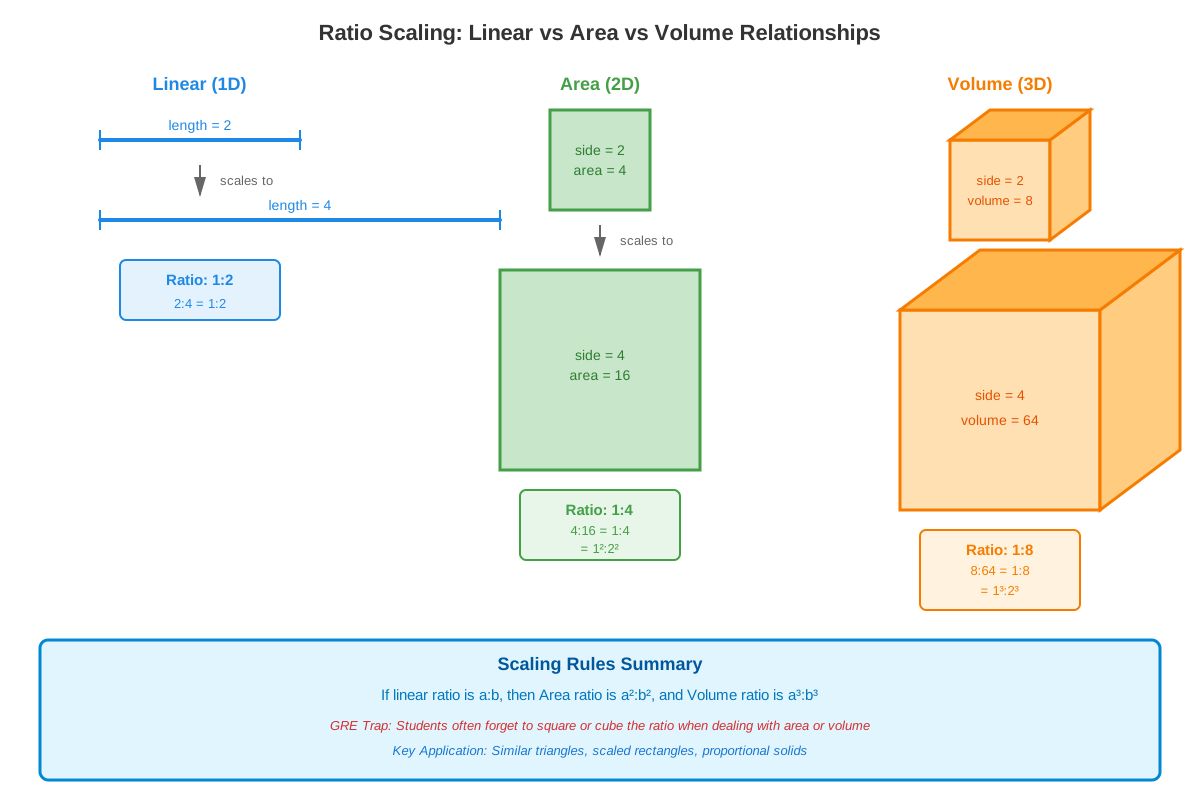
Similar Figures in Geometry: Geometric shapes where corresponding sides are in constant ratio (scale factor). Ratio mastery is essential for solving problems involving similar triangles, proportional sides, and area/volume scaling.
Probability: Ratios of favorable outcomes to total outcomes. The part-to-whole ratio concept directly translates to probability calculations.
Practice CTA
Now that you've mastered the core concepts, strategies, and common pitfalls of ratios, it's time to reinforce your learning through active practice. Attempt the practice questions designed specifically for this topic—they mirror actual GRE question formats and difficulty levels. Use the flashcards to drill high-yield facts and ensure instant recall of key concepts. Remember, ratio problems reward systematic thinking: identify the structure, apply the multiplier method, find your constraint, and solve. With focused practice, you'll develop the pattern recognition and problem-solving speed needed to excel on ratio questions and boost your Quantitative Reasoning score. Every practice problem you solve strengthens your mathematical intuition and builds confidence for test day!
Sign up free to keep reading
Create a free AnvayaPrep account to finish this GRE guide on Ratios — plus flashcards and practice questions.