Overview
Percent decrease is a fundamental arithmetic concept that appears frequently on the GRE Quantitative Reasoning section. This topic tests a student's ability to calculate and interpret reductions in quantities expressed as percentages—a skill that bridges basic arithmetic with more complex problem-solving scenarios. Understanding percent decrease is essential not only for direct calculation questions but also for data interpretation, word problems, and quantitative comparison questions where recognizing proportional changes can lead to elegant solutions.
The concept of gre percent decrease extends beyond simple formula application. Test-makers design questions that require students to work backward from a decreased value, calculate successive decreases, distinguish between percentage points and percent changes, and apply percent decrease in contexts involving prices, populations, measurements, and abstract quantities. Mastery of this topic enables efficient problem-solving across multiple question formats and difficulty levels, making it a high-yield area for focused study.
Within the broader landscape of Quantitative Reasoning, percent decrease connects intimately with ratios, proportions, fractions, and algebraic reasoning. It serves as a building block for understanding compound changes, growth and decay problems, and statistical concepts like variance. Students who develop fluency with percent decrease calculations gain confidence tackling complex multi-step problems and can more readily identify when a problem that appears complicated actually reduces to a straightforward percentage calculation.
Learning Objectives
- [ ] Identify when Percent decrease is being tested in GRE questions
- [ ] Explain the core rule or strategy behind Percent decrease calculations
- [ ] Apply Percent decrease to GRE-style questions accurately
- [ ] Calculate the original value when given a decreased value and the percent decrease
- [ ] Distinguish between successive percent decreases and single equivalent decreases
- [ ] Recognize and avoid common traps involving percentage points versus percent changes
- [ ] Solve multi-step problems combining percent decrease with other arithmetic operations
Prerequisites
- Basic percentage concepts: Understanding that percentages represent parts per hundred is essential for interpreting what a decrease means proportionally
- Decimal and fraction conversions: Converting between percentages, decimals, and fractions enables flexible calculation approaches and verification of answers
- Basic algebra: Solving for unknown variables is necessary when working backward from decreased values to find original quantities
- Multiplication and division fluency: Percent decrease calculations fundamentally involve these operations, and computational accuracy determines success
Why This Topic Matters
Percent decrease appears in countless real-world contexts: retail discounts, population declines, budget cuts, depreciation of assets, reduction in measurements, and statistical decreases. The GRE leverages this universality by embedding percent decrease in diverse problem contexts, testing whether students can extract the mathematical essence from verbal descriptions and apply the appropriate calculations.
On the GRE Quantitative Reasoning section, percent decrease appears in approximately 10-15% of questions, either as the primary focus or as a component of multi-step problems. Questions involving this topic appear across all formats: quantitative comparison, multiple-choice (single and multiple answer), and numeric entry. The concept frequently appears in data interpretation sets where students must calculate changes between data points, in word problems involving prices or quantities, and in abstract problems testing pure computational skill.
Common exam presentations include: "The price decreased by 20% to $80. What was the original price?"; "A quantity decreased by 30% and then by 20%. What is the overall percent decrease?"; "Which is greater: a 25% decrease followed by a 25% increase, or the original value?"; and data interpretation questions asking for percent changes between years or categories. Recognizing these patterns allows students to quickly activate the appropriate solution strategy.
Core Concepts
The Fundamental Formula
The percent decrease represents the proportional reduction in a quantity, expressed as a percentage of the original value. The fundamental formula is:
Percent Decrease = (Original Value - New Value) / Original Value × 100%Alternatively, this can be expressed as:
Percent Decrease = (Amount of Decrease) / Original Value × 100%The critical insight is that percent decrease is always calculated relative to the original value (the starting point), not the new value. This asymmetry is a frequent source of errors and test-maker traps.
Calculating the New Value from Percent Decrease
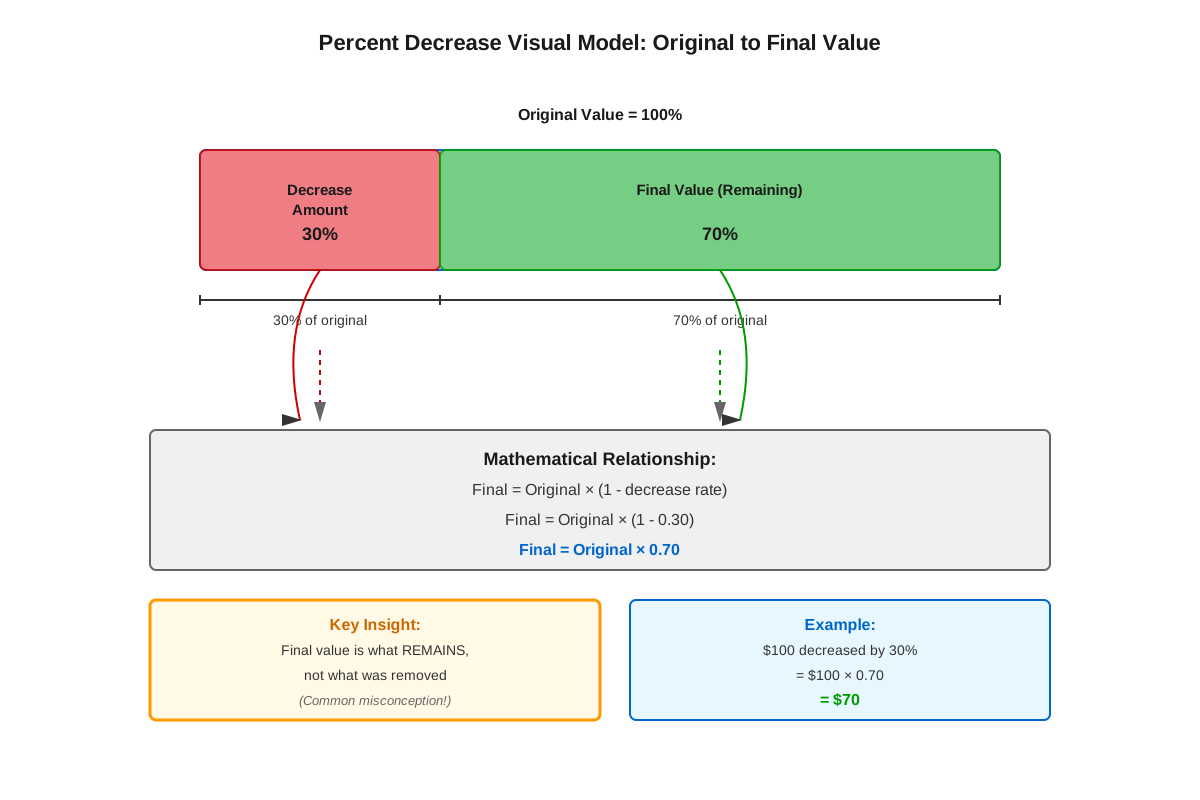
When given an original value and a percent decrease, the new value can be calculated using:
New Value = Original Value × (1 - Percent Decrease as decimal)For example, if a $200 item decreases by 15%:
New Value = 200 × (1 - 0.15) = 200 × 0.85 = $170This formulation is computationally efficient because it combines the subtraction and multiplication into a single step. The multiplier (1 - percent decrease) represents the fraction of the original value that remains.
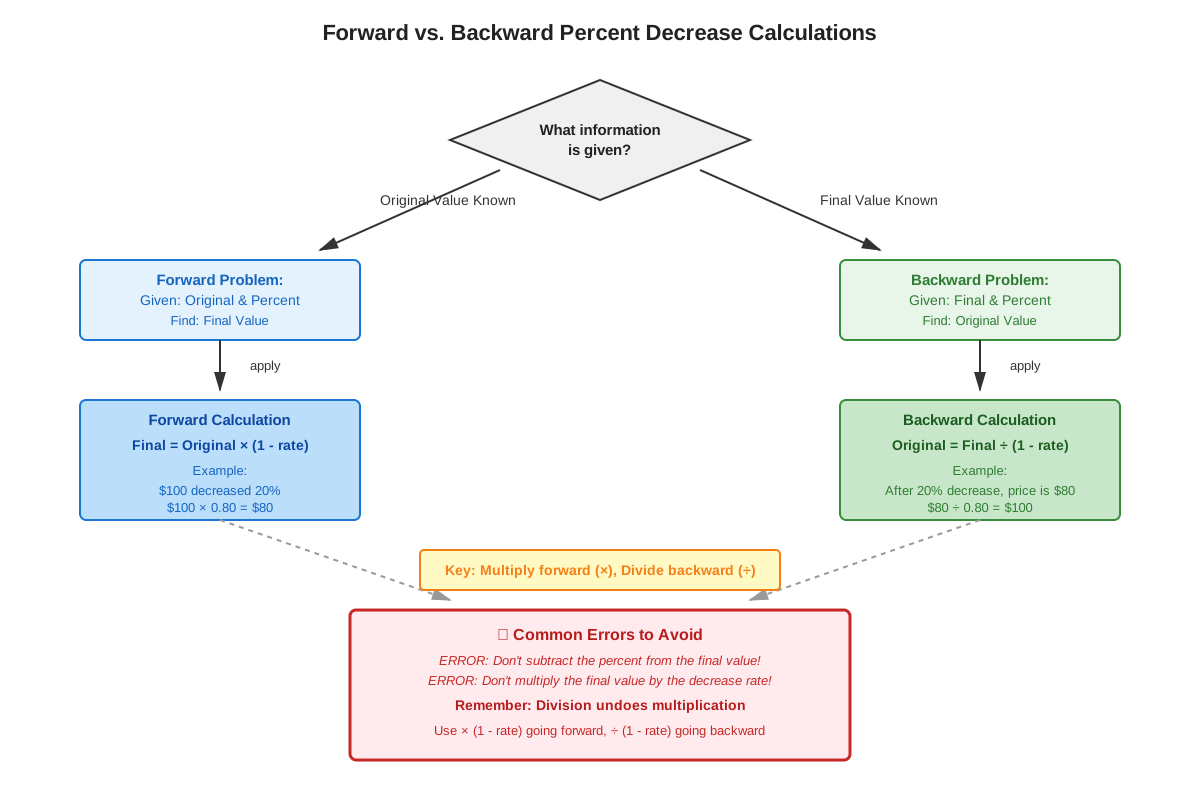
Finding the Original Value (Working Backward)
A high-yield GRE question type provides the decreased value and the percent decrease, requiring calculation of the original value. The formula is:
Original Value = New Value / (1 - Percent Decrease as decimal)For example, if a price decreased by 20% to $80:
Original Value = 80 / (1 - 0.20) = 80 / 0.80 = $100This reverse calculation is conceptually challenging for many students because it requires recognizing that the new value represents a specific fraction (80% in this case) of the unknown original.
Successive Percent Decreases
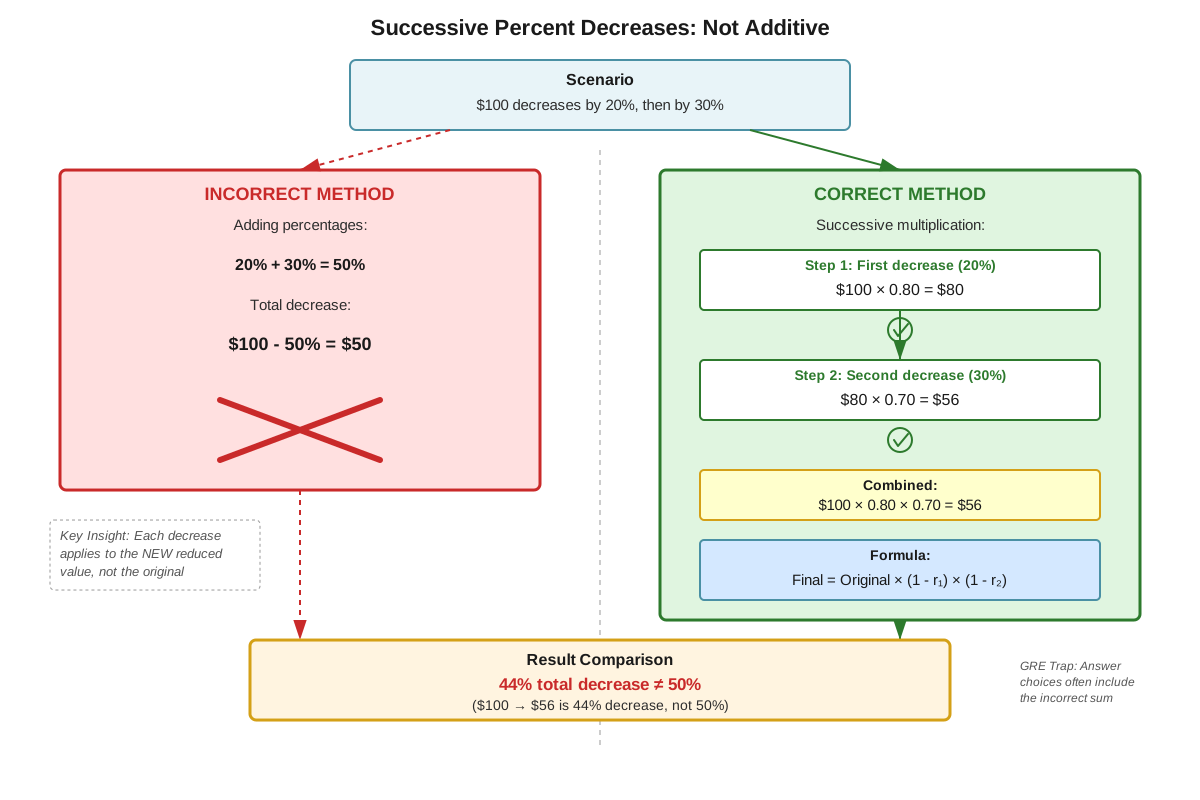
When a quantity undergoes multiple percent decreases, the decreases compound rather than add. If a quantity decreases by x% and then by y%, the overall decrease is not (x + y)%.
The correct calculation applies each decrease sequentially:
Final Value = Original Value × (1 - x/100) × (1 - y/100)For example, a 20% decrease followed by a 30% decrease:
Final Value = Original × 0.80 × 0.70 = Original × 0.56This represents a 44% overall decrease, not 50%. The second decrease applies to an already-reduced value, making the combined effect less than the sum of individual percentages.
Percent Decrease vs. Percentage Points
This distinction is crucial for GRE success. A percent decrease is a relative change, while percentage points represent an absolute difference between two percentages.
| Scenario | Percent Decrease | Percentage Points |
|---|---|---|
| Interest rate drops from 10% to 8% | 20% decrease | 2 percentage point decrease |
| Test score drops from 80% to 60% | 25% decrease | 20 percentage point decrease |
| Market share drops from 50% to 40% | 20% decrease | 10 percentage point decrease |
The GRE exploits this confusion by offering both interpretations as answer choices.
The Multiplier Method
For computational efficiency, memorizing common percent decrease multipliers accelerates problem-solving:
- 10% decrease → multiply by 0.90
- 20% decrease → multiply by 0.80
- 25% decrease → multiply by 0.75
- 30% decrease → multiply by 0.70
- 50% decrease → multiply by 0.50
This approach reduces cognitive load and minimizes calculation errors during timed testing conditions.
Concept Relationships
The concepts within percent decrease form a logical hierarchy. The fundamental formula serves as the foundation, defining what percent decrease means mathematically. From this foundation, two primary branches emerge: forward calculations (finding new values from originals and percent decreases) and reverse calculations (finding originals from decreased values).
The successive decreases concept builds upon forward calculations, introducing the compounding principle that connects percent decrease to exponential thinking. This relationship extends to more advanced topics like compound interest and exponential decay. The distinction between percent decrease and percentage points represents a conceptual refinement that prevents misinterpretation of problem statements.
The multiplier method serves as a computational optimization that applies across all calculation types, representing a strategic layer above the foundational formulas. This efficiency technique connects percent decrease to broader test-taking strategies involving pattern recognition and mental math.
Externally, percent decrease connects to percent increase (its inverse operation), ratios and proportions (as percent decrease represents a specific ratio relationship), fractions and decimals (as alternative representations of the same proportional change), and algebra (when solving for unknown values). Understanding these connections enables flexible problem-solving approaches and recognition of equivalent problem formulations.
High-Yield Facts
⭐ Percent decrease is always calculated relative to the original (starting) value, not the new value
⭐ A 20% decrease followed by a 20% increase does NOT return to the original value—it results in a net 4% decrease
⭐ To find the original value when given a decreased value: divide the decreased value by (1 - percent decrease as decimal)
⭐ Successive percent decreases multiply their retention factors: 20% then 30% decrease = 0.80 × 0.70 = 0.56 (44% total decrease)
⭐ A decrease from 10% to 8% is a 20% decrease, not a 2% decrease (percentage points vs. percent change)
- The amount of decrease equals the original value multiplied by the percent decrease (as a decimal)
- A 50% decrease means the new value is exactly half the original value
- Percent decrease can never exceed 100% (which would represent complete elimination)
- Converting percent decrease to a decimal and subtracting from 1 gives the retention factor (what fraction remains)
- When comparing percent decreases across different base values, the same percentage represents different absolute amounts
- The formula New = Original × (1 - rate) works for any percent decrease, making it universally applicable
- In data interpretation, percent decrease between two values requires identifying which is the original (earlier/baseline) value
Quick check — test yourself on Percent decrease so far.
Try Flashcards →Common Misconceptions
Misconception: Percent decrease is calculated using the new value as the denominator → Correction: Percent decrease always uses the original value as the denominator. If a price drops from $100 to $80, the decrease is $20/$100 = 20%, not $20/$80 = 25%.
Misconception: A 30% decrease followed by a 20% decrease equals a 50% total decrease → Correction: Successive decreases compound multiplicatively, not additively. The calculation is 0.70 × 0.80 = 0.56, representing a 44% total decrease. The second decrease applies to an already-reduced value.
Misconception: A 25% decrease followed by a 25% increase returns to the original value → Correction: These operations are not symmetric. Starting with 100: after 25% decrease = 75; after 25% increase = 75 × 1.25 = 93.75, which is 6.25% below the original.
Misconception: A decrease from 40% to 30% is a 10% decrease → Correction: This confuses percentage points with percent decrease. The decrease is 10 percentage points but represents a 25% decrease (10/40 = 0.25 = 25%).
Misconception: To reverse a 20% decrease, add 20% back → Correction: To reverse a 20% decrease (which leaves 80% remaining), you must increase by 25% (because 80 × 1.25 = 100). The reversal percentage equals (decrease%)/(100% - decrease%).
Misconception: Percent decrease can be greater than 100% → Correction: A 100% decrease means complete elimination (reducing to zero). Decreases greater than 100% are mathematically impossible for positive quantities, though increases can exceed 100%.
Worked Examples
Example 1: Multi-Step Reverse Calculation
Problem: A store advertises a jacket at $136 after applying a 15% discount and then an additional 20% discount on the already-reduced price. What was the original price of the jacket?
Solution:
Step 1: Identify what we know and what we need to find.
- Final price: $136
- Two successive discounts: 15% then 20%
- Need: Original price
Step 2: Recognize this is a reverse calculation with successive decreases.
Step 3: Calculate the combined retention factor.
- After 15% decrease: 85% remains (0.85)
- After 20% decrease: 80% remains (0.80)
- Combined: 0.85 × 0.80 = 0.68
Step 4: The final price represents 68% of the original price.
Original Price = Final Price / Retention Factor
Original Price = 136 / 0.68 = 200
Step 5: Verify by working forward.
- Original: $200
- After 15% decrease: 200 × 0.85 = $170
- After 20% decrease: 170 × 0.80 = $136 ✓
Answer: The original price was $200.
Connection to Learning Objectives: This problem requires identifying percent decrease in a multi-step context, applying the core strategy of working backward using retention factors, and accurately executing calculations with successive decreases.
Example 2: Quantitative Comparison with Percent Decrease
Problem:
Quantity A: The result after a 40% decrease followed by a 50% increase
Quantity B: The result after a 50% increase followed by a 40% decrease
(Both starting from the same original value)Solution:
Step 1: Recognize that order matters in successive percent changes when the percentages differ.
Step 2: Calculate Quantity A using an assumed original value of 100.
- After 40% decrease: 100 × 0.60 = 60
- After 50% increase: 60 × 1.50 = 90
Step 3: Calculate Quantity B using the same original value.
- After 50% increase: 100 × 1.50 = 150
- After 40% decrease: 150 × 0.60 = 90
Step 4: Compare the results.
- Quantity A: 90
- Quantity B: 90
Answer: The quantities are equal (C).
Key Insight: When combining a percent decrease and a percent increase of different magnitudes, the order of operations doesn't affect the final result because multiplication is commutative: 0.60 × 1.50 = 1.50 × 0.60 = 0.90. Both sequences result in 90% of the original value (a net 10% decrease).
Connection to Learning Objectives: This problem tests the ability to identify percent decrease in a comparison context, apply the strategy to successive changes, and recognize the mathematical principle that multiplication order doesn't affect the product.
Exam Strategy
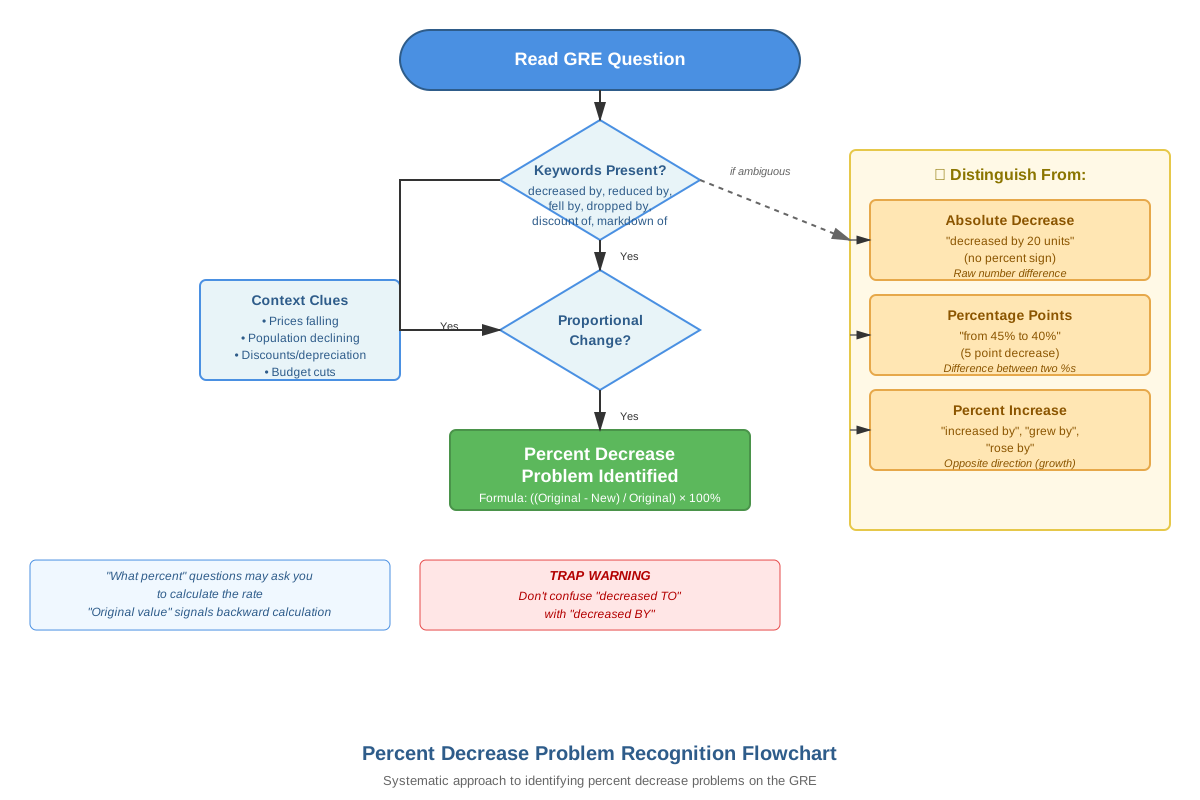
When approaching GRE questions involving percent decrease, follow this systematic process:
Step 1: Identify the question type
- Direct calculation (given original and percent, find new value)
- Reverse calculation (given new value and percent, find original)
- Successive changes (multiple decreases or mixed increase/decrease)
- Comparison (which scenario results in greater/lesser decrease)
Step 2: Watch for trigger words and phrases
- "decreased by," "reduced by," "dropped by" → percent decrease
- "after a discount of," "marked down by" → percent decrease in price context
- "fell from X to Y" → calculate percent decrease
- "what was the original" → reverse calculation
- "then decreased again" → successive decreases
Step 3: Identify the base value
The most critical step is determining which value serves as the denominator (100% reference point). The original/earlier/baseline value is always the base for calculating percent decrease.
Step 4: Use the multiplier method for efficiency
Rather than calculating the decrease amount separately, multiply directly by the retention factor (1 - percent decrease). This reduces steps and minimizes arithmetic errors.
Step 5: Process of elimination strategies
- Eliminate answers that would result from using the wrong base value
- Eliminate answers that add successive percentages instead of multiplying
- Eliminate answers that confuse percentage points with percent change
- For quantitative comparison, consider whether the relationship holds for all positive values or test with convenient numbers like 100
Time allocation: Straightforward percent decrease problems should take 45-60 seconds. Multi-step problems involving successive changes or reverse calculations may require 90-120 seconds. If a problem exceeds two minutes, mark it and return if time permits.
Exam Tip: When working backward from a decreased value, many students instinctively subtract the percent from the given value, which is incorrect. Always divide by the retention factor instead.
Memory Techniques
Mnemonic for the fundamental formula: "Old Minus New Over Old" (OMNOO)
- (Old - New) / Old × 100% = Percent Decrease
- The repetition of "Old" emphasizes that the original value appears twice (in numerator and denominator)
Visualization for successive decreases: Picture a shrinking balloon. Each decrease makes it smaller, but the second decrease acts on an already-smaller balloon, so the total shrinkage is less than adding the percentages would suggest.
The "Reverse Requires Division" rule: When working backward (reverse calculation), you must divide. When working forward, you multiply. The direction of the calculation determines the operation.
Common multiplier memorization: Create a mental table of frequently-tested decreases:
- "Ten-Ninety": 10% decrease → 0.90
- "Quarter-Three": 25% decrease → 0.75
- "Third-Two": 33⅓% decrease → 0.67 (approximately)
- "Half-Half": 50% decrease → 0.50
The "Points vs. Percent" distinction: Remember "Points are Plain subtraction" (percentage points = simple difference), while "Percent needs Proportion" (percent change = ratio calculation).
Summary
Percent decrease is a high-yield GRE Quantitative Reasoning topic that tests the ability to calculate proportional reductions relative to original values. The fundamental formula—(Original - New)/Original × 100%—serves as the foundation for all percent decrease calculations. Mastery requires fluency with forward calculations (finding new values from originals and percent decreases), reverse calculations (finding originals from decreased values by dividing by retention factors), and successive decreases (which compound multiplicatively, not additively). Critical distinctions include recognizing that percent decrease always uses the original value as the base, understanding that percentage points differ from percent changes, and knowing that a decrease followed by an equal increase does not return to the original value. The multiplier method (using retention factors like 0.80 for a 20% decrease) provides computational efficiency essential for timed testing. Success on GRE percent decrease questions requires identifying which value serves as the base, applying the appropriate formula, and avoiding common traps involving successive changes and symmetric operations.
Key Takeaways
- Percent decrease always uses the original (starting) value as the denominator, never the new value
- To find an original value from a decreased value, divide by the retention factor: Original = New / (1 - percent decrease)
- Successive percent decreases multiply their retention factors; a 20% decrease then 30% decrease equals 44% total decrease, not 50%
- A percent decrease followed by an equal percent increase results in a net decrease (e.g., -25% then +25% = -6.25% overall)
- Distinguish between percentage points (absolute difference) and percent change (relative difference): 10% to 8% is 2 percentage points but a 20% decrease
- Use the multiplier method for efficiency: memorize that 20% decrease means multiply by 0.80, 25% decrease means multiply by 0.75
- Percent decrease problems appear in multiple GRE formats and often combine with other arithmetic concepts in multi-step problems
Related Topics
Percent Increase: The complementary operation to percent decrease, involving proportional growth. Mastering percent decrease provides the foundation for understanding percent increase and recognizing the asymmetry between equal increases and decreases.
Successive Percent Changes: Advanced problems combining multiple increases and decreases in various orders. Understanding percent decrease is essential before tackling these more complex scenarios.
Ratio and Proportion: Percent decrease represents a specific type of ratio relationship. Strengthening ratio skills enhances percent decrease problem-solving flexibility.
Compound Interest and Exponential Decay: These topics extend the successive percent decrease concept to continuous or repeated changes over time, representing important applications in finance and science contexts.
Data Interpretation: Many data interpretation sets require calculating percent decreases between data points in tables, graphs, and charts. Fluency with percent decrease accelerates performance on these high-value question sets.
Practice CTA
Now that you've mastered the core concepts, formulas, and strategies for percent decrease, it's time to solidify your understanding through active practice. Attempt the practice questions associated with this topic, focusing on applying the systematic approach outlined in the exam strategy section. Use the flashcards to reinforce the high-yield facts and common multipliers until they become automatic. Remember that percent decrease appears frequently on the GRE in various disguises—the more you practice identifying and solving these problems efficiently, the more confident and accurate you'll become on test day. Your investment in mastering this foundational topic will pay dividends across multiple question types and difficulty levels!
Sign up free to keep reading
Create a free AnvayaPrep account to finish this GRE guide on Percent decrease — plus flashcards and practice questions.