Overview
Percent increase is one of the most frequently tested arithmetic concepts on the GRE Quantitative Reasoning section. This topic examines how quantities grow relative to their original values, expressed as a percentage. Understanding percent increase is fundamental because it appears not only in standalone arithmetic problems but also integrates with data interpretation, word problems, and real-world scenarios involving growth, profit, population changes, and price adjustments. The GRE tests this concept both directly through calculation questions and indirectly through multi-step problems that require recognizing when percent increase formulas apply.
Mastering gre percent increase questions requires more than memorizing a formula—it demands the ability to identify what represents the "original" value, distinguish between absolute change and relative change, and avoid common calculation traps. The GRE often embeds percent increase within complex word problems or presents it alongside related concepts like percent decrease, successive percent changes, or reverse percent problems where students must work backward from a final value to find the original.
This topic sits at the intersection of several Quantitative Reasoning domains. It builds upon basic fraction and decimal operations while connecting to ratio and proportion concepts. Percent increase problems frequently appear in data interpretation questions involving graphs and tables, making this skill essential for maximizing scores across multiple question types. The ability to quickly and accurately calculate percent changes also supports time management strategies, as these questions often appear early in problem-solving sections where efficiency matters most.
Learning Objectives
- [ ] Identify when Percent increase is being tested in GRE questions
- [ ] Explain the core rule or strategy behind Percent increase calculations
- [ ] Apply Percent increase formulas to GRE-style questions accurately
- [ ] Distinguish between absolute change and percent change in problem contexts
- [ ] Calculate original values when given final values and percent increases
- [ ] Solve multi-step problems involving successive percent increases
- [ ] Recognize and avoid common calculation errors in percent increase problems
Prerequisites
- Basic percentage concepts: Understanding that percentages represent parts per hundred is essential for converting between percentages, decimals, and fractions in percent increase calculations
- Decimal and fraction operations: Multiplying and dividing decimals accurately enables quick calculation of percent changes without calculator dependency
- Order of operations: Knowing when to add, multiply, or divide in multi-step percent problems prevents calculation errors
- Basic algebra: Setting up and solving simple equations allows students to work backward from final values to original values
Why This Topic Matters
Percent increase appears in countless real-world contexts that the GRE draws upon for question scenarios: salary raises, investment returns, population growth, inflation rates, sales increases, and price markups. This practical relevance makes percent increase problems particularly accessible for creating realistic word problems that test both mathematical reasoning and reading comprehension simultaneously.
On the GRE specifically, percent increase questions appear with remarkable frequency—approximately 15-20% of Quantitative Reasoning questions involve percentage calculations, with percent increase representing roughly half of these. These questions appear across multiple formats: Quantitative Comparison questions asking students to compare two percent changes, Problem Solving questions requiring direct calculation, and Data Interpretation questions where students must extract values from graphs or tables before calculating percent changes.
The GRE commonly embeds percent increase in scenarios involving business contexts (profit margins, sales growth), demographic data (population changes over time), scientific measurements (experimental result changes), and financial situations (investment returns, price changes). Recognizing the underlying percent increase structure within these varied contexts is crucial for exam success. Additionally, the GRE frequently combines percent increase with other concepts—asking students to calculate percent increase and then use that result in a ratio, or to find percent increase after applying a discount, creating multi-layered problems that test conceptual understanding rather than mere formula memorization.
Core Concepts
The Fundamental Percent Increase Formula
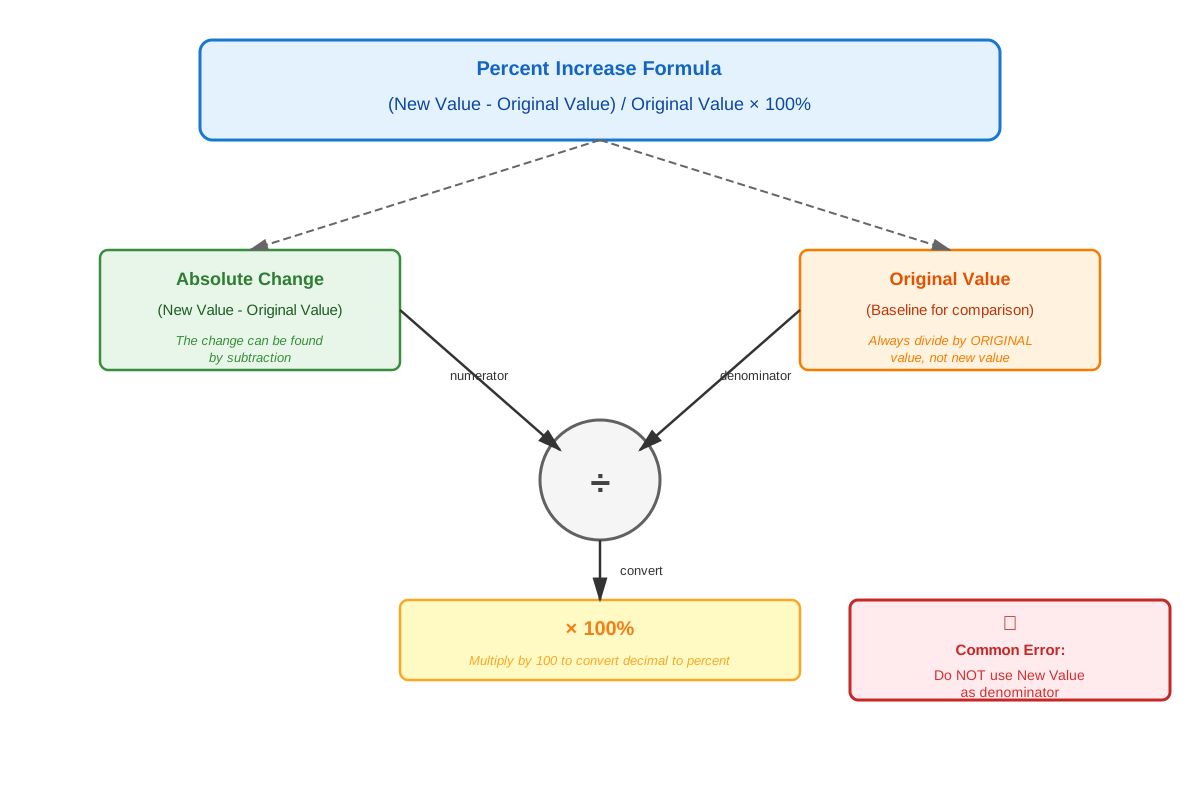
The percent increase formula represents the foundation of all calculations in this topic:
Percent Increase = (New Value - Original Value) / Original Value × 100This formula can be broken into components for better understanding:
- New Value: The quantity after the increase has occurred
- Original Value: The starting quantity before any change
- Difference: (New Value - Original Value) represents the absolute change
- Relative Change: Dividing the difference by the original value converts absolute change to relative change
- Percentage: Multiplying by 100 converts the decimal to a percentage
The critical insight is that percent increase measures change relative to the starting point, not relative to the ending point or to some arbitrary reference. This denominator choice—always using the original value—is where many errors occur.
Alternative Formula Forms
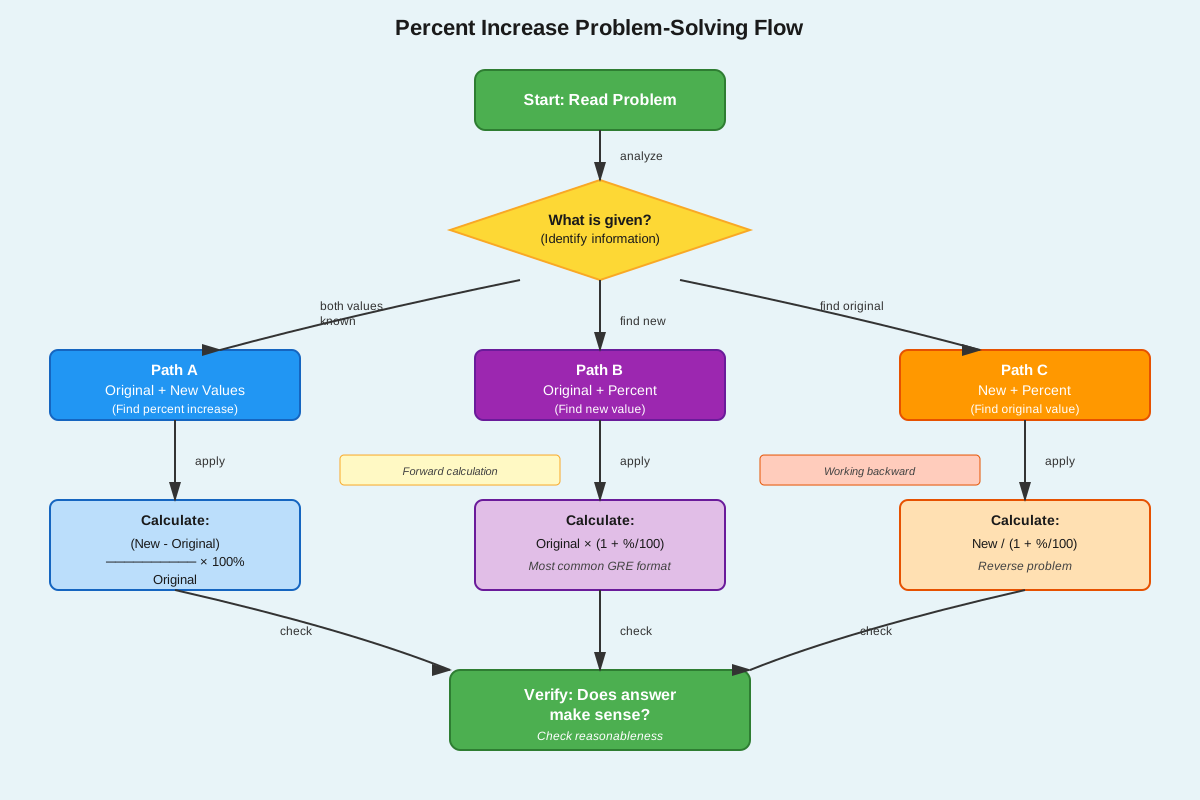
The percent increase formula can be rearranged for different problem types:
Finding the New Value when given original value and percent increase:
New Value = Original Value × (1 + Percent Increase/100)Finding the Original Value when given new value and percent increase:
Original Value = New Value / (1 + Percent Increase/100)These alternative forms prove especially valuable for reverse percent problems, where the GRE provides the final result and asks for the starting value—a common trap for unprepared test-takers.
Percent Increase vs. Absolute Increase
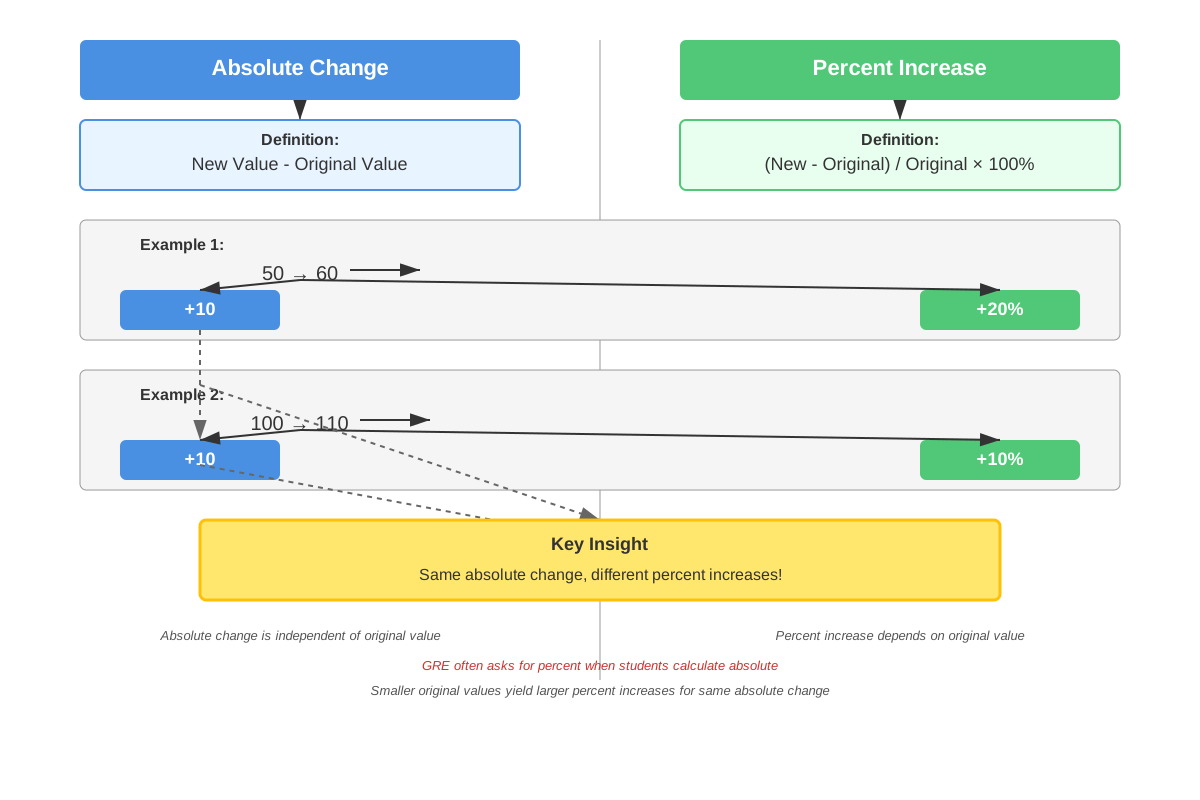
Understanding the distinction between absolute and relative change is crucial:
| Measure | Definition | Example | When to Use |
|---|---|---|---|
| Absolute Increase | Simple difference between values | From 50 to 60 is an increase of 10 | When comparing same-scale quantities |
| Percent Increase | Relative change as percentage | From 50 to 60 is a 20% increase | When comparing different-scale quantities |
The GRE exploits this distinction by presenting answer choices that include both the absolute change and the percent change, testing whether students recognize which measure the question requests. A $10 increase means very different things when applied to a $20 item (50% increase) versus a $1000 item (1% increase).
Successive Percent Increases
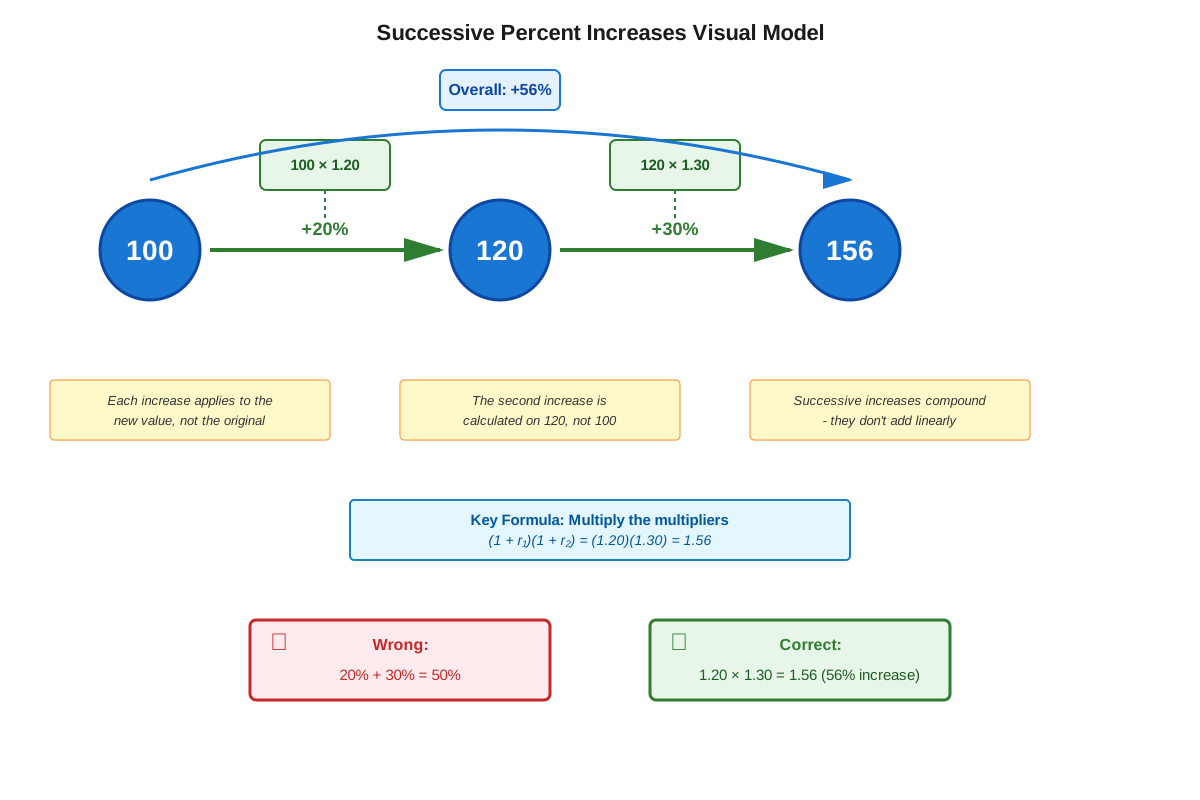
When multiple percent increases occur sequentially, they do not add directly. This represents one of the most tested concepts:
For two successive increases of a% and b%:
Total Effect = (1 + a/100) × (1 + b/100) - 1Example: A 10% increase followed by a 20% increase does NOT equal a 30% increase.
- Starting value: 100
- After 10% increase: 100 × 1.10 = 110
- After 20% increase: 110 × 1.20 = 132
- Total percent increase: (132 - 100)/100 = 32%
The compounding effect means successive increases always produce a result greater than simply adding the percentages. The GRE frequently includes the "sum of percentages" as a trap answer choice.
Percent Increase with Different Reference Points
The GRE tests whether students understand that percent increase depends on which value serves as the reference (original) value:
Example: A quantity increases from 80 to 100.
- Percent increase from 80 to 100: (100-80)/80 × 100 = 25%
- Percent decrease from 100 to 80: (80-100)/100 × 100 = -20%
These are different percentages because they use different denominators. The GRE may ask students to compare these or to recognize that a 25% increase cannot be reversed by a 25% decrease.
Working with Percent Increase in Word Problems
Identifying percent increase in word problems requires recognizing key language patterns:
- "increased by," "grew by," "rose by" signal percent increase
- "more than the original" indicates comparing to the starting value
- "compared to last year" establishes the reference point
- "what percent greater" asks for percent increase calculation
The problem-solving process follows these steps:
- Identify the original value (the reference point, often associated with "was," "originally," or earlier time periods)
- Identify the new value (the result after change, often associated with "is now," "became," or later time periods)
- Calculate the difference (new minus original)
- Divide by the original value (not the new value)
- Multiply by 100 to convert to percentage
Concept Relationships
The concepts within percent increase build hierarchically. The fundamental formula serves as the foundation, from which alternative formula forms derive through algebraic manipulation. Understanding the formula enables distinguishing absolute versus relative change, which in turn clarifies why successive percent increases don't simply add together—each subsequent increase applies to a new, larger base.
The reference point concept connects all other ideas, explaining why percent increase from A to B differs from percent decrease from B to A, and why successive increases compound rather than add. This reference point understanding also explains why reverse percent problems require division rather than multiplication—working backward means undoing the multiplication that created the increase.
Percent increase connects to prerequisite topics through multiple pathways: Basic percentages → provides the foundation for understanding percent as "per hundred" → Percent increase extends this to measuring change. Fractions and decimals → enables converting percentages to multipliers (like 1.25 for a 25% increase) → Percent increase calculations become faster and more intuitive. Ratios → establishes proportional thinking → Percent increase applies this to before/after comparisons.
Looking forward, percent increase connects to advanced topics: Percent increase → combines with percent decrease → enables understanding net change problems. Successive percent increases → extends to compound interest calculations → applies to exponential growth models. Percent increase → integrates with data interpretation → enables analyzing trends in graphs and tables.
High-Yield Facts
⭐ The percent increase formula always uses the original value in the denominator, never the new value
⭐ Successive percent increases multiply their multipliers: (1 + a/100)(1 + b/100), they don't add percentages
⭐ A 25% increase followed by a 25% decrease does NOT return to the original value
⭐ Percent increase can exceed 100% when the new value is more than double the original
⭐ To find the original value given a final value after x% increase, divide by (1 + x/100)
- The absolute increase equals (percent increase/100) × original value
- Comparing percent increases requires using the same reference point for both calculations
- When a quantity increases by x%, the new value equals (100 + x)% of the original
- Percent increase from A to B and percent decrease from B to A are different values
- In Quantitative Comparison questions, percent increases with smaller bases can equal absolute increases with larger bases
- The GRE often provides unnecessary information in percent increase word problems to test reading comprehension
- Percent increase problems frequently combine with ratio problems, requiring students to find actual values before calculating percentages
Quick check — test yourself on Percent increase so far.
Try Flashcards →Common Misconceptions
Misconception: Percent increase and absolute increase are interchangeable terms.
Correction: Percent increase measures relative change (change divided by original), while absolute increase measures only the numerical difference. A $10 increase represents different percent increases depending on the starting value.
Misconception: To reverse a 20% increase, subtract 20% from the new value.
Correction: A 20% increase means multiplying by 1.20. To reverse this, divide by 1.20 (equivalent to decreasing by 16.67%), not by multiplying by 0.80. The percentages are different because they use different reference points.
Misconception: Two successive 10% increases equal one 20% increase.
Correction: Successive percent increases compound. Two 10% increases produce a 21% total increase: (1.10)(1.10) = 1.21. Each increase applies to a progressively larger base.
Misconception: The percent increase from 50 to 100 equals the percent decrease from 100 to 50.
Correction: The percent increase from 50 to 100 is 100% (doubling), while the percent decrease from 100 to 50 is 50% (halving). The percentages differ because the denominators (reference points) differ.
Misconception: When calculating percent increase, use whichever value is larger as the denominator.
Correction: Always use the original (starting) value as the denominator, regardless of whether it's larger or smaller. The original value is determined by time sequence or problem context, not by magnitude.
Misconception: Percent increase cannot exceed 100%.
Correction: Percent increase can be any positive value. A 200% increase means the new value is three times the original (the original plus twice the original). Values can increase by 500%, 1000%, or more.
Worked Examples
Example 1: Basic Percent Increase with Trap Answers
Problem: The population of a town increased from 12,500 to 15,000. What was the percent increase in population?
Solution:
Step 1: Identify the original and new values
- Original value: 12,500 (the starting population)
- New value: 15,000 (the ending population)
Step 2: Calculate the absolute increase
- Absolute increase = 15,000 - 12,500 = 2,500
Step 3: Apply the percent increase formula
- Percent increase = (Absolute increase / Original value) × 100
- Percent increase = (2,500 / 12,500) × 100
- Percent increase = 0.20 × 100 = 20%
Common trap answers the GRE might include:
- 2,500 (the absolute increase, not the percent increase)
- 16.67% (incorrectly using 15,000 as the denominator: 2,500/15,000)
- 25% (calculation error or using wrong denominator)
Connection to learning objectives: This example demonstrates identifying when percent increase is tested (population change scenario) and applying the core formula accurately while avoiding the trap of using the new value as the denominator.
Example 2: Reverse Percent Increase Problem
Problem: After a 25% increase, a stock is worth $75. What was the original value of the stock?
Solution:
Step 1: Recognize this as a reverse percent problem
The problem gives the final value and asks for the original value, requiring the reverse formula.
Step 2: Set up the relationship
- New value = Original value × (1 + percent increase/100)
- 75 = Original value × (1 + 25/100)
- 75 = Original value × 1.25
Step 3: Solve for the original value
- Original value = 75 / 1.25
- Original value = 60
Step 4: Verify the answer
- Check: 60 × 1.25 = 75 ✓
- Check: (75 - 60)/60 × 100 = 15/60 × 100 = 25% ✓
Alternative approach using percentages directly:
- If the stock increased by 25%, the new value represents 125% of the original
- 125% of original = 75
- 1.25 × original = 75
- Original = 75/1.25 = 60
Common trap answers:
- 56.25 (incorrectly subtracting 25% of 75: 75 - 18.75)
- 93.75 (incorrectly adding 25% of 75: 75 + 18.75)
- 50 (calculation error)
Connection to learning objectives: This example demonstrates applying percent increase to find original values (reverse problems), a high-yield GRE question type that tests deeper understanding beyond simple formula application.
Exam Strategy
Trigger Words and Phrases
Watch for these indicators that a question tests percent increase:
- "increased by," "grew by," "rose by," "gained"
- "what percent greater," "percent more than"
- "compared to," "relative to" (establishing reference points)
- "after a ___ percent increase"
- Time-based comparisons: "from 2010 to 2015," "last year versus this year"
Approach Strategy
Step 1: Identify the question type
- Direct calculation: Given both values, find percent increase
- Reverse problem: Given final value and percent, find original
- Comparison: Compare two different percent increases
- Successive changes: Multiple increases applied sequentially
Step 2: Mark the original value
Circle or underline the original (reference) value in the problem. This prevents using the wrong denominator—the most common error in percent increase problems.
Step 3: Organize the information
Write out: Original = ___, New = ___, Difference = ___, Percent = ___
Fill in what's given and solve for what's missing.
Step 4: Check answer reasonableness
- If new value is double the original, percent increase should be 100%
- If new value is 1.5× the original, percent increase should be 50%
- Use these benchmarks to eliminate unreasonable answers quickly
Process of Elimination Tips
For Quantitative Comparison questions:
- If comparing percent increases with different original values, calculate the absolute increases first—sometimes this reveals the answer without completing the percent calculation
- Remember that smaller original values produce larger percent increases for the same absolute change
For Problem Solving questions:
- Eliminate answers that represent the absolute change rather than percent change
- Eliminate answers that would result from using the wrong denominator
- If the new value is larger than the original, eliminate any negative answers
- If the new value is less than double the original, eliminate answers ≥100%
Time Allocation
- Simple percent increase calculations: 30-45 seconds
- Reverse percent problems: 60-90 seconds
- Successive percent increase problems: 90-120 seconds
- Multi-step word problems involving percent increase: 120-180 seconds
Exam Tip: If a percent increase problem seems to require complex calculations, look for a shortcut. The GRE often designs problems where recognizing relationships (like doubling = 100% increase) eliminates the need for detailed arithmetic.
Memory Techniques
The "Original Denominator" Mnemonic
"OLD on the BOTTOM" - The Original/Last/Denominator goes on the bottom of the fraction. The original value (the "old" value in time-based problems) always serves as the denominator.
The Multiplier Visualization
Visualize percent increases as multipliers:
- 10% increase → ×1.10 (original plus 10% more)
- 25% increase → ×1.25 (original plus 25% more)
- 50% increase → ×1.50 (original plus half more)
- 100% increase → ×2.00 (doubling)
This visualization makes successive increases intuitive: two 10% increases means ×1.10 then ×1.10 again, clearly showing why they multiply rather than add.
The "Successive Increases Don't Add" Reminder
"Compound, Don't Add" - Remember that successive percent changes compound (multiply) because each change applies to a new base. Visualize a growing snowball: each layer adds to an increasingly large ball, not to the original small ball.
Benchmark Percentages
Memorize these common percent increase benchmarks:
- 50% increase = 1.5× the original (multiply by 3/2)
- 100% increase = 2× the original (doubling)
- 200% increase = 3× the original (tripling)
- 25% increase = 1.25× the original (multiply by 5/4)
The Reverse Problem Acronym
"DIVIDE to DERIVE" - To derive (find) the original value, divide the final value by the multiplier. This reminds students that reverse problems require division, not subtraction.
Summary
Percent increase measures relative change by comparing the difference between new and original values to the original value, expressed as a percentage. The fundamental formula—(New - Original)/Original × 100—serves as the foundation for all percent increase calculations, but success on the GRE requires understanding when and how to apply alternative forms of this formula. The most critical concept is that percent increase always uses the original value as the reference point (denominator), never the new value, and this reference point determines the percentage calculated. Successive percent increases compound rather than add because each subsequent increase applies to a progressively larger base, making the total effect greater than simply summing the individual percentages. The GRE tests percent increase through direct calculation problems, reverse problems requiring students to find original values, comparison questions, and multi-step word problems that embed percent increase within broader contexts. Mastery requires distinguishing between absolute and relative change, recognizing percent increase trigger words in problem statements, avoiding common traps like using the wrong denominator or adding successive percentages, and efficiently applying the appropriate formula form for each question type.
Key Takeaways
- The percent increase formula always divides by the original value: (New - Original)/Original × 100
- Successive percent increases multiply their effects: (1 + a/100)(1 + b/100), producing compounding rather than simple addition
- To reverse a percent increase and find the original value, divide the final value by (1 + percent/100)
- Percent increase from A to B differs from percent decrease from B to A because they use different reference points
- Percent increase can exceed 100% when the new value is more than double the original value
- The GRE frequently includes trap answers representing absolute change, wrong denominators, or incorrectly added successive percentages
- Recognizing percent increase trigger words ("increased by," "grew by," "percent greater than") helps identify when this concept is being tested
Related Topics
Percent Decrease: The complementary concept measuring relative decline, using the same formula structure but with negative change. Understanding both percent increase and decrease enables solving net change problems where quantities increase and decrease sequentially.
Compound Interest: An application of successive percent increases where interest earned in each period becomes part of the principal for the next period, directly applying the compounding concept learned in successive percent increases.
Ratio and Proportion: Percent increase problems often require finding actual values from ratios before calculating percentages, and percent changes can be expressed as ratios (a 25% increase creates a 5:4 ratio between new and original values).
Data Interpretation: Graphs and tables frequently present data requiring percent increase calculations to answer questions about trends, growth rates, and comparative changes across categories or time periods.
Percent of a Number: The foundational skill of calculating percentages extends directly to percent increase when finding the absolute change (percent of original) before adding it to the original value.
Practice CTA
Now that you've mastered the core concepts, formulas, and strategies for percent increase, it's time to solidify your understanding through active practice. Attempt the practice questions to apply these concepts to GRE-style problems, testing your ability to identify question types, avoid common traps, and calculate accurately under time pressure. Use the flashcards to reinforce the key formulas, trigger words, and high-yield facts until they become automatic. Remember: percent increase appears in approximately 10% of all GRE Quantitative Reasoning questions, making this one of the highest-yield topics for your study time investment. Consistent practice with these problems will build the pattern recognition and calculation speed necessary for test day success!
Sign up free to keep reading
Create a free AnvayaPrep account to finish this GRE guide on Percent increase — plus flashcards and practice questions.