Overview
Percent basics form one of the most fundamental and frequently tested concepts in GRE Quantitative Reasoning. Understanding percentages is not merely about memorizing formulas—it requires developing fluency in converting between fractions, decimals, and percentages, and applying these conversions to solve complex word problems under time pressure. The GRE tests percent basics both directly through standalone computational questions and indirectly through data interpretation, word problems, and quantitative comparison questions where percentage relationships determine the correct answer.
Mastery of gre percent basics is essential because percentages appear across virtually every mathematical domain tested on the exam. From calculating percent change in statistics problems to determining proportional relationships in geometry, from analyzing data in tables and graphs to solving rate problems in algebra, percentages serve as a universal language for expressing relative quantities. Students who struggle with percent basics will find themselves at a significant disadvantage across multiple question types, while those who achieve fluency can quickly identify relationships and eliminate incorrect answer choices.
Within the broader Quantitative Reasoning framework, percent basics connect directly to ratios, proportions, fractions, and decimals—all core arithmetic concepts. These foundational skills then extend upward into more complex applications including compound interest, probability, statistics, and data analysis. The GRE frequently combines percent basics with other topics, creating multi-step problems that test both conceptual understanding and computational accuracy. Therefore, developing automatic recall of percentage conversions and relationships is not optional—it is a prerequisite for achieving a competitive quantitative score.
Learning Objectives
- [ ] Identify when Percent basics is being tested in GRE questions
- [ ] Explain the core rule or strategy behind Percent basics
- [ ] Apply Percent basics to GRE-style questions accurately
- [ ] Convert fluently between percentages, decimals, and fractions without calculation errors
- [ ] Calculate percent increase, percent decrease, and percent difference in multi-step problems
- [ ] Solve problems involving successive percentage changes and recognize when multiplication (not addition) applies
- [ ] Interpret percentage relationships in data interpretation questions and quantitative comparisons
Prerequisites
- Basic arithmetic operations: Addition, subtraction, multiplication, and division are required to perform percentage calculations and conversions
- Fraction fundamentals: Understanding equivalent fractions and simplification is necessary because percentages are fundamentally fractions with denominator 100
- Decimal operations: Multiplying and dividing decimals enables conversion between percentages and decimal form
- Basic algebra: Setting up and solving simple equations helps when the unknown quantity is the base, rate, or percentage value
- Ratio concepts: Percentages express part-to-whole relationships, which are a specific type of ratio
Why This Topic Matters
Percentages permeate everyday decision-making, from calculating sales discounts and tax rates to understanding investment returns and statistical data. In professional contexts, percentages communicate business metrics, scientific findings, and financial analyses. The ability to quickly assess percentage relationships enables informed decisions about resource allocation, risk assessment, and comparative evaluation across different scales.
On the GRE specifically, percent basics appears in approximately 15-20% of Quantitative Reasoning questions, making it one of the highest-yield topics for focused study. Questions involving percentages appear in multiple formats: Problem Solving questions that require direct calculation, Quantitative Comparison questions that test conceptual understanding of percentage relationships, and Data Interpretation questions where tables and graphs present information in percentage form. The GRE particularly favors questions that combine percentages with other concepts, such as calculating the percent of a percent, determining original values after percentage changes, or comparing percentage changes across different base values.
Common question patterns include: word problems describing discounts and markups, population or quantity changes over time, survey results expressed as percentages of different groups, mixture problems involving percentage concentrations, and questions requiring students to work backward from a final value after percentage changes. The exam also tests whether students understand that percentage changes are not reversible (a 20% increase followed by a 20% decrease does not return to the original value) and that percentages of different bases cannot be directly compared without considering the underlying quantities.
Core Concepts
Fundamental Definition and Conversion
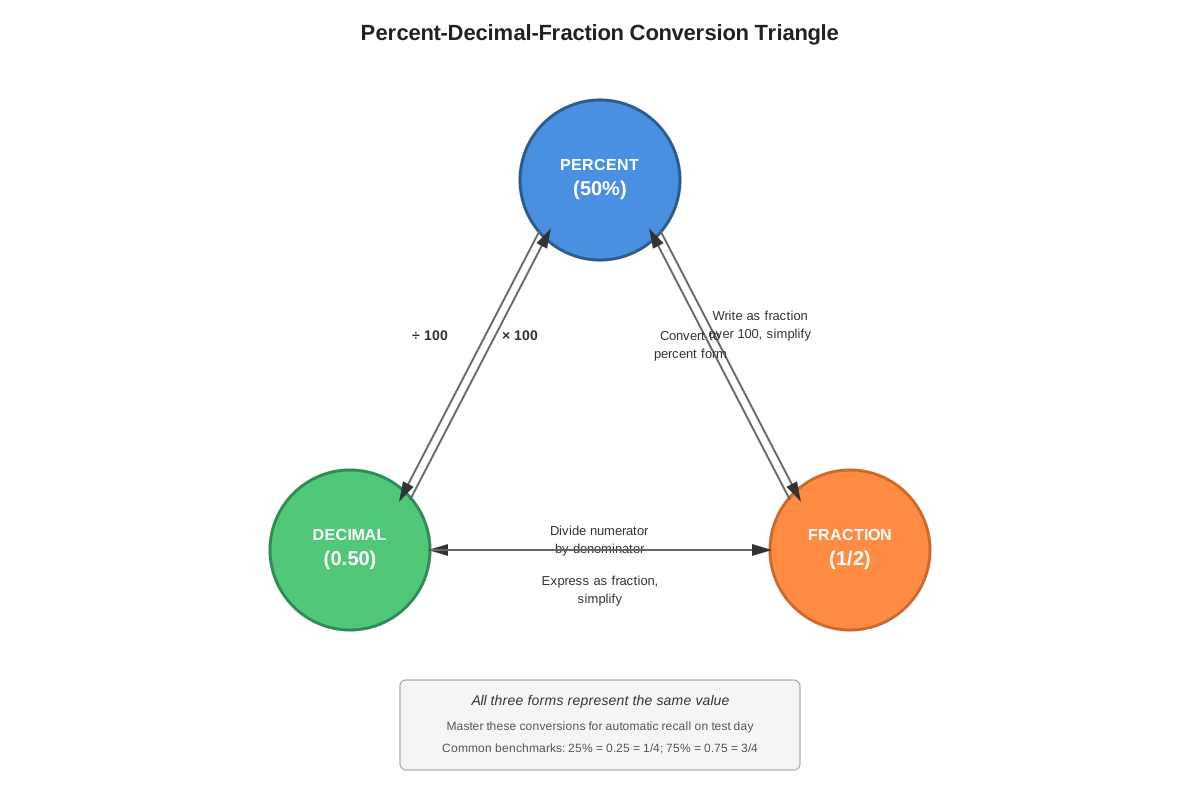
A percentage is a ratio that expresses a number as a fraction of 100. The word "percent" literally means "per hundred" (from Latin per centum). Every percentage can be written as a fraction with denominator 100 or as a decimal by dividing by 100.
The three fundamental forms and their conversions:
| Form | Example | Conversion to Other Forms |
|---|---|---|
| Percentage | 45% | Fraction: 45/100 = 9/20; Decimal: 0.45 |
| Decimal | 0.45 | Percentage: 0.45 × 100 = 45%; Fraction: 45/100 |
| Fraction | 9/20 | Decimal: 9 ÷ 20 = 0.45; Percentage: 0.45 × 100 = 45% |
Key conversion rules:
- To convert percentage to decimal: divide by 100 (or move decimal point two places left)
- To convert decimal to percentage: multiply by 100 (or move decimal point two places right)
- To convert fraction to percentage: divide numerator by denominator, then multiply by 100
- To convert percentage to fraction: write as fraction over 100, then simplify
The Basic Percentage Formula
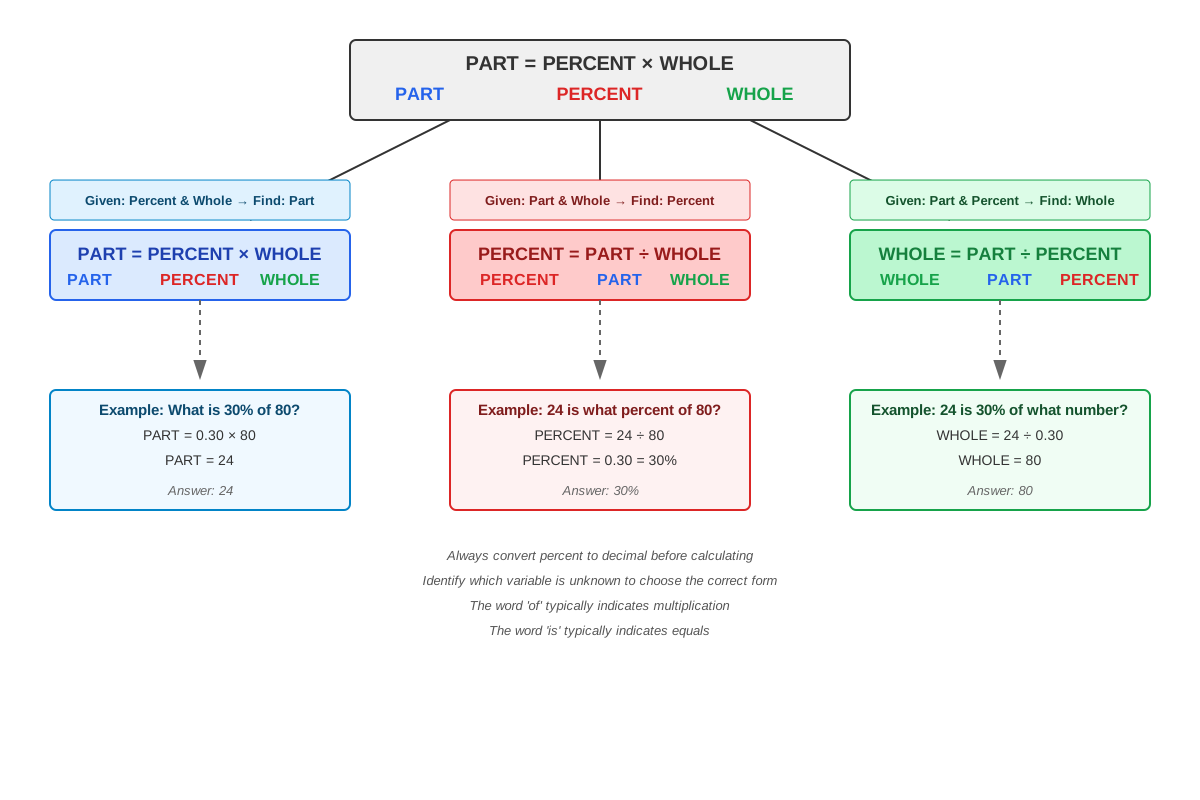
The fundamental relationship in all percentage problems involves three quantities:
Part = Percent × WholeOr equivalently:
Percent = Part / WholeWhere:
- Part (or "amount") is the portion being considered
- Percent is the rate expressed as a decimal
- Whole (or "base") is the total or reference quantity
This formula can be rearranged to solve for any unknown variable:
- If finding the part: Part = Percent × Whole
- If finding the percent: Percent = Part ÷ Whole
- If finding the whole: Whole = Part ÷ Percent
Example: What is 35% of 80?
- Part = 0.35 × 80 = 28
Example: 21 is what percent of 60?
- Percent = 21 ÷ 60 = 0.35 = 35%
Example: 18 is 30% of what number?
- Whole = 18 ÷ 0.30 = 60
Percent Increase and Percent Decrease
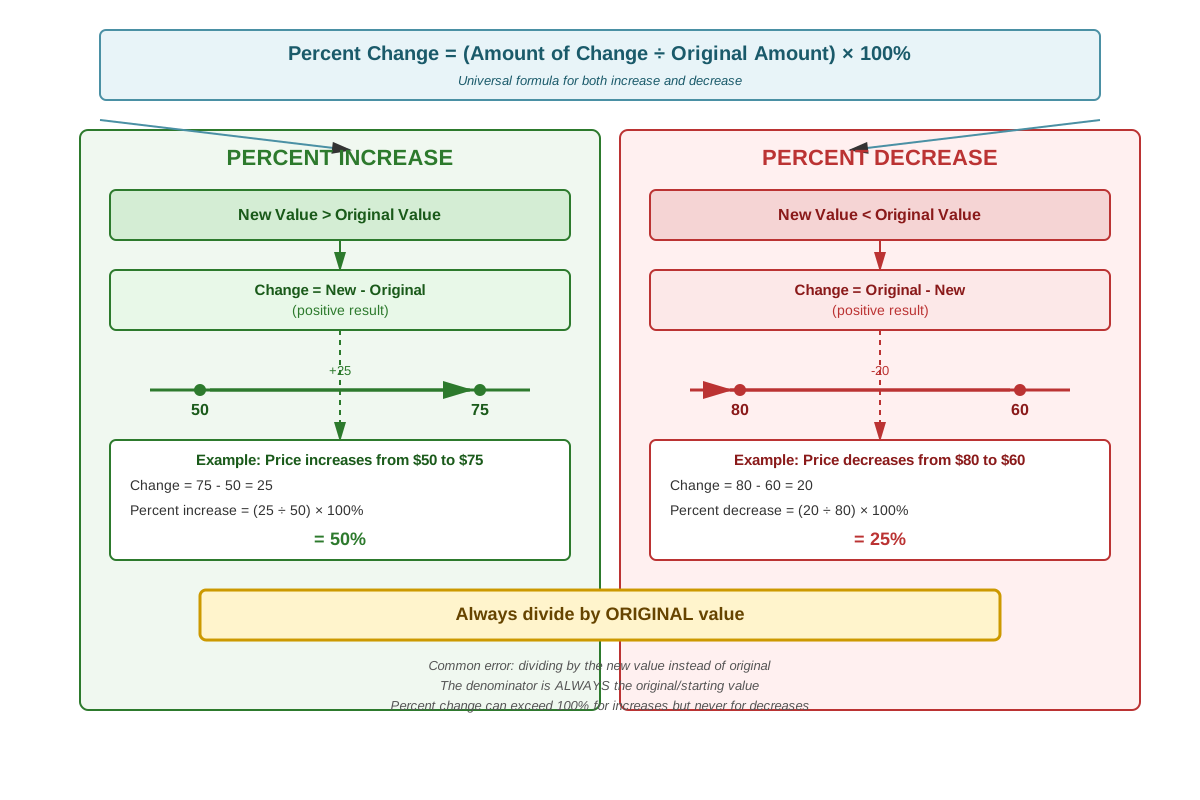
Percent change measures the relative change between an original value and a new value. The formula is:
Percent Change = (New Value - Original Value) / Original Value × 100%When the new value is greater than the original, this is a percent increase. When the new value is less than the original, this is a percent decrease (the result will be negative, but we typically report it as a positive percentage decrease).
Critical insight: The base (denominator) is always the original value, not the new value. This is a frequent source of errors.
Example: A price increases from $40 to $50. What is the percent increase?
- Percent increase = (50 - 40) / 40 × 100% = 10/40 × 100% = 25%
Example: A quantity decreases from 80 to 60. What is the percent decrease?
- Percent decrease = (80 - 60) / 80 × 100% = 20/80 × 100% = 25%
Finding Original Value After Percentage Change
When given a final value after a percentage increase or decrease, working backward requires understanding that the final value represents a different percentage of the original.
For a percent increase:
- If original value increases by x%, the new value = original × (1 + x/100)
- Therefore: Original = New Value ÷ (1 + x/100)
For a percent decrease:
- If original value decreases by x%, the new value = original × (1 - x/100)
- Therefore: Original = New Value ÷ (1 - x/100)
Example: After a 20% increase, a price is $60. What was the original price?
- Original = 60 ÷ 1.20 = 50
Example: After a 15% discount, a price is $85. What was the original price?
- Original = 85 ÷ 0.85 = 100
Successive Percentage Changes
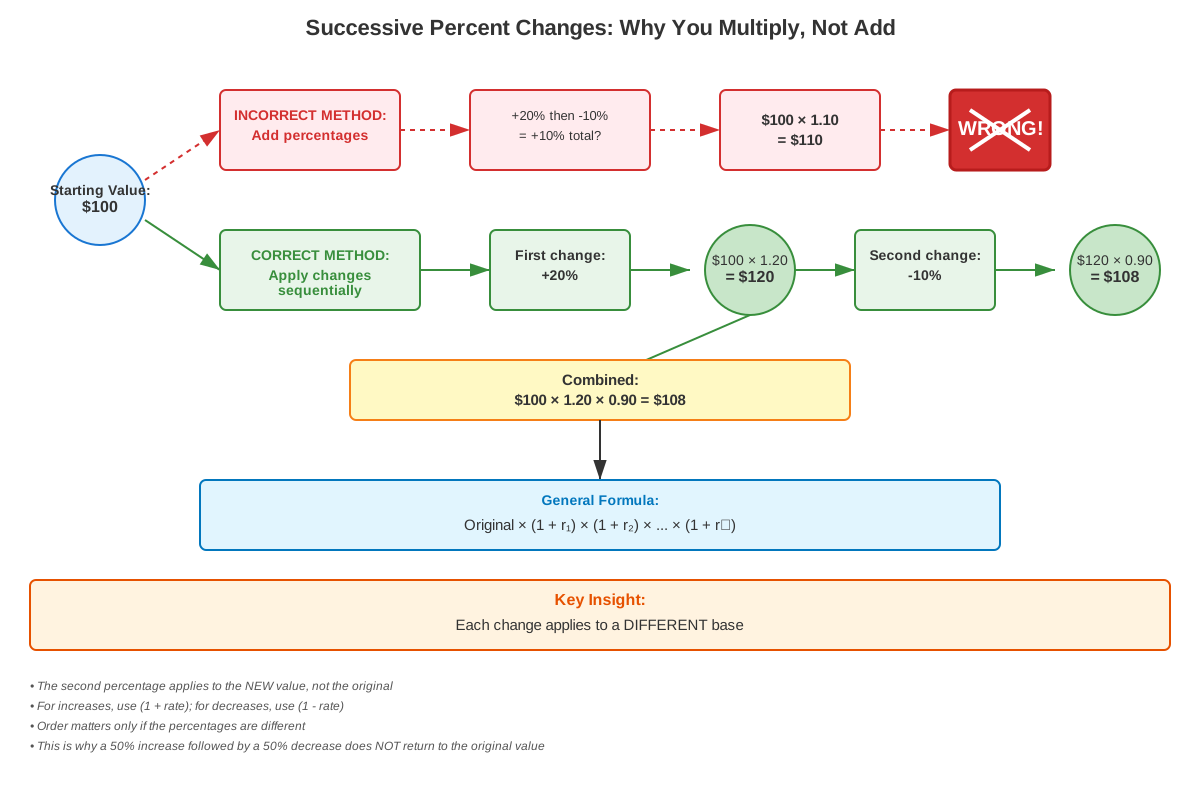
When multiple percentage changes occur sequentially, they multiply rather than add. This is because each subsequent change applies to the result of the previous change, not to the original value.
For two successive changes of a% and b%:
Final Value = Original × (1 ± a/100) × (1 ± b/100)Example: A price increases by 10%, then increases by another 20%. What is the total percent increase?
- Multiplier = 1.10 × 1.20 = 1.32
- Total increase = 32% (not 30%)
Example: A quantity increases by 50%, then decreases by 50%. What is the net change?
- Multiplier = 1.50 × 0.50 = 0.75
- Net result: 25% decrease (not back to original!)
Percent of a Percent
When calculating a percentage of a percentage, convert both to decimals and multiply.
Example: What is 30% of 40% of 200?
- 0.30 × 0.40 × 200 = 0.12 × 200 = 24
This concept frequently appears in problems involving successive discounts, tax on discounted prices, or layered probability scenarios.
Comparing Percentages with Different Bases
A critical conceptual understanding: percentages alone cannot be compared without knowing their base values. A larger percentage of a smaller base may represent a smaller absolute quantity than a smaller percentage of a larger base.
Example: Company A has 40% growth on $100,000 revenue = $40,000 increase. Company B has 20% growth on $300,000 revenue = $60,000 increase. Despite the smaller percentage, Company B's absolute growth is larger.
Concept Relationships
The core concepts within percent basics build upon each other in a logical progression. Fundamental definition and conversion serves as the foundation—without fluency in converting between percentages, decimals, and fractions, all subsequent calculations become error-prone. This foundational skill directly enables the basic percentage formula (Part = Percent × Whole), which is the computational engine for most percentage problems.
The basic formula then extends into percent increase and percent decrease, which adds the concept of change over time or comparison between states. Understanding percent change is prerequisite to finding original value after percentage change, which requires algebraic manipulation of the percent change relationship. These concepts connect to successive percentage changes, which reveals that percentage operations follow multiplicative rather than additive rules—a non-intuitive property that the GRE frequently tests.
Percent of a percent represents a special application of the basic formula where the "whole" is itself a percentage of another quantity, requiring careful tracking of what each percentage references. Finally, comparing percentages with different bases synthesizes all previous concepts by requiring students to distinguish between relative (percentage) and absolute (actual quantity) measures.
These internal relationships connect to prerequisite topics: fractions provide the conceptual framework (percentages are fractions with denominator 100), decimals provide the computational mechanism (percentage calculations use decimal multiplication), and ratios provide the comparative context (percentages express part-to-whole ratios). Looking forward, percent basics enables progression to compound interest (successive percentage changes over time), probability (percentages of outcomes), statistics (percentages in data analysis), and data interpretation (graphs and tables using percentage scales).
High-Yield Facts
⭐ A percentage is a fraction with denominator 100; to convert percentage to decimal, divide by 100
⭐ The basic formula Part = Percent × Whole can be rearranged to solve for any unknown variable
⭐ Percent change always uses the original value as the denominator, not the new value
⭐ Successive percentage changes multiply; a 20% increase followed by 20% decrease does NOT return to the original value
⭐ To find the original value after an x% increase, divide the new value by (1 + x/100)
- To find the original value after an x% decrease, divide the new value by (1 - x/100)
- A 100% increase means doubling; a 50% decrease means halving
- Percentages greater than 100% are valid and indicate the part is larger than the reference whole
- When comparing percentage changes, always verify whether they reference the same base value
- Converting common fractions to percentages saves time: 1/2 = 50%, 1/4 = 25%, 1/5 = 20%, 1/3 ≈ 33.33%, 2/3 ≈ 66.67%
- A discount of x% followed by a discount of y% equals a single discount of [x + y - (xy/100)]%
- Percent increase from A to B is different from percent decrease from B to A (different denominators)
Quick check — test yourself on Percent basics so far.
Try Flashcards →Common Misconceptions
Misconception: Adding successive percentage changes gives the total change (e.g., 10% increase + 20% increase = 30% total increase)
Correction: Successive percentage changes multiply, not add. A 10% increase followed by 20% increase results in 1.10 × 1.20 = 1.32, which is a 32% total increase. Each percentage change applies to the result of the previous change, not the original value.
Misconception: A 20% increase followed by a 20% decrease returns to the original value
Correction: These changes do not cancel. If starting with 100, a 20% increase gives 120, then a 20% decrease from 120 gives 120 × 0.80 = 96, which is 4% below the original. The decrease applies to a larger base, so the absolute decrease is larger than the absolute increase.
Misconception: When calculating percent change, either the original or new value can serve as the denominator
Correction: Percent change always uses the original value as the denominator. Using the new value produces a different calculation called "percent difference" or "reverse percent change," which yields a different result and is not standard.
Misconception: 50% of 80 equals 80% of 50 is just a coincidence
Correction: This is a general property of multiplication: a% of b always equals b% of a because both equal (a/100) × b = (b/100) × a. This property can be strategically used to simplify mental calculations.
Misconception: If quantity A is 20% more than quantity B, then quantity B is 20% less than quantity A
Correction: The percentages are different because they reference different bases. If A is 20% more than B, then A = 1.20B, which means B = A/1.20 ≈ 0.833A, so B is approximately 16.67% less than A, not 20% less.
Misconception: Percentages cannot exceed 100%
Correction: Percentages can be any positive value. A percentage over 100% simply means the part is larger than the reference whole. For example, if sales this year are 250% of last year's sales, sales have increased by 150% (2.5 times the original).
Misconception: When a problem states "what percent," the answer should be in percentage form (with % symbol)
Correction: On the GRE, carefully check whether answer choices include the % symbol or are in decimal form. If choices show 0.35 and 35, and you calculated 35%, the correct answer is 35, not 0.35. Match the format of the answer choices.
Worked Examples
Example 1: Multi-Step Percent Change Problem
Question: A store marks up the wholesale price of an item by 60%, then offers a 25% discount during a sale. If the final sale price is $72, what was the wholesale price?
Solution:
Step 1: Identify the successive changes and set up the relationship.
- Let W = wholesale price
- After 60% markup: Price = W × 1.60
- After 25% discount: Final price = W × 1.60 × 0.75
Step 2: Set up the equation with the known final price.
- W × 1.60 × 0.75 = 72
- W × 1.20 = 72
Step 3: Solve for the wholesale price.
- W = 72 ÷ 1.20
- W = 60
Step 4: Verify the answer.
- Wholesale: $60
- After 60% markup: $60 × 1.60 = $96
- After 25% discount: $96 × 0.75 = $72 ✓
Answer: The wholesale price was $60.
Connection to learning objectives: This problem requires identifying percent basics in a word problem context (markup and discount), applying the core strategy of representing successive changes as multiplication, and accurately calculating through multiple steps.
Example 2: Comparing Percentage Changes
Question: In 2020, City A had a population of 200,000 and City B had a population of 150,000. By 2021, City A's population increased by 15% while City B's population increased by 20%. Which city had the greater absolute population increase, and by how much?
Solution:
Step 1: Calculate City A's absolute increase.
- Increase = 15% of 200,000
- Increase = 0.15 × 200,000 = 30,000
Step 2: Calculate City B's absolute increase.
- Increase = 20% of 150,000
- Increase = 0.20 × 150,000 = 30,000
Step 3: Compare the absolute increases.
- City A: 30,000 increase
- City B: 30,000 increase
- The increases are equal
Step 4: Verify with final populations.
- City A 2021: 200,000 + 30,000 = 230,000
- City B 2021: 150,000 + 30,000 = 180,000
Answer: Both cities had the same absolute population increase of 30,000 people, despite City B having a higher percentage increase.
Connection to learning objectives: This problem tests the critical concept that percentages with different bases cannot be directly compared. It requires applying the basic percentage formula to calculate absolute values, then comparing those values rather than the percentages themselves. This addresses the common GRE trap of assuming larger percentages always mean larger absolute quantities.
Example 3: Finding Original Value After Successive Changes
Question: After a 25% increase followed by a 20% decrease, a stock price is $60. What was the original stock price?
Solution:
Step 1: Represent the successive changes algebraically.
- Let P = original price
- After 25% increase: P × 1.25
- After 20% decrease: P × 1.25 × 0.80
Step 2: Simplify the combined multiplier.
- P × 1.25 × 0.80 = P × 1.00 = P
Wait—this suggests the price returned to original, but the problem states the final price is $60. Let me recalculate:
- 1.25 × 0.80 = 1.00
This means the successive changes exactly cancel out, so the original price equals the final price.
Answer: The original stock price was $60.
Verification:
- Original: $60
- After 25% increase: $60 × 1.25 = $75
- After 20% decrease: $75 × 0.80 = $60 ✓
Connection to learning objectives: This problem demonstrates that successive percentage changes can sometimes cancel out (though this is rare and requires specific percentages). It reinforces that working backward from a final value requires dividing by the combined multiplier, and shows the importance of verification to catch special cases.
Exam Strategy
When approaching GRE questions involving percent basics, begin by identifying the three key quantities: the part, the whole, and the percent. Determine which two are given and which one is unknown. Write down the basic formula and substitute the known values before attempting calculation—this prevents conceptual errors about which quantity goes where.
Trigger words and phrases that signal percent basics questions include:
- "What percent of..." (finding the percent)
- "...is what percent of..." (finding the percent with explicit part and whole)
- "What is X% of..." (finding the part)
- "X is Y% of what number" (finding the whole)
- "percent increase," "percent decrease," "percent change"
- "marked up," "discounted," "reduced by"
- "grew by," "declined by," "increased by"
- "what was the original..." (working backward from percentage change)
For Quantitative Comparison questions involving percentages, avoid calculating actual values when possible. Instead, compare the structure of the relationships. If both quantities involve the same percentage of different bases, compare the bases. If they involve different percentages of the same base, compare the percentages. Watch for trap answers where the comparison depends on unknown values.
Process of elimination strategies:
- Eliminate answer choices that are impossible (e.g., if calculating a percent increase, negative values are impossible)
- For percent change problems, quickly estimate whether the change should be more or less than 50% or 100% to eliminate unreasonable choices
- If a problem involves successive percentage changes, eliminate any choice that simply adds the percentages
- When working backward from a final value after a percentage increase, the original must be smaller than the final; after a decrease, the original must be larger
Time allocation: Simple percentage calculations (one-step problems) should take 30-45 seconds. Multi-step problems involving successive changes or working backward should take 60-90 seconds. If a problem requires more than 90 seconds, consider whether there's a conceptual shortcut being missed, or mark it for review and move on.
Common shortcuts:
- Memorize decimal equivalents of common percentages: 25% = 0.25, 20% = 0.20, 10% = 0.10, 5% = 0.05
- To find 10% of any number, move the decimal point one place left
- To find 5%, calculate 10% and divide by 2
- To find 15%, calculate 10% and add 5%
- When calculating percent of a percent, convert both to decimals and multiply in one step rather than calculating sequentially
Memory Techniques
Mnemonic for the basic formula: "PPW" - Part = Percent × Whole. Remember that the percent must be in decimal form, so think "Percent Produces Whole" when you multiply.
Visualization for percent change: Picture a number line with the original value in the center. A percent increase moves right (adding to the original), while a percent decrease moves left (subtracting from the original). The distance moved is the percentage of the original position, not the new position.
Acronym for successive changes: "MNA" - Multiply, Not Add. When you see multiple percentage changes in sequence, immediately think "multiply the multipliers."
Memory aid for working backward: When finding an original value after a percentage change, remember "Divide to Arrive" - divide the final value by the multiplier to arrive at the original. For increases, the multiplier is greater than 1; for decreases, it's less than 1.
Finger trick for common percentages:
- Hold up 10 fingers for 100%
- 5 fingers = 50%
- 2 fingers = 20%
- 1 finger = 10%
This physical reminder helps quickly estimate percentages in word problems.
Rhyme for base identification: "The base is the place where the percent takes its space" - the base (whole) is always what the percentage is "of," which helps identify the denominator in percent change calculations.
Summary
Percent basics represents a foundational quantitative skill that appears throughout the GRE in various forms and combinations with other topics. Mastery requires fluency in three core areas: converting between percentages, decimals, and fractions; applying the fundamental formula Part = Percent × Whole in all its variations; and understanding percent change including both forward calculations and working backward to find original values. The most critical conceptual understanding is that successive percentage changes multiply rather than add, and that percentage changes are not reversible because each change applies to a different base. Students must distinguish between relative measures (percentages) and absolute measures (actual quantities), recognizing that a larger percentage of a smaller base may represent a smaller absolute amount. Common question types include direct calculation of percentages, multi-step problems involving markups and discounts, comparison questions requiring analysis of different bases, and data interpretation where percentages appear in tables and graphs. Success on GRE percent basics questions requires both computational accuracy and conceptual clarity about what each percentage references.
Key Takeaways
- The fundamental formula Part = Percent × Whole (with percent in decimal form) solves all basic percentage problems when rearranged appropriately for the unknown variable
- Percent change always uses the original value as the denominator: (New - Original) / Original × 100%
- Successive percentage changes multiply, not add: two changes of a% and b% result in a combined multiplier of (1 ± a/100) × (1 ± b/100)
- To find an original value after an x% increase, divide the final value by (1 + x/100); after an x% decrease, divide by (1 - x/100)
- Percentages with different bases cannot be directly compared without calculating the absolute values they represent
- Common percentage-decimal conversions should be automatic: 50% = 0.5, 25% = 0.25, 20% = 0.2, 10% = 0.1, 5% = 0.05
- A percent increase from A to B uses A as the base; a percent decrease from B to A uses B as the base, yielding different percentages for the same absolute change
Related Topics
Ratios and Proportions: Percentages are a specific type of ratio (part-to-whole expressed per 100). Mastering percent basics provides the foundation for solving complex ratio problems and understanding proportional relationships, which frequently appear in GRE mixture problems and rate questions.
Fractions and Decimals: Since percentages are fractions with denominator 100, deeper understanding of fraction operations and decimal arithmetic enhances percentage calculation speed and accuracy. This connection is particularly important for data interpretation questions.
Compound Interest: This topic extends percent basics by applying successive percentage changes over multiple time periods, introducing exponential growth concepts that build directly on understanding how percentage changes multiply.
Data Interpretation: Tables, graphs, and charts frequently present information in percentage form. Mastering percent basics enables quick analysis of trends, comparisons between categories, and calculations based on visual data representations.
Statistics: Many statistical measures are expressed as percentages, including percentile ranks, percentage distributions, and probability expressed as percent chance. Understanding percent basics is prerequisite to interpreting statistical data accurately.
Practice CTA
Now that you've mastered the core concepts of percent basics, it's time to solidify your understanding through active practice. Attempt the practice questions to test your ability to identify when percentages are being tested, apply the appropriate formulas and strategies, and avoid common traps. Use the flashcards to build automatic recall of key conversions and formulas—speed and accuracy on percentage problems comes from making these calculations second nature. Remember, percent basics appears in approximately 15-20% of GRE Quantitative questions, making your investment in this topic one of the highest-yield uses of your study time. Each practice problem you solve correctly builds the pattern recognition and computational fluency that will serve you across multiple question types on test day!
Sign up free to keep reading
Create a free AnvayaPrep account to finish this GRE guide on Percent basics — plus flashcards and practice questions.