Overview
Positive and negative numbers form the foundation of the number system tested extensively on the GRE Quantitative Reasoning section. While the concept may seem elementary at first glance, the GRE tests this topic with sophisticated twists that catch even well-prepared students off guard. Understanding how positive and negative values interact through arithmetic operations, how they behave when raised to powers, and how their properties change under different mathematical transformations is crucial for success on approximately 15-20% of GRE Quantitative questions.
The GRE positive and negative numbers questions rarely test simple addition or subtraction. Instead, they embed these concepts within complex word problems, data interpretation scenarios, and algebraic manipulations where sign errors can cascade into completely incorrect answers. Questions often involve determining whether an unknown quantity must be positive, negative, or could be either—requiring deep conceptual understanding rather than mechanical calculation. The test makers deliberately design problems where intuitive approaches lead to wrong answers, making this a high-yield topic for score improvement.
Mastery of positive and negative numbers connects directly to virtually every other Quantitative Reasoning concept. Algebraic manipulation depends on proper sign handling, coordinate geometry requires understanding the four quadrants defined by positive and negative axes, and data interpretation questions frequently involve negative changes or values below zero. This topic serves as the bedrock upon which more complex mathematical reasoning is built, making it essential not just for direct questions but for avoiding careless errors throughout the entire Quantitative section.
Learning Objectives
- [ ] Identify when Positive and negative numbers is being tested
- [ ] Explain the core rule or strategy behind Positive and negative numbers
- [ ] Apply Positive and negative numbers to GRE-style questions accurately
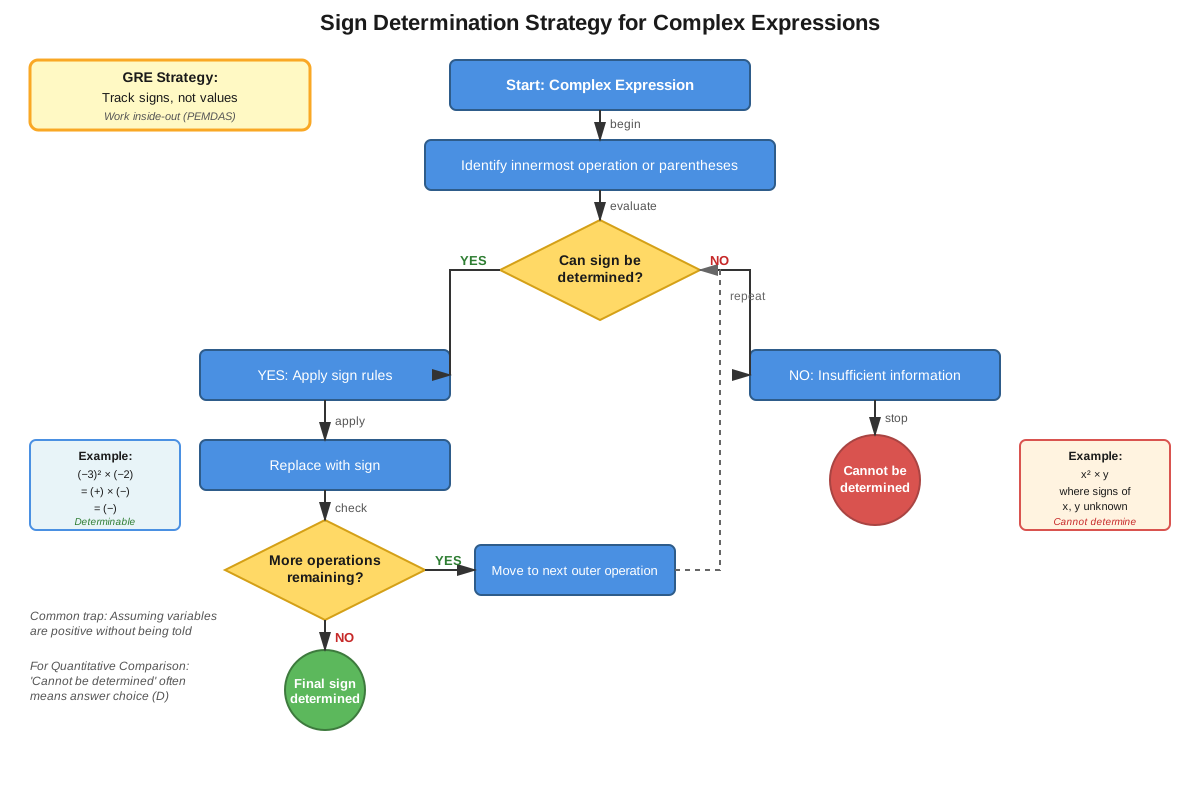
- [ ] Determine the sign of complex expressions involving multiple operations without full calculation
- [ ] Recognize when insufficient information exists to determine whether a quantity is positive or negative
- [ ] Analyze how exponents and roots affect the signs of positive and negative numbers
- [ ] Evaluate inequalities involving positive and negative numbers with confidence
Prerequisites
- Basic arithmetic operations: Understanding addition, subtraction, multiplication, and division is essential because sign rules apply to all these operations
- Order of operations (PEMDAS): Necessary for determining which sign rules to apply first in complex expressions
- Number line visualization: Helps conceptualize the relative positions and distances of positive and negative values
- Absolute value concept: Required for understanding magnitude independent of sign
- Basic algebraic notation: Needed to work with variables that may represent positive or negative quantities
Why This Topic Matters
In real-world applications, positive and negative numbers represent opposing concepts: profit versus loss, temperature above versus below zero, elevation versus depth, credits versus debits. Financial analysis, scientific measurement, and engineering calculations all depend on correctly handling signed quantities. The ability to reason about positive and negative values without always calculating exact numbers is a critical analytical skill that extends far beyond standardized testing.
On the GRE, positive and negative number concepts appear in approximately 15-20% of Quantitative Reasoning questions, making this one of the most frequently tested arithmetic topics. These questions appear across all question types: Quantitative Comparison (where determining relative signs often provides the answer without calculation), Multiple Choice (both single and multiple answer), and Numeric Entry. The topic integrates with algebra, coordinate geometry, data interpretation, and word problems, meaning that sign errors can affect performance across the entire Quantitative section.
Common GRE question patterns include: determining whether an expression must be positive, negative, or could be either; comparing the magnitudes of positive and negative quantities; analyzing how operations affect signs; evaluating statements about unknown quantities based solely on sign information; and identifying which values in a data set are positive versus negative. The test frequently presents scenarios where variables could be positive or negative, requiring students to test both cases—a time-consuming process that rewards systematic thinking.
Core Concepts
The Number Line and Sign Definition
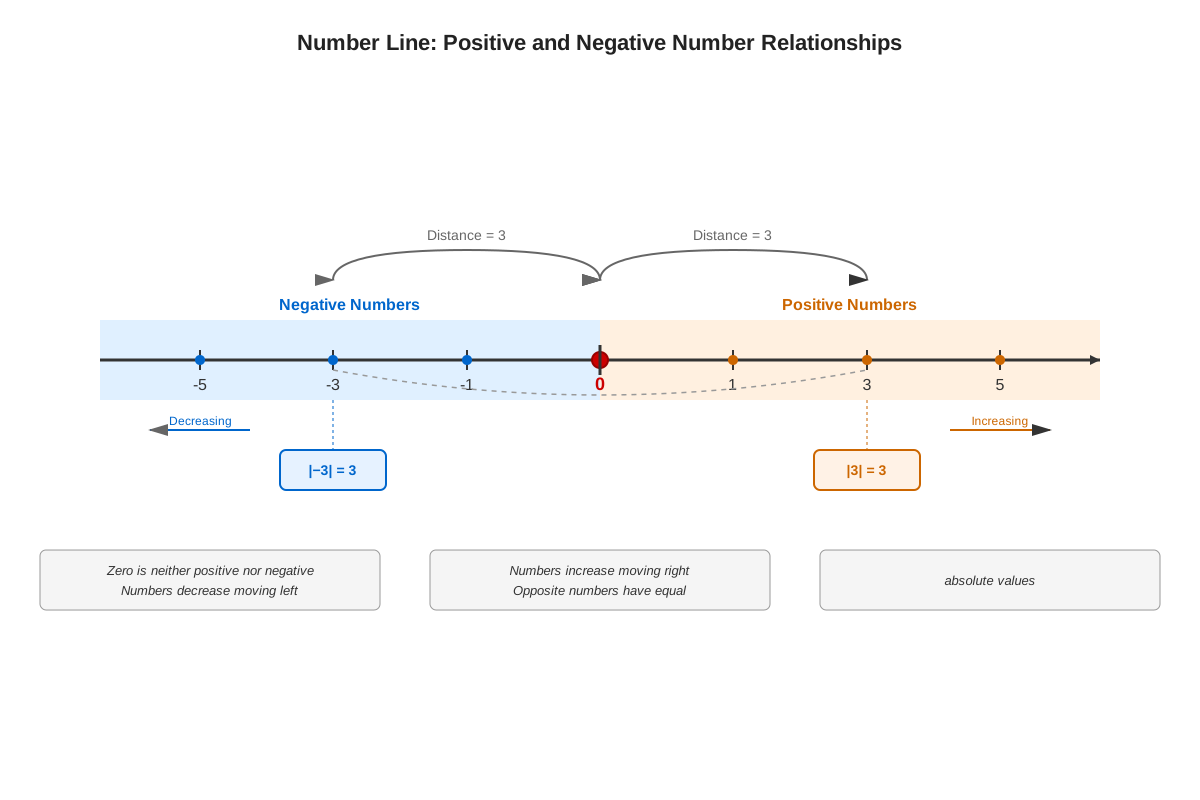
The number line provides the fundamental framework for understanding positive and negative numbers. Zero serves as the origin, with positive numbers extending infinitely to the right and negative numbers extending infinitely to the left. A positive number represents a quantity greater than zero, while a negative number represents a quantity less than zero. Zero itself is neither positive nor negative—a fact the GRE tests explicitly.
The absolute value of a number represents its distance from zero on the number line, regardless of direction. For any number x, |x| equals x if x is positive or zero, and equals -x if x is negative. This means |-5| = 5 and |5| = 5. Understanding that absolute value strips away sign information is crucial for GRE questions that ask about magnitude versus actual value.
Sign Rules for Arithmetic Operations
Addition and subtraction of signed numbers follow patterns that students must internalize:
- Adding two positive numbers yields a positive result: 3 + 5 = 8
- Adding two negative numbers yields a negative result: (-3) + (-5) = -8
- Adding numbers with different signs requires subtracting the smaller absolute value from the larger and taking the sign of the number with larger absolute value: 7 + (-3) = 4, while (-7) + 3 = -4
- Subtracting a number is equivalent to adding its opposite: 5 - 3 = 5 + (-3) and 5 - (-3) = 5 + 3 = 8
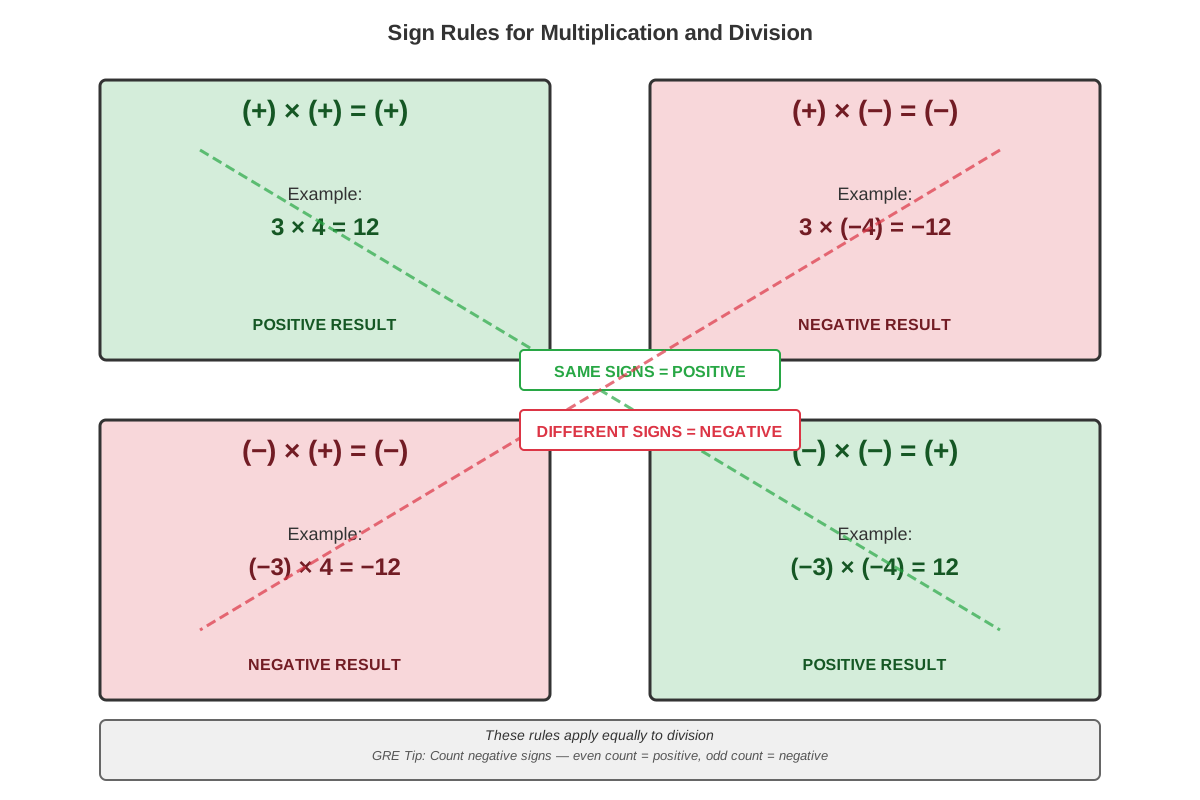
Multiplication and division follow simpler, more symmetric rules:
| Operation | Same Signs | Different Signs |
|---|---|---|
| Multiplication | Positive result | Negative result |
| Division | Positive result | Negative result |
Examples: (3)(5) = 15, (-3)(-5) = 15, (3)(-5) = -15, (-3)(5) = -15. The same patterns apply to division: 15 ÷ 3 = 5, (-15) ÷ (-3) = 5, 15 ÷ (-3) = -5, (-15) ÷ 3 = -5.
Multiple Operations and Sign Determination
When expressions involve multiple multiplications or divisions, count the number of negative factors. An even number of negative factors produces a positive result, while an odd number of negative factors produces a negative result. For example, (-2)(-3)(-4) has three (odd) negative factors, so the result is negative: -24. Meanwhile, (-2)(-3)(-4)(-1) has four (even) negative factors, yielding positive 24.
This principle extends to algebraic expressions. If x, y, and z are all negative, then xyz is negative (three negative factors), while x²yz is positive (x² is positive since any number squared is non-negative, leaving two negative factors y and z, which multiply to give a positive result).
Exponents and Roots with Signed Numbers
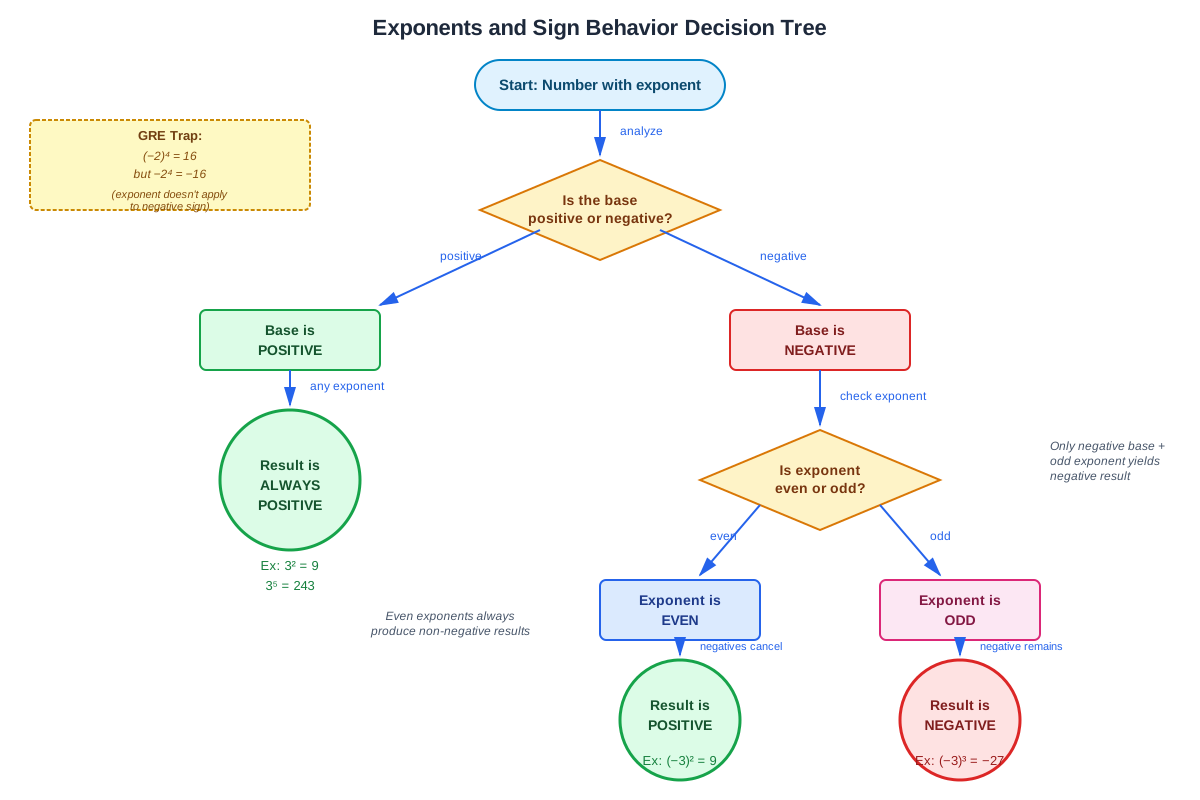
Even exponents always produce non-negative results, regardless of the base's sign: (-3)² = 9 and 3² = 9. This is because raising a negative number to an even power involves an even number of negative factors, which always yields a positive result (except when the base is zero).
Odd exponents preserve the sign of the base: (-3)³ = -27 and 3³ = 27. An odd exponent means an odd number of negative factors, preserving the negative sign.
Square roots (and even roots generally) of positive numbers yield positive results by convention: √9 = 3, not ±3. The GRE follows the convention that the radical symbol represents only the principal (positive) root. However, when solving equations like x² = 9, both x = 3 and x = -3 are solutions because both positive and negative values can square to give 9.
Odd roots (like cube roots) preserve sign: ∛(-8) = -2 because (-2)³ = -8.
Inequalities and Sign Considerations
When multiplying or dividing both sides of an inequality by a negative number, the inequality sign must be reversed. For example, if -2x > 6, dividing both sides by -2 gives x < -3 (note the sign flip). This is one of the most common sources of errors on the GRE.
When working with inequalities involving variables of unknown sign, students must consider cases. If xy > 0, then either both x and y are positive, or both are negative. If xy < 0, then x and y have opposite signs. The GRE frequently tests whether students recognize that multiple scenarios are possible.
Special Cases and Edge Conditions
Zero behaves uniquely: it's the only number that is neither positive nor negative. Zero multiplied by any number equals zero. Division by zero is undefined. When the GRE asks whether a quantity "could be zero," this often represents a critical test case.
Comparing magnitudes versus values: -10 is less than -2 as a value (farther left on the number line), but |-10| > |-2| in terms of absolute value. The GRE tests whether students confuse magnitude with actual value, especially in Quantitative Comparison questions.
Concept Relationships
The core concepts within positive and negative numbers form a hierarchical structure. The number line definition establishes the fundamental framework → which enables understanding of absolute value (distance from zero) → which connects to addition and subtraction rules (combining directed quantities) → which relate to multiplication and division rules (repeated addition or scaling) → which extend to exponent rules (repeated multiplication) → which inform inequality manipulation (preserving or reversing order relationships).
These concepts connect to prerequisite knowledge of basic arithmetic by adding the dimension of direction or sign to pure magnitude. They enable progression to algebra (where variables may be positive or negative), coordinate geometry (where the four quadrants are defined by positive and negative coordinates), and data interpretation (where changes can be positive or negative).
The relationship between multiplication/division rules and exponent rules exemplifies concept connection: understanding that (-3)² = (-3)(-3) = 9 (even number of negative factors) directly follows from the multiplication rule that negative times negative equals positive. Similarly, inequality reversal when multiplying by negatives connects to the fact that multiplying by a negative number reflects values across zero on the number line.
Quick check — test yourself on Positive and negative numbers so far.
Try Flashcards →High-Yield Facts
⭐ Zero is neither positive nor negative and serves as the boundary between positive and negative numbers
⭐ Multiplying or dividing two numbers with the same sign yields a positive result; different signs yield a negative result
⭐ An even number of negative factors produces a positive result; an odd number produces a negative result
⭐ Even exponents always produce non-negative results regardless of whether the base is positive or negative
⭐ Multiplying or dividing both sides of an inequality by a negative number requires reversing the inequality sign
- Odd exponents preserve the sign of the base
- The square root symbol (√) represents only the principal (positive) root by convention
- Subtracting a negative number is equivalent to adding a positive: a - (-b) = a + b
- If xy > 0, then x and y have the same sign (both positive or both negative)
- If xy < 0, then x and y have opposite signs
- The absolute value of a number is always non-negative: |x| ≥ 0 for all x
- Adding a negative number is equivalent to subtracting its absolute value
- The product of any number and zero equals zero, regardless of the other number's sign
- When comparing negative numbers, the one with smaller absolute value is actually greater: -2 > -5
- Squaring a number and taking the square root of a squared number are not always inverse operations: √(x²) = |x|, not necessarily x
Common Misconceptions
Misconception: A negative number raised to any power is always negative → Correction: Negative numbers raised to even powers are positive ((-2)² = 4), while only odd powers preserve the negative sign ((-2)³ = -8)
Misconception: √(x²) = x for all values of x → Correction: √(x²) = |x|, which equals x when x is positive but equals -x when x is negative. For example, √((-3)²) = √9 = 3, not -3
Misconception: When multiplying both sides of an inequality by a variable, the inequality sign stays the same → Correction: If the variable could be negative, you must either consider separate cases or know the variable's sign. Multiplying by a negative requires reversing the inequality
Misconception: The larger the absolute value, the larger the number → Correction: For negative numbers, larger absolute value means a smaller (more negative) number. |-10| > |-3|, but -10 < -3
Misconception: If x² = 25, then x = 5 → Correction: Both x = 5 and x = -5 satisfy this equation because both positive and negative values can square to give a positive result
Misconception: Negative numbers cannot be solutions to real-world problems → Correction: Many real-world scenarios involve negative values (debt, temperature below zero, elevation below sea level, losses), and the GRE frequently tests these contexts
Misconception: The product of three negative numbers is positive → Correction: An odd number of negative factors yields a negative result, so (-2)(-3)(-4) = -24
Worked Examples
Example 1: Sign Determination with Variables
Question: If x < 0 and y > 0, which of the following must be negative?
A) x + y
B) x - y
C) xy
D) x²y
E) x/y²
Solution:
Let's analyze each option systematically by considering the signs:
Option A: x + y — We know x is negative and y is positive, but we don't know their relative magnitudes. If x = -2 and y = 5, then x + y = 3 (positive). If x = -5 and y = 2, then x + y = -3 (negative). Since this could be either positive or negative, it doesn't must be negative.
Option B: x - y — This equals x + (-y). Since x is negative and y is positive, -y is negative. We're adding two negative quantities, which always yields a negative result. For example, if x = -2 and y = 5, then x - y = -2 - 5 = -7. This must be negative.
Option C: xy — Multiplying a negative (x) by a positive (y) yields a negative result. This must be negative.
Option D: x²y — Since x² is always positive (even power) and y is positive, we're multiplying two positive numbers, yielding a positive result. This must be positive, not negative.
Option E: x/y² — Since x is negative and y² is positive (even power), we're dividing a negative by a positive, yielding a negative result. This must be negative.
Answer: Options B, C, and E must be negative. If this were a "select all that apply" question, all three would be correct. If single answer, the question would specify further.
Key Takeaway: This example demonstrates the importance of testing whether expressions must have a certain sign versus could have that sign. Option A could be negative but doesn't have to be, while options B, C, and E must always be negative given the constraints.
Example 2: Quantitative Comparison with Exponents
Question:
Quantity A: (-3)⁴
Quantity B: -3⁴
A) Quantity A is greater
B) Quantity B is greater
C) The two quantities are equal
D) The relationship cannot be determined from the information given
Solution:
This question tests the crucial distinction between parentheses in exponent expressions.
Quantity A: (-3)⁴ — The parentheses indicate that -3 is the base being raised to the fourth power. This means (-3)(-3)(-3)(-3). Since we have four (even number) negative factors, the result is positive: 81.
Quantity B: -3⁴ — Without parentheses, only the 3 is raised to the fourth power, and then the negative sign is applied. This equals -(3⁴) = -(81) = -81.
Comparing: Quantity A = 81 and Quantity B = -81.
Answer: A (Quantity A is greater)
Key Takeaway: The placement of parentheses dramatically affects the result when negative numbers are raised to powers. (-x)ⁿ means the negative number is raised to the power, while -xⁿ means the positive number is raised to the power and then negated. This distinction appears frequently on the GRE and is a common source of errors.
Exam Strategy
When approaching GRE positive and negative numbers questions, begin by identifying whether the question asks what must be true, what could be true, or what cannot be true. This distinction determines whether you need to find one example or prove something holds in all cases. Questions using "must" require proving the statement always holds, while "could" questions only require finding one valid example.
Trigger words and phrases that signal positive and negative number concepts include: "sign of," "positive," "negative," "greater than zero," "less than zero," "opposite signs," "same signs," "even power," "odd power," "absolute value," and "magnitude." In word problems, watch for contexts involving: profit/loss, temperature above/below zero, elevation/depth, credit/debit, increase/decrease, and before/after comparisons.
For Quantitative Comparison questions, often you can determine the relationship by analyzing signs without calculating exact values. If one quantity must be positive and the other must be negative, you immediately know which is greater. Test extreme cases: try making variables very large positive numbers, very large negative numbers, small positive numbers (like 0.1), small negative numbers (like -0.1), and zero if allowed. If different test cases yield different relationships, the answer is D (cannot be determined).
Process of elimination works powerfully with sign questions. If you can determine that an expression must be positive, immediately eliminate any answer choices that are negative or could be negative. When variables could be positive or negative, test both cases systematically. If an answer choice works for positive values but fails for negative values (or vice versa), eliminate it.
Time allocation: Simple sign determination questions should take 30-45 seconds. Complex questions involving multiple variables and operations may require 90-120 seconds. Don't spend time calculating exact values if the question only asks about sign or relative magnitude. Develop the skill of reasoning about signs algebraically rather than plugging in numbers for every question, though strategic number testing remains valuable for verification.
Memory Techniques
SAME-DIFF rule for multiplication/division: SAME signs give POSITIVE, DIFFerent signs give NEGATIVE. This simple mnemonic covers both multiplication and division rules.
EVEN-ODD exponent rule: EVEN exponents make everything EVEN (non-negative/positive), ODD exponents keep the ODD one out (preserve the sign). Visualize even exponents as "evening out" differences between positive and negative.
Inequality FLIP mnemonic: When you MULTIPLY or DIVIDE by a NEGATIVE, the inequality must FLIP. Visualize flipping a number line upside down—everything that was greater becomes less and vice versa.
Parentheses Power rule: Parentheses Protect the negative—if you want the negative sign included in the exponentiation, it must be inside parentheses. Without parentheses, the negative is applied after the exponentiation.
Zero is the HERO: Has no sign (neither positive nor negative), Equals itself when negated, Results from adding opposites, Output when multiplied by anything. This reminds you of zero's special properties.
Number line visualization: Always visualize operations on a number line. Adding a positive number means moving right, adding a negative means moving left. Multiplying by a negative flips your position across zero. This spatial reasoning often provides intuitive understanding faster than memorizing rules.
Summary
Positive and negative numbers form the foundational framework for the GRE Quantitative Reasoning section, appearing directly in 15-20% of questions and indirectly affecting nearly every mathematical operation tested. Mastery requires understanding not just mechanical rules but conceptual relationships: how signs interact through arithmetic operations, how exponents affect signs differently based on whether they're even or odd, and how to determine whether expressions must be positive, negative, or could be either. The GRE tests this topic through sophisticated scenarios requiring systematic case analysis, careful attention to parentheses and notation, and the ability to reason about signs without always calculating exact values. Success depends on internalizing sign rules for all operations, recognizing that zero occupies a unique position as neither positive nor negative, understanding that even exponents always produce non-negative results while odd exponents preserve sign, and remembering to reverse inequality signs when multiplying or dividing by negative numbers. The ability to quickly determine signs of complex expressions and to recognize when insufficient information exists to determine a sign distinguishes high-scoring test-takers from those who struggle with this deceptively challenging topic.
Key Takeaways
- Positive and negative numbers interact through predictable rules: same signs multiply/divide to positive, different signs to negative; even numbers of negative factors yield positive results, odd numbers yield negative results
- Even exponents always produce non-negative results regardless of base sign, while odd exponents preserve the base's sign—a distinction the GRE tests frequently
- Zero is neither positive nor negative and represents a critical test case in many problems; always consider whether zero is a possible value
- Multiplying or dividing both sides of an inequality by a negative number requires reversing the inequality sign—one of the most common error sources on the GRE
- Questions asking what "must" be true require proving the statement holds in all cases, while "could" questions only require finding one valid example; this distinction determines your solution approach
- Determining signs often requires testing multiple cases (positive, negative, zero) systematically rather than calculating exact values
- Parentheses placement critically affects results with negative bases and exponents: (-3)² = 9 but -3² = -9
Related Topics
Absolute Value and Distance: Building on positive and negative numbers, absolute value represents magnitude independent of sign and connects to distance calculations on number lines and coordinate planes
Inequalities and Ranges: Understanding how positive and negative numbers behave in inequalities enables solving complex inequality systems and understanding solution sets
Coordinate Geometry: The four quadrants of the coordinate plane are defined by positive and negative x and y values, making sign analysis essential for geometric reasoning
Algebraic Manipulation: Solving equations and simplifying expressions requires proper handling of positive and negative terms, especially when factoring and combining like terms
Exponents and Radicals: Deeper exploration of how powers and roots interact with signed numbers, including rational exponents and complex radical expressions
Number Properties: Extending sign concepts to understand even/odd integers, prime numbers, and divisibility rules in the context of positive and negative values
Practice CTA
Now that you've mastered the conceptual framework of positive and negative numbers, it's time to cement your understanding through active practice. Attempt the practice questions associated with this topic, focusing on applying the sign determination strategies and systematic case analysis you've learned. Work through the flashcards to reinforce the high-yield facts and rules until they become automatic. Remember: the GRE rewards not just knowledge but the ability to apply that knowledge quickly and accurately under time pressure. Each practice question you complete builds the pattern recognition and strategic thinking that will serve you on test day. You've built the foundation—now strengthen it through deliberate practice!
Sign up free to keep reading
Create a free AnvayaPrep account to finish this GRE guide on Positive and negative numbers — plus flashcards and practice questions.