Overview
Coordinate geometry is one of the most frequently tested topics in the GRE Quantitative Reasoning section, appearing in approximately 15-20% of all geometry questions. This branch of mathematics bridges algebra and geometry by representing geometric figures and relationships using algebraic equations on a coordinate plane. Students who master coordinate geometry gain a powerful analytical tool that transforms visual geometric problems into solvable algebraic equations, and vice versa.
The GRE tests coordinate geometry through various question formats including multiple-choice, numeric entry, and quantitative comparison questions. Test-makers favor this topic because it efficiently assesses multiple mathematical skills simultaneously: algebraic manipulation, spatial reasoning, formula application, and problem-solving strategy. Questions may ask students to find distances between points, determine slopes of lines, identify equations of circles, calculate areas of polygons, or analyze the properties of geometric figures positioned on the xy-plane.
Understanding GRE coordinate geometry is essential not only for direct geometry questions but also for data interpretation problems involving graphs, optimization questions requiring geometric visualization, and word problems that benefit from coordinate-based modeling. This topic connects foundational algebra concepts (linear equations, quadratic functions) with geometric principles (distance, midpoint, symmetry), making it a cornerstone of quantitative reasoning that appears across multiple question types and difficulty levels.
Learning Objectives
- [ ] Identify when Coordinate geometry is being tested
- [ ] Explain the core rule or strategy behind Coordinate geometry
- [ ] Apply Coordinate geometry to GRE-style questions accurately
- [ ] Calculate distances, midpoints, and slopes between any two points on the coordinate plane
- [ ] Determine equations of lines given various pieces of information (slope, points, intercepts)
- [ ] Analyze and interpret geometric figures (circles, triangles, rectangles) positioned on the coordinate plane
- [ ] Solve optimization problems involving coordinate geometry concepts
Prerequisites
- Basic algebra skills: Solving linear equations and manipulating algebraic expressions forms the foundation for working with coordinate equations
- Understanding of the Cartesian plane: Knowledge of x and y axes, quadrants, and ordered pairs (x, y) is essential for plotting and interpreting points
- Fundamental geometry concepts: Familiarity with properties of lines, triangles, circles, and polygons enables recognition of these shapes in coordinate form
- Exponent and radical operations: Square roots and squaring operations appear frequently in distance and circle equations
- Linear equation concepts: Understanding slope-intercept form and point-slope form is necessary for line equations
Why This Topic Matters
Coordinate geometry represents a critical intersection of algebraic and geometric thinking that appears throughout higher mathematics, engineering, computer science, physics, and economics. In real-world applications, coordinate systems enable GPS navigation, computer graphics, architectural design, data visualization, and scientific modeling. The ability to translate between geometric intuition and algebraic precision is a fundamental skill in quantitative fields.
On the GRE, coordinate geometry questions appear with high frequency—typically 2-4 questions per test—and span all difficulty levels. The Educational Testing Service (ETS) particularly favors this topic because it allows for elegant questions that test multiple competencies simultaneously. Questions may appear as standalone geometry problems, integrated into data interpretation sets with scatter plots or line graphs, or embedded within word problems requiring coordinate-based modeling.
Common question formats include: finding the distance between two points; determining whether three points are collinear; calculating the area of a triangle or quadrilateral given vertices; identifying the equation of a line or circle; finding intersection points of geometric figures; and analyzing symmetry or transformations on the coordinate plane. The topic also frequently appears in quantitative comparison questions where students must compare geometric properties (like distances or areas) without necessarily calculating exact values—a format that rewards strategic thinking and estimation skills.
Core Concepts
The Coordinate Plane and Points
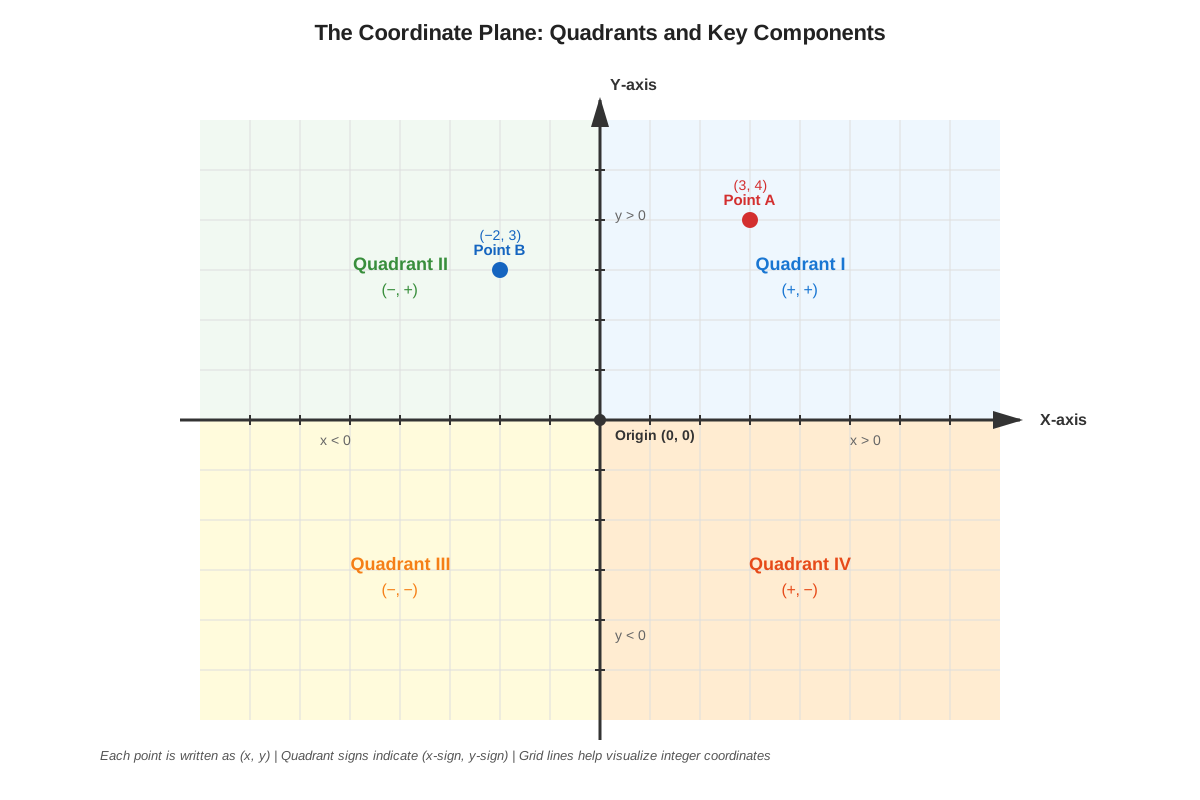
The coordinate plane (also called the Cartesian plane) consists of two perpendicular number lines: the horizontal x-axis and the vertical y-axis. These axes intersect at the origin (0, 0) and divide the plane into four quadrants. Every point on the plane is represented by an ordered pair (x, y), where x represents the horizontal distance from the origin and y represents the vertical distance.
Quadrant locations follow a counterclockwise pattern:
- Quadrant I: x > 0, y > 0 (upper right)
- Quadrant II: x < 0, y > 0 (upper left)
- Quadrant III: x < 0, y < 0 (lower left)
- Quadrant IV: x > 0, y < 0 (lower right)
Points on the axes themselves (where either x = 0 or y = 0) do not belong to any quadrant.
Distance Formula
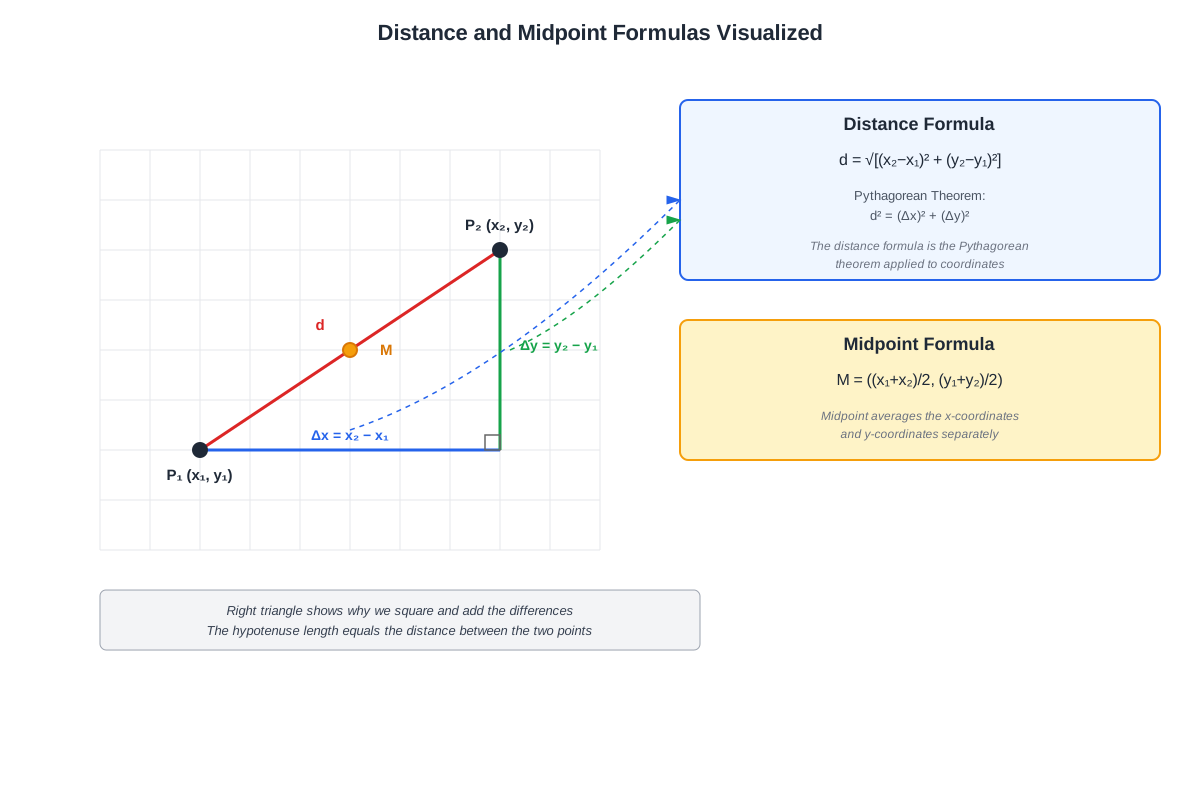
The distance formula calculates the straight-line distance between any two points on the coordinate plane. For points (x₁, y₁) and (x₂, y₂), the distance d is:
d = √[(x₂ - x₁)² + (y₂ - y₁)²]This formula derives directly from the Pythagorean theorem, treating the horizontal and vertical distances as legs of a right triangle. The distance formula is fundamental for problems involving circles (radius as distance from center), geometric figure properties, and optimization questions.
Key applications:
- Finding the radius of a circle given center and a point on the circle
- Determining whether a triangle is isosceles or equilateral
- Calculating perimeters of polygons given vertices
- Verifying whether a point lies on a circle
Midpoint Formula
The midpoint formula finds the point exactly halfway between two given points. For points (x₁, y₁) and (x₂, y₂), the midpoint M is:
M = ((x₁ + x₂)/2, (y₁ + y₂)/2)The midpoint formula simply averages the x-coordinates and y-coordinates separately. This concept appears in problems involving bisectors, centers of geometric figures, and symmetry.
Slope of a Line
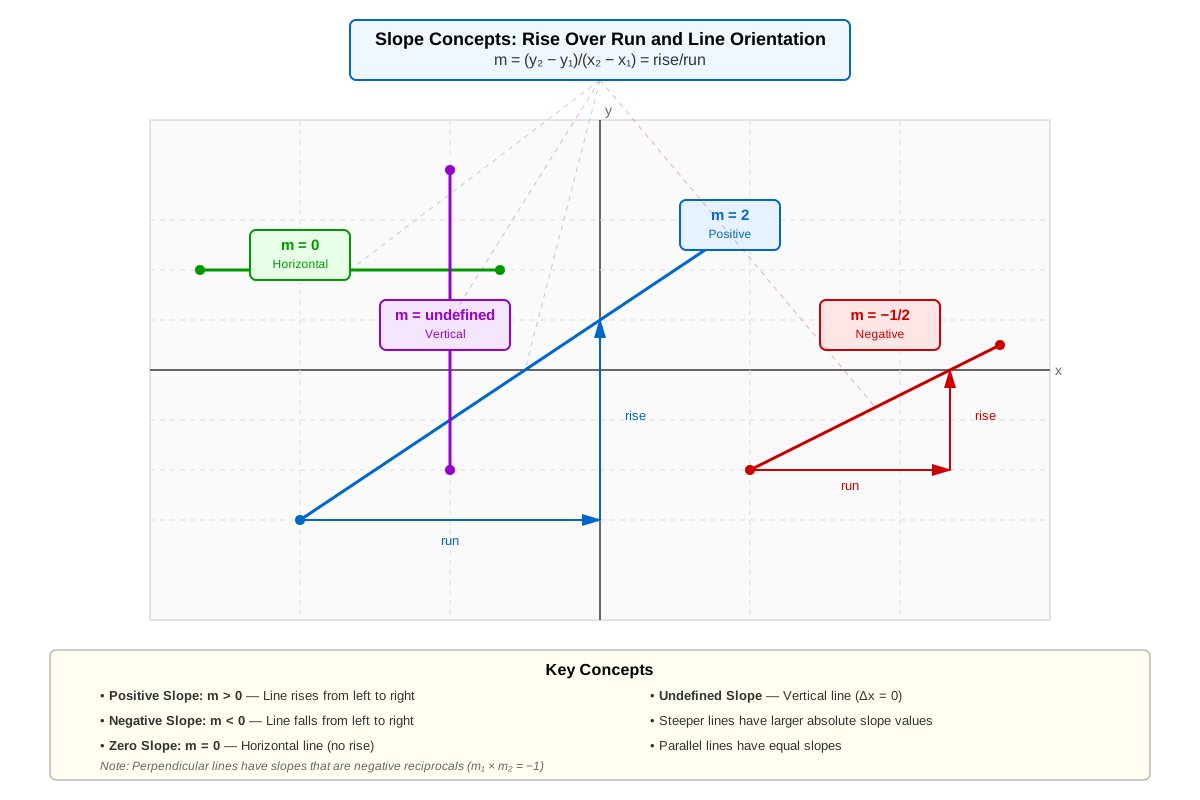
The slope (m) measures the steepness and direction of a line, defined as the ratio of vertical change (rise) to horizontal change (run). For points (x₁, y₁) and (x₂, y₂):
m = (y₂ - y₁)/(x₂ - x₁)Slope properties:
- Positive slope: line rises from left to right
- Negative slope: line falls from left to right
- Zero slope: horizontal line (y₂ = y₁)
- Undefined slope: vertical line (x₂ = x₁)
- Parallel lines: equal slopes (m₁ = m₂)
- Perpendicular lines: slopes are negative reciprocals (m₁ × m₂ = -1)
The slope concept is crucial for line equations, parallel/perpendicular relationships, and analyzing rates of change in applied problems.
Equations of Lines
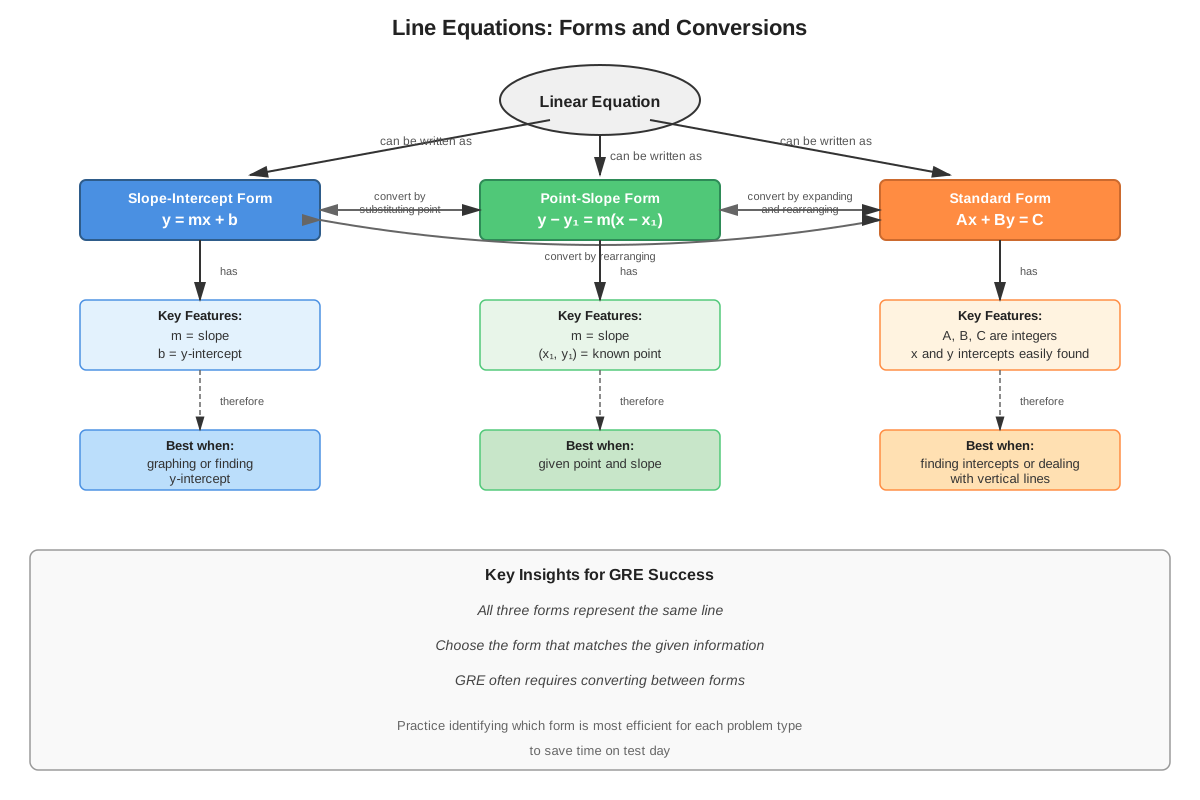
Lines on the coordinate plane can be expressed in multiple forms:
| Form | Equation | When to Use |
|---|---|---|
| Slope-intercept | y = mx + b | When slope (m) and y-intercept (b) are known or needed |
| Point-slope | y - y₁ = m(x - x₁) | When slope and one point are known |
| Standard form | Ax + By = C | For integer coefficients or finding intercepts quickly |
| Two-point form | (y - y₁)/(y₂ - y₁) = (x - x₁)/(x₂ - x₁) | When two points are given |
The y-intercept is the point where the line crosses the y-axis (x = 0), and the x-intercept is where it crosses the x-axis (y = 0).
Circles on the Coordinate Plane
The standard equation of a circle with center (h, k) and radius r is:
(x - h)² + (y - k)² = r²This equation represents all points at distance r from the center point. When the center is at the origin (0, 0), the equation simplifies to:
x² + y² = r²Key circle concepts for the GRE:
- Identifying center and radius from the equation
- Determining whether a point lies on, inside, or outside a circle
- Finding the equation given center and radius or center and a point on the circle
- Calculating areas and circumferences using coordinate information
Area Calculations Using Coordinates
For polygons with vertices given as coordinates, several methods calculate area:
Triangle with vertices (x₁, y₁), (x₂, y₂), (x₃, y₃):
Area = ½|x₁(y₂ - y₃) + x₂(y₃ - y₁) + x₃(y₁ - y₂)|Alternatively, use the base-height method by treating one side as the base and calculating the perpendicular distance to the opposite vertex.
Rectangle or square: Calculate the lengths of adjacent sides using the distance formula, then multiply.
General polygon: Divide into triangles or use the Shoelace formula for more complex shapes.
Collinearity and Special Relationships
Three points are collinear (lie on the same line) if:
- The slope between points A and B equals the slope between points B and C
- The sum of two distances equals the third distance (for points in order)
- The area of the triangle formed by the three points equals zero
Points exhibit symmetry about the y-axis if they have coordinates (x, y) and (-x, y), and symmetry about the x-axis if they have coordinates (x, y) and (x, -y).
Concept Relationships
The coordinate geometry concepts form an interconnected system where each element builds upon and reinforces others. The coordinate plane serves as the foundational framework upon which all other concepts rest. From this base, the distance formula emerges as a direct application of the Pythagorean theorem, connecting coordinate geometry to fundamental geometric principles.
The distance formula → enables calculation of → circle equations (radius as distance from center) and polygon properties (side lengths, perimeter calculations). Similarly, distance calculations → combine with → area formulas to fully characterize geometric figures on the plane.
The slope concept → leads directly to → line equations in various forms, which → enable analysis of → parallel and perpendicular relationships. Slope understanding → also connects to → collinearity testing (equal slopes indicate collinear points).
The midpoint formula → relates to → symmetry concepts and bisector problems, while also → connecting to → distance calculations (the midpoint is equidistant from both endpoints).
All these coordinate concepts → integrate with → prerequisite algebra skills (equation solving, formula manipulation) and → prerequisite geometry knowledge (properties of shapes, angle relationships). This integration makes coordinate geometry a powerful problem-solving tool that transforms geometric questions into algebraic calculations and vice versa.
High-Yield Facts
⭐ The distance between points (x₁, y₁) and (x₂, y₂) is √[(x₂ - x₁)² + (y₂ - y₁)²]
⭐ The slope of a line through (x₁, y₁) and (x₂, y₂) is (y₂ - y₁)/(x₂ - x₁)
⭐ Parallel lines have equal slopes; perpendicular lines have slopes that are negative reciprocals (product = -1)
⭐ The equation of a circle with center (h, k) and radius r is (x - h)² + (y - k)² = r²
⭐ The midpoint of a segment connecting (x₁, y₁) and (x₂, y₂) is ((x₁ + x₂)/2, (y₁ + y₂)/2)
- A horizontal line has slope 0 and equation y = k; a vertical line has undefined slope and equation x = h
- The y-intercept occurs where x = 0; the x-intercept occurs where y = 0
- Three points are collinear if the slope between any two pairs is equal
- The area of a triangle with vertices at (x₁, y₁), (x₂, y₂), (x₃, y₃) can be found using ½|x₁(y₂ - y₃) + x₂(y₃ - y₁) + x₃(y₁ - y₂)|
- A point (x, y) lies on a circle if it satisfies the circle's equation; inside if the left side is less than r²; outside if greater than r²
- The distance from a point to the origin (0, 0) is simply √(x² + y²)
- For a line in slope-intercept form y = mx + b, m is the slope and b is the y-intercept
Quick check — test yourself on Coordinate geometry so far.
Try Flashcards →Common Misconceptions
Misconception: The distance formula can be simplified by taking the absolute value of the differences instead of squaring them.
Correction: The distance formula requires squaring the differences because it derives from the Pythagorean theorem. Simply taking absolute values would give the sum of horizontal and vertical distances (Manhattan distance), not the straight-line Euclidean distance.
Misconception: When finding slope, the order of subtraction doesn't matter, so (y₁ - y₂)/(x₂ - x₁) equals (y₂ - y₁)/(x₁ - x₂).
Correction: While these expressions are equal (both give the correct slope), mixing the order incorrectly—such as (y₁ - y₂)/(x₁ - x₂)—produces the wrong sign. Consistency is crucial: subtract coordinates in the same order for both numerator and denominator.
Misconception: A line with equation x = 5 has a slope of zero.
Correction: Vertical lines (x = constant) have undefined slope, not zero slope. Zero slope describes horizontal lines (y = constant). This distinction is critical because vertical lines cannot be written in slope-intercept form.
Misconception: If two lines are not parallel, they must be perpendicular.
Correction: Perpendicular lines require a specific relationship: slopes that are negative reciprocals (m₁ × m₂ = -1). Most pairs of non-parallel lines intersect at angles other than 90 degrees and are therefore neither parallel nor perpendicular.
Misconception: The midpoint formula gives the distance between two points.
Correction: The midpoint formula finds the coordinates of the point halfway between two given points, not the distance between them. The distance formula calculates how far apart the points are. These are fundamentally different calculations with different purposes.
Misconception: In the circle equation (x - h)² + (y - k)² = r², the center is at (-h, -k).
Correction: The center is at (h, k), not (-h, -k). The subtraction in the equation means you move in the opposite direction: (x - 3)² indicates the center's x-coordinate is +3, not -3. This sign confusion is one of the most common errors in circle problems.
Worked Examples
Example 1: Multi-Step Coordinate Geometry Problem
Question: Point A is at (2, 5) and point B is at (8, -3). Find: (a) the distance between A and B, (b) the midpoint of segment AB, (c) the slope of line AB, and (d) the equation of the line perpendicular to AB that passes through the midpoint.
Solution:
(a) Distance between A and B:
Using the distance formula with (x₁, y₁) = (2, 5) and (x₂, y₂) = (8, -3):
d = √[(8 - 2)² + (-3 - 5)²]
d = √[6² + (-8)²]
d = √[36 + 64]
d = √100 = 10
The distance is 10 units.
(b) Midpoint of AB:
Using the midpoint formula:
M = ((2 + 8)/2, (5 + (-3))/2)
M = (10/2, 2/2)
M = (5, 1)
The midpoint is at (5, 1).
(c) Slope of line AB:
Using the slope formula:
m = (-3 - 5)/(8 - 2)
m = -8/6
m = -4/3
The slope is -4/3.
(d) Equation of perpendicular line through midpoint:
First, find the slope of the perpendicular line. Since perpendicular slopes are negative reciprocals:
m_perp = -1/(-4/3) = 3/4Now use point-slope form with the midpoint (5, 1) and slope 3/4:
y - 1 = (3/4)(x - 5)
y - 1 = (3/4)x - 15/4
y = (3/4)x - 15/4 + 1
y = (3/4)x - 15/4 + 4/4
y = (3/4)x - 11/4
The equation is y = (3/4)x - 11/4 or, in standard form, 3x - 4y = 11.
Connection to learning objectives: This problem demonstrates identification of coordinate geometry testing (multiple formulas in one problem), application of core strategies (systematic use of distance, midpoint, slope, and perpendicular line concepts), and accurate execution of GRE-style calculations.
Example 2: Circle and Triangle Area Problem
Question: A circle has equation x² + y² = 25. Point P is at (3, 4), point Q is at (5, 0), and point R is at (0, 5). Determine whether point P lies on the circle, and find the area of triangle PQR.
Solution:
Part 1: Does P lie on the circle?
The circle equation x² + y² = 25 has center (0, 0) and radius 5 (since r² = 25, so r = 5).
Substitute P(3, 4) into the equation:
3² + 4² = 9 + 16 = 25 ✓Since the equation is satisfied, point P lies on the circle. (We could also verify this by calculating the distance from P to the origin: √(3² + 4²) = √25 = 5, which equals the radius.)
Part 2: Area of triangle PQR
Using the coordinate formula for triangle area with vertices P(3, 4), Q(5, 0), and R(0, 5):
Area = ½|x₁(y₂ - y₃) + x₂(y₃ - y₁) + x₃(y₁ - y₂)|
Area = ½|3(0 - 5) + 5(5 - 4) + 0(4 - 0)|
Area = ½|3(-5) + 5(1) + 0|
Area = ½|-15 + 5|
Area = ½|-10|
Area = ½(10) = 5
The area of triangle PQR is 5 square units.
Alternative method: Notice that Q and R lie on the axes. We could use base-height method:
- Base QR: distance from (5, 0) to (0, 5) = √[(5-0)² + (0-5)²] = √50 = 5√2
- Height: perpendicular distance from P to line QR
The line through Q(5, 0) and R(0, 5) has slope (5-0)/(0-5) = -1 and equation y = -x + 5 or x + y = 5.
Distance from P(3, 4) to line x + y = 5:
distance = |3 + 4 - 5|/√(1² + 1²) = 2/√2 = √2Area = ½ × base × height = ½ × 5√2 × √2 = ½ × 5 × 2 = 5 ✓
Connection to learning objectives: This example shows identification of circle equations, application of the circle equation to test point membership, and use of coordinate-based area formulas—all high-yield GRE skills.
Exam Strategy
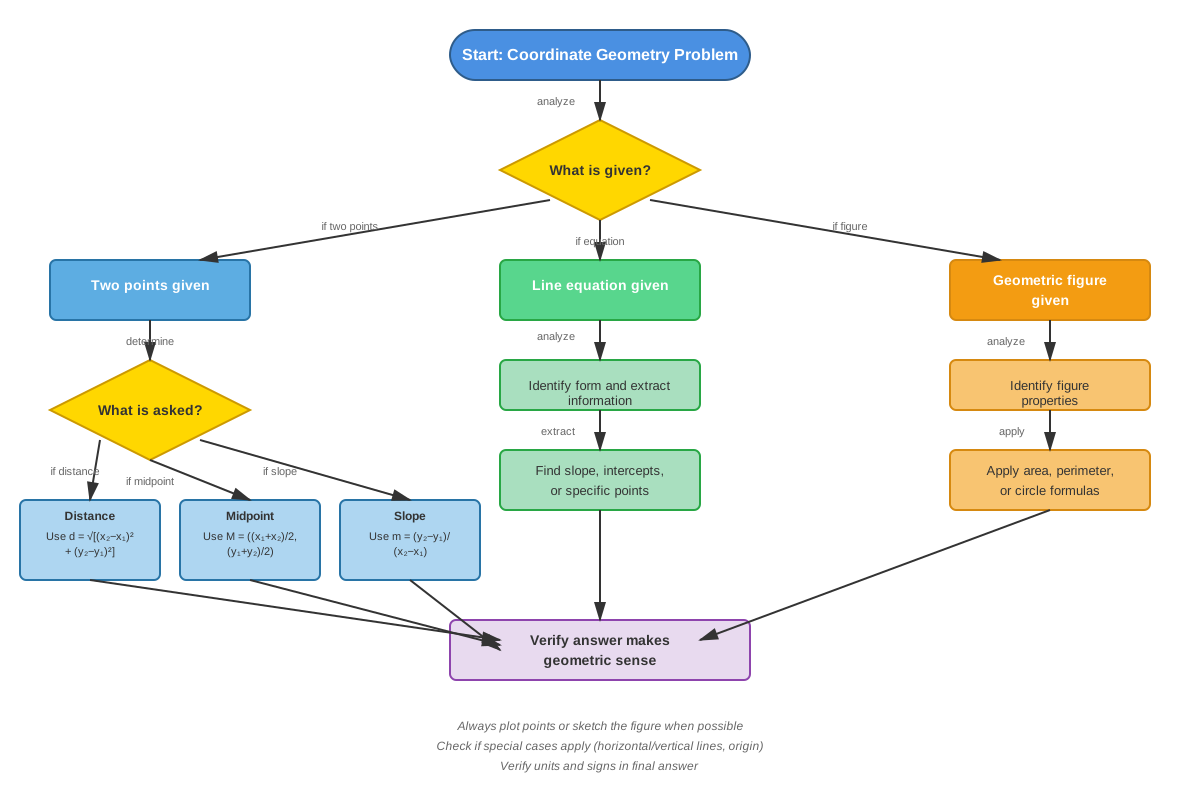
When approaching GRE coordinate geometry questions, begin by identifying what information is given and what is being asked. Draw a quick sketch of the coordinate plane when possible, even if rough—visualization prevents sign errors and reveals geometric relationships that might not be obvious from coordinates alone.
Trigger words and phrases to watch for:
- "Distance between" → distance formula
- "Midpoint" or "halfway between" → midpoint formula
- "Slope" or "steepness" → slope formula
- "Parallel" → equal slopes
- "Perpendicular" → negative reciprocal slopes
- "Equation of a line" → choose appropriate form based on given information
- "Circle with center" → circle equation (x - h)² + (y - k)² = r²
- "Lies on," "passes through" → substitute coordinates into equation
- "Area of triangle/polygon" → coordinate area formula or divide into simpler shapes
Process-of-elimination strategies:
- For quantitative comparison questions, test special cases (like points on axes or at the origin) before doing full calculations
- Eliminate answer choices with wrong signs by checking whether the result should be positive or negative
- For line equations, quickly check the y-intercept by setting x = 0 in answer choices
- For circle problems, verify that the radius value makes geometric sense given the context
Time allocation advice:
- Simple distance or slope calculations: 30-45 seconds
- Line equation problems: 45-60 seconds
- Circle problems: 60-90 seconds
- Complex multi-step problems (like Example 1): 2-2.5 minutes
- If a problem requires more than 2.5 minutes, mark it and return later
Strategic shortcuts:
- For distance between points with one matching coordinate, use simple subtraction (no formula needed)
- When comparing distances, sometimes you can compare squared distances to avoid calculating square roots
- For perpendicular line problems, remember that swapping the slope's numerator and denominator and changing sign gives the perpendicular slope
- Recognize special right triangles (3-4-5, 5-12-13) in distance calculations to avoid computation
Exam Tip: On quantitative comparison questions involving coordinate geometry, look for symmetry or special relationships before calculating. Often the answer is "cannot be determined" when the problem allows multiple configurations.
Memory Techniques
Distance Formula Mnemonic: "Difference Squared Summed Rooted" (DSSR)
- Difference: subtract coordinates
- Squared: square each difference
- Summed: add the squared differences
- Rooted: take the square root
Slope Memory Device: "Rise over Run" or visualize climbing stairs—the slope tells you how many steps up (or down) for each step forward.
Perpendicular Slopes: "Flip and Negate" (FN)
- Flip: take the reciprocal (swap numerator and denominator)
- Negate: change the sign
Circle Equation: Remember "Center Opposite Sign" (COS)
- The signs in (x - h)² + (y - k)² = r² are opposite to the center coordinates
- (x - 3)² means center x-coordinate is +3, not -3
Quadrant Signs: Use the phrase "All Students Take Calculus" moving counterclockwise from Quadrant I:
- All (Quadrant I): both x and y positive
- Students (Quadrant II): only sine (y) positive
- Take (Quadrant III): only tangent positive (both negative)
- Calculus (Quadrant IV): only cosine (x) positive
Visualization Strategy: For any coordinate problem, mentally or physically sketch the axes and plot approximate point locations. This spatial representation helps catch sign errors and reveals geometric patterns.
Summary
Coordinate geometry represents the powerful synthesis of algebraic and geometric reasoning on the Cartesian plane, making it one of the highest-yield topics for GRE Quantitative Reasoning. Mastery requires fluency with five core formulas: distance (√[(x₂-x₁)² + (y₂-y₁)²]), midpoint ((x₁+x₂)/2, (y₁+y₂)/2), slope ((y₂-y₁)/(x₂-x₁)), line equations (particularly y = mx + b), and circles ((x-h)² + (y-k)² = r²). Success on GRE questions demands not just formula memorization but strategic application—knowing when to use each formula, how to combine multiple concepts in complex problems, and how to leverage geometric intuition to check algebraic work. The key to excellence is recognizing that coordinate geometry problems often test multiple concepts simultaneously: a single question might require calculating distances, determining slopes, and finding areas. Students who develop systematic approaches—sketching diagrams, organizing given information, selecting appropriate formulas, and verifying answers through alternative methods—will confidently handle the 2-4 coordinate geometry questions that typically appear on each GRE administration.
Key Takeaways
- Coordinate geometry bridges algebra and geometry, allowing geometric problems to be solved algebraically and vice versa—this dual nature makes it exceptionally powerful for GRE problem-solving
- Master the five essential formulas: distance, midpoint, slope, line equations, and circle equations—these form the foundation for virtually all coordinate geometry questions
- Parallel lines have equal slopes (m₁ = m₂) while perpendicular lines have negative reciprocal slopes (m₁ × m₂ = -1)—this relationship appears frequently in GRE questions
- Always sketch a diagram when working with coordinate geometry problems—visualization prevents sign errors and reveals geometric relationships not obvious from coordinates alone
- The circle equation (x - h)² + (y - k)² = r² has signs opposite to the center coordinates—this is the most common source of errors in circle problems
- Coordinate geometry questions often combine multiple concepts—expect to use distance, slope, and area formulas together in complex problems
- Strategic thinking trumps calculation—on quantitative comparison questions, look for symmetry, special cases, or geometric relationships before computing exact values
Related Topics
Linear Inequalities and Regions: Building on line equations, this topic explores shading regions on the coordinate plane that satisfy inequalities, essential for optimization problems and systems of inequalities.
Transformations and Symmetry: Understanding how geometric figures move on the coordinate plane through translations, reflections, rotations, and dilations extends coordinate geometry concepts to dynamic situations.
Quadratic Functions and Parabolas: The coordinate representation of parabolas (y = ax² + bx + c) connects coordinate geometry to more advanced function analysis, including vertex form and axis of symmetry.
Three-Dimensional Coordinate Systems: While rarely tested on the GRE, understanding how coordinate concepts extend to three dimensions (x, y, z) provides context for spatial reasoning questions.
Vectors and Parametric Equations: Advanced applications of coordinate geometry that represent directed line segments and curves using parameter-based equations, occasionally appearing in challenging GRE questions.
Practice CTA
Now that you've mastered the core concepts, formulas, and strategies for coordinate geometry, it's time to solidify your understanding through active practice. Attempt the practice questions designed specifically for this topic—they mirror actual GRE question formats and difficulty levels. Use the flashcards to drill essential formulas and relationships until they become automatic. Remember: coordinate geometry rewards systematic thinking and careful execution. Each practice problem you solve builds the pattern recognition and strategic intuition that will serve you on test day. You've built a strong foundation—now strengthen it through deliberate practice!
Sign up free to keep reading
Create a free AnvayaPrep account to finish this GRE guide on Coordinate geometry — plus flashcards and practice questions.