Overview
Absolute value is one of the most frequently tested concepts in GRE Quantitative Reasoning, appearing in approximately 10-15% of all quantitative questions. This fundamental mathematical concept measures the distance of a number from zero on the number line, regardless of direction. Understanding absolute value is crucial not only for direct computational questions but also for solving inequalities, analyzing algebraic expressions, and interpreting geometric relationships on the coordinate plane.
The gre absolute value questions test both computational fluency and conceptual understanding. Students must recognize that absolute value creates two possible scenarios in equations and inequalities, leading to multiple solution paths that must be carefully evaluated. This dual-nature characteristic makes absolute value a powerful tool for the GRE test makers to assess logical reasoning and systematic problem-solving skills. Questions may appear as standalone computational problems, embedded within word problems, integrated into coordinate geometry scenarios, or disguised within data interpretation questions.
Mastering absolute value connects directly to success in algebra, coordinate geometry, and number properties—three pillars of GRE Quantitative Reasoning. The concept serves as a bridge between basic arithmetic operations and more complex algebraic manipulations, making it an essential building block for achieving competitive scores. Students who develop strong absolute value skills gain significant advantages in time management and accuracy across multiple question types.
Learning Objectives
- [ ] Identify when Absolute value is being tested in GRE questions
- [ ] Explain the core rule or strategy behind Absolute value
- [ ] Apply Absolute value to GRE-style questions accurately
- [ ] Solve absolute value equations with single and multiple variables
- [ ] Interpret absolute value inequalities and determine solution sets
- [ ] Recognize absolute value in disguised forms within complex expressions
- [ ] Apply absolute value concepts to distance problems on the number line and coordinate plane
Prerequisites
- Basic arithmetic operations: Understanding addition, subtraction, multiplication, and division is essential for manipulating expressions within absolute value symbols
- Number line concepts: Visualizing positive and negative numbers on a number line provides the geometric foundation for understanding absolute value as distance
- Algebraic manipulation: Solving basic equations and isolating variables enables students to work with absolute value equations systematically
- Inequality notation: Familiarity with inequality symbols (<, >, ≤, ≥) is necessary for solving absolute value inequalities
Why This Topic Matters
Absolute value appears in real-world applications ranging from engineering tolerances (acceptable deviation from specifications) to financial analysis (measuring variance from targets) to physics (calculating magnitude regardless of direction). In computer science, absolute value functions help calculate differences and distances, while in statistics, they form the basis for understanding deviation and error measurements.
On the GRE, absolute value questions appear in multiple formats: approximately 40% as direct computational problems, 30% embedded within algebraic equations or inequalities, 20% in coordinate geometry contexts, and 10% in word problems involving distance or deviation. The Educational Testing Service (ETS) particularly favors questions that combine absolute value with other concepts, testing whether students can maintain accuracy when managing multiple mathematical principles simultaneously.
Common GRE question formats include: comparing quantities involving absolute values, solving equations with absolute value expressions on both sides, determining the number of integer solutions to absolute value inequalities, analyzing geometric interpretations on coordinate planes, and evaluating complex expressions where absolute value interacts with exponents or roots. Recognizing these patterns enables strategic preparation and confident test-day performance.
Core Concepts
Definition and Fundamental Properties
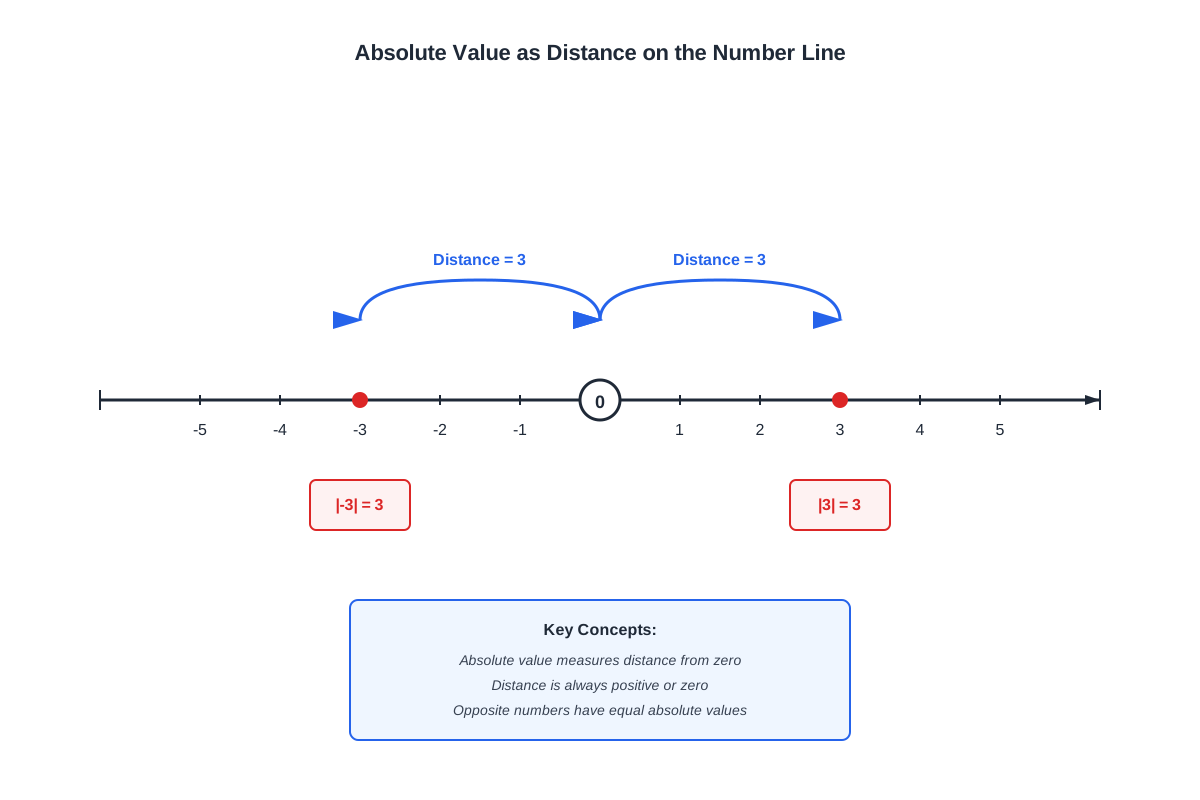
The absolute value of a number, denoted |x|, represents the distance between that number and zero on the number line. Distance is always non-negative, which explains why absolute value always produces a non-negative result. Mathematically, the absolute value function is defined piecewise:
|x| = {
  x,   if x ≥ 0
  -x,  if x < 0
}
This definition reveals a crucial insight: for negative numbers, absolute value changes the sign (making them positive), while for positive numbers and zero, absolute value leaves the value unchanged. For example, |5| = 5 because 5 is already positive, while |-5| = 5 because we take the opposite of -5.
Key properties of absolute value include:
- |x| ≥ 0 for all real numbers x
- |x| = 0 if and only if x = 0
- |x| = |-x| (symmetry property)
- |xy| = |x| · |y| (multiplicative property)
- |x/y| = |x|/|y| when y ≠ 0 (division property)
Geometric Interpretation
Understanding absolute value geometrically provides powerful problem-solving insights. On a number line, |x| represents the distance from x to 0. More generally, |x - a| represents the distance between x and a. This interpretation transforms abstract algebraic expressions into concrete spatial relationships.
For instance, |x - 3| = 5 asks: "What numbers are exactly 5 units away from 3?" The answer includes both 8 (moving 5 units right) and -2 (moving 5 units left). This geometric perspective immediately reveals why absolute value equations typically have two solutions.
Solving Absolute Value Equations
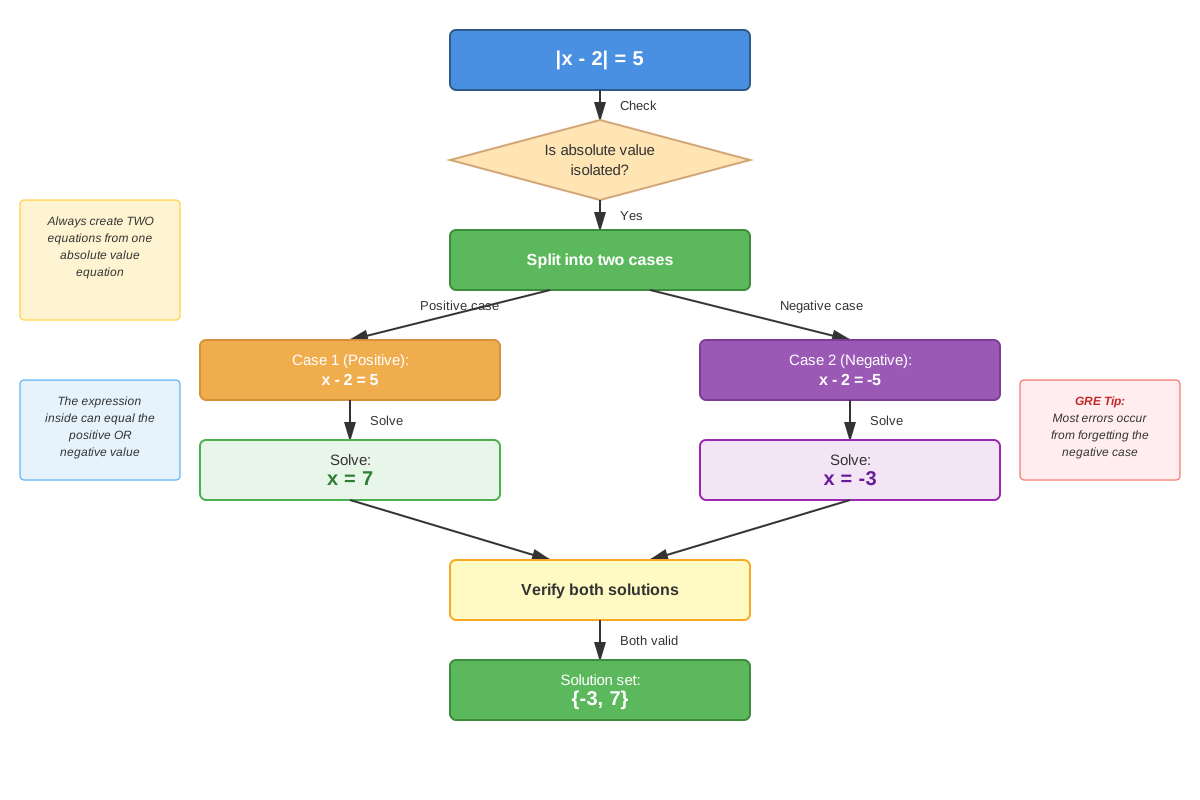
When solving equations involving absolute value, the fundamental strategy involves case analysis—considering separately the scenarios where the expression inside the absolute value is positive or negative.
Standard form: |expression| = k (where k ≥ 0)
Solution method:
- If k < 0, there is no solution (absolute value cannot equal a negative number)
- If k = 0, solve expression = 0
- If k > 0, solve both:
- expression = k
- expression = -k
Example: Solve |2x - 3| = 7
Case 1: 2x - 3 = 7 → 2x = 10 → x = 5
Case 2: 2x - 3 = -7 → 2x = -4 → x = -2
Both solutions must be verified in the original equation.
Absolute Value Inequalities
Absolute value inequalities require careful attention to inequality direction and solution set interpretation.
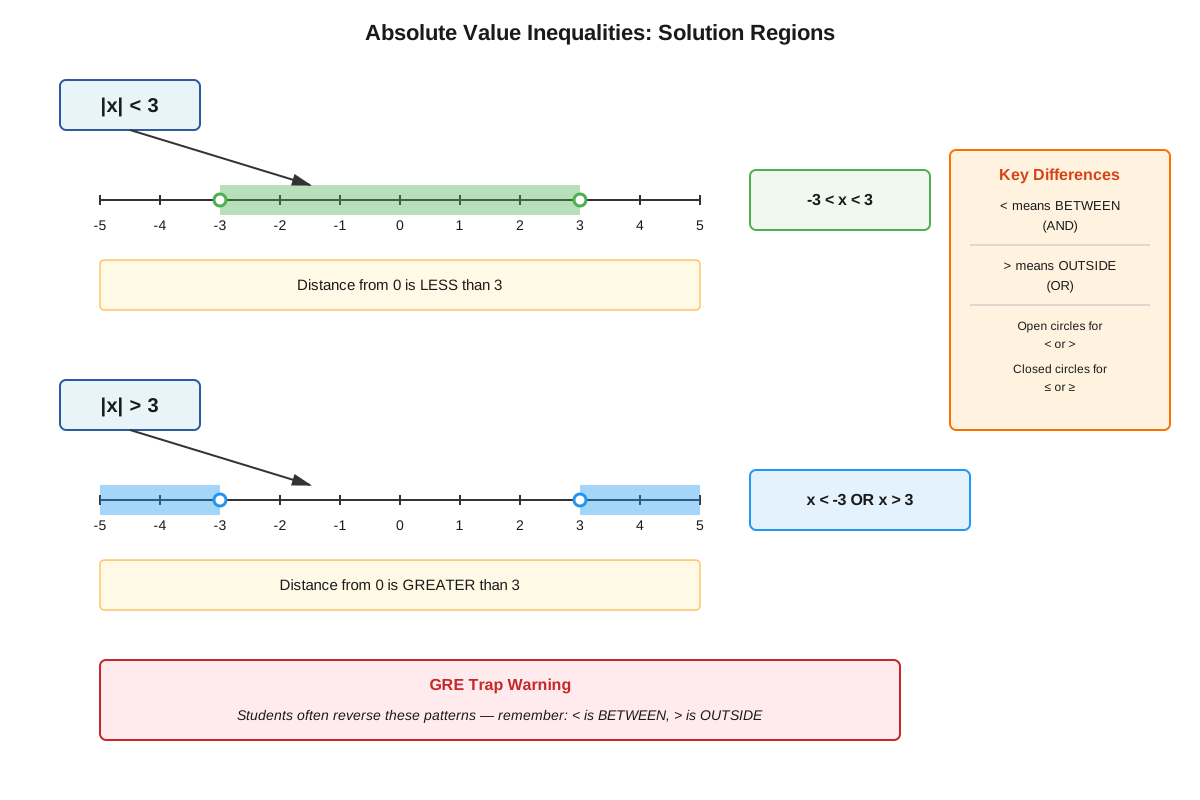
Type 1: |x| < a (where a > 0)
- Interpretation: x is less than a units away from zero
- Solution: -a < x < a
- Geometric: all points within a units of zero
Type 2: |x| > a (where a > 0)
- Interpretation: x is more than a units away from zero
- Solution: x < -a OR x > a
- Geometric: all points outside the interval from -a to a
| Inequality Type | Solution Pattern | Interval Notation | ||
|---|---|---|---|---|
| \ | x\ | < a | -a < x < a | (-a, a) |
| \ | x\ | ≤ a | -a ≤ x ≤ a | [-a, a] |
| \ | x\ | > a | x < -a or x > a | (-∞, -a) ∪ (a, ∞) |
| \ | x\ | ≥ a | x ≤ -a or x ≥ a | (-∞, -a] ∪ [a, ∞) |
Complex Absolute Value Expressions
GRE questions often feature absolute value in more sophisticated contexts:
Multiple absolute values: |x - 2| + |x + 3| = 10
- Strategy: Identify critical points (2 and -3) where expressions change sign
- Test intervals: x < -3, -3 ≤ x < 2, x ≥ 2
- Solve separately in each interval
Absolute value on both sides: |2x - 1| = |x + 4|
- Strategy: Consider four cases based on sign combinations
- Alternative: Square both sides (valid since both sides are non-negative)
- (2x - 1)² = (x + 4)²
Nested absolute values: ||x| - 3| = 2
- Strategy: Work from inside out
- First solve |x| - 3 = 2 and |x| - 3 = -2
- Then solve resulting absolute value equations
Concept Relationships
The absolute value concept connects hierarchically within mathematics: basic number properties → absolute value definition → absolute value equations → absolute value inequalities → complex multi-variable expressions. Each level builds upon previous understanding while adding layers of complexity.
Absolute value relates directly to distance formulas in coordinate geometry. The expression |x₂ - x₁| calculates horizontal distance between points, while the full distance formula √[(x₂-x₁)² + (y₂-y₁)²] incorporates absolute value principles through squaring (which produces the same non-negative result as absolute value for single terms).
Within algebra, absolute value connects to piecewise functions, as the absolute value function itself is defined piecewise. This relationship helps students understand why graphing |f(x)| involves reflecting negative portions of f(x) above the x-axis.
The concept also links to number properties, particularly when analyzing expressions like |a + b| versus |a| + |b|. The triangle inequality (|a + b| ≤ |a| + |b|) represents a fundamental relationship tested on the GRE, connecting absolute value to inequality reasoning.
Quick check — test yourself on Absolute value so far.
Try Flashcards →High-Yield Facts
⭐ The absolute value of any real number is always non-negative: |x| ≥ 0 for all x
⭐ Absolute value equations |x| = a have two solutions when a > 0: x = a or x = -a
⭐ The inequality |x| < a is equivalent to -a < x < a (conjunction: AND)
⭐ The inequality |x| > a is equivalent to x < -a OR x > a (disjunction: OR)
⭐ |x - a| represents the distance between x and a on the number line
- The equation |x| = 0 has exactly one solution: x = 0
- If |x| = a where a < 0, there is no solution (absolute value cannot be negative)
- The multiplicative property states |xy| = |x| · |y| for all real numbers
- |x|² = x² for all real numbers (squaring eliminates the absolute value)
- The maximum value of -|x| is 0, occurring when x = 0
- For any expression, |expression| = |-expression| (symmetry property)
- When solving |f(x)| = |g(x)|, squaring both sides is valid and often simplifies the problem
- The graph of y = |x| forms a V-shape with vertex at the origin
Common Misconceptions
Misconception: |x + y| = |x| + |y| for all values
Correction: This is only true when x and y have the same sign. In general, |x + y| ≤ |x| + |y| (triangle inequality). For example, |3 + (-5)| = |-2| = 2, but |3| + |-5| = 3 + 5 = 8.
Misconception: The solution to |x| > -3 is x > -3 or x < 3
Correction: Since absolute value is always non-negative, |x| is always greater than any negative number. Therefore, |x| > -3 is true for all real numbers; the solution set is all real numbers.
Misconception: When solving |2x - 4| = 6, you can simply remove the absolute value bars and solve 2x - 4 = 6
Correction: You must consider both cases: 2x - 4 = 6 AND 2x - 4 = -6. Ignoring the negative case means missing half the solutions (x = 5 and x = -1).
Misconception: |x| < 5 means x < 5 or x > -5
Correction: The correct interpretation uses AND, not OR: -5 < x < 5. The "less than" inequality with absolute value creates a bounded interval (conjunction), while "greater than" creates an unbounded union (disjunction).
Misconception: |-x| = -|x| for all values of x
Correction: |-x| = |x| due to the symmetry property of absolute value. However, -|x| is always non-positive (the negative of a non-negative number). For example, |-3| = 3, but -|3| = -3.
Misconception: If |x - 2| = 5, then x - 2 = 5, so x = 7 is the only solution
Correction: Both x - 2 = 5 (giving x = 7) and x - 2 = -5 (giving x = -3) must be considered. Always check both the positive and negative cases.
Worked Examples
Example 1: Solving an Absolute Value Equation
Problem: Solve for all values of x: |3x + 2| = 11
Solution:
Step 1: Recognize this is a standard absolute value equation in the form |expression| = k where k > 0, so we expect two solutions.
Step 2: Set up two cases based on the definition of absolute value.
Case 1 (expression is positive or zero):
3x + 2 = 11
3x = 9
x = 3
Case 2 (expression is negative):
3x + 2 = -11
3x = -13
x = -13/3
Step 3: Verify both solutions in the original equation.
For x = 3: |3(3) + 2| = |9 + 2| = |11| = 11 ✓
For x = -13/3: |3(-13/3) + 2| = |-13 + 2| = |-11| = 11 ✓
Answer: x = 3 or x = -13/3
Connection to learning objectives: This example demonstrates applying absolute value to solve equations accurately (Objective 3) and explains the core strategy of case analysis (Objective 2).
Example 2: Solving an Absolute Value Inequality
Problem: Solve and express in interval notation: |2x - 5| ≤ 7
Solution:
Step 1: Identify the inequality type. This is a "less than or equal to" inequality, which produces a bounded interval (conjunction).
Step 2: Apply the rule: |expression| ≤ a means -a ≤ expression ≤ a
-7 ≤ 2x - 5 ≤ 7
Step 3: Solve the compound inequality by adding 5 to all parts.
-7 + 5 ≤ 2x - 5 + 5 ≤ 7 + 5
-2 ≤ 2x ≤ 12
Step 4: Divide all parts by 2.
-1 ≤ x ≤ 6
Step 5: Express in interval notation.
Answer: [-1, 6]
Geometric interpretation: This solution represents all numbers whose distance from 5/2 is at most 7/2 units.
Verification: Test boundary and interior points:
- At x = -1: |2(-1) - 5| = |-7| = 7 ≤ 7 ✓
- At x = 6: |2(6) - 5| = |7| = 7 ≤ 7 ✓
- At x = 2: |2(2) - 5| = |-1| = 1 ≤ 7 ✓
Connection to learning objectives: This example shows how to interpret absolute value inequalities (Objective 5) and apply systematic strategies (Objective 2) while demonstrating the geometric meaning of absolute value as distance.
Exam Strategy
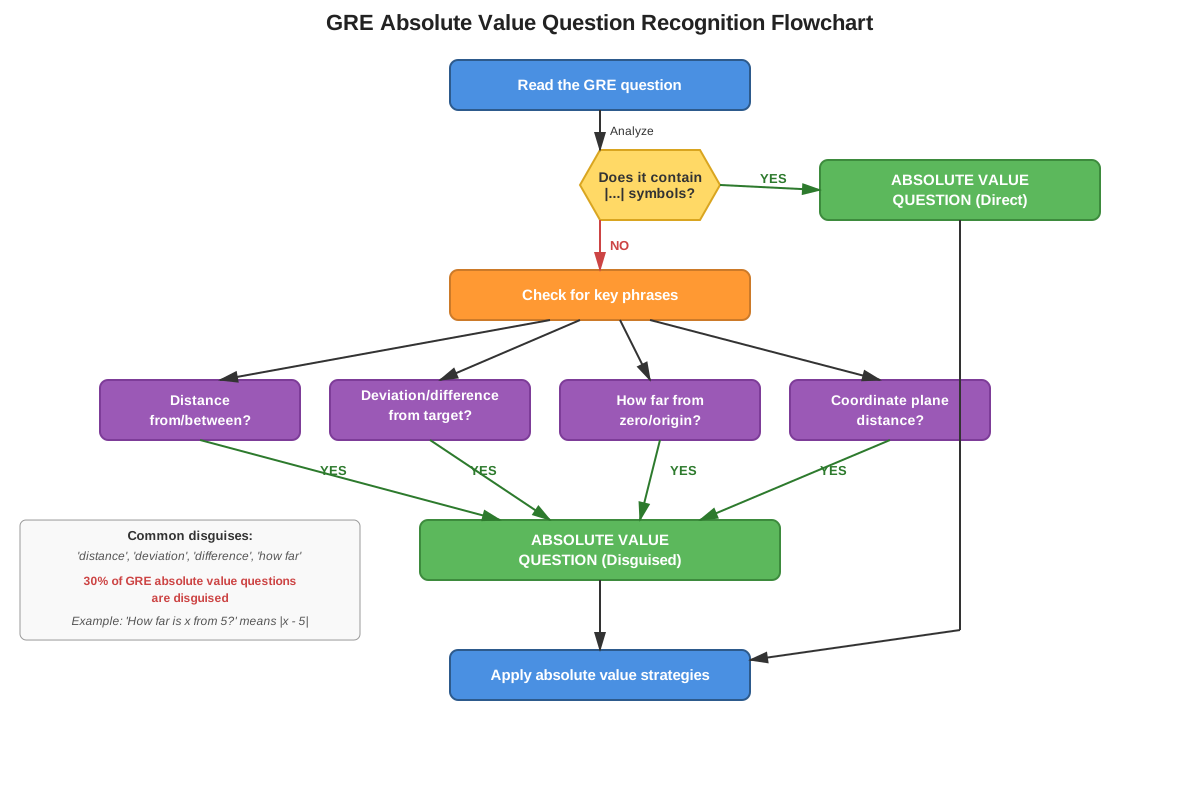
Trigger Recognition: Watch for vertical bars (| |), phrases like "distance from," "how far from," "deviation," "difference between," or questions asking "how many integer solutions."
Systematic Approach for GRE Absolute Value Questions:
- Identify the structure: Determine whether you're dealing with an equation, inequality, or expression evaluation
- Check for quick eliminations: If comparing quantities, test x = 0 first (often reveals patterns)
- Apply appropriate strategy: Use case analysis for equations, inequality rules for inequalities
- Consider geometric interpretation: Visualize on a number line when stuck
- Verify critical solutions: Always check boundary cases and at least one interior point
Time-Saving Techniques:
- For |x| = a, immediately write x = ±a rather than working through full case analysis
- When you see |x - a| < b, quickly convert to a - b < x < a + b
- If absolute value appears on both sides, consider squaring to eliminate it
- For multiple absolute values, identify critical points first, then test only relevant intervals
Process of Elimination Tips:
- Eliminate any answer choice that makes |expression| negative
- For inequality questions, test x = 0 if it's in the domain (often eliminates 2-3 choices)
- If a question asks for "number of integer solutions," calculate the range first, then count
- When comparing Quantity A and Quantity B with absolute values, test positive, negative, and zero values
Common GRE Traps:
- Questions that require recognizing |x|² = x² to simplify
- Inequalities where the answer is "all real numbers" or "no solution"
- Problems mixing absolute value with other operations (exponents, roots)
- Questions where the absolute value expression equals zero (single solution, not two)
Memory Techniques
Mnemonic for Inequality Direction: "Less than means Locked in" (< creates a bounded interval), "Greater means Go away" (> creates two separate rays)
Visual Memory Aid: Picture the absolute value symbol | | as a mirror reflecting negative values to positive. Whatever goes in comes out non-negative.
Acronym for Solution Steps - CASE:
- Check if the equation/inequality is valid (right side non-negative for equations)
- Analyze the structure (equation vs. inequality)
- Split into cases or apply inequality rules
- Evaluate and verify solutions
Geometric Visualization: Always imagine the number line with zero as home base. Absolute value measures "how far from home" you are—direction doesn't matter, only distance.
The "Two-Solution Rule" Reminder: Think of absolute value as a fork in the road—one path goes positive, one goes negative. For equations, you must explore both paths.
Summary
Absolute value represents the distance from zero on the number line, always producing non-negative results. The concept requires understanding both computational and geometric interpretations: algebraically, |x| equals x when x ≥ 0 and -x when x < 0; geometrically, |x - a| measures distance between x and a. Solving absolute value equations demands case analysis, considering both positive and negative scenarios, typically yielding two solutions. Absolute value inequalities follow distinct patterns: |x| < a produces bounded intervals (-a < x < a), while |x| > a creates unbounded unions (x < -a or x > a). GRE questions test these concepts through direct computation, embedded algebraic problems, coordinate geometry applications, and word problems involving distance or deviation. Mastery requires recognizing absolute value in various disguises, applying systematic solution strategies, and understanding the geometric meaning underlying algebraic manipulations. Success depends on avoiding common errors like forgetting the second solution, misapplying inequality rules, or incorrectly distributing absolute value across addition.
Key Takeaways
- Absolute value always produces non-negative results and represents distance from zero
- Equations in the form |x| = a (where a > 0) have two solutions: x = a and x = -a
- The inequality |x| < a translates to -a < x < a (bounded interval with AND)
- The inequality |x| > a translates to x < -a OR x > a (unbounded union with OR)
- Geometric interpretation as distance provides powerful problem-solving insights
- Case analysis is the fundamental strategy for solving absolute value equations
- Always verify solutions, especially for complex expressions or inequalities
Related Topics
Coordinate Geometry and Distance Formula: Absolute value principles extend to two-dimensional distance calculations, where |x₂ - x₁| and |y₂ - y₁| represent horizontal and vertical distances. Mastering absolute value enables confident work with distance, midpoint, and geometric relationship problems.
Piecewise Functions: Since absolute value is defined piecewise, understanding this topic provides foundation for analyzing more complex piecewise functions that appear in advanced GRE questions and function behavior analysis.
Quadratic Equations: The technique of squaring both sides to eliminate absolute value connects to quadratic solution methods. Many complex absolute value problems transform into quadratics.
Number Properties and Integer Solutions: Absolute value questions frequently ask for integer solutions within specific ranges, connecting to number theory concepts like consecutive integers and counting techniques.
Practice CTA
Now that you've mastered the core concepts, properties, and strategies for absolute value, it's time to solidify your understanding through active practice. Attempt the practice questions to test your ability to recognize absolute value in various contexts, apply systematic solution strategies, and avoid common traps. Use the flashcards to reinforce high-yield facts and build automatic recall of key patterns. Remember: absolute value appears in 10-15% of GRE Quantitative questions—your investment in mastering this topic will pay dividends across multiple question types. Approach each practice problem methodically, visualize the geometric interpretation, and verify your solutions. You've got this!
Sign up free to keep reading
Create a free AnvayaPrep account to finish this GRE guide on Absolute value — plus flashcards and practice questions.