Overview
Unit rates represent one of the most fundamental and frequently tested concepts in GRE Quantitative Reasoning. A unit rate expresses a quantity in terms of a single unit of another quantity—for example, miles per hour, dollars per item, or words per minute. While the concept may seem straightforward, the GRE tests unit rates in sophisticated ways that require students to recognize patterns, convert between different rate expressions, and combine multiple rates to solve complex problems.
Understanding gre unit rates is essential because rate problems appear across multiple question formats on the exam, including Quantitative Comparison questions, Multiple Choice questions (both single and multiple answer), and Numeric Entry questions. Rate problems often disguise themselves within word problems involving work, distance, cost, or productivity scenarios. Students who master unit rates gain a significant advantage because these problems, while common, can be solved systematically using consistent approaches that minimize calculation errors and maximize efficiency.
Unit rates connect to broader Quantitative Reasoning concepts including ratios, proportions, algebra, and problem-solving with multiple variables. They serve as building blocks for more complex topics such as combined work problems, mixture problems, and optimization scenarios. The ability to set up and manipulate rate equations translates directly into success on problems involving linear relationships, direct and inverse variation, and real-world modeling situations that the GRE frequently presents.
Learning Objectives
- [ ] Identify when Unit rates is being tested
- [ ] Explain the core rule or strategy behind Unit rates
- [ ] Apply Unit rates to GRE-style questions accurately
- [ ] Convert between different unit rate expressions and equivalent forms
- [ ] Solve multi-step problems involving combined rates or changing rates
- [ ] Recognize and avoid common calculation traps in rate problems
- [ ] Determine when to use reciprocals in rate calculations
Prerequisites
- Basic arithmetic operations: Multiplication, division, and fraction manipulation are essential for calculating and converting rates
- Ratio and proportion fundamentals: Unit rates are specialized ratios, and proportional reasoning underlies rate conversions
- Algebraic equation setup: Translating word problems into mathematical expressions is necessary for complex rate scenarios
- Unit conversion basics: Understanding how to convert between different measurement units (hours to minutes, miles to kilometers) supports rate calculations
Why This Topic Matters
Unit rates appear in everyday decision-making scenarios: comparing grocery prices, calculating fuel efficiency, determining work productivity, and estimating travel times. These practical applications make rate problems ideal for standardized testing because they assess both mathematical competency and real-world reasoning ability. Students who understand unit rates can make informed comparisons and optimize choices in professional and personal contexts.
On the GRE specifically, unit rate problems appear in approximately 15-20% of Quantitative Reasoning questions, making them one of the highest-yield topics for focused study. Rate questions appear across all difficulty levels, from straightforward single-rate calculations to complex scenarios involving multiple workers, changing speeds, or combined processes. The GRE particularly favors problems that require students to recognize inverse relationships (such as the connection between rate and time when distance is constant) or to combine rates in non-obvious ways.
Common GRE manifestations include: work problems where multiple people complete tasks at different rates; distance-rate-time problems involving relative motion or average speeds; cost analysis problems requiring per-unit price comparisons; and productivity scenarios involving machines, printers, or assembly lines operating at specified rates. The exam often embeds rate calculations within Data Interpretation sets, where students must extract rate information from tables or graphs before performing calculations.
Core Concepts
Definition and Basic Structure
A unit rate expresses a ratio as a quantity per one unit of another measure. The fundamental form is:
Unit Rate = Quantity / Units = Amount per 1 unitFor example, if a car travels 240 miles in 4 hours, the unit rate is 240 ÷ 4 = 60 miles per hour (60 miles per 1 hour). The numerator represents the quantity being measured, while the denominator represents the reference unit. Unit rates always reduce the denominator to 1, which enables direct comparisons between different scenarios.
The Three Core Rate Formulas
Rate problems typically involve three interconnected variables, and knowing any two allows calculation of the third:
| Formula | Variables | Application |
|---|---|---|
| Distance = Rate × Time | D = R × T | Travel problems, motion scenarios |
| Work = Rate × Time | W = R × T | Productivity, task completion |
| Cost = Rate × Quantity | C = R × Q | Pricing, purchasing decisions |
These formulas can be rearranged algebraically:
- Rate = Quantity ÷ Time
- Time = Quantity ÷ Rate
- Quantity = Rate × Time
Converting Between Rate Expressions
The GRE frequently requires converting rates from one form to another. Key conversion principles include:
- Maintaining dimensional consistency: When converting units, multiply by conversion factors that equal 1
- Reciprocal relationships: The rate of "time per unit" is the reciprocal of "units per time"
- Compound conversions: Multiple conversion factors can be chained together
Example: Convert 45 miles per hour to feet per second
- 45 miles/hour × 5,280 feet/mile × 1 hour/3,600 seconds = 66 feet/second
Combined Rates
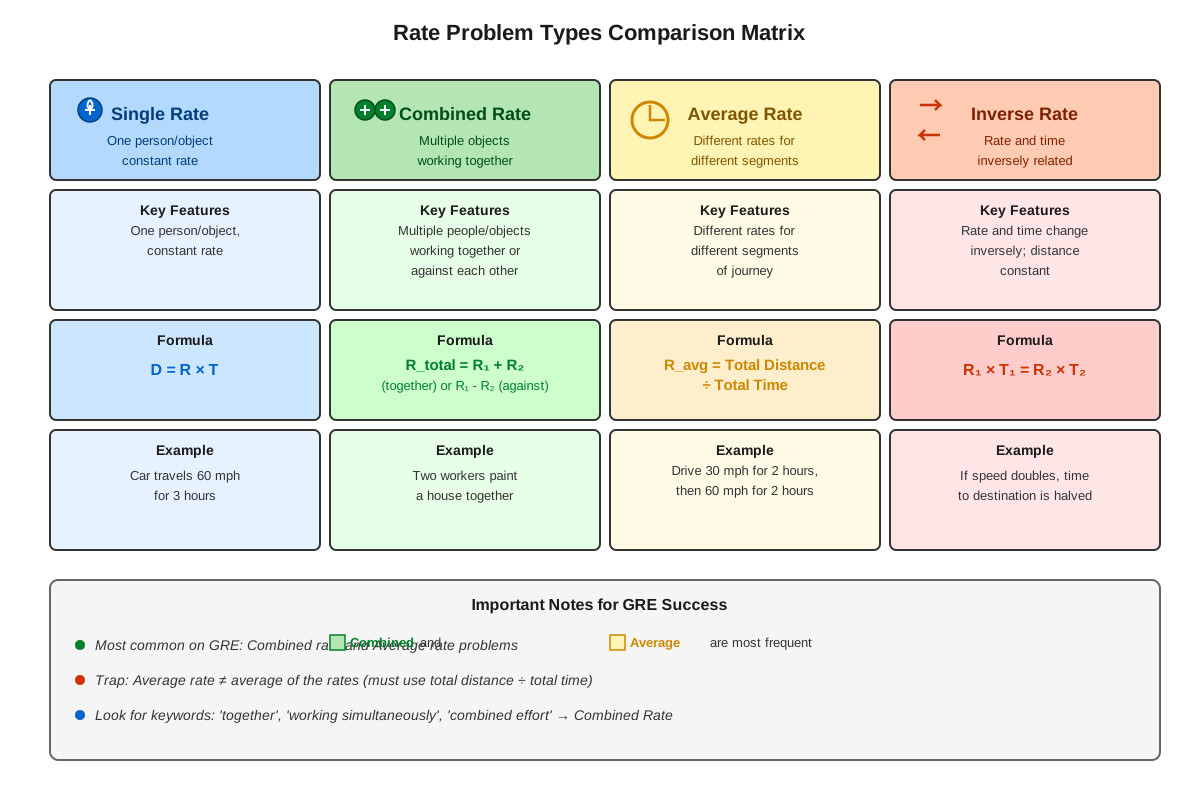
When multiple entities work together at different rates, their combined rate equals the sum of individual rates (assuming they work independently):
Combined Rate = Rate₁ + Rate₂ + Rate₃ + ...This principle applies when:
- Multiple workers complete a task together
- Multiple machines operate simultaneously
- Multiple pipes fill or drain a container
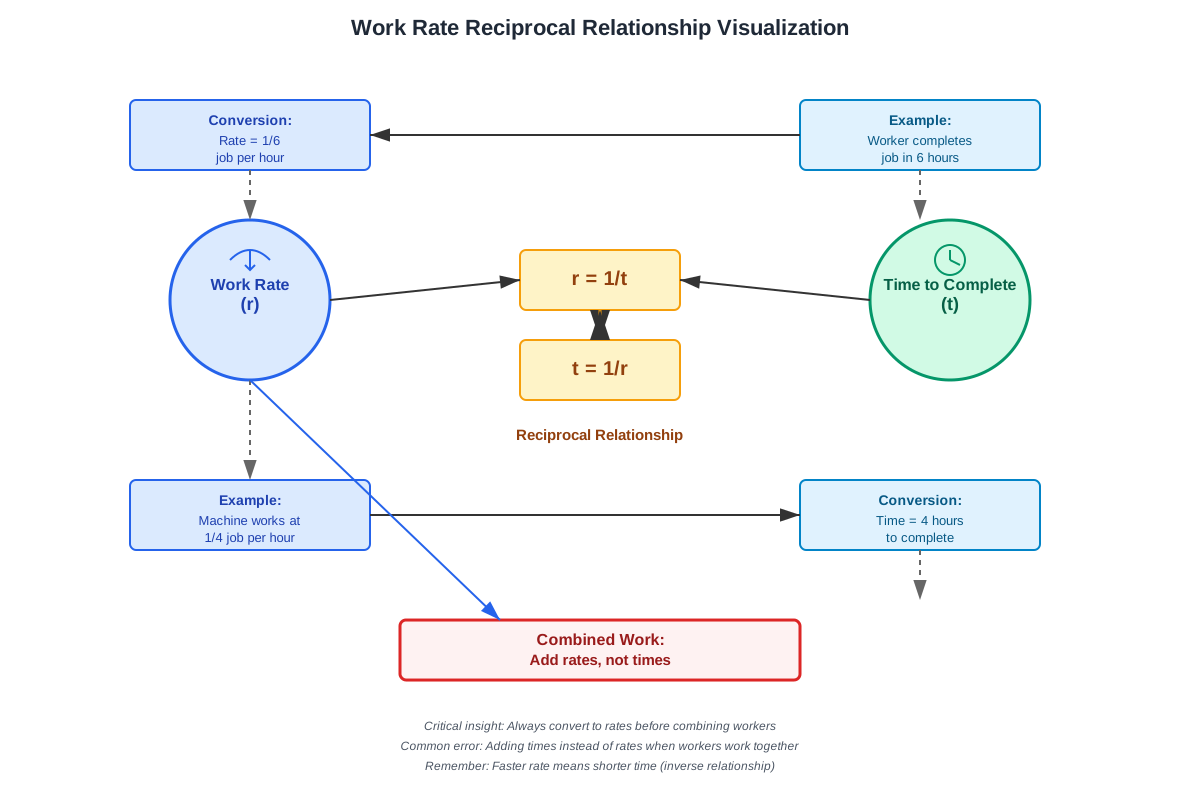
Critical distinction: This addition rule applies to rates (work per time), not to times. If Person A completes a job in 3 hours and Person B completes it in 6 hours, their combined time is NOT 9 hours.
Rate as a Fraction of Work
A powerful GRE strategy involves expressing rates as fractions of the total job:
If a task takes T hours to complete, the rate is 1/T of the job per hour.
Example: If Machine X completes a job in 5 hours, its rate is 1/5 of the job per hour. If Machine Y completes the same job in 3 hours, its rate is 1/3 of the job per hour. Working together, their combined rate is 1/5 + 1/3 = 8/15 of the job per hour, meaning they complete the job in 15/8 hours (1 hour 52.5 minutes).
Inverse Relationships
When one variable is held constant, rate and time have an inverse relationship:
- If rate increases, time decreases proportionally
- If rate decreases, time increases proportionally
- Rate × Time = Constant (when quantity is fixed)
This relationship is crucial for Quantitative Comparison questions where the GRE asks students to compare scenarios with different rates.
Average Rate vs. Average of Rates
A common GRE trap involves distinguishing between average rate and the average of individual rates:
Average Rate = Total Quantity ÷ Total Time
This differs from simply averaging the individual rates. For example, if someone drives 60 mph for 1 hour and 40 mph for 1 hour, the average rate is (60 + 40) ÷ 2 = 50 mph. However, if they drive 60 mph for 1 hour and 40 mph for 3 hours, the average rate is (60 + 120) ÷ (1 + 3) = 45 mph, not 50 mph.
Relative Rates
When two objects move in relation to each other:
- Same direction: Relative rate = |Rate₁ - Rate₂|
- Opposite directions: Relative rate = Rate₁ + Rate₂
These principles apply to problems involving trains passing each other, runners on a track, or objects approaching or separating.
Concept Relationships
Unit rates serve as the foundation connecting multiple arithmetic and algebraic concepts. The relationship flow proceeds as follows:
Basic Ratios → Unit Rates → Proportional Relationships → Linear Functions
Within unit rate problems themselves, concepts interconnect hierarchically:
Simple Unit Rate Calculation → Rate Conversions → Combined Rates → Complex Multi-Step Rate Problems
The inverse relationship between rate and time (when quantity is constant) connects to the broader mathematical concept of inverse variation. Understanding this relationship enables students to solve problems involving changing conditions without recalculating from scratch.
Combined rate problems build upon the additive property of rates, which itself derives from the distributive property of multiplication. When Worker A and Worker B work together, the total work equals (Rate_A × Time) + (Rate_B × Time) = (Rate_A + Rate_B) × Time.
Rate problems also connect backward to prerequisite topics: ratio and proportion provide the conceptual framework, while algebraic manipulation enables equation solving. Forward connections include work problems, mixture problems, and optimization scenarios that appear in higher-difficulty GRE questions.
Quick check — test yourself on Unit rates so far.
Try Flashcards →High-Yield Facts
⭐ Unit rate always expresses quantity per ONE unit of another measure (e.g., 50 miles per 1 hour, not 100 miles per 2 hours)
⭐ Combined rate equals the sum of individual rates when entities work independently: Rate_total = Rate₁ + Rate₂
⭐ Average rate equals total distance divided by total time, NOT the average of individual rates
⭐ When distance is constant, rate and time are inversely proportional: If rate doubles, time halves
⭐ Rate expressed as fraction of work: If a job takes T hours, the rate is 1/T per hour
- Converting between rate expressions requires multiplying by conversion factors that equal 1
- Relative rate when moving in opposite directions equals the sum of individual rates
- Relative rate when moving in the same direction equals the difference of individual rates
- The reciprocal of "hours per unit" gives "units per hour"
- In work problems, the total work can be normalized to 1 (representing 100% of the job)
- Rate problems often require setting up equations where Rate × Time = Work or Distance
- When rates change during a problem, calculate work or distance for each segment separately, then sum
Common Misconceptions
Misconception: Combined time equals the sum of individual times → Correction: If Person A takes 3 hours and Person B takes 6 hours to complete a job individually, working together they do NOT take 9 hours. Instead, calculate combined rate (1/3 + 1/6 = 1/2 per hour), then find time (2 hours).
Misconception: Average rate equals the average of individual rates → Correction: Average rate must be calculated as total distance divided by total time. If you drive 60 mph for 2 hours and 40 mph for 2 hours, average rate is 200 miles ÷ 4 hours = 50 mph, which happens to equal (60+40)/2, but this is coincidental because times are equal. With unequal times, the calculation differs.
Misconception: Doubling rate doubles the work completed in a given time → Correction: This is actually TRUE, but students often confuse this with the false belief that doubling rate doubles the time required (it actually halves the time).
Misconception: Unit rates must use standard units like mph or dollars per item → Correction: Any ratio can be expressed as a unit rate by dividing to get a denominator of 1. "3 apples per 2 dollars" becomes "1.5 apples per dollar" or "0.67 dollars per apple."
Misconception: In relative motion problems, objects always move at their combined rates → Correction: Combined rates apply only when objects move toward each other (opposite directions). When moving in the same direction, use the difference of rates.
Misconception: Rate problems always involve motion or distance → Correction: The GRE tests rates in diverse contexts including work completion, cost per unit, production rates, water flow rates, and data processing speeds.
Worked Examples
Example 1: Combined Work Rate Problem
Problem: Machine A can complete a job in 6 hours. Machine B can complete the same job in 4 hours. If both machines work together, how long will it take them to complete the job?
Solution:
Step 1: Express each machine's rate as a fraction of the job per hour
- Machine A's rate: 1/6 of the job per hour
- Machine B's rate: 1/4 of the job per hour
Step 2: Calculate the combined rate
- Combined rate = 1/6 + 1/4
- Find common denominator: 1/6 + 1/4 = 2/12 + 3/12 = 5/12 of the job per hour
Step 3: Calculate time using the relationship Time = Work ÷ Rate
- Time = 1 job ÷ (5/12 job per hour)
- Time = 1 × 12/5 = 12/5 = 2.4 hours = 2 hours 24 minutes
Connection to Learning Objectives: This problem demonstrates identifying unit rate testing (work completion scenario), applying the core strategy (expressing rates as fractions of work), and accurately solving a GRE-style question.
Example 2: Average Rate with Varying Speeds
Problem: A cyclist travels 30 miles at 15 mph, then travels 20 miles at 10 mph. What is the cyclist's average speed for the entire trip?
Solution:
Step 1: Calculate time for each segment using Time = Distance ÷ Rate
- First segment: 30 miles ÷ 15 mph = 2 hours
- Second segment: 20 miles ÷ 10 mph = 2 hours
Step 2: Calculate total distance and total time
- Total distance: 30 + 20 = 50 miles
- Total time: 2 + 2 = 4 hours
Step 3: Calculate average rate using Average Rate = Total Distance ÷ Total Time
- Average rate = 50 miles ÷ 4 hours = 12.5 mph
Common Trap: Students might average the speeds (15 + 10)/2 = 12.5 mph. This happens to give the correct answer here because the times are equal, but this method fails when times differ.
Alternative scenario: If the cyclist traveled 30 miles at 15 mph (2 hours) and 30 miles at 10 mph (3 hours):
- Average rate = 60 miles ÷ 5 hours = 12 mph
- Averaging speeds would give (15 + 10)/2 = 12.5 mph (incorrect)
Connection to Learning Objectives: This example shows how to recognize average rate testing, apply the correct formula (not the intuitive but wrong approach), and avoid a common misconception.
Exam Strategy
Recognition Triggers
Watch for these phrases that signal unit rate problems:
- "per hour," "per minute," "per item," "per gallon"
- "working together," "combined," "simultaneously"
- "average speed," "average rate"
- "how long will it take"
- "at what rate," "at what speed"
- "completes the job in X hours"
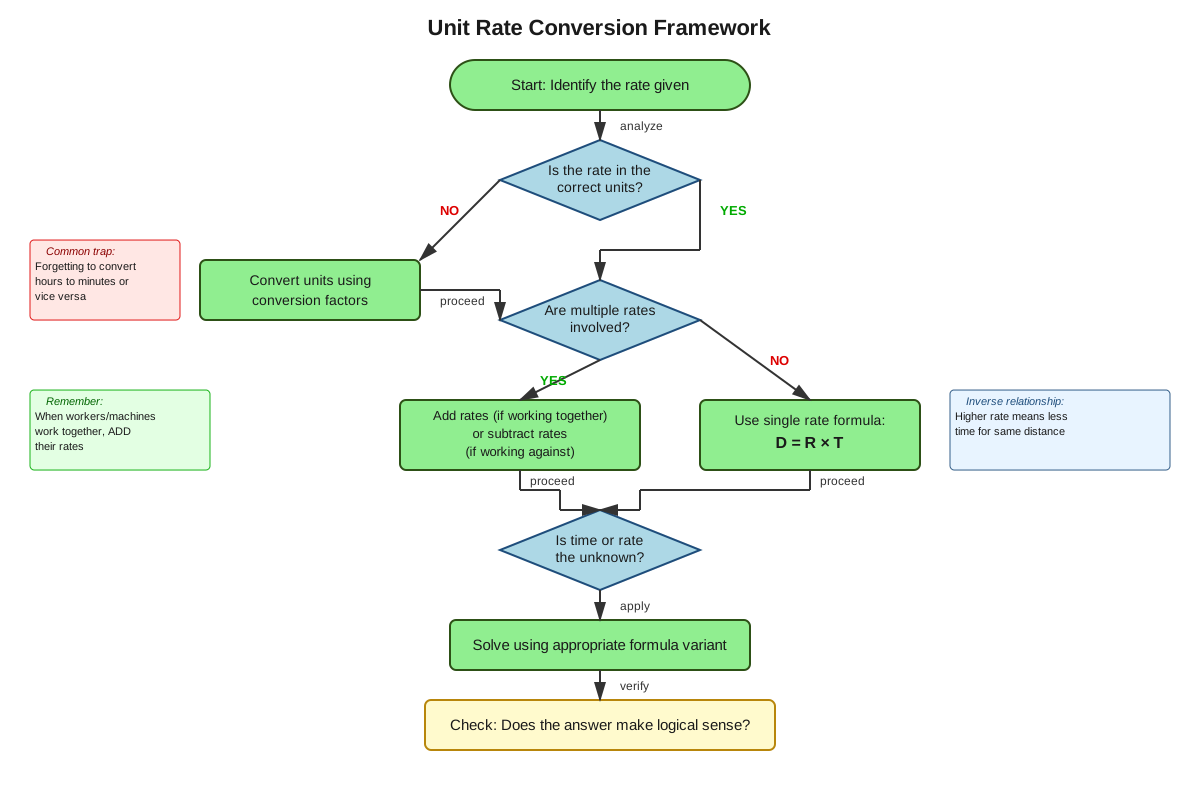
Systematic Approach
- Identify what's being measured: Distance, work, cost, volume, etc.
- Extract the rates: Convert all given information into rate form (quantity per unit time)
- Determine what's being asked: Time, rate, or total quantity
- Set up the equation: Use the appropriate formula (D=RT, W=RT, etc.)
- Solve algebraically: Isolate the unknown variable
- Check units: Ensure your answer has the correct units
Quantitative Comparison Strategy
For QC questions involving rates:
- If comparing times with different rates, remember the inverse relationship
- If comparing work completed, calculate Rate × Time for each quantity
- Look for proportional relationships that allow comparison without full calculation
- Consider extreme cases to test relationships
Time Management
- Simple unit rate calculations: 30-45 seconds
- Combined rate problems: 60-90 seconds
- Complex multi-step rate problems: 90-120 seconds
- If a problem requires more than 2 minutes, mark it and return later
Process of Elimination
- Eliminate answers with incorrect units
- Eliminate answers that violate logical constraints (e.g., combined time greater than individual times)
- Check if the answer makes intuitive sense (e.g., higher rate should mean less time)
- For average rate problems, the answer must lie between the minimum and maximum individual rates (when considering equal time intervals)
Memory Techniques
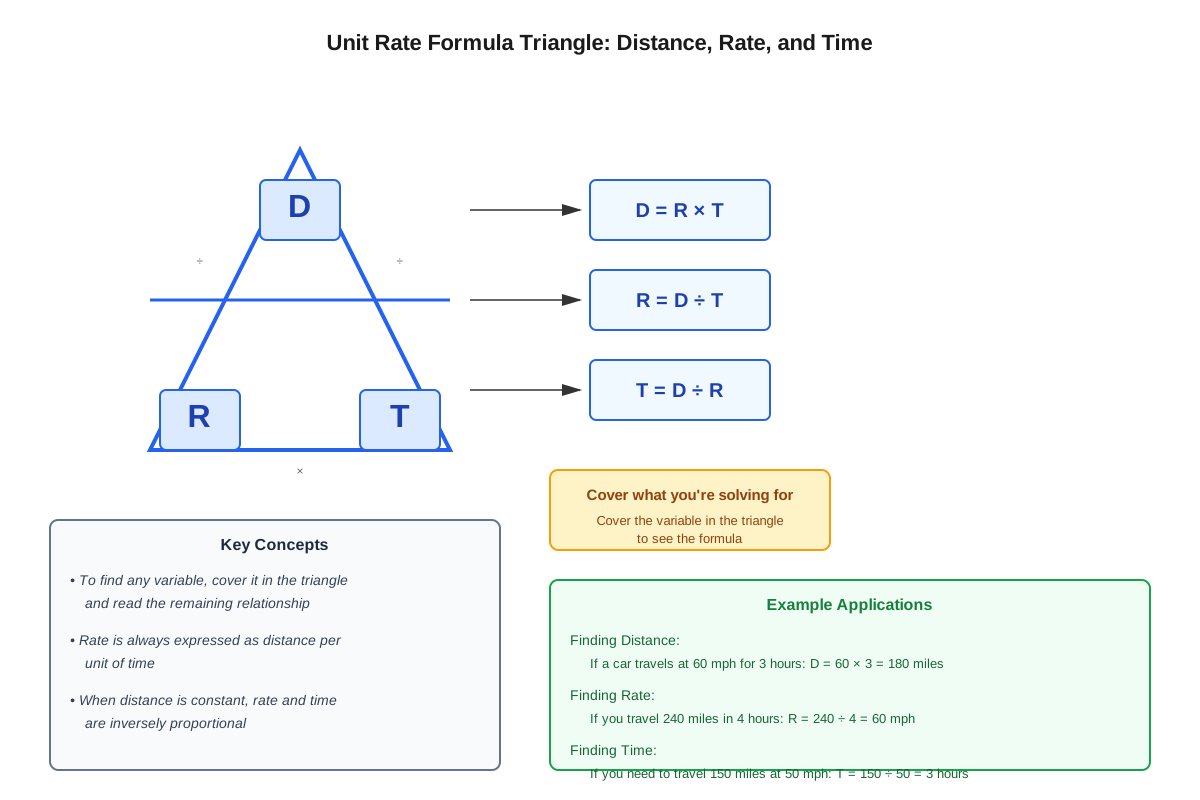
The "DRT Triangle" Mnemonic
Visualize a triangle with D at the top, R and T at the bottom corners:
- Cover D: R × T
- Cover R: D ÷ T
- Cover T: D ÷ R
This works for Distance-Rate-Time and Work-Rate-Time problems.
"RATS" for Rate Problem Steps
Recognize the rate scenario
Assign variables and rates
Translate into equations
Solve and check units
Combined Rate Visualization
Think of rates as "faucets filling a pool." Each faucet (worker/machine) contributes its flow rate. The total flow is the sum of all faucets. This visualization helps remember that combined rates add.
Reciprocal Reminder: "Flip for Rate"
When given "hours per job," flip it to get "jobs per hour" (the rate). Remember: "Time to complete → Flip → Rate of work"
Average Rate Acronym: "TDT"
Total Distance divided by Total Time (not average of rates)
Summary
Unit rates represent quantities expressed per single unit of another measure and constitute a high-yield GRE topic appearing in approximately 15-20% of Quantitative Reasoning questions. The fundamental relationship Rate = Quantity ÷ Time can be rearranged to solve for any variable, and this relationship applies across contexts including distance, work, and cost problems. Combined rates equal the sum of individual rates when entities work independently, and this principle enables solving problems involving multiple workers or machines. A critical distinction exists between average rate (total quantity divided by total time) and the average of individual rates, which are equal only under specific conditions. Rate and time maintain an inverse relationship when quantity remains constant, meaning doubling the rate halves the time required. Success on GRE rate problems requires recognizing problem types through trigger phrases, systematically converting information into rate expressions, setting up appropriate equations, and avoiding common misconceptions about averaging and combining rates. Students who master unit rate concepts gain efficient problem-solving frameworks applicable across diverse question formats and difficulty levels.
Key Takeaways
- Unit rates express quantity per ONE unit of measure, enabling direct comparisons between scenarios
- The formula Rate = Quantity ÷ Time (and its rearrangements) solves most rate problems systematically
- Combined rates add when entities work independently: Rate_total = Rate₁ + Rate₂
- Average rate equals total distance (or work) divided by total time, NOT the average of individual rates
- Rate and time are inversely proportional when quantity is constant: doubling rate halves time
- Express work rates as fractions (1/T per hour if job takes T hours) to simplify combined work problems
- Always check that your final answer has appropriate units and makes logical sense
Related Topics
Ratio and Proportion: Unit rates are specialized ratios; deeper understanding of proportional relationships enhances rate problem-solving and enables recognition of equivalent rate expressions.
Work Problems: Advanced applications of combined rates where multiple entities complete tasks with varying efficiencies, often incorporating concepts of partial work and changing conditions.
Distance and Motion Problems: Specialized rate applications involving relative motion, average speeds, and round-trip scenarios that build on fundamental rate concepts.
Mixture Problems: Problems involving combining substances at different concentrations use rate-like reasoning about quantities per unit volume.
Algebraic Word Problems: Rate problems provide practice in translating verbal descriptions into mathematical equations, a skill that transfers to all word problem types.
Practice CTA
Now that you've mastered the core concepts, strategies, and common traps in unit rate problems, it's time to solidify your understanding through active practice. Attempt the practice questions designed specifically for this topic, focusing on applying the systematic approaches outlined in this guide. Use the flashcards to reinforce high-yield facts and formulas until they become automatic. Remember: rate problems are among the most predictable on the GRE—consistent practice with these question types translates directly into points on test day. Challenge yourself with increasingly complex scenarios, and track which problem types require more review. Your investment in mastering unit rates will pay dividends across multiple questions on your actual exam!
Sign up free to keep reading
Create a free AnvayaPrep account to finish this GRE guide on Unit rates — plus flashcards and practice questions.