Overview
The complement rule is one of the most powerful and elegant tools in probability theory, and it appears frequently on the GRE Quantitative Reasoning section. At its core, the complement rule provides a shortcut for calculating probabilities by focusing on what doesn't happen rather than what does happen. Instead of directly computing the probability of a complex event, the complement rule allows test-takers to calculate the probability of the opposite event and subtract from 1. This approach often transforms difficult, multi-step probability problems into straightforward calculations.
Understanding and applying the GRE complement rule is essential because probability questions consistently appear on the exam, and many of these questions are specifically designed to be tedious or error-prone when solved directly. The test-makers deliberately construct scenarios where calculating all the ways something can happen involves numerous cases, but calculating the ways it cannot happen requires just one or two simple calculations. Students who recognize these situations and apply the complement rule gain both accuracy and speed—two critical advantages under timed testing conditions.
Within the broader landscape of Quantitative Reasoning, the complement rule sits at the intersection of probability theory, set theory, and logical reasoning. It connects to fundamental concepts like sample spaces, mutually exclusive events, and the addition rule for probabilities. Mastering this topic strengthens overall mathematical reasoning and provides a foundation for more advanced data analysis questions involving conditional probability, independent events, and combinatorial probability problems that frequently appear on the GRE.
Learning Objectives
- [ ] Identify when Complement rule is being tested
- [ ] Explain the core rule or strategy behind Complement rule
- [ ] Apply Complement rule to GRE-style questions accurately
- [ ] Determine when using the complement rule is more efficient than direct calculation
- [ ] Convert between complement notation and standard probability notation
- [ ] Recognize trigger phrases that signal complement rule applications
- [ ] Solve multi-step probability problems by strategically choosing between direct and complement approaches
Prerequisites
- Basic probability concepts: Understanding that probabilities range from 0 to 1 and represent the likelihood of events is fundamental to applying the complement rule
- Fraction and decimal operations: The complement rule requires subtracting probabilities from 1, necessitating comfort with these arithmetic operations
- Set theory basics: Recognizing that events and their complements partition the sample space helps visualize why the rule works
- Counting principles: Many complement rule problems require counting favorable and total outcomes to establish initial probabilities
Why This Topic Matters
The complement rule has profound practical applications beyond standardized testing. In fields ranging from quality control (calculating defect rates) to medicine (determining the probability a patient doesn't have a condition), to computer science (error detection), professionals regularly use complement thinking to simplify complex probability calculations. Insurance actuaries, data scientists, and risk analysts employ this principle daily to make critical decisions involving uncertainty.
On the GRE specifically, probability questions appear in approximately 10-15% of Quantitative Reasoning sections, and roughly 30-40% of these probability questions are most efficiently solved using the complement rule. These questions typically appear as both Quantitative Comparison and Problem Solving formats. The GRE test-makers favor complement rule questions because they effectively distinguish between students who mechanically apply formulas and those who think strategically about problem-solving approaches.
Common GRE manifestations include: "What is the probability that at least one..." scenarios (where calculating "none" is simpler), "What is the probability that not all..." questions (where calculating "all" is straightforward), and problems involving multiple independent trials where success in any trial matters. The complement rule also appears embedded within more complex data interpretation questions where students must analyze charts or tables to extract probability information before applying the rule.
Core Concepts
The Fundamental Complement Rule
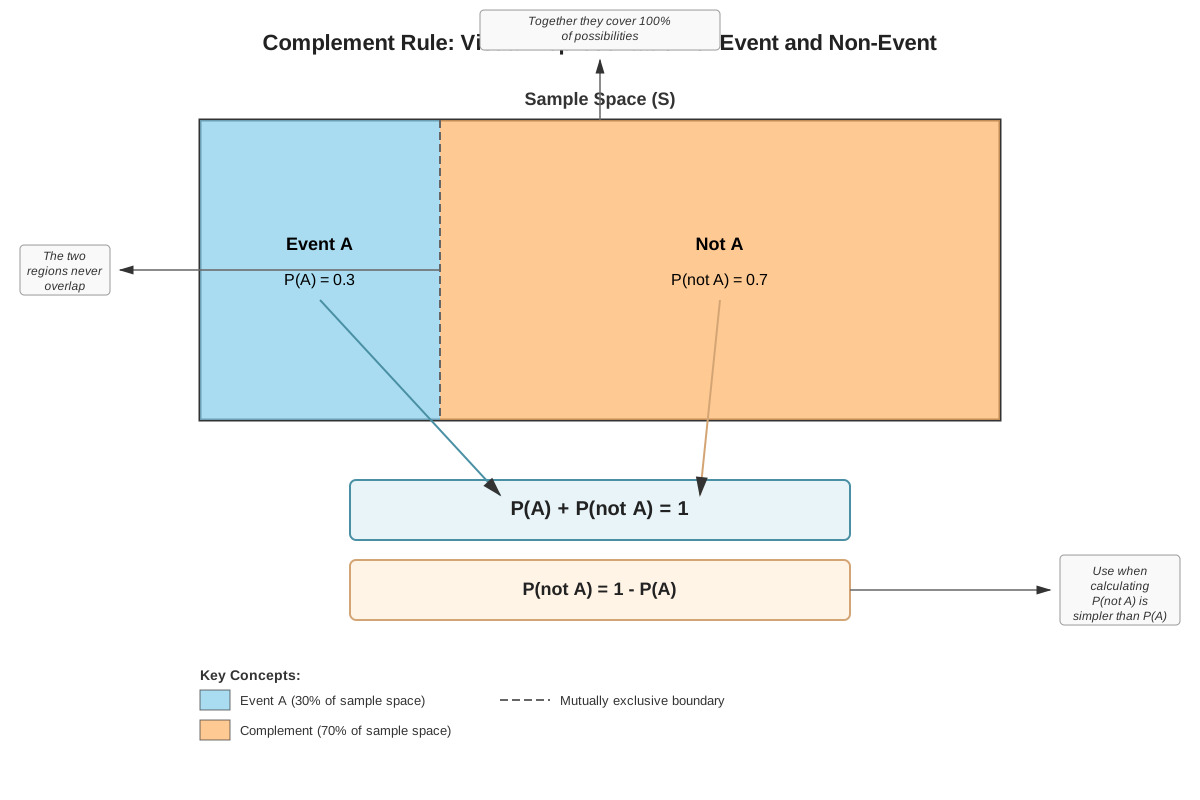
The complement rule states that the probability of an event occurring plus the probability of that event not occurring equals 1. Mathematically expressed:
P(A) + P(A') = 1or equivalently:
P(A) = 1 - P(A')where A represents any event and A' (read as "A complement" or "not A") represents the complement of that event—everything in the sample space that is not A.
This relationship exists because every outcome in a sample space must either be in event A or not in event A; there are no other possibilities. These two events are mutually exclusive (they cannot both occur) and exhaustive (together they account for all possibilities). Since the probability of the entire sample space equals 1, and A and A' partition this space, their probabilities must sum to 1.
When to Apply the Complement Rule
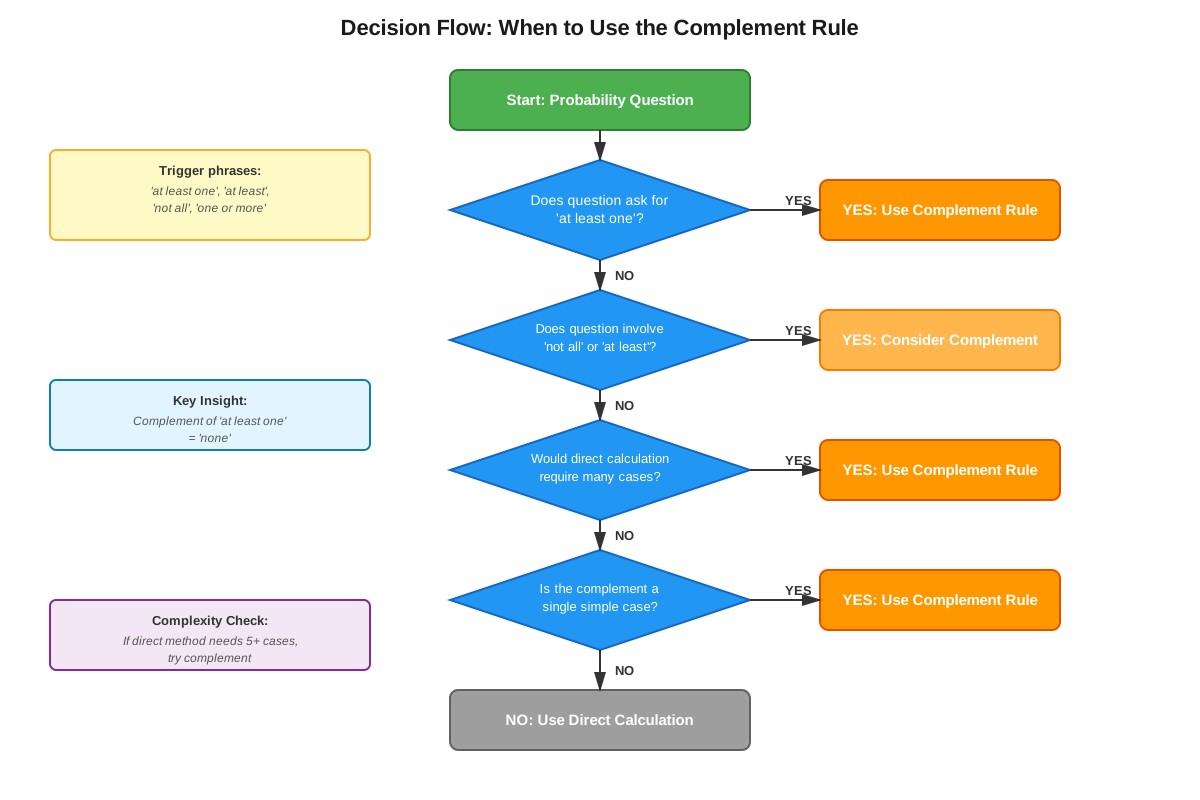
The strategic power of the complement rule emerges when calculating P(A') is significantly simpler than calculating P(A) directly. Several scenarios signal that the complement approach will be more efficient:
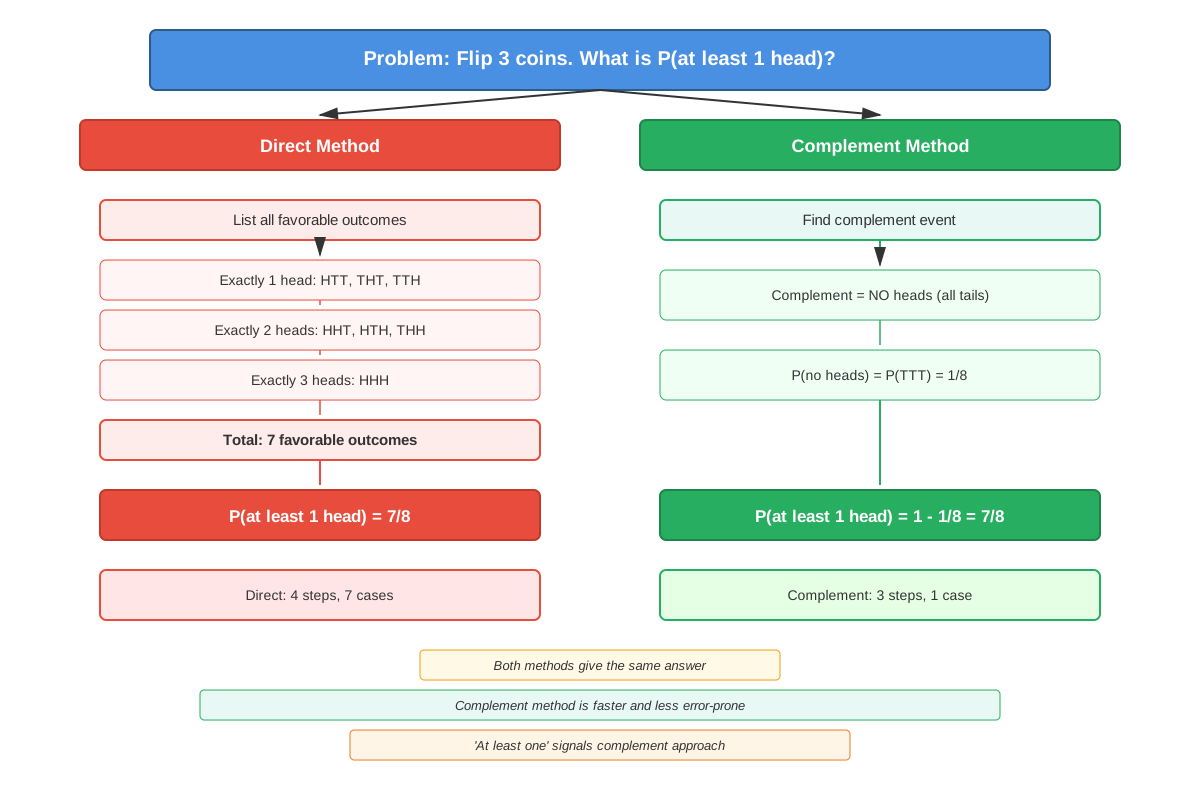
"At least one" problems: When asked for the probability that at least one event occurs among multiple trials, the complement (none occur) typically involves a single calculation rather than summing multiple cases (exactly one, exactly two, exactly three, etc.).
"Not all" problems: When determining the probability that not all items share a property, calculating the complement (all items share the property) is usually straightforward.
Complex "or" statements: When an event can occur in many different ways, but its complement occurs in few ways, the complement rule simplifies the calculation dramatically.
Multiple independent events: When dealing with several independent events where you need at least one success, calculating the probability of all failures and subtracting from 1 is typically faster.
Notation and Terminology
Different sources use various notations for complements, and GRE questions may employ any of these:
| Notation | Meaning | Example |
|---|---|---|
| A' | Complement of A | P(A') = probability A does not occur |
| Ā | Complement of A | P(Ā) = probability A does not occur |
| A^c | Complement of A | P(A^c) = probability A does not occur |
| "not A" | Complement of A | P(not A) = probability A does not occur |
The GRE most commonly uses plain language ("not," "does not," "fails to") rather than mathematical notation, though understanding all forms ensures complete preparedness.
Calculating Complements in Practice
The practical application follows a consistent three-step process:
- Identify the complement event: Clearly define what "not happening" means in the context of the problem
- Calculate the complement probability: Determine P(A') using direct methods, counting, or given information
- Subtract from 1: Compute P(A) = 1 - P(A')
For example, if the probability of rain on any given day is 0.3, the probability of no rain is 1 - 0.3 = 0.7. This simple case illustrates the principle, but the rule's true value appears in more complex scenarios.
Complement Rule with Independent Events
When dealing with multiple independent events, the complement rule becomes especially powerful. If you need the probability that at least one of several independent events occurs, calculate the probability that none occur and subtract from 1:
P(at least one occurs) = 1 - P(none occur) = 1 - P(A₁')×P(A₂')×...×P(Aₙ')This formula works because when events are independent, the probability of multiple events all occurring (or all not occurring) equals the product of their individual probabilities. This multiplication principle combined with the complement rule transforms potentially complex problems into manageable calculations.
Complement Rule with Dependent Events
The complement rule itself (P(A) = 1 - P(A')) remains valid regardless of whether events are independent or dependent. However, calculating P(A') for dependent events requires different techniques than for independent events. With dependent events, you cannot simply multiply individual probabilities; instead, you must use conditional probability or carefully count outcomes while respecting the dependencies.
The strategic advantage of the complement rule persists even with dependent events, as long as the complement event is simpler to calculate than the original event.
Concept Relationships
The complement rule serves as a bridge between several fundamental probability concepts. It directly relies on the axiom that total probability equals 1, which itself stems from the definition of probability as a measure of certainty. This connection flows as: Sample Space → Total Probability = 1 → Complement Rule.
The rule also connects intimately with set theory operations. The complement of an event A corresponds to the set of all outcomes not in A. This relationship extends to more complex set operations: the complement of (A or B) equals (not A) and (not B), known as De Morgan's Law, which occasionally appears in advanced GRE probability questions.
When combined with the multiplication principle for independent events, the complement rule enables efficient solutions to "at least one" problems: Independent Events → Multiplication Rule → Complement Rule → "At Least One" Solutions. This chain represents one of the most high-yield problem-solving sequences on the GRE.
The complement rule also relates to mutually exclusive events and the addition rule. Since an event and its complement are mutually exclusive, P(A or A') = P(A) + P(A') = 1, which is simply another way of expressing the complement rule. This connection helps students understand why the probabilities must sum to 1.
Finally, the complement rule provides a foundation for understanding conditional probability and Bayes' theorem, though these advanced topics appear less frequently on the GRE. The principle that probabilities must account for all possibilities underlies these more sophisticated probability concepts.
High-Yield Facts
- ⭐ The complement rule states: P(A) + P(A') = 1, or equivalently, P(A) = 1 - P(A')
- ⭐ Use the complement rule when calculating "at least one" in multiple independent trials
- ⭐ The probability of an event and its complement always sum to exactly 1
- ⭐ "At least one" problems are almost always faster to solve using the complement (calculate "none")
- ⭐ The complement of "all" is "not all" (at least one different)
- An event and its complement are mutually exclusive (cannot both occur)
- An event and its complement are exhaustive (one must occur)
- The complement rule applies to all probability problems, regardless of independence
- For independent events: P(none occur) = P(A₁') × P(A₂') × ... × P(Aₙ')
- The complement of "exactly k" is "not exactly k" (which may require multiple calculations)
- Complement probabilities must be between 0 and 1, providing a check for calculation errors
- The complement rule can be applied iteratively in multi-stage problems
- "Not all" means at least one is different; "none" means all are different from the specified outcome
Quick check — test yourself on Complement rule so far.
Try Flashcards →Common Misconceptions
Misconception: The complement rule only applies to independent events. → Correction: The complement rule P(A) = 1 - P(A') is universally valid for any event A, regardless of independence. Independence only affects how you calculate P(A') when multiple events are involved, not whether the complement rule itself applies.
Misconception: The complement of "at least 2" is "at most 1." → Correction: The complement of "at least 2" is "fewer than 2," which means "0 or 1." While this might seem like "at most 1," students must be careful with boundary cases. The complement of "at least k" is "fewer than k" or "at most k-1."
Misconception: You should always use the complement rule for probability problems. → Correction: The complement rule is a strategic tool, not a universal requirement. Use it when calculating the complement is simpler than direct calculation. For straightforward single-event probabilities, direct calculation is often faster and less error-prone.
Misconception: P(A') means the probability of the opposite outcome. → Correction: P(A') means the probability of any outcome that is not A. For events with more than two possible outcomes, the complement includes all other outcomes, not just one "opposite." For example, if A is "rolling a 6 on a die," A' includes rolling 1, 2, 3, 4, or 5.
Misconception: The complement of "at least one success" is "at least one failure." → Correction: The complement of "at least one success" is "no successes" (all failures). This is a critical distinction that frequently appears on the GRE. "At least one failure" would be the complement of "all successes."
Misconception: When using the complement rule with multiple events, you add the complement probabilities. → Correction: For independent events where you want none to occur, you multiply the individual complement probabilities: P(none) = P(A₁') × P(A₂') × ... × P(Aₙ'). Addition is used for mutually exclusive events in "or" scenarios, not for calculating "none occur" in independent trials.
Worked Examples
Example 1: At Least One Success
Problem: A quality control inspector tests 3 independent components. Each component has a 0.95 probability of passing inspection. What is the probability that at least one component passes?
Solution:
Step 1: Recognize the complement opportunity
The phrase "at least one" signals that the complement rule will be efficient. Calculating "at least one passes" directly would require: P(exactly 1 passes) + P(exactly 2 pass) + P(all 3 pass), which involves multiple calculations.
Step 2: Define the complement
The complement of "at least one passes" is "none pass" or "all fail."
Step 3: Calculate the probability each component fails
If P(pass) = 0.95, then P(fail) = 1 - 0.95 = 0.05
Step 4: Calculate the probability all fail
Since the components are independent:
P(all fail) = P(fail) × P(fail) × P(fail) = 0.05 × 0.05 × 0.05 = 0.000125
Step 5: Apply the complement rule
P(at least one passes) = 1 - P(none pass) = 1 - 0.000125 = 0.999875
Answer: 0.999875 or approximately 0.9999
This example demonstrates the learning objective of applying the complement rule to GRE-style questions accurately. Notice how the complement approach required just one multiplication versus three separate binomial probability calculations for the direct method.
Example 2: Not All the Same
Problem: A bag contains 5 red marbles and 5 blue marbles. If 3 marbles are drawn randomly with replacement, what is the probability that not all three marbles are the same color?
Solution:
Step 1: Identify the complement structure
"Not all the same color" means the three marbles include at least one different color. The complement is "all the same color," which means either all red or all blue.
Step 2: Calculate probability of drawing red
P(red) = 5/10 = 1/2
Step 3: Calculate probability of drawing blue
P(blue) = 5/10 = 1/2
Step 4: Calculate probability all three are red
Since draws are with replacement (independent):
P(all red) = (1/2) × (1/2) × (1/2) = 1/8
Step 5: Calculate probability all three are blue
P(all blue) = (1/2) × (1/2) × (1/2) = 1/8
Step 6: Calculate probability all same color
These are mutually exclusive events (cannot both happen):
P(all same) = P(all red) + P(all blue) = 1/8 + 1/8 = 2/8 = 1/4
Step 7: Apply complement rule
P(not all same) = 1 - P(all same) = 1 - 1/4 = 3/4
Answer: 3/4 or 0.75
This example illustrates identifying when the complement rule is being tested (learning objective 1) and demonstrates the strategy of breaking down "all same" into mutually exclusive cases before applying the complement rule. The direct approach would require calculating P(2 red, 1 blue) + P(1 red, 2 blue), which involves binomial coefficients and is more complex.
Exam Strategy
Key Strategy: Before solving any probability problem, ask yourself: "Is the complement simpler?" This single question can save minutes on the GRE.
Trigger words and phrases that signal complement rule opportunities:
- "At least one"
- "At least once"
- "One or more"
- "Not all"
- "Not every"
- "Some" (in certain contexts)
- "Fails to" (when referring to all failing)
Process-of-elimination approach: When facing answer choices, quickly calculate the complement probability and subtract from 1. If your result matches an answer choice, you've likely found the correct answer. If it doesn't match, verify your complement identification before recalculating.
Time allocation: Complement rule problems should take 1.5-2 minutes on average. If you find yourself writing out more than 3-4 cases for a probability problem, stop and reconsider whether the complement approach would be simpler. The GRE rewards strategic thinking, not computational endurance.
Common trap: The GRE may present answer choices that include both P(A') and 1 - P(A') to catch students who calculate the complement but forget the final subtraction step. Always complete the complement rule calculation by subtracting from 1.
Verification technique: After calculating a probability using the complement rule, check that your answer is between 0 and 1, and consider whether it makes intuitive sense. For "at least one" problems with high individual probabilities, the answer should be close to 1.
Quantitative Comparison strategy: When comparing probabilities in QC format, sometimes calculating the complement of both quantities and comparing those is easier than direct comparison. Remember that if P(A') > P(B'), then P(A) < P(B).
Memory Techniques
Mnemonic for when to use complement rule: "ALAN" - At Least, All, Not all
- "At least" → use complement (calculate "none")
- "All" → might use complement for "not all"
- "Not all" → use complement (calculate "all")
Visualization strategy: Picture a complete circle representing probability = 1. The event A takes up some portion of the circle, and A' fills the remaining space. Together they complete the circle. This visual reinforces that P(A) + P(A') = 1.
Acronym for the calculation process: "DCS" - Define complement, Calculate complement, Subtract from 1
Memory phrase: "One minus the opposite" - This simple phrase captures the essence of the complement rule and is easy to recall under test pressure.
Finger technique: When reading a problem, physically cover the word "at least" and replace it mentally with "none" to identify the complement. This kinesthetic action reinforces the mental transformation needed.
Summary
The complement rule is a fundamental probability principle stating that P(A) = 1 - P(A'), where A' represents all outcomes that are not A. This rule transforms complex probability problems into simpler calculations by focusing on what doesn't happen rather than what does. The strategic application of the complement rule is essential for GRE success, particularly for "at least one" and "not all" problems where direct calculation involves multiple cases. The rule applies universally to all probability scenarios, though its efficiency advantage is greatest when the complement event is significantly simpler to calculate than the original event. Mastery requires recognizing trigger phrases, correctly identifying complement events, and executing the three-step process: define the complement, calculate its probability, and subtract from 1. The complement rule frequently combines with the multiplication principle for independent events, creating a powerful problem-solving framework for multi-trial probability questions that regularly appear on the GRE Quantitative Reasoning section.
Key Takeaways
- The complement rule P(A) = 1 - P(A') is valid for all probability problems and provides strategic shortcuts when the complement is simpler to calculate
- "At least one" problems almost always benefit from the complement approach: calculate "none occur" and subtract from 1
- An event and its complement are mutually exclusive and exhaustive, which is why their probabilities sum to exactly 1
- For independent events, P(none occur) = P(A₁') × P(A₂') × ... × P(Aₙ'), combining multiplication and complement principles
- Always verify that your final probability is between 0 and 1, and complete the subtraction from 1 to avoid the common trap of reporting P(A') instead of P(A)
- Recognize trigger phrases like "at least," "not all," and "one or more" as signals to consider the complement approach
- The complement of "all" is "not all" (at least one different), while the complement of "at least one" is "none"
Related Topics
Independent Events and Multiplication Rule: Understanding how to calculate probabilities of multiple independent events occurring together is essential for applying the complement rule to "at least one" problems. Mastering the complement rule provides a foundation for more efficient solutions to complex independent event scenarios.
Conditional Probability: The complement rule extends to conditional probabilities with P(A|B) = 1 - P(A'|B). This advanced application appears occasionally on the GRE and builds directly on complement rule mastery.
Combinatorics and Counting: Many complement rule problems require counting favorable outcomes and total outcomes. Strengthening counting skills enhances the ability to calculate complement probabilities accurately.
Binomial Probability: The complement rule provides an alternative to summing multiple binomial probability terms, particularly for "at least k successes" problems. Understanding both approaches allows strategic selection of the most efficient method.
Set Theory and Venn Diagrams: Visualizing events and their complements using set notation and Venn diagrams deepens conceptual understanding and connects probability to other mathematical domains tested on the GRE.
Practice CTA
Now that you've mastered the complement rule conceptually, it's time to cement your understanding through practice. Attempt the practice questions to test your ability to identify complement rule opportunities, execute the three-step solution process, and avoid common traps. The flashcards will help you internalize trigger phrases and key formulas for rapid recall during the actual exam. Remember: strategic problem-solving distinguishes high scorers from average performers on the GRE. The complement rule is one of the most powerful strategic tools in your probability arsenal—practice until recognizing and applying it becomes automatic. Your investment in mastering this high-yield topic will pay dividends across multiple questions on test day.
Sign up free to keep reading
Create a free AnvayaPrep account to finish this GRE guide on Complement rule — plus flashcards and practice questions.