Overview
Percent change in data is a fundamental quantitative concept that appears frequently throughout the GRE Quantitative Reasoning section, particularly within Data Analysis questions. This topic tests a student's ability to calculate, interpret, and compare relative changes in numerical values across various contexts—from business scenarios involving profit margins to scientific data showing population growth. Understanding percent change is not merely about applying a formula; it requires recognizing when values are increasing or decreasing, distinguishing between percentage points and percent change, and interpreting the real-world significance of these calculations.
The GRE consistently tests gre percent change in data through multiple question formats including Quantitative Comparison questions, Multiple Choice questions (both single and multiple answer), and Numeric Entry questions. These problems often embed percent change calculations within data interpretation questions featuring tables, graphs, or charts. The exam writers deliberately create scenarios where students must work backward from a final value to find an original amount, calculate successive percent changes, or compare multiple percent changes across different baseline values—all skills that require deep conceptual understanding rather than rote memorization.
Mastering percent change connects directly to broader Quantitative Reasoning competencies including ratio and proportion reasoning, algebraic manipulation, and data interpretation. This topic serves as a bridge between pure arithmetic operations and real-world analytical thinking, making it one of the highest-yield areas for focused study. Students who develop fluency with percent change calculations gain significant advantages not only in Data Analysis questions but also in Problem Solving questions that incorporate business scenarios, scientific measurements, and statistical comparisons.
Learning Objectives
- [ ] Identify when Percent change in data is being tested
- [ ] Explain the core rule or strategy behind Percent change in data
- [ ] Apply Percent change in data to GRE-style questions accurately
- [ ] Distinguish between percent change and percentage point change in data sets
- [ ] Calculate successive percent changes and determine the net effect
- [ ] Work backward from a final value to determine the original value given a percent change
- [ ] Compare percent changes across different baseline values to identify which represents the larger absolute change
Prerequisites
- Basic percentage calculations: Understanding how to convert between decimals, fractions, and percentages is essential for all percent change calculations
- Algebraic equation solving: Percent change problems often require setting up and solving equations with variables representing unknown original or final values
- Ratio and proportion reasoning: Percent change fundamentally expresses a ratio between the change amount and the original value
- Order of operations: Successive percent changes require careful attention to which operations occur in which sequence
Why This Topic Matters
Percent change appears in virtually every quantitative field, from economics and finance to biology and demographics. Business analysts use percent change to evaluate revenue growth, scientists track population changes in ecosystems, and policymakers assess the impact of interventions through percentage-based metrics. This real-world ubiquity makes percent change a natural choice for GRE test writers seeking to assess practical quantitative reasoning skills.
On the GRE specifically, percent change questions appear in approximately 15-20% of Quantitative Reasoning sections, making this one of the most frequently tested Data Analysis concepts. These questions appear across all difficulty levels, with easier questions testing straightforward calculations and harder questions embedding multiple steps, requiring reverse calculations, or presenting data in complex graphical formats. The topic appears most commonly in Data Interpretation sets (where 2-3 questions share a common graph or table), in standalone Problem Solving questions with real-world scenarios, and in Quantitative Comparison questions that require students to compare percent changes across different contexts.
Common exam presentations include: tables showing values across multiple years requiring percent change calculations between non-consecutive periods; bar graphs or line graphs where students must calculate percent changes from visual data; word problems describing business scenarios with successive discounts or price increases; and questions comparing percent changes across categories with different baseline values. The GRE particularly favors questions that test whether students understand that a 20% increase followed by a 20% decrease does not return to the original value—a conceptual understanding that separates high scorers from average performers.
Core Concepts
The Fundamental Percent Change Formula
The percent change formula represents the foundation of all calculations in this topic:
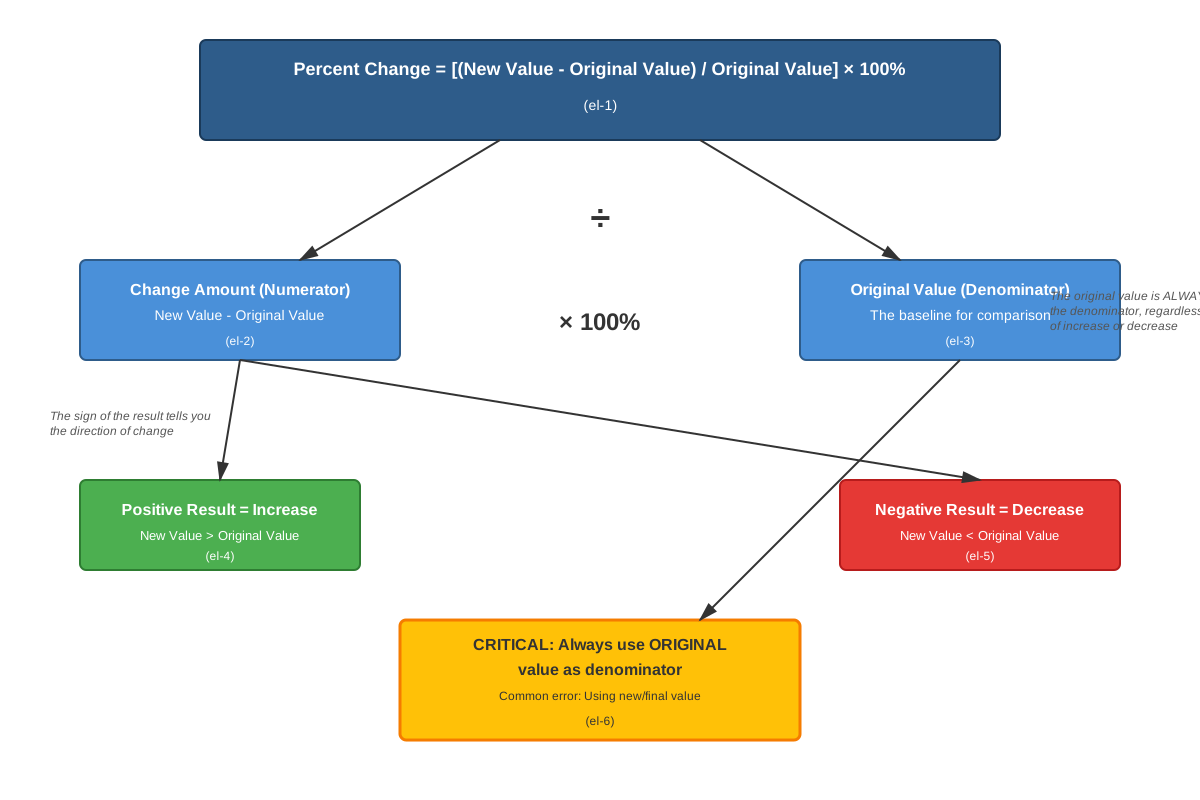
Percent Change = (New Value - Original Value) / Original Value × 100%This formula can also be written as:
Percent Change = (Amount of Change) / (Original Value) × 100%The numerator (New Value - Original Value) represents the absolute change, while dividing by the Original Value converts this absolute change into a relative measure. Multiplying by 100% expresses the result as a percentage rather than a decimal. When the New Value exceeds the Original Value, the percent change is positive (representing an increase). When the New Value is less than the Original Value, the percent change is negative (representing a decrease).
Critical insight: The denominator must always be the original (starting) value, not the new (ending) value. This is the single most common error students make when calculating percent change. The question "What is the percent change FROM A TO B?" always uses A as the denominator.
Percent Increase vs. Percent Decrease
A percent increase occurs when a value grows from its original amount. The calculation follows the standard formula with a positive result:
Percent Increase = (New Value - Original Value) / Original Value × 100%For example, if a stock price rises from $40 to $50:
- Percent Increase = (50 - 40) / 40 × 100% = 10/40 × 100% = 25%
A percent decrease occurs when a value declines from its original amount. While the formula structure remains identical, the result is negative (though often reported as a positive number with the word "decrease"):
Percent Decrease = (Original Value - New Value) / Original Value × 100%For example, if enrollment drops from 500 students to 400 students:
- Percent Decrease = (500 - 400) / 500 × 100% = 100/500 × 100% = 20%
Working Backward: Finding Original Values
Many GRE questions provide the final value after a percent change and ask for the original value. This requires algebraic manipulation of the percent change relationship.
If a value increases by p%, the new value equals:
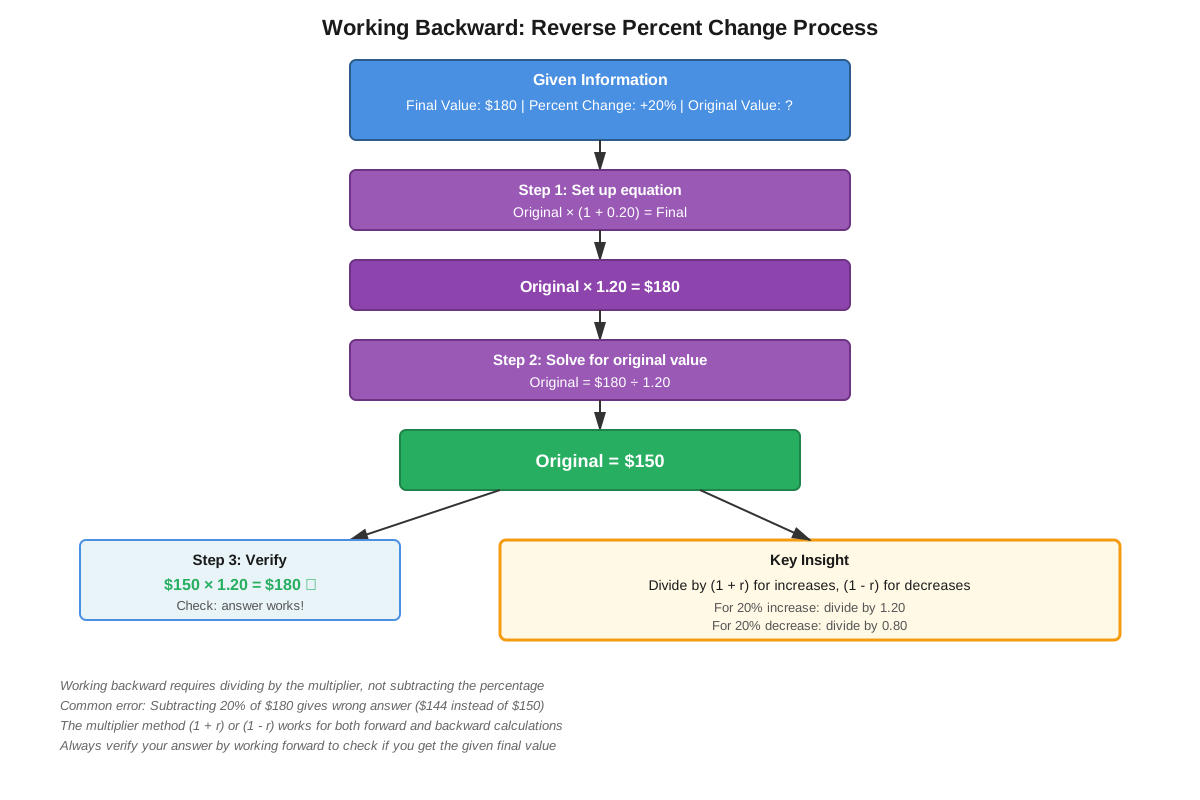
New Value = Original Value × (1 + p/100)If a value decreases by p%, the new value equals:
New Value = Original Value × (1 - p/100)To find the original value, rearrange:
Original Value = New Value / (1 ± p/100)Example: After a 25% increase, a population reaches 1,500. What was the original population?
- 1,500 = Original × (1 + 0.25)
- 1,500 = Original × 1.25
- Original = 1,500 / 1.25 = 1,200
Successive Percent Changes
When multiple percent changes occur in sequence, they compound rather than add. This is a high-yield concept that the GRE tests extensively.
For two successive changes of p% and q%:
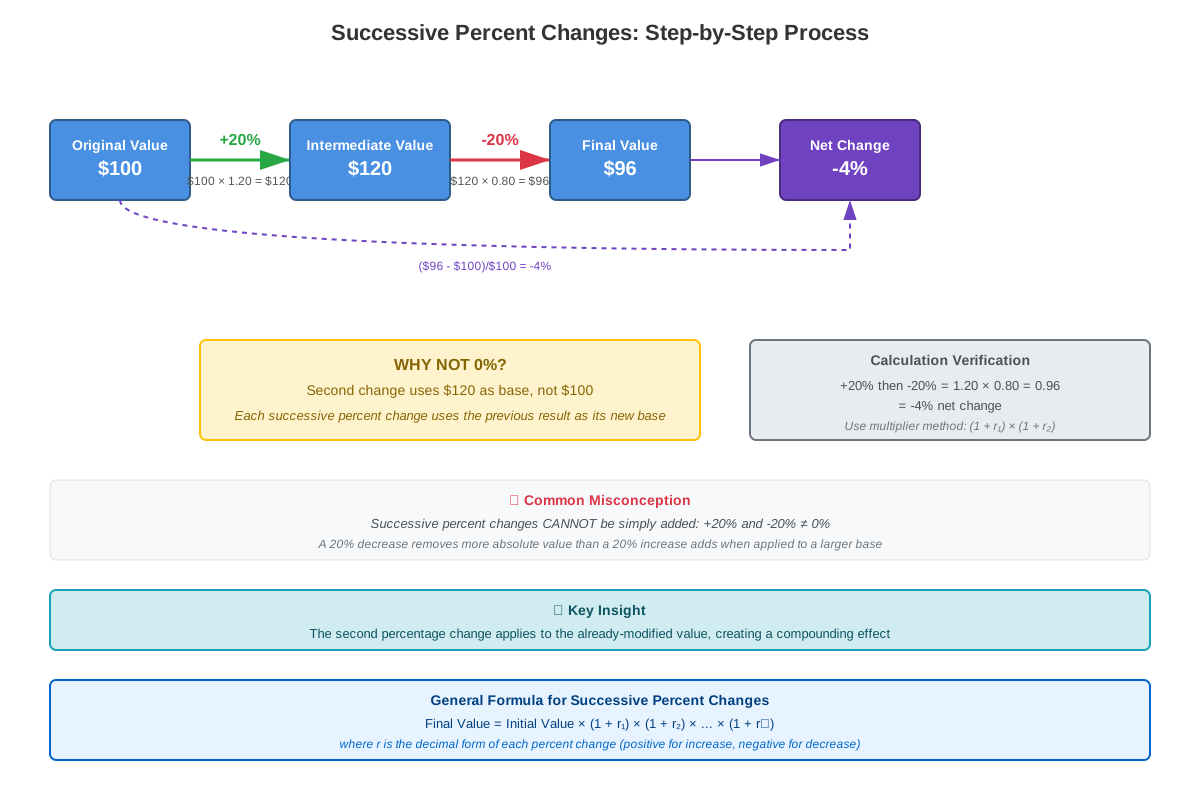
Final Value = Original Value × (1 ± p/100) × (1 ± q/100)The net percent change is NOT simply p + q. Instead, calculate the final multiplier and determine the overall change.
Example: A price increases by 20%, then decreases by 20%.
- Final Value = Original × 1.20 × 0.80 = Original × 0.96
- Net change = -4% (a decrease of 4%)
This demonstrates the critical principle: successive percent changes of equal magnitude but opposite direction do not cancel out. The second change applies to an already-modified base, creating an asymmetric effect.
Percentage Points vs. Percent Change
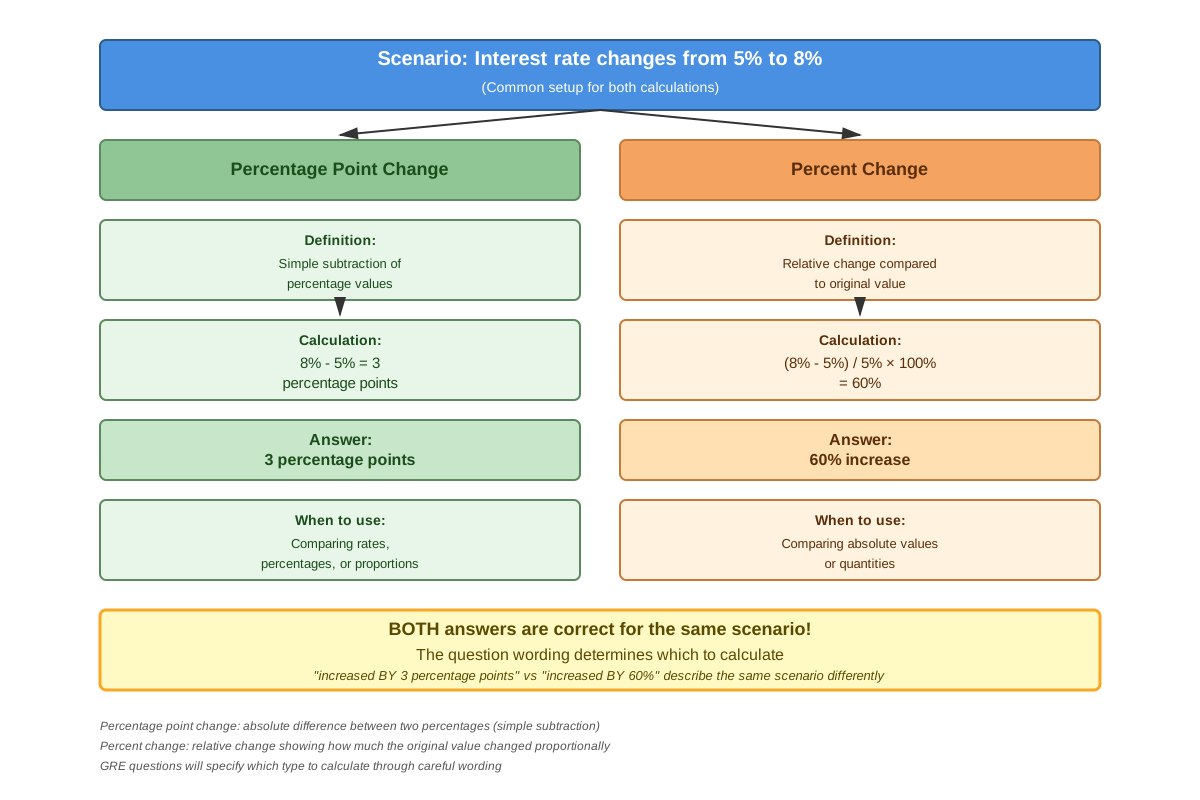
This distinction causes significant confusion and is frequently tested on the GRE. Percentage points measure the absolute difference between two percentages, while percent change measures the relative change.
Example: An interest rate increases from 5% to 8%.
- Change in percentage points = 8% - 5% = 3 percentage points
- Percent change = (8 - 5) / 5 × 100% = 60%
The interest rate increased BY 3 percentage points but increased by 60% (relative to its original value). The GRE often asks questions that require distinguishing these concepts, particularly in questions about interest rates, tax rates, or survey percentages.
Comparing Percent Changes Across Different Baselines
A 10% increase on a base of 100 produces an absolute change of 10, while a 10% increase on a base of 1,000 produces an absolute change of 100. The GRE frequently tests whether students recognize that equal percent changes on different baselines produce different absolute changes.
| Original Value | Percent Change | Absolute Change | Final Value |
|---|---|---|---|
| 100 | +10% | +10 | 110 |
| 1,000 | +10% | +100 | 1,100 |
| 50 | +10% | +5 | 55 |
Conversely, equal absolute changes on different baselines produce different percent changes. An increase of 20 represents a 20% increase from a base of 100 but only a 2% increase from a base of 1,000.
Concept Relationships
The core percent change formula serves as the foundation from which all other concepts derive. Understanding this formula enables calculation of both percent increases and percent decreases, which are simply applications of the same formula with different signs. The ability to manipulate this formula algebraically leads directly to the skill of working backward from final values to original values—a transformation that requires recognizing the multiplicative relationship between original and final values.
Successive percent changes build upon the basic formula by applying it multiple times in sequence, revealing the compounding nature of percentage-based growth or decline. This concept connects to exponential growth patterns and demonstrates why percentage changes cannot be simply added. The distinction between percentage points and percent change emerges from understanding that the percent change formula requires a baseline value in the denominator, while percentage point differences involve simple subtraction without division.
Comparing percent changes across different baselines synthesizes multiple concepts: it requires calculating individual percent changes using the fundamental formula while simultaneously recognizing that the absolute change (numerator) depends on the baseline value (denominator). This relationship map can be visualized as:
Fundamental Formula → enables → Basic Increase/Decrease Calculations → extends to → Working Backward Problems → combines with → Successive Changes → requires distinguishing → Percentage Points vs. Percent Change → applies across → Different Baseline Comparisons
Quick check — test yourself on Percent change in data so far.
Try Flashcards →High-Yield Facts
⭐ The denominator in percent change calculations must always be the original (starting) value, never the final value
⭐ A percent increase of x% followed by a percent decrease of x% does NOT return to the original value
⭐ Percentage point change and percent change are different: percentage points measure absolute differences between percentages, while percent change measures relative change
⭐ To find an original value after a p% increase: Original = Final / (1 + p/100)
⭐ To find an original value after a p% decrease: Original = Final / (1 - p/100)
- Successive percent changes multiply their multipliers: a 10% increase then 20% increase yields 1.10 × 1.20 = 1.32 (32% total increase)
- A 50% decrease followed by a 100% increase returns to the original value (0.50 × 2.00 = 1.00)
- Percent change can exceed 100% when the new value is more than double the original value
- A 100% increase means doubling; a 200% increase means tripling
- When comparing percent changes, the larger percent change does not necessarily represent the larger absolute change unless the baselines are equal
Common Misconceptions
Misconception: Percent change is calculated using the final value as the denominator → Correction: Percent change always uses the original (starting) value as the denominator. Using the final value produces an incorrect result and is one of the most common errors on the GRE.
Misconception: A 20% increase followed by a 20% decrease returns to the original value → Correction: These changes do not cancel. The second change applies to the already-modified value. The result is Original × 1.20 × 0.80 = Original × 0.96, representing a 4% net decrease.
Misconception: Percentage point change and percent change are the same thing → Correction: Percentage point change is the simple arithmetic difference between two percentages (8% - 5% = 3 percentage points), while percent change measures the relative change ((8-5)/5 × 100% = 60% increase).
Misconception: To find the original value after a 25% increase, subtract 25% from the final value → Correction: This approach is incorrect because 25% of the final value differs from 25% of the original value. Instead, divide the final value by 1.25 to find the original.
Misconception: Successive percent changes can be added to find the net change → Correction: Percent changes multiply, not add. A 10% increase followed by a 15% increase yields 1.10 × 1.15 = 1.265 (26.5% total increase), not 25%.
Misconception: A larger percent change always represents a larger absolute change → Correction: The absolute change depends on both the percent change and the baseline value. A 50% increase from 10 (absolute change of 5) is smaller than a 10% increase from 100 (absolute change of 10).
Worked Examples
Example 1: Multi-Step Percent Change with Data Interpretation
Question: A company's revenue was $800,000 in 2018. Revenue increased by 25% in 2019, then decreased by 20% in 2020. What was the company's revenue in 2020, and what was the overall percent change from 2018 to 2020?
Solution:
Step 1: Calculate 2019 revenue after 25% increase
- 2019 Revenue = 2018 Revenue × 1.25
- 2019 Revenue = $800,000 × 1.25 = $1,000,000
Step 2: Calculate 2020 revenue after 20% decrease
- 2020 Revenue = 2019 Revenue × 0.80
- 2020 Revenue = $1,000,000 × 0.80 = $800,000
Step 3: Calculate overall percent change from 2018 to 2020
- Percent Change = (2020 Revenue - 2018 Revenue) / 2018 Revenue × 100%
- Percent Change = ($800,000 - $800,000) / $800,000 × 100% = 0%
Answer: The 2020 revenue was $800,000, representing a 0% overall change from 2018.
Key Insight: This example demonstrates that a 25% increase followed by a 20% decrease returns to the original value. This occurs because 1.25 × 0.80 = 1.00. This is a special case—most successive percent changes do not return to the original value. This problem connects to Learning Objective 5 (calculating successive percent changes) and illustrates why percent changes cannot simply be added (25% - 20% ≠ 0% in most cases).
Example 2: Working Backward from Final Value
Question: After a 40% discount, a television costs $420. What was the original price before the discount?
Solution:
Step 1: Identify the relationship between original and final price
- A 40% discount means the customer pays 60% of the original price
- Final Price = Original Price × 0.60
Step 2: Set up the equation
- $420 = Original Price × 0.60
Step 3: Solve for Original Price
- Original Price = $420 / 0.60
- Original Price = $700
Step 4: Verify the answer
- 40% of $700 = 0.40 × $700 = $280 (discount amount)
- $700 - $280 = $420 ✓
Answer: The original price was $700.
Common Error to Avoid: Students often incorrectly calculate 40% of $420 ($168) and add it to $420 to get $588. This is wrong because 40% of the original price is not the same as 40% of the discounted price. This problem directly addresses Learning Objective 6 (working backward from a final value) and demonstrates the importance of understanding the multiplicative relationship in percent change problems.
Exam Strategy
When approaching GRE percent change in data questions, begin by identifying what the question asks: Are you calculating a percent change, finding an original value, or comparing multiple percent changes? This initial classification determines your solution strategy.
Trigger words and phrases that signal percent change questions include:
- "increased by," "decreased by," "grew by," "declined by"
- "percent change from X to Y"
- "what percent greater/less"
- "after a discount of," "after an increase of"
- "the original value before"
- "successive changes," "consecutive increases/decreases"
Process-of-elimination strategies:
- Eliminate answer choices that would require percent changes exceeding 100% unless the new value is more than double the original
- For successive percent change questions, eliminate any answer that simply adds the individual percent changes
- When comparing percent changes across different baselines, eliminate answers that assume equal absolute changes
- For percentage point vs. percent change questions, eliminate answers that confuse these concepts (the percentage point change is always smaller than the percent change when dealing with increases from small percentages)
Time allocation: Straightforward percent change calculations should take 45-60 seconds. Multi-step problems involving successive changes or working backward may require 90-120 seconds. Data interpretation questions with percent change calculations embedded in tables or graphs may require 2-3 minutes for the entire set. If a percent change problem is taking longer than 2 minutes, mark it for review and move on—these questions often have a conceptual shortcut that becomes apparent on a second look.
Strategic approach for complex problems:
- Write down the fundamental formula if you're uncertain about the setup
- For successive changes, calculate step-by-step rather than trying to combine operations mentally
- For working-backward problems, set up an equation with the unknown as a variable
- Always verify that your denominator is the original value, not the final value
- When comparing percent changes, consider whether the question asks about relative or absolute change
Memory Techniques
Mnemonic for percent change formula: "NOON" - New minus Old, Over New? No! Over Old!
This reminds you that the denominator is the Old (original) value, not the New value.
Visualization for successive changes: Picture a ladder where each rung represents a percent change. You can't skip rungs—each change applies to the current position, not the original starting point. A 20% climb up followed by a 20% climb down doesn't return you to the starting rung because the second 20% is calculated from a higher position.
Acronym for percentage points vs. percent change: "PADS" - Percentage points = Absolute Difference, Simple subtraction. If it's not simple subtraction, it's percent change.
Memory device for working backward: When finding the original after an increase, think "DIVIDE to DERIVE" - divide the final value by the multiplier to derive the original. For a 30% increase, divide by 1.30; for a 30% decrease, divide by 0.70.
Conceptual anchor: Remember that percent change is always relative to where you started. This single principle prevents most common errors and helps you set up problems correctly.
Summary
Percent change in data represents one of the highest-yield topics in GRE Quantitative Reasoning, testing students' ability to calculate relative changes, work backward from final values, handle successive changes, and distinguish between percentage points and percent change. The fundamental formula—(New Value - Original Value) / Original Value × 100%—serves as the foundation for all calculations, with the critical requirement that the denominator must always be the original value. Successive percent changes multiply rather than add, creating compound effects that often surprise students who expect symmetric results from equal-magnitude increases and decreases. Working backward from a final value requires algebraic manipulation, dividing the final value by the appropriate multiplier (1 + p/100 for increases, 1 - p/100 for decreases). The distinction between percentage points (absolute difference between percentages) and percent change (relative change) appears frequently and requires careful attention to question wording. Comparing percent changes across different baselines demands recognition that equal percentages produce different absolute changes when applied to different starting values. Mastery of these concepts, combined with strategic problem identification and systematic calculation approaches, enables students to handle the 15-20% of GRE questions that test percent change with confidence and accuracy.
Key Takeaways
- The percent change formula always uses the original (starting) value as the denominator, never the final value
- Successive percent changes multiply their multipliers; they cannot be simply added or subtracted
- A percent increase of x% followed by a percent decrease of x% does NOT return to the original value
- Percentage point change (absolute difference) and percent change (relative change) are fundamentally different concepts
- To find an original value after a percent change, divide the final value by the appropriate multiplier (1 ± p/100)
- Equal percent changes on different baselines produce different absolute changes; equal absolute changes on different baselines produce different percent changes
- Percent change can exceed 100% when values more than double, and understanding this prevents elimination of correct answers
Related Topics
Ratios and Proportions: Percent change fundamentally expresses a ratio between the change and the original value. Mastering percent change strengthens proportional reasoning skills essential for rate problems and scaling questions.
Compound Interest: This financial application extends successive percent changes to multiple time periods, using the same multiplicative principles covered in percent change calculations.
Data Interpretation with Graphs and Tables: Percent change calculations frequently appear within data interpretation sets, requiring students to extract values from visual representations before performing calculations.
Weighted Averages: Understanding how percent changes affect different components of a total connects to weighted average calculations, particularly in business scenarios involving mixed product lines or demographic groups.
Exponential Growth and Decay: Successive percent changes over many periods create exponential patterns, making percent change the foundation for understanding growth models in science and finance contexts.
Practice CTA
Now that you've mastered the core concepts, formulas, and strategies for percent change in data, it's time to solidify your understanding through active practice. Attempt the practice questions associated with this topic, focusing on identifying the type of percent change problem, setting up calculations correctly, and avoiding common misconceptions. Use the flashcards to reinforce the fundamental formula, the distinction between percentage points and percent change, and the key principles for successive changes. Remember that percent change appears in approximately 15-20% of GRE Quantitative Reasoning questions—your investment in mastering this topic will pay dividends across multiple questions on test day. Approach each practice problem systematically, verify your denominator is always the original value, and build the confidence that comes from consistent, accurate performance on this high-yield topic.
Sign up free to keep reading
Create a free AnvayaPrep account to finish this GRE guide on Percent change in data — plus flashcards and practice questions.