Overview
GRE geometry traps are deliberately designed question features that exploit common assumptions, visual misinterpretations, and incomplete reasoning patterns that test-takers frequently exhibit under time pressure. These traps represent one of the most strategic elements of the GRE Quantitative Reasoning section, as they separate students who merely know geometric formulas from those who can apply critical thinking and systematic verification to spatial problems. Understanding these traps is not about memorizing exotic theorems or complex calculations—rather, it requires developing a skeptical, methodical approach to geometric information and recognizing when the test is intentionally leading reasoning astray.
The Educational Testing Service (ETS) constructs geometry questions with specific psychological vulnerabilities in mind. Test-takers naturally make assumptions based on how figures appear, trust that diagrams are drawn to scale when they're explicitly not, or apply formulas without verifying that all necessary conditions are met. GRE GRE geometry traps capitalize on these tendencies by presenting scenarios where the intuitive answer is incorrect, where visual estimation contradicts mathematical reality, or where missing information makes definitive answers impossible. Mastering these traps requires understanding both the geometric content and the test design philosophy that underlies question construction.
Within the broader Quantitative Reasoning framework, geometry trap awareness serves as a meta-skill that enhances performance across multiple question types. While specific geometric concepts like triangles, circles, and coordinate geometry each have their own content requirements, trap recognition provides a universal quality-control mechanism that prevents careless errors and identifies questions requiring special caution. This topic integrates with problem-solving strategies, quantitative comparison techniques, and data sufficiency reasoning, making it a high-leverage area for score improvement across the entire mathematics section.
Learning Objectives
- [ ] Identify when GRE geometry traps is being tested
- [ ] Explain the core rule or strategy behind GRE geometry traps
- [ ] Apply GRE geometry traps to GRE-style questions accurately
- [ ] Distinguish between figures drawn to scale and those explicitly marked as not to scale
- [ ] Recognize insufficient information scenarios where multiple configurations are possible
- [ ] Systematically verify assumptions before applying geometric formulas or theorems
- [ ] Evaluate answer choices by testing extreme cases and boundary conditions
Prerequisites
- Basic geometric formulas: Area, perimeter, and volume formulas provide the computational foundation for recognizing when calculations are being deliberately complicated or misdirected
- Properties of triangles, circles, and polygons: Understanding standard geometric relationships enables identification of when these relationships are being violated or misapplied in trap scenarios
- Coordinate geometry fundamentals: Distance, midpoint, and slope concepts are necessary for recognizing coordinate plane traps involving visual distortion
- Angle relationships: Knowledge of supplementary, complementary, and vertical angles helps identify when angle measures are being assumed without justification
- Algebraic manipulation: Many geometry traps involve setting up equations correctly, requiring comfort with variables and solving systems
Why This Topic Matters
Geometry questions constitute approximately 15-20% of the GRE Quantitative Reasoning section, appearing in both discrete quantitative comparison and problem-solving formats. Within this subset, trap-laden questions represent a disproportionate share of medium-to-hard difficulty items, making them critical for students aiming for scores above the 160 threshold (approximately 80th percentile). The ability to recognize and avoid these traps can directly impact 3-5 questions per test administration, translating to several points on the scaled score.
In real-world applications, the critical thinking skills developed through geometry trap recognition extend far beyond standardized testing. Professionals in fields ranging from architecture and engineering to data visualization and user interface design must regularly evaluate spatial information, identify when visual representations might be misleading, and verify assumptions before making consequential decisions. The habit of questioning apparent relationships and systematically checking constraints represents a transferable analytical skill valuable across quantitative disciplines.
On the GRE specifically, geometry traps appear most frequently in quantitative comparison questions where the two quantities involve geometric measurements, in problem-solving questions featuring diagrams marked "Note: Figure not drawn to scale," and in data interpretation sets where geometric relationships must be inferred from numerical information. The test consistently exploits specific vulnerabilities: assuming figures are drawn to scale, failing to consider multiple possible configurations, applying formulas without verifying prerequisites, and trusting visual estimation over calculation.
Core Concepts
The "Not Drawn to Scale" Warning
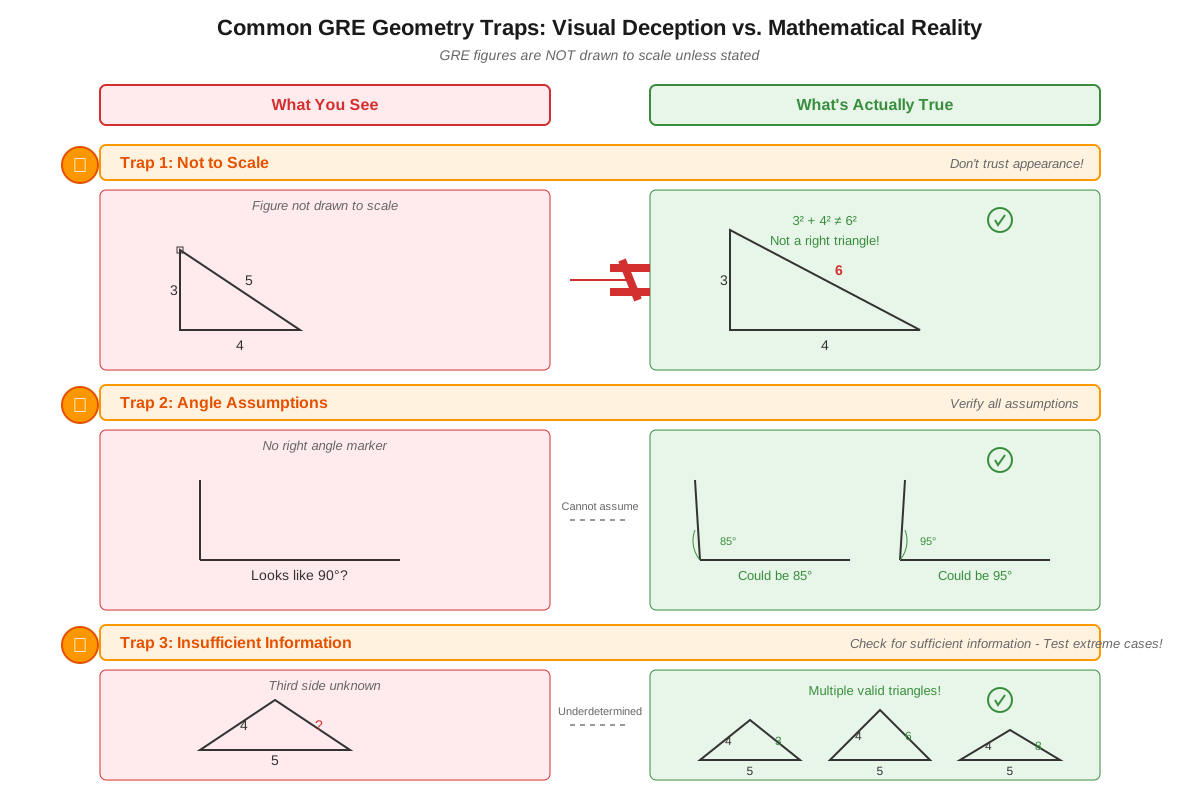
The most explicit geometry trap indicator on the GRE is the statement "Note: Figure not drawn to scale." This warning appears when the visual representation intentionally misrepresents the actual geometric relationships described in the problem. When this notice appears, test-takers must completely disregard visual impressions and rely exclusively on the given numerical information and geometric constraints.
The trap mechanism works through visual anchoring: the human brain automatically processes spatial information and forms judgments about relative sizes, angle measures, and proportions based on what appears on screen. Even when consciously aware of the warning, test-takers struggle to override these visual impressions. Questions exploit this by making the correct answer correspond to a configuration that looks dramatically different from the presented figure.
Strategy: When encountering this warning, actively list all given information separately from the diagram, work through the problem using only stated facts, and consider sketching alternative configurations that satisfy the constraints. Never estimate angles, lengths, or areas based on appearance when this warning is present.
Insufficient Information Traps
Many geometry traps involve scenarios where the given information appears sufficient but actually allows for multiple possible configurations, each yielding different answers. These questions test whether students recognize when additional constraints are necessary to determine a unique solution.
Common insufficient information scenarios include:
- Quadrilaterals without specified type: A four-sided figure with one or two known side lengths could be a square, rectangle, parallelogram, trapezoid, or irregular quadrilateral, each with different area formulas
- Triangles with limited information: Knowing one side and one angle (not the included angle) may allow for two different triangle configurations (the ambiguous case of the Law of Sines)
- Circles and tangent lines: Without explicit statements about tangency or perpendicularity, apparent geometric relationships may not actually hold
- Three-dimensional figures: Spatial configurations often have multiple possible orientations that affect measurements
Strategy: Before calculating, explicitly verify that sufficient information exists to determine a unique answer. In quantitative comparison questions, if multiple configurations are possible that yield different relationships between Quantity A and Quantity B, the answer is always (D) "The relationship cannot be determined."
The Right Angle Assumption Trap
One of the most frequently exploited assumptions involves right angles. Test-takers habitually assume that angles that appear to be 90 degrees actually are right angles, even when no right angle marker (the small square symbol) or explicit statement confirms this.
This trap appears in multiple contexts:
- Coordinate geometry problems where lines appear perpendicular but have slopes that aren't negative reciprocals
- Geometric figures where sides appear to meet at right angles without confirmation
- Problems involving "corners" or "intersections" where perpendicularity is suggested but not stated
The psychological mechanism relies on the brain's tendency to regularize geometric figures, interpreting near-right angles as exactly 90 degrees and assuming symmetry where none is guaranteed.
Strategy: Actively search for right angle markers (□) or explicit statements like "perpendicular," "forms a right angle," or "90 degrees." If these indicators are absent, do not assume perpendicularity regardless of appearance. In calculations, verify that slopes multiply to -1 before assuming lines are perpendicular.
The Equal Length/Equal Angle Assumption Trap
Similar to the right angle trap, test-takers frequently assume that segments or angles that appear equal actually are equal without verification. This trap is particularly insidious in problems involving:
- Isosceles or equilateral triangles where the equal sides aren't marked with hash marks
- Parallel lines where corresponding or alternate interior angles appear equal but parallelism isn't stated
- Circles where radii appear equal to other segments without explicit confirmation
- Symmetric-looking figures that aren't actually symmetric
Strategy: Look for explicit equality markers (hash marks on segments, arc marks on angles) or statements confirming equal measures. In the absence of these indicators, treat segments and angles as potentially different even if they appear similar. Use algebraic variables to represent unknown quantities rather than assuming specific values.
The Hidden Constraint Trap
Some geometry problems provide all necessary information but present it in a way that obscures a critical constraint or relationship. These traps test whether students can extract and apply all relevant geometric principles, not just the most obvious ones.
Examples include:
- Triangle inequality theorem violations: Three given lengths that cannot actually form a triangle
- Angle sum constraints: Interior angles of a polygon that must sum to a specific value based on the number of sides
- Pythagorean theorem applications: Right triangles where the relationship among sides provides additional information beyond what's explicitly stated
- Inscribed angle theorems: Relationships between central and inscribed angles in circles that provide hidden constraints
Strategy: After reading the problem, systematically list all geometric principles that apply to the given figure type. Check whether these principles provide additional constraints or relationships beyond those explicitly stated. Verify that all given information is geometrically consistent (e.g., three side lengths can actually form a triangle).
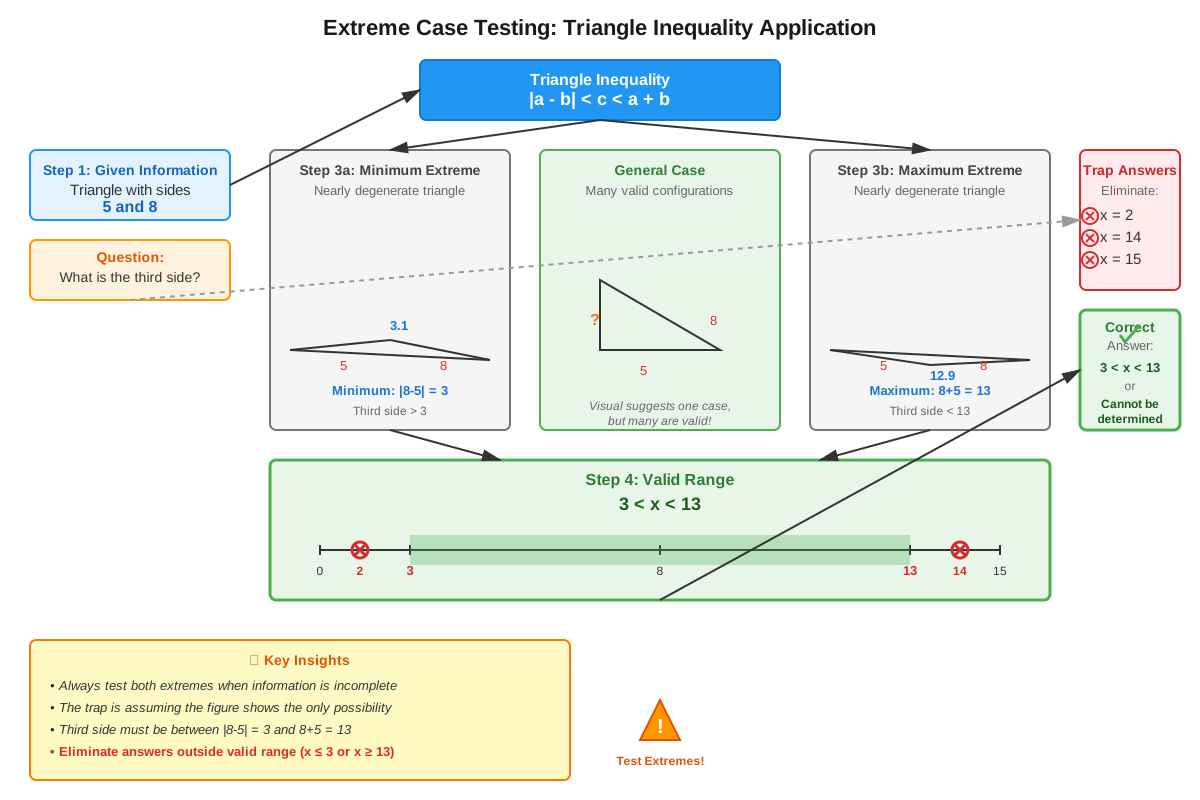
The Extreme Case Trap
Quantitative comparison questions frequently feature geometry traps where the relationship between quantities changes depending on the specific configuration within the allowed constraints. These questions require testing extreme or boundary cases rather than assuming a typical or middle-ground scenario.
For example, if a problem states that a triangle has two sides of length 5 and 7, the third side could range from just over 2 (5 + 7 - ε) to just under 12 (5 + 7 - ε) by the triangle inequality. The relationship between the triangle's perimeter and some other quantity might differ at these extremes.
Strategy: When facing quantitative comparisons with geometric constraints, identify the range of possible values for variable elements. Test the extreme cases (maximum and minimum possible values) to determine whether the relationship between Quantity A and Quantity B remains constant. If the relationship changes, answer (D).
The Formula Misapplication Trap
These traps involve scenarios where a standard geometric formula appears applicable but actually isn't because a prerequisite condition isn't met. Common examples include:
- Applying the Pythagorean theorem to triangles that aren't right triangles
- Using the formula for the area of a parallelogram (base × height) when the given measurements aren't actually base and perpendicular height
- Calculating arc length or sector area without verifying that the angle is measured in the correct units (degrees vs. radians)
- Using circle formulas when the figure is actually an ellipse or partial circle
Strategy: Before applying any formula, explicitly verify that all prerequisites are met. For the Pythagorean theorem, confirm a right angle exists. For area formulas involving height, verify that the height is perpendicular to the base. Check unit consistency for angle measurements.
Concept Relationships
The various geometry trap types interconnect through a common underlying principle: systematic verification of assumptions. The "not drawn to scale" warning → triggers the need to check for → insufficient information scenarios and hidden constraints. Recognition of insufficient information → requires understanding of → what constitutes complete specification for different geometric figures. The right angle assumption trap and equal measure assumption trap → both stem from → visual regularization tendencies that must be overridden through explicit verification.
These trap recognition skills build upon prerequisite geometric knowledge by adding a critical evaluation layer. Basic formulas and theorems → provide the computational tools, while trap awareness → ensures these tools are applied only when appropriate. The extreme case strategy → connects to → algebraic reasoning about inequalities and ranges, while the hidden constraint recognition → links to → theorem application and logical deduction skills.
Within the broader GRE Quantitative Reasoning framework, geometry trap recognition → supports → quantitative comparison strategy (particularly the "cannot be determined" option), → enhances → data sufficiency reasoning, and → improves → overall problem-solving accuracy by reducing careless errors. The meta-cognitive skill of questioning assumptions → transfers to → word problem interpretation, data interpretation, and algebraic problem-solving beyond pure geometry.
High-Yield Facts
⭐ When a figure is marked "not drawn to scale," visual estimation is completely unreliable and must be ignored entirely
⭐ The absence of a right angle marker (□) means you cannot assume an angle is 90 degrees, regardless of appearance
⭐ In quantitative comparison questions, if multiple geometric configurations are possible that yield different relationships, the answer is always (D)
⭐ Equal-looking segments or angles are not equal unless marked with hash marks or explicitly stated
⭐ The triangle inequality theorem (sum of any two sides must exceed the third side) provides hidden constraints in many problems
- Quadrilaterals without specified type cannot have their area calculated without additional information
- Perpendicular lines in coordinate geometry must have slopes that are negative reciprocals (m₁ × m₂ = -1)
- Inscribed angles in a circle are half the measure of the central angle subtending the same arc
- The Pythagorean theorem applies only to right triangles; its use requires explicit confirmation of a right angle
- When testing extreme cases, consider both maximum and minimum possible values within the given constraints
- Parallel lines must be explicitly stated or proven; apparent parallelism in a diagram is insufficient
- Circle problems often hide information in the relationship between radii, chords, and tangent lines
- Three-dimensional geometry problems frequently allow multiple spatial configurations unless fully constrained
- Angle measures in geometric formulas must be in the correct units (degrees for most GRE problems)
- Symmetry cannot be assumed from appearance; it must be stated or proven from given information
Quick check — test yourself on GRE geometry traps so far.
Try Flashcards →Common Misconceptions
Misconception: If a figure looks like it's drawn to scale, it probably is, even without explicit confirmation → Correction: GRE figures are generally drawn reasonably accurately UNLESS marked "not drawn to scale," but this doesn't mean you should rely on visual estimation for precise measurements. Always use given numerical information and geometric relationships rather than visual approximation, even for unmarked figures.
Misconception: If I can't determine a unique answer, I must be missing something or making an error → Correction: Many GRE geometry questions, especially quantitative comparisons, are specifically designed to have insufficient information. Recognizing this and selecting "cannot be determined" is the correct response, not a failure of understanding.
Misconception: The Pythagorean theorem can be used to find any missing side of any triangle → Correction: The Pythagorean theorem (a² + b² = c²) applies exclusively to right triangles. Using it for non-right triangles is a formula misapplication trap. Always verify the presence of a right angle before applying this theorem.
Misconception: If two angles look equal in a diagram, they're probably meant to be equal → Correction: Equal angles must be marked with identical arc symbols or explicitly stated in the problem. Visual similarity is intentionally misleading in many trap questions. Treat unmarked angles as potentially different values.
Misconception: Complex geometry problems always require complex calculations → Correction: Many geometry traps are designed to make test-takers perform unnecessary calculations. Often, recognizing insufficient information, identifying a hidden constraint, or testing a simple extreme case provides the answer more efficiently than elaborate computation.
Misconception: Coordinate geometry problems with perpendicular-looking lines always involve right angles → Correction: In coordinate geometry, perpendicularity must be verified by checking that slopes are negative reciprocals. Visual appearance on a coordinate grid can be misleading, especially when axes have different scales or when the viewing window is non-standard.
Misconception: If a problem provides three side lengths for a triangle, those lengths definitely form a valid triangle → Correction: The triangle inequality theorem requires that the sum of any two sides exceeds the third side. Some trap questions provide three lengths that violate this principle, making the scenario geometrically impossible—a hidden constraint that affects the answer.
Worked Examples
Example 1: Quantitative Comparison with Insufficient Information
Problem:
Triangle ABC has side AB = 6 and side BC = 8.
Quantity A: The area of triangle ABC
Quantity B: 24
Solution:
Step 1: Identify what information is given and what is needed.
- Given: Two sides of a triangle (AB = 6, BC = 8)
- Needed: Area of the triangle to compare with 24
Step 2: Recognize the trap—insufficient information.
The area of a triangle requires either (base × height)/2 or can be calculated with two sides and the included angle. We have two sides but no information about:
- The angle between these sides
- The length of the third side
- Any height measurement
Step 3: Test extreme cases to verify the relationship varies.
Case 1 (Right angle at B): If angle ABC = 90°, then AB and BC are perpendicular, so:
- Area = (1/2)(6)(8) = 24
- Quantity A = Quantity B
Case 2 (Very small angle at B): If angle ABC is close to 0°, the triangle becomes very flat:
- Height approaches 0
- Area approaches 0
- Quantity A < Quantity B
Case 3 (Angle at B close to 180°): If angle ABC is close to 180°, the triangle again becomes very flat:
- Height approaches 0
- Area approaches 0
- Quantity A < Quantity B
Step 4: Conclusion.
Since the relationship between Quantity A and Quantity B changes depending on the configuration (equal in Case 1, but A < B in Cases 2 and 3), the answer is (D) The relationship cannot be determined from the information given.
Connection to Learning Objectives: This example demonstrates identifying insufficient information traps (Objective 1), explaining the core strategy of testing extreme cases (Objective 2), and applying this to a GRE-style quantitative comparison accurately (Objective 3).
Example 2: "Not Drawn to Scale" with Right Angle Assumption
Problem:
[Imagine a diagram showing a quadrilateral PQRS where angle P appears to be 90°, PQ = 5, PS = 12, and QR = 13. The diagram is marked "Note: Figure not drawn to scale."]
If PQRS is a quadrilateral with PQ = 5, PS = 12, and QR = 13, what is the area of quadrilateral PQRS?
(A) 30
(B) 60
(C) 65
(D) 78
(E) Cannot be determined from the information given
Solution:
Step 1: Note the "not drawn to scale" warning and identify potential traps.
The diagram might suggest that angle P is a right angle (making this appear to be a right triangle PQS with an additional triangle). This is a classic right angle assumption trap.
Step 2: List what is actually given.
- Four points forming a quadrilateral
- Three side lengths: PQ = 5, PS = 12, QR = 13
- NO information about angles
- NO information about side RS
- NO information about whether any sides are parallel
Step 3: Determine if sufficient information exists.
To calculate the area of a quadrilateral, we need either:
- All four sides and at least one angle, or
- A decomposition into triangles with sufficient information for each, or
- Identification as a special quadrilateral type (rectangle, parallelogram, etc.) with appropriate measurements
We have only three of four side lengths and no angle information. Even if we notice that 5² + 12² = 25 + 144 = 169 = 13², suggesting these could be sides of a right triangle, we don't know:
- Whether P is actually a right angle
- How the fourth side RS connects the figure
- The shape's overall configuration
Step 4: Recognize this as an insufficient information trap.
Multiple different quadrilaterals could have sides PQ = 5, PS = 12, and QR = 13, each with different areas depending on the angles and the length of RS.
Answer: (E) Cannot be determined from the information given
Key Insight: The numbers 5, 12, and 13 form a Pythagorean triple, which is intentionally included to tempt test-takers into assuming a right angle exists and calculating area = (1/2)(5)(12) = 30. This would lead to the trap answer (A). The correct response recognizes that without explicit confirmation of a right angle and complete information about the quadrilateral, no unique area can be determined.
Connection to Learning Objectives: This example shows identifying when traps are being tested through the "not drawn to scale" warning (Objective 1), explaining the strategy of verifying sufficient information and not assuming right angles (Objective 2), and applying systematic verification to avoid trap answers (Objective 3).
Exam Strategy
Approach Process for Geometry Questions:
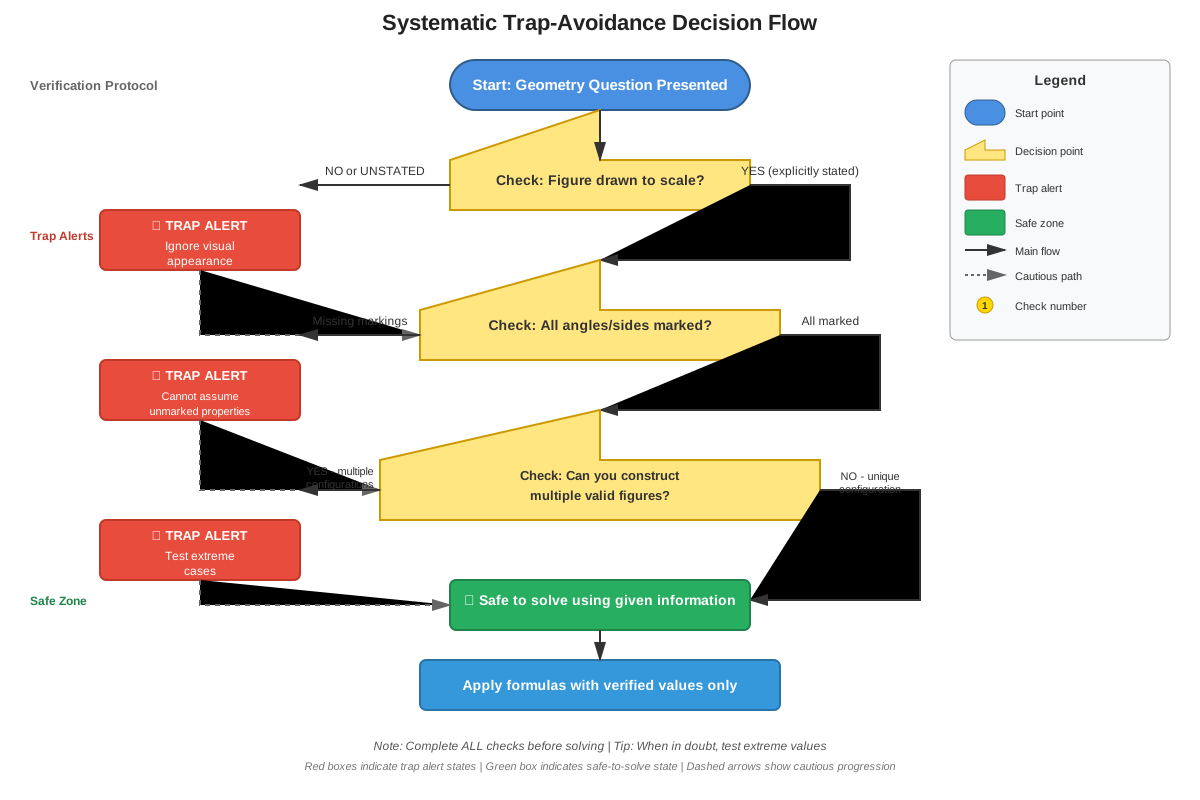
- Read the question stem completely before looking at the diagram to avoid visual anchoring
- Check for "not drawn to scale" warnings immediately—if present, mentally discard visual impressions
- List all explicitly given information separately from what appears to be true
- Identify the figure type and recall all relevant geometric principles and constraints
- Look for trap indicators: missing right angle markers, unmarked equal segments, ambiguous configurations
- Verify sufficient information exists before attempting calculation
- For quantitative comparisons, test extreme cases within the allowed constraints
Trigger Words and Phrases:
- "Note: Figure not drawn to scale" → Disregard all visual estimation; rely only on stated facts
- "Appears to be" or "looks like" → Warning that appearance may be misleading
- "Could be" or "might be" → Suggests multiple configurations are possible
- Absence of "perpendicular," "right angle," or □ symbol → Cannot assume 90-degree angles
- "Quadrilateral" without further specification → Cannot assume rectangle, square, or parallelogram properties
- Quantitative comparison with geometric variables → Strong candidate for "cannot be determined" if constraints are loose
Process-of-Elimination Tips:
- In quantitative comparisons, if you can construct even one scenario where A > B and another where B > A, eliminate (A), (B), and (C)—the answer must be (D)
- For problem-solving questions, eliminate answers that require assumptions not supported by given information
- If an answer seems too straightforward and uses only the most obvious given numbers, consider whether you're falling into a trap
- Answers that equal common Pythagorean triples (3-4-5, 5-12-13, 8-15-17) when no right angle is confirmed are often trap answers
Time Allocation Advice:
Geometry trap questions often appear more complex than they are. Paradoxically, recognizing insufficient information can be faster than performing elaborate calculations. Allocate:
- 30-45 seconds for initial assessment and trap identification
- 45-60 seconds for testing extreme cases or verifying constraints
- 30-45 seconds for calculation (if sufficient information exists)
- Total: 2-2.5 minutes per geometry question
If you find yourself performing complex multi-step calculations, pause and verify that you're not missing a simpler approach or falling into a trap that makes the problem appear more complicated than necessary.
Memory Techniques
SCALE Mnemonic for "Not Drawn to Scale" Questions:
- Skeptical of appearance
- Catalog given facts only
- Assumptions must be verified
- List all constraints
- Extreme cases reveal truth
RIGHT Checklist for Right Angle Verification:
- Right angle marker (□) present?
- Is "perpendicular" stated?
- Given as 90 degrees explicitly?
- Has slopes multiply to -1 (coordinate geometry)?
- Theorem or property guarantees it?
If none of these are true, do NOT assume a right angle exists.
EQUAL Verification for Segments and Angles:
- Explicit statement of equality?
- Quantities marked with hash marks/arc marks?
- Unambiguous from given constraints?
- Axiomatic property (e.g., all radii of a circle)?
- Logically proven from other information?
Visualization Strategy: When encountering a geometry problem, mentally sketch three versions:
- The configuration as shown
- An extreme case (maximum possible variation)
- Another extreme case (minimum possible variation)
If all three versions yield the same answer, proceed confidently. If they differ, you've likely identified an insufficient information scenario.
Acronym for Common Traps: RAINS
- Right angles assumed
- Angles/segments assumed equal
- Insufficient information
- Not drawn to scale ignored
- Scale/proportion misestimated
Summary
GRE geometry traps represent systematic question design features that exploit common reasoning shortcuts and visual processing tendencies. Mastering these traps requires developing a skeptical, verification-oriented approach to geometric problems rather than relying on visual intuition or hasty assumptions. The core strategy involves explicitly checking for right angle markers and equality indicators, recognizing when information is insufficient to determine a unique answer, testing extreme cases in quantitative comparisons, and completely disregarding visual appearance when figures are marked "not drawn to scale." These traps appear frequently in medium-to-hard difficulty questions and disproportionately affect test-takers who know geometric formulas but fail to verify that prerequisites for applying those formulas are met. Success requires integrating content knowledge with metacognitive awareness—not just knowing what to calculate, but systematically verifying when calculation is appropriate and when insufficient information makes definitive answers impossible. The ability to recognize these patterns and avoid trap answers directly translates to higher scores by preventing careless errors on questions where the correct answer often involves recognizing what cannot be determined rather than performing complex calculations.
Key Takeaways
- Always verify right angles explicitly—the absence of a right angle marker (□) or statement means you cannot assume 90 degrees, regardless of appearance
- "Not drawn to scale" warnings require complete disregard of visual impressions; work exclusively from stated numerical facts and geometric constraints
- Insufficient information is a valid answer—many quantitative comparison questions are designed so that multiple configurations yield different relationships, making (D) correct
- Test extreme cases in quantitative comparisons to determine whether the relationship between quantities remains constant across all allowed configurations
- Equal-looking elements are not equal without explicit confirmation through hash marks, arc marks, or statements
- Verify formula prerequisites before applying them—particularly for the Pythagorean theorem (requires right triangle) and area formulas (require perpendicular height)
- Complex-appearing problems may have simple solutions through trap recognition rather than elaborate calculation
Related Topics
Quantitative Comparison Strategy: Mastering geometry traps directly enhances quantitative comparison performance, particularly in recognizing when answer choice (D) "cannot be determined" is correct. This broader strategic framework applies trap recognition across all mathematical content areas.
Triangle Properties and Theorems: Deep understanding of triangle inequality, angle sum properties, and special triangle relationships provides the foundation for recognizing when triangle-based geometry traps are present and what constraints must be satisfied.
Coordinate Geometry: Many geometry traps appear in coordinate plane contexts, where visual distortion is common and perpendicularity must be verified through slope relationships rather than appearance. Mastering coordinate geometry enhances trap recognition in this specific context.
Circle Geometry: Circles present unique trap opportunities involving tangent lines, inscribed angles, and radius relationships. Understanding circle theorems enables recognition of hidden constraints and insufficient information scenarios specific to circular figures.
Three-Dimensional Geometry: Spatial reasoning problems amplify geometry trap potential because multiple configurations are often possible in three dimensions. Mastering 3D geometry requires enhanced visualization skills and systematic constraint verification.
Practice CTA
Now that you understand the systematic patterns behind GRE geometry traps, it's time to apply this knowledge to authentic practice questions. The concepts covered here—from recognizing insufficient information to testing extreme cases—will become automatic only through deliberate practice with GRE-style problems. Challenge yourself with the practice questions and flashcards designed specifically for this topic, paying particular attention to questions marked "not drawn to scale" and quantitative comparisons involving geometric figures. Remember: recognizing a trap is often faster and more valuable than performing complex calculations. Each practice question you attempt strengthens your pattern recognition and builds the skeptical, verification-oriented mindset that separates high scorers from average performers. Your investment in mastering these traps will pay dividends across the entire Quantitative Reasoning section—start practicing now!
Sign up free to keep reading
Create a free AnvayaPrep account to finish this GRE guide on GRE geometry traps — plus flashcards and practice questions.