Overview
Parallel lines are one of the most frequently tested geometric concepts on the GRE Quantitative Reasoning section. Understanding parallel lines and their properties is essential for solving a wide range of geometry problems, from basic angle relationships to complex coordinate geometry questions. When two or more lines never intersect and maintain a constant distance from each other, they are parallel—a simple definition that unlocks numerous mathematical relationships and problem-solving strategies.
The GRE tests parallel lines in multiple contexts: through transversals cutting across parallel lines creating predictable angle patterns, in coordinate geometry where slopes reveal parallelism, and in complex figures where recognizing parallel relationships simplifies seemingly difficult problems. Questions involving gre parallel lines often combine multiple geometric concepts, making this topic a cornerstone of geometric reasoning. Students who master parallel lines gain the ability to quickly identify angle relationships, set up equations, and eliminate incorrect answer choices efficiently.
This topic connects intimately with other Quantitative Reasoning concepts including angles, triangles, quadrilaterals, coordinate geometry, and algebraic reasoning. Parallel lines serve as the foundation for understanding properties of special quadrilaterals like parallelograms and trapezoids, and they're crucial for solving problems involving similar triangles. The ability to recognize when parallel lines are present—even when not explicitly stated—often provides the key insight needed to solve challenging GRE problems within the time constraints of the exam.
Learning Objectives
- [ ] Identify when Parallel lines is being tested
- [ ] Explain the core rule or strategy behind Parallel lines
- [ ] Apply Parallel lines to GRE-style questions accurately
- [ ] Determine angle measures using transversal properties with parallel lines
- [ ] Recognize parallel lines in coordinate geometry using slope relationships
- [ ] Solve multi-step problems combining parallel line properties with other geometric concepts
Prerequisites
- Basic angle types and relationships: Understanding complementary, supplementary, and vertical angles is essential because parallel lines create these angle relationships when intersected by transversals
- Linear equations and slope: Necessary for identifying parallel lines in coordinate geometry, as parallel lines have equal slopes
- Algebraic equation solving: Required to set up and solve equations involving angle measures in parallel line configurations
- Basic geometric notation: Understanding how to interpret geometric diagrams, angle notation, and line symbols ensures accurate problem interpretation
Why This Topic Matters
Parallel lines appear in approximately 10-15% of GRE Quantitative Reasoning geometry questions, making them one of the highest-yield geometry topics to master. The concept appears across multiple question formats: Quantitative Comparison questions asking you to compare angle measures, Multiple Choice questions requiring calculation of specific angles, and Numeric Entry questions where you must determine exact values. Understanding parallel lines is not merely about memorizing angle relationships—it's about developing spatial reasoning skills that transfer to more complex geometric scenarios.
In real-world applications, parallel lines are fundamental to architecture, engineering, navigation, and computer graphics. Architects use parallel line principles to ensure structural integrity, while computer programmers rely on these concepts for rendering graphics and designing user interfaces. The logical reasoning required to work with parallel lines—identifying patterns, making deductions, and applying rules systematically—mirrors the analytical thinking valued in graduate-level academic work.
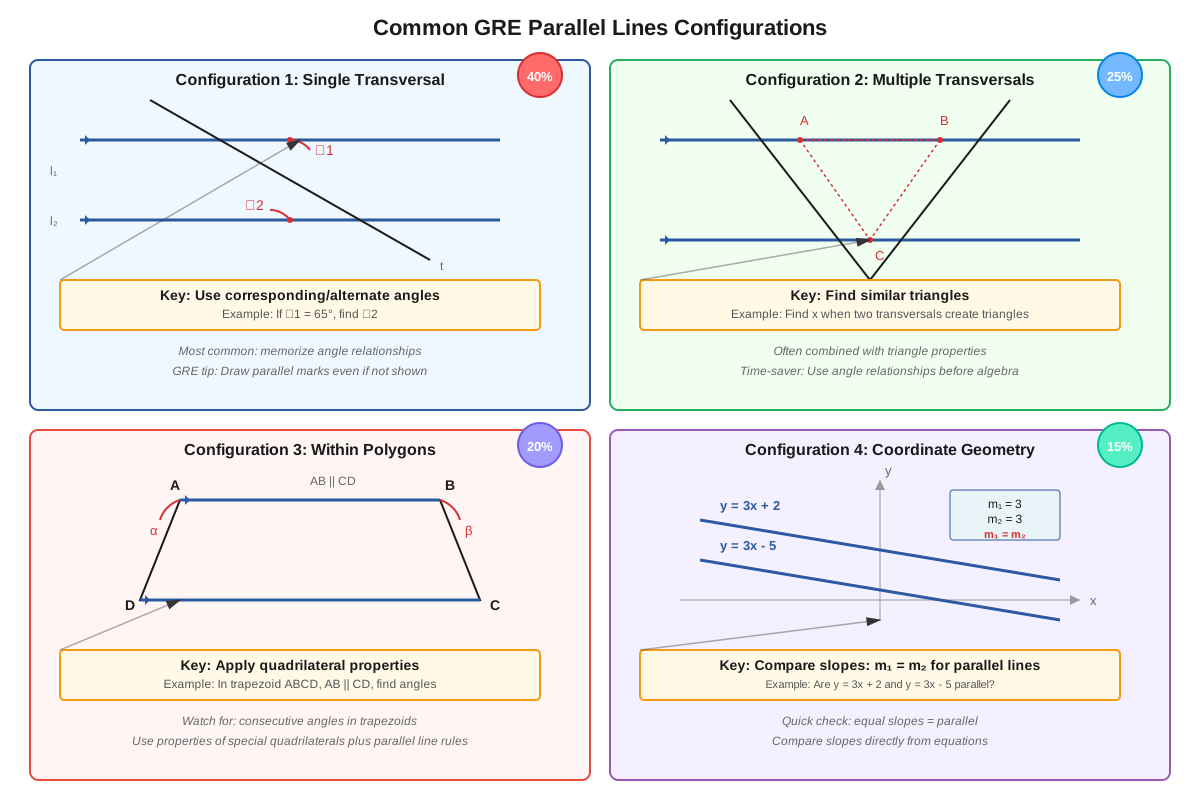
On the GRE, parallel lines commonly appear in problems involving: transversals creating angle relationships that must be identified and calculated; coordinate geometry questions where you must determine if lines are parallel based on their equations; complex figures where recognizing hidden parallel relationships simplifies the problem; and word problems describing geometric scenarios where parallel lines must be inferred from the context. The test makers frequently combine parallel lines with other concepts like triangles, quadrilaterals, or algebraic expressions to create medium and hard difficulty questions.
Core Concepts
Definition and Basic Properties
Parallel lines are two or more lines in the same plane that never intersect, regardless of how far they are extended in either direction. The symbol for parallel is ∥, so if line l is parallel to line m, we write l ∥ m. The fundamental property of parallel lines is that they maintain a constant perpendicular distance from each other at all points.
Key properties include:
- Parallel lines have the same slope in coordinate geometry
- Parallel lines never meet or intersect
- If two lines are both parallel to a third line, they are parallel to each other (transitive property)
- Through a point not on a given line, exactly one line can be drawn parallel to the given line (parallel postulate)
Transversals and Angle Relationships
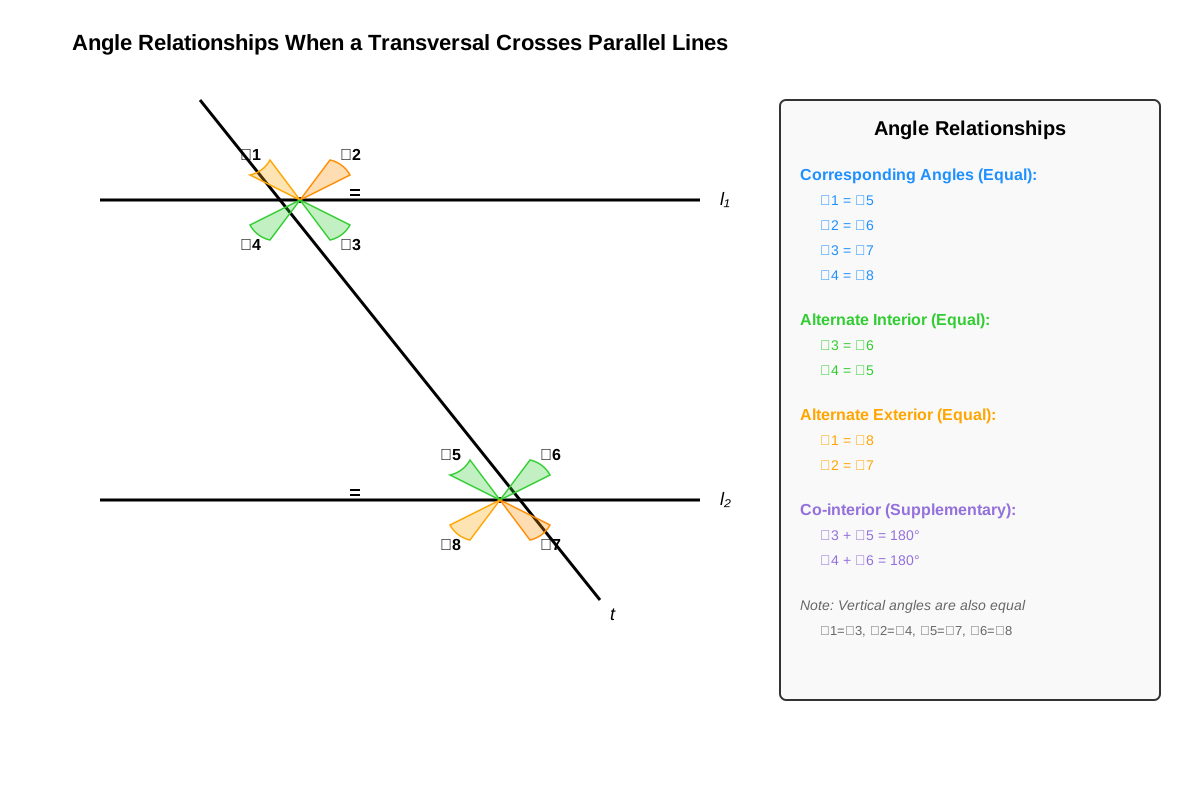
A transversal is a line that intersects two or more lines at distinct points. When a transversal crosses parallel lines, it creates eight angles with specific, predictable relationships. Understanding these relationships is crucial for solving GRE problems efficiently.
The eight angles formed can be categorized into several types:
| Angle Type | Definition | Relationship |
|---|---|---|
| Corresponding angles | Angles in the same relative position at each intersection | Equal when lines are parallel |
| Alternate interior angles | Angles on opposite sides of the transversal, between the parallel lines | Equal when lines are parallel |
| Alternate exterior angles | Angles on opposite sides of the transversal, outside the parallel lines | Equal when lines are parallel |
| Consecutive interior angles | Angles on the same side of the transversal, between the parallel lines | Supplementary (sum to 180°) when lines are parallel |
These relationships work bidirectionally: if the angle relationships hold, then the lines must be parallel. This converse property is frequently tested on the GRE, where you must determine whether lines are parallel based on given angle measures.
Corresponding Angles
When a transversal intersects two parallel lines, corresponding angles occupy the same relative position at each intersection point. Imagine the transversal creating an "F" shape with the parallel lines—the angles at the same position in each intersection are corresponding angles. For parallel lines, all corresponding angles are congruent (equal in measure).
For example, if a transversal crosses two parallel lines creating an angle of 65° in the upper-right position at the first intersection, the upper-right angle at the second intersection will also be 65°. This property allows you to transfer angle information from one intersection point to another.
Alternate Interior Angles
Alternate interior angles are located between the parallel lines but on opposite sides of the transversal, creating a "Z" pattern. When lines are parallel, these angles are always equal. This relationship is one of the most commonly tested on the GRE because it's less immediately obvious than corresponding angles but equally powerful for solving problems.
If you know one alternate interior angle measures 110°, you immediately know its alternate interior angle also measures 110°. This property is particularly useful in problems involving triangles formed by parallel lines and transversals, where alternate interior angles help establish angle relationships within the triangles.
Consecutive Interior Angles
Also called co-interior angles or same-side interior angles, these angles lie between the parallel lines on the same side of the transversal. Unlike corresponding and alternate interior angles, consecutive interior angles are supplementary—they sum to 180°. This property creates a powerful equation-solving opportunity on the GRE.
If one consecutive interior angle measures x°, the other measures (180 - x)°. Test questions often provide algebraic expressions for these angles, such as (2x + 10)° and (3x - 20)°, requiring you to set up the equation: (2x + 10) + (3x - 20) = 180.
Parallel Lines in Coordinate Geometry
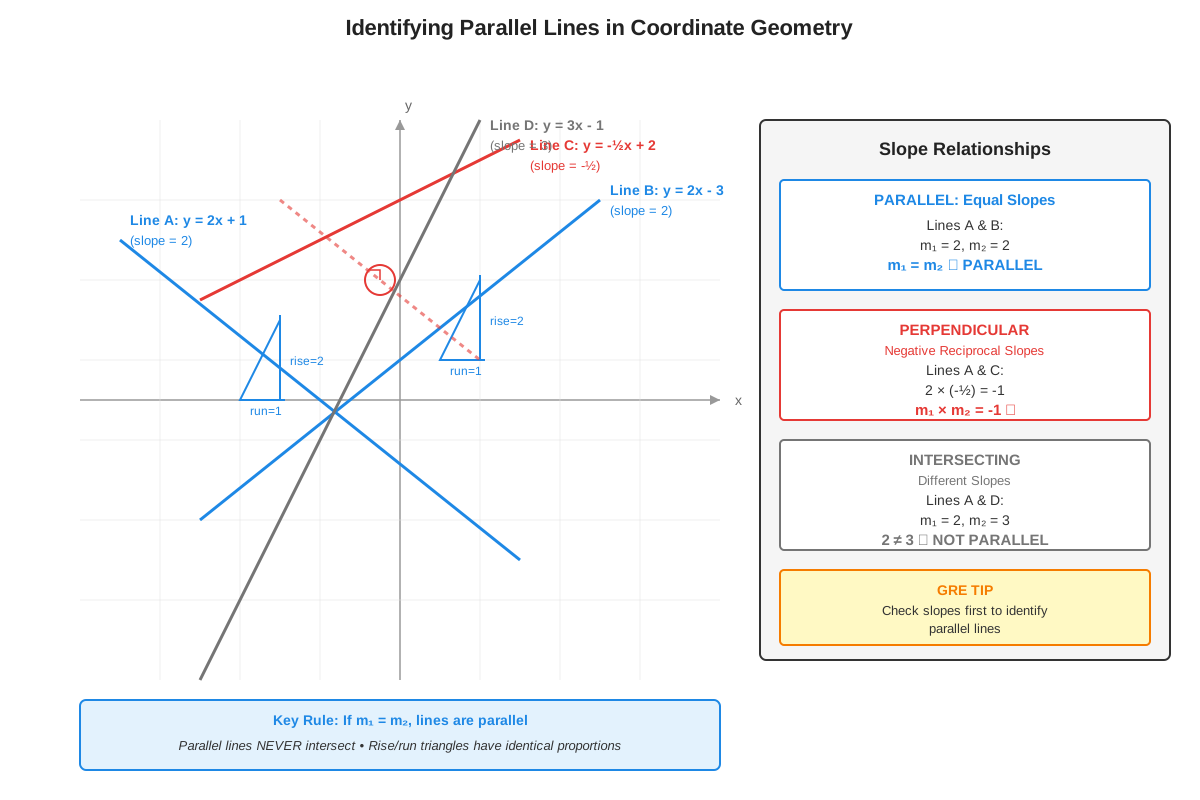
In the coordinate plane, two non-vertical lines are parallel if and only if they have the same slope. If line 1 has equation y = m₁x + b₁ and line 2 has equation y = m₂x + b₂, then the lines are parallel when m₁ = m₂ (and b₁ ≠ b₂, otherwise they're the same line).
For lines given in standard form (Ax + By = C), you can determine parallelism by comparing the coefficients. Lines A₁x + B₁y = C₁ and A₂x + B₂y = C₂ are parallel when A₁/A₂ = B₁/B₂ (provided these ratios are defined and not equal to C₁/C₂).
Special cases to remember:
- All vertical lines (x = k for various constants k) are parallel to each other
- All horizontal lines (y = k for various constants k) are parallel to each other
- A vertical line and a horizontal line are perpendicular, not parallel
Using Parallel Lines to Solve Complex Problems
Many GRE problems don't explicitly state that lines are parallel but provide enough information for you to deduce parallelism. Look for:
- Opposite sides of parallelograms or rectangles (always parallel by definition)
- Lines with equal slopes in coordinate geometry
- Angle relationships that satisfy parallel line conditions
- Statements like "line l is perpendicular to line m, and line n is perpendicular to line m" (making l ∥ n)
Once you identify parallel lines, you can apply all the angle relationships to set up equations, find unknown values, and eliminate impossible answer choices. The key strategy is to mark all equal angles and supplementary angle pairs immediately upon recognizing parallel lines.
Concept Relationships
The concepts within parallel lines form a hierarchical structure: the basic definition of parallel lines → leads to → the introduction of transversals → which creates → specific angle relationships (corresponding, alternate interior, alternate exterior, consecutive interior) → which enable → problem-solving through equations and deductions.
Parallel lines connect to prerequisite topics through multiple pathways. The angle relationships created by transversals rely on understanding of supplementary angles and vertical angles. When solving for unknown angle measures, algebraic equation-solving skills become essential. In coordinate geometry, the slope concept from linear equations directly determines parallelism.
Related topics build upon parallel lines: parallelograms are defined by having two pairs of parallel sides; trapezoids have exactly one pair of parallel sides; similar triangles often involve parallel lines creating proportional relationships; and perpendicular lines have slopes that are negative reciprocals, contrasting with parallel lines' equal slopes.
The relationship map: Basic parallel line definition → Transversal introduction → Eight angles created → Angle pair identification (corresponding, alternate interior, etc.) → Angle relationships (equal or supplementary) → Equation setup → Problem solution. Additionally: Parallel lines in coordinate plane → Slope comparison → Determination of parallelism → Application to line equations and graphing problems.
Quick check — test yourself on Parallel lines so far.
Try Flashcards →High-Yield Facts
⭐ When a transversal crosses parallel lines, corresponding angles are always equal
⭐ Alternate interior angles formed by a transversal crossing parallel lines are always equal
⭐ Consecutive interior angles (same-side interior angles) formed by a transversal crossing parallel lines are always supplementary (sum to 180°)
⭐ In coordinate geometry, two non-vertical lines are parallel if and only if they have equal slopes
⭐ If two lines are both parallel to a third line, they are parallel to each other
- Alternate exterior angles formed by a transversal crossing parallel lines are equal
- All vertical lines are parallel to each other; all horizontal lines are parallel to each other
- The converse relationships hold: if corresponding angles are equal, the lines must be parallel
- Parallel lines maintain constant perpendicular distance from each other
- In a parallelogram, opposite sides are parallel by definition
- If a line is perpendicular to one of two parallel lines, it is perpendicular to both
- The sum of all angles on one side of a transversal equals 360°
Common Misconceptions
Misconception: All angles formed by a transversal crossing parallel lines are equal → Correction: Only specific angle pairs are equal (corresponding, alternate interior, alternate exterior). Consecutive interior angles are supplementary, not equal. Adjacent angles on the same line are supplementary.
Misconception: Lines that look parallel in a diagram are definitely parallel → Correction: On the GRE, never assume lines are parallel based on appearance alone unless explicitly stated or marked with the parallel symbol. Diagrams are not necessarily drawn to scale, and the test makers intentionally create misleading visual impressions.
Misconception: If two lines have the same y-intercept, they are parallel → Correction: Lines are parallel when they have the same slope, not the same y-intercept. Lines with the same y-intercept but different slopes intersect at that y-intercept point on the y-axis.
Misconception: Alternate interior angles are always on the interior of the figure → Correction: "Interior" refers to the region between the two parallel lines, not the interior of any polygon that might be formed. Alternate interior angles are specifically between the parallel lines and on opposite sides of the transversal.
Misconception: You need to memorize all eight angle measures when a transversal crosses parallel lines → Correction: You only need to find one angle measure. All other angles can be determined using just two relationships: vertical angles are equal, and linear pairs are supplementary. If you know one angle is 70°, its vertical angle is 70°, and all adjacent angles are 110°.
Misconception: Parallel lines must be horizontal or vertical → Correction: Parallel lines can have any orientation. They simply need to have the same slope (direction) and never intersect. Lines with slope 2/3 are parallel to other lines with slope 2/3, regardless of their position or orientation on the coordinate plane.
Worked Examples
Example 1: Transversal Angle Problem
Problem: Two parallel lines are cut by a transversal. One of the angles formed measures 3x + 15 degrees, and its consecutive interior angle measures 2x + 25 degrees. What is the value of x?
Solution:
Step 1: Identify the relationship. Consecutive interior angles formed by a transversal crossing parallel lines are supplementary, meaning they sum to 180°.
Step 2: Set up the equation:
(3x + 15) + (2x + 25) = 180Step 3: Combine like terms:
5x + 40 = 180Step 4: Solve for x:
5x = 140
x = 28
Step 5: Verify (optional but recommended): If x = 28, the first angle is 3(28) + 15 = 84 + 15 = 99°, and the second angle is 2(28) + 25 = 56 + 25 = 81°. Check: 99 + 81 = 180° ✓
Answer: x = 28
Connection to learning objectives: This problem requires identifying when parallel lines are being tested (consecutive interior angles), explaining the core rule (supplementary relationship), and applying it accurately to solve for an unknown value.
Example 2: Coordinate Geometry Parallel Lines
Problem: Line k passes through points (2, 5) and (6, 13). Line m passes through point (1, 3) and has a y-intercept of -1. Are lines k and m parallel?
Solution:
Step 1: Find the slope of line k using the slope formula:
m_k = (y₂ - y₁)/(x₂ - x₁) = (13 - 5)/(6 - 2) = 8/4 = 2Step 2: Find the slope of line m. We know it passes through (1, 3) and has y-intercept -1, meaning it passes through (0, -1):
m_m = (3 - (-1))/(1 - 0) = 4/1 = 4Step 3: Compare slopes. For lines to be parallel, they must have equal slopes:
m_k = 2 and m_m = 4Since 2 ≠ 4, the slopes are not equal.
Answer: No, lines k and m are not parallel because they have different slopes (2 and 4, respectively).
Connection to learning objectives: This problem tests the ability to identify parallel lines in coordinate geometry context, apply the core rule that parallel lines have equal slopes, and accurately determine whether lines are parallel based on calculation rather than visual inspection.
Exam Strategy
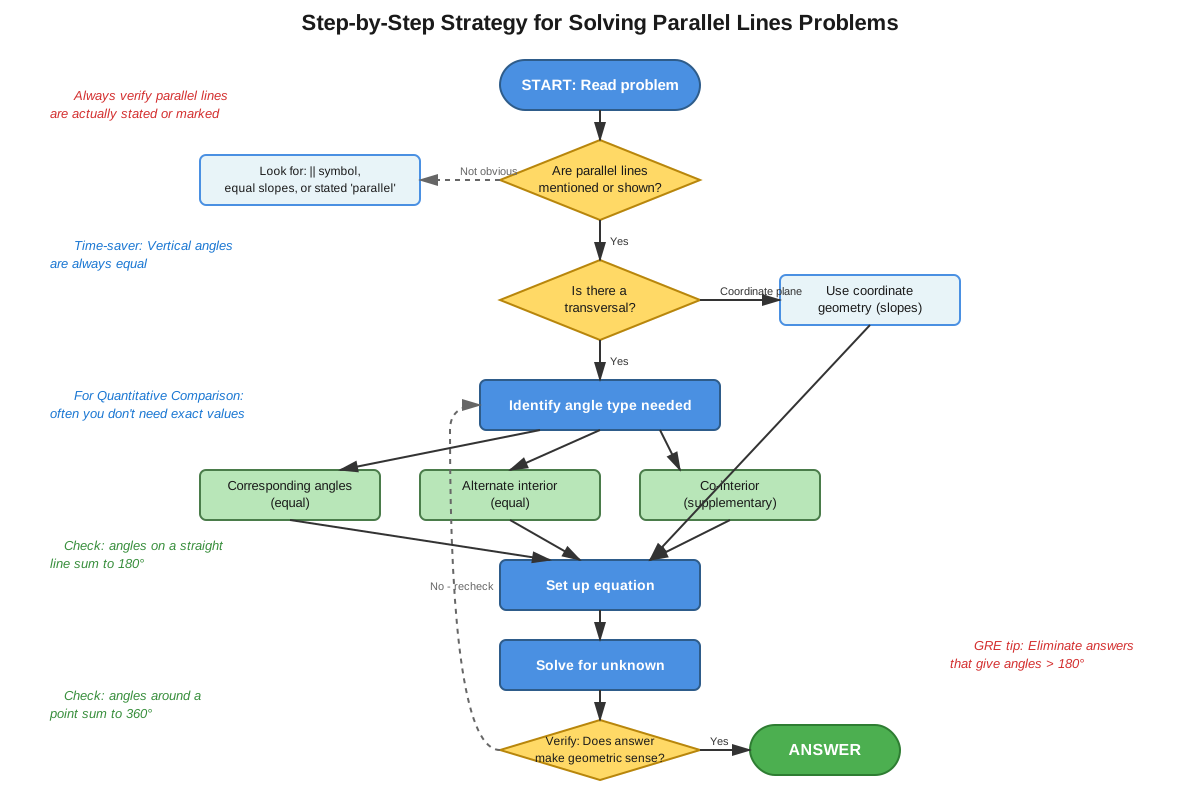
When approaching gre parallel lines questions, begin by carefully reading the problem to identify whether parallel lines are explicitly stated or must be inferred. Look for the parallel symbol (∥), phrases like "parallel to," or geometric figures where parallelism is implied (opposite sides of parallelograms, for instance).
Trigger words and phrases to watch for:
- "Parallel lines cut by a transversal"
- "Corresponding angles"
- "Alternate interior angles"
- "Same-side interior angles" or "consecutive interior angles"
- "Lines l and m are parallel"
- In coordinate geometry: "same slope," "equal slopes," or questions asking if lines are parallel
Process-of-elimination strategies:
- If a question asks which angles must be equal, eliminate any answer choices showing consecutive interior angles (these are supplementary, not equal)
- For coordinate geometry, immediately eliminate any answer choice with lines having different slopes when the question asks about parallel lines
- If a diagram shows angles that appear equal but aren't marked as equal, don't assume—calculate based on given information
- When comparing angle measures in Quantitative Comparison questions, identify one angle measure and use parallel line properties to determine the other; if you can't determine the relationship, the answer is likely (D) "The relationship cannot be determined"
Time allocation advice: Most parallel line problems should take 1.5-2 minutes. If you find yourself spending more than 2.5 minutes, you may be overcomplicating the problem. Look for the most direct relationship: often one angle relationship immediately gives you the answer. Mark all equal angles in your diagram immediately upon recognizing parallel lines—this visual organization saves time and prevents errors.
Quick decision tree:
- Are lines stated or shown to be parallel? → Yes: Apply angle relationships
- Is this coordinate geometry? → Yes: Compare slopes
- Are angle measures given algebraically? → Yes: Set up equation using appropriate relationship (equal or supplementary)
- Can you find one angle measure? → Yes: All other angles can be determined from that one measure
Exam Tip: On the GRE, if you identify parallel lines and a transversal, immediately mark all corresponding angles as equal and all consecutive interior angles as supplementary. This proactive marking prevents calculation errors and often reveals the answer path immediately.
Memory Techniques
Mnemonic for angle relationships: "CAI-CAI"
- Corresponding angles are Congruent (equal)
- Alternate Interior angles are Congruent (equal)
- Consecutive Angles are Interior supplementary
Visual memory technique: Picture the letter "F" for corresponding angles, "Z" for alternate interior angles, and "C" for consecutive interior angles. When you see a transversal crossing parallel lines, these letter shapes help you quickly identify which angles have which relationships.
Slope parallelism acronym: "PEST"
- Parallel lines have
- Equal
- Slopes
- Throughout
Supplementary sum memory aid: Think "CON-180"—CONsecutive interior angles sum to 180 degrees. The "con" also reminds you they're on the same side (connected side) of the transversal.
Coordinate geometry check: Remember "Same Slope = Same Direction = Parallel". If you can recite this phrase, you'll never forget the fundamental parallel line test in coordinate geometry.
Summary
Parallel lines are lines in the same plane that never intersect and maintain constant distance from each other. When a transversal crosses parallel lines, it creates predictable angle relationships that are heavily tested on the GRE: corresponding angles are equal, alternate interior angles are equal, alternate exterior angles are equal, and consecutive interior angles are supplementary (sum to 180°). In coordinate geometry, parallel lines are identified by having equal slopes. To excel on GRE parallel line questions, students must recognize when parallel lines are present (either explicitly stated or implied by geometric figures), identify which angle relationship applies to the specific angles in question, and set up appropriate equations to solve for unknown values. The key to success is immediate recognition of the angle relationships and systematic application of the equality or supplementary properties. Most errors occur from confusing which angles are equal versus supplementary, or from assuming parallelism based on diagram appearance rather than given information. Mastering parallel lines provides the foundation for understanding more complex geometric figures and relationships tested throughout the Quantitative Reasoning section.
Key Takeaways
- Parallel lines never intersect and have equal slopes in coordinate geometry
- When a transversal crosses parallel lines, corresponding angles and alternate interior angles are equal, while consecutive interior angles are supplementary (sum to 180°)
- Never assume lines are parallel based on diagram appearance; parallelism must be stated or proven through angle relationships or slope equality
- Finding one angle measure in a parallel lines configuration allows you to determine all eight angles using only vertical angles and linear pairs
- The converse properties hold: if angle relationships indicate parallelism (equal corresponding angles, etc.), then the lines must be parallel
- In coordinate geometry, compare slopes to determine parallelism: equal slopes mean parallel lines (except for identical lines)
- Parallel line problems often combine with algebra, requiring equation setup and solving to find unknown angle measures or variable values
Related Topics
Perpendicular Lines: Lines that intersect at 90° angles have slopes that are negative reciprocals. Mastering parallel lines makes understanding perpendicular lines natural, as they represent the complementary relationship in coordinate geometry.
Parallelograms and Trapezoids: These quadrilaterals are defined by their parallel sides. Understanding parallel line properties is essential for solving problems involving these shapes, particularly for finding angle measures and side lengths.
Similar Triangles: Parallel lines often create similar triangles in geometric figures. The angle relationships from parallel lines help establish the angle congruence needed to prove similarity.
Coordinate Geometry: Parallel lines in the coordinate plane connect to broader topics of linear equations, graphing, and systems of equations. Mastery here enables solving complex problems involving multiple lines and their intersections.
Transversal Properties in Polygons: Understanding how transversals interact with parallel lines extends to analyzing complex polygons where multiple parallel line pairs exist, creating intricate angle relationships.
Practice CTA
Now that you've mastered the concepts, properties, and strategies for parallel lines, it's time to solidify your understanding through practice. Attempt the practice questions to test your ability to identify parallel line scenarios, apply angle relationships, and solve problems efficiently under timed conditions. Use the flashcards to reinforce the key angle relationships and properties until they become automatic. Remember: recognizing parallel lines quickly and applying the correct angle relationship is often the difference between solving a problem in 90 seconds versus 3 minutes. Your investment in mastering this high-yield topic will pay dividends across numerous GRE geometry questions. Start practicing now to build the confidence and speed you need for test day success!
Sign up free to keep reading
Create a free AnvayaPrep account to finish this GRE guide on Parallel lines — plus flashcards and practice questions.