Overview
Supplementary angles represent one of the most fundamental and frequently tested concepts in GRE Quantitative Reasoning geometry questions. Two angles are supplementary when their measures add up to exactly 180 degrees, forming a straight line. This seemingly simple relationship appears in countless GRE problems, often disguised within complex diagrams involving parallel lines, polygons, circles, and coordinate geometry. Understanding supplementary angles is not merely about memorizing a definition—it's about recognizing the geometric situations where this relationship applies and using it strategically to unlock solutions to multi-step problems.
The importance of gre supplementary angles extends far beyond isolated angle problems. This concept serves as a building block for understanding linear pairs, angles formed by transversals cutting parallel lines, interior and exterior angles of polygons, and even inscribed angles in circles. When the GRE presents a diagram with intersecting lines or adjacent angles along a straight edge, the test is almost certainly expecting students to apply the supplementary angle relationship. Questions may ask directly for an angle measure, or they may embed this concept within algebraic expressions, requiring students to set up and solve equations based on the 180-degree sum.
Mastery of supplementary angles connects directly to broader Quantitative Reasoning skills including algebraic manipulation, logical reasoning, and spatial visualization. This topic frequently appears in Quantitative Comparison questions where recognizing supplementary relationships can immediately reveal which quantity is larger. It also surfaces in Data Interpretation questions involving geometric figures and in Problem Solving questions that combine multiple geometric principles. Students who can quickly identify and apply supplementary angle relationships gain significant time advantages on the exam, allowing them to allocate more attention to genuinely challenging problems.
Learning Objectives
- [ ] Identify when Supplementary angles is being tested in GRE questions
- [ ] Explain the core rule or strategy behind Supplementary angles
- [ ] Apply Supplementary angles to GRE-style questions accurately
- [ ] Recognize linear pairs and their relationship to supplementary angles
- [ ] Set up and solve algebraic equations involving supplementary angle relationships
- [ ] Distinguish between supplementary angles and complementary angles in problem contexts
- [ ] Apply supplementary angle concepts to problems involving parallel lines and transversals
Prerequisites
- Basic angle measurement: Understanding that angles are measured in degrees and that a full rotation equals 360 degrees is essential for comprehending why a straight line represents 180 degrees
- Algebraic equation solving: The ability to set up and solve linear equations is necessary because GRE problems frequently express angle measures as algebraic expressions
- Geometric notation: Familiarity with how angles are labeled (using three points or angle symbols) helps students interpret diagrams correctly
- Properties of straight lines: Recognizing that a straight line represents a 180-degree angle provides the foundation for understanding supplementary relationships
Why This Topic Matters
Supplementary angles appear in approximately 15-20% of GRE Quantitative Reasoning geometry questions, making this one of the highest-yield geometry concepts to master. The concept appears across multiple question formats: it shows up in standalone geometry problems, embedded within coordinate geometry questions, integrated into data interpretation sets with geometric figures, and frequently in Quantitative Comparison questions where angle relationships determine which quantity is larger.
In real-world applications, supplementary angles govern architectural design, engineering calculations, navigation systems, and computer graphics. Architects use supplementary angle relationships when designing roof pitches and structural supports. Engineers apply these principles when calculating forces and vectors. Navigation systems rely on angular relationships to determine bearings and directions. Understanding supplementary angles develops spatial reasoning skills that extend far beyond test preparation.
On the GRE specifically, supplementary angles commonly appear in questions involving: intersecting lines where students must find unknown angle measures; parallel lines cut by transversals where corresponding, alternate interior, or alternate exterior angles create supplementary relationships with other angles; polygon problems where exterior angles are supplementary to interior angles; and coordinate geometry where lines intersect axes or other lines. The test writers favor this concept because it can be tested at multiple difficulty levels—from straightforward calculation to complex multi-step reasoning—and because it effectively discriminates between students who truly understand geometric relationships versus those who merely memorize formulas.
Core Concepts
Definition of Supplementary Angles
Two angles are supplementary angles when the sum of their measures equals exactly 180 degrees. This relationship exists regardless of whether the angles are adjacent (next to each other) or non-adjacent (separated in space). The key defining characteristic is the sum: if angle A measures x degrees and angle B measures y degrees, and x + y = 180, then angles A and B are supplementary.
The mathematical representation is straightforward:
∠A + ∠B = 180°This relationship is bidirectional: if you know one angle in a supplementary pair, you can immediately determine the other by subtracting the known angle from 180 degrees. For example, if one angle measures 65 degrees, its supplement must measure 180° - 65° = 115°.
Linear Pairs
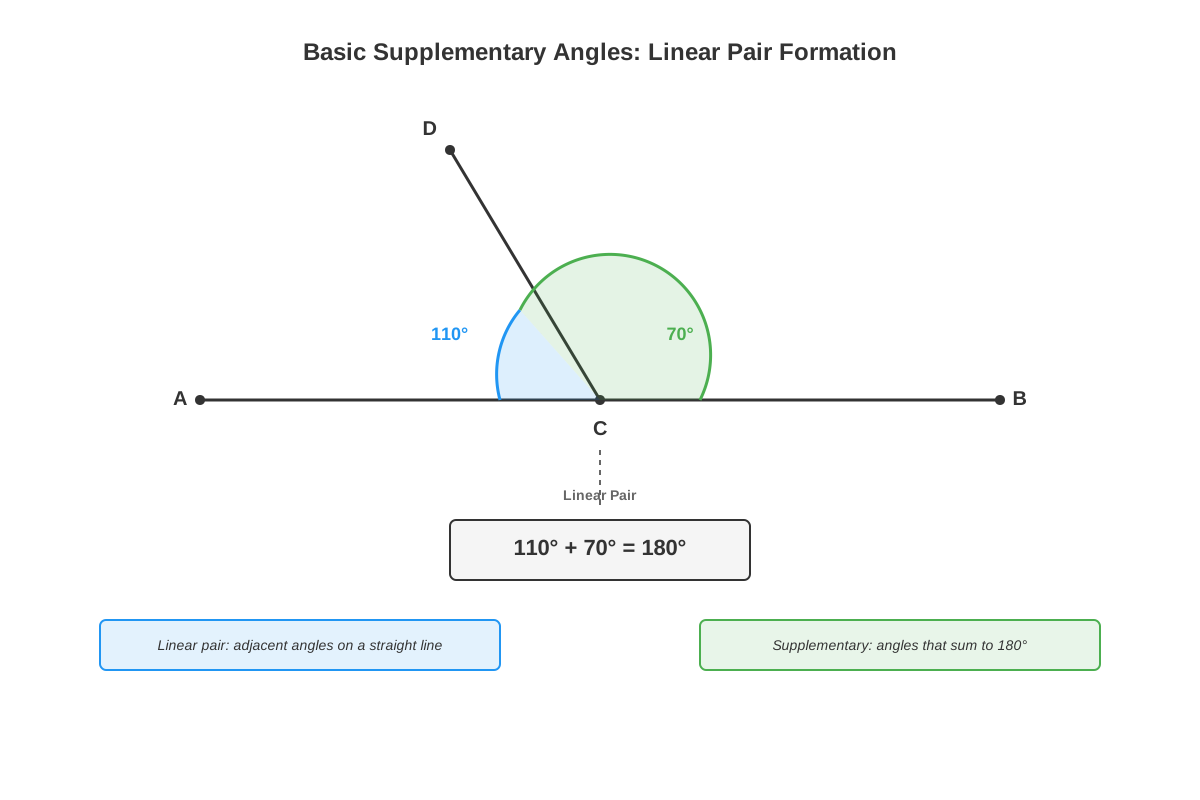
A linear pair consists of two adjacent angles whose non-common sides form a straight line. Linear pairs are always supplementary because a straight line represents a 180-degree angle. When two lines intersect or when a single line is divided by a ray extending from a point on that line, linear pairs are formed.
Consider a straight line with a ray extending upward from a point on that line. This ray divides the 180-degree straight angle into two adjacent angles. These two angles must sum to 180 degrees because together they comprise the entire straight line. This is the most common way supplementary angles appear on the GRE—as angles that visually form a straight line in a diagram.
The distinction between "supplementary angles" and "linear pairs" is important: all linear pairs are supplementary, but not all supplementary angles form linear pairs. Two angles can be supplementary without being adjacent or even appearing in the same diagram.
Algebraic Applications
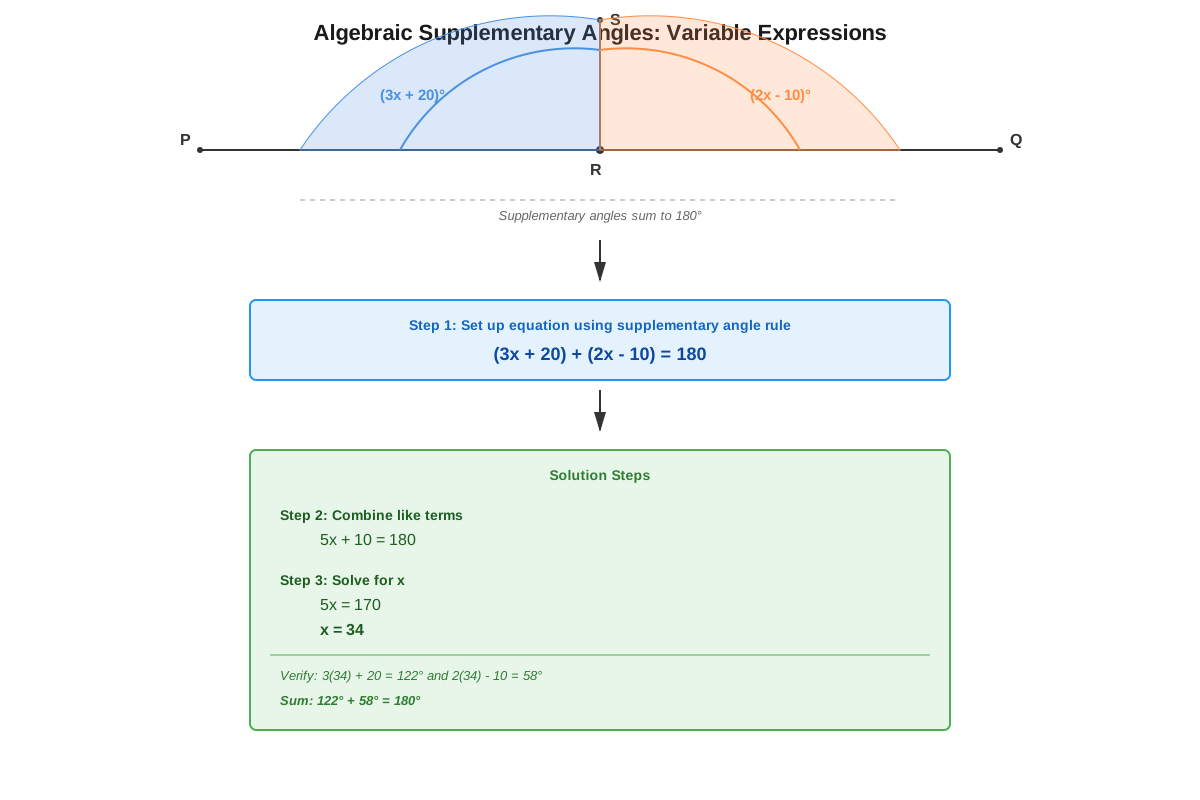
GRE questions frequently express angle measures using algebraic expressions rather than numerical values. When working with supplementary angles algebraically, students must set up equations based on the 180-degree sum and solve for unknown variables.
Example setup: If two supplementary angles are expressed as (3x + 10)° and (2x - 5)°, the equation becomes:
(3x + 10) + (2x - 5) = 180
5x + 5 = 180
5x = 175
x = 35
After finding x, students must often substitute back to find the actual angle measures: one angle is 3(35) + 10 = 115°, and the other is 2(35) - 5 = 65°. Verification confirms: 115° + 65° = 180°.
Supplementary Angles in Complex Figures
Supplementary angle relationships appear within more complex geometric configurations:
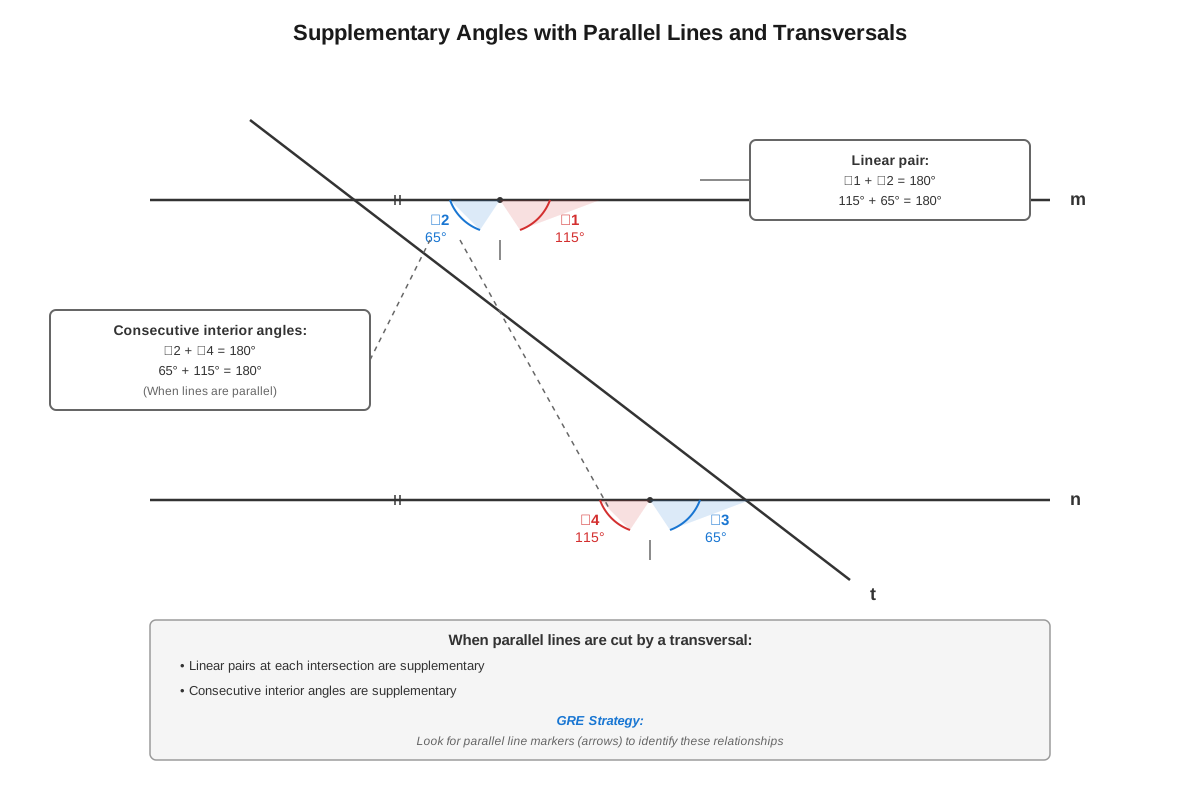
Parallel lines with transversals: When a transversal crosses two parallel lines, several angle pairs are created. While corresponding angles are equal and alternate interior angles are equal, consecutive interior angles (also called co-interior angles or same-side interior angles) are supplementary. This relationship is crucial for solving multi-step problems involving parallel lines.
Polygons: Each exterior angle of a polygon is supplementary to its adjacent interior angle. This relationship allows students to move between interior and exterior angle measures, which is essential for polygon problems.
Intersecting chords and secants in circles: When lines intersect within or outside circles, supplementary angle relationships often emerge, particularly when combined with inscribed angle theorems.
Comparison with Complementary Angles
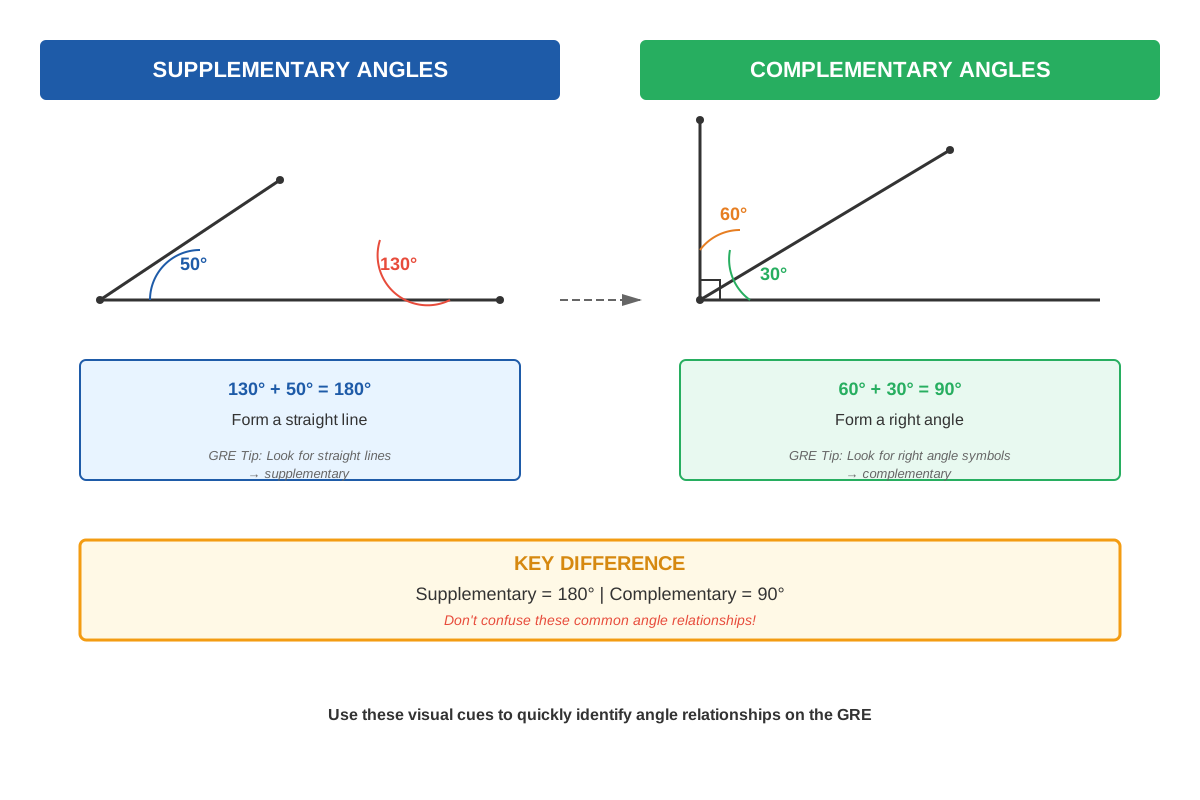
Understanding the distinction between supplementary and complementary angles prevents common errors:
| Angle Relationship | Sum | Example Pair | Common Context |
|---|---|---|---|
| Complementary | 90° | 30° and 60° | Right triangles, perpendicular lines |
| Supplementary | 180° | 65° and 115° | Straight lines, linear pairs |
The GRE occasionally tests whether students can distinguish between these relationships, particularly in Quantitative Comparison questions where one quantity involves complementary angles and another involves supplementary angles.
Multiple Supplementary Relationships
Complex GRE problems may involve chains of supplementary relationships. For example, if angle A is supplementary to angle B, and angle B is supplementary to angle C, then angles A and C are equal (both equal 180° - B). Recognizing these transitive relationships allows students to solve problems with multiple unknowns by creating systems of equations.
Concept Relationships
The concept of supplementary angles serves as a central hub connecting multiple geometric principles. At its foundation, supplementary angles derive from the straight angle concept (180 degrees), which itself stems from the definition of angular measurement. This relationship flows directly into linear pairs, which are the most common manifestation of supplementary angles on the GRE.
Moving outward, supplementary angles connect to vertical angles through intersecting lines: when two lines intersect, they create two pairs of vertical angles and four linear pairs. Understanding that adjacent angles at an intersection are supplementary while opposite angles are equal provides a complete picture of angle relationships at intersections.
The concept extends to parallel lines and transversals, where consecutive interior angles are supplementary. This connection is crucial: Parallel lines → Transversal creates angle pairs → Consecutive interior angles are supplementary → Can solve for unknown angles. This chain of reasoning appears frequently in medium and hard GRE geometry questions.
Supplementary angles also connect to polygon geometry through the relationship between interior and exterior angles. Each exterior angle is supplementary to its adjacent interior angle, creating the pathway: Interior angle + Exterior angle = 180° → Sum of exterior angles = 360° → Can determine number of sides or individual angle measures.
The relationship map flows as follows:
Straight Angle (180°) → Supplementary Angles → Linear Pairs → Intersecting Lines → Vertical Angles
Supplementary Angles → Parallel Lines with Transversals → Consecutive Interior Angles
Supplementary Angles → Polygon Interior/Exterior Angles → Polygon Angle Sum Theorems
Supplementary Angles → Algebraic Expressions → Equation Solving → Finding Unknown Angles
High-Yield Facts
⭐ Two angles are supplementary if and only if their measures sum to exactly 180 degrees
⭐ All linear pairs (adjacent angles forming a straight line) are supplementary
⭐ Consecutive interior angles formed by a transversal cutting parallel lines are supplementary
⭐ Each exterior angle of a polygon is supplementary to its adjacent interior angle
⭐ If two angles are each supplementary to the same angle, they are equal to each other
- Supplementary angles do not need to be adjacent or even in the same diagram
- The supplement of an acute angle is always obtuse
- The supplement of an obtuse angle is always acute
- The supplement of a right angle is another right angle (90° + 90° = 180°)
- When solving for x in supplementary angle problems, always verify that both resulting angles are positive and sum to 180°
- In Quantitative Comparison questions, recognizing supplementary relationships can often determine the answer without calculation
- Supplementary angles cannot both be obtuse (since two obtuse angles would sum to more than 180°)
- If an angle measures x degrees, its supplement measures (180 - x) degrees
Quick check — test yourself on Supplementary angles so far.
Try Flashcards →Common Misconceptions
Misconception: Supplementary angles must be adjacent to each other.
Correction: Supplementary angles only need to sum to 180 degrees; they can be anywhere in space. While linear pairs are both supplementary AND adjacent, two non-adjacent angles can also be supplementary if their measures sum to 180°.
Misconception: Supplementary angles and complementary angles are interchangeable terms.
Correction: Complementary angles sum to 90 degrees, while supplementary angles sum to 180 degrees. These are distinct relationships that apply in different geometric contexts. Confusing these terms leads to incorrect equation setup and wrong answers.
Misconception: When two lines intersect, all four angles formed are supplementary to each other.
Correction: At an intersection, only adjacent angles are supplementary (forming linear pairs). Opposite angles (vertical angles) are equal, not supplementary. Each angle is supplementary to the two angles adjacent to it, but not to the angle opposite it.
Misconception: If two angles look like they form a straight line in a diagram, they must be supplementary.
Correction: While this is often true, GRE diagrams include the warning "figure not drawn to scale." Never assume angles are supplementary based solely on appearance; look for explicit indicators like a straight line marking, parallel line markings, or given angle measures that confirm the relationship.
Misconception: The supplement of an angle is always smaller than the original angle.
Correction: The supplement is smaller only when the original angle is greater than 90 degrees. If the original angle is acute (less than 90°), its supplement is obtuse (greater than 90°) and therefore larger. For example, the supplement of 30° is 150°, which is larger than the original angle.
Misconception: In algebraic problems, finding the value of x completes the problem.
Correction: Many GRE questions ask for the measure of a specific angle, not the value of the variable. After solving for x, students must substitute back into the appropriate expression to find the requested angle measure. Always read what the question actually asks for.
Worked Examples
Example 1: Basic Algebraic Application
Problem: Two supplementary angles are in the ratio 2:3. What is the measure of the larger angle?
Solution:
Step 1: Set up the relationship using the ratio. If the angles are in ratio 2:3, we can express them as 2x and 3x for some positive value x.
Step 2: Apply the supplementary angle definition:
2x + 3x = 180°
5x = 180°
x = 36°
Step 3: Find both angle measures:
- Smaller angle: 2x = 2(36°) = 72°
- Larger angle: 3x = 3(36°) = 108°
Step 4: Verify the answer:
- Check that they sum to 180°: 72° + 108° = 180° ✓
- Identify the larger angle: 108°
Answer: The larger angle measures 108°.
Connection to learning objectives: This problem demonstrates the core strategy of setting up an equation based on the supplementary angle definition and solving algebraically. It also shows the importance of reading carefully—the question asks for the larger angle specifically, not the value of x.
Example 2: Complex Diagram with Multiple Relationships
Problem: In the figure below (described), line AB is straight, and ray CD intersects it at point C. Angle ACD measures (4x - 20)°, and angle DCB measures (2x + 40)°. Additionally, ray CE bisects angle DCB. What is the measure of angle DCE?
Solution:
Step 1: Recognize that angles ACD and DCB form a linear pair on straight line AB, so they are supplementary:
(4x - 20) + (2x + 40) = 180
6x + 20 = 180
6x = 160
x = 26.67° (or 80/3)
Step 2: Find the measure of angle DCB:
DCB = 2x + 40 = 2(80/3) + 40 = 160/3 + 120/3 = 280/3 ≈ 93.33°Step 3: Since CE bisects angle DCB, angle DCE is half of angle DCB:
DCE = (1/2) × DCB = (1/2) × (280/3) = 140/3 ≈ 46.67°Step 4: Verify by checking angle ACD:
ACD = 4x - 20 = 4(80/3) - 20 = 320/3 - 60/3 = 260/3 ≈ 86.67°
ACD + DCB = 260/3 + 280/3 = 540/3 = 180° ✓Answer: Angle DCE measures 140/3 degrees (or approximately 46.67°, or 46°40').
Connection to learning objectives: This problem requires identifying the supplementary relationship (linear pair on line AB), setting up and solving an algebraic equation, and then applying an additional geometric property (angle bisector). It demonstrates how supplementary angles often appear as one step in multi-step GRE problems.
Exam Strategy
When approaching GRE questions involving supplementary angles, follow this systematic strategy:
Recognition triggers: Watch for these visual and verbal cues that indicate supplementary angles are being tested:
- The phrase "forms a straight line" or "lies on a line"
- Diagrams showing angles that appear to form a straight line (even if not drawn to scale)
- Problems involving "linear pair" explicitly
- Questions about parallel lines with transversals asking about "consecutive interior angles" or "co-interior angles"
- Polygon problems asking about exterior angles
- Any problem stating two angles "sum to 180 degrees"
Approach sequence:
- Identify the relationship: Determine which angles are supplementary by looking for linear pairs, parallel line configurations, or explicit statements.
- Set up the equation: If angle measures are given algebraically, write the equation: angle₁ + angle₂ = 180°.
- Solve systematically: Use algebraic techniques to find unknown variables, being careful with negative signs and distribution.
- Find what's asked: Don't stop at finding x—substitute back to find the specific angle measure requested.
- Verify when possible: Check that your angles sum to 180° and that both angles are positive and reasonable.
Quantitative Comparison strategy: When comparing quantities involving supplementary angles:
- If one quantity is an angle and the other is its supplement, immediately recognize that the larger angle is the one greater than 90°
- If both quantities involve expressions with the same variable, set up the supplementary equation to find the variable, then evaluate both quantities
- Look for relationships that make the quantities equal (such as both angles being 90°)
Time management: Straightforward supplementary angle problems should take 45-60 seconds. If a problem involves supplementary angles as part of a more complex geometric figure, allocate 90-120 seconds. Don't spend excessive time on verification unless you're uncertain—trust your setup and move forward.
Process of elimination: In multiple-choice questions, eliminate answers that:
- Would make the angle sum exceed 180° or fall short of 180°
- Result in negative angle measures
- Produce two obtuse angles (impossible for supplementary angles)
- Don't match the ratio or relationship described in the problem
Memory Techniques
Mnemonic for Supplementary vs. Complementary:
- Supplementary = Straight line = 180 (the "S" in Supplementary reminds you of Straight)
- Complementary = Corner (right angle) = 90 (the "C" in Complementary reminds you of Corner)
Visual memory aid: Picture a straight line as a "supplement" that "completes" or "supplements" the angle to form a full straight angle. The word "supplement" means "something added to complete," which reinforces that you're adding to reach 180°.
Algebraic setup mnemonic: "Sum To One-Eighty" (STOE)
- Set up the angles
- Total them
- One-eighty is the target
- Equate and solve
Linear pair memory: "Linear Pairs Always Supplement" (LPAS) - Linear Pairs Always Supplement reminds you that any linear pair is automatically supplementary.
Ratio problem technique: When angles are given in a ratio like a:b, remember "Ratio Parts Make X" (RPMX):
- Ratio parts: ax and bx
- Parts sum: ax + bx
- Make 180: ax + bx = 180
- X is found: solve for x
Summary
Supplementary angles—two angles whose measures sum to exactly 180 degrees—represent a foundational concept that appears throughout GRE Quantitative Reasoning geometry questions. Mastery requires understanding that supplementary relationships exist whenever angles form a linear pair along a straight line, when consecutive interior angles are created by a transversal crossing parallel lines, and when exterior angles of polygons relate to their adjacent interior angles. The GRE tests this concept both directly through straightforward angle calculation problems and indirectly by embedding supplementary relationships within complex multi-step problems involving algebraic expressions, parallel lines, polygons, and coordinate geometry. Success depends on quickly recognizing when supplementary angles are present, accurately setting up equations based on the 180-degree sum, solving algebraically for unknown variables, and carefully identifying which specific angle measure the question requests. Students must distinguish supplementary angles (sum to 180°) from complementary angles (sum to 90°) and remember that while all linear pairs are supplementary, supplementary angles need not be adjacent. The ability to identify and apply supplementary angle relationships efficiently provides a significant advantage on the GRE, as this concept appears in approximately 15-20% of geometry questions across multiple question formats.
Key Takeaways
- Supplementary angles always sum to exactly 180 degrees, whether adjacent or non-adjacent
- Linear pairs (adjacent angles on a straight line) are always supplementary, making this the most common visual presentation on the GRE
- Consecutive interior angles formed by parallel lines and a transversal are supplementary, connecting this concept to parallel line problems
- Each exterior angle of a polygon is supplementary to its adjacent interior angle, linking supplementary angles to polygon geometry
- Algebraic problems require setting up the equation angle₁ + angle₂ = 180° and solving for variables, then substituting to find requested angle measures
- Supplementary angles cannot both be obtuse, and the supplement of an acute angle is always obtuse
- Recognition of supplementary relationships often provides the key insight needed to solve complex multi-step GRE geometry problems
Related Topics
Complementary Angles: Understanding angles that sum to 90 degrees provides important contrast with supplementary angles and appears in right triangle problems and perpendicular line contexts. Mastering supplementary angles makes learning complementary angles straightforward through comparison.
Vertical Angles: When two lines intersect, vertical angles are equal while adjacent angles are supplementary. These concepts work together to solve intersection problems and appear frequently in the same GRE questions.
Parallel Lines and Transversals: Supplementary angle mastery is essential for understanding consecutive interior angles, which are supplementary when lines are parallel. This topic builds directly on supplementary angle concepts.
Polygon Angle Sums: The relationship between interior and exterior angles (which are supplementary) leads to formulas for polygon angle sums. Supplementary angles provide the foundation for understanding why exterior angles sum to 360°.
Coordinate Geometry: Lines in the coordinate plane create angles with axes and with each other. Supplementary angle relationships help determine slopes and angle measures in coordinate problems.
Practice CTA
Now that you've mastered the concept of supplementary angles, it's time to reinforce your understanding through active practice. Attempt the practice questions associated with this topic, focusing on recognizing supplementary relationships quickly and setting up equations accurately. Use the flashcards to drill the key facts until they become automatic—speed of recognition is crucial for GRE success. Remember that geometry concepts build on each other, and your solid understanding of supplementary angles will make subsequent topics significantly easier to master. Approach each practice problem as an opportunity to refine your strategy and build confidence. You're developing skills that will serve you throughout the Quantitative Reasoning section!
Sign up free to keep reading
Create a free AnvayaPrep account to finish this GRE guide on Supplementary angles — plus flashcards and practice questions.