Overview
Geometry word problems represent one of the most frequently tested question types on the GRE Quantitative Reasoning section, appearing in approximately 20-25% of all geometry questions. These problems challenge test-takers to translate verbal descriptions of geometric situations into mathematical relationships, diagrams, and calculations. Unlike straightforward computational geometry questions, GRE geometry word problems require students to synthesize multiple geometric concepts, identify relevant information from complex scenarios, and apply appropriate formulas and strategies to reach solutions.
The complexity of geometry word problems lies not in advanced mathematical concepts but in the translation process itself. Students must decode verbal descriptions involving shapes, measurements, spatial relationships, and constraints, then construct a mental or physical representation that allows for problem-solving. These questions test both geometric knowledge and critical reading skills, making them particularly challenging under timed conditions. Success requires recognizing common problem patterns, efficiently extracting key information, and selecting the most direct solution path among multiple possibilities.
Mastering geometry word problems is essential for achieving competitive GRE scores because these questions integrate multiple Quantitative Reasoning skills simultaneously. They connect pure geometric knowledge (areas, perimeters, angles, volumes) with algebraic reasoning, proportional thinking, and logical deduction. Furthermore, the problem-solving strategies developed for geometry word problems—careful reading, diagram construction, systematic variable assignment—transfer directly to other challenging GRE question types, including data interpretation and quantitative comparison questions.
Learning Objectives
- [ ] Identify when Geometry word problems is being tested
- [ ] Explain the core rule or strategy behind Geometry word problems
- [ ] Apply Geometry word problems to GRE-style questions accurately
- [ ] Construct accurate diagrams from verbal descriptions of geometric scenarios
- [ ] Distinguish between relevant and irrelevant information in complex word problems
- [ ] Recognize the five most common geometry word problem patterns on the GRE
- [ ] Execute multi-step solutions that combine multiple geometric formulas and concepts
Prerequisites
- Basic geometric formulas: Area, perimeter, circumference, and volume formulas for common shapes are essential building blocks for solving word problems
- Coordinate geometry fundamentals: Understanding the coordinate plane, distance formula, and slope enables solving problems involving positioned shapes
- Angle relationships: Knowledge of complementary, supplementary, vertical, and parallel line angles is necessary for problems involving angular measurements
- Properties of triangles, circles, and quadrilaterals: Familiarity with special properties (e.g., Pythagorean theorem, circle theorems) allows quick recognition of solution paths
- Algebraic equation-solving: The ability to set up and solve equations with one or multiple variables is required to translate geometric relationships into solvable problems
Why This Topic Matters
Geometry word problems appear in 4-6 questions per GRE Quantitative section, making them one of the highest-yield topics for focused study. The Educational Testing Service (ETS) deliberately uses these questions to differentiate between mid-range and high-scoring test-takers, as they require both conceptual understanding and application skills. Students who master this topic typically see score improvements of 2-4 points in the Quantitative section.
Beyond the exam, the skills developed through geometry word problems have practical applications in fields ranging from architecture and engineering to data visualization and spatial reasoning tasks. The ability to translate verbal descriptions into visual representations is fundamental to technical communication, design thinking, and problem-solving across STEM disciplines.
On the GRE, geometry word problems commonly appear as:
- Quantitative Comparison questions asking students to compare geometric measurements described verbally
- Multiple-choice questions requiring calculation of specific measurements from word-based scenarios
- Numeric entry questions demanding precise answers derived from complex geometric situations
- Data Interpretation questions combining geometric concepts with graphs or tables
The most frequently tested scenarios involve rectangular plots and fencing, circular gardens and paths, overlapping shapes, three-dimensional containers, and scale drawings or maps.
Core Concepts
The Translation Process
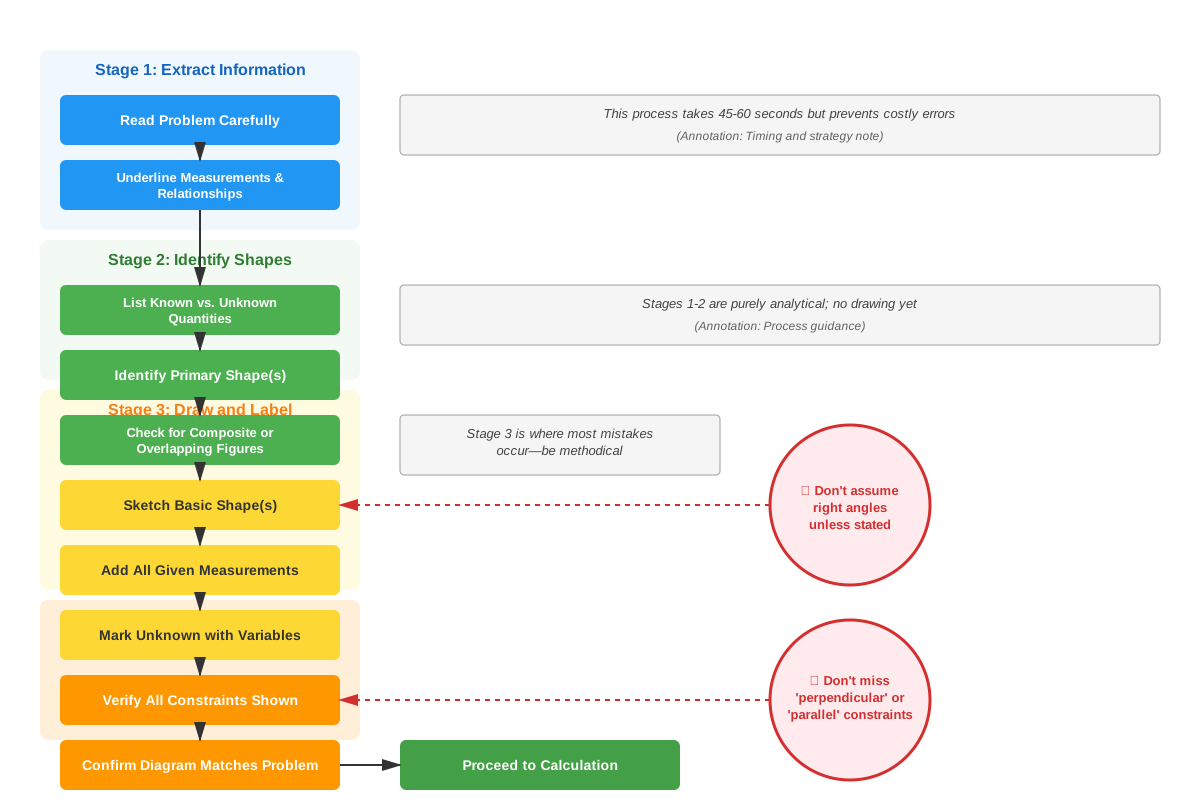
The fundamental skill in solving geometry word problems is systematic translation from verbal description to mathematical representation. This process involves four distinct stages:
- Careful reading: Identify all geometric objects, measurements, and relationships mentioned
- Diagram construction: Create an accurate visual representation with labels
- Variable assignment: Define unknowns and express relationships algebraically
- Formula application: Select and apply appropriate geometric formulas to solve
The translation process is non-negotiable for success. Students who attempt to solve geometry word problems mentally or skip diagram construction make significantly more errors and consume more time than those who follow this systematic approach.
Common Geometric Scenarios
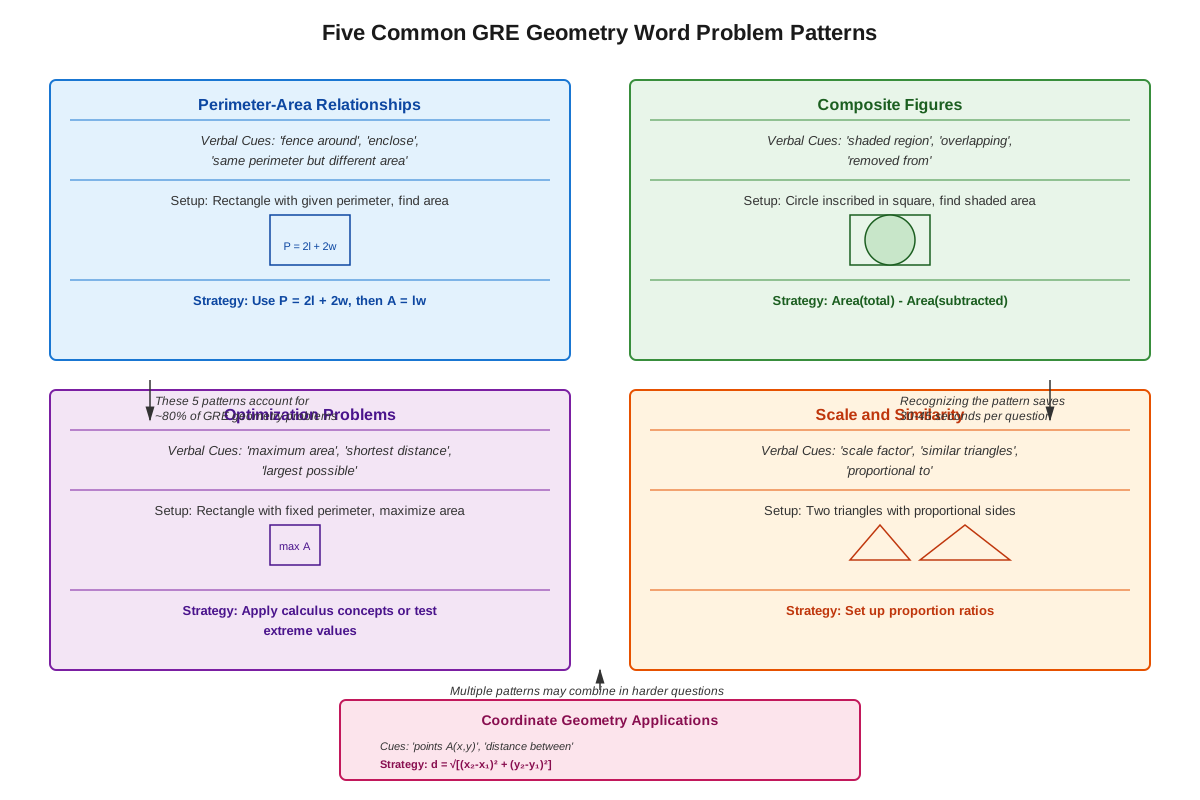
GRE geometry word problems typically fall into five high-frequency categories:
| Scenario Type | Key Features | Common Formulas |
|---|---|---|
| Perimeter/Fencing Problems | Enclosing regions, borders, boundaries | P = 2l + 2w, C = 2πr |
| Area/Coverage Problems | Painting, carpeting, tiling, land plots | A = lw, A = πr², A = ½bh |
| Path/Border Problems | Walkways around shapes, frames, margins | Nested shape formulas |
| Volume/Capacity Problems | Filling containers, packing, storage | V = lwh, V = πr²h |
| Scale/Proportion Problems | Maps, models, similar figures | Ratio relationships |
Perimeter and Fencing Problems
These problems describe situations where the boundary of a region must be calculated or constrained. The key insight is recognizing that perimeter represents the total distance around a shape's exterior. Common variations include:
- Finding the amount of fencing needed to enclose a rectangular garden
- Determining dimensions when given a fixed perimeter
- Calculating the perimeter of composite shapes (multiple rectangles joined together)
- Comparing perimeters of different configurations with the same area
Critical strategy: When a problem states "a rectangular region" without specifying dimensions, consider that multiple length-width combinations may satisfy the constraints. The problem will typically provide additional information (area, ratio of sides, or optimization requirement) to determine unique dimensions.
Area and Coverage Problems
Area problems require calculating the two-dimensional space within a boundary. These questions often involve:
- Determining how much material (paint, carpet, tile) covers a surface
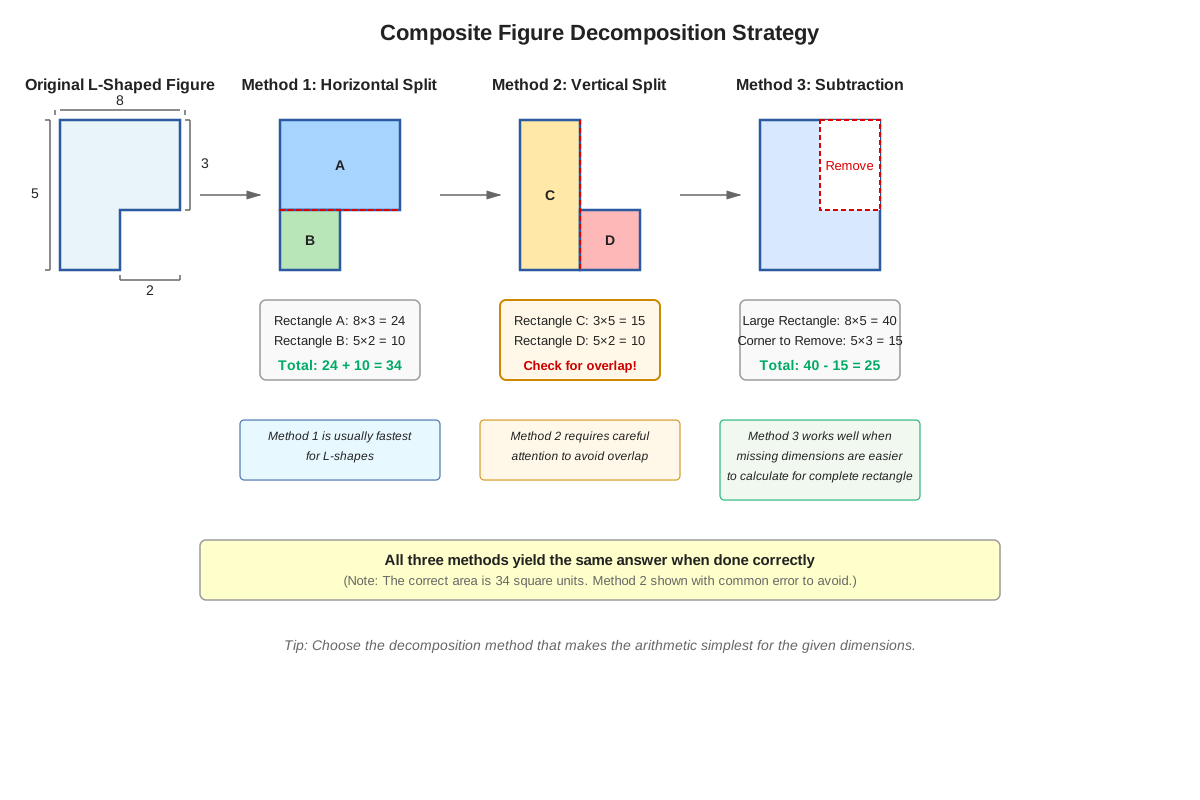
- Finding the area of irregular shapes by decomposition into standard shapes
- Calculating remaining area after removing portions (e.g., a circular pool in a rectangular yard)
- Comparing areas of different configurations
Critical strategy: For composite shapes, identify whether to add areas (separate regions) or subtract areas (one shape removed from another). Drawing clear boundaries between regions prevents calculation errors.
Path and Border Problems
A distinctive GRE favorite involves shapes with borders, frames, or paths around them. These problems describe a shape with a uniform-width border surrounding it, requiring calculation of the border's area or the outer shape's dimensions.
Solution approach:
- Draw the inner shape with given dimensions
- Add the border width to all sides (remember: width affects both sides, so add 2× the width to linear dimensions)
- Calculate outer shape dimensions
- Find border area by subtracting inner area from outer area
Example scenario: "A rectangular garden measuring 20 feet by 30 feet is surrounded by a uniform path 2 feet wide. What is the area of the path?"
- Inner rectangle: 20 × 30 = 600 sq ft
- Outer rectangle: (20 + 4) × (30 + 4) = 24 × 34 = 816 sq ft
- Path area: 816 - 600 = 216 sq ft
Volume and Three-Dimensional Problems
Volume problems extend area concepts into three dimensions. The GRE tests:
- Rectangular containers (boxes, rooms, tanks): V = length × width × height
- Cylindrical containers (cans, pipes, wells): V = πr²h
- Capacity problems involving filling or emptying containers
- Surface area of three-dimensional objects
Critical strategy: Distinguish between volume (space inside) and surface area (total area of all faces). The problem will specify which measurement is needed, often through context clues like "holds," "contains," or "capacity" for volume versus "paint," "wrap," or "cover" for surface area.
Scale and Proportion Problems
These problems involve similar figures, maps, or models where corresponding dimensions maintain constant ratios. Key principles:
- If the scale factor between similar figures is k, then areas scale by k² and volumes by k³
- Map problems provide a scale (e.g., "1 inch = 50 miles") requiring conversion between map measurements and actual distances
- Similar triangle problems use proportional sides to find unknown measurements
Critical strategy: Set up proportions carefully, ensuring corresponding measurements occupy corresponding positions in the ratio. For area and volume problems, remember to square or cube the linear scale factor.
Multi-Step Integration Problems
The most challenging GRE geometry word problems require combining multiple concepts in sequence. These problems might:
- Require finding one measurement (e.g., radius) before calculating another (e.g., area)
- Involve both two-dimensional and three-dimensional calculations
- Combine geometric and algebraic reasoning (setting up equations with geometric constraints)
- Present optimization scenarios (maximum area for given perimeter)
Solution approach: Break complex problems into discrete steps, solving for intermediate values before proceeding to the final answer. Write down each intermediate result to avoid calculation errors and enable checking work if time permits.
Concept Relationships
The concepts within geometry word problems form a hierarchical structure. The translation process serves as the foundation, enabling all other problem-solving activities. From this base, students must master the five common geometric scenarios, each representing a distinct problem pattern with characteristic features and solution approaches.
Perimeter and area problems form a complementary pair, often appearing together in problems that constrain one measurement while asking for the other. Path and border problems represent a specialized application of area concepts, requiring subtraction of nested shapes. Volume problems extend area reasoning into three dimensions, while scale and proportion problems apply multiplicative relationships across all measurement types.
The relationship map flows as follows:
Translation Process → enables → Scenario Recognition → determines → Formula Selection → combined with → Multi-Step Integration → produces → Solution
Connections to prerequisite topics are direct: basic geometric formulas provide the computational tools, coordinate geometry enables problems involving positioned shapes, angle relationships support problems with angular constraints, and algebraic equation-solving allows translation of geometric relationships into solvable equations.
Mastery of geometry word problems enables progression to more advanced topics including coordinate geometry word problems, optimization problems in geometry, and data sufficiency questions with geometric content.
Quick check — test yourself on Geometry word problems so far.
Try Flashcards →High-Yield Facts
⭐ The GRE tests geometry word problems in approximately 20-25% of geometry questions, making them one of the highest-yield topics for focused study.
⭐ Always draw a diagram, even if the problem provides one—creating your own representation with clear labels prevents misinterpretation and reveals solution paths.
⭐ When a path or border surrounds a shape, add twice the border width to each linear dimension (once for each side) before calculating the outer shape's measurements.
⭐ Perimeter and area are independent—shapes with identical perimeters can have vastly different areas, and vice versa.
⭐ In scale problems, areas scale by the square of the linear scale factor, and volumes scale by the cube of the linear scale factor.
- Composite shapes should be decomposed into standard shapes (rectangles, triangles, circles) whose formulas are known and easily applied.
- The phrase "uniform width" or "uniform border" signals a path/border problem requiring calculation of nested shapes.
- Volume problems use context clues: "holds," "contains," and "capacity" indicate volume, while "paint," "wrap," and "cover" indicate surface area.
- When dimensions aren't specified, the problem will provide constraints (area, perimeter, ratio) that determine unique values or allow comparison.
- Optimization problems (maximum area for given perimeter) for rectangles occur when the shape is a square; for fixed perimeter, the square has maximum area.
- The area of a path around a rectangular shape equals the perimeter of the inner rectangle times the path width, plus four corner squares: A_path = P_inner × w + 4w².
- Three-dimensional problems often require finding a two-dimensional measurement first (e.g., finding the base area before calculating volume).
Common Misconceptions
Misconception: When a 2-foot-wide path surrounds a shape, add 2 feet to each dimension of the inner shape to find outer dimensions.
Correction: Add twice the path width (4 feet) to each dimension because the path extends on both sides. A 10×15 rectangle with a 2-foot path becomes 14×19, not 12×17.
Misconception: If two shapes have the same perimeter, they have the same area.
Correction: Perimeter and area are independent measurements. A 1×9 rectangle and a 5×5 square both have perimeter 20, but their areas are 9 and 25 square units respectively.
Misconception: In scale problems, if linear dimensions double, area also doubles.
Correction: Area scales by the square of the linear scale factor. If dimensions double (scale factor = 2), area quadruples (2² = 4). If dimensions triple, area increases ninefold.
Misconception: The area of a border around a shape equals the perimeter of the inner shape times the border width.
Correction: This formula works only for thin borders. The complete formula includes corner regions: A_border = P_inner × w + 4w² for rectangular shapes. For thick borders, calculating outer area minus inner area is more reliable.
Misconception: Volume and surface area are interchangeable concepts for three-dimensional objects.
Correction: Volume measures the space inside a three-dimensional object (cubic units), while surface area measures the total area of all exterior faces (square units). They require different formulas and represent fundamentally different measurements.
Misconception: Word problems always provide exactly the information needed, no more and no less.
Correction: GRE geometry word problems often include extraneous information to test reading comprehension and information filtering. Identifying relevant versus irrelevant data is part of the challenge.
Worked Examples
Example 1: Path Around a Rectangular Garden
Problem: A rectangular garden measures 30 feet by 40 feet. A uniform path 3 feet wide surrounds the garden. What is the area of the path?
Solution:
Step 1 - Draw and label a diagram: Sketch a rectangle (the garden) with another rectangle around it (the path). Label the inner rectangle 30 by 40.
Step 2 - Find outer rectangle dimensions: The path adds 3 feet on all sides. Since it extends on both the left and right, add 2(3) = 6 feet to the width. Similarly, add 6 feet to the length.
- Outer width: 30 + 6 = 36 feet
- Outer length: 40 + 6 = 46 feet
Step 3 - Calculate areas:
- Inner area (garden): 30 × 40 = 1,200 square feet
- Outer area (garden + path): 36 × 46 = 1,656 square feet
Step 4 - Find path area by subtraction:
- Path area = Outer area - Inner area = 1,656 - 1,200 = 456 square feet
Connection to learning objectives: This problem demonstrates the translation process (verbal description → diagram → calculation) and applies the core strategy for path problems (add twice the width to dimensions, then subtract areas).
Example 2: Multi-Step Volume and Cost Problem
Problem: A rectangular swimming pool is 25 meters long, 10 meters wide, and 2 meters deep. If water costs $0.003 per liter to fill the pool, what is the total cost to fill the pool? (1 cubic meter = 1,000 liters)
Solution:
Step 1 - Identify what's being asked: The problem asks for cost, which requires finding volume first, then converting units, then multiplying by unit cost.
Step 2 - Calculate pool volume:
- V = length × width × height
- V = 25 × 10 × 2 = 500 cubic meters
Step 3 - Convert to liters:
- 500 cubic meters × 1,000 liters/cubic meter = 500,000 liters
Step 4 - Calculate total cost:
- Cost = 500,000 liters × $0.003/liter = $1,500
Connection to learning objectives: This multi-step problem requires recognizing the volume scenario, applying the appropriate formula, performing unit conversion, and executing arithmetic operations in sequence—demonstrating the integration of multiple skills tested in GRE geometry word problems.
Example 3: Perimeter Constraint with Area Calculation
Problem: A rectangular plot of land has a perimeter of 120 meters. If the length is twice the width, what is the area of the plot?
Solution:
Step 1 - Define variables: Let w = width, then length = 2w (given relationship)
Step 2 - Set up perimeter equation:
- Perimeter = 2(length) + 2(width)
- 120 = 2(2w) + 2(w)
- 120 = 4w + 2w
- 120 = 6w
- w = 20 meters
Step 3 - Find length:
- length = 2w = 2(20) = 40 meters
Step 4 - Calculate area:
- Area = length × width = 40 × 20 = 800 square meters
Connection to learning objectives: This problem demonstrates how geometry word problems integrate algebraic reasoning (setting up and solving equations) with geometric formulas, requiring students to translate verbal constraints into mathematical relationships.
Exam Strategy
Approaching GRE Geometry Word Problems
Initial reading strategy: Read the entire problem once without attempting to solve, focusing on understanding the scenario and identifying what's being asked. On the second reading, extract and note specific measurements, relationships, and constraints.
Trigger words to recognize:
- "Surrounds," "around," "border," "frame" → Path/border problem
- "Enclose," "fence," "perimeter," "distance around" → Perimeter calculation
- "Cover," "paint," "carpet," "tile" → Area calculation
- "Holds," "contains," "capacity," "fill" → Volume calculation
- "Scale," "model," "map," "similar" → Proportion problem
Diagram construction protocol: Spend 15-30 seconds drawing a clear, labeled diagram for every geometry word problem. This investment saves time by preventing errors and revealing solution paths. Label all given measurements directly on the diagram and mark unknowns with variables.
Process-of-elimination tips:
- Eliminate answer choices with incorrect units (square units for area, cubic units for volume, linear units for perimeter)
- Check whether answers are reasonable given the context (e.g., a path area shouldn't exceed the total area)
- For quantitative comparison questions, test extreme cases (very small or very large values) to determine relationships
Time allocation: Budget 1.5-2 minutes per geometry word problem. If a problem requires more than 2.5 minutes, mark it for review and move forward. The systematic translation process, while initially time-consuming, becomes faster with practice and ultimately saves time by preventing false starts and calculation errors.
Common trap patterns: The GRE frequently includes answer choices representing common errors:
- Adding path width once instead of twice to dimensions
- Calculating the outer area instead of the border area
- Using linear scale factor instead of squared/cubed for area/volume
- Confusing perimeter with area or volume with surface area
Recognizing these traps allows quick elimination of incorrect choices.
Memory Techniques
PATH mnemonic for border problems:
- Plus twice the width
- Add to each dimension
- Total outer area
- Half (subtract) inner area
DRAW strategy for all geometry word problems:
- Diagram first, always
- Relationships identified
- Assign variables
- Write equations and solve
Scale factor memory aid: "Linear, Square, Cube" - remember that dimensions scale linearly, areas by the square, and volumes by the cube. Visualize: 1D → 2D → 3D corresponds to k → k² → k³.
Perimeter vs. Area distinction: "Perimeter is a trip AROUND (1D journey), Area is space INSIDE (2D coverage)." The dimensionality difference helps prevent confusion.
Volume context clues: "If it HOLDS or FILLS, it's volume. If it COVERS or WRAPS, it's surface area." The verb indicates which measurement to calculate.
Border width visualization: Picture a picture frame—the frame extends equally on all four sides, so a 2-inch frame adds 4 inches to both the height and width of the picture. This concrete image prevents the single-width error.
Summary
Geometry word problems constitute a high-yield GRE topic that tests the ability to translate verbal descriptions into mathematical representations and solutions. Success requires mastering a systematic four-step translation process: careful reading, diagram construction, variable assignment, and formula application. The five most common problem patterns—perimeter/fencing, area/coverage, path/border, volume/capacity, and scale/proportion—account for the vast majority of GRE geometry word problems. Path and border problems require particular attention to the principle of adding twice the border width to linear dimensions. Multi-step problems integrate multiple geometric concepts and often combine geometric and algebraic reasoning. The key to consistent accuracy is disciplined diagram construction, clear labeling, and systematic problem decomposition. Students who master these strategies and recognize common problem patterns can efficiently solve geometry word problems within the time constraints of the GRE, significantly improving their Quantitative Reasoning scores.
Key Takeaways
- Always construct a labeled diagram—this single habit prevents the majority of errors and reveals solution paths that aren't apparent from verbal descriptions alone
- Path and border problems require adding twice the border width to each linear dimension because borders extend on both sides
- Perimeter and area are independent measurements—identical perimeters don't imply identical areas, and vice versa
- Scale factors apply differently to different measurements: linearly to dimensions, squared to areas, cubed to volumes
- Context clues indicate measurement type: "holds/fills" signals volume, "covers/wraps" signals surface area, "enclose/fence" signals perimeter
- Multi-step problems require intermediate calculations—solve for necessary values in sequence before attempting the final answer
- The systematic translation process (read → diagram → variables → formulas) is non-negotiable for consistent accuracy under timed conditions
Related Topics
Coordinate Geometry Word Problems: Building on the translation skills developed here, these problems add the complexity of positioned shapes on the coordinate plane, requiring integration of distance formulas, slope concepts, and geometric properties.
Optimization Problems in Geometry: These advanced problems ask for maximum or minimum values (e.g., maximum area for a given perimeter), requiring understanding of geometric relationships and often calculus-based reasoning or systematic testing.
Data Sufficiency with Geometric Content: Mastering geometry word problems provides the foundation for data sufficiency questions, where determining whether given information is sufficient to solve a problem is more important than actually solving it.
Three-Dimensional Geometry: Extending the volume concepts introduced in word problems, this topic covers more complex three-dimensional shapes, surface area calculations, and spatial reasoning challenges.
Similar Figures and Proportional Reasoning: The scale and proportion concepts from word problems expand into detailed study of similar triangles, proportional sides, and applications to indirect measurement problems.
Practice CTA
Now that you've mastered the core concepts and strategies for GRE geometry word problems, it's time to solidify your understanding through active practice. Attempt the practice questions associated with this topic, focusing on applying the systematic translation process and recognizing the five common problem patterns. Use the flashcards to reinforce high-yield facts and formulas until they become automatic. Remember: geometry word problems reward systematic approaches over mathematical brilliance—your disciplined application of the strategies learned here will directly translate to points on test day. Each practice problem you solve builds the pattern recognition and confidence needed to tackle these questions efficiently under timed conditions.
Sign up free to keep reading
Create a free AnvayaPrep account to finish this GRE guide on Geometry word problems — plus flashcards and practice questions.