Overview
Triangles are among the most frequently tested geometric figures on the GRE Quantitative Reasoning section, appearing in approximately 15-20% of all geometry questions. Mastery of triangle properties, relationships, and problem-solving techniques is essential for achieving a competitive score. The GRE tests triangles not merely as isolated shapes but as fundamental building blocks that connect to coordinate geometry, area calculations, similarity and congruence principles, and even algebraic reasoning. Questions may present triangles explicitly or embed them within complex figures, requiring test-takers to recognize when triangle properties provide the key to solving seemingly unrelated problems.
Understanding GRE triangles extends beyond memorizing formulas—it requires developing spatial reasoning skills and recognizing patterns that appear across multiple question types. Triangle questions on the GRE range from straightforward applications of the Pythagorean theorem to sophisticated problems involving special right triangles, triangle inequality principles, and relationships between angles and sides. The exam frequently combines triangle concepts with other geometric figures, coordinate plane problems, and quantitative comparison questions where estimating relationships becomes more valuable than precise calculation.
The strategic importance of triangles in Quantitative Reasoning stems from their role as connective tissue linking various mathematical domains. Triangles appear in problems involving polygons (which can be decomposed into triangles), circles (through inscribed and circumscribed relationships), three-dimensional figures (as faces of pyramids and other solids), and optimization problems. A solid foundation in triangle properties enables efficient problem-solving across the entire geometry domain and provides tools for tackling Data Interpretation questions that involve geometric representations.
Learning Objectives
- [ ] Identify when Triangles is being tested
- [ ] Explain the core rule or strategy behind Triangles
- [ ] Apply Triangles to GRE-style questions accurately
- [ ] Distinguish between different triangle classifications and apply appropriate properties to each type
- [ ] Recognize and efficiently solve problems involving special right triangles (30-60-90 and 45-45-90)
- [ ] Apply the triangle inequality theorem to determine possible side lengths and eliminate impossible answer choices
- [ ] Calculate areas using multiple methods and select the most efficient approach based on given information
Prerequisites
- Basic angle relationships: Understanding supplementary, complementary, and vertical angles is essential because triangle problems frequently involve exterior angles and angle relationships within and around triangles
- Algebraic manipulation: Setting up and solving equations with one or more variables appears in nearly every triangle problem, particularly when working with unknown side lengths or angle measures
- Square roots and exponents: The Pythagorean theorem and distance calculations require comfort with radical expressions and simplification techniques
- Coordinate plane fundamentals: Many triangle problems place vertices at coordinate points, requiring the ability to calculate distances and visualize geometric relationships on a grid
Why This Topic Matters
Triangle problems appear with remarkable consistency on the GRE, making them one of the highest-yield geometry topics for focused study. Approximately 3-5 questions per exam directly test triangle properties, while many additional questions incorporate triangles as components of more complex scenarios. The GRE particularly favors questions that test multiple concepts simultaneously—for example, combining triangle area calculations with coordinate geometry, or using similar triangles within data interpretation contexts.
In real-world applications, triangular relationships underpin structural engineering, navigation systems, computer graphics, and surveying. The principles tested on the GRE—particularly those involving right triangles and trigonometric relationships—form the foundation for fields ranging from architecture to physics. Understanding how triangles maintain structural integrity explains why this shape appears so frequently in bridges, roof trusses, and support frameworks.
On the exam, triangle concepts appear across multiple question formats: Quantitative Comparison questions often ask test-takers to compare triangle measurements without requiring exact calculations; Multiple Choice questions may test special triangle properties or area calculations; and Numeric Entry questions frequently involve applying the Pythagorean theorem or calculating specific measurements. The GRE also embeds triangles within word problems, data interpretation sets, and geometric diagrams where recognizing the presence of triangles becomes the first critical step toward solution.
Core Concepts
Fundamental Triangle Properties
A triangle is a closed three-sided polygon with three interior angles. The most fundamental property states that the sum of interior angles in any triangle always equals 180 degrees. This angle sum property serves as the foundation for countless GRE problems and enables test-takers to find unknown angles when two angles are known. The relationship can be expressed as: if a triangle has angles A, B, and C, then A + B + C = 180°.
The exterior angle of a triangle equals the sum of the two non-adjacent interior angles. This property provides an alternative approach to many angle problems and often simplifies calculations. When a side of a triangle is extended, the exterior angle formed relates directly to the interior angles, creating relationships that the GRE exploits in both straightforward and disguised formats.
Triangle Classification by Sides
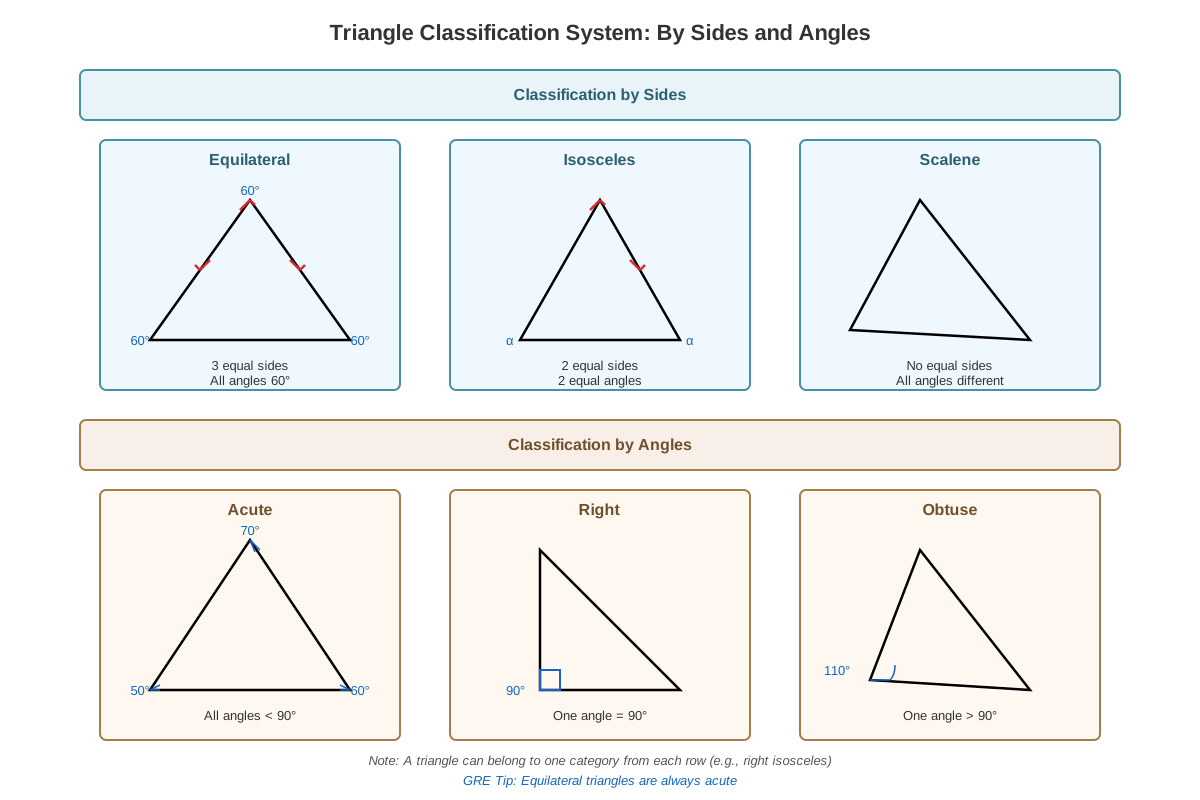
Triangles are classified by their side relationships into three categories:
- Equilateral triangles: All three sides have equal length, and all three angles measure 60 degrees. These triangles possess maximum symmetry and frequently appear in GRE problems involving regular hexagons or tessellation patterns.
- Isosceles triangles: Exactly two sides have equal length, and the angles opposite these equal sides (called base angles) are also equal. The GRE often provides information about one base angle and expects test-takers to recognize that the other base angle must be equal.
- Scalene triangles: All three sides have different lengths, and all three angles have different measures. These triangles have no special symmetry properties but still obey all fundamental triangle rules.
Triangle Classification by Angles
Triangles can also be categorized by their largest angle:
- Acute triangles: All three angles measure less than 90 degrees. Every angle is acute, and the triangle appears "sharp" with no right or obtuse angles.
- Right triangles: Exactly one angle measures 90 degrees. Right triangles are the most frequently tested triangle type on the GRE due to their connection with the Pythagorean theorem and special right triangle ratios.
- Obtuse triangles: Exactly one angle measures greater than 90 degrees. The GRE occasionally tests whether test-takers recognize that a triangle cannot have more than one obtuse angle.
The Pythagorean Theorem
For any right triangle with legs of length a and b and hypotenuse of length c, the relationship a² + b² = c² always holds. This theorem is among the most tested concepts in GRE geometry. The hypotenuse is always the longest side and is always opposite the right angle. Common Pythagorean triples—sets of three integers that satisfy the Pythagorean theorem—appear frequently and recognizing them saves valuable time:
| Triple | Multiples | Example |
|---|---|---|
| 3-4-5 | 6-8-10, 9-12-15, 15-20-25 | If legs are 6 and 8, hypotenuse is 10 |
| 5-12-13 | 10-24-26, 15-36-39 | If legs are 5 and 12, hypotenuse is 13 |
| 8-15-17 | 16-30-34 | If legs are 8 and 15, hypotenuse is 17 |
| 7-24-25 | 14-48-50 | If legs are 7 and 24, hypotenuse is 25 |
Special Right Triangles
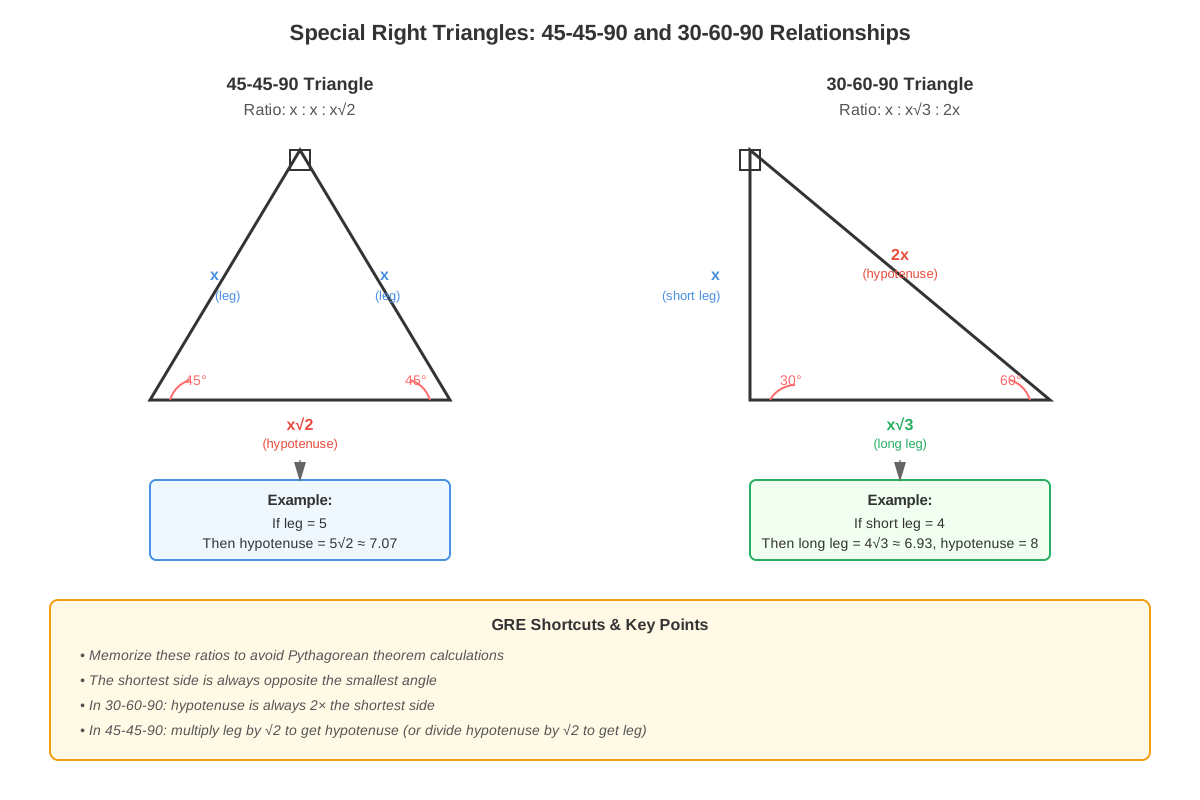
Two special right triangles appear with extraordinary frequency on the GRE, and memorizing their side ratios is essential:
45-45-90 triangles (isosceles right triangles) have angles of 45°, 45°, and 90°. The sides are in the ratio 1 : 1 : √2, where the two legs are equal and the hypotenuse is √2 times the length of each leg. If each leg has length x, the hypotenuse has length x√2. These triangles appear when squares are divided by their diagonals.
30-60-90 triangles have angles of 30°, 60°, and 90°. The sides are in the ratio 1 : √3 : 2, where the side opposite the 30° angle is the shortest, the side opposite the 60° angle is √3 times the shortest side, and the hypotenuse (opposite the 90° angle) is twice the shortest side. If the shortest side has length x, the other leg has length x√3, and the hypotenuse has length 2x. These triangles appear when equilateral triangles are divided by their altitudes.
Triangle Inequality Theorem
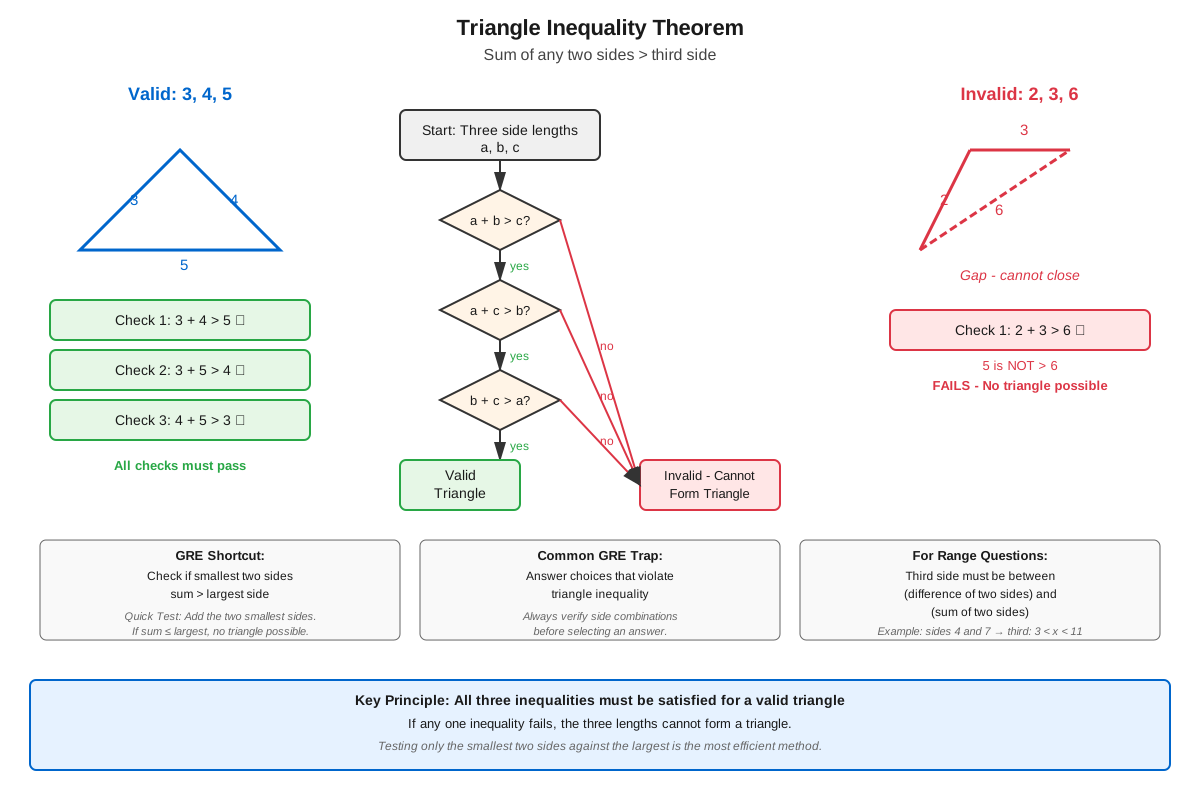
The triangle inequality theorem states that the sum of any two sides of a triangle must be greater than the third side. This principle has three equivalent formulations for a triangle with sides a, b, and c:
- a + b > c
- a + c > b
- b + c > a
This theorem enables test-takers to determine whether three given lengths can form a triangle and to establish bounds on possible values for unknown sides. A related principle states that the difference between any two sides must be less than the third side, which can be expressed as |a - b| < c.
Area Calculations
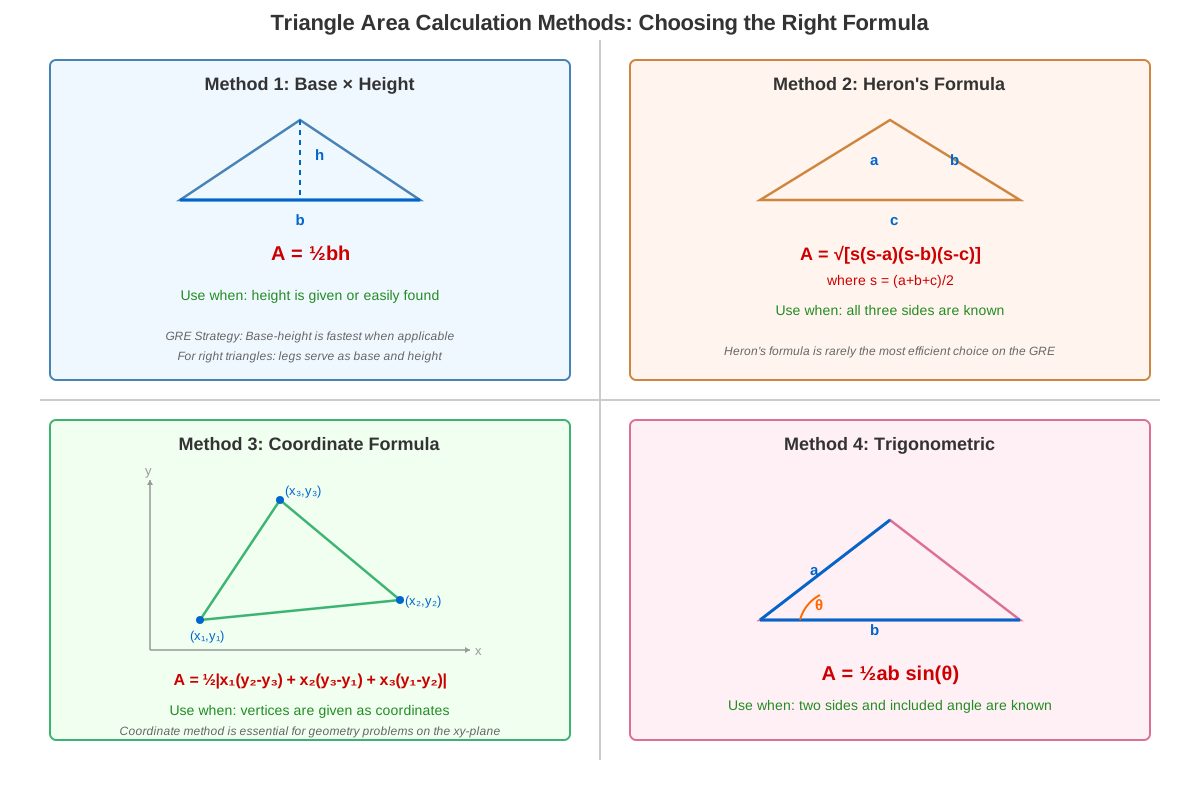
The GRE tests triangle area through multiple formulas, and selecting the appropriate formula depends on the given information:
Standard area formula: Area = (1/2) × base × height, where the height must be perpendicular to the base. This formula works for all triangles and is the most commonly applied method.
Heron's formula: When all three sides (a, b, c) are known but no height is given, Area = √[s(s-a)(s-b)(s-c)], where s = (a+b+c)/2 is the semi-perimeter. This formula rarely appears on the GRE but can solve problems where other methods fail.
Special triangle areas: For a 45-45-90 triangle with leg length x, Area = x²/2. For a 30-60-90 triangle with shortest side x, Area = (x²√3)/2. For an equilateral triangle with side length s, Area = (s²√3)/4.
Similarity and Congruence
Similar triangles have the same shape but not necessarily the same size—their corresponding angles are equal, and their corresponding sides are proportional. The GRE frequently presents similar triangles within diagrams where parallel lines create proportional relationships. When triangles are similar with a ratio of similarity k, their areas are in the ratio k².
Congruent triangles have both the same shape and the same size—all corresponding sides and angles are equal. The GRE occasionally tests the conditions that guarantee congruence (SSS, SAS, ASA, AAS) but more commonly expects test-takers to recognize when triangles must be congruent based on given information.
Concept Relationships
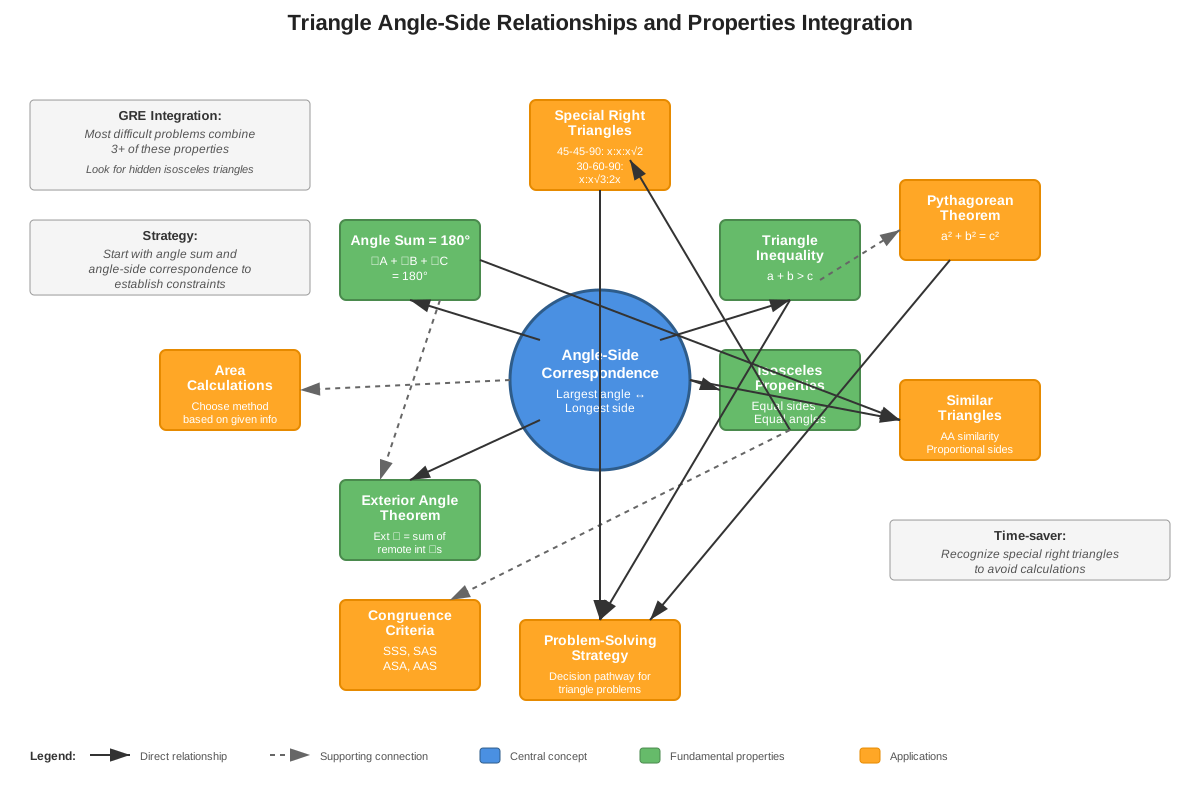
The fundamental angle sum property (angles sum to 180°) → enables calculation of unknown angles → which determines triangle classification by angles (acute, right, obtuse) → which then determines which area formulas and theorems apply.
Triangle classification by sides (equilateral, isosceles, scalene) → determines angle relationships → which connects to the concept of base angles in isosceles triangles → and leads to special cases like equilateral triangles where all angles equal 60°.
Right triangles → enable application of the Pythagorean theorem → which connects to Pythagorean triples for rapid calculation → and leads to special right triangles (45-45-90 and 30-60-90) → which provide ratio-based shortcuts that eliminate the need for the Pythagorean theorem in specific cases.
The triangle inequality theorem → establishes constraints on possible side lengths → which connects to optimization problems and quantitative comparison questions → and relates to the principle that the shortest distance between two points is a straight line.
Area calculations → depend on available information (base and height, or three sides, or special triangle type) → which connects to coordinate geometry when vertices are given as points → and relates to decomposition strategies where complex figures are broken into triangles.
Similar triangles → arise from parallel lines in diagrams → connect to proportional reasoning and ratio problems → and relate to scaling principles where linear dimensions scale by factor k but areas scale by factor k².
High-Yield Facts
⭐ The sum of interior angles in any triangle always equals 180 degrees, regardless of triangle type or size.
⭐ In a right triangle with legs a and b and hypotenuse c, the relationship a² + b² = c² always holds (Pythagorean theorem).
⭐ The sides of a 45-45-90 triangle are in the ratio 1 : 1 : √2 (leg : leg : hypotenuse).
⭐ The sides of a 30-60-90 triangle are in the ratio 1 : √3 : 2 (short leg : long leg : hypotenuse).
⭐ The area of any triangle equals (1/2) × base × height, where height is perpendicular to the base.
- The sum of any two sides of a triangle must be greater than the third side (triangle inequality).
- An exterior angle of a triangle equals the sum of the two non-adjacent interior angles.
- In an isosceles triangle, the angles opposite the equal sides are themselves equal (base angles).
- The most common Pythagorean triples are 3-4-5, 5-12-13, 8-15-17, and 7-24-25, along with their multiples.
- An equilateral triangle with side length s has area (s²√3)/4 and all angles equal 60 degrees.
- The longest side of a triangle is always opposite the largest angle; the shortest side is opposite the smallest angle.
- A triangle can have at most one right angle or one obtuse angle, but it can have three acute angles.
- When two triangles are similar with ratio of similarity k, their areas are in ratio k².
- The altitude to the hypotenuse of a right triangle creates two smaller triangles that are similar to each other and to the original triangle.
- In any triangle, the median to any side divides the triangle into two triangles of equal area.
Quick check — test yourself on Triangles so far.
Try Flashcards →Common Misconceptions
Misconception: The Pythagorean theorem applies to all triangles. → Correction: The Pythagorean theorem applies only to right triangles. For non-right triangles, the relationship between sides and angles requires different formulas (such as the Law of Cosines, which is beyond GRE scope).
Misconception: In a 30-60-90 triangle, the side opposite the 30° angle is always 1 unit long. → Correction: The ratio 1 : √3 : 2 describes the proportional relationship between sides, not their absolute lengths. If the shortest side is 5, the sides are 5 : 5√3 : 10. The "1" in the ratio is a scaling factor, not a fixed length.
Misconception: Any three positive numbers can form the sides of a triangle. → Correction: Three lengths can form a triangle only if the sum of any two sides exceeds the third side. For example, sides of length 2, 3, and 10 cannot form a triangle because 2 + 3 < 10.
Misconception: The height of a triangle must be one of its sides. → Correction: The height (altitude) is perpendicular to the base and may fall inside the triangle, on a side (in right triangles), or outside the triangle (in obtuse triangles). The height is a side only when the triangle is a right triangle and the height is drawn to one of the legs.
Misconception: Doubling all sides of a triangle doubles its area. → Correction: When all linear dimensions of a triangle are multiplied by factor k, the area is multiplied by k². Doubling all sides (k = 2) quadruples the area (2² = 4).
Misconception: An isosceles triangle must have a right angle. → Correction: An isosceles triangle has two equal sides and two equal angles, but these angles can be acute, right, or obtuse. Only when the two equal angles are each 45° is the triangle also a right triangle (45-45-90).
Misconception: The hypotenuse is always the vertical side of a right triangle. → Correction: The hypotenuse is the longest side of a right triangle and is always opposite the right angle, regardless of the triangle's orientation. The hypotenuse can be horizontal, vertical, or diagonal depending on how the triangle is positioned.
Worked Examples
Example 1: Special Right Triangle Application
Problem: In the coordinate plane, point A is at the origin (0, 0), point B is at (6, 0), and point C is at (3, 3√3). What is the area of triangle ABC?
Solution:
Step 1: Visualize or sketch the triangle. Point A is at the origin, B is 6 units to the right on the x-axis, and C is above the midpoint of AB.
Step 2: Calculate the base. The base AB lies along the x-axis from (0, 0) to (6, 0), so the base length is 6.
Step 3: Determine the height. The height is the perpendicular distance from C to the x-axis, which is simply the y-coordinate of C: 3√3.
Step 4: Apply the area formula. Area = (1/2) × base × height = (1/2) × 6 × 3√3 = 9√3.
Step 5: Verify using special triangle recognition. Notice that if we draw a line from C perpendicular to AB, it hits at point (3, 0), creating two congruent right triangles. Each has a base of 3 and height of 3√3. The ratio of height to base is √3:1, indicating these are 30-60-90 triangles. The side opposite the 60° angle is 3√3, and the side opposite the 30° angle is 3, confirming our setup. The hypotenuse would be 6 (twice the shortest side), which we can verify: distance from A to C = √(3² + (3√3)²) = √(9 + 27) = √36 = 6. ✓
Answer: The area is 9√3 square units.
Connection to learning objectives: This problem requires identifying that triangles are being tested (through coordinate geometry), applying the core strategy of recognizing special right triangles, and accurately calculating area using the standard formula.
Example 2: Triangle Inequality and Quantitative Comparison
Problem:
Quantity A: The length of the third side of a triangle with two sides of length 7 and 10
Quantity B: 16
Solution:
Step 1: Apply the triangle inequality theorem. For a triangle with sides a, b, and c, we know that a + b > c, a + c > b, and b + c > a.
Step 2: Set up inequalities for the unknown third side. Let x be the length of the third side. Then:
- 7 + 10 > x → x < 17
- 7 + x > 10 → x > 3
- 10 + x > 7 (automatically satisfied when x > 0)
Step 3: Determine the range of possible values. Combining the constraints: 3 < x < 17. The third side must be greater than 3 and less than 17.
Step 4: Compare to Quantity B. Since x can range from just over 3 to just under 17, and Quantity B is 16, the third side could be less than 16 (for example, x = 10) or greater than 16 (for example, x = 16.5).
Step 5: Reach a conclusion. Because Quantity A could be either less than or greater than Quantity B depending on the specific value of the third side, the relationship cannot be determined from the information given.
Answer: The relationship cannot be determined (Choice D in standard GRE format).
Connection to learning objectives: This problem tests the ability to identify when triangle inequality is being tested, explain the core rule (sum of two sides must exceed the third), and apply this concept to eliminate impossible values and recognize when insufficient information exists for a definitive comparison.
Exam Strategy
When approaching GRE triangle problems, begin by identifying what type of triangle is presented or implied. Look for explicit statements like "right triangle" or "isosceles triangle," but also watch for visual cues in diagrams such as the small square indicating a right angle or tick marks showing equal sides. Many problems embed triangles within other figures—rectangles, circles, or coordinate planes—so train yourself to recognize when drawing auxiliary lines or identifying hidden triangles will unlock the solution.
Trigger words and phrases that signal triangle concepts include: "perpendicular," "altitude," "right angle," "hypotenuse," "legs," "base angles," "equilateral," "isosceles," "similar," "corresponding sides," and "ratio of sides." When you see coordinates given for three points, immediately consider whether calculating distances and areas using triangle properties will be necessary. Phrases like "what is the maximum/minimum possible length" often signal triangle inequality applications.
For Quantitative Comparison questions involving triangles, avoid unnecessary calculations. Instead, test extreme cases within the constraints given. If a problem asks about the relationship between angles or sides, consider whether the triangle could be isosceles, right, or have other special properties that would affect the comparison. Remember that Quantitative Comparison questions often have answer choice D (relationship cannot be determined) when the triangle's specific type isn't fully constrained.
Process of elimination works particularly well with triangle problems. If a multiple-choice question asks for a possible side length, immediately eliminate any choices that violate the triangle inequality. If the question involves a right triangle and asks for the hypotenuse, eliminate any answer choices smaller than either leg. For area questions, eliminate choices that don't match the units (area should be in square units) or that seem unreasonably large or small compared to the given dimensions.
Time allocation for triangle problems should average 1.5-2 minutes per question. If you immediately recognize a special right triangle, you can often solve in under a minute. If a problem requires multiple steps—such as finding a side length using the Pythagorean theorem and then calculating area—budget 2-2.5 minutes. If you don't see a clear path forward within 30 seconds, mark the question and return to it, as triangle problems often become clearer after your mind has processed other questions.
Exam Tip: When a diagram is marked "not drawn to scale," don't trust visual appearances about which angles are largest or which sides are longest. Rely only on the given numerical information and proven relationships.
Memory Techniques
For the 30-60-90 triangle ratio (1 : √3 : 2): Remember "1, 2, 3" in a specific way—the side opposite the 30° angle is 1 unit, the side opposite the 60° angle involves √3, and the side opposite the 90° angle (hypotenuse) is 2 units. The numbers 30, 60, 90 are in the ratio 1:2:3, which mirrors the pattern in the sides.
For the 45-45-90 triangle ratio (1 : 1 : √2): Think "square diagonal"—when you draw a diagonal across a square, you create two 45-45-90 triangles. The diagonal is √2 times the side length of the square, giving you the ratio directly.
For the Pythagorean theorem: The mnemonic "a² + b² = c²" can be remembered as "A squared plus B squared equals C squared," but visualize it as areas of squares built on each side. The areas of squares on the two legs sum to the area of the square on the hypotenuse.
For common Pythagorean triples: Remember "3-4-5 is alive" as the fundamental triple, then recognize that 5-12-13 is the next most common (5 = 3+2, 12 = 4×3, 13 = 5+8). For 8-15-17, notice that 8 and 15 differ by 7, and 17 is 2 more than 15.
For triangle inequality: Use the phrase "Two sides together beat the third"—the sum of any two sides must be greater than (beat) the remaining side. Alternatively, remember that the shortest path between two points is a straight line, so going around two sides of a triangle must be longer than the third side.
For angle sum: Visualize tearing off the three corners of any triangle and arranging them side-by-side—they always form a straight line (180°). This physical visualization reinforces why the angle sum is always 180 degrees.
Summary
Triangles represent one of the highest-yield topics in GRE Quantitative Reasoning, appearing in 15-20% of geometry questions and serving as foundational elements in more complex problems. Mastery requires understanding fundamental properties (angle sum of 180°, exterior angle relationships), classification systems (by sides and by angles), and the critical distinction between right triangles and other types. The Pythagorean theorem (a² + b² = c²) and recognition of common Pythagorean triples (3-4-5, 5-12-13, 8-15-17) enable rapid solutions to right triangle problems. Special right triangles—45-45-90 with ratio 1:1:√2 and 30-60-90 with ratio 1:√3:2—appear with extraordinary frequency and must be memorized. The triangle inequality theorem constrains possible side lengths and provides a powerful tool for elimination in multiple-choice questions. Area calculations using the formula (1/2) × base × height work for all triangles, while special formulas apply to specific triangle types. Success on GRE triangle problems requires not just formula memorization but pattern recognition, strategic thinking about when to apply which concept, and the ability to identify triangles embedded within complex diagrams or coordinate geometry contexts.
Key Takeaways
- The sum of interior angles in any triangle always equals 180°, and an exterior angle equals the sum of the two non-adjacent interior angles
- The Pythagorean theorem (a² + b² = c²) applies exclusively to right triangles; memorize common Pythagorean triples (3-4-5, 5-12-13, 8-15-17) for rapid calculation
- Special right triangles have fixed ratios: 45-45-90 triangles use 1:1:√2, and 30-60-90 triangles use 1:√3:2 (short leg : long leg : hypotenuse)
- The triangle inequality theorem states that the sum of any two sides must exceed the third side, providing constraints for possible side lengths
- Triangle area always equals (1/2) × base × height, with special formulas for equilateral triangles (s²√3/4) and other special cases
- Classification by sides (equilateral, isosceles, scalene) and by angles (acute, right, obtuse) determines which properties and shortcuts apply
- Similar triangles have proportional sides and equal corresponding angles; when the ratio of similarity is k, areas are in ratio k²
Related Topics
Coordinate Geometry: Triangles frequently appear with vertices given as coordinate points, requiring integration of distance formula, midpoint calculations, and slope concepts with triangle properties. Mastering triangles enables efficient solution of coordinate plane problems involving area and perimeter.
Quadrilaterals and Polygons: Understanding triangles is prerequisite to analyzing quadrilaterals, which can be decomposed into triangles. Properties of parallelograms, trapezoids, and other polygons often rely on triangle relationships, particularly when diagonals create triangular regions.
Circles: Many circle problems involve inscribed or circumscribed triangles, where triangle properties combine with circle theorems. Right triangles appear frequently in problems involving tangent lines and radii.
Three-Dimensional Geometry: Pyramids, tetrahedrons, and other 3D figures have triangular faces. Calculating surface area and understanding spatial relationships requires applying triangle concepts to three-dimensional contexts.
Trigonometry: While the GRE tests minimal trigonometry, the special right triangles (30-60-90 and 45-45-90) form the foundation for understanding sine, cosine, and tangent ratios that occasionally appear in advanced problems.
Practice CTA
Now that you've built a comprehensive understanding of triangles and their applications on the GRE, it's time to solidify your mastery through active practice. Attempt the practice questions associated with this topic, focusing on recognizing which triangle properties apply to each problem and selecting the most efficient solution path. Use the flashcards to drill the special right triangle ratios, Pythagorean triples, and key formulas until they become automatic. Remember that triangle problems reward pattern recognition and strategic thinking—the more problems you solve, the faster you'll identify the underlying concepts being tested. Your investment in mastering triangles will pay dividends across the entire Quantitative Reasoning section!
Sign up free to keep reading
Create a free AnvayaPrep account to finish this GRE guide on Triangles — plus flashcards and practice questions.