Overview
Lines and angles form the foundational building blocks of geometry on the GRE Quantitative Reasoning section. These concepts appear not only in dedicated geometry questions but also underpin coordinate geometry, polygons, circles, and even data interpretation problems involving graphs and diagrams. Mastery of GRE lines and angles is essential because these questions test spatial reasoning, logical deduction, and the ability to apply fundamental geometric principles under time pressure. The GRE frequently presents angle relationships in complex diagrams where multiple rules must be applied simultaneously, making this topic both high-yield and strategically important.
Understanding lines and angles extends beyond memorizing angle measures. Success requires recognizing patterns, identifying which geometric principles apply to a given situation, and efficiently calculating unknown values. The GRE tests these concepts through direct calculation problems, quantitative comparison questions, and multi-step reasoning challenges. Questions may involve parallel lines cut by transversals, intersecting lines, perpendicular relationships, or angle measures within polygons—all requiring fluency with fundamental angle properties.
This topic connects intimately with other Quantitative Reasoning areas. Coordinate geometry relies on understanding slopes as angle relationships; triangle problems require knowledge of interior and exterior angles; circle geometry involves central and inscribed angles; and polygon questions demand facility with interior angle sums. Building a strong foundation in lines and angles creates the framework for tackling virtually every geometry question on the GRE, making this 20-minute investment one of the highest-yield study sessions in test preparation.
Learning Objectives
- [ ] Identify when Lines and angles is being tested
- [ ] Explain the core rule or strategy behind Lines and angles
- [ ] Apply Lines and angles to GRE-style questions accurately
- [ ] Calculate angle measures using properties of parallel lines and transversals
- [ ] Recognize and apply relationships between complementary, supplementary, and vertical angles
- [ ] Determine unknown angles in complex diagrams involving multiple intersecting lines
- [ ] Distinguish between different angle types and their properties in various geometric configurations
Prerequisites
- Basic arithmetic operations: Essential for calculating angle measures and solving equations involving angles
- Algebraic equation solving: Required when angle measures are expressed as variables or algebraic expressions
- Understanding of geometric notation: Necessary to interpret diagrams, angle symbols, and geometric terminology correctly
- Fundamental number properties: Needed to work with angle relationships and proportional reasoning
Why This Topic Matters
Lines and angles represent one of the most frequently tested geometry concepts on the GRE, appearing in approximately 15-20% of all Quantitative Reasoning questions either directly or as components of more complex problems. The Educational Testing Service (ETS) favors these questions because they efficiently assess logical reasoning, spatial visualization, and the ability to apply multiple rules systematically—all skills valued in graduate-level academic work.
In real-world applications, angle relationships govern architecture, engineering, navigation, computer graphics, and physics. Understanding how angles relate when lines intersect or run parallel enables problem-solving in fields from urban planning to robotics. For the GRE specifically, these concepts appear in pure geometry questions, coordinate geometry problems, data interpretation questions with geometric diagrams, and word problems involving spatial relationships.
Common question formats include: quantitative comparisons asking students to determine which of two angle measures is larger; multiple-choice questions requiring calculation of unknown angles in diagrams with intersecting or parallel lines; numeric entry questions where students must determine exact angle measures; and complex multi-step problems where angle relationships provide the key to unlocking other geometric properties. The GRE particularly favors questions involving parallel lines cut by transversals, as these efficiently test multiple concepts simultaneously.
Core Concepts
Fundamental Angle Types and Measures
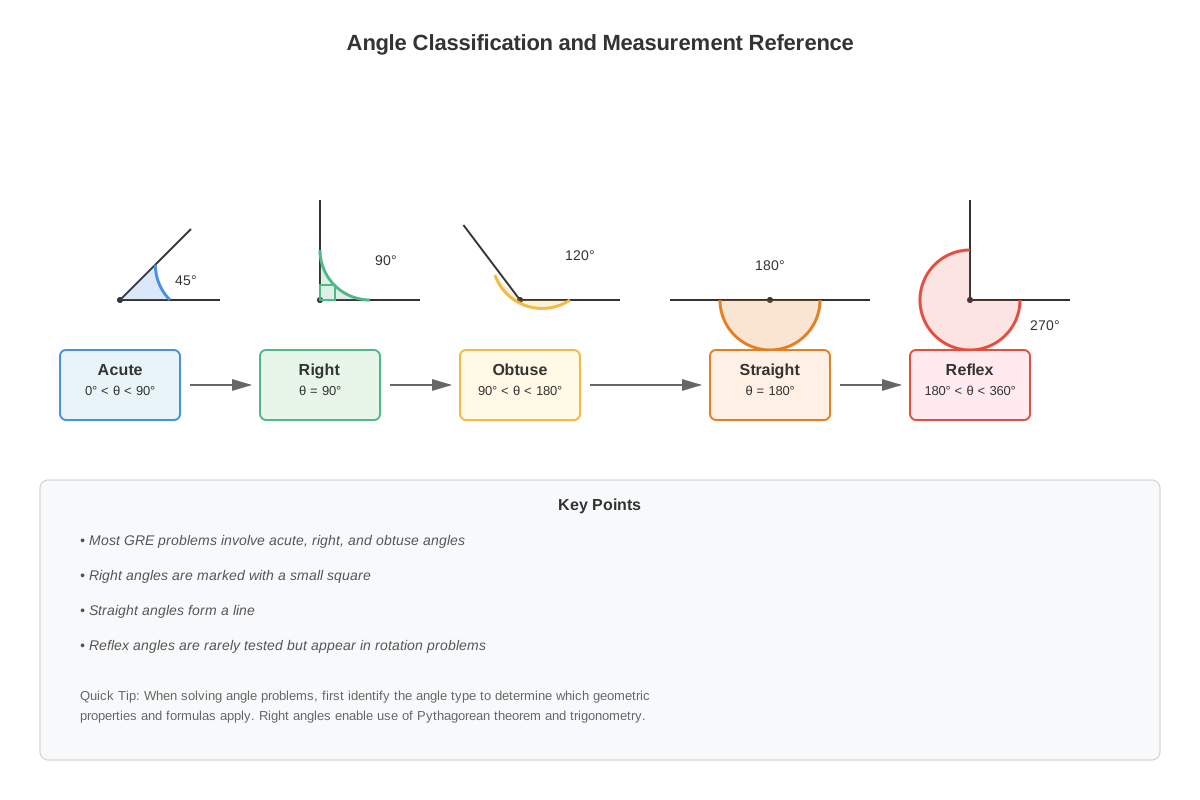
An angle is formed when two rays share a common endpoint called the vertex. Angles are measured in degrees, with a complete rotation around a point equaling 360°. Understanding angle classification is essential for GRE success:
- Acute angle: measures between 0° and 90°
- Right angle: measures exactly 90°, indicated by a small square at the vertex
- Obtuse angle: measures between 90° and 180°
- Straight angle: measures exactly 180°, forming a straight line
- Reflex angle: measures between 180° and 360°
The GRE rarely asks students to simply identify angle types but instead embeds these classifications within problem-solving contexts where recognizing angle categories helps eliminate incorrect answer choices or verify calculations.
Angle Relationships at Intersections
When two lines intersect, they create four angles. Understanding the relationships between these angles is crucial:
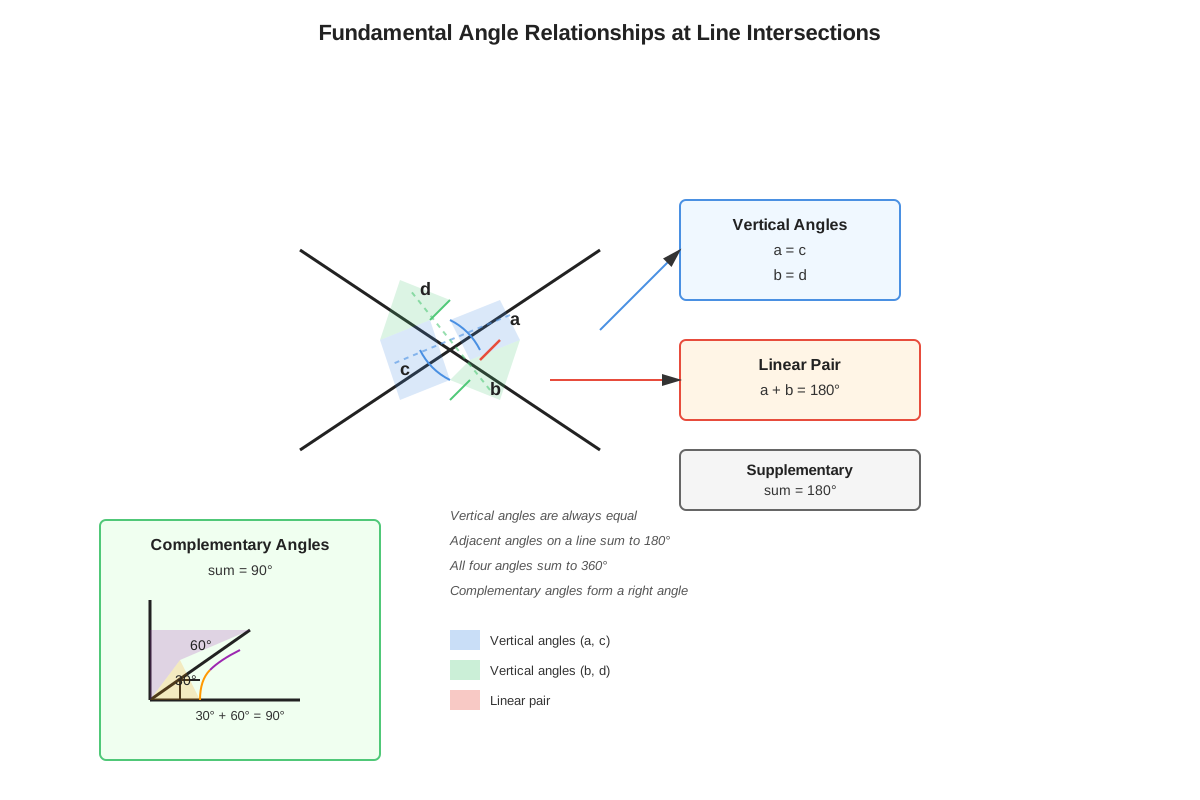
Vertical angles are the pairs of opposite angles formed when two lines intersect. The fundamental property: vertical angles are always equal in measure. If two lines intersect creating angles of measures a°, b°, a°, and b° (going around the intersection), the two angles marked a° are vertical angles, as are the two marked b°.
Adjacent angles share a common vertex and a common side but do not overlap. When two adjacent angles are formed by intersecting lines, they are supplementary, meaning their measures sum to 180°. This relationship provides a powerful tool for calculating unknown angles: if one angle at an intersection measures x°, the adjacent angle measures (180 - x)°.
Complementary and Supplementary Angles
Complementary angles are two angles whose measures sum to 90°. If angle A measures x°, its complement measures (90 - x)°. These relationships frequently appear in right triangle problems and perpendicular line configurations.
Supplementary angles are two angles whose measures sum to 180°. If angle B measures y°, its supplement measures (180 - y)°. Supplementary angles appear when dealing with straight lines, linear pairs, and parallel line problems.
| Relationship Type | Sum of Measures | Common Contexts |
|---|---|---|
| Complementary | 90° | Right angles, perpendicular lines |
| Supplementary | 180° | Straight lines, linear pairs, parallel lines with transversals |
| Vertical | Equal measures | Any line intersection |
Parallel Lines and Transversals
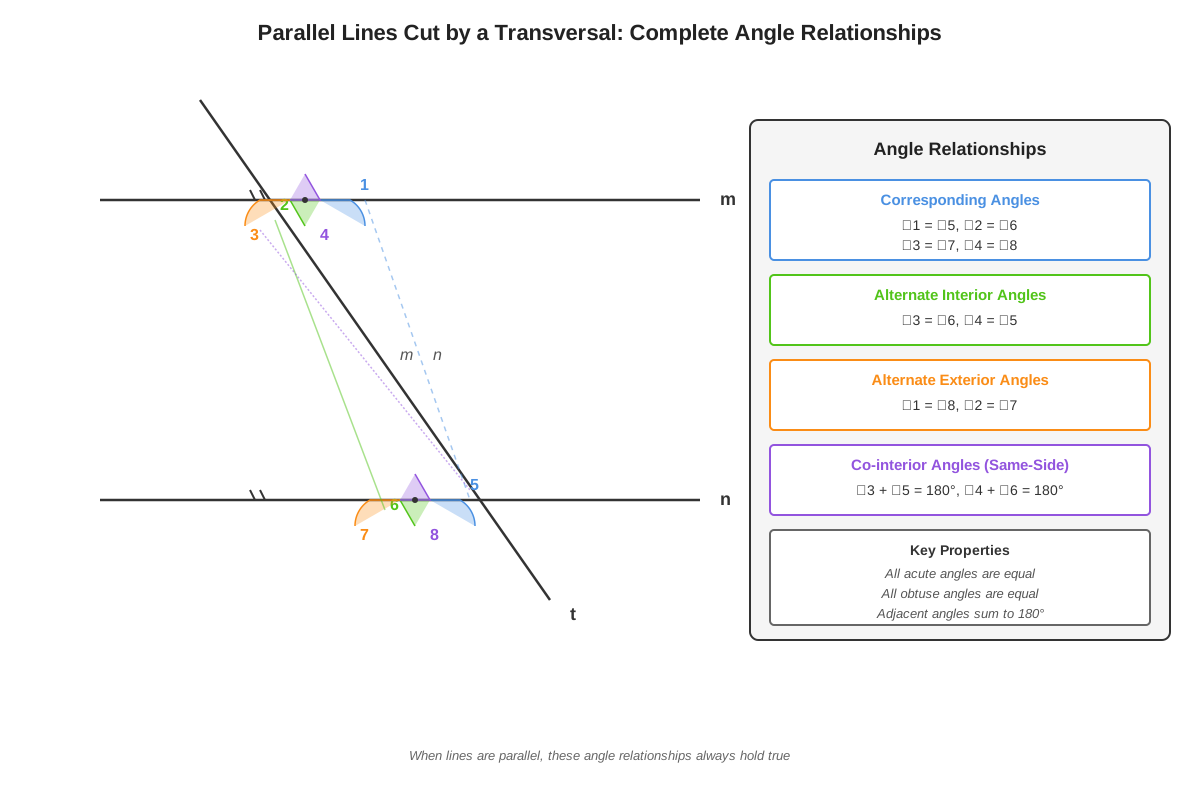
When a transversal (a line that intersects two or more other lines) crosses parallel lines, eight angles are formed, creating multiple important relationships. This configuration is among the most tested on the GRE.
The angles formed have special names and relationships:
Corresponding angles occupy the same relative position at each intersection point. When lines are parallel, corresponding angles are equal. For example, if a transversal crosses two parallel lines, the upper-right angle at the first intersection equals the upper-right angle at the second intersection.
Alternate interior angles lie between the parallel lines on opposite sides of the transversal. When lines are parallel, alternate interior angles are equal. These angles form a "Z" pattern (or reverse "Z") in the diagram.
Alternate exterior angles lie outside the parallel lines on opposite sides of the transversal. When lines are parallel, alternate exterior angles are equal.
Consecutive interior angles (also called co-interior or same-side interior angles) lie between the parallel lines on the same side of the transversal. When lines are parallel, consecutive interior angles are supplementary (sum to 180°).
GRE Exam Tip: When you see parallel lines marked with arrows or stated as parallel in the problem, immediately identify all angle relationships. Often, you can determine all eight angle measures from knowing just one angle.
Perpendicular Lines
Perpendicular lines intersect at right angles (90°). The symbol ⊥ denotes perpendicularity. When two lines are perpendicular, all four angles formed at their intersection measure 90°. This property connects to complementary angles and appears frequently in coordinate geometry, where perpendicular lines have slopes that are negative reciprocals of each other.
Angle Bisectors
An angle bisector is a ray that divides an angle into two equal parts. If an angle measures 60°, its bisector creates two 30° angles. Angle bisectors appear in triangle problems, circle geometry, and construction-based questions. The GRE may present problems where recognizing that a line bisects an angle provides the key relationship needed to solve for unknown measures.
Sum of Angles Around a Point
The angles formed around a single point sum to 360°. This principle applies when multiple rays emanate from a common vertex or when several angles meet at a point. The GRE uses this property in complex diagrams where multiple lines intersect at a single point, requiring students to set up equations where the sum of all angles equals 360°.
Concept Relationships
The concepts within lines and angles form an interconnected web of relationships. Vertical angles and supplementary angles both emerge from the fundamental property that angles around a point sum to 360°, and angles on a straight line sum to 180°. When two lines intersect, vertical angles are equal because each pair of adjacent angles is supplementary to the same angle.
Parallel lines with transversals represent an extension of basic angle relationships. The equality of corresponding angles, alternate interior angles, and alternate exterior angles all derive from the parallel nature of the lines combined with the properties of vertical and supplementary angles. Specifically: corresponding angles are equal → alternate interior angles are equal (because they're related through vertical angles) → consecutive interior angles are supplementary (because they're adjacent to equal alternate interior angles).
Complementary and supplementary angles connect to perpendicular lines and straight angles respectively. Perpendicular lines create four right angles, and any division of a right angle creates complementary angles. Similarly, any straight line (180°) can be divided into supplementary angles.
The relationship map flows as follows:
Basic angle measurement → Angle types (acute, right, obtuse) → Intersecting lines create vertical and adjacent angles → Parallel lines with transversals extend these relationships → Special cases (perpendicular lines, angle bisectors) → Complex multi-line configurations requiring multiple rule applications
These concepts connect to prerequisite algebra through equation-solving when angles are expressed as variables (e.g., "angle A measures 2x + 10"). They extend forward to triangles (interior angles sum to 180°), polygons (interior angle formulas), coordinate geometry (slope relationships), and circles (inscribed and central angles).
High-Yield Facts
⭐ Vertical angles formed by intersecting lines are always equal in measure
⭐ When a transversal crosses parallel lines, corresponding angles are equal, alternate interior angles are equal, and consecutive interior angles are supplementary
⭐ Angles on a straight line sum to 180° (supplementary angles)
⭐ Angles around a point sum to 360°
⭐ Complementary angles sum to 90°; supplementary angles sum to 180°
- Adjacent angles formed by intersecting lines are supplementary
- Alternate exterior angles are equal when formed by parallel lines and a transversal
- Perpendicular lines create four 90° angles at their intersection
- An angle bisector divides an angle into two equal parts
- If two lines are parallel to the same line, they are parallel to each other
- The measure of an exterior angle of a triangle equals the sum of the two non-adjacent interior angles (connects to triangle geometry)
- When parallel lines are cut by a transversal, if you know one angle measure, you can determine all eight angles
Quick check — test yourself on Lines and angles so far.
Try Flashcards →Common Misconceptions
Misconception: All angles formed by intersecting lines are equal → Correction: Only vertical angles are equal; adjacent angles are supplementary but not equal unless all angles are 90° (perpendicular lines)
Misconception: Alternate interior angles are always equal regardless of whether lines are parallel → Correction: Alternate interior angles are equal only when the lines are parallel; if lines are not parallel, these angles have no special relationship
Misconception: Complementary angles must be adjacent to each other → Correction: Complementary angles need only sum to 90°; they can be anywhere in a diagram and need not share a vertex or side
Misconception: When a transversal crosses two lines creating equal corresponding angles, the lines must be parallel → Correction: This is actually correct—equal corresponding angles is both a consequence of and a test for parallel lines. However, students often fail to use this as a proof method
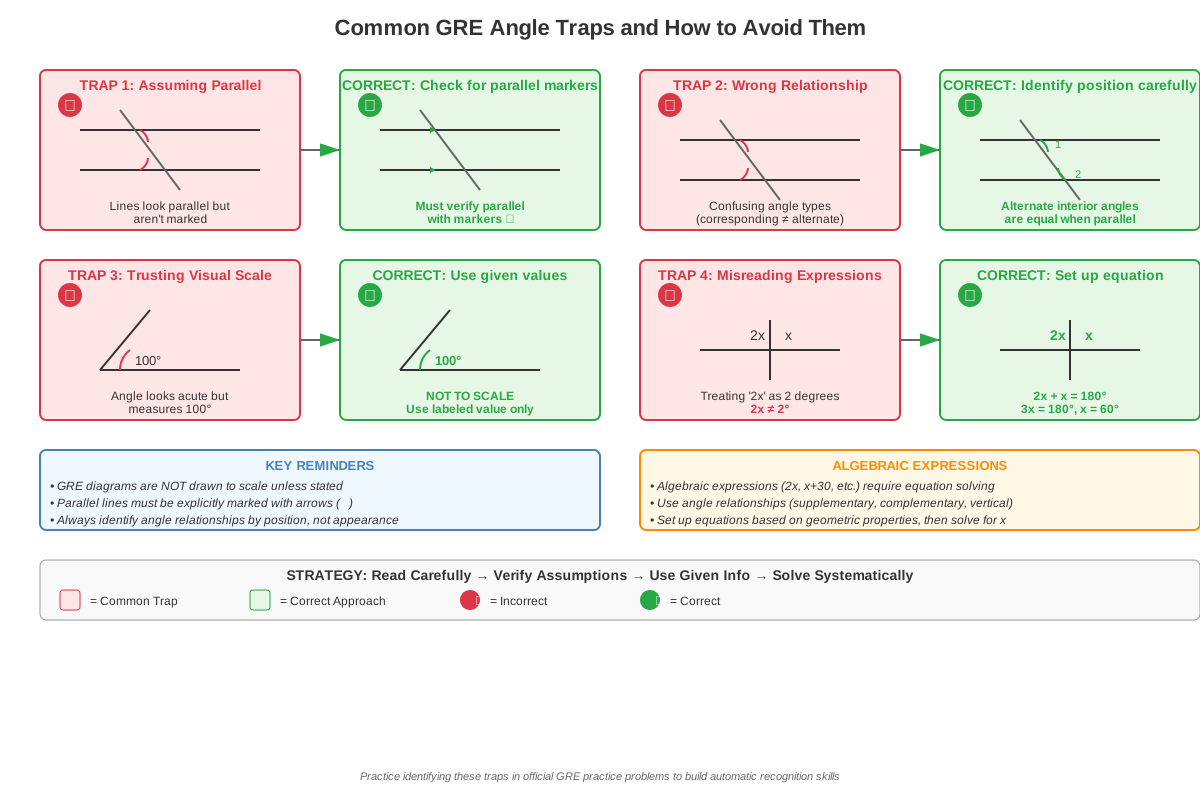
Misconception: The larger an angle appears in a diagram, the larger its actual measure → Correction: GRE diagrams are explicitly noted as "not drawn to scale" unless stated otherwise; never rely on visual appearance to estimate angle measures
Misconception: Consecutive interior angles formed by parallel lines and a transversal are equal → Correction: Consecutive interior angles are supplementary (sum to 180°), not equal, unless each measures 90°
Misconception: If two angles are supplementary, they must form a straight line → Correction: Supplementary angles need only sum to 180°; they can be located anywhere in a figure and need not be adjacent
Worked Examples
Example 1: Parallel Lines with Transversal
Problem: Line l is parallel to line m. A transversal t intersects line l at point A and line m at point B. The angle formed above line l and to the left of the transversal measures 65°. What is the measure of the angle formed below line m and to the right of the transversal?
Solution:
Step 1: Visualize or sketch the configuration. We have two parallel lines (l and m) cut by a transversal (t).
Step 2: Identify the given angle. The angle above line l and to the left of transversal t measures 65°.
Step 3: Identify the target angle. We need the angle below line m and to the right of the transversal.
Step 4: Recognize the angle relationship. The given angle and the target angle are alternate exterior angles (both outside the parallel lines, on opposite sides of the transversal).
Step 5: Apply the rule. When a transversal crosses parallel lines, alternate exterior angles are equal.
Step 6: Calculate. The target angle measures 65°.
Connection to Learning Objectives: This problem requires identifying when lines and angles concepts are being tested (parallel lines with transversal), explaining the core rule (alternate exterior angles are equal for parallel lines), and applying this to calculate accurately.
Example 2: Multiple Intersecting Lines
Problem: Three lines intersect at point P. The six angles formed around point P have measures that can be expressed as x°, x°, 2x°, 2x°, y°, and y°. If one of the angles measuring x° and one of the angles measuring 2x° are vertical angles, what is the value of x?
Solution:
Step 1: Understand the constraint. Angles around a point sum to 360°.
Step 2: Set up the equation: x + x + 2x + 2x + y + y = 360, which simplifies to 6x + 2y = 360, or 3x + y = 180.
Step 3: Use the vertical angles information. If an angle measuring x° and an angle measuring 2x° are vertical angles, they must be equal. But x ≠ 2x unless x = 0, which is impossible for an angle in this context.
Step 4: Reinterpret the problem. The problem states "one of the angles measuring x°" is vertical to "one of the angles measuring 2x°." This seems contradictory. Let's reconsider: perhaps the problem means these angles are adjacent, not vertical.
Step 5: Alternative interpretation. If we have three lines intersecting at a point, we get six angles. The angles must be arranged so that vertical angles are equal. Given we have pairs (x°, x°), (2x°, 2x°), and (y°, y°), these must be the three pairs of vertical angles.
Step 6: Apply the angle sum: x + x + 2x + 2x + y + y = 360, so 6x + 2y = 360, giving us 3x + y = 180.
Step 7: We need another relationship. Since these are three lines intersecting at a point, adjacent angles must be supplementary. If x° and 2x° are adjacent: x + 2x = 180, so 3x = 180, therefore x = 60.
Step 8: Verify. If x = 60, then 3(60) + y = 180, so y = 0. This is impossible.
Step 9: Correct interpretation. The angles x°, 2x°, and y° must be three consecutive angles around the point, with their vertical angles being the other x°, 2x°, and y°. Adjacent angles sum to create relationships. If x° and 2x° are adjacent: they don't need to sum to 180° unless they're on a straight line.
Step 10: Simplest case. For three lines at a point creating six angles, if we have three pairs of vertical angles measuring x°, 2x°, and y°, and these six angles sum to 360°: 2x + 4x + 2y = 360, so 6x + 2y = 360. We need one more constraint. If the three lines create angles where x° and 2x° are adjacent angles from two of the lines, and these are supplementary: x + 2x = 180 is only true if they form a straight angle, meaning two of the "three lines" are actually one straight line. Then x = 60°.
Answer: x = 60°
Connection to Learning Objectives: This complex problem requires identifying multiple angle relationships, applying rules about vertical angles and angles around a point, and working through algebraic equations—demonstrating mastery of lines and angles in challenging contexts.
Exam Strategy
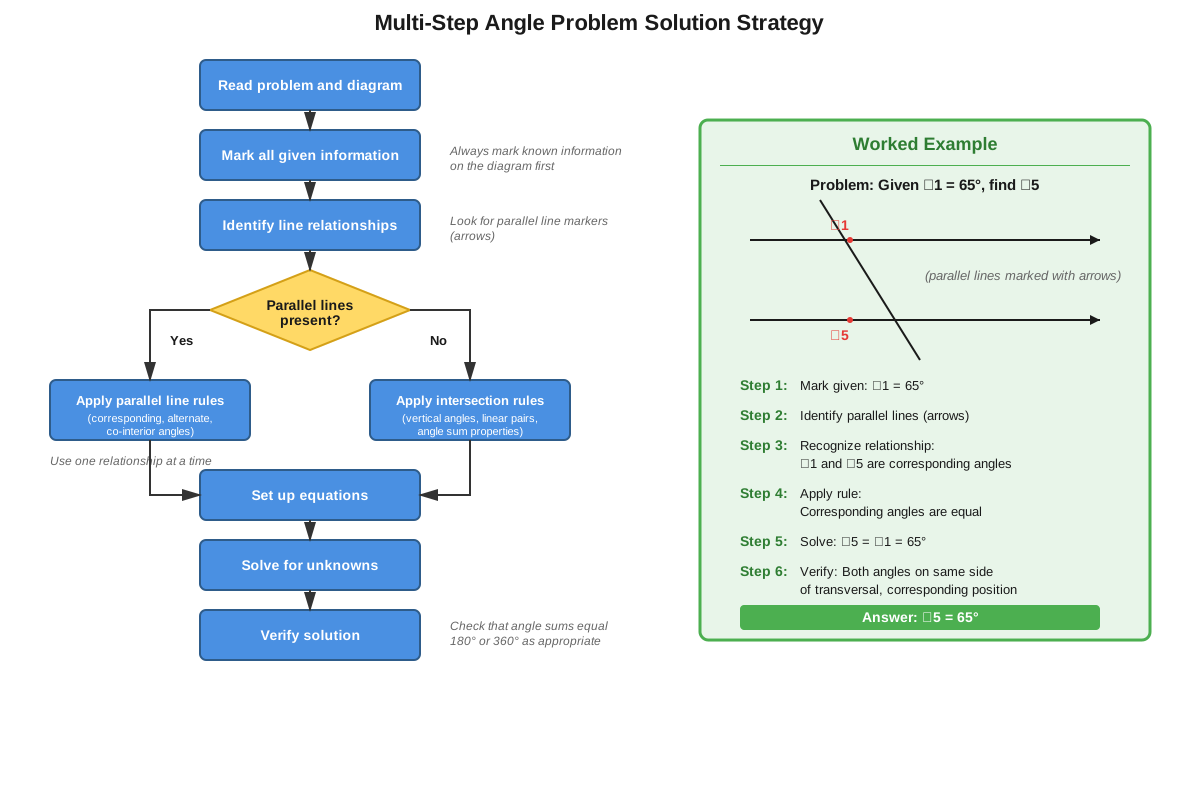
When approaching GRE questions on lines and angles, follow this systematic process:
- Identify parallel lines immediately. Look for arrow markings, parallel symbols (∥), or statements like "line l is parallel to line m." Parallel lines unlock multiple angle relationships.
- Mark known angles directly on the diagram. Write angle measures on the figure itself. Then use angle relationships to fill in additional angles you can determine.
- Look for trigger words: "vertical angles," "supplementary," "complementary," "transversal," "perpendicular," "bisector," "straight line." Each triggers specific rules.
- In quantitative comparison questions, don't calculate unless necessary. Often you can determine which quantity is larger by recognizing angle relationships without finding exact measures.
- Watch for "not drawn to scale" warnings. Never estimate angle measures visually. Rely only on given information and geometric principles.
- Set up equations for unknown angles. If angles are expressed as variables (e.g., "angle A measures 3x + 10"), use angle relationships to create equations, then solve algebraically.
- Check for multiple solution paths. Complex diagrams often allow several approaches. If one method seems tedious, look for a more elegant relationship.
- Time allocation: Simple angle calculation problems should take 30-45 seconds. Complex multi-step problems involving parallel lines and multiple unknowns may require 90-120 seconds. If you're exceeding these times, mark the question and return if time permits.
- Process of elimination: In multiple-choice questions, eliminate answers that violate basic principles (e.g., an acute angle can't measure more than 90°, angles on a straight line can't sum to more than 180°).
- Verify your answer by checking if it satisfies all given conditions. If you calculated that an angle measures 75°, ensure this value is consistent with all relationships in the problem.
Memory Techniques
Mnemonic for parallel lines with transversals - "CAI": Corresponding angles are Always Identical (when lines are parallel)
Visualization for alternate interior angles: Picture a "Z" shape (or reverse "Z") connecting alternate interior angles—they're equal when lines are parallel.
Complementary vs. Supplementary: Complementary goes with Corner (right angle, 90°); Supplementary goes with Straight line (180°)
Vertical angles memory aid: Think of a "V" shape—vertical angles are at the "V" points of an intersection and are always equal.
Acronym for angle types by size - "AROS": Acute (smallest), Right (90°), Obtuse (larger), Straight (180°)
Angles around a point: Visualize a complete circle (360°) to remember that angles around a point sum to 360°.
Perpendicular lines: Think of a plus sign (+) or the corner of a sheet of paper—all angles are 90°.
Summary
Lines and angles form the essential foundation of GRE geometry, appearing in approximately 15-20% of Quantitative Reasoning questions. Mastery requires understanding fundamental angle relationships: vertical angles are equal, adjacent angles on a line are supplementary (sum to 180°), and angles around a point sum to 360°. When parallel lines are cut by a transversal, corresponding angles are equal, alternate interior angles are equal, alternate exterior angles are equal, and consecutive interior angles are supplementary. Complementary angles sum to 90°, while supplementary angles sum to 180°. Success on GRE questions demands the ability to identify which relationships apply to a given diagram, set up appropriate equations when angles are expressed algebraically, and efficiently calculate unknown measures. The key to excellence is recognizing patterns quickly, marking known information directly on diagrams, and systematically applying geometric principles. Students must avoid relying on visual appearance since GRE diagrams are not drawn to scale, instead using only stated information and proven geometric relationships to reach conclusions.
Key Takeaways
- Vertical angles are always equal; adjacent angles at an intersection are supplementary (sum to 180°)
- Parallel lines with transversals create predictable angle patterns: corresponding angles equal, alternate interior angles equal, consecutive interior angles supplementary
- Angles on a straight line sum to 180°; angles around a point sum to 360°
- Complementary angles sum to 90°; supplementary angles sum to 180°—these relationships need not involve adjacent angles
- Never rely on diagram appearance on the GRE; use only given information and geometric principles to determine angle measures
- Mark known angles directly on diagrams and systematically determine additional angles using relationships
- Perpendicular lines create four 90° angles; angle bisectors divide angles into two equal parts
Related Topics
Triangles and Polygons: Understanding interior and exterior angles of triangles (sum to 180°) and polygons builds directly on lines and angles concepts, particularly angle relationships and supplementary angles.
Coordinate Geometry: Slopes of perpendicular and parallel lines connect to angle relationships; perpendicular lines have slopes that are negative reciprocals, while parallel lines have equal slopes.
Circle Geometry: Central angles, inscribed angles, and angles formed by chords and tangents all extend the fundamental angle measurement and relationship concepts covered here.
Three-Dimensional Geometry: Angles between planes, dihedral angles, and spatial reasoning in 3D figures require mastery of basic angle relationships as a foundation.
Mastering lines and angles provides the geometric reasoning skills necessary for tackling these more advanced topics, making this foundational knowledge essential for comprehensive GRE preparation.
Practice CTA
Now that you've built a comprehensive understanding of lines and angles, it's time to cement this knowledge through active practice. Attempt the practice questions designed specifically for this topic, focusing on applying the angle relationships and problem-solving strategies you've learned. Use the flashcards to reinforce key definitions and properties until they become automatic. Remember: geometry mastery comes from recognizing patterns quickly and applying principles confidently. Each practice problem you solve strengthens your ability to tackle GRE questions efficiently and accurately. You've invested the time to learn these concepts—now invest the time to practice them, and watch your geometry performance soar!
Sign up free to keep reading
Create a free AnvayaPrep account to finish this GRE guide on Lines and angles — plus flashcards and practice questions.