Overview
Transversals are lines that intersect two or more other lines at distinct points, creating a rich geometric configuration that appears frequently on the GRE Quantitative Reasoning section. When a transversal crosses parallel lines, it generates predictable angle relationships that form the foundation for numerous geometry problems. Understanding these angle relationships—including corresponding angles, alternate interior angles, alternate exterior angles, and consecutive interior angles—is essential for solving problems efficiently and accurately on test day.
The concept of GRE transversals extends beyond simple angle identification. Test-makers frequently embed transversal problems within coordinate geometry questions, polygon problems, and multi-step reasoning challenges that require students to recognize parallel line configurations even when they're not explicitly stated. Mastery of transversals enables quick calculation of unknown angles, identification of parallel relationships, and strategic problem-solving that can save valuable time during the exam. Questions involving transversals often appear 2-3 times per GRE administration, making this a high-yield topic that directly impacts scores.
Within the broader Quantitative Reasoning framework, transversals connect foundational angle concepts to more complex geometric reasoning. They bridge basic angle properties (such as supplementary and vertical angles) with advanced topics like polygon interior angles, coordinate geometry slope relationships, and geometric proof strategies. A solid understanding of transversals provides the geometric intuition necessary for tackling the most challenging GRE geometry questions, particularly those requiring multi-step reasoning or integration of multiple geometric principles.
Learning Objectives
- [ ] Identify when Transversals is being tested in GRE questions, including implicit scenarios
- [ ] Explain the core rule or strategy behind Transversals, particularly angle relationships with parallel lines
- [ ] Apply Transversals to GRE-style questions accurately and efficiently
- [ ] Distinguish between the four primary angle pair types created by transversals (corresponding, alternate interior, alternate exterior, consecutive interior)
- [ ] Determine whether two lines are parallel based on angle relationships created by a transversal
- [ ] Solve multi-step problems combining transversal properties with other geometric concepts
- [ ] Calculate multiple unknown angles in complex diagrams involving transversals in under 90 seconds
Prerequisites
- Basic angle types and properties: Understanding of acute, obtuse, right, and straight angles is necessary to identify and measure angles formed by transversals
- Supplementary and complementary angles: These relationships frequently combine with transversal properties to solve for unknown angles
- Vertical angles: Transversal problems often require recognizing that vertical angles are congruent as an intermediate step
- Linear pairs: Understanding that adjacent angles on a straight line sum to 180° is essential for working through transversal configurations
- Basic properties of parallel lines: Familiarity with the concept of lines that never intersect provides context for why special angle relationships emerge
Why This Topic Matters
Transversals represent one of the most practical applications of geometric reasoning in both academic and real-world contexts. Architects use transversal principles when designing structures with parallel support beams, engineers apply these concepts when analyzing force vectors in mechanical systems, and urban planners rely on transversal relationships when designing street grids and traffic flow patterns. The logical reasoning required to work with transversals—identifying patterns, applying rules systematically, and drawing valid conclusions—mirrors the analytical thinking valued across STEM fields and professional contexts.
On the GRE specifically, transversal questions appear with remarkable consistency. Approximately 15-20% of geometry questions involve transversals either directly or as a component of a larger problem. These questions typically appear in both Quantitative Comparison and Problem Solving formats, with difficulty levels ranging from medium to hard. The ETS (Educational Testing Service) favors transversal problems because they efficiently test multiple skills simultaneously: spatial reasoning, rule application, algebraic manipulation (when angles are expressed as variables), and logical deduction.
Common GRE question formats include: diagrams showing two lines cut by a transversal with some angles labeled and others to be determined; word problems describing geometric configurations without diagrams; Quantitative Comparison questions asking students to compare angle measures; and complex multi-figure problems where recognizing parallel lines and transversal relationships is the key to unlocking the solution. Questions may also embed transversals within coordinate geometry contexts, asking about slopes of parallel lines or angles formed by lines with given equations.
Core Concepts
Definition and Basic Configuration
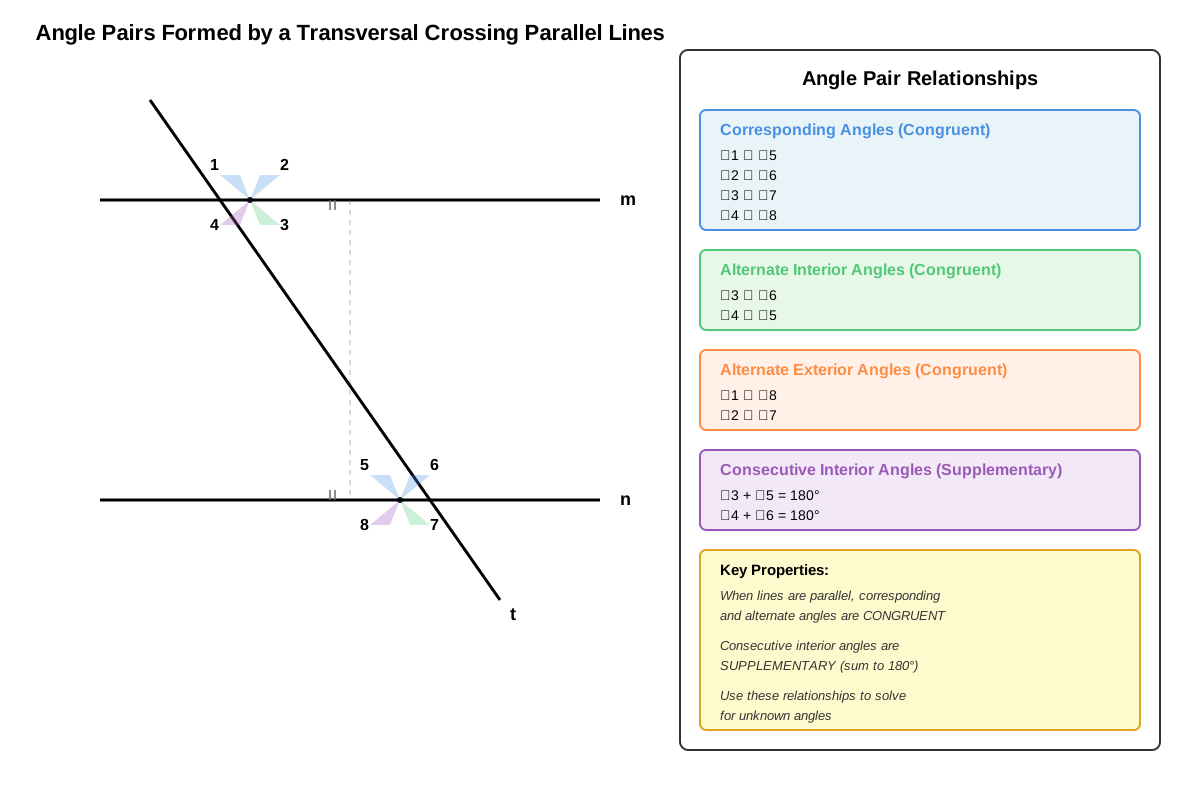
A transversal is a line that intersects two or more coplanar lines at distinct points. The most important and frequently tested scenario involves a transversal intersecting two parallel lines, though transversals can also intersect non-parallel lines (in which case the special angle relationships do not apply). When a single transversal crosses two lines, it creates eight angles total—four at each intersection point. These eight angles form specific relationships that allow for efficient problem-solving.
The fundamental principle underlying all transversal problems is this: when a transversal intersects two parallel lines, specific pairs of angles are congruent (equal in measure), and other specific pairs are supplementary (sum to 180°). This principle enables solvers to determine multiple unknown angles from a single known angle, making it a powerful tool for GRE efficiency.
The Four Critical Angle Pair Types
When a transversal intersects two parallel lines, four distinct types of angle pairs emerge, each with specific properties:
| Angle Pair Type | Location | Relationship | GRE Frequency |
|---|---|---|---|
| Corresponding Angles | Same side of transversal, same relative position at each intersection | Congruent (equal) | Very High |
| Alternate Interior Angles | Opposite sides of transversal, between the parallel lines | Congruent (equal) | Very High |
| Alternate Exterior Angles | Opposite sides of transversal, outside the parallel lines | Congruent (equal) | Medium |
| Consecutive Interior Angles | Same side of transversal, between the parallel lines | Supplementary (sum to 180°) | High |
Corresponding Angles
Corresponding angles occupy the same relative position at each intersection point. Imagine the transversal creating an "F" shape with the parallel lines—the angles at the top of each vertical line segment of the "F" are corresponding angles. When lines are parallel, all corresponding angle pairs are congruent. This is often the quickest relationship to identify visually and forms the basis for many GRE solutions.
For example, if a transversal crosses two parallel lines and creates an angle of 65° in the upper-left position at the first intersection, the upper-left angle at the second intersection is also 65°. The GRE frequently tests this by labeling one angle and asking for a corresponding angle's measure, sometimes requiring students to first identify the parallel line relationship.
Alternate Interior Angles
Alternate interior angles lie on opposite sides of the transversal and between (interior to) the two parallel lines, forming a "Z" pattern. These angles are congruent when the lines are parallel. The "Z" pattern (or reverse "Z") provides a reliable visual cue for identification. This relationship is particularly useful in proof-based reasoning and in determining whether lines are parallel—if alternate interior angles are congruent, the lines must be parallel (the converse is also true).
In GRE problems, alternate interior angles often appear in questions involving algebraic expressions. For instance, if one alternate interior angle measures (3x + 20)° and its pair measures (5x - 10)°, setting them equal allows solving for x, then determining actual angle measures.
Alternate Exterior Angles
Alternate exterior angles lie on opposite sides of the transversal and outside (exterior to) the two parallel lines. Like alternate interior angles, they form a "Z" pattern but in the exterior regions. These angles are congruent when lines are parallel. While tested less frequently than corresponding or alternate interior angles, they appear in more complex diagrams where multiple transversals or extended line segments create numerous angle relationships.
Consecutive Interior Angles (Co-Interior Angles)
Consecutive interior angles, also called co-interior angles or same-side interior angles, lie on the same side of the transversal and between the parallel lines, forming a "C" or "U" shape. Unlike the previous three types, these angles are supplementary—they sum to 180°—when lines are parallel. This relationship is crucial for problems where you know one angle and need to find its consecutive interior partner.
For example, if one consecutive interior angle measures 115°, its partner measures 180° - 115° = 65°. The GRE often uses this relationship in multi-step problems where finding one angle via consecutive interior angles enables finding others via corresponding or alternate interior relationships.
Non-Parallel Lines and Transversals
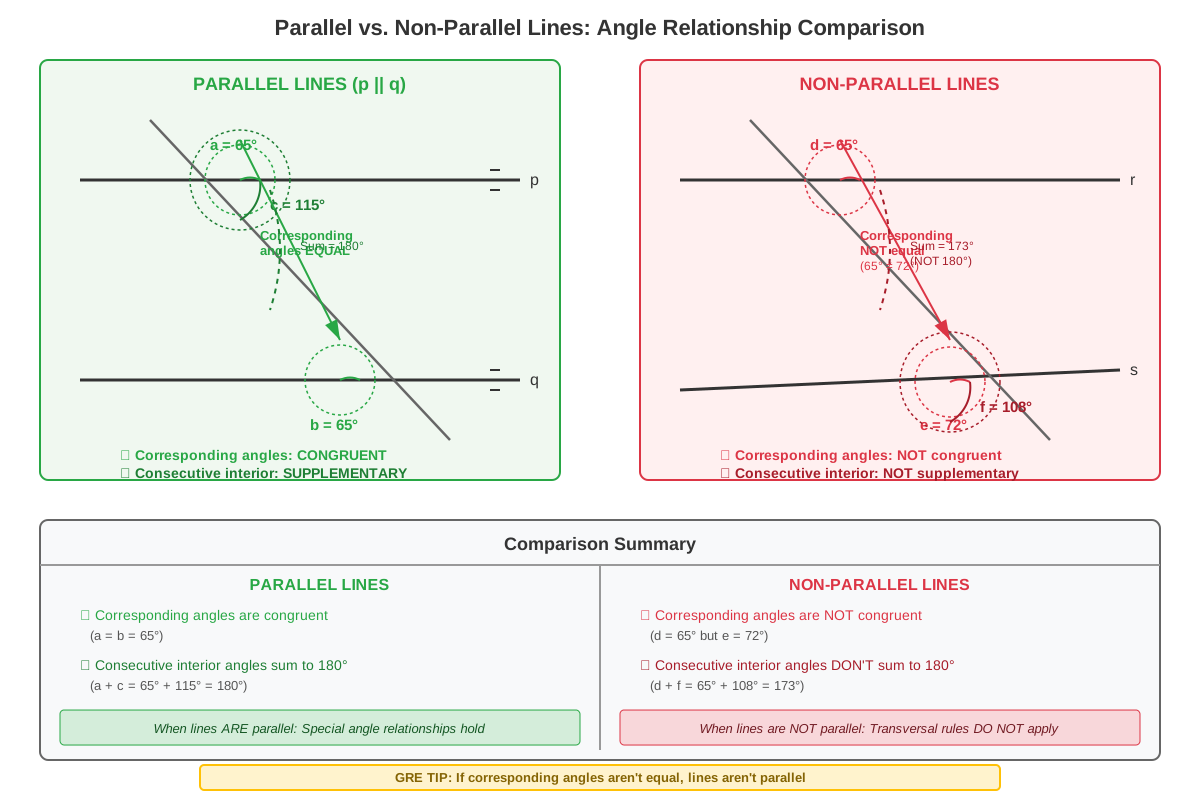
When a transversal intersects non-parallel lines, the special angle relationships (congruent corresponding angles, congruent alternate interior angles, etc.) do not hold. However, basic angle properties still apply: vertical angles remain congruent, and linear pairs remain supplementary. The GRE occasionally includes problems where students must first determine whether lines are parallel before applying transversal properties. This tests deeper understanding rather than rote memorization.
Multiple Transversals and Complex Configurations
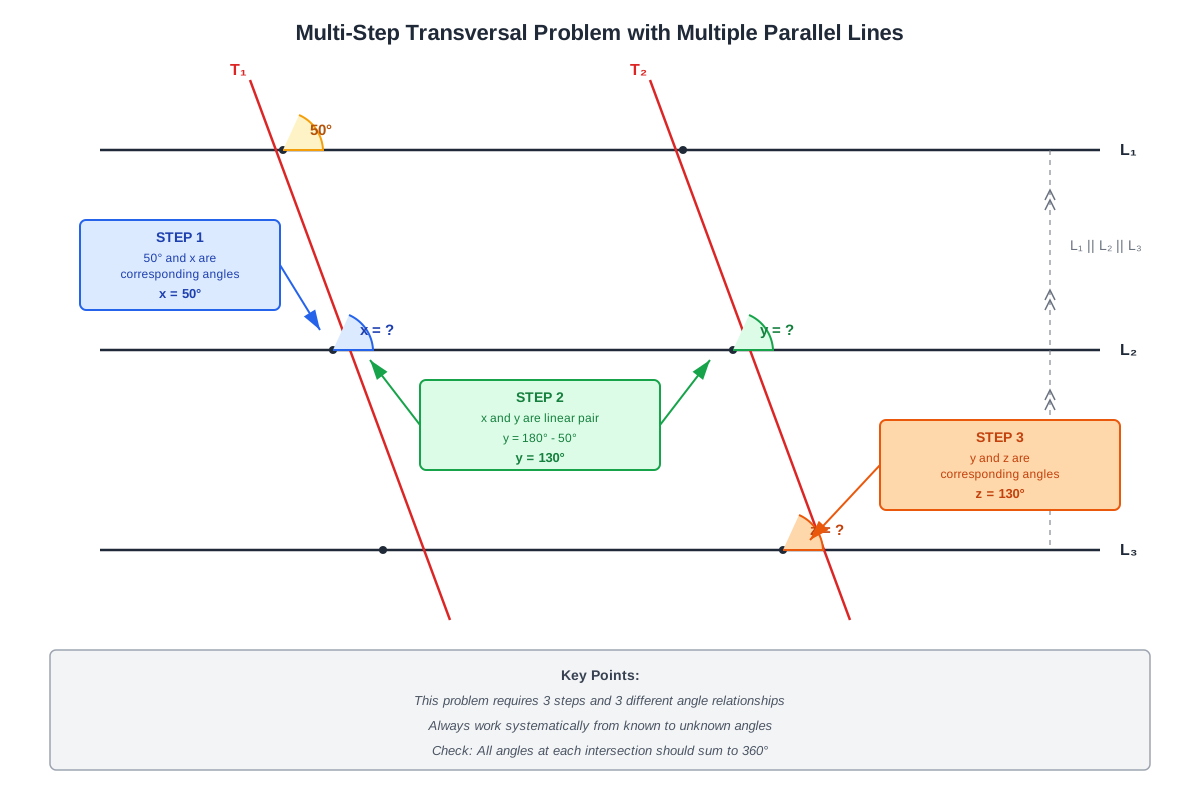
Advanced GRE problems may involve multiple transversals intersecting the same pair of parallel lines, or a single transversal intersecting three or more parallel lines. In these scenarios, systematic application of angle relationships is essential. The strategy involves: (1) identifying all parallel line pairs, (2) identifying each transversal, (3) marking known angles, (4) using angle relationships to find one unknown angle at a time, and (5) continuing until all required angles are determined.
Concept Relationships
The concepts within transversals form a hierarchical and interconnected system. At the foundation lies the definition of a transversal (a line intersecting two or more lines), which leads to the creation of eight angles when intersecting two lines. These eight angles can be analyzed through basic angle properties (vertical angles, linear pairs) regardless of whether the lines are parallel.
When the two lines are parallel, the system expands to include four special angle pair relationships: corresponding angles (congruent) → alternate interior angles (congruent) → alternate exterior angles (congruent) → consecutive interior angles (supplementary). Each relationship can be derived from the others using basic angle properties. For example, if corresponding angles are congruent, then alternate interior angles must also be congruent (using vertical angles as an intermediate step).
Transversals connect backward to prerequisite topics: vertical angles and linear pairs are used constantly within transversal problems as intermediate steps. They connect forward to advanced topics: polygon interior angles (where transversals help prove the (n-2)×180° formula), coordinate geometry (where parallel lines have equal slopes, connecting to transversal properties), and geometric proofs (where transversal relationships serve as justifications).
The relationship map flows as follows: Basic Angle Properties → Transversal Definition → Eight Angles Created → Parallel Lines Condition → Four Special Angle Pairs → Application to Complex Diagrams → Integration with Algebra and Coordinate Geometry → Advanced Problem Solving.
Quick check — test yourself on Transversals so far.
Try Flashcards →High-Yield Facts
⭐ When a transversal intersects two parallel lines, corresponding angles are always congruent.
⭐ When a transversal intersects two parallel lines, alternate interior angles are always congruent.
⭐ When a transversal intersects two parallel lines, consecutive interior angles are always supplementary (sum to 180°).
⭐ If alternate interior angles formed by a transversal are congruent, the two lines must be parallel (converse theorem).
⭐ All acute angles formed by a transversal crossing parallel lines are congruent to each other, and all obtuse angles are congruent to each other.
- When a transversal intersects two parallel lines, alternate exterior angles are congruent.
- Each acute angle formed is supplementary to each obtuse angle formed when a transversal crosses parallel lines.
- If you know the measure of any one angle formed by a transversal crossing parallel lines, you can determine all eight angles.
- Vertical angles at each intersection point are always congruent, regardless of whether the lines are parallel.
- The special angle relationships (corresponding, alternate interior, etc.) only apply when lines are parallel; they do not apply to non-parallel lines.
- In coordinate geometry, parallel lines have equal slopes, which connects to transversal angle relationships.
- A transversal can intersect more than two lines, creating multiple sets of angle relationships.
Common Misconceptions
Misconception: All angles formed by a transversal are equal. → Correction: Only specific angle pairs are equal (corresponding, alternate interior, alternate exterior) when lines are parallel. At each intersection, there are typically two different angle measures—one acute and one obtuse—that are supplementary to each other.
Misconception: Transversal angle relationships apply to any two lines, whether parallel or not. → Correction: The special relationships (congruent corresponding angles, congruent alternate interior angles, etc.) only apply when the two lines are parallel. For non-parallel lines, only basic angle properties (vertical angles, linear pairs) apply.
Misconception: Consecutive interior angles are congruent like the other angle pairs. → Correction: Consecutive interior angles are supplementary (sum to 180°), not congruent. This is the one major angle pair type that has a different relationship.
Misconception: If a diagram shows two lines that look parallel, you can assume they are parallel. → Correction: On the GRE, never assume lines are parallel unless explicitly stated, marked with arrows, or provable from given information. Diagrams are not necessarily drawn to scale.
Misconception: Alternate interior angles are always on the interior of the parallel lines and on alternating sides, but they must be adjacent to the transversal. → Correction: Alternate interior angles are indeed interior and on opposite sides of the transversal, but "adjacent to the transversal" is redundant—all angles formed are at the intersection points. The key is that they're between the parallel lines and on opposite sides of the transversal, forming a "Z" pattern.
Misconception: You need to memorize all eight angle positions and their relationships. → Correction: You only need to understand the four angle pair types and recognize that at each intersection, vertical angles are equal and linear pairs are supplementary. From any one known angle, you can find all others using these principles systematically.
Worked Examples
Example 1: Basic Angle Calculation
Problem: Line l and line m are parallel. A transversal t intersects line l, creating an angle of 125° on the upper-left side of the intersection. What is the measure of the alternate interior angle?
Solution:
Step 1: Visualize or sketch the configuration. Line l and line m are parallel, with transversal t crossing both.
Step 2: Identify the given angle. The 125° angle is at the intersection of t and l, in the upper-left position.
Step 3: Locate the alternate interior angle. The alternate interior angle would be at the intersection of t and m, on the opposite side of the transversal (right side), and in the interior region (between the parallel lines). However, we need to be careful about which angle is actually alternate interior to the 125° angle.
Step 4: Since the 125° angle is on the upper-left at the first intersection, it's actually an exterior angle (above line l). Its alternate exterior angle would be at the lower-right of the second intersection. But the question asks for the alternate interior angle.
Step 5: Let's reconsider. If the 125° angle is at the upper-left of the intersection with line l, the alternate interior angle to consider would be at the intersection with line m. First, find the angle that's supplementary to 125° at the first intersection (on the same line): 180° - 125° = 55°. This 55° angle is in the upper-right position at the first intersection.
Step 6: The alternate interior angle to this 55° angle would be at the lower-left position at the second intersection, measuring 55°.
Alternatively, using corresponding angles: The 125° angle has a corresponding angle at the second intersection (same position), also 125°. The alternate interior angle to the original 125° would be supplementary to this corresponding angle: 180° - 125° = 55°.
Answer: 55°
Connection to Learning Objectives: This problem requires identifying transversal relationships (corresponding and supplementary angles) and applying the core rules to find unknown angles.
Example 2: Algebraic Application with Multiple Steps
Problem: Two parallel lines are cut by a transversal. One of the alternate interior angles measures (4x + 15)°, and its pair measures (6x - 25)°. Find the measure of a corresponding angle to the first alternate interior angle.
Solution:
Step 1: Apply the alternate interior angles theorem. Since the lines are parallel, alternate interior angles are congruent:
4x + 15 = 6x - 25Step 2: Solve for x:
15 + 25 = 6x - 4x
40 = 2x
x = 20
Step 3: Calculate the measure of the first alternate interior angle:
4x + 15 = 4(20) + 15 = 80 + 15 = 95°Step 4: Verify with the second angle:
6x - 25 = 6(20) - 25 = 120 - 25 = 95° ✓Step 5: Find a corresponding angle to the first alternate interior angle. A corresponding angle occupies the same relative position at its intersection point. Since corresponding angles are congruent when lines are parallel, the corresponding angle also measures 95°.
Answer: 95°
Connection to Learning Objectives: This problem integrates algebraic manipulation with transversal properties, requiring students to apply the alternate interior angles theorem, solve for a variable, and then use corresponding angles to find the final answer—demonstrating multi-step problem-solving with transversals.
Exam Strategy
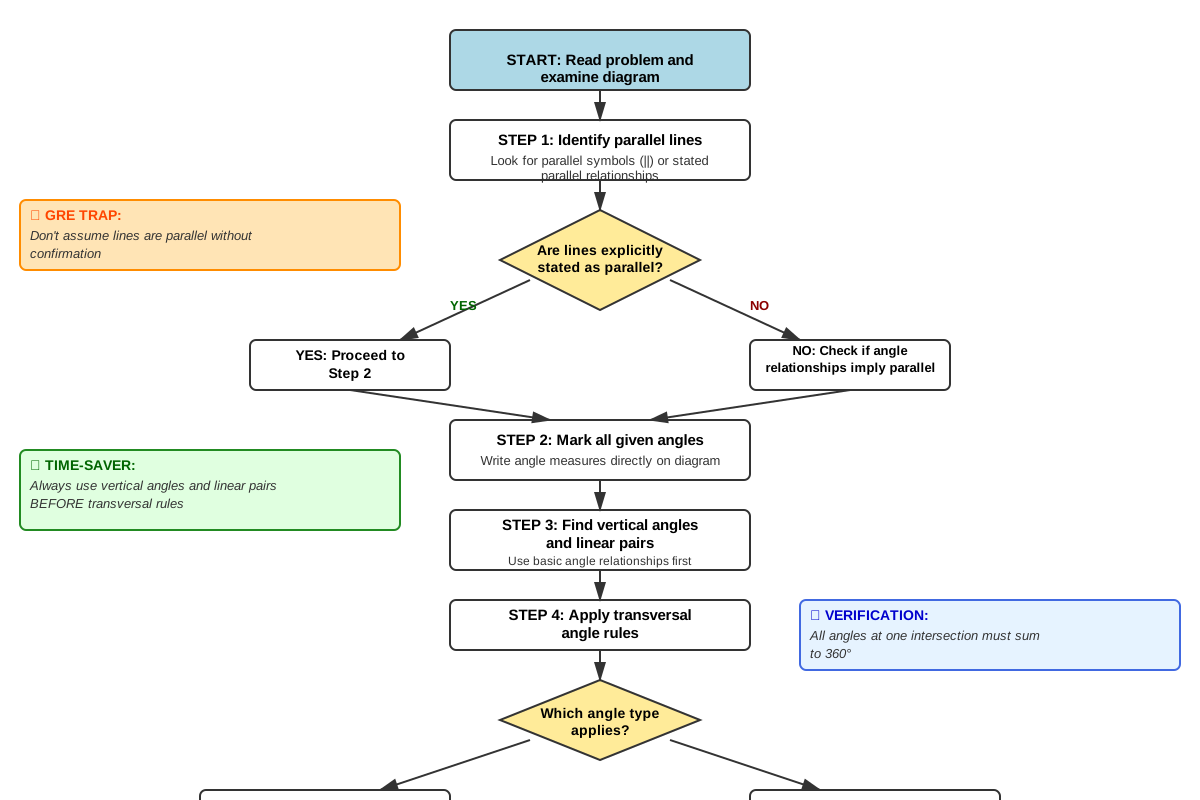
When approaching GRE questions involving transversals, begin by identifying whether the problem explicitly states or implies that lines are parallel. Look for trigger phrases such as "parallel lines," "lines l and m are parallel," or visual indicators like arrow marks on lines in diagrams. If parallelism isn't stated, determine whether you can prove it from given angle relationships.
Systematic angle-finding strategy: Once you've confirmed parallel lines, mark the one known angle clearly. Then systematically find other angles using this sequence: (1) Find the vertical angle (always equal), (2) Find linear pair angles (supplementary), (3) Find corresponding angles at the other intersection (equal), (4) Repeat steps 1-2 at the second intersection. This methodical approach prevents errors and ensures you don't miss relationships.
Watch for these trigger words and phrases: "transversal," "parallel lines," "corresponding angles," "alternate interior," "same-side interior," "cut by a line," "intersects two lines," and "if lines are parallel." In Quantitative Comparison questions, phrases like "appears to be parallel" are traps—never assume parallelism from appearance alone.
Process of elimination tips: In multiple-choice questions, if you know one angle is 65°, immediately eliminate any answer choices that aren't either 65° or 115° (its supplement), as these are the only two possible angle measures in a parallel lines/transversal configuration. For Quantitative Comparison questions, if you cannot determine whether lines are parallel, the answer is typically (D) "The relationship cannot be determined."
Time allocation: Simple transversal problems (one transversal, two parallel lines, finding one or two angles) should take 45-60 seconds. Complex problems (multiple transversals, algebraic expressions, or integration with other geometry concepts) may require 90-120 seconds. If you're spending more than two minutes, mark the question and return to it later.
Diagram strategy: If no diagram is provided, quickly sketch one. Draw two roughly parallel horizontal lines, then a transversal crossing both at an angle. Mark the given angle and systematically label others as you find them. This visual reference prevents confusion and reduces errors.
Memory Techniques
Mnemonic for angle pair types: "CACE" - Corresponding, Alternate interior, Consecutive interior, (alternate) Exterior. The first three are the most frequently tested.
Visual pattern recognition:
- Corresponding angles: Think "F pattern" - the angles at the same position on the F shape
- Alternate interior angles: Think "Z pattern" - the angles form a Z (or reverse Z) between the lines
- Consecutive interior angles: Think "C pattern" - the angles form a C or U shape on the same side
The "Three Equals, One Supplements" rule: Of the four main angle pair types, three are equal (corresponding, alternate interior, alternate exterior) and one supplements (consecutive interior). Remember: "C-A-A are the same, C-I adds to 180."
Acronym for problem-solving steps: "PIMA" - Parallel? (confirm lines are parallel), Identify (the known angle), Mark (vertical and supplementary angles at that intersection), Apply (corresponding or alternate interior to find angles at the other intersection).
Visualization for all eight angles: Remember there are only two different angle measures in any parallel lines/transversal configuration. If one is x°, the other is (180 - x)°. Four angles equal x°, and four angles equal (180 - x)°.
Summary
Transversals are lines that intersect two or more other lines, creating predictable angle relationships that are essential for GRE success. When a transversal crosses two parallel lines, it generates four critical angle pair types: corresponding angles (congruent), alternate interior angles (congruent), alternate exterior angles (congruent), and consecutive interior angles (supplementary). Mastery requires recognizing these patterns quickly, applying the appropriate relationship, and working systematically through multi-step problems. The key insight is that knowing any single angle in a parallel lines/transversal configuration allows determination of all eight angles using vertical angles, linear pairs, and the special parallel line relationships. GRE questions test this concept through direct angle calculation, algebraic problems with variable expressions, Quantitative Comparisons, and complex diagrams requiring multiple steps. Success depends on confirming parallelism before applying special relationships, using systematic angle-finding strategies, and integrating transversal properties with other geometric concepts.
Key Takeaways
- A transversal intersecting two parallel lines creates only two distinct angle measures; four angles equal one measure, and four equal its supplement
- The three "congruent" angle pairs are corresponding, alternate interior, and alternate exterior; the one "supplementary" pair is consecutive interior
- Always verify that lines are parallel before applying special transversal angle relationships; never assume from diagram appearance
- From any single known angle, you can determine all eight angles using vertical angles, linear pairs, and one transversal relationship
- Transversal problems frequently combine with algebra (variable expressions for angles) and coordinate geometry (slope relationships)
- The systematic approach—confirm parallel, identify known angle, mark vertical/supplementary, apply transversal relationship—prevents errors and saves time
- Recognizing visual patterns (F for corresponding, Z for alternate interior, C for consecutive interior) enables rapid angle pair identification
Related Topics
Polygon Interior and Exterior Angles: Transversal principles underlie the formulas for polygon angle sums. Understanding how parallel lines and transversals create angle relationships helps prove why a triangle's angles sum to 180° and extends to all polygons. Mastering transversals provides the foundation for these more complex polygon problems.
Coordinate Geometry and Slope: Parallel lines in the coordinate plane have equal slopes, directly connecting to transversal concepts. When a transversal (another line) intersects two parallel lines, the angle relationships studied here correspond to slope relationships and angle of inclination calculations.
Geometric Proofs: Many formal geometry proofs rely on transversal properties as justification steps. Understanding these relationships deeply enables construction of logical arguments and recognition of valid geometric reasoning—skills tested in more advanced GRE problems.
Similar Triangles: Transversals cutting parallel lines often create similar triangles, combining angle congruence (from transversal properties) with proportional sides. This integration appears in high-difficulty GRE problems.
Circle Geometry: Parallel chords and tangent lines in circles create transversal-like configurations. The angle relationships studied here extend to inscribed angles and arc measures.
Practice CTA
Now that you've mastered the core concepts of transversals, it's time to solidify your understanding through active practice. Attempt the practice questions to test your ability to identify angle relationships quickly and accurately under timed conditions. Use the flashcards to reinforce the four critical angle pair types and their properties until recognition becomes automatic. Remember: transversal problems reward systematic thinking and pattern recognition—skills that improve dramatically with deliberate practice. Each problem you solve strengthens your geometric intuition and builds the confidence needed for test day success. You've built the foundation; now apply it!
Sign up free to keep reading
Create a free AnvayaPrep account to finish this GRE guide on Transversals — plus flashcards and practice questions.