Overview
The triangle angle sum theorem stands as one of the most fundamental principles in plane geometry and appears with remarkable frequency on the GRE Quantitative Reasoning section. This theorem states that the interior angles of any triangle, regardless of its shape or size, always sum to exactly 180 degrees. While this concept may seem elementary, the GRE tests it in sophisticated ways that require students to combine this knowledge with other geometric principles, algebraic manipulation, and logical reasoning.
Understanding GRE triangle angle sum questions is essential because triangles form the building blocks for countless other geometric figures tested on the exam. Quadrilaterals can be divided into triangles, polygons rely on triangular decomposition for angle calculations, and complex figures often hide triangular relationships that unlock solutions. The GRE exploits this foundational theorem by embedding it within multi-step problems, coordinate geometry questions, and data sufficiency scenarios where recognizing the angle sum property becomes the critical insight needed to solve the problem efficiently.
Mastery of triangle angle sum connects directly to broader Quantitative Reasoning skills including algebraic equation-solving, spatial visualization, and pattern recognition. Questions testing this concept frequently appear alongside other geometric properties such as exterior angles, parallel lines cut by transversals, isosceles and equilateral triangle properties, and similarity relationships. The ability to quickly identify when the 180-degree angle sum applies—and to set up the corresponding equations—separates high-scoring test-takers from those who struggle with geometry sections.
Learning Objectives
- [ ] Identify when Triangle angle sum is being tested
- [ ] Explain the core rule or strategy behind Triangle angle sum
- [ ] Apply Triangle angle sum to GRE-style questions accurately
- [ ] Construct algebraic equations using the angle sum property to solve for unknown angles
- [ ] Recognize how triangle angle sum interacts with other geometric theorems (exterior angles, parallel lines, special triangles)
- [ ] Evaluate data sufficiency questions involving triangle angles to determine when information is adequate
- [ ] Synthesize triangle angle sum with coordinate geometry and complex figure problems
Prerequisites
- Basic algebraic equation solving: Required to set up and solve equations when angle measures are expressed as variables or expressions
- Understanding of angle measurement in degrees: Essential for interpreting angle notation and performing arithmetic with angle measures
- Familiarity with geometric notation and figures: Necessary to read diagrams, identify vertices, and understand angle labeling conventions
- Knowledge of supplementary and complementary angles: Often combined with triangle angle sum in multi-step problems
- Basic properties of equality: Needed to manipulate equations and isolate variables when solving for unknown angles
Why This Topic Matters
Triangle angle sum appears in approximately 15-20% of GRE geometry questions, making it one of the highest-yield geometric concepts to master. The theorem serves as a gateway to understanding more complex geometric relationships and frequently appears in questions worth critical points in the Quantitative Reasoning sections. Students who can rapidly apply this principle gain significant time advantages, allowing them to allocate more minutes to challenging problems elsewhere on the exam.
In real-world applications, triangle angle sum underlies structural engineering, architecture, navigation, computer graphics, and surveying. Architects use triangular bracing because the angle sum property ensures structural stability and predictable load distribution. GPS systems rely on triangulation, which depends fundamentally on angle relationships within triangles. Computer-aided design software uses triangular meshes to model three-dimensional objects, with angle calculations ensuring accurate rendering.
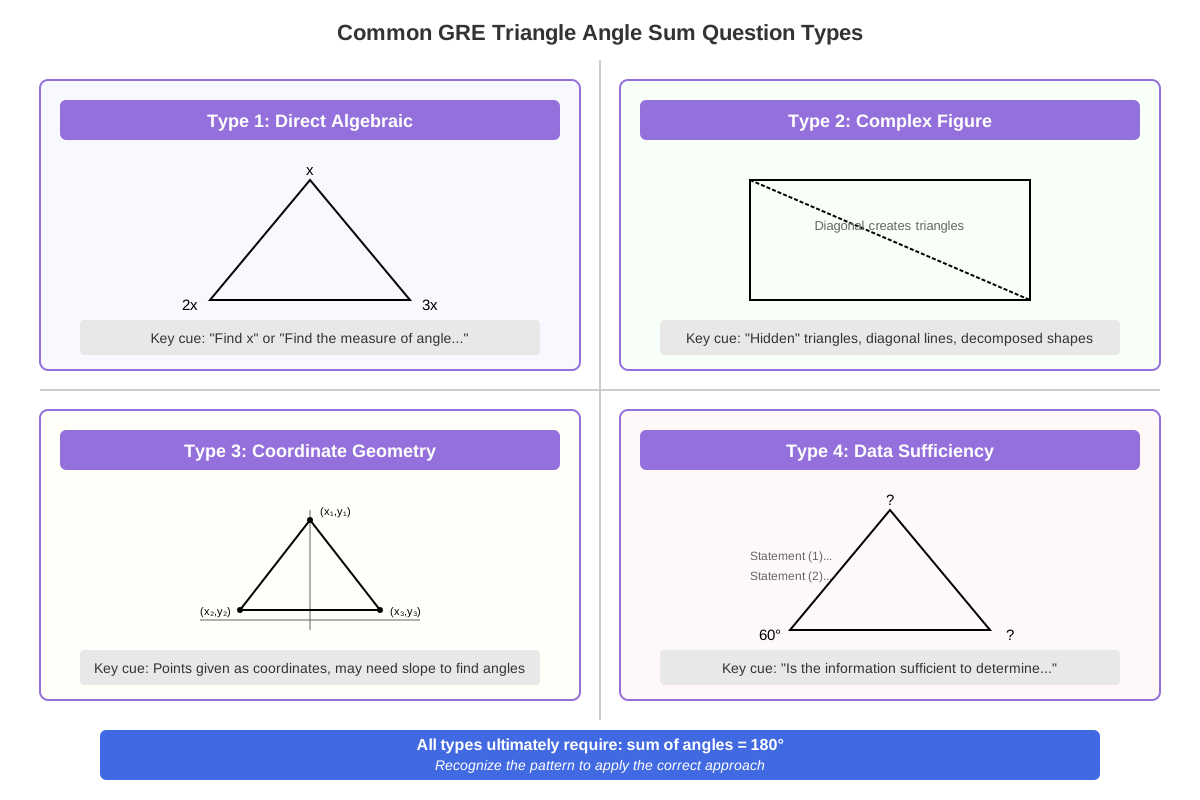
On the GRE, triangle angle sum appears in multiple question formats: quantitative comparison questions asking students to compare angle measures, problem-solving questions requiring calculation of specific angles, and data sufficiency questions testing whether given information determines all angles. The concept frequently appears disguised within complex figures where students must identify embedded triangles, in word problems describing geometric scenarios, and in coordinate geometry questions where triangles are defined by vertex coordinates. Questions may present angles algebraically (such as "2x + 10 degrees"), require recognition of special triangle types, or combine angle sum with properties of parallel lines and transversals.
Core Concepts
The Fundamental Triangle Angle Sum Theorem
The triangle angle sum theorem states that for any triangle in Euclidean (flat) geometry, the sum of the three interior angles equals exactly 180 degrees. Mathematically, if a triangle has angles measuring α, β, and γ degrees, then:
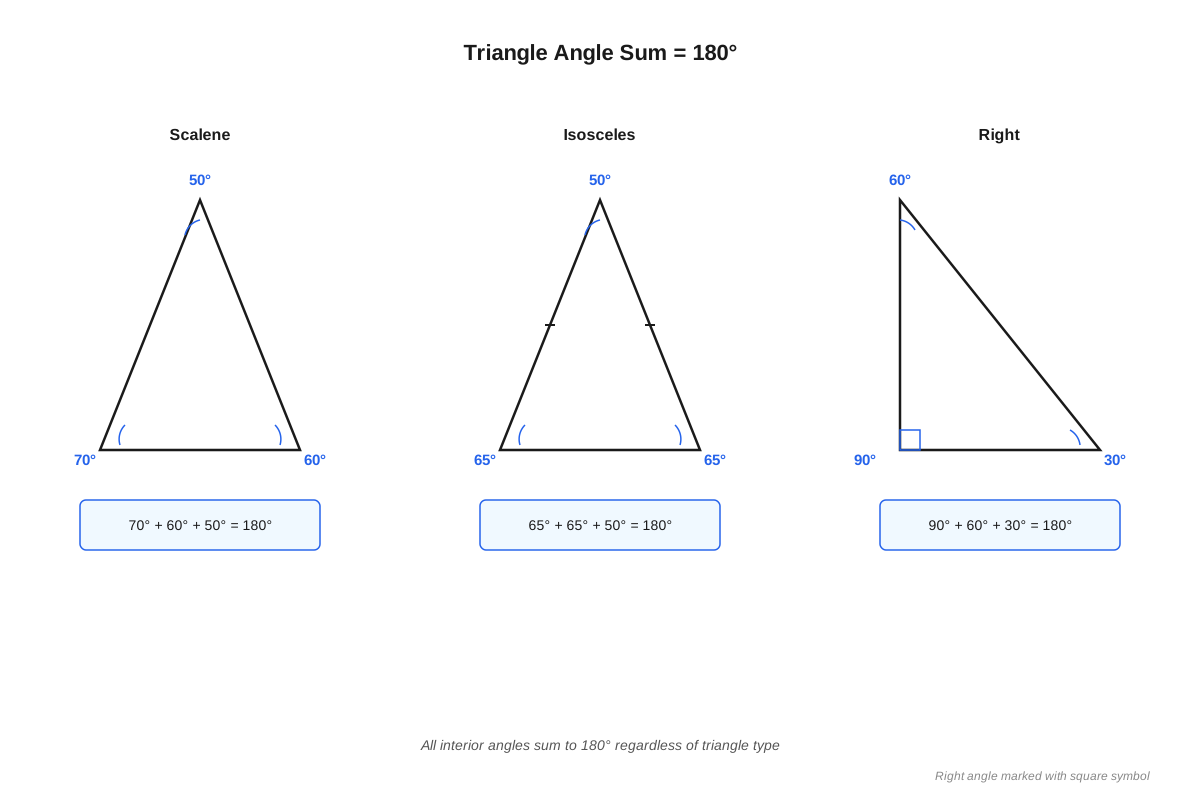
α + β + γ = 180°This relationship holds true for all triangle types: acute triangles (all angles less than 90°), right triangles (one 90° angle), obtuse triangles (one angle greater than 90°), scalene triangles (all sides different), isosceles triangles (two equal sides), and equilateral triangles (all sides equal). The universality of this theorem makes it an indispensable tool for solving geometric problems.
The proof of this theorem relies on the parallel postulate and can be demonstrated by drawing a line through one vertex parallel to the opposite side, then using alternate interior angles to show that the three angles of the triangle can be rearranged to form a straight line (180°). While the GRE does not require students to prove theorems, understanding the logical foundation helps build confidence in applying the principle.
Algebraic Applications of Angle Sum
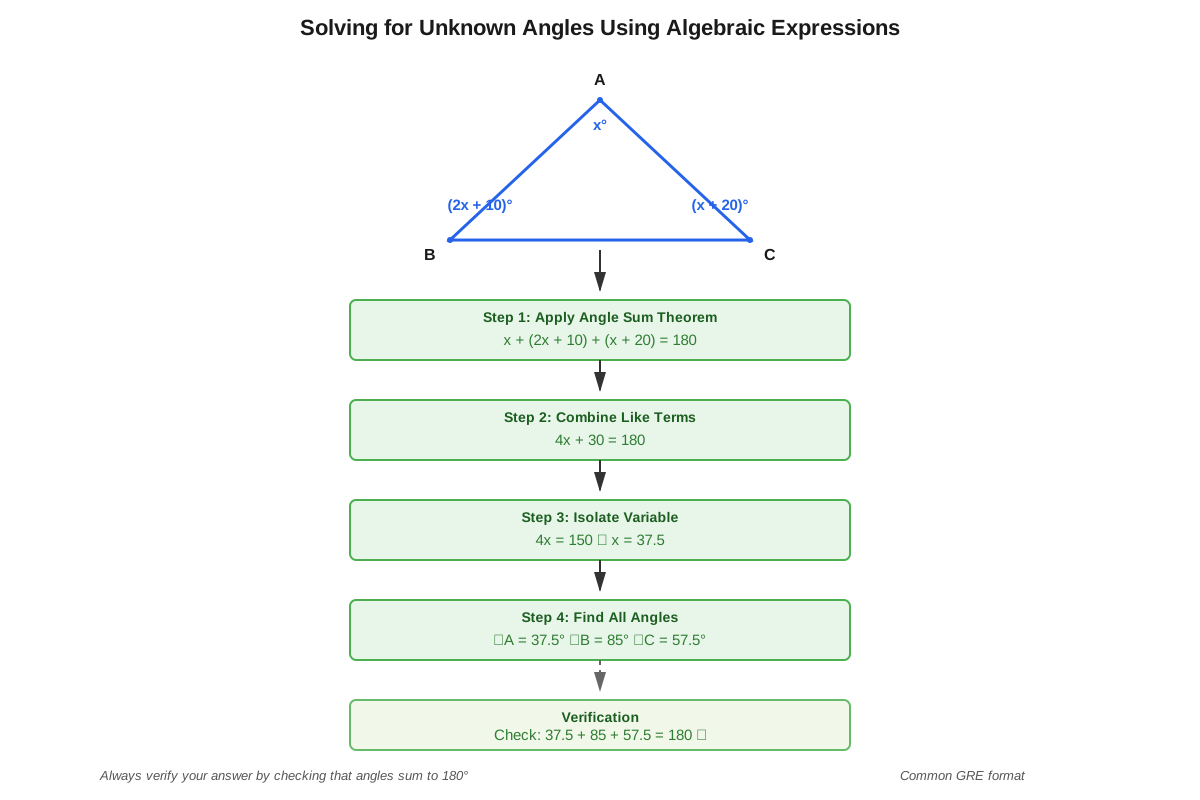
GRE questions frequently express angle measures using algebraic expressions rather than numerical values. When angles are given as variables or expressions containing variables, the angle sum theorem provides an equation that can be solved. For example, if a triangle has angles measuring x°, (2x + 15)°, and (x - 5)°, the equation becomes:
x + (2x + 15) + (x - 5) = 180
4x + 10 = 180
4x = 170
x = 42.5
This algebraic approach extends to more complex scenarios where multiple triangles share angles or where angle relationships are described verbally. The key skill involves translating geometric information into algebraic equations, then solving systematically. Students must remember to substitute back to find actual angle measures when questions ask for specific angles rather than variable values.
Exterior Angle Theorem Connection
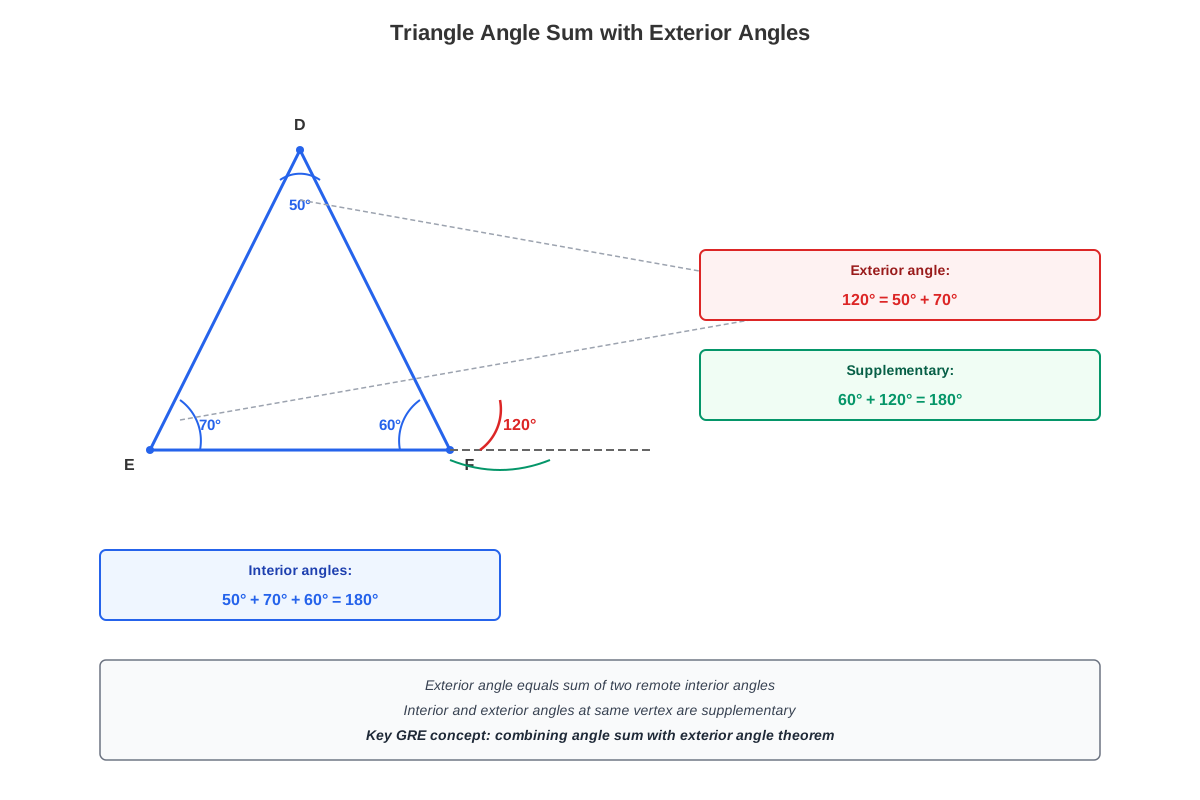
The exterior angle theorem states that an exterior angle of a triangle equals the sum of the two non-adjacent interior angles. This theorem derives directly from the triangle angle sum property. If a triangle has interior angles α, β, and γ, and an exterior angle δ is formed by extending one side, then:
δ = α + βThis relationship exists because the interior angle adjacent to δ and δ itself form a linear pair (supplementary angles summing to 180°). If the adjacent interior angle is γ, then:
γ + δ = 180°Since α + β + γ = 180°, substitution yields δ = α + β. Recognizing this connection allows students to solve problems more efficiently, particularly when exterior angles are explicitly shown or described.
Special Triangle Angle Relationships
Certain triangle types have additional angle constraints that combine with the 180° sum:
| Triangle Type | Angle Properties | Angle Sum Application |
|---|---|---|
| Equilateral | All three angles equal | Each angle = 180° ÷ 3 = 60° |
| Isosceles | Two angles equal (base angles) | If base angles = x, then 2x + apex angle = 180° |
| Right Triangle | One angle = 90° | The two acute angles sum to 90° (complementary) |
| 30-60-90 | Angles are 30°, 60°, 90° | Special right triangle with fixed angle measures |
| 45-45-90 | Two angles = 45°, one = 90° | Isosceles right triangle |
These special cases appear frequently on the GRE because they allow for rapid calculation and often connect to side-length ratios. Recognizing when a triangle falls into one of these categories can dramatically reduce solution time.
Multiple Triangle Systems
Complex GRE problems often present figures containing multiple triangles that share sides or angles. In these scenarios, the angle sum theorem must be applied to each triangle individually, creating a system of equations. For example, if two triangles share a common side, angles along that side may be related, and solving requires considering both triangles' angle sums simultaneously.
When a quadrilateral is divided by a diagonal into two triangles, the sum of all interior angles of the quadrilateral (360°) can be understood as the sum of the angles in both triangles (180° + 180°). This principle extends to any polygon: an n-sided polygon can be divided into (n - 2) triangles, giving a total interior angle sum of (n - 2) × 180°.
Angle Sum in Coordinate Geometry
When triangles are defined by coordinate points, the angle sum theorem still applies, but students must first determine angle measures using other methods such as slope calculations, distance formulas, or trigonometric relationships. The GRE may present a triangle with vertices at specific coordinates and ask about angle relationships. While calculating exact angle measures from coordinates can be complex, the 180° sum provides constraints that enable logical deduction even without precise calculations.
Concept Relationships
The triangle angle sum theorem serves as a central hub connecting numerous geometric concepts. At the foundational level, it builds upon basic angle measurement and the properties of straight lines (180°), which themselves derive from the definition of a circle (360°). The theorem directly enables the exterior angle theorem: since interior angles sum to 180° and an exterior angle forms a linear pair with one interior angle, the exterior angle must equal the sum of the two remote interior angles.
Triangle angle sum connects bidirectionally with special triangle properties. For equilateral triangles, the angle sum combined with the constraint that all angles are equal yields the 60° measure for each angle. For isosceles triangles, the angle sum works with the property that base angles are equal to determine all angle measures when any one angle is known. For right triangles, the angle sum reveals that the two acute angles must be complementary (summing to 90°).
The relationship map flows as follows:
Basic Angle Concepts → Linear Pairs (180°) → Triangle Angle Sum (180°) → Exterior Angle Theorem → Polygon Angle Sums
Parallel to this main pathway:
Triangle Angle Sum → Special Triangle Angle Properties → Side-Length Ratios → Trigonometric Relationships
Additionally, triangle angle sum connects to similarity and congruence theorems. When triangles are similar, corresponding angles are equal, and the angle sum property applies to both triangles identically. In proofs of congruence (though not typically required on the GRE), angle sum helps establish angle relationships that determine when triangles are congruent.
The theorem also interfaces with coordinate geometry through the relationship between slopes and angles. When two line segments meet at a point, the angle between them can be related to their slopes, and if three points form a triangle, the three angles determined by the slopes must sum to 180°.
Quick check — test yourself on Triangle angle sum so far.
Try Flashcards →High-Yield Facts
⭐ The sum of the interior angles of any triangle always equals exactly 180 degrees, regardless of triangle type or size.
⭐ In a right triangle, the two acute angles are complementary, meaning they sum to 90 degrees.
⭐ Each angle of an equilateral triangle measures exactly 60 degrees.
⭐ An exterior angle of a triangle equals the sum of the two non-adjacent interior angles.
⭐ In an isosceles triangle, if the two equal angles each measure x degrees, the third angle measures (180 - 2x) degrees.
- If two angles of a triangle are known, the third angle can always be determined by subtracting their sum from 180 degrees.
- The largest angle in a triangle is opposite the longest side; the smallest angle is opposite the shortest side.
- A triangle can have at most one right angle or one obtuse angle, but must have at least two acute angles.
- In a 30-60-90 triangle, the angles are in the ratio 1:2:3, and this ratio is fixed.
- When a triangle is divided by a line segment from one vertex to the opposite side, two new triangles are formed, each with angles summing to 180 degrees.
- The sum of any two angles in a triangle is less than 180 degrees (since the third angle must be positive).
- If angles are expressed algebraically, setting up the equation (angle₁ + angle₂ + angle₃ = 180) is the standard first step.
Common Misconceptions
Misconception: The angle sum theorem applies only to right triangles or special triangles.
Correction: The 180-degree angle sum applies to ALL triangles in Euclidean geometry, including acute, obtuse, right, scalene, isosceles, and equilateral triangles without exception.
Misconception: An exterior angle is supplementary to any interior angle of the triangle.
Correction: An exterior angle is supplementary only to its adjacent interior angle (they form a linear pair). The exterior angle equals the sum of the two non-adjacent interior angles, which is a different relationship.
Misconception: If two triangles share a side, their angles must be related in some special way beyond the basic angle sum.
Correction: While triangles sharing a side may have related angles in specific configurations (such as when they form a parallelogram), the only universal property is that each triangle's angles independently sum to 180 degrees. Additional relationships depend on the specific geometric configuration.
Misconception: The angle sum theorem can be used to determine side lengths directly.
Correction: The angle sum theorem provides information only about angle relationships. To determine side lengths, additional information such as the Law of Sines, Law of Cosines, special triangle ratios, or given measurements is required. However, angle information can constrain possible side length relationships.
Misconception: In coordinate geometry, if three points form a triangle, their coordinates directly reveal the angle measures.
Correction: While coordinates determine the triangle completely, calculating exact angle measures requires additional steps using slope relationships, the distance formula, or trigonometric functions. The angle sum property provides a constraint but doesn't directly yield angles from coordinates alone.
Misconception: When angles are given as algebraic expressions, the variable must represent an actual angle measure.
Correction: Variables in angle expressions may represent any quantity; the expression as a whole represents the angle measure. For example, if an angle is (3x - 10)°, the variable x might equal 30, making the angle 80°, but x itself is not an angle measure.
Worked Examples
Example 1: Algebraic Angle Determination
Problem: In triangle ABC, angle A measures (3x + 5)°, angle B measures (2x - 10)°, and angle C measures (x + 25)°. Find the measure of each angle.
Solution:
Step 1: Apply the triangle angle sum theorem by setting up the equation:
(3x + 5) + (2x - 10) + (x + 25) = 180Step 2: Combine like terms:
3x + 2x + x + 5 - 10 + 25 = 180
6x + 20 = 180
Step 3: Solve for x:
6x = 160
x = 26.67° (or 26⅔°)
Step 4: Substitute back to find each angle:
- Angle A = 3(26.67) + 5 = 80 + 5 = 85°
- Angle B = 2(26.67) - 10 = 53.33 - 10 = 43.33° (or 43⅓°)
- Angle C = 26.67 + 25 = 51.67° (or 51⅔°)
Step 5: Verify the solution:
85 + 43.33 + 51.67 = 180° ✓Connection to Learning Objectives: This problem demonstrates applying triangle angle sum to GRE-style questions accurately by translating algebraic expressions into a solvable equation, then interpreting the results geometrically.
Example 2: Complex Figure with Multiple Triangles
Problem: In the figure below (described), line segment BD divides triangle ABC into two smaller triangles, ABD and BCD. Angle ABD measures 35°, angle ADB measures 75°, and angle BCD measures 50°. Find the measure of angle BAC.
Solution:
Step 1: Identify the triangles and known angles:
- Triangle ABD: angles are 35° (ABD), 75° (ADB), and angle BAD (unknown)
- Triangle BCD: angles are 50° (BCD), angle DBC (unknown), and angle BDC (unknown)
Step 2: Find angle BAD using triangle ABD:
35 + 75 + angle BAD = 180
angle BAD = 180 - 110 = 70°
Step 3: Recognize that angle BAD is the same as angle BAC (they are the same angle):
angle BAC = 70°Alternative approach using exterior angles: Angle ADB (75°) is an exterior angle to triangle BCD at vertex D. However, we need more information about triangle BCD to use this approach effectively. The direct application to triangle ABD is more efficient here.
Connection to Learning Objectives: This problem requires identifying when triangle angle sum is being tested (recognizing the embedded triangles), explaining the core strategy (applying the theorem to the appropriate triangle), and accurately calculating the result.
Exam Strategy
When approaching GRE questions involving triangle angle sum, begin by carefully examining the figure or description to identify all triangles present. Many problems embed triangles within complex figures, and recognizing these hidden triangles is often the key insight. Look for vertices where three line segments meet, as these typically define triangles.
Trigger words and phrases that signal triangle angle sum questions include: "the angles of a triangle," "interior angles," "find the measure of angle," "if two angles of a triangle are," "the third angle," and "the sum of two angles." Questions describing triangles formed by intersecting lines, divided figures, or coordinate points also frequently test this concept. Be alert for phrases like "what is the value of x" when angles are expressed algebraically.
For quantitative comparison questions, quickly determine whether you can establish a definitive relationship between the quantities. If both quantities involve angles from the same triangle or related triangles, the 180° constraint often determines the comparison. Remember that without specific angle measures, you may need to test extreme cases (such as nearly flat triangles versus nearly equilateral triangles) to determine if the relationship holds universally.
Process of elimination works effectively when answer choices represent possible angle measures. Immediately eliminate any choice that would make the angle sum exceed 180° or result in negative or zero angle measures. If the problem involves a right triangle, eliminate choices that would make the two acute angles sum to anything other than 90°. For special triangles, eliminate choices inconsistent with the known angle relationships (such as angles not equal to 60° in an equilateral triangle).
Time allocation: Most triangle angle sum questions should be solvable within 1.5 to 2 minutes. If you find yourself spending more time, reassess whether you've identified the correct triangle or whether there's a simpler approach. Setting up the angle sum equation should take no more than 30 seconds; if the algebra becomes complex, verify that you've correctly translated the geometric information.
When angles are given algebraically, immediately write down the equation "angle₁ + angle₂ + angle₃ = 180" and substitute the given expressions. This systematic approach prevents errors and provides a clear path to the solution. If the problem involves multiple triangles, consider which triangle provides the most direct path to the answer before setting up equations for all triangles.
Memory Techniques
The "Triangle = Half Circle" Mnemonic: Visualize a triangle as half of a circle. Since a full circle contains 360°, half a circle (a straight line) contains 180°. Imagine the three angles of a triangle "opening up" to form a straight line—this reinforces that they sum to 180°.
The "Three-Sixty-Two" Rule: Remember "360 ÷ 2 = 180" to recall that a triangle (which can be thought of as half of a quadrilateral) has an angle sum of 180°. Extend this to "360 ÷ 2 = 180 ÷ 3 = 60" to remember that each angle of an equilateral triangle is 60°.
The "Right Triangle Complement" Visualization: For right triangles, visualize the two acute angles as puzzle pieces that fit together to form a right angle (90°). This reinforces that they're complementary. Picture the right angle as a corner, and the other two angles as pieces that complete the corner.
The "EXT = SUM" Acronym: Remember that an EXTerior angle equals the SUM of the two remote interior angles. This acronym helps recall the exterior angle theorem, which derives from the triangle angle sum property.
The "ISO-2" Pattern: For isosceles triangles, remember "ISO-2" to recall that two angles are equal. If you know one base angle, double it and subtract from 180 to find the apex angle. If you know the apex angle, subtract from 180 and divide by 2 to find each base angle.
Finger Counting Technique: Hold up three fingers to represent the three angles of a triangle. As you identify each angle's measure (or expression), touch each finger while mentally adding the values. This kinesthetic approach helps prevent forgetting to include all three angles in your equation.
Summary
The triangle angle sum theorem—stating that the interior angles of any triangle sum to exactly 180 degrees—represents one of the most fundamental and frequently tested concepts in GRE Quantitative Reasoning geometry. This universal property applies to all triangle types and serves as the foundation for solving numerous geometric problems, from simple angle calculations to complex multi-triangle systems. Mastery requires not only memorizing the 180° sum but also developing the ability to recognize when this property applies, translate geometric information into algebraic equations, and combine the angle sum with other geometric principles such as the exterior angle theorem, special triangle properties, and polygon angle relationships. GRE questions test this concept through direct angle calculations, algebraic problem-solving, quantitative comparisons, and embedded applications within complex figures. Success demands systematic equation setup, careful attention to all three angles, and strategic use of the theorem in conjunction with other geometric knowledge to efficiently navigate the diverse question formats encountered on the exam.
Key Takeaways
- The interior angles of any triangle always sum to exactly 180 degrees, without exception for any triangle type
- When angles are expressed algebraically, immediately set up the equation (angle₁ + angle₂ + angle₃ = 180) and solve systematically
- The exterior angle theorem (exterior angle = sum of two remote interior angles) derives directly from the triangle angle sum property
- In right triangles, the two acute angles are complementary (sum to 90°); in equilateral triangles, each angle measures 60°
- Complex figures often contain multiple triangles; apply the angle sum theorem to each triangle independently
- Recognizing when triangle angle sum is being tested—even when disguised within complex problems—is a critical GRE skill
- Combine triangle angle sum with other geometric properties (parallel lines, special triangles, similarity) for efficient problem-solving
Related Topics
Exterior Angles of Triangles: Building directly on triangle angle sum, this topic explores the relationship between exterior angles and remote interior angles, providing alternative solution pathways for many problems.
Properties of Special Triangles: Mastering triangle angle sum enables deeper study of equilateral, isosceles, and right triangles, including the special 30-60-90 and 45-45-90 triangles with their fixed angle and side ratios.
Polygon Angle Sums: Understanding that triangles sum to 180° provides the foundation for calculating interior angle sums of any polygon using the formula (n - 2) × 180°.
Triangle Similarity and Congruence: Angle relationships, constrained by the 180° sum, determine when triangles are similar (corresponding angles equal) or congruent (all corresponding parts equal).
Coordinate Geometry with Triangles: Applying triangle angle sum to triangles defined by coordinate points integrates geometric and algebraic reasoning, a high-yield GRE skill area.
Practice CTA
Now that you've mastered the triangle angle sum theorem and its applications, reinforce your understanding by attempting the practice questions designed specifically for this topic. These problems mirror actual GRE question formats and difficulty levels, providing essential experience with the diverse ways this concept appears on the exam. Work through the flashcards to cement the high-yield facts and relationships in your memory. Remember: geometry mastery comes through active practice, not passive reading. Each problem you solve strengthens your pattern recognition and builds the confidence needed to tackle any triangle angle sum question on test day. You've built a solid foundation—now apply it!
Sign up free to keep reading
Create a free AnvayaPrep account to finish this GRE guide on Triangle angle sum — plus flashcards and practice questions.