Overview
Vertical angles are one of the most fundamental and frequently tested angle relationships in GRE Quantitative Reasoning. When two straight lines intersect, they create two pairs of opposite angles, and each pair consists of vertical angles that are always equal in measure. This elegant geometric property appears in countless GRE problems, often embedded within more complex diagrams involving parallel lines, triangles, polygons, and coordinate geometry. Understanding vertical angles is not merely about memorizing a definition—it's about recognizing this pattern instantly in diagrams and leveraging it to unlock multi-step problems efficiently.
The importance of gre vertical angles cannot be overstated for test-takers aiming for competitive scores. This topic appears in approximately 15-20% of geometry questions on the GRE, either as the primary concept being tested or as a necessary intermediate step in solving more complex problems. Vertical angles serve as a gateway concept that connects to numerous other geometric principles: they work in tandem with supplementary angles, linear pairs, parallel line relationships, and polygon angle calculations. Mastering vertical angles builds the foundation for quickly identifying angle measures in complex diagrams, which is essential for time management on the quantitative section.
Beyond isolated angle problems, vertical angles frequently appear in questions involving algebraic expressions for angle measures, requiring students to set up and solve equations. They also emerge in data sufficiency questions where recognizing the vertical angle relationship can immediately determine whether given information is sufficient. The concept's versatility makes it a high-yield study target—investing time to achieve automatic recognition and application of vertical angles will pay dividends across multiple question types and difficulty levels throughout the GRE Quantitative Reasoning section.
Learning Objectives
- [ ] Identify when Vertical angles is being tested
- [ ] Explain the core rule or strategy behind Vertical angles
- [ ] Apply Vertical angles to GRE-style questions accurately
- [ ] Recognize vertical angles within complex geometric diagrams containing multiple intersecting lines
- [ ] Set up and solve algebraic equations involving vertical angle expressions
- [ ] Distinguish between vertical angles and other angle relationships (supplementary, complementary, linear pairs)
- [ ] Combine vertical angle properties with other geometric theorems to solve multi-step problems
Prerequisites
- Basic angle measurement: Understanding that angles are measured in degrees and that a complete rotation equals 360° is essential for working with any angle relationships
- Straight lines and line segments: Recognizing that a straight line forms a 180° angle is necessary to understand how intersecting lines create angle pairs
- Algebraic equation solving: The ability to set up and solve linear equations with one variable is required for problems where angle measures are expressed algebraically
- Basic geometric notation: Familiarity with how angles are labeled (using three points or angle symbols) helps in identifying which angles are being referenced in problems
Why This Topic Matters
Vertical angles represent a cornerstone of geometric reasoning that extends far beyond the GRE. In architecture, engineering, and design, understanding how intersecting lines create predictable angle relationships is fundamental to structural analysis and spatial planning. When bridges are designed with intersecting support beams, or when city planners lay out intersecting streets, the vertical angle principle ensures accurate measurements and calculations. In physics, the concept appears in optics when analyzing light rays reflecting off surfaces, and in mechanics when determining force vectors at intersection points.
On the GRE specifically, vertical angles appear in approximately 3-5 questions per test administration, either directly or as part of compound geometry problems. The Educational Testing Service (ETS) favors this topic because it efficiently tests both geometric intuition and algebraic manipulation skills. Questions typically fall into three categories: (1) direct identification problems where students must find an angle measure using the vertical angle property, (2) algebraic problems where angle measures are expressed as variables or expressions, and (3) complex diagram problems where vertical angles must be recognized among multiple angle relationships.
The topic commonly appears in Quantitative Comparison questions, where recognizing vertical angles can immediately reveal that two quantities are equal. It also surfaces in multiple-choice problems embedded within diagrams showing intersecting lines with some angles labeled and others requiring calculation. Data Sufficiency questions (though more common on the GMAT) occasionally appear in GRE practice materials, testing whether students recognize that knowing one angle at an intersection is sufficient to determine its vertical angle. The concept's frequent pairing with parallel lines cut by transversals makes it doubly important—students who master vertical angles gain access to solving an entire category of multi-step geometry problems efficiently.
Core Concepts
Definition of Vertical Angles
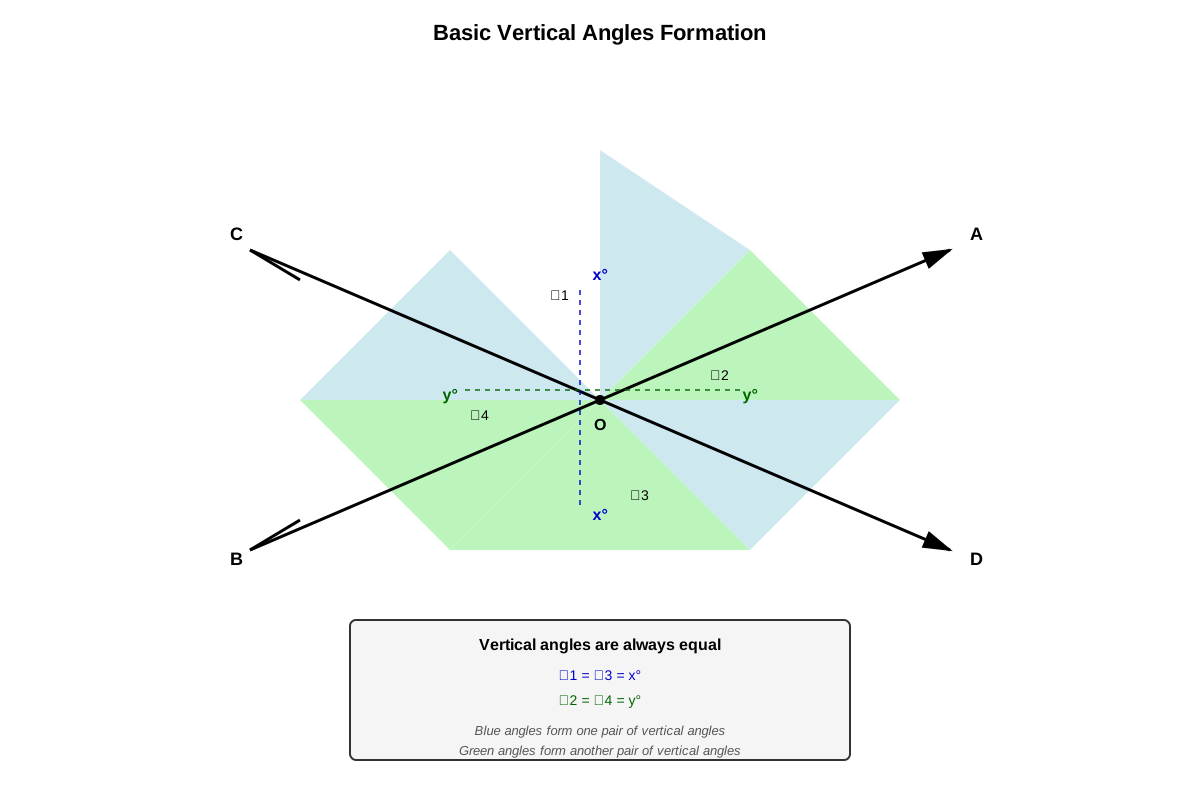
Vertical angles are the pairs of opposite angles formed when two straight lines intersect at a point. The term "vertical" in this context does not mean "up and down" as in everyday language; rather, it comes from the Latin word "vertex," meaning the point where the lines meet. When two lines cross, they create four angles at their intersection point. The angles that are directly across from each other—not adjacent, but opposite—are vertical angles.
The fundamental property that makes vertical angles so powerful is this: vertical angles are always congruent (equal in measure). This is not an approximation or a special case—it is a mathematical certainty that holds for any pair of intersecting straight lines, regardless of the angle at which they intersect. If one vertical angle measures 47°, its opposite angle also measures exactly 47°. If one vertical angle measures x°, its opposite angle also measures x°.
The Vertical Angles Theorem
The Vertical Angles Theorem states that when two lines intersect, the vertical angles formed are congruent. This theorem can be proven using the properties of linear pairs and supplementary angles. Consider two intersecting lines creating four angles: ∠1, ∠2, ∠3, and ∠4, arranged clockwise around the intersection point. Angles 1 and 3 are vertical angles, as are angles 2 and 4.
Here's the logical proof:
- ∠1 and ∠2 form a linear pair (adjacent angles on a straight line), so ∠1 + ∠2 = 180°
- ∠2 and ∠3 also form a linear pair, so ∠2 + ∠3 = 180°
- Since both sums equal 180°, we can write: ∠1 + ∠2 = ∠2 + ∠3
- Subtracting ∠2 from both sides: ∠1 = ∠3
This same logic applies to prove that ∠2 = ∠4. The proof demonstrates that vertical angles are congruent not by coincidence, but as a necessary consequence of the properties of straight lines.
Identifying Vertical Angles in Diagrams
On the GRE, vertical angles rarely appear in isolation. Instead, they're embedded within complex diagrams that may include:
- Multiple intersecting lines creating several pairs of vertical angles
- Parallel lines cut by transversals, where vertical angles appear at each intersection point
- Triangles or polygons with extended sides that create intersection points
- Coordinate plane problems where lines intersect at various points
The key to identifying vertical angles is to locate the vertex (intersection point) and then identify the two angles that are directly opposite each other across that point. These angles will not share any sides—they are separated by the other two angles at the intersection. A helpful visual strategy is to imagine the intersection as an "X" shape: the angles at the top and bottom of the X are one pair of vertical angles, while the angles at the left and right are the other pair.
Algebraic Applications
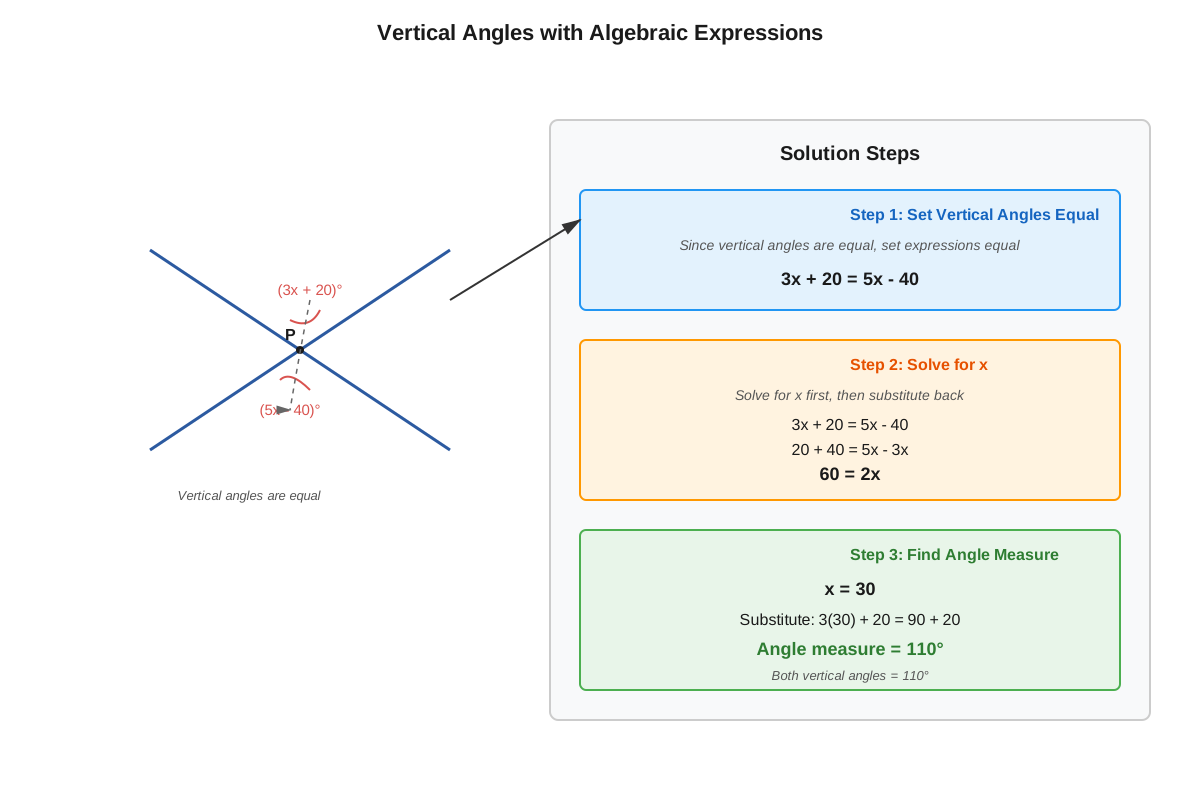
Many GRE problems express angle measures using algebraic expressions rather than numerical values. For example, one angle might be labeled as (3x + 10)° while its vertical angle is labeled as (5x - 20)°. Since vertical angles are equal, you can set up an equation:
3x + 10 = 5x - 20
Solving this equation:
- Subtract 3x from both sides: 10 = 2x - 20
- Add 20 to both sides: 30 = 2x
- Divide by 2: x = 15
Once you find x, you can substitute back to find the actual angle measure: 3(15) + 10 = 55°.
This algebraic approach extends to more complex scenarios where multiple variables appear, or where the vertical angle relationship is one of several equations needed to solve a system.
Relationship to Adjacent Angles
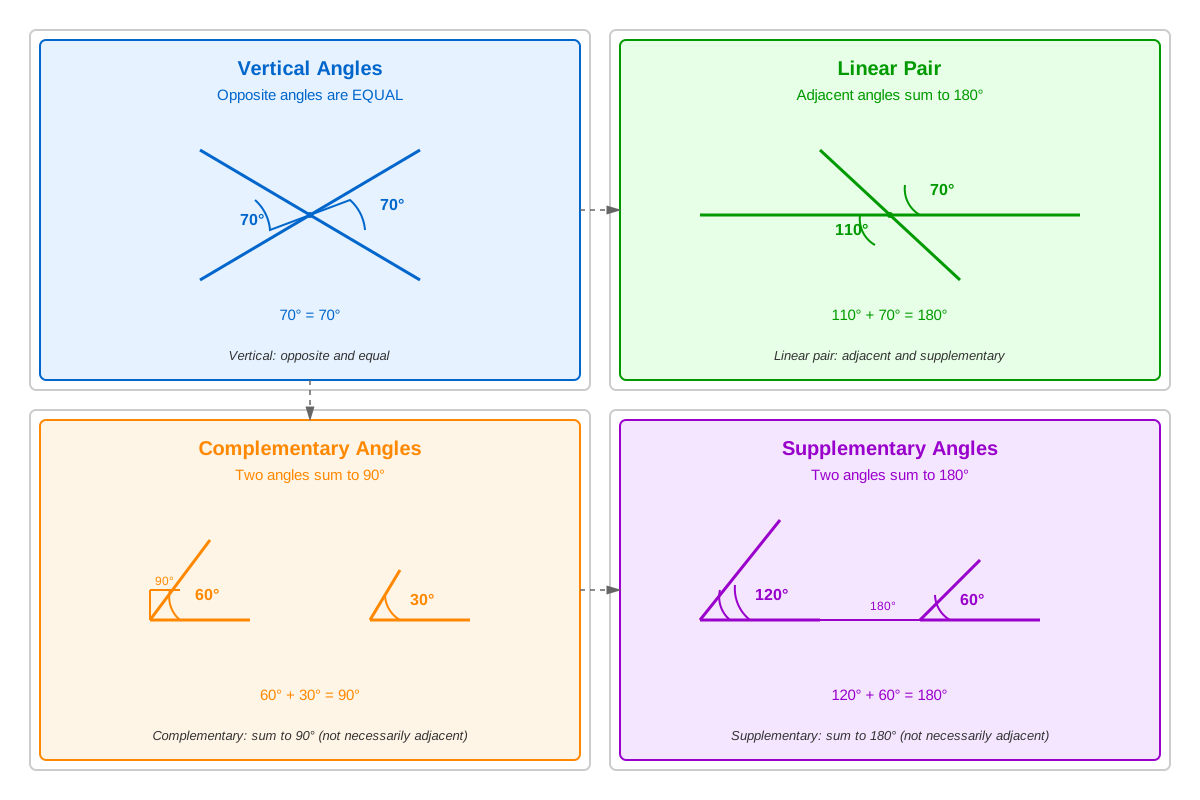
At any intersection of two straight lines, adjacent angles (angles that share a side) are supplementary, meaning they sum to 180°. This creates an important relationship: if you know any one angle at an intersection, you can determine all four angles. The angle directly opposite (vertical angle) equals the known angle, while the two adjacent angles each equal 180° minus the known angle.
| Angle Type | Relationship | Example |
|---|---|---|
| Vertical angles | Equal (congruent) | If ∠1 = 60°, then ∠3 = 60° |
| Adjacent angles (linear pair) | Supplementary (sum to 180°) | If ∠1 = 60°, then ∠2 = 120° |
| All four angles at intersection | Sum to 360° | ∠1 + ∠2 + ∠3 + ∠4 = 360° |
Multiple Intersections
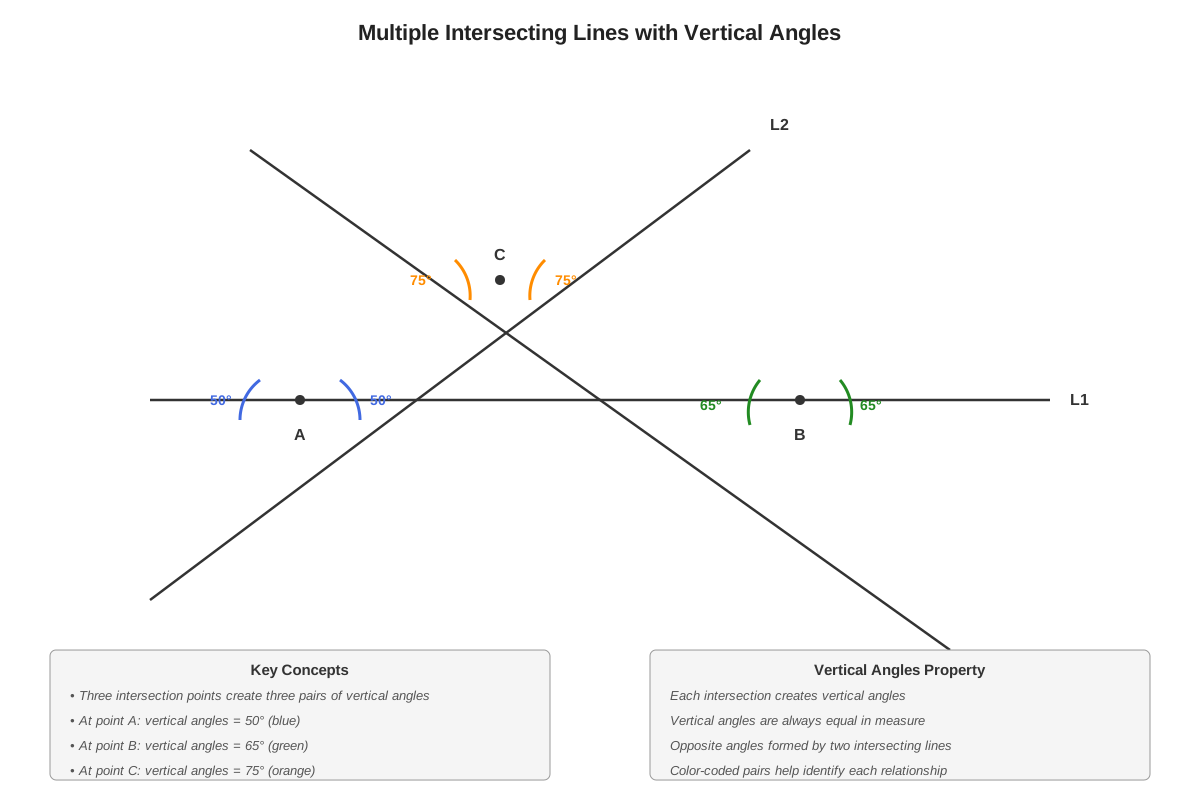
When three or more lines intersect at a single point, or when multiple intersection points exist in a diagram, the vertical angle principle applies at each individual intersection. For example, if three lines intersect at one point, they create six angles (not four), and the vertical angle pairs must be identified carefully by looking at angles directly opposite each other across the intersection point.
When dealing with multiple separate intersections (such as two parallel lines cut by two transversals), each intersection point has its own two pairs of vertical angles. Keeping track of which angles are vertical to each other requires careful attention to which specific intersection point you're analyzing.
Concept Relationships
The vertical angles concept sits at the center of a web of geometric relationships. Most directly, vertical angles connect to linear pairs and supplementary angles—the proof of the Vertical Angles Theorem relies on the fact that adjacent angles at an intersection form linear pairs summing to 180°. This means that understanding supplementary angles is not just a prerequisite but an integral part of working with vertical angles.
Moving outward, vertical angles form a critical component of parallel lines cut by a transversal problems. When a transversal crosses two parallel lines, it creates two intersection points, each with two pairs of vertical angles. The corresponding angles, alternate interior angles, and alternate exterior angles that characterize parallel line relationships all interact with vertical angles at these intersections. For instance, if you know that two lines are parallel and you're given one angle measure, you can often use vertical angles at one intersection combined with corresponding angles between intersections to find all eight angles in the diagram.
The relationship map flows as follows:
Straight lines (180°) → Linear pairs (supplementary angles) → Vertical Angles Theorem → Parallel line angle relationships → Polygon angle problems
Vertical angles also connect to triangle angle problems when triangle sides are extended beyond their vertices, creating intersections with other lines. The exterior angle theorem for triangles often requires recognizing vertical angles to identify which angle is actually the exterior angle. Similarly, in polygon problems, when sides are extended or when diagonals are drawn, the resulting intersections create vertical angles that must be identified to solve for unknown angle measures.
In coordinate geometry, when two lines with known slopes intersect, the angles they form can be analyzed using vertical angle properties. This connects algebraic representations of lines (slope-intercept form) with geometric angle relationships. Finally, vertical angles appear in circle geometry when chords or secants intersect, either inside or outside the circle, creating angles whose measures relate to arc measures—and identifying vertical angles correctly is essential for applying the relevant circle theorems.
Quick check — test yourself on Vertical angles so far.
Try Flashcards →High-Yield Facts
⭐ Vertical angles are always congruent (equal in measure) when formed by two intersecting straight lines.
⭐ At any intersection of two lines, there are exactly two pairs of vertical angles, and the angles in each pair are equal.
⭐ Adjacent angles at an intersection are supplementary (sum to 180°), not vertical angles.
⭐ If you know one angle at an intersection, you can determine all four angles using vertical angles and supplementary angle relationships.
⭐ Vertical angles can be expressed algebraically, and setting expressions equal allows you to solve for unknown variables.
- The four angles at any intersection of two straight lines sum to 360°.
- Vertical angles are non-adjacent; they do not share a common side.
- The term "vertical" refers to the vertex (intersection point), not to orientation.
- In diagrams with multiple intersections, each intersection point has its own pairs of vertical angles.
- Vertical angles remain congruent regardless of the angle at which the lines intersect (acute, obtuse, or right angles).
- When three or more lines intersect at a single point, vertical angles are still identified as angles directly opposite each other across the intersection.
- Recognizing vertical angles is often the first step in solving complex geometry problems involving parallel lines and transversals.
Common Misconceptions
Misconception: Vertical angles are angles that point vertically (up and down) in a diagram.
Correction: The term "vertical" comes from "vertex" (the intersection point), not from orientation. Vertical angles are opposite angles at an intersection, regardless of whether they point up, down, left, or right.
Misconception: Adjacent angles at an intersection are vertical angles.
Correction: Vertical angles are non-adjacent; they are the angles directly across from each other at an intersection. Adjacent angles at an intersection form linear pairs and are supplementary (sum to 180°), not equal.
Misconception: Vertical angles only exist when lines intersect at right angles.
Correction: Vertical angles are formed whenever two straight lines intersect, regardless of the angle of intersection. Whether the intersection creates acute, obtuse, or right angles, the opposite angles are always vertical angles and always congruent.
Misconception: In a diagram with multiple intersections, all angles that "look similar" are vertical angles.
Correction: Vertical angles must share the same vertex (intersection point). Angles at different intersection points are not vertical angles to each other, even if they have the same measure. Each intersection has its own pairs of vertical angles.
Misconception: If two angles are equal, they must be vertical angles.
Correction: While vertical angles are always equal, equal angles are not necessarily vertical angles. Angles can be equal due to other relationships (corresponding angles with parallel lines, angles in congruent triangles, etc.). Vertical angles specifically must be opposite angles at the same intersection point.
Misconception: The Vertical Angles Theorem applies to angles formed by curved lines or rays that don't extend infinitely.
Correction: The Vertical Angles Theorem applies only to straight lines. If the intersecting figures are curves, rays with endpoints at the intersection, or line segments that don't extend through the intersection, the vertical angle relationship may not hold.
Worked Examples
Example 1: Basic Algebraic Application
Problem: Two lines intersect, forming four angles. One angle measures (4x - 15)° and its vertical angle measures (2x + 25)°. Find the value of x and the measure of these vertical angles.
Solution:
Step 1: Recognize that vertical angles are congruent, so we can set the expressions equal:
4x - 15 = 2x + 25Step 2: Solve for x by collecting like terms:
4x - 2x = 25 + 15
2x = 40
x = 20
Step 3: Substitute x = 20 back into either expression to find the angle measure:
4(20) - 15 = 80 - 15 = 65°Step 4: Verify using the other expression:
2(20) + 25 = 40 + 25 = 65° ✓Answer: x = 20, and the vertical angles each measure 65°.
Connection to Learning Objectives: This example demonstrates applying vertical angles to GRE-style questions accurately by setting up and solving an algebraic equation based on the core rule that vertical angles are congruent.
Example 2: Complex Diagram with Multiple Relationships
Problem: In the diagram below (described), line AB intersects line CD at point E. Line FG also passes through point E. Angle AEC measures 110°. Angle FEB measures 35°. Find the measure of angle GED.
Solution:
Step 1: Draw or visualize the diagram with three lines intersecting at point E, creating six angles around the point.
Step 2: Identify that angle AEC = 110° is given. Since angles AEC and BED are vertical angles (opposite each other across point E), angle BED also measures 110°.
Step 3: Recognize that angle FEB = 35° is given. Since angles FEB and GEA are vertical angles, angle GEA also measures 35°.
Step 4: To find angle GED, note that angles GEA, AEC, and CEG form a straight line from G to B (180°). Wait—let's reconsider the configuration more carefully.
Step 4 (revised): The three lines create six angles around point E. Going clockwise from ray EA, we might have: angle AEF, angle FEC, angle CEB, angle BEG, angle GED, and angle DEA.
Step 5: We know angle AEC = 110° (this spans from ray EA to ray EC, likely covering two of our six angles). We know angle FEB = 35°.
Step 6: Since angle AEC and angle BED are vertical angles, angle BED = 110°.
Step 7: Angle FEB = 35° and its vertical angle GED must also equal 35°.
Answer: Angle GED = 35°.
Connection to Learning Objectives: This example requires identifying when vertical angles are being tested within a complex diagram with multiple intersecting lines, and applying the core rule to find unknown angle measures through multi-step reasoning.
Exam Strategy
When approaching gre vertical angles questions on the GRE, begin by carefully examining the diagram for intersection points. Mark each intersection with a small dot or circle to ensure you've identified all vertices where vertical angles exist. This visual organization prevents confusion in complex diagrams with multiple intersecting lines.
Trigger words and phrases that signal vertical angle problems include:
- "Two lines intersect..."
- "Opposite angles..."
- "Lines cross at point..."
- "Find the measure of the angle across from..."
- Any diagram showing an "X" or cross pattern
When you encounter these triggers, immediately recall that vertical angles are congruent and look for the angle directly opposite the one in question.
For Quantitative Comparison questions, vertical angles are particularly powerful. If Quantity A is one angle at an intersection and Quantity B is its vertical angle, you can immediately conclude they are equal without calculation. However, be cautious: ensure the angles are truly vertical (opposite at the same intersection) and not merely equal-looking angles at different intersections or angles related by other properties.
Process-of-elimination strategy: If a problem gives you one angle measure at an intersection and asks for another angle, you can eliminate any answer choice that doesn't account for the vertical angle relationship. For instance, if one angle is 65°, you know its vertical angle is also 65°, and the two adjacent angles are each 115° (since 180° - 65° = 115°). Any answer choice outside these two values can be eliminated immediately.
Time allocation: Simple vertical angle problems should take 30-45 seconds once you've identified the relationship. If you're spending more than a minute, you may be overcomplicating the problem—step back and look for the direct vertical angle relationship. For complex problems involving vertical angles as one step among many (such as parallel lines with transversals), allocate 90-120 seconds and work systematically through each intersection point.
Algebraic setup efficiency: When angle measures are given as expressions, write the equation immediately upon recognizing vertical angles. Don't waste time trying to "see" the answer—set up the equation, solve for the variable, then substitute back. This systematic approach prevents arithmetic errors and ensures you can check your work if time permits.
Memory Techniques
Mnemonic for the definition: "Vertex Opposite Equals" (VOE) - Vertical angles are at the vertex, they're opposite each other, and they're equal.
Visual memory technique: Picture the intersection as a butterfly or bowtie. The two wings on opposite sides of the body (the intersection point) are the vertical angles—they're mirror images and therefore equal. The wings touching each other (adjacent angles) are different and supplementary.
Acronym for problem-solving steps: VISE
- Visually identify the intersection point
- Identify which angles are opposite (vertical)
- Set expressions equal if algebraic
- Evaluate to find the measure
Rhyme for the core property: "Angles that are vertical, are always identical."
Kinesthetic technique: When studying, physically cross your arms in front of you to form an X. Your left hand and right hand represent one pair of vertical angles (opposite each other), while your left elbow and right elbow represent the other pair. This physical representation helps cement the "opposite and equal" concept.
Number association: Remember "2-2-4": At any intersection, there are 2 pairs of vertical angles, each pair has 2 angles, creating 4 total angles. This helps you verify you've identified all angles correctly.
Summary
Vertical angles are opposite angles formed when two straight lines intersect, and they are always congruent (equal in measure). This fundamental property, proven through the relationship between linear pairs and supplementary angles, appears frequently on the GRE in both straightforward identification problems and complex multi-step geometry questions. Recognizing vertical angles quickly and accurately is essential for solving problems involving intersecting lines, parallel lines cut by transversals, and polygon angle calculations. The concept extends to algebraic applications where angle measures are expressed as variables or expressions, requiring students to set up and solve equations based on the equality of vertical angles. At any intersection of two lines, there are exactly two pairs of vertical angles, and knowing any one angle at the intersection allows determination of all four angles using vertical angle congruence and supplementary angle relationships. Mastery of vertical angles provides a foundation for more advanced geometry topics and significantly improves efficiency on GRE Quantitative Reasoning questions involving angle relationships.
Key Takeaways
- Vertical angles are always congruent—this is the single most important property to remember and apply automatically when you see intersecting lines
- Vertical angles are opposite angles at an intersection, not adjacent angles; adjacent angles at an intersection are supplementary (sum to 180°)
- Each intersection of two lines creates exactly two pairs of vertical angles, totaling four angles that sum to 360°
- Knowing one angle at an intersection determines all four angles through vertical angle equality and supplementary relationships
- Algebraic expressions for vertical angles can be set equal to solve for unknown variables, a common GRE question type
- Vertical angles appear in approximately 15-20% of GRE geometry questions, either as the primary concept or as a necessary step in multi-part problems
- The term "vertical" refers to the vertex (intersection point), not to the orientation of the angles in the diagram
Related Topics
Linear Pairs and Supplementary Angles: Understanding that adjacent angles at an intersection sum to 180° is essential for proving the Vertical Angles Theorem and for finding all angles at an intersection when only one is known. This topic works hand-in-hand with vertical angles in nearly every application.
Parallel Lines Cut by a Transversal: This topic builds directly on vertical angles by introducing corresponding angles, alternate interior angles, and alternate exterior angles. Each intersection point in these problems has vertical angles that must be identified correctly to solve for all eight angles in the configuration.
Triangle Angle Sum and Exterior Angles: When triangle sides are extended, they create intersections where vertical angles appear. The exterior angle theorem often requires recognizing vertical angles to identify which angle is the exterior angle and which angles are remote interior angles.
Polygon Interior and Exterior Angles: As polygons become more complex, their sides and diagonals create multiple intersection points, each with vertical angles. Mastering vertical angles enables efficient solution of problems involving angle measures in complex polygons.
Coordinate Geometry and Linear Equations: When lines are expressed algebraically in the coordinate plane and their intersection point is found, the angles they form can be analyzed using vertical angle properties, connecting algebraic and geometric reasoning.
Practice CTA
Now that you've mastered the core concepts, properties, and strategies for vertical angles, it's time to solidify your understanding through active practice. Attempt the practice questions designed specifically for this topic—they'll challenge you to identify vertical angles in various contexts, set up and solve algebraic equations, and apply the concept within complex diagrams. Don't forget to review the flashcards to ensure instant recall of key definitions and properties. Remember: vertical angles appear on virtually every GRE, and automatic recognition of this relationship will save you valuable time and boost your confidence on test day. You've built a strong foundation—now put it into action!
Sign up free to keep reading
Create a free AnvayaPrep account to finish this GRE guide on Vertical angles — plus flashcards and practice questions.