Overview
Complementary angles represent one of the foundational angle relationships tested extensively on the GRE Quantitative Reasoning section. Two angles are complementary when their measures sum to exactly 90 degrees (a right angle). This seemingly simple concept appears in numerous geometric contexts throughout the exam, from basic angle calculations to complex multi-step problems involving triangles, coordinate geometry, and even data interpretation questions with geometric elements. Understanding complementary angles is not merely about memorizing a definition—it requires recognizing when this relationship is present, often implicitly, and leveraging it to unlock solutions that might otherwise seem inaccessible.
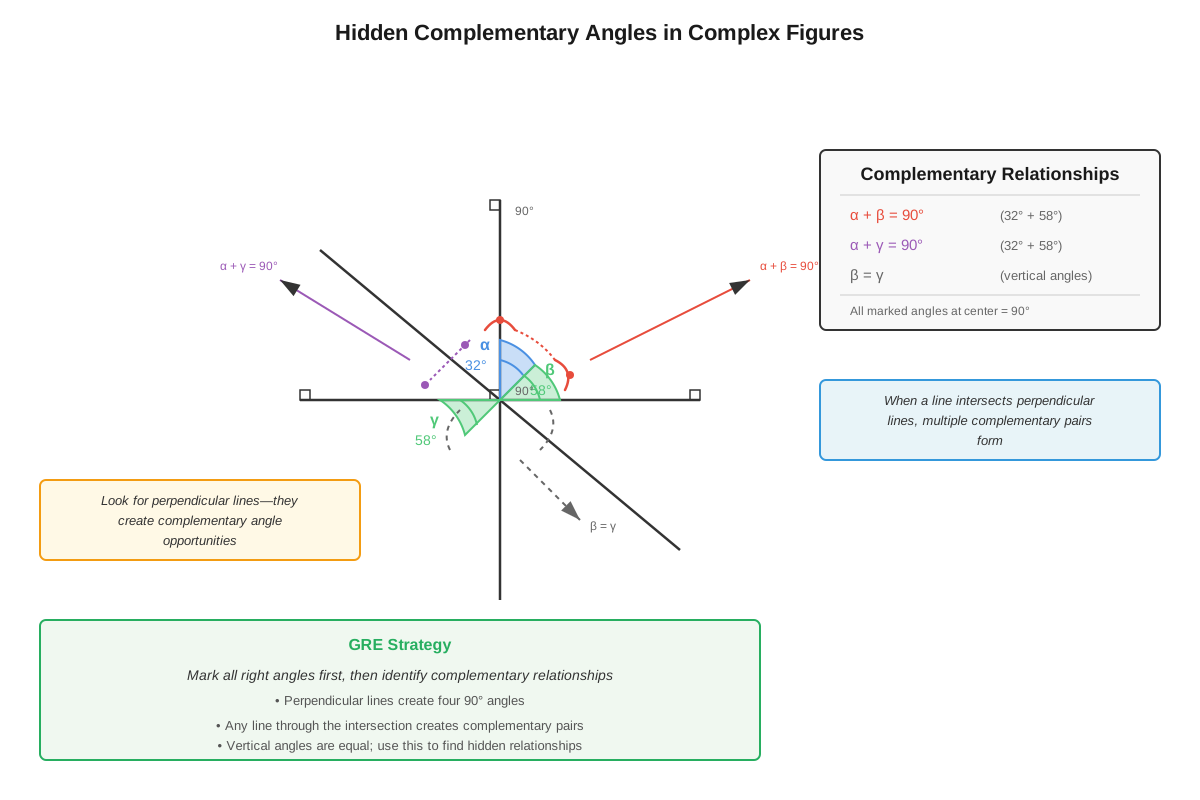
The GRE frequently embeds complementary angle relationships within more complex geometric figures, requiring test-takers to identify these relationships without explicit labeling. Questions may present perpendicular lines, right triangles, or rectangular shapes where complementary angles naturally occur at vertices and intersections. The exam rewards students who can quickly spot these relationships and translate them into algebraic equations, making complementary angles a high-yield topic that bridges pure geometry with algebraic problem-solving skills.
Mastering gre complementary angles connects directly to broader Quantitative Reasoning competencies including angle relationships (supplementary angles, vertical angles), triangle properties (particularly right triangles where complementary angles are inherent), coordinate geometry (where perpendicular lines create complementary slope relationships), and algebraic equation-solving. This topic serves as a building block for more advanced geometric reasoning and frequently appears in combination with other concepts, making it essential for achieving competitive scores on the GRE.
Learning Objectives
- [ ] Identify when Complementary angles is being tested
- [ ] Explain the core rule or strategy behind Complementary angles
- [ ] Apply Complementary angles to GRE-style questions accurately
- [ ] Recognize implicit complementary angle relationships in complex geometric figures
- [ ] Translate complementary angle relationships into algebraic equations efficiently
- [ ] Distinguish between complementary and supplementary angle scenarios
- [ ] Solve multi-step problems involving complementary angles combined with other geometric properties
Prerequisites
- Basic angle measurement: Understanding that angles are measured in degrees and that a full rotation equals 360° is essential for comprehending why complementary angles sum to 90°
- Right angle recognition: Knowing that a right angle measures exactly 90° provides the foundation for the complementary angle definition
- Basic algebra: The ability to set up and solve simple linear equations (such as x + y = 90) is necessary for most complementary angle problems
- Geometric notation: Familiarity with angle notation (∠ABC) and the symbols for right angles (small square) helps in interpreting GRE diagrams efficiently
Why This Topic Matters
Complementary angles appear with remarkable frequency on the GRE, showing up in approximately 15-20% of geometry questions across all test administrations. This high appearance rate makes the topic one of the most efficient areas for focused study, offering substantial return on time investment. The concept appears across multiple question formats including Quantitative Comparison questions (where angle measures are compared), Problem Solving questions (requiring calculation of specific angle values), and Data Interpretation questions (where geometric diagrams accompany data sets).
In real-world applications, complementary angles govern countless practical scenarios: architectural design relies on perpendicular supports creating complementary angles; navigation systems use complementary bearing angles; and engineering calculations for structural stability depend on understanding angle relationships at right-angle joints. While the GRE focuses on abstract problem-solving, these practical foundations make the concept intuitive once properly understood.
The exam typically presents complementary angles in several disguised forms: within right triangles (where the two acute angles are always complementary), at the intersection of perpendicular lines (creating four right angles, each containing complementary angle pairs), in coordinate geometry problems (where perpendicular lines have negative reciprocal slopes), and in three-dimensional figures (where edges meet at right angles). Recognizing these common presentations allows test-takers to quickly identify solution pathways that might otherwise remain hidden.
Core Concepts
Definition and Fundamental Relationship
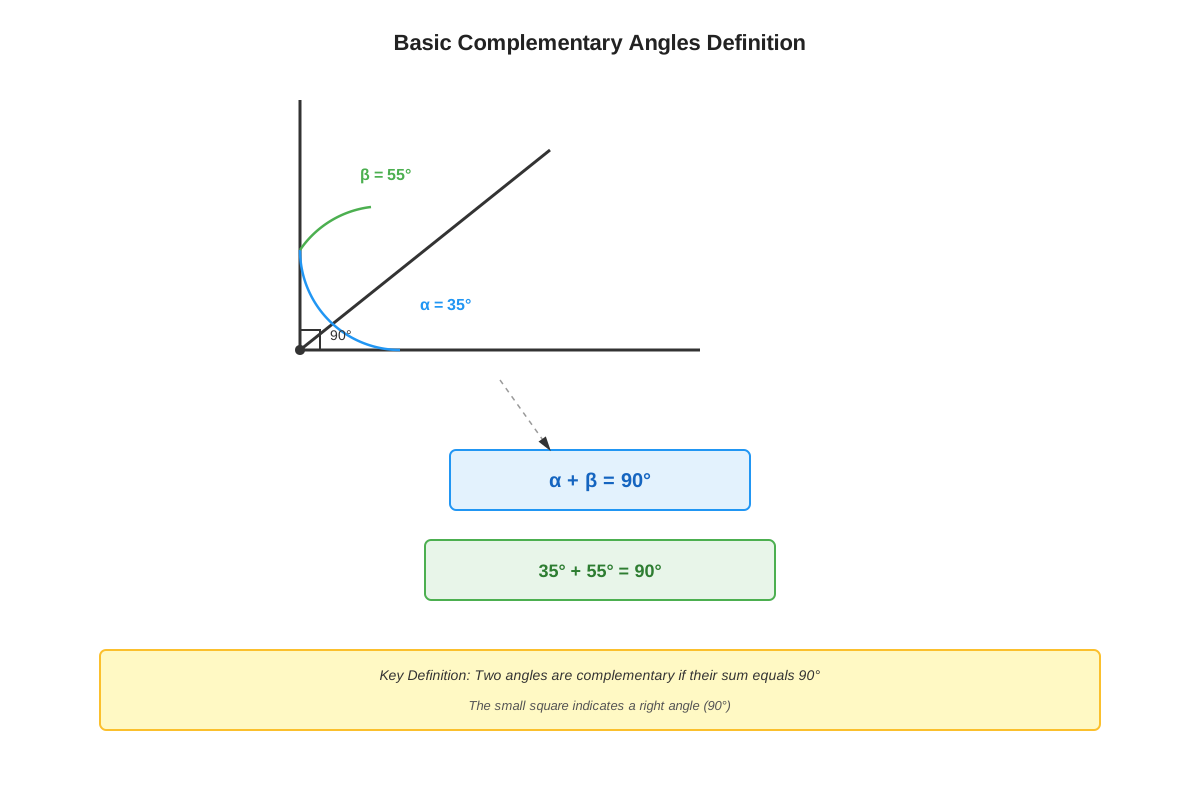
Complementary angles are two angles whose measures add up to exactly 90 degrees. This relationship can be expressed algebraically as: if angles A and B are complementary, then m∠A + m∠B = 90°. The term "complementary" derives from the Latin "complementum," meaning "that which completes," reflecting how these angles complete a right angle. Importantly, complementary angles need not be adjacent (sharing a common side) or even part of the same geometric figure—the relationship depends solely on the sum of their measures.
For example, an angle measuring 30° and another measuring 60° are complementary because 30° + 60° = 90°. Similarly, a 45° angle is complementary to another 45° angle, demonstrating that complementary angles can be equal. An angle measuring 23.7° has a complement of 66.3°, showing that complementary angles can involve decimal values on the GRE.
Algebraic Representation
When one angle in a complementary pair is unknown, algebraic notation becomes essential. If one angle measures x degrees, its complement measures (90 - x) degrees. This representation appears frequently in GRE problems where the relationship between angles must be expressed before solving. For instance, if one angle is described as "twice its complement," the equation becomes: x = 2(90 - x), which simplifies to x = 180 - 2x, yielding 3x = 180, so x = 60°.
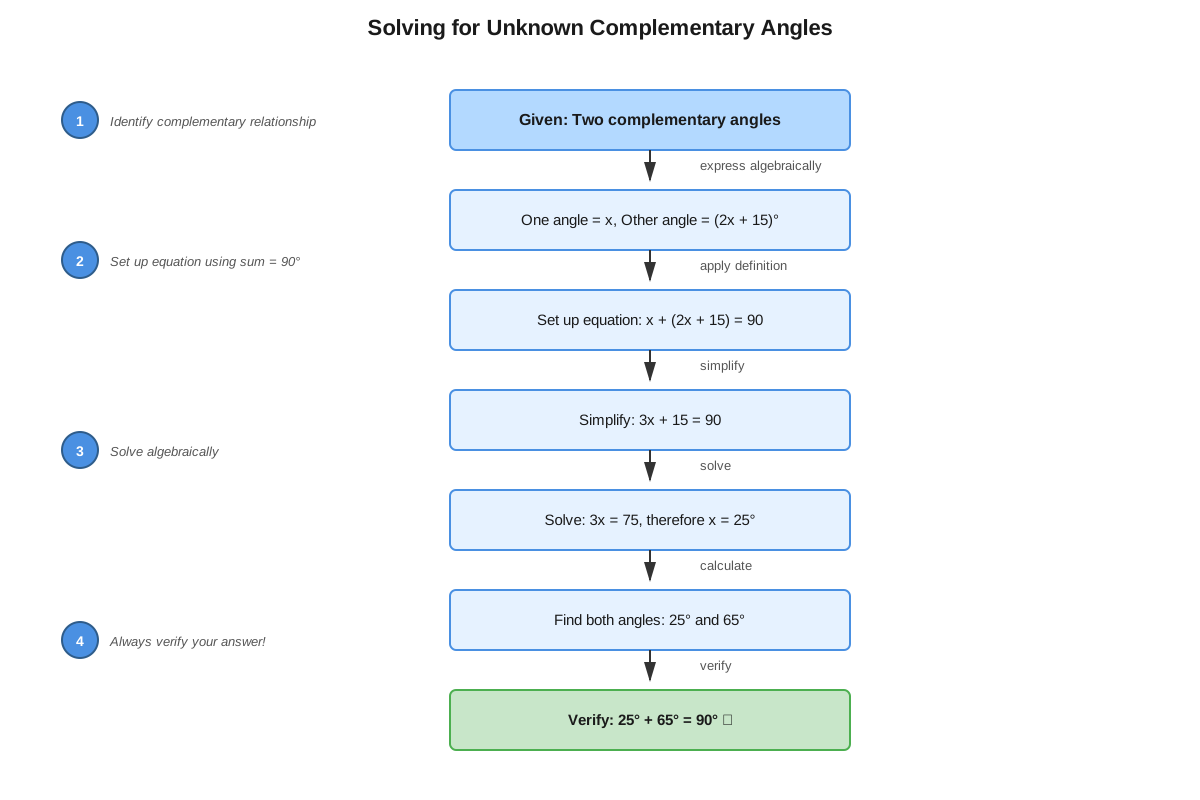
More complex scenarios involve both angles expressed algebraically. If two complementary angles are represented as 3x and 2x, the equation becomes: 3x + 2x = 90, which simplifies to 5x = 90, giving x = 18°. The actual angle measures would then be 54° and 36°. This algebraic approach transforms geometric relationships into solvable equations, a critical skill for GRE success.
Complementary Angles in Right Triangles
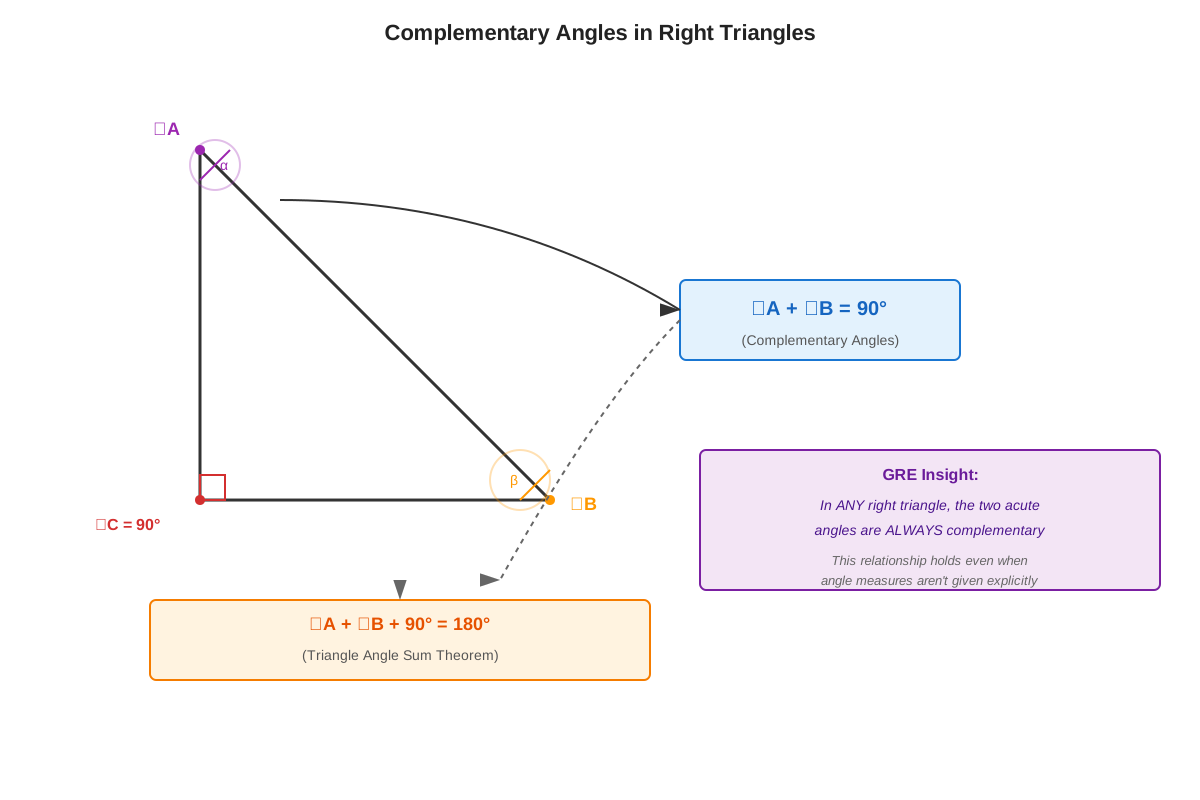
Every right triangle contains exactly one 90° angle and two acute angles that are necessarily complementary. This property is fundamental and appears in countless GRE problems. If a right triangle has one acute angle measuring 35°, the other acute angle must measure 55° because 35° + 55° = 90°. This relationship holds regardless of the triangle's size or orientation.
The complementary angle relationship in right triangles connects directly to trigonometric functions, though the GRE rarely requires advanced trigonometry. However, understanding that in a right triangle with acute angle θ, the other acute angle measures (90° - θ) helps in recognizing angle relationships quickly. This becomes particularly useful in problems involving special right triangles (30-60-90 and 45-45-90 triangles) where angle measures are predetermined.
Complementary Angles at Perpendicular Intersections
When two lines intersect perpendicularly, they create four right angles at the point of intersection. Within each right angle, any division creates two complementary angles. For example, if a line segment bisects one of these right angles, it creates two 45° angles (which are complementary to each other). If the division is unequal, such as creating a 70° angle, the adjacent angle within that right angle must measure 20°.
This concept extends to more complex figures. In rectangles and squares, the diagonals create angles at each vertex. Understanding which angles are complementary helps solve problems about diagonal intersections and the angles they form with the sides. Similarly, in coordinate geometry, perpendicular lines (such as the x and y axes) create complementary angle relationships with any line segment drawn in the plane.
Distinguishing Complementary from Supplementary Angles
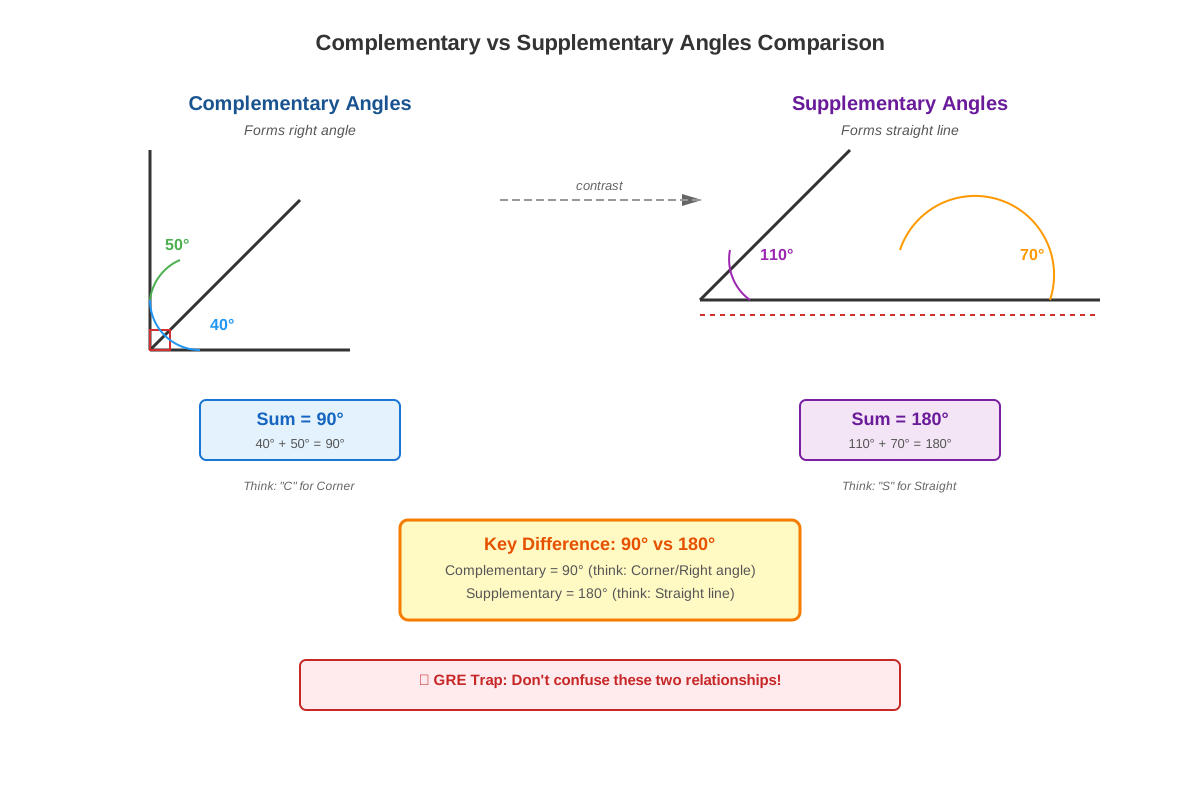
A critical distinction for GRE success involves differentiating complementary angles (sum = 90°) from supplementary angles (sum = 180°). The following table clarifies these relationships:
| Angle Relationship | Sum of Measures | Common Contexts | Visual Cue |
|---|---|---|---|
| Complementary | 90° | Right triangles, perpendicular lines | Forms a right angle |
| Supplementary | 180° | Linear pairs, straight lines | Forms a straight line |
| Vertical | Equal measures | Intersecting lines | Opposite angles at intersection |
Confusing these relationships represents one of the most common errors on the GRE. When a problem describes angles at a straight line or linear pair, they are supplementary (sum to 180°), not complementary. When angles are described in the context of a right angle or perpendicular lines, they are complementary (sum to 90°).
Multiple Complementary Pairs
Complex geometric figures often contain multiple complementary angle pairs simultaneously. In a rectangle, for instance, each corner contains a right angle, and any line drawn from a corner creates two complementary angles at that vertex. Recognizing all complementary pairs in a figure can provide multiple pathways to a solution, increasing problem-solving flexibility.
Consider a right triangle with an altitude drawn from the right angle to the hypotenuse. This configuration creates three similar triangles and multiple complementary angle pairs. Each of the two smaller triangles contains its own pair of complementary acute angles, and these angles relate systematically to the angles in the original triangle. While this level of complexity appears in harder GRE problems, the underlying principle remains the same: identify right angles, then look for complementary pairs within or adjacent to them.
Concept Relationships
The complementary angle concept serves as a foundational node connecting multiple geometric principles. At the most basic level, understanding right angles (90°) leads directly to complementary angles (two angles summing to 90°). This relationship then extends upward to right triangle properties, where the two acute angles must be complementary, which in turn connects to triangle angle sum (all three angles totaling 180°).
Horizontally, complementary angles relate closely to supplementary angles through contrast—both involve angle sums, but with different totals (90° vs. 180°). This distinction becomes crucial when analyzing linear pairs (supplementary) versus perpendicular intersections (creating complementary angle opportunities). The relationship map flows as follows:
Basic angle measurement → Right angles (90°) → Complementary angles → Right triangle angle relationships → Trigonometric ratios (advanced)
Parallel branches include:
Complementary angles ↔ Supplementary angles (contrasting relationships)
Complementary angles → Perpendicular lines → Coordinate geometry (perpendicular slopes)
Complementary angles → Angle bisectors → Geometric constructions
Understanding these connections allows test-takers to approach problems from multiple angles (literally), recognizing that a question about right triangles is implicitly testing complementary angles, or that a coordinate geometry problem involving perpendicular lines may require complementary angle reasoning.
Quick check — test yourself on Complementary angles so far.
Try Flashcards →High-Yield Facts
⭐ Two angles are complementary if and only if their measures sum to exactly 90 degrees
⭐ In any right triangle, the two acute angles are always complementary
⭐ If one angle measures x degrees, its complement measures (90 - x) degrees
⭐ Complementary angles need not be adjacent or part of the same figure
⭐ When two lines are perpendicular, they create multiple complementary angle pairs at their intersection
- An angle and its complement are both acute (less than 90°) unless one angle is exactly 90° (making the other 0°)
- The complement of a 45° angle is also 45°, making this the only angle equal to its complement
- Complementary angles cannot both be obtuse (greater than 90°) or both be right angles
- In coordinate geometry, if two lines are perpendicular, the acute angles they form with the x-axis are complementary
- The phrase "the complement of angle A" always refers to (90° - A), not to a specific angle in a diagram
Common Misconceptions
Misconception: Complementary angles must be adjacent (next to each other) in a geometric figure.
Correction: Complementary angles are defined solely by their sum equaling 90°. They can be anywhere in a figure, in different figures, or even described abstractly without any figure. Adjacency is not required for the complementary relationship.
Misconception: Complementary and supplementary angles are interchangeable terms.
Correction: These are distinct concepts. Complementary angles sum to 90° (forming a right angle), while supplementary angles sum to 180° (forming a straight line). Using the wrong relationship leads to incorrect equations and wrong answers.
Misconception: If two angles are complementary, they must each be less than 45°.
Correction: Complementary angles must each be less than 90° (both acute), but one can be greater than 45° while the other is less than 45°. For example, 70° and 20° are complementary, as are 89° and 1°.
Misconception: In a right triangle, the right angle and one of the acute angles are complementary.
Correction: A 90° angle cannot be part of a complementary pair (except with a 0° angle, which doesn't exist in standard geometry). In a right triangle, only the two acute angles are complementary to each other.
Misconception: The complement of an angle is always smaller than the original angle.
Correction: The complement is smaller only when the original angle is greater than 45°. If the original angle is less than 45°, its complement is larger. At exactly 45°, an angle equals its complement.
Misconception: Complementary angles must have a specific ratio or relationship beyond summing to 90°.
Correction: The only requirement for complementary angles is that their sum equals 90°. They can have any ratio: 1:1 (both 45°), 1:2 (30° and 60°), 1:8 (10° and 80°), or any other combination that sums to 90°.
Worked Examples
Example 1: Algebraic Complementary Angle Problem
Problem: One angle measures 15° more than twice its complement. Find the measure of both angles.
Solution:
Step 1: Define variables. Let x = the measure of the unknown angle in degrees.
Step 2: Express the complement. The complement of x is (90 - x) degrees.
Step 3: Translate the word problem into an equation. "One angle measures 15° more than twice its complement" becomes:
x = 2(90 - x) + 15Step 4: Solve the equation.
x = 180 - 2x + 15
x = 195 - 2x
x + 2x = 195
3x = 195
x = 65
Step 5: Find the complement. The complement is 90 - 65 = 25 degrees.
Step 6: Verify the answer. Check that 65° is indeed 15° more than twice 25°:
2(25) + 15 = 50 + 15 = 65 ✓
Answer: The two complementary angles measure 65° and 25°.
Connection to Learning Objectives: This problem demonstrates applying complementary angles to GRE-style questions by translating a verbal description into an algebraic equation using the core rule that complements sum to 90°.
Example 2: Complementary Angles in a Geometric Figure
Problem: In the figure (described), line segment AB is perpendicular to line segment CD at point E. Line segment EF bisects angle AEC. If angle FEC measures 45°, what is the measure of angle AEF?
Solution:
Step 1: Identify the right angle. Since AB ⊥ CD, angle AEC is a right angle measuring 90°.
Step 2: Recognize the angle bisector. EF bisects angle AEC, meaning it divides the 90° angle into two equal parts.
Step 3: Calculate each part. If EF bisects the 90° angle, then angle AEF = angle FEC = 45°.
Step 4: Verify with given information. The problem states angle FEC = 45°, which confirms our bisector calculation.
Answer: Angle AEF measures 45°.
Alternative approach using complementary angles: Since angle AEC = 90° and angle FEC = 45°, we can find angle AEF by recognizing that angles AEF and FEC are complementary parts of the right angle AEC:
angle AEF + angle FEC = 90°
angle AEF + 45° = 90°
angle AEF = 45°
Connection to Learning Objectives: This problem requires identifying when complementary angles are being tested (within a right angle created by perpendicular lines) and applying the core strategy that angles within a right angle are complementary.
Exam Strategy
When approaching GRE questions involving complementary angles, begin by scanning the problem for trigger words and phrases: "perpendicular," "right angle," "right triangle," "90 degrees," or any mention of angles "summing to" or "totaling" a value. These phrases signal that angle relationships, potentially complementary angles, are central to the solution.
Exam Tip: If a diagram shows a small square symbol at an angle, this indicates a right angle (90°), immediately suggesting that complementary angle relationships may be relevant.
Develop a systematic approach: (1) Identify all right angles in the figure, whether explicitly marked or implied by perpendicular lines; (2) Look for angle measures or algebraic expressions within or adjacent to these right angles; (3) Set up equations using the complementary relationship (sum = 90°); (4) Solve algebraically and verify that your answer makes geometric sense.
For Quantitative Comparison questions, complementary angles often appear when comparing angle measures in different parts of a figure. Remember that without specific numerical values, you may need to test extreme cases. For instance, if comparing two complementary angles where one is described as "larger," recognize that the larger angle must be between 45° and 90°, while the smaller must be between 0° and 45°.
Process-of-elimination strategies specific to complementary angles include: immediately eliminate any answer choice suggesting angles sum to 180° (that's supplementary, not complementary); eliminate choices where both angles are greater than 45° but described as equal (complementary equal angles must both be exactly 45°); and eliminate any answer where an angle measure exceeds 90° in a complementary pair.
Time allocation: Most complementary angle problems should take 1-2 minutes. If you find yourself spending more than 2 minutes, you may be overcomplicating the problem. Step back and look for the basic complementary relationship—GRE problems often have elegant solutions once the right relationship is identified. Mark the question for review if needed and move forward to maintain pacing.
Memory Techniques
Mnemonic for Complementary vs. Supplementary: "Complementary = Corner (right angle = 90°)" and "Supplementary = Straight (straight line = 180°)." The matching first letters help distinguish these frequently confused concepts.
Visualization strategy: Picture a right angle as a corner of a room where two walls meet. Any angle drawn within that corner creates two complementary angles. This concrete image helps recall that complementary angles "fit together" to form a right angle.
The 90-Rule Formula: Memorize the instant formula: "If one angle is x, its complement is (90 - x)." Write this relationship at the top of your scratch paper when beginning the Quantitative Reasoning section, creating a quick reference for complementary angle problems.
Acronym for Right Triangle Angles: CAC = "Complementary Acute angles in right triangles Combine to 90°." This reminds you that the two non-right angles in any right triangle are always complementary.
The 45-45 Checkpoint: Remember that 45° is the only angle that equals its own complement (since 45 + 45 = 90). This serves as a mental checkpoint—if you calculate an angle and its complement and both equal 45°, you've likely found a correct answer in an angle bisector or isosceles right triangle problem.
Summary
Complementary angles—two angles whose measures sum to exactly 90 degrees—represent a high-yield concept for GRE Quantitative Reasoning success. This relationship appears throughout geometry problems, particularly in right triangles (where the two acute angles are always complementary), at perpendicular line intersections, and in coordinate geometry contexts. Mastering complementary angles requires three core competencies: recognizing when the relationship is present (often implicitly), translating the geometric relationship into algebraic equations using the formula that if one angle measures x degrees then its complement measures (90 - x) degrees, and distinguishing complementary angles (sum = 90°) from supplementary angles (sum = 180°). The GRE tests this concept through direct calculation problems, multi-step geometric reasoning questions, and Quantitative Comparison formats. Success depends on quickly identifying right angles in figures, understanding that complementary angles need not be adjacent, and efficiently setting up and solving the resulting equations. With focused practice, complementary angles become a reliable source of correct answers and a foundation for more complex geometric problem-solving.
Key Takeaways
- Complementary angles always sum to exactly 90 degrees, regardless of whether they are adjacent or in the same figure
- In every right triangle, the two acute angles are complementary—this is an automatic relationship that appears in countless GRE problems
- The algebraic expression for a complement is (90 - x) where x is the original angle measure
- Perpendicular lines create right angles, which contain complementary angle pairs—look for the small square symbol indicating perpendicularity
- Complementary (90°) and supplementary (180°) are different concepts—use the mnemonic "Corner vs. Straight" to keep them distinct
- Both angles in a complementary pair must be acute (less than 90°) unless one is exactly 0°
- Trigger words like "perpendicular," "right angle," and "right triangle" signal complementary angle relationships on the GRE
Related Topics
Supplementary Angles: Understanding angles that sum to 180° provides important contrast to complementary angles and appears with similar frequency on the GRE. Mastering complementary angles makes learning supplementary angles more efficient through comparison.
Right Triangle Properties: Complementary angles form the foundation for understanding right triangles, including the Pythagorean theorem, special right triangles (30-60-90 and 45-45-90), and triangle similarity. Strong complementary angle skills accelerate mastery of these advanced topics.
Angle Relationships at Intersecting Lines: Vertical angles, linear pairs, and angles formed by parallel lines cut by a transversal all build on the same angle-relationship reasoning used with complementary angles.
Coordinate Geometry and Perpendicular Lines: The concept of perpendicular lines in the coordinate plane (with negative reciprocal slopes) connects directly to complementary angles, as perpendicular lines create right angles and complementary angle relationships.
Trigonometric Ratios: Though tested minimally on the GRE, understanding that sine and cosine of complementary angles are equal (sin(x) = cos(90-x)) represents an advanced application of complementary angle concepts.
Practice CTA
Now that you've mastered the core concepts of complementary angles, reinforce your understanding by attempting the practice questions designed specifically for this topic. These problems mirror actual GRE question formats and difficulty levels, providing essential experience with the various ways complementary angles appear on test day. Additionally, use the flashcards to drill the key definitions, formulas, and relationships until they become automatic. Remember: recognizing complementary angle relationships quickly is a skill that improves with deliberate practice. Each problem you solve strengthens your pattern recognition and builds the confidence needed to tackle even the most complex geometry questions efficiently. Your investment in mastering this high-yield topic will pay dividends across multiple questions on test day!
Sign up free to keep reading
Create a free AnvayaPrep account to finish this GRE guide on Complementary angles — plus flashcards and practice questions.