Overview
The triangle inequality is one of the most fundamental principles in geometry, establishing the relationship between the lengths of the sides of any triangle. This concept states that the sum of the lengths of any two sides of a triangle must be greater than the length of the third side. While this may seem like a simple geometric fact, it has profound implications for solving GRE Quantitative Reasoning problems, particularly those involving geometric constraints, optimization, and logical reasoning about possible configurations.
On the GRE, GRE triangle inequality questions appear with surprising frequency, often disguised within more complex geometry problems or presented as quantitative comparison questions. Test-makers favor this topic because it efficiently tests multiple skills simultaneously: spatial reasoning, algebraic manipulation, and the ability to work with inequalities. Students who master the triangle inequality gain a powerful tool for eliminating impossible answer choices, determining ranges of possible values, and solving problems that might otherwise require complex calculations.
Understanding the triangle inequality connects directly to broader Quantitative Reasoning concepts including inequalities, absolute values, distance problems, and coordinate geometry. It serves as a bridge between pure geometric intuition and algebraic reasoning, making it an essential component of a comprehensive GRE preparation strategy. This topic frequently appears in combination with other geometric principles such as properties of special triangles, perimeter calculations, and optimization problems.
Learning Objectives
- [ ] Identify when Triangle inequality is being tested
- [ ] Explain the core rule or strategy behind Triangle inequality
- [ ] Apply Triangle inequality to GRE-style questions accurately
- [ ] Determine the range of possible values for an unknown side of a triangle given two known sides
- [ ] Recognize and eliminate impossible triangle configurations in multiple-choice questions
- [ ] Combine triangle inequality with other geometric properties to solve complex problems
- [ ] Apply triangle inequality concepts to coordinate geometry and distance problems
Prerequisites
- Basic properties of triangles: Understanding what defines a triangle and familiarity with terminology (sides, vertices, angles) is essential for applying the inequality rules
- Working with inequalities: Ability to manipulate algebraic inequalities, including adding, subtracting, and combining multiple inequality statements
- Absolute value concepts: The triangle inequality extends to absolute value expressions, so comfort with absolute value is beneficial
- Basic arithmetic operations: Facility with addition, subtraction, and comparison of numerical values to quickly evaluate whether given measurements can form a triangle
Why This Topic Matters
The triangle inequality appears in approximately 5-8% of GRE Quantitative Reasoning questions, making it a high-yield topic for test preparation. Beyond its direct application in geometry problems, this principle underlies many optimization and constraint-based questions that don't explicitly mention triangles. Understanding this concept provides students with a rapid method for eliminating incorrect answer choices and validating geometric configurations.
In real-world applications, the triangle inequality governs everything from GPS navigation systems (which use triangulation) to network routing algorithms and structural engineering. The principle ensures physical stability in truss designs and helps determine optimal paths in logistics and transportation. For GRE purposes, however, the focus remains on its application to pure geometry problems, quantitative comparisons, and word problems involving distances.
On the GRE, triangle inequality questions typically appear in three formats: (1) quantitative comparison questions asking students to compare possible side lengths, (2) multiple-choice questions requiring identification of valid triangle configurations, and (3) numeric entry questions asking for maximum or minimum possible values of a triangle's side or perimeter. The topic frequently combines with other concepts such as isosceles triangles, right triangles, or perimeter constraints, making it a versatile testing ground for mathematical reasoning.
Core Concepts
The Fundamental Triangle Inequality Theorem
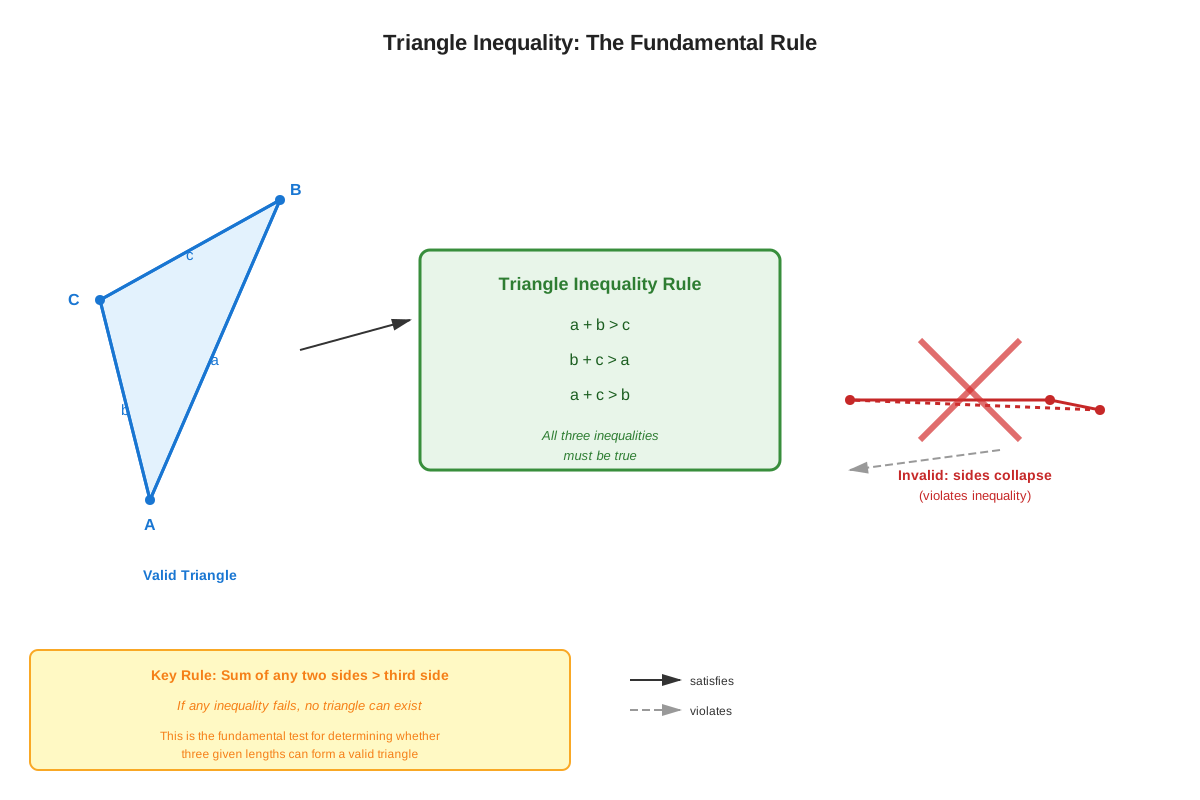
The triangle inequality states that for any triangle with sides of lengths a, b, and c, the following three conditions must all be satisfied:
- a + b > c
- a + c > b
- b + c > a
In words: the sum of the lengths of any two sides must be strictly greater than (not equal to) the length of the remaining side. This is not merely a mathematical curiosity but a necessary condition for three line segments to actually form a closed triangle. If any of these inequalities fails, the three segments cannot connect to form a triangle—they would either fall short of meeting or would form a degenerate case (a straight line).
Intuitive Understanding
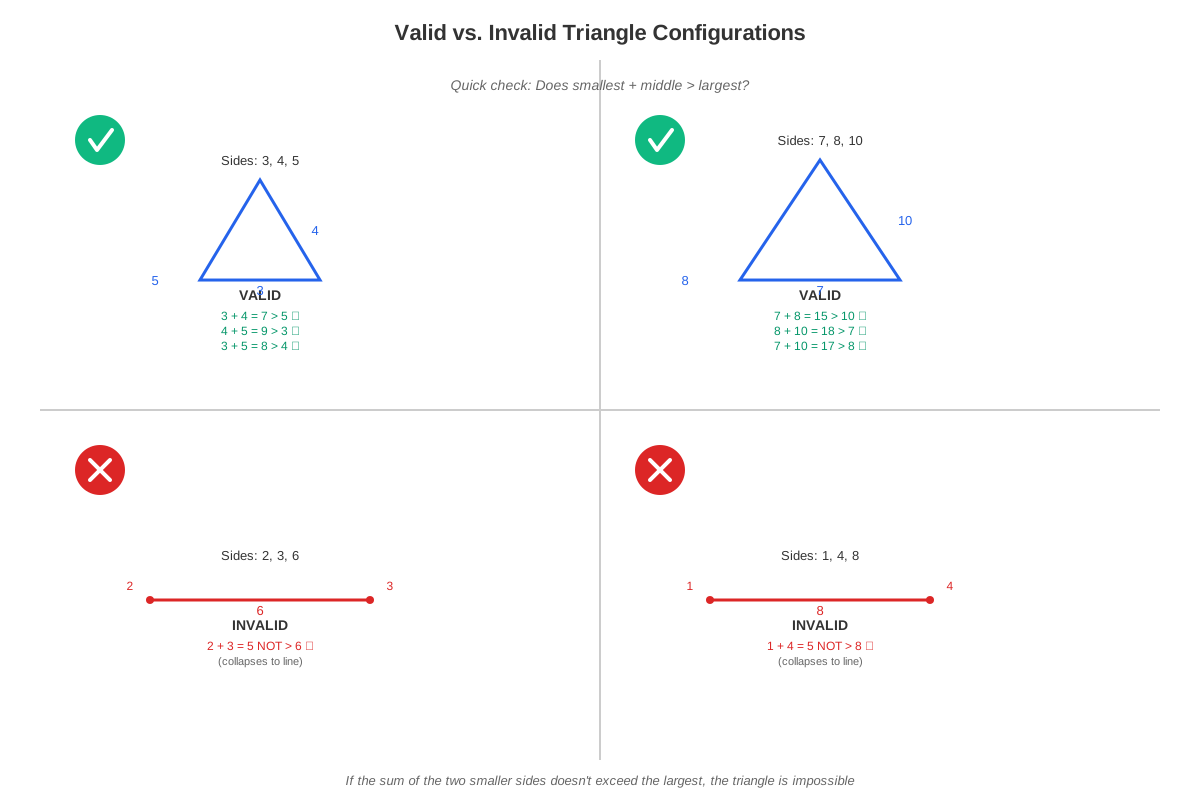
Imagine trying to form a triangle with three sticks. If one stick is extremely long compared to the other two, you'll find that the two shorter sticks cannot span the distance needed to connect the endpoints of the long stick. For example, if you have sticks of length 3 inches, 4 inches, and 10 inches, you cannot form a triangle because 3 + 4 = 7, which is not greater than 10. The two shorter sides simply cannot "reach" to close the triangle.
The equality case (a + b = c) represents a degenerate triangle—essentially a straight line where the three points are collinear. While mathematically interesting, this is not considered a valid triangle for GRE purposes.
Determining the Range of the Third Side
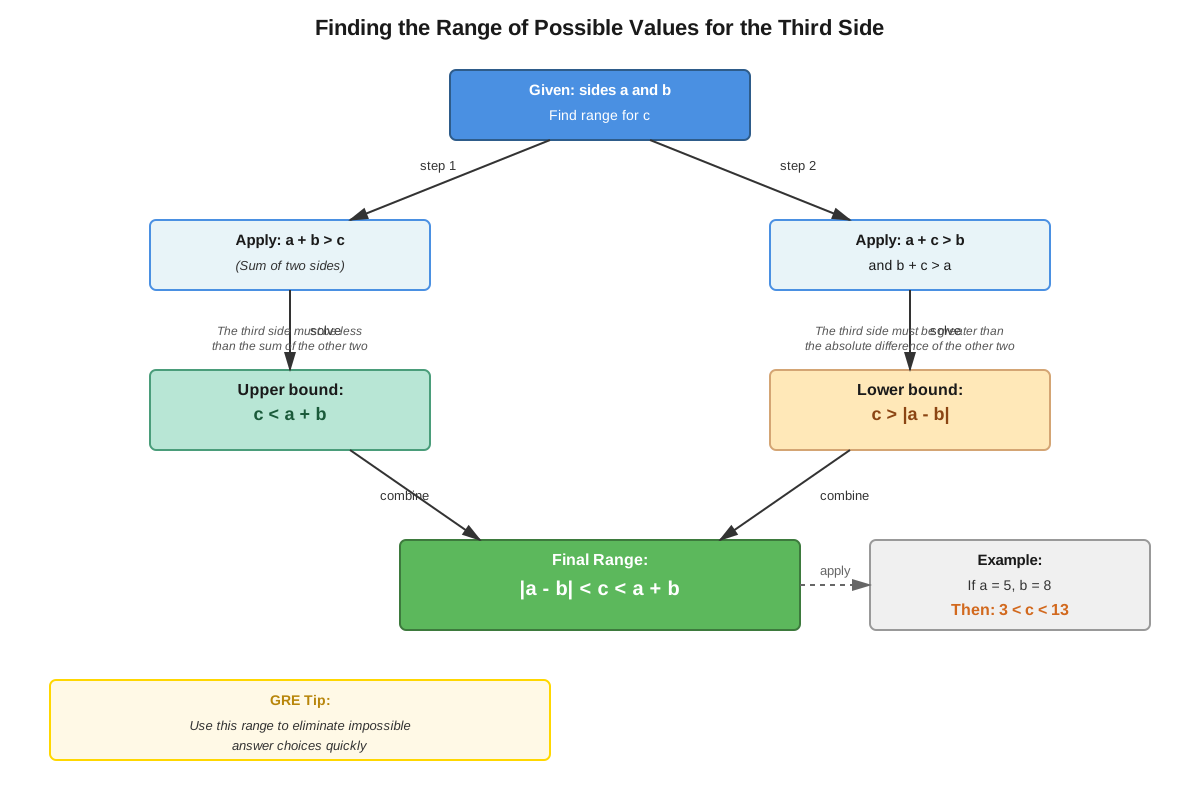
One of the most common GRE applications involves finding the possible range of values for an unknown side when two sides are known. If a triangle has sides of length a and b, and the third side has length x, then:
Lower bound: x > |a - b| (the absolute difference of the two known sides)
Upper bound: x < a + b (the sum of the two known sides)
Combined: |a - b| < x < a + b
For example, if two sides of a triangle measure 5 and 8:
- The third side must be greater than |5 - 8| = 3
- The third side must be less than 5 + 8 = 13
- Therefore: 3 < x < 13
The third side could be 4, 5, 6, 7, 8, 9, 10, 11, or 12 (if restricted to integers), or any real number in the open interval (3, 13).
Application to Perimeter Problems
When the triangle inequality combines with perimeter constraints, it creates powerful problem-solving opportunities. If a triangle has perimeter P and two known sides a and b, then the third side c = P - a - b, and this value must satisfy the triangle inequality with respect to a and b.
This leads to constraints on the possible perimeter:
- Minimum perimeter: slightly more than 2 times the longest side
- Maximum perimeter: approaches infinity (as the triangle becomes increasingly flat)
Special Cases and Extreme Values
Maximum third side: The third side approaches (but never reaches) the sum of the other two sides. As the third side gets closer to this sum, the triangle becomes increasingly "flat," with the angle opposite the longest side approaching 180 degrees.
Minimum third side: The third side approaches (but never reaches) the absolute difference of the other two sides. As the third side approaches this minimum, the triangle again becomes flat, but with the two longer sides nearly parallel.
Isosceles and equilateral triangles: These special cases must still satisfy the triangle inequality. For an isosceles triangle with two sides of length a and base b: 2a > b and a + b > a (which simplifies to b > 0).
Comparison Table: Valid vs. Invalid Triangles
| Side 1 | Side 2 | Side 3 | Valid Triangle? | Reason |
|---|---|---|---|---|
| 3 | 4 | 5 | Yes | 3+4=7>5, 3+5=8>4, 4+5=9>3 |
| 2 | 3 | 6 | No | 2+3=5, which is not >6 |
| 5 | 5 | 8 | Yes | 5+5=10>8, 5+8=13>5 |
| 1 | 2 | 3 | No | 1+2=3, which equals (not >) 3 |
| 7 | 10 | 15 | Yes | 7+10=17>15, 7+15=22>10, 10+15=25>7 |
| 4 | 4 | 10 | No | 4+4=8, which is not >10 |
Concept Relationships
The triangle inequality serves as a foundational concept that connects to numerous other geometric and algebraic principles. At its core, it relates directly to inequality manipulation, requiring students to work with compound inequalities and understand how to combine multiple constraints simultaneously.
The relationship flow can be visualized as:
Basic inequalities → Triangle inequality theorem → Range determination for unknown sides → Application to specific triangle types (isosceles, right, equilateral) → Integration with perimeter and area problems → Extension to coordinate geometry and distance formula
The triangle inequality also connects backward to prerequisite knowledge of absolute value, since the lower bound for the third side involves |a - b|. This absolute value relationship reflects the fact that we don't know which of the two given sides is longer, so we must consider both cases.
Forward connections include applications to coordinate geometry, where the triangle inequality can be expressed using the distance formula between three points. It also extends to optimization problems, where students must find maximum or minimum values subject to geometric constraints. Additionally, the concept appears in quantitative comparison questions, where understanding the range of possible values allows for rapid determination of which quantity is larger.
The triangle inequality also relates to the Law of Cosines and angle relationships: as the third side approaches its maximum value (sum of the other two), the angle opposite that side approaches 180°; as it approaches its minimum value (difference of the other two), the angle approaches 0°.
High-Yield Facts
⭐ The sum of any two sides of a triangle must be strictly greater than the third side (not equal to, but greater than)
⭐ For a triangle with sides a and b, the third side x must satisfy: |a - b| < x < a + b
⭐ The longest side of a triangle is always less than half the perimeter
⭐ If three lengths are given, check only whether the sum of the two smallest exceeds the largest (this single check is sufficient)
⭐ A degenerate triangle (where a + b = c) is a straight line and not considered a valid triangle on the GRE
- The minimum perimeter of a triangle with one side of length s is slightly greater than 2s
- In an isosceles triangle with legs of length a and base b, the constraint 2a > b must hold
- The triangle inequality applies to all triangles regardless of type (acute, right, obtuse, scalene, isosceles, equilateral)
- When comparing possible triangles, the configuration with sides closest to equal lengths (approaching equilateral) maximizes area for a given perimeter
- The triangle inequality extends to three-dimensional space and can be applied to paths and distances in coordinate geometry
- If you know the range of one side is [m, n] and another side is k, the third side must satisfy constraints from both the minimum and maximum values
- Integer side lengths that satisfy the triangle inequality may still not form a right triangle (Pythagorean theorem is a separate condition)
Quick check — test yourself on Triangle inequality so far.
Try Flashcards →Common Misconceptions
Misconception: The sum of two sides must be greater than or equal to the third side.
Correction: The inequality must be strict (>), not inclusive (≥). If the sum equals the third side, the three segments form a straight line, not a triangle. On the GRE, equality cases are never valid triangles.
Misconception: You need to check all three inequality conditions separately for every problem.
Correction: When given three specific side lengths, you only need to verify that the sum of the two smallest sides exceeds the largest side. If this single condition holds, the other two conditions are automatically satisfied.
Misconception: The third side can equal the difference of the other two sides.
Correction: The third side must be strictly greater than the absolute difference |a - b|. If it equals the difference, the result is a degenerate triangle (straight line), which is not valid.
Misconception: The triangle inequality only applies to finding whether three given lengths can form a triangle.
Correction: The triangle inequality is equally important for determining ranges of possible values, comparing quantities, and solving optimization problems. Many GRE questions test the concept indirectly through these applications.
Misconception: If two sides of a triangle are 5 and 8, then the third side can be any value from 3 to 13.
Correction: The third side must be strictly between these values: 3 < x < 13. The endpoints (3 and 13) are not included in the valid range. If dealing with integers, valid values are 4, 5, 6, 7, 8, 9, 10, 11, and 12.
Misconception: The triangle inequality guarantees that three segments will form a specific type of triangle (acute, right, or obtuse).
Correction: The triangle inequality only determines whether three segments can form any triangle at all. Additional conditions (like the Pythagorean theorem) are needed to determine the specific type of triangle.
Worked Examples
Example 1: Determining Valid Triangle Configurations
Problem: Which of the following sets of three lengths can form a triangle?
(A) 2, 5, 8
(B) 3, 6, 9
(C) 4, 7, 10
(D) 5, 5, 11
(E) 6, 8, 15
Solution:
For each set, we'll check whether the sum of the two smallest sides exceeds the largest side.
(A) 2, 5, 8: Check if 2 + 5 > 8
- 2 + 5 = 7, which is NOT greater than 8
- Cannot form a triangle
(B) 3, 6, 9: Check if 3 + 6 > 9
- 3 + 6 = 9, which equals but is NOT greater than 9
- Cannot form a triangle (degenerate case)
(C) 4, 7, 10: Check if 4 + 7 > 10
- 4 + 7 = 11, which IS greater than 10
- Can form a triangle ✓
(D) 5, 5, 11: Check if 5 + 5 > 11
- 5 + 5 = 10, which is NOT greater than 11
- Cannot form a triangle
(E) 6, 8, 15: Check if 6 + 8 > 15
- 6 + 8 = 14, which is NOT greater than 15
- Cannot form a triangle
Answer: (C)
This example demonstrates the learning objective of identifying when triangle inequality is being tested and applying the core rule accurately. The key strategy is recognizing that only one check is necessary: sum of two smallest > largest.
Example 2: Finding the Range of Possible Values
Problem: A triangle has two sides of length 6 and 11. If the length of the third side is an integer, what is the maximum possible perimeter of the triangle?
Solution:
Step 1: Determine the range for the third side using the triangle inequality.
The third side x must satisfy: |11 - 6| < x < 11 + 6
This gives us: 5 < x < 17
Step 2: Since we want the maximum perimeter and x must be an integer, we need the largest integer value in this range.
The largest integer less than 17 is 16.
Step 3: Verify that x = 16 satisfies the triangle inequality:
- 6 + 11 = 17 > 16 ✓
- 6 + 16 = 22 > 11 ✓
- 11 + 16 = 27 > 6 ✓
Step 4: Calculate the maximum perimeter:
Perimeter = 6 + 11 + 16 = 33
Answer: 33
This problem illustrates how the triangle inequality applies to optimization questions. The key insight is understanding that the third side approaches (but never reaches) the sum of the other two sides, and when restricted to integers, we take the largest integer strictly less than that sum.
Example 3: Quantitative Comparison with Triangle Inequality
Problem:
Quantity A: The maximum possible value of the third side of a triangle with two sides measuring 8 and 15
Quantity B: 22
Solution:
For a triangle with sides 8 and 15, the third side x must satisfy:
|15 - 8| < x < 15 + 8
7 < x < 23
The maximum possible value of x approaches 23 but never reaches it. Therefore, the maximum value is any number less than 23.
Since Quantity A is "less than 23" and Quantity B is 22:
- Quantity A < 23
- Quantity B = 22
Since 22 < 23, Quantity B (22) is a valid value that Quantity A could approach but never exceed.
However, the question asks for the "maximum possible value," which is technically the supremum (least upper bound) of the open interval, which is 23 (though not attainable).
More precisely: Quantity A can be any value arbitrarily close to 23 (like 22.9, 22.99, 22.999), which means Quantity A can be greater than 22.
Answer: Quantity A is greater
This example shows how triangle inequality appears in quantitative comparison format and requires careful attention to whether endpoints are included in the valid range.
Exam Strategy
When approaching GRE questions involving the triangle inequality, follow this systematic process:
Step 1: Identify the trigger words and scenarios
- Look for phrases like "can form a triangle," "possible values," "third side," "maximum/minimum perimeter"
- Questions asking "which of the following" with sets of three numbers
- Quantitative comparisons involving triangle side lengths
- Problems stating two sides are known and asking about the third
Step 2: Quick validity check
When given three specific lengths, immediately add the two smallest and compare to the largest. This single check saves time compared to verifying all three inequalities.
Step 3: Range determination strategy
When two sides are known (a and b) and you need to find the range of the third side (x):
- Subtract the smaller from the larger: this is your lower bound (exclusive)
- Add the two sides: this is your upper bound (exclusive)
- Remember: the endpoints are NEVER included
Step 4: Integer constraints
If the problem specifies integer side lengths:
- For maximum: take the largest integer less than the upper bound
- For minimum: take the smallest integer greater than the lower bound
- Count carefully when asked "how many possible integer values"
Step 5: Elimination strategy for multiple choice
- Immediately eliminate any answer choice where the sum of two sides equals or is less than the third
- For "which cannot be true" questions, look for violations of the inequality
- For "must be true" questions, verify the statement holds for all valid triangles in the given range
Time allocation: Triangle inequality questions should typically take 1-2 minutes. If you find yourself spending more time, you may be overcomplicating the problem. The concept itself is straightforward; the challenge is recognizing when and how to apply it.
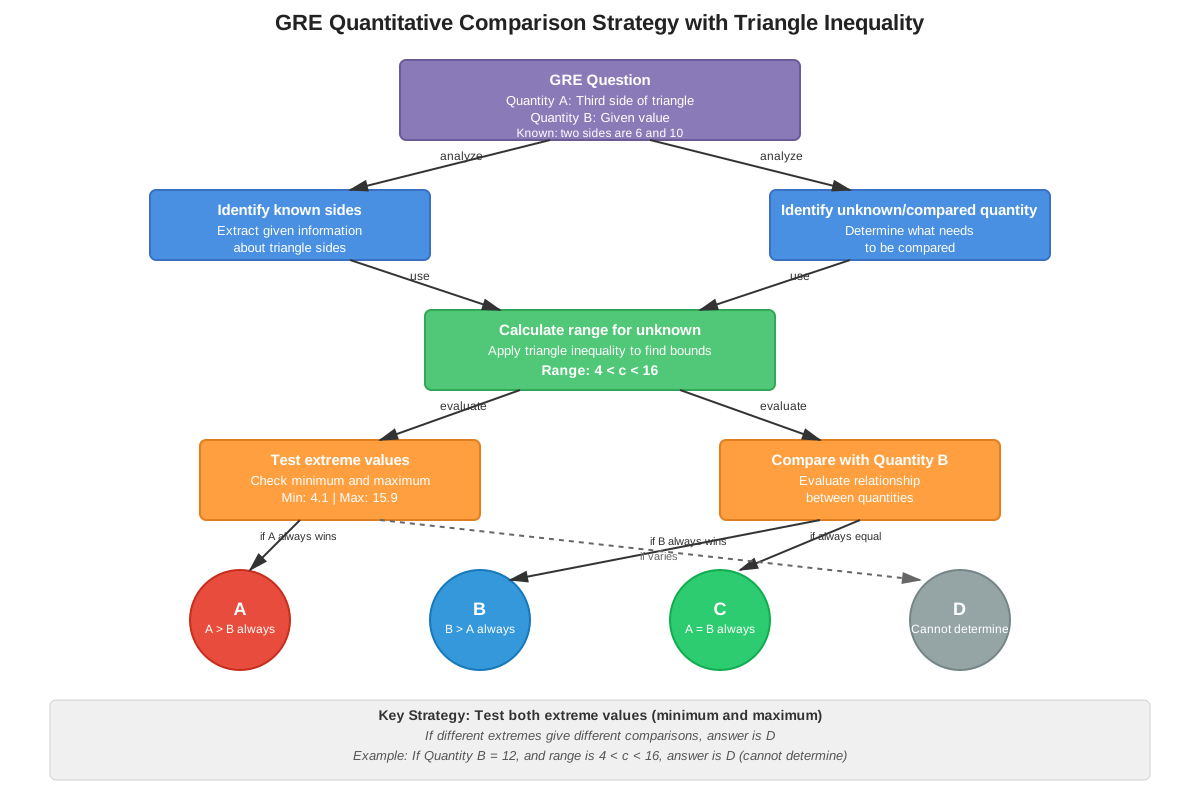
Exam Tip: On quantitative comparison questions, if both quantities involve expressions with triangle sides, try extreme values within the valid range (values close to the minimum and maximum) to determine the relationship.
Memory Techniques
The "Two Against One" Rule: Remember that in any triangle, any two sides must "team up" to beat the third side. If they can't beat it (sum isn't greater), there's no triangle.
The "Reaching" Visualization: Imagine two sides as arms trying to reach each other. If one arm is too long compared to the other two, they can't reach to close the triangle. The sum of the two shorter arms must exceed the length of the longest arm.
The Range Mnemonic: "DULL-SUM"
- Difference gives the Under Limit (but Larger than it)
- SUM gives the upper limit (but Must be less)
The "Almost But Not Quite" Principle: The third side can get arbitrarily close to the sum or difference of the other two sides, but can never actually reach these values. Think "almost but not quite."
The Quick Check Acronym: "STAT"
- Smallest two sides
- Together (add them)
- Are they greater than
- The largest side?
Inequality Direction Memory: The third side x is "trapped" between the difference and sum: DIFFERENCE < x < SUM. Visualize x as being squeezed between two boundaries.
Summary
The triangle inequality is a fundamental geometric principle stating that the sum of any two sides of a triangle must be strictly greater than the third side. This concept appears frequently on the GRE in various forms: determining whether three given lengths can form a triangle, finding the range of possible values for an unknown side, and solving optimization problems involving perimeters. The key formula to remember is that for a triangle with two known sides a and b, the third side x must satisfy |a - b| < x < a + b. When checking whether three specific lengths form a valid triangle, the most efficient approach is to verify that the sum of the two smallest sides exceeds the largest side. Understanding this principle enables rapid elimination of incorrect answer choices and provides a systematic approach to solving complex geometry problems. The inequality is strict—equality cases represent degenerate triangles (straight lines) and are never valid on the GRE.
Key Takeaways
- The triangle inequality states that for any triangle, the sum of any two sides must be strictly greater than the third side (a + b > c)
- For a triangle with sides a and b, the third side x must satisfy: |a - b| < x < a + b (strict inequalities, endpoints excluded)
- To verify three given lengths can form a triangle, check only that the sum of the two smallest exceeds the largest
- The longest side of any triangle is always less than half the perimeter
- Degenerate triangles (where the sum of two sides equals the third) are straight lines and not valid triangles on the GRE
- Triangle inequality questions frequently appear as quantitative comparisons, range-finding problems, and validity checks
- When dealing with integer constraints, remember that the maximum integer value is one less than the upper bound, and the minimum is one more than the lower bound
Related Topics
Properties of Special Triangles: Understanding isosceles, equilateral, and right triangles builds on triangle inequality knowledge, as these special cases must still satisfy the fundamental inequality while having additional constraints.
Pythagorean Theorem and Right Triangles: While the triangle inequality determines whether three sides can form any triangle, the Pythagorean theorem determines whether they form a right triangle specifically—a more restrictive condition.
Perimeter and Area Optimization: Many advanced geometry problems combine triangle inequality with optimization, asking for maximum or minimum perimeters or areas subject to various constraints.
Coordinate Geometry and Distance Formula: The triangle inequality extends naturally to coordinate geometry, where the distance between points can be analyzed using the same principles.
Absolute Value and Inequalities: Deepening understanding of absolute value inequalities and compound inequalities enhances ability to work with triangle inequality problems efficiently.
Practice CTA
Now that you've mastered the triangle inequality theorem and its applications, it's time to reinforce your understanding through practice. Work through the practice questions to test your ability to identify valid triangles, determine ranges of possible values, and solve complex GRE-style problems. Use the flashcards to memorize the key formulas and relationships until they become second nature. Remember: the triangle inequality appears in approximately 5-8% of GRE Quantitative Reasoning questions, making it one of the highest-yield geometry topics you can master. Your investment in understanding this concept will pay dividends on test day, giving you both speed and accuracy on multiple question types. Start practicing now to build the confidence and automaticity you need for GRE success!
Sign up free to keep reading
Create a free AnvayaPrep account to finish this GRE guide on Triangle inequality — plus flashcards and practice questions.