Overview
Isosceles triangles represent one of the most frequently tested geometric concepts on the GRE Quantitative Reasoning section. These special triangles, characterized by having exactly two sides of equal length, appear in approximately 15-20% of all geometry questions and serve as the foundation for solving complex problems involving angles, perimeters, areas, and coordinate geometry. Understanding isosceles triangles is not merely about memorizing their definition—it requires mastering the relationship between equal sides and equal angles, recognizing when problems involve isosceles triangles even when not explicitly stated, and applying these properties to solve multi-step problems efficiently.
The importance of GRE isosceles triangles extends beyond standalone geometry questions. These triangles frequently appear embedded within larger geometric figures, coordinate plane problems, and data interpretation questions. Test-makers favor isosceles triangles because they allow for elegant problem construction where one or two pieces of information can unlock an entire solution through the application of fundamental properties. Students who master isosceles triangles gain a significant strategic advantage, as these problems often appear deceptively simple but reward those who can quickly identify the relevant properties and apply them systematically.
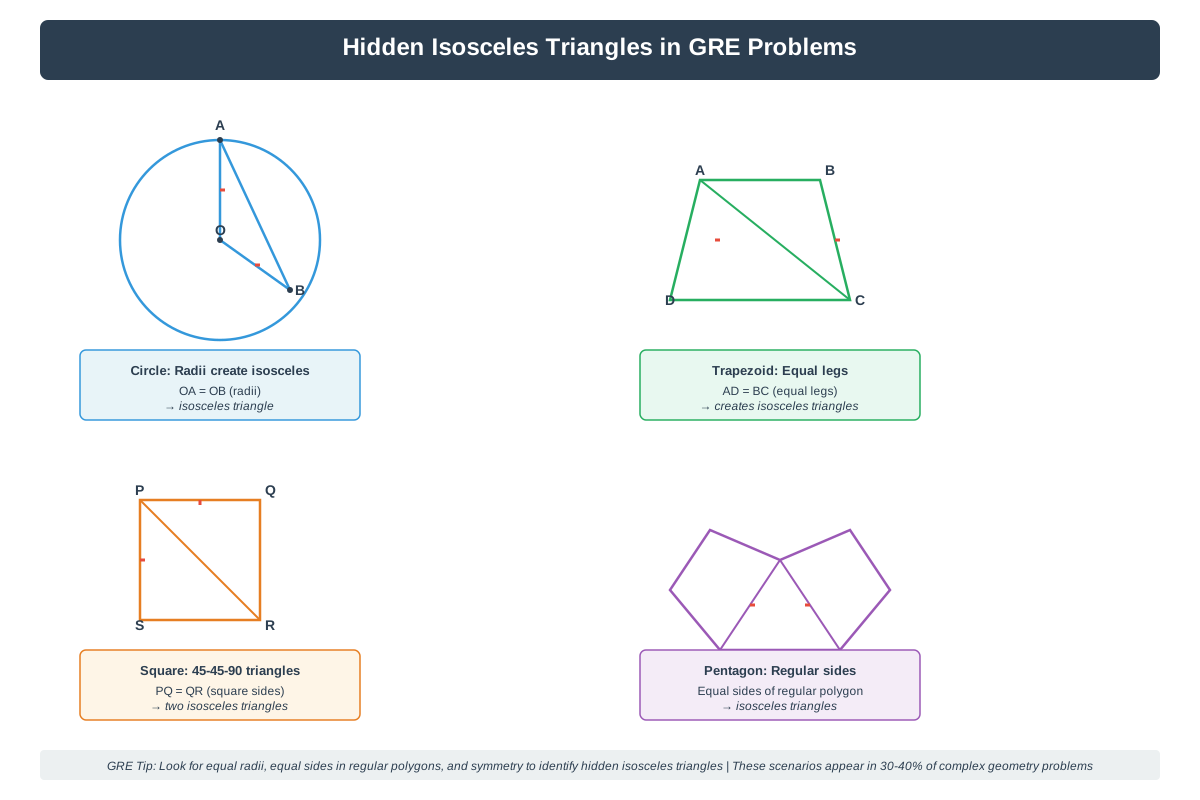
Within the broader Quantitative Reasoning framework, isosceles triangles connect directly to concepts including triangle inequality, the Pythagorean theorem, special right triangles (particularly 45-45-90 triangles, which are isosceles), circle geometry (where radii create isosceles triangles), and coordinate geometry. This topic serves as a bridge between basic triangle properties and more advanced geometric reasoning, making it an essential component of a comprehensive GRE preparation strategy.
Learning Objectives
- [ ] Identify when isosceles triangles are being tested, including implicit scenarios where the isosceles property must be inferred
- [ ] Explain the core rule or strategy behind isosceles triangles, particularly the relationship between equal sides and equal angles
- [ ] Apply isosceles triangles properties to GRE-style questions accurately and efficiently
- [ ] Determine unknown angles in isosceles triangles using the base angles theorem
- [ ] Calculate perimeters and areas of isosceles triangles given partial information
- [ ] Recognize isosceles triangles within complex geometric figures and coordinate plane scenarios
- [ ] Distinguish between isosceles and equilateral triangles and apply the appropriate properties
Prerequisites
- Basic triangle properties: Understanding that the sum of interior angles equals 180° is essential for calculating unknown angles in isosceles triangles
- Angle relationships: Knowledge of complementary, supplementary, and vertical angles enables solving problems where isosceles triangles interact with other geometric figures
- Pythagorean theorem: Required for calculating heights, side lengths, and areas when working with right isosceles triangles
- Basic algebraic manipulation: Necessary for setting up and solving equations involving unknown sides or angles in isosceles triangles
- Coordinate geometry fundamentals: Understanding distance formula and slope helps identify isosceles triangles in the coordinate plane
Why This Topic Matters
Isosceles triangles appear in real-world applications ranging from architectural design and structural engineering to navigation and computer graphics. The symmetry inherent in isosceles triangles makes them fundamental to understanding balance, stability, and aesthetic proportion in both natural and human-made structures. In physics and engineering, isosceles triangular configurations frequently appear in force diagrams, truss designs, and optical systems.
On the GRE specifically, isosceles triangle questions appear in multiple formats: pure geometry problems (30% of geometry questions), quantitative comparison questions (25%), data interpretation with geometric diagrams (20%), and word problems requiring geometric reasoning (15%). The test-makers particularly favor isosceles triangles because they allow for elegant problem construction where strategic thinking matters as much as computational ability. Questions may present isosceles triangles explicitly, or students may need to recognize that a triangle must be isosceles based on given constraints—this recognition skill separates high scorers from average performers.
Common GRE question patterns include: determining unknown angles when one angle is given; calculating perimeter when only one side length is known; finding areas using the relationship between base and height; identifying isosceles triangles formed by radii in circles; recognizing isosceles triangles in coordinate geometry through equal distances; and solving optimization problems where isosceles configurations provide maximum or minimum values. Understanding these patterns enables students to approach questions with confidence and efficiency.
Core Concepts
Definition and Fundamental Properties
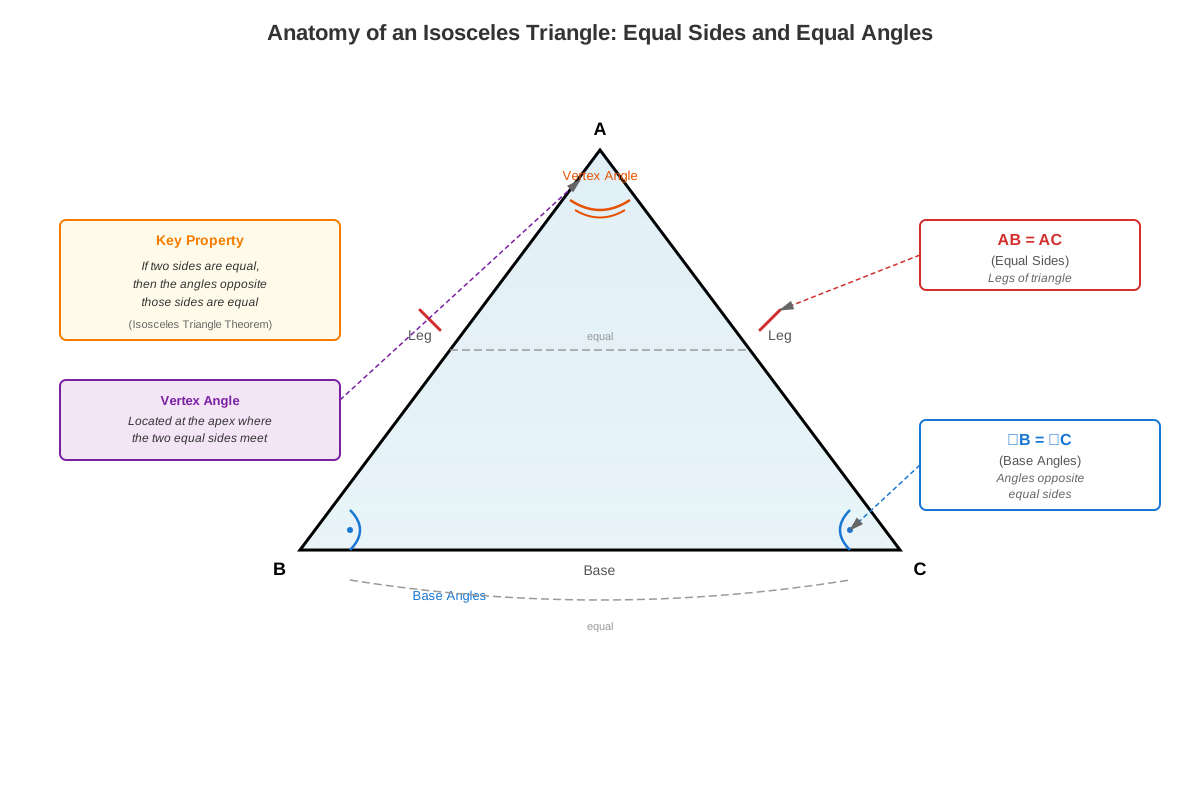
An isosceles triangle is defined as a triangle with exactly two sides of equal length. These equal sides are called the legs of the isosceles triangle, while the third side is called the base. The angle formed by the two legs is called the vertex angle, and the two angles adjacent to the base are called the base angles. This terminology is crucial for understanding problem statements and applying the correct properties.
The fundamental theorem governing isosceles triangles states: If two sides of a triangle are equal, then the angles opposite those sides are equal. Conversely, if two angles of a triangle are equal, then the sides opposite those angles are equal. This bidirectional relationship is the cornerstone of solving virtually all isosceles triangle problems on the GRE.
The Base Angles Theorem
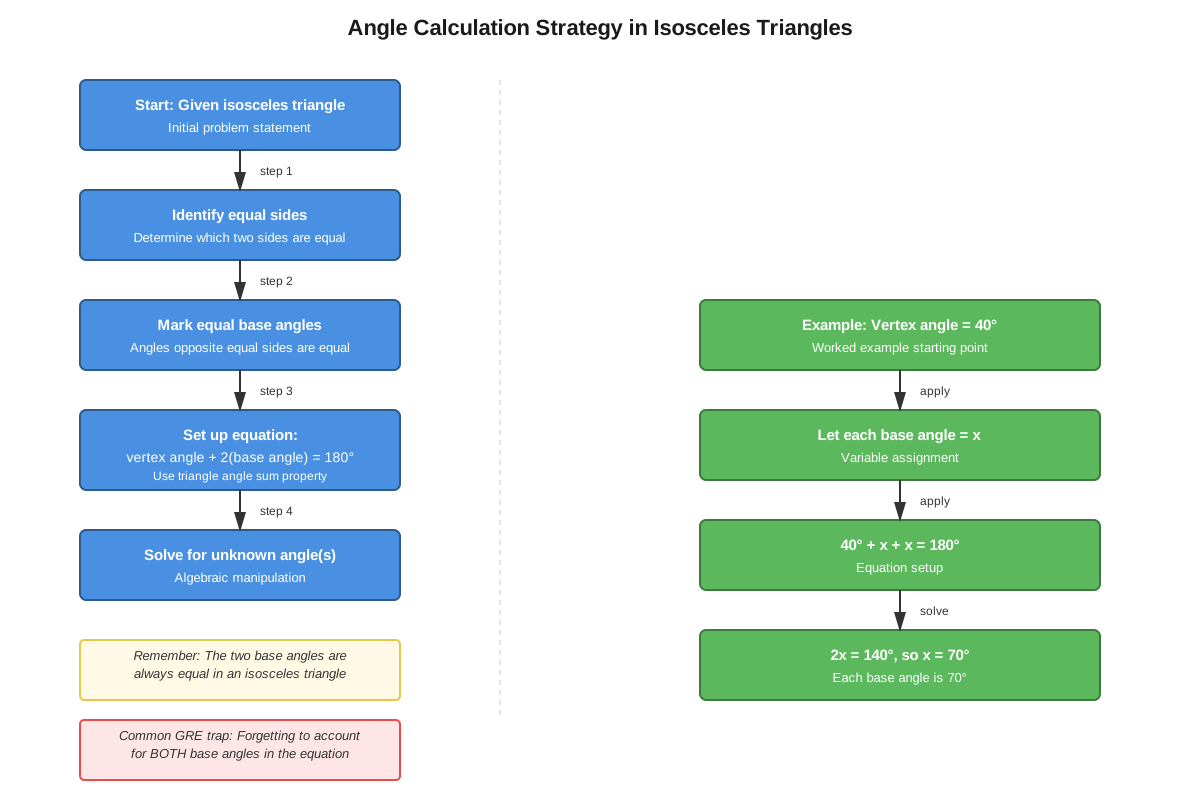
The base angles theorem is the most frequently tested property of isosceles triangles. If triangle ABC has AB = AC (making it isosceles with vertex angle at A), then angle B = angle C. This property allows students to determine unknown angles with minimal information. For example, if the vertex angle measures 40°, the two base angles must each measure (180° - 40°)/2 = 70°.
The converse is equally important: if you know that two angles in a triangle are equal, you can immediately conclude that the triangle is isosceles, and the sides opposite those equal angles must be equal in length. This recognition is often the key insight needed to solve complex problems where the isosceles property is not explicitly stated.
Angle Calculations in Isosceles Triangles
Given any one angle in an isosceles triangle, you can determine the other two angles using the following systematic approach:
- If given the vertex angle (v): Each base angle = (180° - v)/2
- If given one base angle (b): The other base angle = b, and the vertex angle = 180° - 2b
- If given that one angle is x and another is y, and x = y, then these must be the base angles, and the vertex angle = 180° - 2x
Special Cases: Right Isosceles Triangles
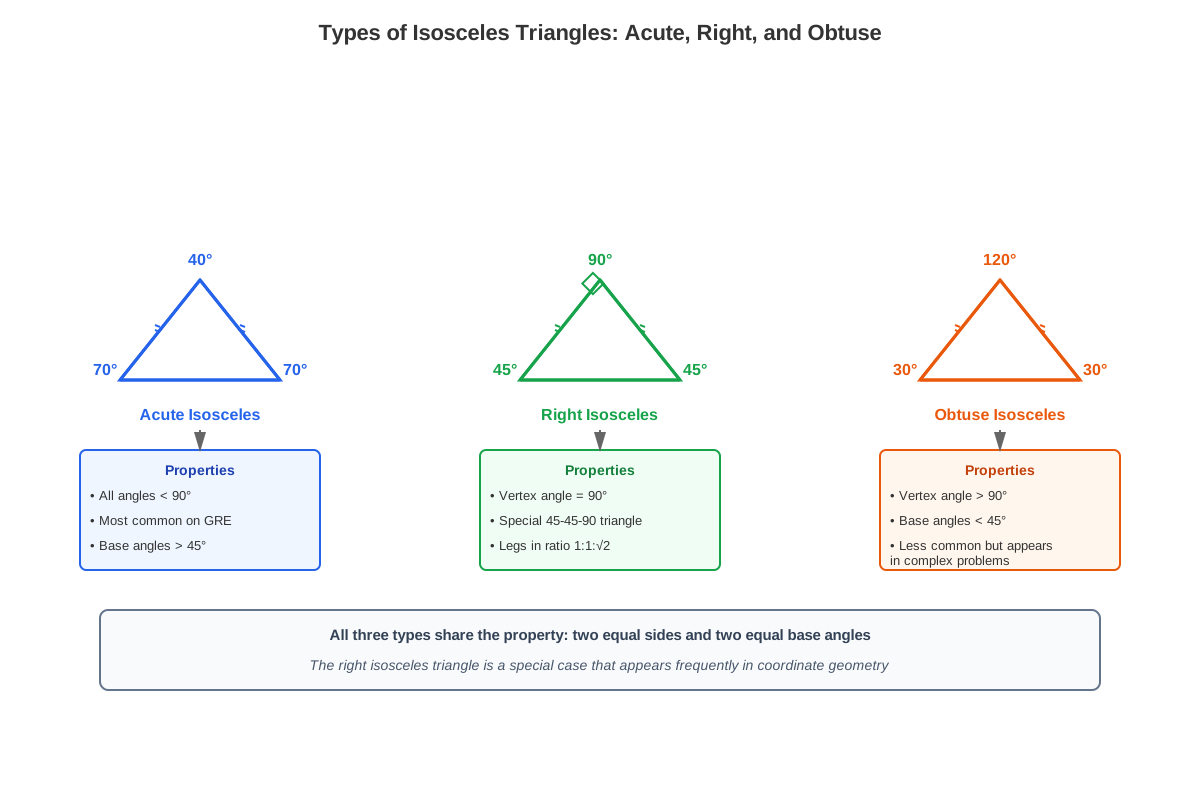
A right isosceles triangle (also known as a 45-45-90 triangle) occurs when the vertex angle is 90°. In this special case, each base angle measures 45°. The sides are in the ratio 1:1:√2, where the two legs are equal and the hypotenuse is √2 times the length of each leg. This is one of the most important special right triangles for the GRE.
If an isosceles triangle has a right angle at one of the base angles (not the vertex), it's actually impossible—this would require the vertex angle to be 0°, which cannot form a triangle. Recognizing such impossibilities helps eliminate incorrect answer choices.
Perimeter and Side Length Relationships
For an isosceles triangle with legs of length a and base of length b, the perimeter P = 2a + b. GRE questions often provide the perimeter and one side length, requiring students to determine the other sides. The key is identifying which side is given:
- If given a leg length and perimeter: base = P - 2(leg)
- If given base length and perimeter: each leg = (P - base)/2
The triangle inequality theorem applies to isosceles triangles with special constraints. For an isosceles triangle with legs of length a and base b: 2a > b (the sum of the two legs must exceed the base) and a + b > a, which simplifies to b > 0. More restrictively, b < 2a, meaning the base must be less than twice the leg length.
Area Calculations
The area of an isosceles triangle can be calculated using several methods:
Method 1: Standard formula - Area = (1/2) × base × height, where the height is the perpendicular distance from the vertex angle to the base. In an isosceles triangle, this height bisects the base, creating two congruent right triangles.
Method 2: Using the Pythagorean theorem - If you know the legs (length a) and base (length b), the height h can be found using: h² + (b/2)² = a². Then Area = (1/2) × b × h.
Method 3: For right isosceles triangles - If the two legs each have length a, Area = (1/2) × a × a = a²/2.
Symmetry and the Altitude
A critical property of isosceles triangles is that the altitude (perpendicular line segment) from the vertex angle to the base has three simultaneous properties:
- It is the median (divides the base into two equal segments)
- It is the angle bisector (divides the vertex angle into two equal angles)
- It is the perpendicular bisector of the base
This three-in-one property is unique to isosceles triangles and frequently appears in GRE problems. When you draw the altitude from the vertex angle to the base, you create two congruent right triangles, which often simplifies calculations significantly.
Coordinate Geometry Applications
In the coordinate plane, identifying isosceles triangles requires calculating distances using the distance formula: d = √[(x₂-x₁)² + (y₂-y₁)²]. A triangle with vertices at three points is isosceles if exactly two of the three side lengths are equal. GRE questions may ask students to:
- Determine if a given triangle is isosceles
- Find a coordinate that makes a triangle isosceles
- Calculate the area of an isosceles triangle using coordinates
Concept Relationships
The properties of isosceles triangles form an interconnected web of relationships. The definition (two equal sides) → leads to → the base angles theorem (two equal angles) → enables → angle calculations using the 180° sum property. This chain represents the most direct path for solving standard problems.
The altitude from the vertex angle → creates → two congruent right triangles → allows application of → the Pythagorean theorem → enables → height and area calculations. This relationship is crucial for problems requiring area or involving unknown side lengths.
Right isosceles triangles → are a special case of → both isosceles triangles and 45-45-90 special right triangles → connects to → special right triangle ratios and trigonometric values. This intersection makes right isosceles triangles particularly high-yield for the GRE.
The triangle inequality theorem → constrains → possible side length combinations → helps eliminate → impossible answer choices in quantitative comparison and problem-solving questions.
Isosceles triangles in circles → are formed by → two radii and a chord → connects to → circle geometry and central angles. This relationship frequently appears in complex multi-concept problems.
High-Yield Facts
⭐ In an isosceles triangle, the two base angles are always equal in measure
⭐ If you know one angle in an isosceles triangle, you can determine the other two angles
⭐ The altitude from the vertex angle to the base bisects both the base and the vertex angle
⭐ A right isosceles triangle has angles measuring 45°-45°-90° and sides in ratio 1:1:√2
⭐ For an isosceles triangle with legs a and base b, the triangle inequality requires b < 2a
- The perimeter of an isosceles triangle with legs a and base b equals 2a + b
- An equilateral triangle is a special case of an isosceles triangle (all equilateral triangles are isosceles, but not vice versa)
- In any triangle, if two angles are equal, the triangle must be isosceles
- The altitude from the vertex angle creates two congruent right triangles
- In a circle, any triangle formed by two radii and a chord is isosceles
- The area of a right isosceles triangle with leg length a is a²/2
- If an isosceles triangle has a perimeter of P and base of b, each leg measures (P-b)/2
Quick check — test yourself on Isosceles triangles so far.
Try Flashcards →Common Misconceptions
Misconception: All isosceles triangles are right triangles → Correction: Isosceles triangles can have any vertex angle between 0° and 180° (exclusive). Only when the vertex angle is exactly 90° is the triangle both isosceles and right. Most isosceles triangles are not right triangles.
Misconception: The base of an isosceles triangle is always the bottom side in a diagram → Correction: The base is defined as the side that is different from the two equal sides (legs), regardless of the triangle's orientation. Always identify which sides are equal before determining which is the base.
Misconception: If a triangle has two equal angles, those must be the base angles → Correction: While this is often true, the two equal angles could theoretically be any pair. However, by definition, if two angles are equal, the sides opposite them are equal, making it isosceles. The terminology "base angles" specifically refers to the angles opposite the equal sides.
Misconception: The altitude, median, and angle bisector are always the same line in any triangle → Correction: These three lines coincide only for the altitude drawn from the vertex angle to the base in an isosceles triangle (or for any altitude in an equilateral triangle). In scalene triangles, these are three different line segments.
Misconception: An isosceles triangle with perimeter 12 and one side of length 5 must have sides 5-5-2 → Correction: You must verify which side is given. If 5 is a leg, the sides are 5-5-2. If 5 is the base, the sides are 3.5-3.5-5. Always check the triangle inequality: for 5-5-2, we have 5+2 > 5 ✓, but for a configuration like 5-5-10, we'd have 5+5 = 10, which violates the inequality.
Misconception: In coordinate geometry, if two sides of a triangle have the same slope, the triangle is isosceles → Correction: Equal slopes mean the sides are parallel, which is impossible in a triangle. For an isosceles triangle, you need two sides with equal length (calculated using the distance formula), not equal slope.
Misconception: The vertex angle in an isosceles triangle must be acute → Correction: The vertex angle can be acute, right, or obtuse. For example, an isosceles triangle with vertex angle 120° and base angles of 30° each is perfectly valid.
Worked Examples
Example 1: Angle Calculation with Algebraic Expression
Problem: In isosceles triangle ABC, AB = AC, and angle B measures (2x + 10)°. Angle C measures (3x - 15)°. What is the measure of angle A?
Solution:
Step 1: Recognize that since AB = AC, the triangle is isosceles with vertex angle at A. Therefore, the base angles B and C must be equal.
Step 2: Set up an equation using the fact that angles B and C are equal:
2x + 10 = 3x - 15Step 3: Solve for x:
10 + 15 = 3x - 2x
25 = x
Step 4: Calculate the measure of angle B (or C):
Angle B = 2(25) + 10 = 50 + 10 = 60°Step 5: Use the triangle angle sum to find angle A:
Angle A = 180° - angle B - angle C
Angle A = 180° - 60° - 60° = 60°
Step 6: Verify the answer. Since all three angles equal 60°, this is actually an equilateral triangle (which is a special case of isosceles). This makes sense because AB = AC was given, and our calculation shows angle B = angle C, confirming the isosceles property. Additionally, angle A also equals 60°, making it equilateral.
Connection to Learning Objectives: This problem requires identifying the isosceles property (angles B and C must be equal), applying the core rule (equal sides opposite equal angles), and accurately solving a GRE-style algebraic geometry problem.
Example 2: Area Calculation Using Multiple Steps
Problem: An isosceles triangle has a base of 12 cm and legs of 10 cm each. What is the area of the triangle?
Solution:
Step 1: Sketch the triangle and identify what's given. We have legs = 10 cm and base = 12 cm. We need to find the area, which requires the height.
Step 2: Recognize that the altitude from the vertex angle to the base bisects the base, creating two congruent right triangles. Each right triangle has:
- Hypotenuse = 10 cm (the leg of the isosceles triangle)
- Base = 6 cm (half of the 12 cm base)
- Height = h (unknown)
Step 3: Apply the Pythagorean theorem to find the height:
h² + 6² = 10²
h² + 36 = 100
h² = 64
h = 8 cm
Step 4: Calculate the area using the standard formula:
Area = (1/2) × base × height
Area = (1/2) × 12 × 8
Area = 48 cm²
Step 5: Verify using the triangle inequality. For sides 10, 10, and 12:
- 10 + 10 = 20 > 12 ✓
- 10 + 12 = 22 > 10 ✓
The triangle is valid, and our answer is correct.
Connection to Learning Objectives: This problem demonstrates applying the core properties of isosceles triangles (altitude bisects the base), integrating prerequisite knowledge (Pythagorean theorem), and accurately calculating area in a multi-step GRE-style problem.
Exam Strategy
When approaching GRE questions involving isosceles triangles, follow this systematic strategy:
Step 1: Identify the isosceles property. Look for explicit statements like "AB = AC" or implicit clues such as "two angles are equal" or "a triangle formed by two radii." Circle or mark equal sides in your diagram immediately. Watch for trigger phrases: "two equal sides," "two congruent angles," "symmetric triangle," or "formed by two radii."
Step 2: Mark what you know. Use tick marks to indicate equal sides and arc marks to indicate equal angles. This visual representation prevents errors and often reveals the solution path. If working in the coordinate plane, calculate all three side lengths to identify which two are equal.
Step 3: Apply the base angles theorem. If you know the sides are equal, mark the opposite angles as equal. If you know two angles are equal, mark the opposite sides as equal. This bidirectional relationship is your primary tool.
Step 4: Use the 180° angle sum. With one angle known in an isosceles triangle, you can always find the others. Set up equations systematically: if vertex angle = v, then each base angle = (180-v)/2.
Step 5: Consider the altitude. For area problems or when you need to find heights or side lengths, draw the altitude from the vertex angle to the base. Remember it creates two congruent right triangles and bisects both the base and the vertex angle.
Time allocation: Simple angle-finding problems should take 30-45 seconds. Multi-step problems involving area or coordinate geometry may require 90-120 seconds. If a problem requires more than 2 minutes, you may be missing a key insight—look for the isosceles property you haven't yet applied.
Process of elimination tips:
- Eliminate any answer choice that violates the triangle inequality (sum of two sides must exceed the third)
- If base angles are given as different values, eliminate that choice immediately
- For angle measures, eliminate any choice where the three angles don't sum to 180°
- In quantitative comparison, if both quantities involve the same isosceles triangle property, they're often equal
Common trap answers: Test-makers often include the vertex angle when you're asked for a base angle, or vice versa. They may also present the perimeter when you're asked for one side length. Always verify what the question is asking before selecting your answer.
Memory Techniques
Mnemonic for base angles theorem: "Equal Sides, Equal Angles" (ESEA) - If you see equal sides, you know you have equal angles, and vice versa.
Visualization strategy: Picture an isosceles triangle as a "roof" or "mountain peak." The vertex angle is at the top (the peak), and the two base angles are at the bottom corners (the foundation). The two equal sides are the "slopes" going up to the peak. This mental image helps you remember that the base angles (at the foundation) are equal.
Acronym for altitude properties: "Median, Angle bisector, Perpendicular bisector" = MAP. The altitude from the vertex angle in an isosceles triangle is a MAP to solving the problem—it gives you all three properties at once.
Rhyme for right isosceles: "Forty-five, forty-five, ninety degrees—sides are one, one, root-two with ease." This helps you remember both the angles and the side ratios for 45-45-90 triangles.
Finger technique for angle calculation: Hold up three fingers. If you know one angle in an isosceles triangle, fold down one finger. If the known angle is a base angle, fold down a second finger (because both base angles are equal). The remaining finger(s) represent what you need to find. This physical reminder helps you set up the correct equation.
Triangle inequality check: "Two sides must Beat the third" (TB). For an isosceles triangle with legs a and base b, remember that 2a > b. The two legs together must "beat" (be greater than) the base.
Summary
Isosceles triangles are defined by having exactly two equal sides (legs), which creates two equal base angles opposite those sides. This fundamental relationship—equal sides create equal angles, and equal angles indicate equal sides—is the cornerstone of solving all isosceles triangle problems on the GRE. The vertex angle (formed by the two equal sides) and the two base angles must sum to 180°, allowing you to calculate any unknown angle when given just one angle measurement. The altitude from the vertex angle to the base has three simultaneous properties: it bisects the base, bisects the vertex angle, and is perpendicular to the base, creating two congruent right triangles that enable area and side length calculations using the Pythagorean theorem. Special cases include right isosceles triangles (45-45-90 triangles with side ratios 1:1:√2) and isosceles triangles formed by two radii in a circle. Success on GRE isosceles triangle questions requires recognizing when the isosceles property applies (even when not explicitly stated), systematically applying the base angles theorem, and efficiently using the altitude to create right triangles for calculations. The triangle inequality (the sum of any two sides must exceed the third) constrains possible side lengths and helps eliminate incorrect answer choices.
Key Takeaways
- Equal sides opposite equal angles: This bidirectional relationship is the fundamental property of isosceles triangles and the key to solving most problems
- One angle determines all: Given any single angle in an isosceles triangle, you can calculate the other two using the 180° sum and the base angles theorem
- The altitude is a three-in-one tool: From the vertex angle to the base, it simultaneously bisects the base, bisects the vertex angle, and creates two congruent right triangles
- Right isosceles triangles are 45-45-90 triangles: These special triangles have sides in the ratio 1:1:√2 and appear frequently on the GRE
- Recognition is crucial: Many GRE problems require identifying that a triangle is isosceles based on given information (equal angles, two radii, symmetric configuration) rather than explicit statement
- Triangle inequality applies: For legs a and base b, you must have b < 2a; this constraint helps eliminate impossible answer choices
- Coordinate geometry applications: Calculate all three side lengths using the distance formula to identify which two are equal and confirm the isosceles property
Related Topics
Equilateral Triangles: A special case where all three sides are equal (making it isosceles in three different ways). Mastering isosceles triangles provides the foundation for understanding equilateral triangle properties, including 60° angles and area formulas.
Special Right Triangles (30-60-90): While 45-45-90 triangles are isosceles, 30-60-90 triangles are not. Understanding the distinction and when to apply each set of ratios is crucial for GRE success.
Circle Geometry: Isosceles triangles formed by two radii and a chord appear frequently in circle problems. The vertex angle of such triangles equals the central angle, connecting isosceles triangle properties to arc measures and sector areas.
Triangle Congruence and Similarity: The properties of isosceles triangles support understanding congruence criteria (SAS, ASA, SSS) and similarity ratios, as the symmetry of isosceles triangles often creates congruent or similar sub-triangles.
Coordinate Geometry: Identifying isosceles triangles in the coordinate plane requires distance calculations and connects to concepts of midpoint, slope, and perpendicular lines.
Practice CTA
Now that you've mastered the core concepts, properties, and strategies for isosceles triangles, it's time to reinforce your learning through active practice. Attempt the practice questions to apply these concepts to GRE-style problems, and use the flashcards to ensure instant recall of key properties and formulas. Remember, recognizing when a triangle is isosceles—even when not explicitly stated—is often the critical insight that unlocks a problem. With focused practice, you'll develop the pattern recognition and strategic thinking that separates top scorers from the rest. Your investment in mastering this high-yield topic will pay dividends across multiple question types on test day!
Sign up free to keep reading
Create a free AnvayaPrep account to finish this GRE guide on Isosceles triangles — plus flashcards and practice questions.