Overview
Algebraic comparison is a critical skill tested extensively in the GRE Quantitative Reasoning section, particularly within Quantitative Comparison questions. This technique involves comparing two algebraic expressions or quantities without necessarily solving for exact values. Rather than performing complete calculations, students learn to manipulate expressions strategically—adding, subtracting, multiplying, or dividing both quantities by the same value—to determine which is larger, whether they're equal, or if the relationship cannot be determined from the given information.
The GRE frequently presents scenarios where direct calculation would be time-consuming or impossible, making gre algebraic comparison strategies essential for efficient test-taking. These questions test mathematical reasoning rather than computational ability, rewarding students who recognize patterns and apply algebraic properties systematically. Mastering this topic enables students to answer questions in 30-45 seconds rather than spending 2-3 minutes on lengthy calculations.
Within the broader Quantitative Reasoning framework, algebraic comparison bridges fundamental algebra skills with strategic test-taking. It builds upon knowledge of inequalities, equation manipulation, and number properties while serving as a foundation for more complex problem-solving scenarios. This topic represents approximately 15-20% of all Quantitative Comparison questions and appears across various mathematical contexts including geometry, statistics, and word problems.
Learning Objectives
- [ ] Identify when Algebraic comparison is being tested
- [ ] Explain the core rule or strategy behind Algebraic comparison
- [ ] Apply Algebraic comparison to GRE-style questions accurately
- [ ] Determine which algebraic operations preserve inequality relationships
- [ ] Recognize when additional information is needed to establish a relationship
- [ ] Evaluate expressions with variables to determine definitive versus conditional relationships
- [ ] Execute multi-step algebraic manipulations while maintaining comparison validity
Prerequisites
- Basic algebraic manipulation: Essential for adding, subtracting, and factoring expressions during comparison operations
- Properties of inequalities: Required to understand which operations preserve or reverse inequality signs
- Order of operations: Necessary to correctly simplify expressions before comparing
- Integer and rational number properties: Helps determine when variables might be positive, negative, or zero
- Equation solving fundamentals: Provides the foundation for isolating variables and simplifying expressions
Why This Topic Matters
Algebraic comparison appears in approximately 6-8 questions per GRE Quantitative section, making it one of the highest-yield topics for score improvement. Unlike traditional algebra problems that require finding specific values, these questions assess deeper mathematical reasoning—the ability to determine relationships without complete information. This mirrors real-world analytical thinking where professionals must make decisions based on incomplete data or comparative analysis rather than absolute values.
In professional contexts, algebraic comparison skills translate to cost-benefit analysis, resource allocation decisions, and data interpretation where relative magnitudes matter more than precise calculations. Graduate programs value this skill because it demonstrates logical reasoning and efficiency—qualities essential for research, data analysis, and problem-solving in academic and professional settings.
On the GRE, algebraic comparison questions typically appear as Quantitative Comparison items (the four-choice format where students select A, B, C, or D based on whether Quantity A is greater, Quantity B is greater, the quantities are equal, or the relationship cannot be determined). These questions often involve variables with constraints, expressions requiring simplification, or scenarios where testing special cases reveals the answer. The topic also appears in multiple-choice questions where students must determine which of several expressions is largest or smallest.
Core Concepts
The Fundamental Principle of Algebraic Comparison
The core strategy behind algebraic comparison involves performing identical operations to both quantities being compared while preserving the relationship between them. Just as a balanced scale remains balanced when equal weights are added to or removed from both sides, algebraic expressions maintain their relative magnitude when subjected to the same mathematical operations.
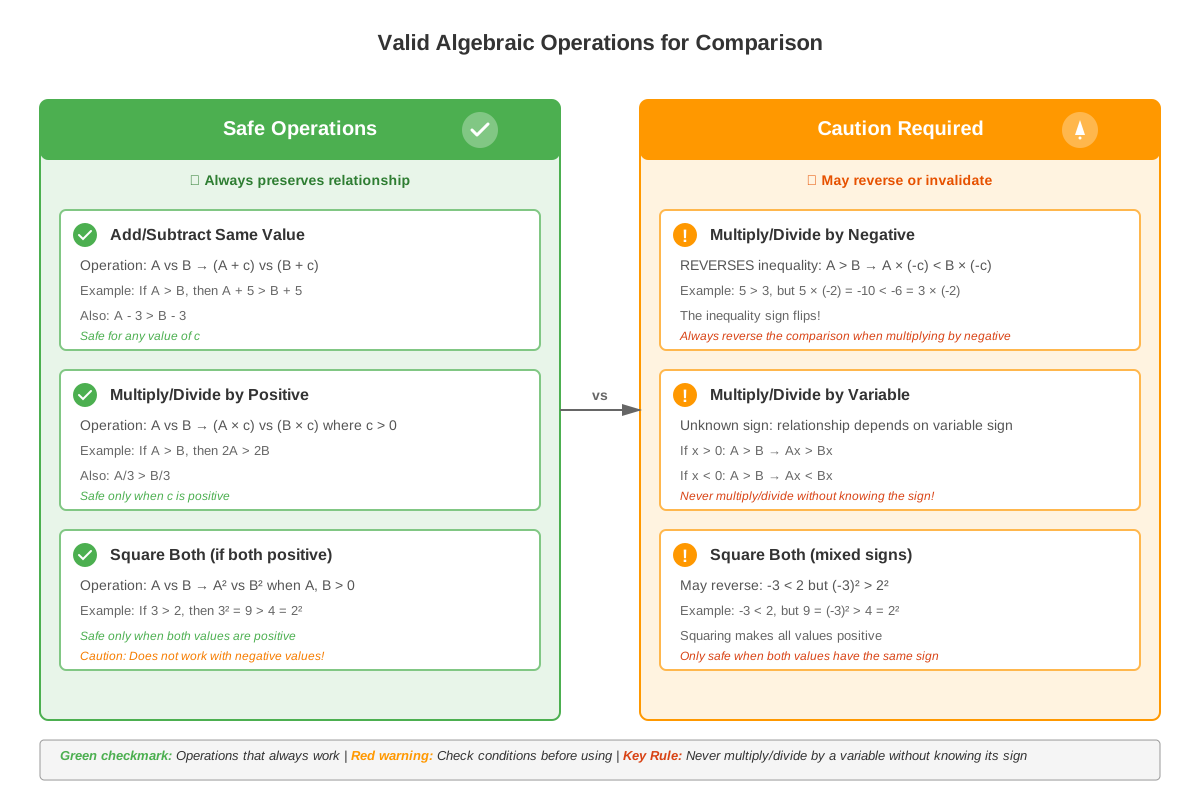
Valid operations that preserve relationships include:
- Adding or subtracting the same value from both quantities
- Multiplying or dividing both quantities by the same positive value
- Squaring both quantities when both are known to be positive
- Taking square roots of both quantities when both are non-negative
Critical restrictions exist for certain operations:
- Multiplying or dividing by a negative value reverses the inequality
- Squaring quantities of unknown sign can produce misleading results
- Cross-multiplication in inequalities requires attention to sign
The Four-Step Comparison Process
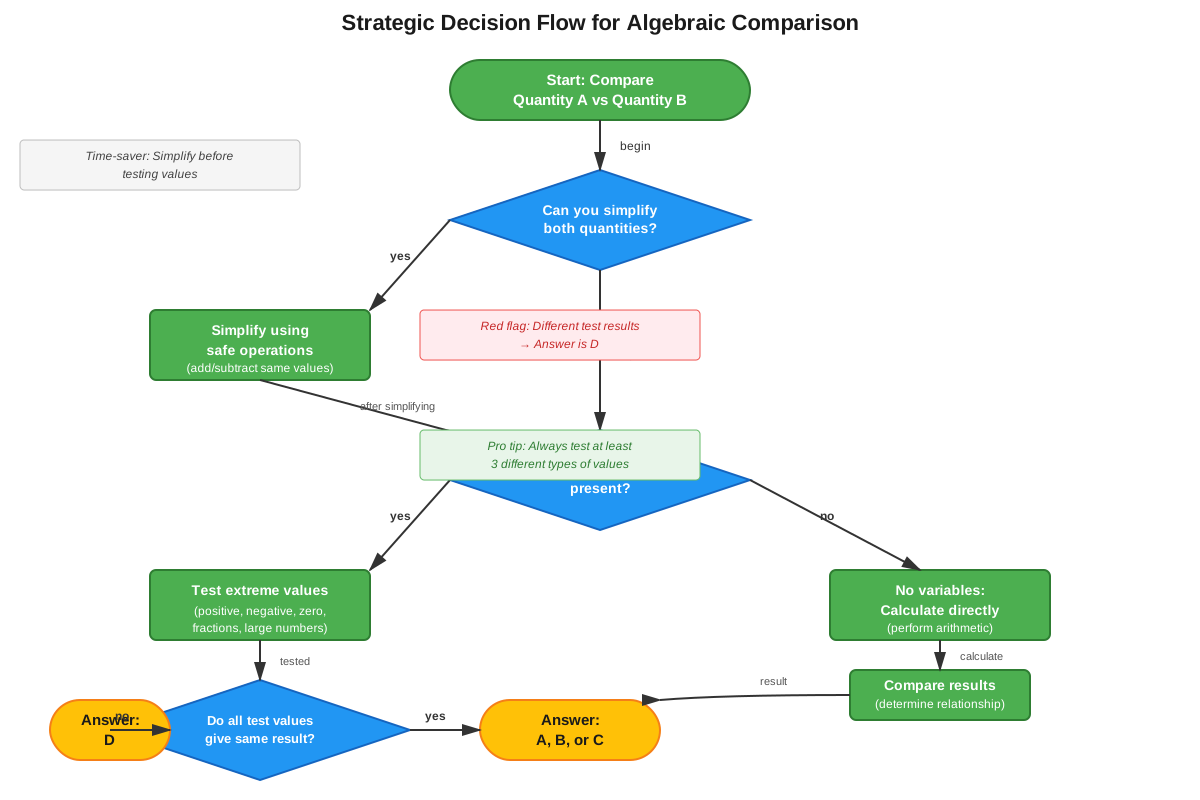
When approaching algebraic comparison questions, follow this systematic process:
- Simplify each quantity independently: Combine like terms, factor where helpful, and eliminate unnecessary complexity
- Identify a strategic operation: Determine what can be added, subtracted, multiplied, or divided to make comparison easier
- Apply the operation to both quantities: Execute the same manipulation on both sides
- Evaluate the resulting relationship: Determine if one quantity is definitively larger, if they're equal, or if the relationship depends on unknown variable values
Variable Analysis and Special Cases
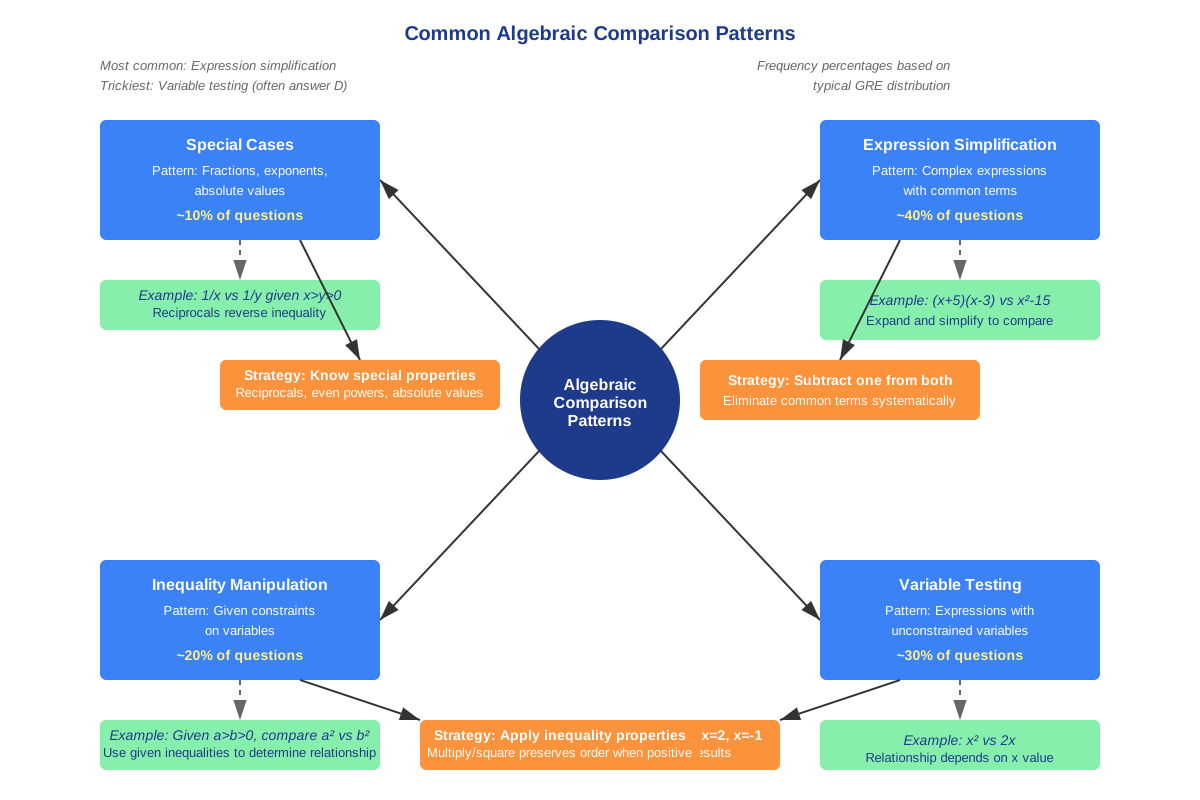
Many algebraic comparison questions include variables without complete constraints. The special case testing strategy involves substituting specific values to explore different scenarios:
- Test zero: Often reveals unexpected relationships
- Test positive and negative values: Determines if the relationship changes with sign
- Test fractions between 0 and 1: Critical because these behave differently than integers when squared or multiplied
- Test 1: Simplifies many expressions and reveals patterns
- Test very large or very small values: Shows behavior at extremes
If testing different values produces different relationships (sometimes A is larger, sometimes B is larger), the answer is always "D" (the relationship cannot be determined).
Operations That Preserve Inequality
Understanding which operations maintain comparison validity is essential:
| Operation | Preserves Relationship? | Conditions |
|---|---|---|
| Add/subtract same value | Always | None |
| Multiply/divide by positive | Always | Value must be positive |
| Multiply/divide by negative | Reverses relationship | Must flip inequality |
| Square both sides | Sometimes | Both quantities must have same sign |
| Take reciprocals | Reverses relationship | Both quantities must be same sign |
| Absolute value | Sometimes | Depends on original signs |
Simplification Before Comparison
Often, the most efficient approach involves simplifying the comparison itself rather than simplifying each quantity separately. Consider comparing Quantity A: 3x + 7 with Quantity B: 3x + 5. Rather than solving for x, subtract 3x from both quantities, leaving 7 versus 5—an immediate answer.
This technique, called comparison by subtraction, transforms the question into: "Is Quantity A - Quantity B positive, negative, or zero?" If the result is always positive, A is greater; if always negative, B is greater; if always zero, they're equal; if the sign depends on variable values, the relationship cannot be determined.
Handling Compound Expressions
When quantities contain multiple terms or complex expressions, strategic factoring and cancellation become powerful tools. For expressions with common factors, factor them out before comparing. For fractions, finding common denominators or cross-multiplying (with attention to sign) can clarify relationships.
Consider comparing (x² - 4)/(x - 2) with x + 2. Rather than substituting values, recognize that x² - 4 factors to (x + 2)(x - 2), so the first expression simplifies to x + 2 when x ≠ 2. This reveals the quantities are equal except at the restriction point.
Concept Relationships
The algebraic comparison process begins with simplification techniques (combining like terms, factoring) which enable strategic operation selection. This selection depends on understanding inequality properties, which determine whether operations preserve or reverse relationships. When variables appear without complete constraints, special case testing becomes necessary, drawing on knowledge of number properties (how positive/negative values, fractions, and zero behave differently).
The relationship flows: Simplification → Operation Selection → Relationship Preservation → Conclusion
This topic connects to prerequisite knowledge of basic algebra (providing the manipulation tools) and inequality properties (governing which operations are valid). It extends to more advanced topics like optimization problems (finding maximum/minimum values) and function comparison (determining which function grows faster).
Within Quantitative Comparison questions specifically, algebraic comparison often combines with geometric relationships (comparing areas or perimeters), statistical measures (comparing means or medians), and word problem translation (converting scenarios into comparable expressions).
High-Yield Facts
⭐ Adding or subtracting the same value from both quantities always preserves the relationship—this is the safest and most frequently useful operation
⭐ Multiplying or dividing both quantities by a negative number reverses the inequality—forgetting this is the most common error
⭐ If testing different values for a variable produces different relationships, the answer is always "D" (cannot be determined)
⭐ Squaring both sides is only safe when both quantities are known to be positive—otherwise, the relationship may reverse
⭐ When comparing expressions with the same terms, subtract those terms from both sides to simplify
- Cross-multiplying fractions requires both denominators to have the same sign to preserve the relationship
- Taking reciprocals of both sides reverses the inequality when both quantities are positive
- If a variable appears with the same coefficient in both quantities, that term can be eliminated by subtraction
- Zero is neither positive nor negative—always test it separately when variables have unknown sign
- Fractions between 0 and 1 become smaller when squared, while numbers greater than 1 become larger
- When both quantities are always positive, comparing their squares is equivalent to comparing the originals
- Absolute values can mask the true relationship—consider both positive and negative cases
- If one quantity is always positive and the other always negative, no algebraic manipulation is needed
- Common factors in numerator and denominator can be canceled only when the factor is non-zero
- When expressions contain radicals, squaring both sides (if both are non-negative) often simplifies comparison
Quick check — test yourself on Algebraic comparison so far.
Try Flashcards →Common Misconceptions
Misconception: Squaring both sides of a comparison always preserves the relationship → Correction: Squaring only preserves relationships when both quantities are known to be positive. If one quantity is negative and the other positive, squaring can reverse the relationship. For example, -3 < 2, but (-3)² = 9 > 4 = 2².
Misconception: If a variable appears in both quantities, the relationship cannot be determined → Correction: Variables appearing in both quantities often cancel out through subtraction, revealing a definitive relationship. The presence of variables doesn't automatically mean "D" is the answer.
Misconception: Cross-multiplication always works for comparing fractions → Correction: Cross-multiplication only preserves the inequality when both denominators are positive. If denominators have opposite signs or unknown signs, cross-multiplication may reverse the relationship or produce invalid conclusions.
Misconception: Testing one value for a variable is sufficient to determine the relationship → Correction: A single test case can only prove that the relationship is NOT always the same (leading to answer D), but cannot prove a relationship holds for all values. To confirm A, B, or C, either test multiple strategic cases or use algebraic proof.
Misconception: Simplifying each quantity separately is always the best approach → Correction: Often, the most efficient strategy is to compare the quantities directly by subtracting one from the other or by eliminating common terms. Simplifying separately can waste time and obscure the relationship.
Misconception: When both quantities contain the same variable term, they must be equal → Correction: Having the same variable term doesn't make quantities equal—only the coefficients and other terms matter. For example, 2x + 5 and 2x + 3 both contain 2x, but the first is always 2 greater than the second.
Misconception: Dividing both sides by a variable is always safe → Correction: Dividing by a variable is dangerous because the variable might be zero (making division undefined) or negative (reversing the inequality). Unless the variable's sign and non-zero status are guaranteed, avoid this operation.
Worked Examples
Example 1: Comparison with Common Terms
Question:
- Quantity A: 5x + 12
- Quantity B: 5x + 8
- Given: x is a real number
Solution:
Step 1 - Identify the strategy: Both quantities contain the term 5x, which can be eliminated by subtraction.
Step 2 - Subtract 5x from both quantities:
- Quantity A becomes: 12
- Quantity B becomes: 8
Step 3 - Compare the simplified quantities: 12 > 8 for all values of x.
Step 4 - Conclusion: Quantity A is always greater.
Answer: A
Learning objective addressed: This example demonstrates applying algebraic comparison by eliminating common terms through subtraction, showing how the presence of variables doesn't prevent definitive conclusions.
Example 2: Comparison Requiring Sign Analysis
Question:
- Quantity A: x²
- Quantity B: x³
- Given: x is a real number
Solution:
Step 1 - Recognize that the relationship depends on x's value, so test special cases.
Step 2 - Test x = 2 (positive integer greater than 1):
- Quantity A: 2² = 4
- Quantity B: 2³ = 8
- Result: B is greater
Step 3 - Test x = 0.5 (positive fraction between 0 and 1):
- Quantity A: (0.5)² = 0.25
- Quantity B: (0.5)³ = 0.125
- Result: A is greater
Step 4 - Since different values produce different relationships, the answer cannot be determined.
Answer: D
Alternative algebraic approach: Subtract Quantity B from Quantity A to get x² - x³ = x²(1 - x). This expression is positive when 0 < x < 1, negative when x > 1, and zero when x = 0 or x = 1. Since the sign varies, the relationship cannot be determined.
Learning objective addressed: This example shows how to identify when additional information is needed and demonstrates both special case testing and algebraic manipulation approaches.
Example 3: Comparison with Constraints
Question:
- Quantity A: 3a + 2b
- Quantity B: 2a + 3b
- Given: a > b and both a and b are positive
Solution:
Step 1 - Subtract Quantity B from Quantity A to determine the sign of the difference:
(3a + 2b) - (2a + 3b) = 3a + 2b - 2a - 3b = a - b
Step 2 - Analyze the result: We need to determine if a - b is positive, negative, or zero.
Step 3 - Apply the given constraint: Since a > b, we know that a - b > 0.
Step 4 - Conclusion: Since a - b is positive, Quantity A - Quantity B is positive, meaning Quantity A > Quantity B.
Answer: A
Learning objective addressed: This demonstrates how to use given constraints with algebraic manipulation to determine definitive relationships, addressing the objective of applying algebraic comparison accurately to GRE-style questions.
Exam Strategy
When approaching algebraic comparison questions on the GRE, begin by scanning for common terms that appear in both quantities—these can usually be eliminated immediately through subtraction. Look for trigger phrases like "for all values," "where x is a real number," or specific constraints like "x > 0," as these determine whether you need to test multiple cases or can proceed with algebraic manipulation.
Time allocation: Spend no more than 60-90 seconds on algebraic comparison questions. If algebraic manipulation doesn't yield an answer within 30 seconds, switch to testing special cases. The most efficient test values are 0, 1, -1, 2, and 0.5, in that order of usefulness.
Process-of-elimination approach:
- First, eliminate answer choices by testing x = 0 (if allowed)
- If the relationship holds, test x = 1 to confirm
- If still consistent, test a negative value or fraction
- If any test produces a different relationship, select D immediately
Red flag phrases that signal potential "D" answers:
- "x is a real number" (no constraints)
- "n is an integer" (without specifying positive/negative)
- Variables in exponents or denominators without restrictions
- Expressions that could be positive or negative
Green light phrases that often lead to definitive answers (A, B, or C):
- "x > 0" or other specific constraints
- "x is a positive integer"
- Both quantities are always positive or always negative
- One quantity is clearly always larger by inspection
Strategic operation selection: Always prefer addition/subtraction over multiplication/division. Only multiply or divide when you're certain of the sign. When in doubt, subtract Quantity B from Quantity A and determine if the result is always positive, always negative, always zero, or variable.
Memory Techniques
SAND Mnemonic for safe operations:
- Subtract anything from both sides
- Add anything to both sides
- Never multiply/divide by variables of unknown sign
- Dividing by negatives flips the inequality
"Positive Permission" rule: Remember that multiplication and division require positive permission—you need to know the value is positive before using these operations safely.
The Zero-One-Negative (ZON) Testing Sequence: When testing special cases, always check in this order: Zero, One, Negative. This sequence catches the most common relationship changes efficiently.
Fraction Flip: Visualize that fractions between 0 and 1 behave "opposite" to integers greater than 1—they get smaller when squared and larger when you take reciprocals. Picture a number line with 1 as the "flip point."
"Same Sign, Same Side" for squaring: Both quantities must be on the same side of zero (both positive or both negative) to safely square both sides. Visualize a number line divided at zero—squaring only works within one region.
Summary
Algebraic comparison is a high-yield GRE strategy that enables efficient determination of relationships between quantities without complete calculation. The fundamental principle involves performing identical operations on both quantities while preserving their relationship, with addition and subtraction being universally safe while multiplication and division require attention to sign. Success requires recognizing when to eliminate common terms, when to test special cases (particularly 0, 1, -1, and fractions), and when constraints provide sufficient information for definitive conclusions. The most efficient approach typically involves subtracting one quantity from the other to determine if the difference is always positive, always negative, always zero, or variable. Understanding which operations preserve versus reverse inequalities—particularly that multiplying or dividing by negatives flips the relationship—prevents the most common errors. Mastery of this topic dramatically improves both accuracy and speed on Quantitative Comparison questions, which constitute a significant portion of the GRE Quantitative Reasoning section.
Key Takeaways
- Adding or subtracting the same value from both quantities always preserves the relationship and is the safest first move
- Multiplying or dividing by negative values reverses inequalities—when variable signs are unknown, avoid these operations
- Testing special cases (0, 1, -1, fractions) quickly reveals whether relationships are definitive or variable
- If different test values produce different relationships, the answer is always "D" (cannot be determined)
- Eliminate common terms by subtraction before attempting other manipulations—this often reveals the answer immediately
- Squaring both sides only preserves relationships when both quantities are known to be positive
- The most efficient strategy is often to subtract Quantity B from Quantity A and determine the sign of the result
Related Topics
Inequality Manipulation: Builds directly on algebraic comparison by exploring more complex inequality systems, compound inequalities, and absolute value inequalities. Mastering algebraic comparison provides the foundation for understanding how operations affect inequality relationships.
Quantitative Comparison with Geometry: Applies algebraic comparison techniques to geometric quantities like areas, perimeters, and volumes, requiring integration of geometric formulas with comparison strategies.
Function Comparison and Analysis: Extends algebraic comparison to comparing function values, rates of change, and growth patterns, essential for higher-level GRE questions involving graphs and data interpretation.
Optimization Problems: Uses comparison techniques to determine maximum and minimum values, building on the ability to determine when one expression is always greater than another.
Systems of Inequalities: Combines multiple algebraic comparisons to find solution regions, representing advanced application of the comparison principles learned in this topic.
Practice CTA
Now that you've mastered the core concepts and strategies of algebraic comparison, it's time to solidify your understanding through practice. Attempt the practice questions designed specifically for this topic, focusing on applying the four-step comparison process and testing special cases strategically. Use the flashcards to reinforce the key facts about which operations preserve relationships and common misconceptions to avoid. Remember, algebraic comparison questions reward strategic thinking over computational effort—with practice, you'll recognize patterns instantly and answer these questions in under a minute. Your investment in mastering this high-yield topic will pay dividends across multiple questions on test day!
Sign up free to keep reading
Create a free AnvayaPrep account to finish this GRE guide on Algebraic comparison — plus flashcards and practice questions.