Overview
The "Cannot be determined" answer choice is a unique and strategically important feature of GRE Quantitative Comparison questions. Unlike traditional multiple-choice questions that ask for a specific numerical answer or algebraic expression, Quantitative Comparison questions present two quantities (Quantity A and Quantity B) and ask test-takers to determine their relationship. Among the four standard answer choices, option D—"The relationship cannot be determined from the information given"—represents a critical thinking challenge that separates high-scoring students from average performers.
Understanding when the relationship cannot be determined requires a fundamentally different analytical approach than solving for exact values. Students must recognize that this answer choice is correct when the relationship between the two quantities changes depending on which permissible values are substituted into variables or which scenarios are considered within the given constraints. This concept tests logical reasoning, variable analysis, and the ability to construct counterexamples—skills that extend beyond computational ability into mathematical reasoning.
Mastery of GRE cannot be determined questions directly impacts test performance because these questions appear frequently throughout the Quantitative Reasoning sections and often involve variables, inequalities, and conditional statements. This topic connects to fundamental concepts in algebra, number properties, and logical reasoning. Students who can confidently identify when insufficient information exists—or when multiple scenarios yield different relationships—demonstrate the sophisticated mathematical maturity that the GRE rewards with top scores.
Learning Objectives
- [ ] Identify when "Cannot be determined" is being tested in Quantitative Comparison questions
- [ ] Explain the core rule or strategy behind determining when relationships are indeterminate
- [ ] Apply "Cannot be determined" logic to GRE-style questions accurately
- [ ] Construct effective counterexamples to test whether relationships hold consistently
- [ ] Distinguish between scenarios where relationships are constant versus variable-dependent
- [ ] Recognize common question patterns and variable types that signal potential indeterminacy
- [ ] Avoid the trap of assuming relationships based on single test cases
Prerequisites
- Basic algebra and variable manipulation: Essential for substituting different values into expressions to test relationships
- Understanding of inequalities: Necessary to recognize when constraints allow multiple scenarios that produce different outcomes
- Number properties (positive, negative, zero, fractions): Required to select strategic test values that reveal changing relationships
- Quantitative Comparison question format: Students must understand the four standard answer choices (A: Quantity A is greater, B: Quantity B is greater, C: The two quantities are equal, D: The relationship cannot be determined)
Why This Topic Matters
In real-world decision-making, recognizing when available information is insufficient to reach a definitive conclusion is a critical analytical skill. Scientists, engineers, financial analysts, and researchers regularly encounter situations where data constraints prevent absolute determinations, requiring them to acknowledge uncertainty rather than force premature conclusions. The GRE tests this intellectual honesty and logical rigor through "Cannot be determined" questions.
On the GRE, approximately 15-20% of Quantitative Comparison questions involve scenarios where the correct answer is "The relationship cannot be determined." These questions typically appear across all difficulty levels, though medium and hard questions more frequently test this concept with subtle variable constraints or complex conditional scenarios. Missing these questions significantly impacts scores because students often incorrectly select A, B, or C after testing only one scenario or making unwarranted assumptions.
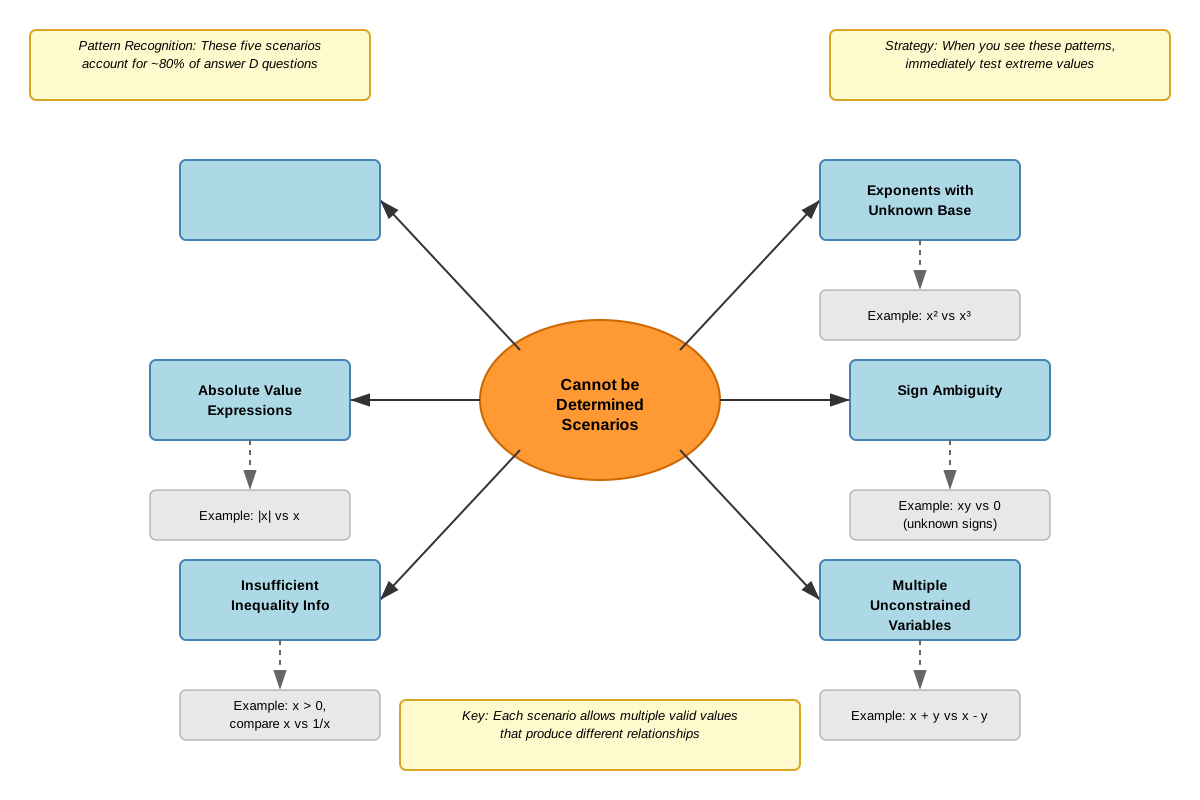
This topic commonly appears in questions involving: variables without sufficient constraints, expressions with unknown signs, geometric figures not drawn to scale with variable dimensions, data sufficiency scenarios with multiple possible values, and problems involving inequalities where the direction of relationships can reverse. Questions may present algebraic expressions with multiple variables, comparison of exponents with unknown bases, or scenarios where the relative magnitude of quantities depends on whether variables are positive, negative, fractional, or zero.
Core Concepts
The Fundamental Principle of Indeterminacy
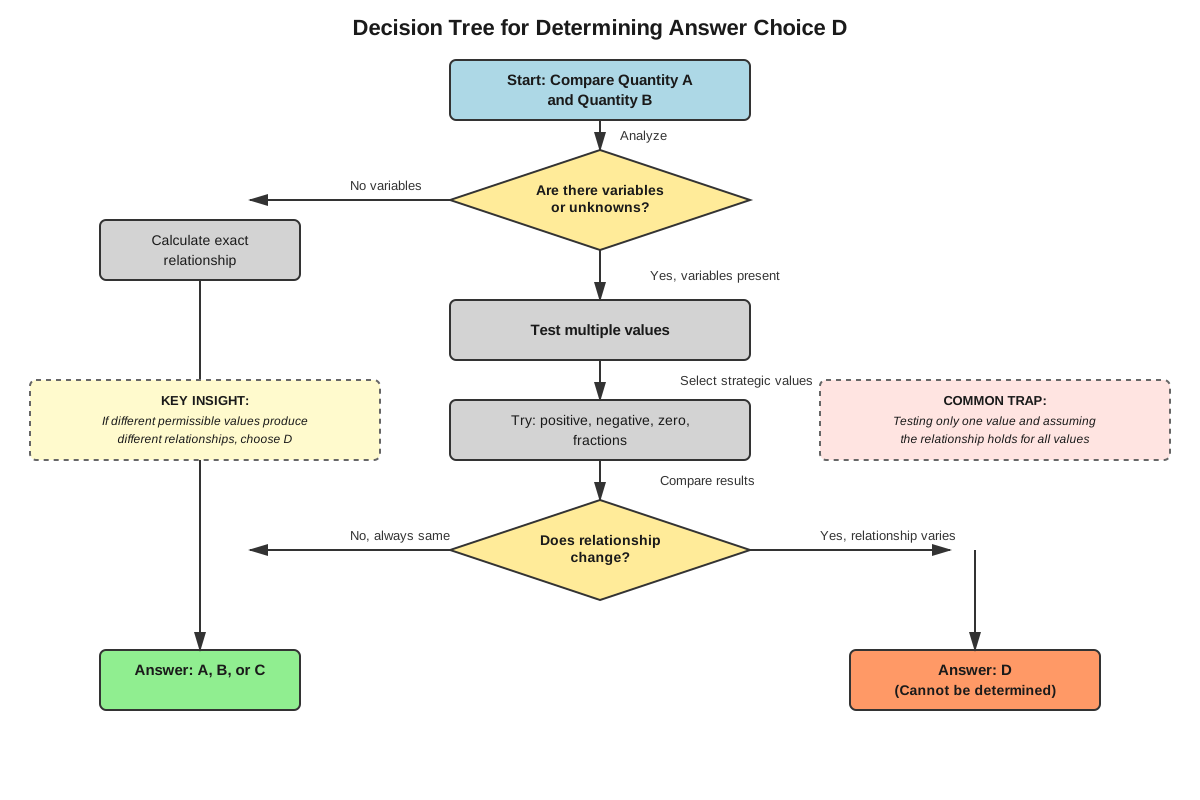
The relationship cannot be determined when the comparison between Quantity A and Quantity B yields different results depending on which permissible values are assigned to variables or which valid scenarios are considered. The key insight is that for answers A, B, or C to be correct, the relationship must hold true for ALL possible values within the given constraints. If even one legitimate counterexample produces a different relationship, the answer must be D.
This principle requires testing multiple strategic values rather than relying on a single calculation. Students must actively search for scenarios that might change the relationship, particularly focusing on special cases: positive versus negative values, values greater than versus less than 1, zero (when permissible), and extreme values within any stated constraints.
The Counterexample Strategy
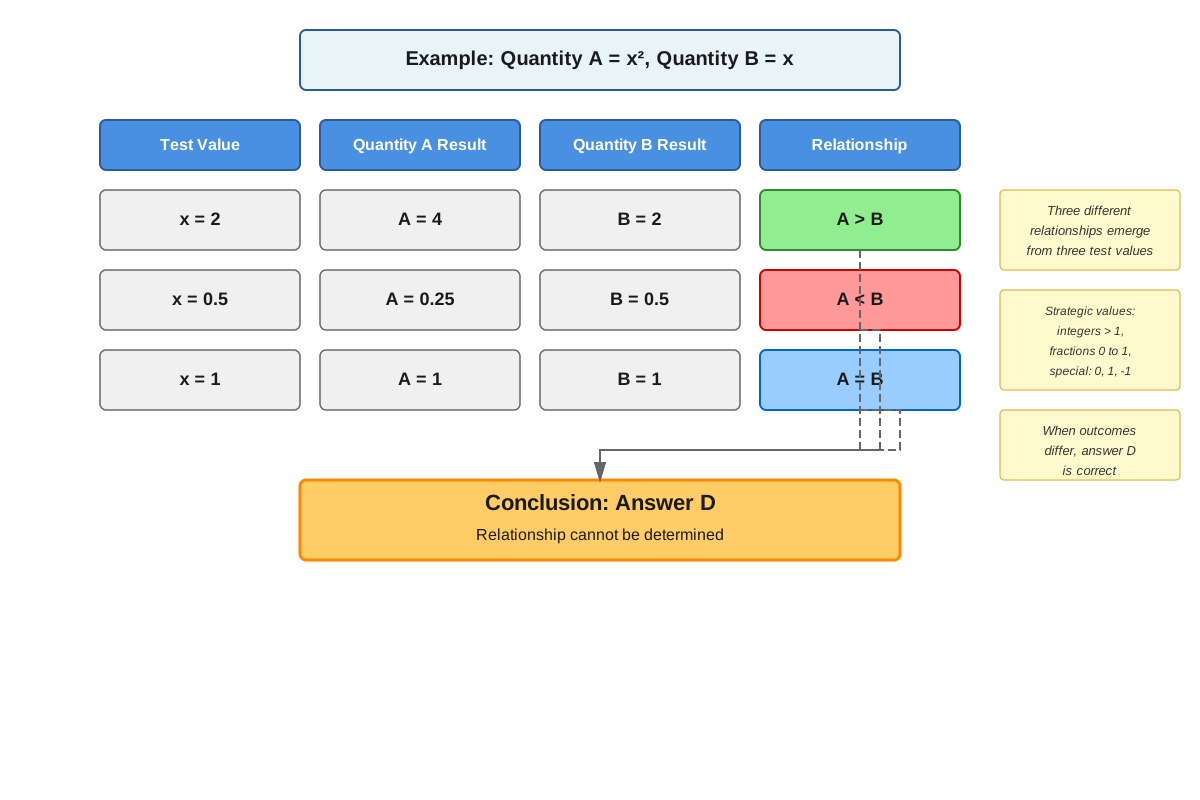
To determine whether a relationship is consistent or variable, employ the counterexample strategy: First, test one set of values and observe which quantity is larger (or if they're equal). Then, deliberately select different values—particularly those with different properties—and check whether the same relationship holds. If the second test produces a different outcome, the relationship cannot be determined.
For example, if testing x = 2 shows Quantity A > Quantity B, but testing x = -2 shows Quantity B > Quantity A, then the answer is definitively D. The counterexample proves that no single relationship (A, B, or C) consistently describes the comparison across all permissible values.
Variable Constraints and Their Impact
The presence or absence of constraints on variables fundamentally determines whether relationships can be established. Consider these scenarios:
| Constraint Type | Example | Impact on Determinacy |
|---|---|---|
| No constraints | x is a real number | High likelihood of indeterminacy; test positive, negative, zero, fractions |
| Partial constraints | x > 0 | Reduces scenarios but may still allow indeterminacy; test values like 0.5 and 10 |
| Full constraints | x = 5 | Eliminates indeterminacy; relationship can be calculated definitively |
| Inequality constraints | -3 < x < 2 | Test boundary behavior and values on both sides of critical points like 0 and 1 |
When variables appear without explicit constraints, assume they can take any real number value unless context implies otherwise. This assumption is crucial for identifying indeterminate relationships.
Critical Test Values
Certain values are particularly powerful for revealing indeterminate relationships:
- Zero: Often produces dramatically different results, especially in multiplication, division, or exponent scenarios
- One: Critical for exponents and multiplicative comparisons; behaviors change around this value
- Negative one: Combines properties of negative numbers with the magnitude of one
- Positive and negative versions of the same magnitude: Tests sign-dependent behavior (e.g., 2 and -2)
- Fractions between 0 and 1: Reveal counterintuitive behaviors in exponents and products
- Large positive and negative values: Test extreme behavior and asymptotic relationships
Sign Ambiguity and Algebraic Expressions
When variables can be positive or negative, algebraic operations may produce relationships that reverse direction. Consider comparing x² and x³:
- If x = 2: x² = 4 and x³ = 8, so x³ > x²
- If x = 0.5: x² = 0.25 and x³ = 0.125, so x² > x³
- If x = -2: x² = 4 and x³ = -8, so x² > x³
The relationship changes based on whether x is greater than 1, between 0 and 1, or negative. Without constraints specifying x's range, the relationship cannot be determined.
The "Always, Sometimes, Never" Framework
Apply this mental framework to every Quantitative Comparison question:
- Always: Does Quantity A always exceed Quantity B (or vice versa) for every permissible value? If yes, choose A or B.
- Sometimes: Does the relationship change depending on which values are used? If yes, choose D.
- Never: This applies when considering whether equality always holds (choice C) or whether a particular relationship never occurs.
The question fundamentally asks: "Is this relationship constant or variable?" If variable, the answer is D.
Geometric Figures and "Not Drawn to Scale"
When geometric figures appear with the warning "Figure not drawn to scale" and contain variables or insufficient constraints, the relationship often cannot be determined. The figure provides a visual reference but should not be trusted for relative magnitudes. Test whether the given constraints allow the figure to be reconfigured in ways that change the relationship between the quantities.
Concept Relationships
The core concepts within this topic form a logical progression: The fundamental principle of indeterminacy establishes the theoretical foundation—that variable relationships require consistency across all scenarios. This principle necessitates the counterexample strategy, which provides the practical method for testing consistency. The effectiveness of the counterexample strategy depends on understanding variable constraints, which determine the range of values to test. Knowing which critical test values to select makes the counterexample strategy efficient and reliable. Sign ambiguity represents a specific application of these principles to algebraic expressions, while the "always, sometimes, never" framework provides a mental model that synthesizes all previous concepts into a decision-making process.
This topic connects to prerequisite knowledge of algebra (manipulating expressions with variables), number properties (understanding how different types of numbers behave), and inequalities (recognizing constraint boundaries). It also relates to broader Quantitative Reasoning skills like logical reasoning, proof by counterexample, and systematic case analysis. Mastery of "Cannot be determined" enhances performance on other question types by developing the habit of testing multiple scenarios rather than assuming patterns from single examples.
The relationship map: Indeterminacy Principle → requires → Counterexample Strategy → depends on → Variable Constraints → guides selection of → Critical Test Values → reveals → Sign Ambiguity → all synthesized by → Always/Sometimes/Never Framework → produces → Correct Answer Selection
Quick check — test yourself on Cannot be determined so far.
Try Flashcards →High-Yield Facts
⭐ The relationship cannot be determined when different permissible values for variables produce different relationships between Quantity A and Quantity B
⭐ Always test at least two strategically different values: one positive and one negative, or one fraction and one integer greater than 1
⭐ Zero is a critical test value that often reveals indeterminate relationships, especially in products, quotients, and exponents
⭐ If a question contains variables without explicit constraints, assume they can be any real number (positive, negative, zero, or fractional)
⭐ For answer choices A, B, or C to be correct, the relationship must hold for ALL possible values, not just some values
- When comparing expressions with exponents and unconstrained variables, test values greater than 1, between 0 and 1, and negative values
- The phrase "Figure not drawn to scale" combined with variable dimensions often signals a potential "Cannot be determined" answer
- Testing x = 1 is particularly useful for exponent comparisons because many expressions equal 1 when the base is 1
- If you can find even one counterexample that produces a different relationship, the answer must be D
- Questions with multiple variables and no equations relating them frequently cannot be determined
Common Misconceptions
Misconception: If one test value shows Quantity A is greater, then Quantity A is always greater. → Correction: A single test case does not prove a relationship holds universally. You must test multiple strategically different values to confirm consistency. One positive result does not eliminate the possibility of counterexamples.
Misconception: Variables without stated constraints must be positive integers. → Correction: Unless explicitly stated or clearly implied by context (like "number of people"), variables can be any real number including negative values, zero, and fractions. Always consider the full range of possibilities.
Misconception: If the quantities look equal for the values you tested, the answer is C. → Correction: Equality must hold for ALL permissible values. Test additional values, especially special cases like 0, 1, and -1, to verify that equality is constant rather than coincidental for your chosen test values.
Misconception: Geometric figures drawn to scale accurately represent the relative sizes of quantities. → Correction: When figures are labeled "not drawn to scale" or contain variables, visual appearance is unreliable. The figure shows topology and relationships but not accurate proportions. Always work from given constraints, not visual estimation.
Misconception: Complex algebraic manipulation will always reveal a definitive relationship. → Correction: Sometimes algebraic simplification helps, but when variables remain with insufficient constraints, no amount of manipulation will eliminate indeterminacy. Recognize when testing values is more efficient than algebraic approaches.
Worked Examples
Example 1: Algebraic Expression with Unconstrained Variable
Question:
- Quantity A: x² - 4
- Quantity B: x - 2
Solution:
Step 1: Identify that x has no stated constraints, so it can be any real number.
Step 2: Test a positive value. Let x = 3:
- Quantity A: 3² - 4 = 9 - 4 = 5
- Quantity B: 3 - 2 = 1
- Result: Quantity A > Quantity B
Step 3: Test a different value to check consistency. Let x = 0:
- Quantity A: 0² - 4 = -4
- Quantity B: 0 - 2 = -2
- Result: Quantity B > Quantity A (since -2 > -4)
Step 4: We found a counterexample. When x = 3, Quantity A is greater, but when x = 0, Quantity B is greater.
Answer: D (The relationship cannot be determined)
Connection to Learning Objectives: This example demonstrates identifying when "Cannot be determined" is being tested (unconstrained variable), applying the counterexample strategy (testing multiple values), and constructing effective counterexamples (choosing 3 and 0 to reveal different relationships).
Example 2: Exponent Comparison with Sign Ambiguity
Question:
Given: n ≠ 0
- Quantity A: n³
- Quantity B: n⁵
Solution:
Step 1: Note that n can be any non-zero real number (positive or negative, greater than or less than 1).
Step 2: Test n = 2 (positive integer greater than 1):
- Quantity A: 2³ = 8
- Quantity B: 2⁵ = 32
- Result: Quantity B > Quantity A
Step 3: Test n = 0.5 (positive fraction between 0 and 1):
- Quantity A: (0.5)³ = 0.125
- Quantity B: (0.5)⁵ = 0.03125
- Result: Quantity A > Quantity B
Step 4: We found that the relationship reverses depending on whether n is greater than or less than 1.
Answer: D (The relationship cannot be determined)
Alternative approach: We could also test n = -1:
- Quantity A: (-1)³ = -1
- Quantity B: (-1)⁵ = -1
- Result: Equal
Then test n = -2:
- Quantity A: (-2)³ = -8
- Quantity B: (-2)⁵ = -32
- Result: Quantity A > Quantity B (since -8 > -32)
This confirms indeterminacy through a different set of counterexamples.
Connection to Learning Objectives: This example illustrates recognizing critical test values (fractions vs. integers, positive vs. negative), understanding how exponent behavior changes around 1, and explaining the core strategy of testing multiple scenarios to reveal indeterminacy.
Exam Strategy
When approaching Quantitative Comparison questions, immediately scan for variables and their constraints. If you see variables without explicit restrictions, mentally flag the question as a potential "Cannot be determined" scenario. Before performing any calculations, ask: "Could different values for these variables produce different relationships?"
Trigger words and phrases that suggest testing for indeterminacy include: "x is a real number," "n is an integer," figures labeled "not drawn to scale," expressions with multiple unrelated variables, and any scenario where variables appear without equations connecting them. The absence of constraints is itself a trigger—what's NOT stated is as important as what is stated.
Process-of-elimination approach: If you're uncertain, systematically test the critical values (0, 1, -1, 2, 0.5) and document which relationship each produces. If you observe any inconsistency—even once—eliminate choices A, B, and C immediately. You don't need to test every possible value; finding one counterexample is sufficient to prove indeterminacy.
Time allocation: Don't spend excessive time on algebraic manipulation if variables remain unconstrained. Testing 2-3 strategic values typically takes 30-45 seconds and definitively answers the question. If algebraic simplification doesn't eliminate variables or establish clear inequalities within 20 seconds, switch to the testing strategy.
Common trap: The GRE often presents questions where one obvious test value (like x = 2) makes Quantity A appear consistently larger, tempting you to select A. Always test at least one additional value with different properties before committing to A, B, or C. The test-makers deliberately design these questions to reward thorough analysis over hasty pattern recognition.
Memory Techniques
Mnemonic for critical test values: "ZONE-FP" (Zero, One, Negative one, Extreme values, Fractions, Positive/negative pairs)
Visualization strategy: Picture a number line with your variable moving along it. As it moves from negative to positive, passing through critical points (0 and 1), visualize whether the relationship between the quantities stays constant or flips. If you can imagine the relationship changing as the variable moves, the answer is likely D.
Acronym for the decision process: "CAST"
- Constraints: What restrictions exist on variables?
- Assumptions: What am I assuming that isn't stated?
- Scenarios: Have I tested multiple different scenarios?
- Test: Did all scenarios produce the same relationship?
Memory phrase: "One counterexample destroys a universal claim." If you can find even a single case where the relationship differs, you've proven indeterminacy.
Summary
The "Cannot be determined" answer choice in GRE Quantitative Comparison questions tests whether students can recognize when insufficient information prevents establishing a definitive relationship between two quantities. This answer is correct when different permissible values for variables produce different relationships—sometimes Quantity A is larger, sometimes Quantity B is larger, or sometimes they're equal. Mastery requires understanding that answers A, B, and C demand universal consistency across all possible scenarios, while finding even one counterexample proves indeterminacy. The core strategy involves testing multiple strategically selected values, particularly critical cases like zero, one, negative values, and fractions between zero and one. Students must resist the temptation to generalize from single test cases and instead systematically verify whether relationships hold constant or vary. Success on these questions demonstrates sophisticated mathematical reasoning—recognizing the limits of available information and avoiding unwarranted conclusions. This skill appears in approximately 15-20% of Quantitative Comparison questions and significantly impacts overall scores because these questions reward careful analysis over computational speed.
Key Takeaways
- The relationship cannot be determined when different permissible values for variables yield different comparisons between Quantity A and Quantity B
- Always test at least two strategically different values before selecting A, B, or C; one counterexample proves the answer is D
- Critical test values include zero, one, negative one, fractions between 0 and 1, and positive/negative pairs
- Variables without explicit constraints can be any real number—positive, negative, zero, or fractional
- For answers A, B, or C to be correct, the relationship must hold universally for ALL possible values within the given constraints
- Recognize trigger patterns: unconstrained variables, multiple unrelated variables, "not drawn to scale" figures, and expressions where sign matters
- The counterexample strategy is more efficient than extensive algebraic manipulation when variables remain unconstrained
Related Topics
Quantitative Comparison Strategy: Understanding the four answer choices and general approaches to comparing quantities builds the foundation for recognizing when relationships cannot be determined. Mastering "Cannot be determined" enhances overall Quantitative Comparison performance.
Inequalities and Number Properties: Deeper knowledge of how inequalities behave under various operations and how different types of numbers (positive, negative, fractions) interact strengthens the ability to predict when relationships might vary.
Algebraic Manipulation and Simplification: While not always sufficient to resolve indeterminate relationships, strong algebra skills help identify when expressions can be simplified to reveal definitive relationships versus when variables will remain unconstrained.
Exponents and Roots: Many "Cannot be determined" questions involve exponential expressions where behavior changes dramatically based on whether bases are greater than 1, between 0 and 1, or negative. Advanced understanding of exponent properties enhances performance on these questions.
Practice CTA
Now that you understand the principles and strategies for identifying when relationships cannot be determined, it's time to apply this knowledge to authentic GRE-style questions. The practice questions and flashcards will reinforce your ability to recognize indeterminate scenarios, construct effective counterexamples, and avoid common traps. Each practice problem you solve strengthens your pattern recognition and builds the confidence needed to tackle these questions efficiently on test day. Remember: mastery comes from active practice, not passive reading. Challenge yourself to test multiple values systematically and prove to yourself when relationships truly cannot be determined!
Sign up free to keep reading
Create a free AnvayaPrep account to finish this GRE guide on Cannot be determined — plus flashcards and practice questions.