Overview
Always smaller is a critical strategic concept within GRE Quantitative Comparison questions that helps test-takers quickly identify relationships between quantities without performing extensive calculations. This concept refers to situations where one quantity (Quantity A or Quantity B) will consistently be smaller than the other across all possible values of any variables involved. Recognizing these patterns allows students to confidently select an answer even when variables are present, which is often the most challenging aspect of Quantitative Comparison questions.
Understanding when a quantity is always smaller is essential because Quantitative Comparison questions constitute approximately one-third of the Quantitative Reasoning section on the GRE. These questions require a different approach than standard problem-solving questions—they reward pattern recognition and conceptual understanding over computational ability. The "always smaller" strategy is particularly valuable because it helps eliminate answer choice (D) "The relationship cannot be determined from the information given," which students often select incorrectly when they see variables.
This topic connects directly to fundamental algebraic principles, inequality manipulation, and number properties. Mastering the gre always smaller strategy builds upon understanding of positive and negative numbers, absolute values, exponents, and algebraic expressions. It also reinforces critical thinking about mathematical relationships and develops the analytical skills necessary for tackling more complex quantitative reasoning problems throughout the exam.
Learning Objectives
- [ ] Identify when Always smaller is being tested in GRE Quantitative Comparison questions
- [ ] Explain the core rule or strategy behind Always smaller and why it guarantees a definitive answer
- [ ] Apply Always smaller to GRE-style questions accurately and efficiently
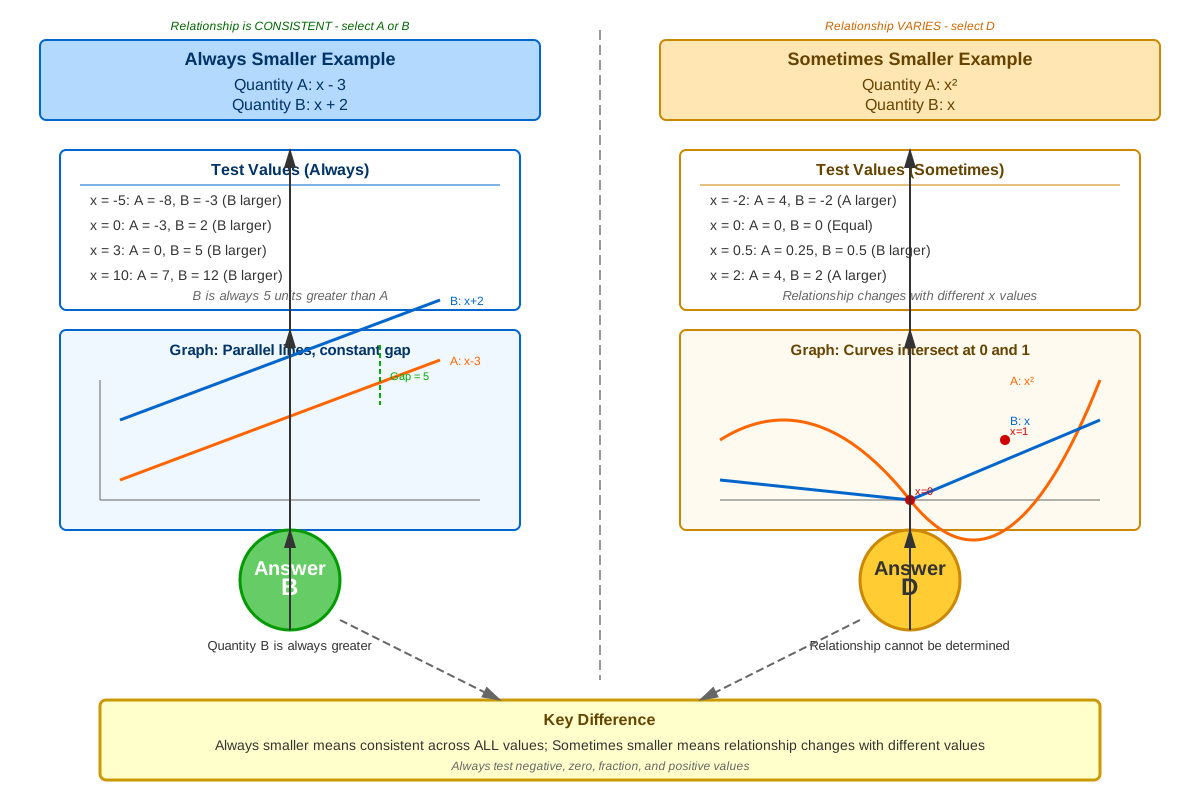
- [ ] Distinguish between situations where a quantity is always smaller versus sometimes smaller
- [ ] Recognize common mathematical structures that produce always-smaller relationships
- [ ] Evaluate expressions with variables to determine if one is consistently smaller across all valid inputs
- [ ] Combine the always-smaller strategy with other quantitative comparison techniques for maximum efficiency
Prerequisites
- Basic algebra and variable manipulation: Essential for understanding how expressions with variables behave across different values and for simplifying comparative expressions
- Understanding of inequalities: Necessary to recognize when one expression is definitively less than another and to manipulate inequality statements correctly
- Number properties (positive, negative, zero): Critical for determining how expressions change value across different number domains and for identifying boundary cases
- Exponent rules: Required to compare expressions involving powers and to understand how exponents affect the magnitude of quantities
- Absolute value concepts: Important for recognizing how absolute values create consistent relationships between quantities
Why This Topic Matters
The always-smaller concept appears in approximately 15-20% of all Quantitative Comparison questions on the GRE, making it one of the highest-yield strategies for this question type. Students who master this concept can save significant time on test day by avoiding unnecessary calculations and can approach variable-based comparison questions with confidence rather than anxiety.
In real-world applications, the logical reasoning behind always-smaller relationships mirrors decision-making processes in fields like economics (comparing costs), engineering (evaluating efficiency), and data science (analyzing bounds and constraints). The ability to determine definitive relationships despite variable conditions is a fundamental analytical skill that extends far beyond standardized testing.
On the GRE, always-smaller scenarios most commonly appear in questions involving: squared terms versus linear terms, absolute values compared to the original expressions, expressions with subtracted positive quantities, negative exponents, and reciprocals of numbers greater than one. These questions typically present two columns (Quantity A and Quantity B) with algebraic expressions, and the test-taker must determine whether one quantity is always greater, always smaller, always equal, or if the relationship cannot be determined. Recognizing always-smaller patterns allows immediate selection of answer choice (B) "Quantity B is greater" without testing multiple values.
Core Concepts
Definition of Always Smaller
A quantity is always smaller than another when, regardless of the values assigned to any variables (within their stated constraints), the first quantity will consistently have a lesser value than the second. This creates a definitive relationship that holds true across the entire domain of possible values. The key distinction is between "always" and "sometimes"—if even one valid value makes the quantities equal or reverses the relationship, then the quantity is not always smaller.
For Quantitative Comparison questions, recognizing an always-smaller relationship means you can confidently select answer choice (B) without testing multiple cases or performing complete calculations. This strategy is particularly powerful when variables are involved, as many students incorrectly assume that the presence of variables automatically means "the relationship cannot be determined."
Mathematical Structures That Create Always-Smaller Relationships
Several common mathematical patterns guarantee that one quantity will always be smaller than another:
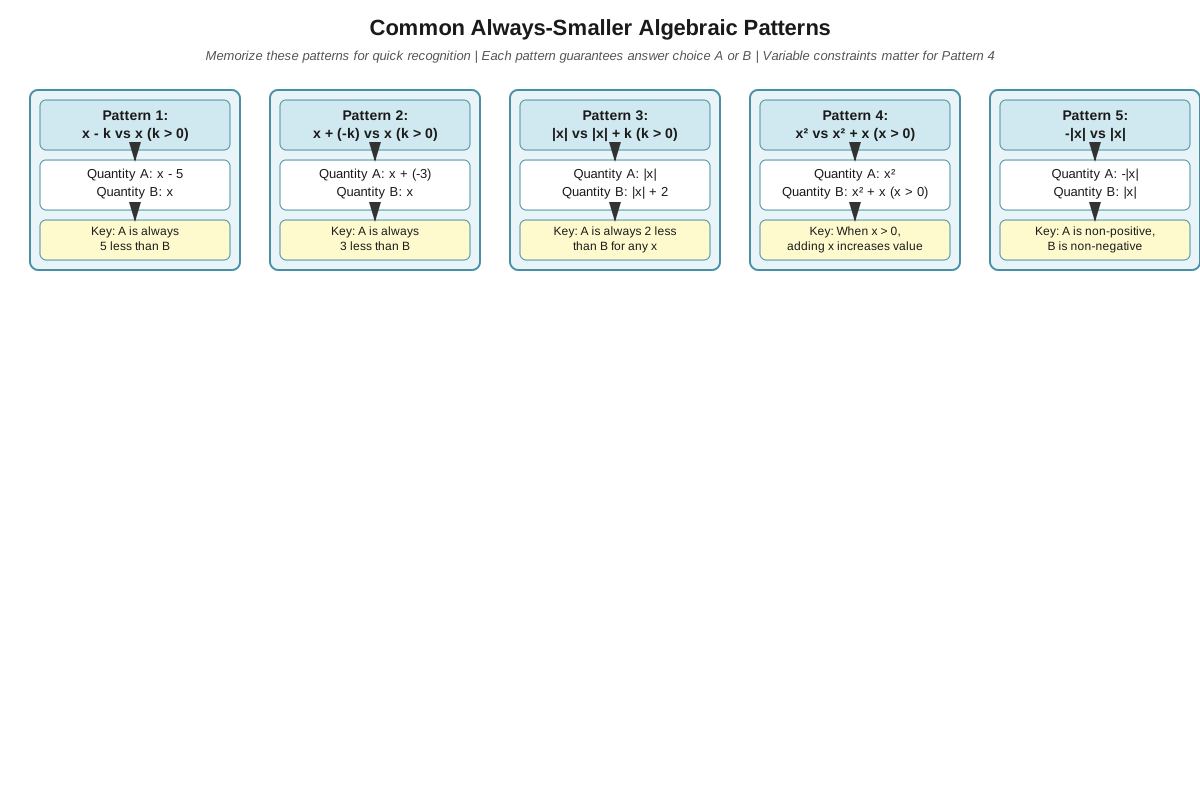
Subtraction of Positive Quantities
When a positive quantity is subtracted from an expression, the result is always smaller than the original expression. For example, if x > 0, then (x - 5) is always smaller than x (assuming x > 5 to keep both quantities positive). More generally:
- Expression - Positive Value < Expression
- x - a < x (when a > 0)
This principle extends to more complex expressions: (x² + 3x - 7) is always smaller than (x² + 3x) because we're subtracting 7.
Squared Terms vs. Absolute Values
For any non-zero value, x² is always greater than or equal to |x|, which means |x| is always smaller than or equal to x². When |x| > 1, we have x² > |x|. When |x| < 1, we have x² < |x|. However, when comparing x² to x for specific domains:
- For x > 1: x² > x (so x is always smaller)
- For 0 < x < 1: x² < x (so x² is always smaller)
- For x < 0: x² > x (so x is always smaller)
Understanding these domain-specific relationships is crucial for identifying always-smaller scenarios.
Negative Exponents and Reciprocals
When comparing a number greater than 1 to its reciprocal, the reciprocal is always smaller:
- For x > 1: 1/x < x
- For x > 1: x⁻¹ < x
This relationship reverses for numbers between 0 and 1, where the reciprocal is larger than the original number.
Absolute Value Comparisons
The absolute value of a number is always greater than or equal to the number itself when the number is negative, and equal when the number is positive:
- For x < 0: x < |x| (x is always smaller)
- For x ≥ 0: x = |x|
Therefore, for any negative number, the number itself is always smaller than its absolute value.
Algebraic Manipulation for Comparison
A powerful technique for identifying always-smaller relationships involves algebraically manipulating the comparison. Instead of comparing Quantity A to Quantity B directly, compare (Quantity A - Quantity B) to zero:
- If (A - B) < 0 for all valid values, then A is always smaller than B
- If (A - B) > 0 for all valid values, then A is always greater than B
- If (A - B) = 0 for all valid values, then A always equals B
- If (A - B) can be positive, negative, or zero depending on values, the relationship cannot be determined
This approach transforms the comparison into a simpler problem of determining the sign of a single expression.
Domain Restrictions and Constraints
Always pay attention to stated constraints on variables, as these dramatically affect whether a quantity is always smaller:
| Constraint | Impact on Relationships |
|---|---|
| x > 0 | Eliminates negative number cases; affects squared vs. linear comparisons |
| x is an integer | Limits possible values; eliminates fractional cases |
| 0 < x < 1 | Reverses typical squared vs. linear relationships |
| x ≥ 1 | Ensures certain inequality directions hold |
| x ≠ 0 | Prevents division by zero; allows reciprocal comparisons |
Testing Critical Values
When uncertain whether a relationship is "always" true, test critical boundary values:
- Zero: Often reveals whether a relationship holds at the boundary
- One: Critical for exponent and reciprocal relationships
- Negative one: Tests behavior with negative values
- Large positive number: Reveals asymptotic behavior
- Small positive fraction (e.g., 0.5): Tests behavior between 0 and 1
If the same relationship holds for all critical values, it likely holds for all values (though this isn't a mathematical proof, it's a practical test-taking strategy).
Concept Relationships
The always-smaller concept builds directly on inequality fundamentals, which provide the mathematical foundation for comparing quantities. Understanding inequalities leads to recognizing algebraic manipulation techniques that simplify comparisons. These manipulation techniques connect to domain analysis, where constraints on variables determine which relationships hold consistently.
Domain analysis → determines valid test values → which inform critical value testing → which confirms always-smaller relationships. Simultaneously, mathematical structure recognition (identifying patterns like subtraction of positives, absolute values, or reciprocals) → enables immediate identification of always-smaller scenarios → which eliminates the need for extensive testing.
The concept also connects to answer choice elimination strategies in Quantitative Comparison: recognizing an always-smaller relationship immediately eliminates choices (A), (C), and (D), leaving only (B) as correct. This relationship between concept recognition and strategic elimination is fundamental to efficient GRE test-taking.
Furthermore, always-smaller analysis relates to function behavior and number properties: understanding how functions behave across domains (increasing, decreasing, bounded) helps predict when one expression will consistently dominate another. The concept also reinforces logical reasoning: the difference between "always," "sometimes," and "never" is a fundamental logical distinction that appears throughout quantitative reasoning.
High-Yield Facts
⭐ A quantity with a positive value subtracted is always smaller than the original quantity: x - a < x when a > 0
⭐ For any negative number x, the number itself is always smaller than its absolute value: x < |x| when x < 0
⭐ For numbers greater than 1, the reciprocal is always smaller than the original number: 1/x < x when x > 1
⭐ When comparing expressions with variables, if (A - B) is always negative, then A is always smaller than B
⭐ The presence of variables does NOT automatically mean "the relationship cannot be determined"—many variable expressions have definitive relationships
- For x > 1, x² is always greater than x, meaning x is always smaller than x²
- For 0 < x < 1, x² is always smaller than x
- Adding a positive quantity to an expression makes it larger; subtracting makes it smaller
- If an expression can be proven algebraically to always be negative, it's always smaller than zero
- When both quantities have the same variable terms but different constants, the one with the smaller constant is always smaller
- For x < -1, x² is always greater than x (since x² is positive and x is negative)
- The square of any real number is always greater than or equal to zero, so negative numbers are always smaller than any squared expression
- When comparing a/b to a/c where a > 0 and b > c > 0, a/b is always greater than a/c (so a/c is always smaller)
Quick check — test yourself on Always smaller so far.
Try Flashcards →Common Misconceptions
Misconception: If a question contains variables, the answer must be (D) "The relationship cannot be determined."
Correction: Many expressions with variables have definitive relationships that hold for all valid values. Variables only make the relationship indeterminate when different values produce different comparative results. Always test critical values and look for algebraic patterns before assuming indeterminacy.
Misconception: x² is always greater than x for any value of x.
Correction: This relationship depends on the domain. For x > 1, x² > x is true. For 0 < x < 1, x² < x (the squared value is smaller). For x < 0, x² > x because x² is positive while x is negative. Always consider the domain constraints given in the problem.
Misconception: If Quantity A is smaller than Quantity B for one test value, then A is always smaller than B.
Correction: Testing a single value only shows the relationship for that specific case. To prove "always smaller," you must either test all critical values (including boundaries and different domains) or use algebraic proof to show the relationship holds universally. One confirming case is not sufficient.
Misconception: Absolute value always makes a number larger.
Correction: Absolute value makes negative numbers larger (less negative, actually positive), but leaves positive numbers unchanged. For x ≥ 0, |x| = x. The absolute value is the distance from zero, so it's always non-negative, but it doesn't increase positive values.
Misconception: When comparing fractions with variables, the fraction with the larger denominator is always smaller.
Correction: This is only true when the numerators are equal and positive, and the denominators are positive. If numerators differ, or if signs are involved, the relationship can change. For example, -1/5 > -1/3 even though 5 > 3, because both fractions are negative.
Misconception: Subtracting a variable always makes an expression smaller.
Correction: Subtracting a positive value makes an expression smaller, but subtracting a negative value (which is equivalent to adding a positive value) makes it larger. The expression x - y is only definitely smaller than x when y is constrained to be positive.
Worked Examples
Example 1: Absolute Value Comparison
Question:
Quantity A: x (where x < 0)
Quantity B: |x|
Solution:
Step 1: Identify the constraint. We're told that x < 0, meaning x is negative.
Step 2: Understand what absolute value means. The absolute value |x| represents the distance from zero, which is always non-negative. For a negative number, |x| = -x (the opposite of x).
Step 3: Compare the quantities. Since x is negative, it's some value less than zero (like -5, -10, -0.3, etc.). The absolute value |x| is the positive version of that number (5, 10, 0.3, etc.).
Step 4: Test critical values to confirm:
- If x = -1: Quantity A = -1, Quantity B = 1 → B is greater
- If x = -100: Quantity A = -100, Quantity B = 100 → B is greater
- If x = -0.01: Quantity A = -0.01, Quantity B = 0.01 → B is greater
Step 5: Algebraic reasoning. For any x < 0, we know x is negative and |x| is positive. Any negative number is less than any positive number, so x < |x| for all x < 0.
Conclusion: Quantity A is always smaller than Quantity B. The answer is (B).
Connection to Learning Objectives: This example demonstrates identifying when always-smaller is being tested (absolute value with domain restriction), explaining the core rule (negative numbers are always less than their absolute values), and applying it to reach a definitive answer.
Example 2: Algebraic Expression with Subtraction
Question:
Quantity A: x² + 5x - 3
Quantity B: x² + 5x + 2
Solution:
Step 1: Observe the structure. Both quantities have identical terms (x² + 5x) but different constants.
Step 2: Use the subtraction method. Calculate (Quantity A - Quantity B):
(x² + 5x - 3) - (x² + 5x + 2) = x² + 5x - 3 - x² - 5x - 2 = -5
Step 3: Analyze the result. The difference is -5, which is always negative regardless of the value of x.
Step 4: Interpret the result. Since (A - B) = -5 < 0 for all values of x, we know A < B for all values of x.
Step 5: Verify with test values (optional but recommended):
- If x = 0: A = -3, B = 2 → B is greater
- If x = 1: A = 1 + 5 - 3 = 3, B = 1 + 5 + 2 = 8 → B is greater
- If x = -2: A = 4 - 10 - 3 = -9, B = 4 - 10 + 2 = -4 → B is greater
Conclusion: Quantity A is always smaller than Quantity B by exactly 5 units. The answer is (B).
Connection to Learning Objectives: This example shows how to apply algebraic manipulation to identify always-smaller relationships, demonstrates the subtraction technique for comparing quantities, and illustrates how identical variable terms cancel out to reveal constant differences.
Example 3: Reciprocal Comparison with Domain Constraint
Question:
Quantity A: x (where x > 2)
Quantity B: 1/x
Solution:
Step 1: Identify the constraint. We know x > 2, meaning x is greater than 2 (could be 2.1, 3, 100, etc.).
Step 2: Understand reciprocal behavior. For numbers greater than 1, the reciprocal is smaller than the original number. Since x > 2, we definitely have x > 1.
Step 3: Test critical values:
- If x = 2: A = 2, B = 1/2 = 0.5 → A is greater (so B is smaller)
- If x = 3: A = 3, B = 1/3 ≈ 0.33 → A is greater (so B is smaller)
- If x = 10: A = 10, B = 1/10 = 0.1 → A is greater (so B is smaller)
Step 4: Algebraic reasoning. For x > 2, we can multiply both sides of the inequality x > 1/x by x (which is positive, so the inequality direction is preserved): x² > 1, which simplifies to x² > 1. Since x > 2, we have x² > 4 > 1, confirming x > 1/x.
Step 5: Consider the pattern. As x increases beyond 2, the gap between x and 1/x grows larger (x increases while 1/x decreases toward zero).
Conclusion: Quantity B (1/x) is always smaller than Quantity A (x) for all x > 2. The answer is (A), meaning Quantity A is greater.
Note: While this example shows Quantity B is always smaller, it demonstrates the same analytical process used to identify always-smaller relationships.
Exam Strategy
Trigger Words and Phrases
Watch for these indicators that an always-smaller question may be present:
- Domain restrictions: "where x > 0," "for all positive integers," "when x < -1"
- Absolute value symbols: |x|, |y|, or any expression within absolute value bars
- Subtraction of constants: Expressions that differ only by added or subtracted numbers
- Reciprocals: 1/x, x⁻¹, or fractions with variables in denominators
- Squared terms: x², y², especially when compared to linear terms
- "For all values": Suggests testing whether a relationship holds universally
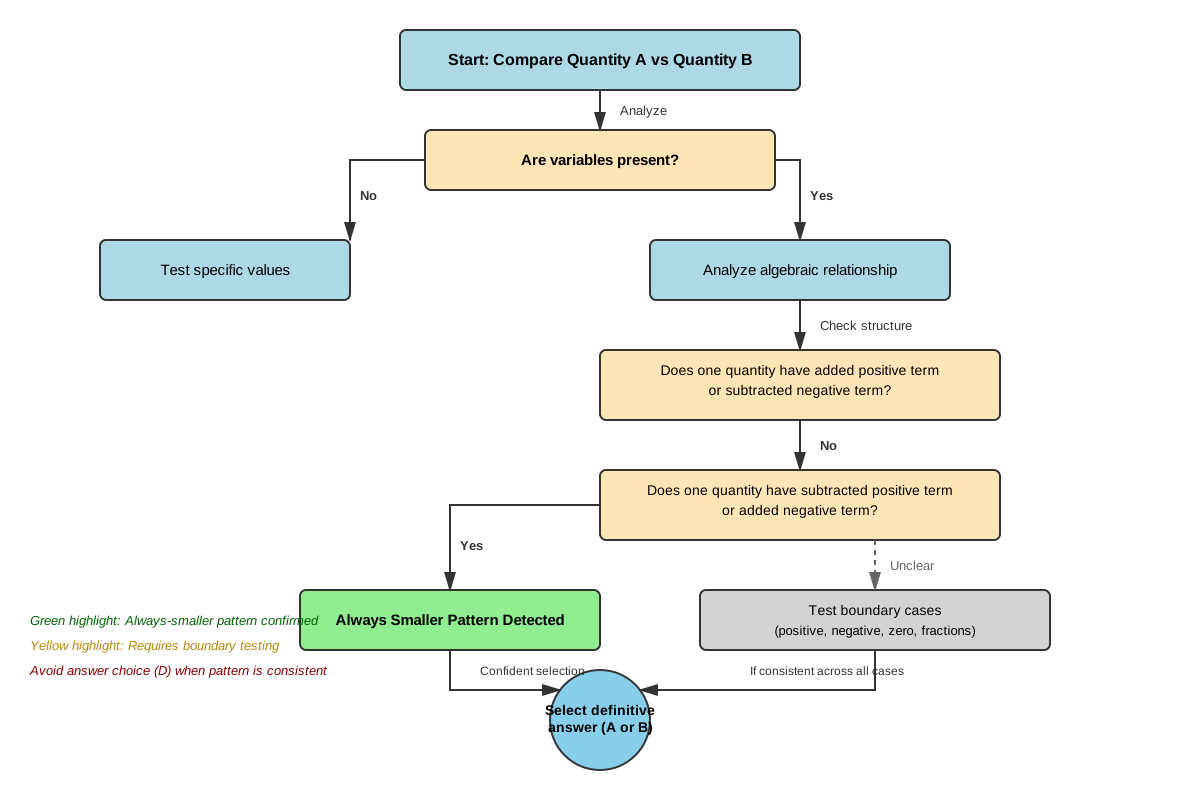
Systematic Approach
- Read constraints carefully (5 seconds): Note any restrictions on variables before comparing quantities
- Look for structural patterns (10 seconds): Identify if the quantities match any always-smaller templates
- Use algebraic subtraction (15 seconds): Calculate (A - B) and determine if it's always positive, always negative, or variable
- Test critical values if uncertain (20 seconds): Try x = 0, 1, -1, 0.5, and a large number
- Eliminate impossible answers (5 seconds): If you've found the relationship for all test cases, eliminate accordingly
Exam Tip: If you can prove algebraically that (A - B) is always negative, you've proven A is always smaller than B. This is faster and more reliable than testing multiple values.
Process of Elimination
- If testing one value shows A > B and another value shows A < B, immediately select (D) "cannot be determined"
- If all tested values show the same relationship AND the algebraic structure supports it, eliminate (D)
- When you see identical variable terms with different constants, the relationship is definitive—eliminate (D)
- If the problem involves only constants (no variables), the relationship is always definitive—eliminate (D)
Time Allocation
Quantitative Comparison questions should take 60-90 seconds each. For always-smaller questions:
- Simple structural recognition (e.g., x vs. x - 3): 30-45 seconds
- Absolute value or reciprocal comparisons: 45-60 seconds
- Complex algebraic expressions: 60-90 seconds
If you're spending more than 90 seconds, make your best educated guess and move on. The always-smaller strategy should save time, not consume it.
Common Traps to Avoid
- Don't assume variables mean indeterminate relationships
- Don't test only positive integers if the domain includes fractions or negative numbers
- Don't forget that squaring negative numbers produces positive results
- Don't confuse "always smaller" with "sometimes smaller"—one counterexample breaks the "always" claim
Memory Techniques
The SAND Mnemonic
Subtraction of positives makes things Smaller
Absolute values of negatives are larger (so negatives are smaller)
Negative exponents create reciprocals (smaller for numbers > 1)
Difference method: subtract quantities to find the sign
Visualization Strategy
Picture a number line when comparing quantities. For x < 0 compared to |x|, visualize:
<----[-5]----[-3]----[-1]----[0]----[1]----[3]----[5]---->
     x (negative)              |x| (positive)
The negative value (x) is always to the left (smaller) than its positive absolute value.
The "Subtract and Sign" Rule
When comparing two quantities, remember: "Subtract to find the sign, the sign tells the size."
- If (A - B) is always negative → A is always smaller
- If (A - B) is always positive → A is always greater
- If (A - B) is always zero → A always equals B
- If (A - B) changes sign → relationship cannot be determined
Domain Dependency Rhyme
"Greater than one, squared is more fun (x² > x)
Between zero and one, squared is less done (x² < x)
Less than zero, squared is a hero (x² > x, since x² is positive)"
Summary
The always smaller concept is a high-yield strategy for GRE Quantitative Comparison questions that enables test-takers to identify definitive relationships between quantities even when variables are present. A quantity is always smaller when it consistently has a lesser value than another quantity across all valid values within the stated domain. Key patterns that create always-smaller relationships include subtraction of positive quantities, absolute values compared to negative numbers, reciprocals of numbers greater than one, and expressions that differ only by constant terms. The most powerful technique for identifying these relationships is algebraic subtraction: if (Quantity A - Quantity B) is always negative, then A is always smaller than B. Critical to success is careful attention to domain restrictions, testing of boundary values (0, 1, -1, fractions, large numbers), and recognition that variables do not automatically make relationships indeterminate. Mastering this concept allows students to confidently select definitive answers on approximately 15-20% of Quantitative Comparison questions, saving valuable time and improving accuracy on one of the GRE's most challenging question types.
Key Takeaways
- Always smaller means the relationship holds for ALL valid values, not just some values—one counterexample breaks the "always" claim
- Subtract quantities algebraically: if (A - B) < 0 for all values, then A is always smaller than B
- Common always-smaller patterns: x - (positive) < x; negative numbers < their absolute values; reciprocals < original numbers when original > 1
- Domain restrictions are critical: x² > x when x > 1, but x² < x when 0 < x < 1—always check constraints
- Test critical values systematically: 0, 1, -1, 0.5, and large numbers reveal most relationship patterns
- Variables don't mean indeterminate: many variable expressions have definitive relationships that hold universally
- Structural recognition saves time: identical terms with different constants create definitive relationships immediately
Related Topics
Quantitative Comparison Strategies: Mastering always-smaller is one component of a comprehensive approach to Quantitative Comparison questions, which also includes always-equal, always-greater, and truly indeterminate relationships.
Inequality Manipulation: Understanding how to add, subtract, multiply, and divide inequalities while preserving or reversing their direction builds directly on always-smaller concepts.
Function Behavior and Domain Analysis: Recognizing how functions behave across different domains (increasing, decreasing, bounded) extends the always-smaller concept to more complex mathematical relationships.
Number Properties and Special Cases: Deep understanding of how different types of numbers (integers, fractions, negatives, irrationals) behave under various operations enhances always-smaller analysis.
Algebraic Expression Simplification: The ability to manipulate and simplify complex expressions is essential for applying the subtraction method to identify always-smaller relationships.
Practice CTA
Now that you've mastered the always-smaller concept, it's time to cement your understanding through practice. Attempt the practice questions designed specifically for this topic—they'll challenge you to recognize patterns, apply algebraic techniques, and make confident decisions under time pressure. Use the flashcards to reinforce the key patterns and critical values that appear most frequently on the GRE. Remember, recognizing always-smaller relationships can save you 30-45 seconds per question, giving you more time for challenging problem-solving questions. Your investment in mastering this high-yield strategy will pay dividends on test day!
Sign up free to keep reading
Create a free AnvayaPrep account to finish this GRE guide on Always smaller — plus flashcards and practice questions.