Overview
Geometric comparison represents one of the most frequently tested question types within the GRE Quantitative Reasoning section, specifically appearing in the Quantitative Comparison format. This question type challenges test-takers to evaluate two geometric quantities—such as areas, perimeters, angles, or volumes—and determine their relative relationship without necessarily calculating exact values. The strategic importance of mastering GRE geometric comparison cannot be overstated: these questions reward spatial reasoning, estimation skills, and the ability to recognize when figures are deliberately drawn to mislead or when they're explicitly labeled "not drawn to scale."
Unlike traditional problem-solving questions that require a single numerical answer, geometric comparison questions demand a different cognitive approach. Students must develop the ability to compare quantities efficiently, often using properties of shapes, theorems, and logical reasoning rather than extensive calculations. This skill set directly aligns with the GRE's emphasis on analytical thinking and mathematical reasoning over rote computation. The ability to quickly assess geometric relationships under time pressure distinguishes high-scoring test-takers from average performers.
Within the broader Quantitative Reasoning framework, geometric comparison serves as a bridge between pure geometry knowledge and quantitative comparison strategy. It requires synthesizing multiple mathematical domains: understanding geometric properties, applying algebraic relationships, recognizing special cases, and employing comparison techniques. Success in this area builds confidence across the entire Quantitative Comparison question type while reinforcing fundamental geometric principles that appear throughout the GRE mathematics section.
Learning Objectives
- [ ] Identify when Geometric comparison is being tested in Quantitative Comparison questions
- [ ] Explain the core rule or strategy behind Geometric comparison, including when to calculate versus estimate
- [ ] Apply Geometric comparison to GRE-style questions accurately and efficiently
- [ ] Distinguish between figures drawn to scale and those explicitly labeled otherwise
- [ ] Recognize special cases and extreme values that affect geometric relationships
- [ ] Evaluate multiple geometric properties simultaneously to determine quantity relationships
- [ ] Avoid common traps involving visual assumptions and incomplete information
Prerequisites
- Basic geometric formulas: Understanding area, perimeter, circumference, and volume formulas is essential for comparing geometric quantities
- Properties of triangles, circles, and quadrilaterals: Knowledge of angle relationships, special triangles, and shape characteristics enables quick property identification
- Coordinate geometry fundamentals: Distance, slope, and midpoint concepts help when geometric figures appear on coordinate planes
- Quantitative Comparison format: Familiarity with the four answer choices (A: Quantity A is greater, B: Quantity B is greater, C: The two quantities are equal, D: The relationship cannot be determined) is necessary
- Algebraic manipulation: Basic equation solving and inequality reasoning support cases where geometric relationships require algebraic expression
Why This Topic Matters
Geometric comparison questions appear with remarkable consistency on the GRE, typically comprising 15-20% of all Quantitative Comparison questions and 8-12% of the entire Quantitative Reasoning section. This frequency makes geometric comparison a high-yield study area where focused preparation directly translates to score improvement. The Educational Testing Service (ETS) deliberately includes these questions because they efficiently assess multiple competencies simultaneously: geometric knowledge, spatial reasoning, logical analysis, and strategic thinking.
In real-world applications, the skills developed through geometric comparison extend far beyond standardized testing. Architects compare spatial relationships when designing buildings, engineers evaluate structural dimensions without precise measurements, data scientists visualize multidimensional relationships, and business analysts assess proportional changes in graphical data. The ability to make accurate comparative judgments about geometric quantities without exhaustive calculation represents a practical cognitive skill applicable across STEM fields, design disciplines, and analytical professions.
On the GRE specifically, geometric comparison questions appear in several distinct formats: comparing areas of overlapping shapes, evaluating angle measures in complex figures, assessing perimeters when dimensions change, comparing volumes of three-dimensional objects, and analyzing geometric properties on coordinate planes. These questions frequently incorporate variables, creating scenarios where the relationship between quantities depends on the value of the variable—a deliberate test of whether students recognize when "the relationship cannot be determined from the information given" (answer choice D).
Core Concepts
Understanding the Geometric Comparison Framework
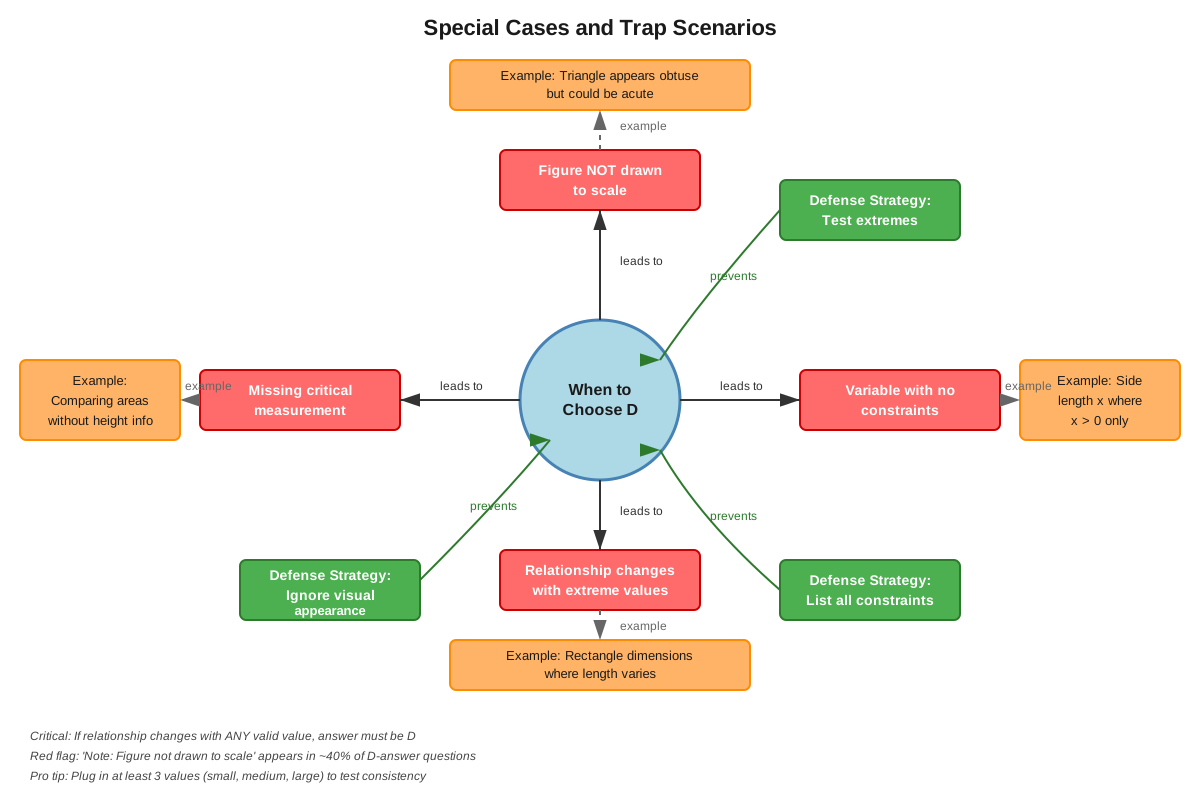
The fundamental principle underlying all geometric comparison questions is that test-takers must establish a relationship between two geometric quantities without necessarily computing exact values. This approach differs markedly from standard problem-solving questions. The four possible relationships—Quantity A greater, Quantity B greater, quantities equal, or relationship indeterminate—require different levels of certainty. Selecting A, B, or C demands absolute confidence that the relationship holds for all permissible values, while selecting D requires demonstrating that the relationship varies depending on specific values or conditions.
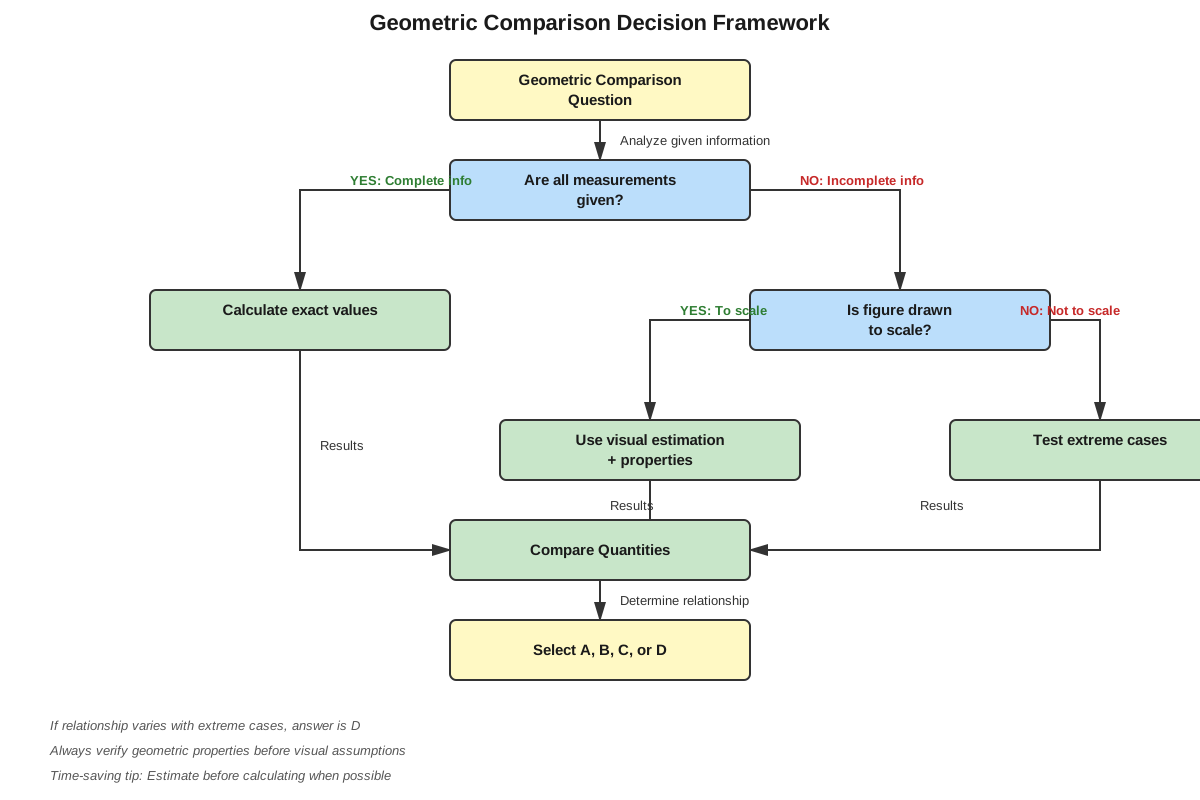
When approaching geometric comparison questions, the strategic decision tree begins with assessing whether sufficient information exists to determine a definite relationship. Questions involving variables require particular scrutiny: test different values (positive, negative, zero, fractions, large numbers) to see if the relationship remains constant. If the relationship changes based on the variable's value, answer D is correct. If the relationship holds across all tested values, further analysis or proof confirms A, B, or C.
Key Geometric Properties for Comparison
Several geometric properties appear repeatedly in comparison questions and warrant memorization:
Triangle Properties:
- The sum of any two sides must exceed the third side (triangle inequality)
- The largest angle lies opposite the longest side
- Area = (1/2) × base × height, regardless of triangle type
- In right triangles, the hypotenuse is always the longest side
- Equilateral triangles have all sides equal and all angles measuring 60°
Circle Properties:
- Circumference = 2πr and Area = πr²
- The ratio of circumference to diameter is always π
- A circle's area increases with the square of the radius
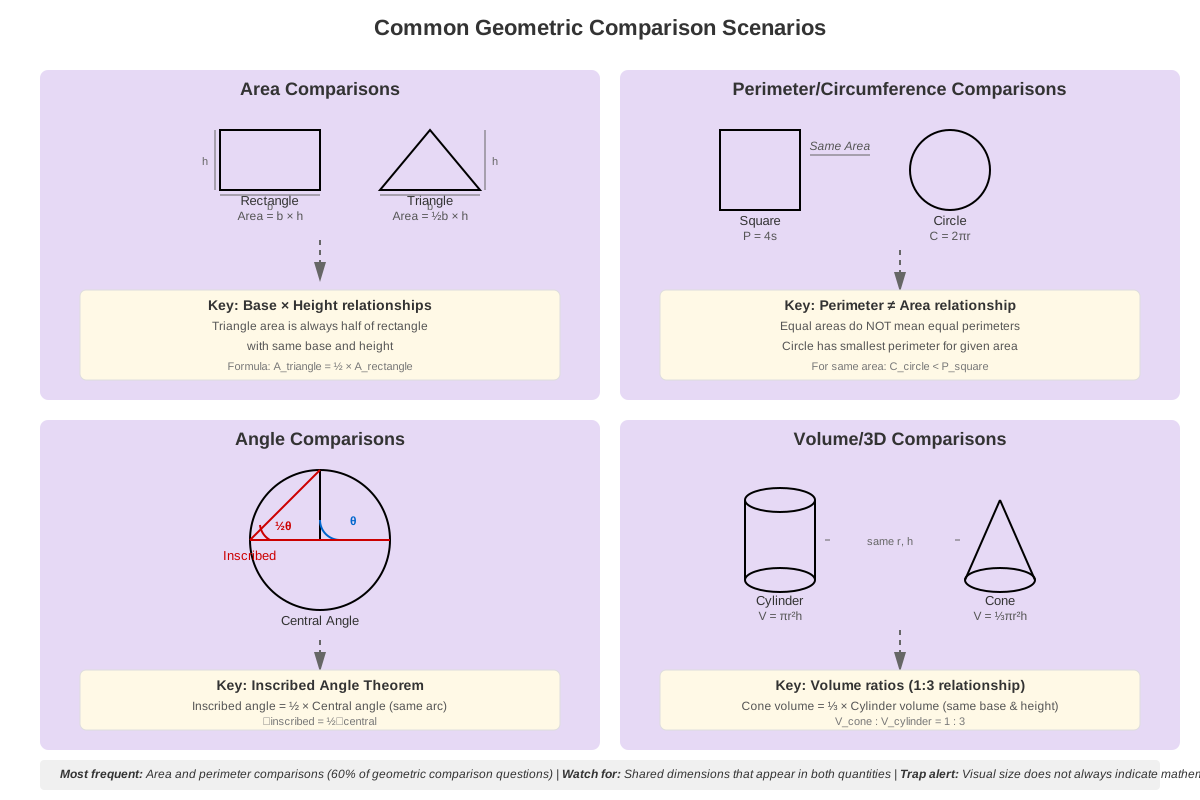
- Inscribed angles subtending the same arc are equal
- A diameter divides a circle into two equal semicircles
Rectangle and Square Properties:
- For a fixed perimeter, the square has maximum area
- Area = length × width; Perimeter = 2(length + width)
- Diagonals of a rectangle are equal; diagonals of a square are equal and perpendicular
- Doubling all dimensions quadruples the area
Comparison-Specific Principles:
- When comparing areas, consider how dimensions scale (linear changes produce quadratic area changes)
- When comparing perimeters, remember that different shapes with equal areas have different perimeters
- Angles in geometric figures sum predictably (triangles: 180°, quadrilaterals: 360°)
Strategic Approaches to Geometric Comparison
| Strategy | When to Use | Example Application |
|---|---|---|
| Direct Calculation | When values are concrete and calculation is simple | Comparing area of a 3×4 rectangle to area of a circle with radius 2 |
| Estimation | When exact calculation is complex but relationship is clear | Comparing π to 3.14 or estimating √50 ≈ 7 |
| Property Application | When geometric theorems determine relationships | Using triangle inequality to establish side length constraints |
| Variable Testing | When variables appear without constraints | Testing x = 1, x = -1, x = 0, x = 100 to check consistency |
| Extreme Case Analysis | When ranges are given | Testing minimum and maximum permissible values |
| Visual Reasoning | When figures are drawn to scale (and labeled as such) | Estimating relative sizes when precise calculation is unnecessary |
Handling "Not Drawn to Scale" Figures
The phrase "Note: Figure not drawn to scale" serves as a critical warning that visual appearance cannot be trusted. When this appears, students must rely exclusively on given numerical information and geometric properties, not visual estimation. This warning typically appears when:
- The figure's appearance would mislead toward an incorrect answer
- The relationship between quantities depends on variable values
- The test-makers want to prevent visual guessing
The correct approach involves ignoring the figure's visual proportions entirely and reconstructing understanding from labeled measurements, angles, and stated properties. Consider whether the given information fully constrains the figure or whether multiple configurations are possible—the latter scenario often leads to answer D.
Comparing Areas and Perimeters
A particularly common geometric comparison involves the relationship between area and perimeter, which are independent properties. Two shapes can have equal areas but different perimeters, or equal perimeters but different areas. This independence creates rich testing opportunities:
Key Principle: Among all shapes with a given perimeter, the circle has the maximum area. Among all rectangles with a given perimeter, the square has the maximum area.
When comparing a shape's area to its perimeter numerically, remember these are different dimensional quantities (square units versus linear units), so direct numerical comparison depends entirely on the unit of measurement. A square with side length 4 has area 16 and perimeter 16 (numerically equal), but a square with side length 5 has area 25 and perimeter 20 (area numerically greater).
Three-Dimensional Geometric Comparisons
Volume and surface area comparisons introduce additional complexity. The relationship between linear dimensions and volume is cubic (doubling all dimensions multiplies volume by 8), while the relationship with surface area is quadratic (doubling all dimensions multiplies surface area by 4). This differential scaling creates comparison opportunities:
- Rectangular solids: Volume = length × width × height; Surface Area = 2(lw + lh + wh)
- Cylinders: Volume = πr²h; Surface Area = 2πr² + 2πrh
- Cubes: Volume = s³; Surface Area = 6s²
When comparing volumes or surface areas, look for opportunities to factor out common terms or recognize proportional relationships rather than computing full values.
Concept Relationships
The concepts within geometric comparison form an interconnected web where mastery of one area reinforces others. Basic geometric properties (triangle inequality, angle sums, area formulas) serve as the foundation → these properties enable strategic comparison approaches (estimation, property application, extreme case testing) → which combine with quantitative comparison methodology (testing for answer D, recognizing sufficient information) → ultimately producing efficient problem-solving that maximizes accuracy while minimizing time expenditure.
The relationship to prerequisite topics is equally important. Algebraic manipulation enables handling geometric comparisons involving variables, where geometric relationships must be expressed as inequalities or equations. Coordinate geometry provides the framework for comparing distances, slopes, and areas when figures appear on coordinate planes. Basic arithmetic and number properties support the numerical calculations and estimations required when comparing concrete geometric quantities.
Looking forward, mastering geometric comparison prepares students for more advanced quantitative reasoning by developing the analytical habit of asking "What information is sufficient?" and "Could this relationship change?" These metacognitive skills transfer directly to data interpretation questions, word problems requiring geometric reasoning, and complex multi-step quantitative problems where geometric relationships form one component of a larger analytical challenge.
Quick check — test yourself on Geometric comparison so far.
Try Flashcards →High-Yield Facts
⭐ In Quantitative Comparison, answer D ("cannot be determined") is correct when the relationship between quantities changes based on different permissible values of variables.
⭐ Figures labeled "not drawn to scale" cannot be used for visual estimation; rely only on given numerical information and geometric properties.
⭐ For a fixed perimeter, a square has greater area than any non-square rectangle; a circle has greater area than any polygon.
⭐ When comparing geometric quantities involving variables, always test at least three values: a positive number, zero (if permitted), and a negative number (if permitted).
⭐ The area of a circle with radius r is πr², which is always greater than 3r² but less than 3.15r²; use 3.14 as a practical approximation for π.
- Triangle inequality states that the sum of any two sides must exceed the third side; this constrains possible side lengths.
- In any triangle, the largest angle is opposite the longest side, and the smallest angle is opposite the shortest side.
- Doubling all linear dimensions of a two-dimensional figure quadruples its area; tripling all dimensions multiplies area by 9.
- The diagonal of a square with side s has length s√2 ≈ 1.414s; the diagonal of a rectangle with sides a and b has length √(a² + b²).
- Inscribed angles in a circle that subtend the same arc are equal; an angle inscribed in a semicircle is always a right angle.
- The perimeter of a semicircle with radius r is πr + 2r (curved part plus diameter).
- When a geometric figure contains variables without specified constraints, consider extreme cases: very large values, very small positive values, and zero.
- Comparing an area (square units) to a perimeter (linear units) numerically is meaningless without considering the unit of measurement.
Common Misconceptions
Misconception: Figures in Quantitative Comparison questions are always drawn to scale and can be used for visual estimation.
Correction: Only figures without the "not drawn to scale" warning can be used for visual estimation. When this warning appears, the figure may be deliberately misleading, and only numerical information and geometric properties should guide reasoning.
Misconception: If two shapes have the same area, they must have the same perimeter.
Correction: Area and perimeter are independent properties. A 2×8 rectangle and a 4×4 square both have area 16, but their perimeters are 20 and 16 respectively. Different shapes with equal areas typically have different perimeters.
Misconception: When a geometric comparison involves a variable, calculating with one specific value is sufficient to determine the relationship.
Correction: Testing a single value can never prove a relationship holds for all values. To confidently select A, B, or C, the relationship must be proven algebraically or through geometric properties. To select D, demonstrate that the relationship changes by finding at least two values that produce different orderings.
Misconception: In a right triangle, if one leg is longer than the other leg, it must also be longer than the hypotenuse.
Correction: The hypotenuse is always the longest side in a right triangle, regardless of the relative lengths of the two legs. This follows from the Pythagorean theorem: c² = a² + b², so c > a and c > b for positive values.
Misconception: Doubling the radius of a circle doubles its area.
Correction: Since area = πr², doubling the radius quadruples the area (π(2r)² = 4πr²). Linear dimensions and area scale differently—area changes with the square of linear dimension changes.
Misconception: If a geometric figure looks like a square or appears to have equal sides, it can be assumed to be a square unless stated otherwise.
Correction: Never assume properties not explicitly stated or derivable from given information. A quadrilateral that looks like a square might be a rectangle, rhombus, or general quadrilateral. Use only the information provided or what can be logically deduced from it.
Worked Examples
Example 1: Triangle Side Comparison with Variable
Question Setup:
Triangle ABC has sides of length x, x + 2, and 10, where x > 0.
Quantity A: x
Quantity B: 6
Solution:
First, identify that this is a geometric comparison involving a triangle with a variable side length. The triangle inequality theorem must be satisfied: the sum of any two sides must exceed the third side.
Apply the triangle inequality in all three combinations:
- x + (x + 2) > 10 → 2x + 2 > 10 → 2x > 8 → x > 4
- x + 10 > (x + 2) → 10 > 2 (always true for positive x)
- (x + 2) + 10 > x → 12 + x > x (always true)
The binding constraint is x > 4, meaning x must be greater than 4 for a valid triangle to exist.
Now compare Quantity A (x) to Quantity B (6):
- Since x > 4, we know x could be 4.1, 5, 6, 7, or any value greater than 4
- When x = 5, Quantity A < Quantity B
- When x = 7, Quantity A > Quantity B
Because the relationship changes depending on the specific value of x (as long as x > 4), the relationship cannot be determined from the information given.
Answer: D
Connection to Learning Objectives: This example demonstrates identifying geometric comparison (triangle properties), explaining the strategy (apply triangle inequality to constrain variables), and applying the method accurately (testing multiple values to determine the relationship varies).
Example 2: Area Comparison with Scaling
Question Setup:
Rectangle R has length 6 and width 4.
Rectangle S has length 12 and width 8.
Quantity A: The area of Rectangle S
Quantity B: Four times the area of Rectangle R
Solution:
This geometric comparison involves understanding how area scales when dimensions change proportionally.
Calculate the area of Rectangle R:
Area of R = length × width = 6 × 4 = 24
Calculate Quantity B:
Quantity B = 4 × 24 = 96
Calculate the area of Rectangle S:
Area of S = 12 × 8 = 96
Observe the relationship: Rectangle S has dimensions exactly double those of Rectangle R (12 = 2×6 and 8 = 2×4). When all linear dimensions of a two-dimensional figure are multiplied by a factor k, the area is multiplied by k². Here, k = 2, so the area is multiplied by 2² = 4.
This confirms: Area of S = 4 × Area of R = 96
Answer: C (The two quantities are equal)
Alternative Strategic Approach: Without calculating exact values, recognize that doubling all dimensions of a rectangle quadruples its area. Since Rectangle S has exactly double the dimensions of Rectangle R, its area must be exactly 4 times greater, making the quantities equal.
Connection to Learning Objectives: This example shows applying geometric comparison efficiently by recognizing scaling relationships rather than relying solely on calculation, demonstrating both the computational and strategic approaches to geometric comparison.
Exam Strategy
When approaching geometric comparison questions on the GRE, implement this systematic process:
Step 1: Read Carefully and Identify Given Information
Note all numerical values, variable constraints, and special conditions. Check whether the figure is drawn to scale. Identify what geometric properties are explicitly stated versus what might be visually suggested but not confirmed.
Step 2: Determine the Question Type
Recognize whether the comparison involves:
- Concrete numerical values (calculate or estimate)
- Variables without constraints (test multiple values, consider answer D)
- Variables with constraints (determine if constraints make relationship definite)
- Pure geometric properties (apply theorems and relationships)
Step 3: Choose Your Approach
Select the most efficient strategy based on the question type:
- For concrete values: Calculate if simple, estimate if complex
- For variables: Test at least three diverse values (small positive, large positive, zero if allowed, negative if allowed)
- For constrained variables: Determine if constraints force a definite relationship
- For property-based questions: Apply relevant geometric theorems
Step 4: Watch for Trigger Phrases
Exam Tip: These phrases signal specific strategic responses: - "Note: Figure not drawn to scale" → Ignore visual appearance completely - "where x > 0" or similar constraints → Test boundary values and typical values - "inscribed in" or "circumscribed about" → Apply circle-polygon relationships - "perimeter" vs. "area" → Remember these are independent properties
Step 5: Verify Before Selecting
Before choosing A, B, or C, confirm the relationship holds universally. Before choosing D, verify you've found at least two scenarios producing different relationships. Common verification checks:
- Did I test negative values if they're permitted?
- Did I consider extreme cases (very large, very small, zero)?
- Am I assuming something from the figure that isn't stated?
- Could there be a special case I haven't considered?
Time Allocation Advice:
Geometric comparison questions should average 1.5-2 minutes each. If calculation becomes complex, step back and look for a property-based or estimation approach. The GRE rewards strategic thinking over computational persistence. If you're spending more than 2.5 minutes, make your best strategic guess and move forward—time management across the section matters more than perfecting any single question.
Memory Techniques
SCALE Mnemonic for Geometric Comparison Approach:
- Sufficient information? (Check if relationship can be determined)
- Constraints on variables? (Note any restrictions given)
- Apply properties (Use geometric theorems before calculating)
- Look for extremes (Test boundary and extreme values)
- Estimate when exact calculation is complex
"PANDA" for Testing Variables:
- Positive typical value (like 2 or 5)
- Another positive value (different magnitude)
- Negative value (if permitted)
- Decimal/fraction (like 0.5 or 1/2)
- At the boundary (minimum or maximum allowed value)
Visualization Strategy for Area vs. Perimeter:
Picture a rubber band (perimeter) surrounding a region (area). The rubber band can be stretched into different shapes—a long thin rectangle or a compact square—while keeping the same length (perimeter), but the enclosed area changes dramatically. This mental image reinforces that equal perimeters don't mean equal areas.
"Double-Quad, Triple-Nine" for Scaling:
When you double all dimensions, area becomes quadruple (×4).
When you triple all dimensions, area becomes nine times larger (×9).
This rhyming pattern helps recall that area scales with the square of dimension changes.
Summary
Geometric comparison represents a high-yield GRE Quantitative Comparison question type that tests the ability to evaluate relationships between geometric quantities efficiently and accurately. Success requires synthesizing geometric property knowledge with strategic comparison techniques, particularly the critical skill of recognizing when sufficient information exists to determine a definite relationship versus when the relationship depends on variable values. The core competencies include applying fundamental geometric formulas and theorems, understanding how geometric properties scale with dimension changes, distinguishing between figures drawn to scale and those explicitly labeled otherwise, and systematically testing variables to identify whether relationships remain constant or vary. Students must develop the discipline to rely on given numerical information and derivable properties rather than visual assumptions, especially when figures are not drawn to scale. The most successful approach combines property-based reasoning to avoid unnecessary calculation, strategic value testing when variables appear, and careful verification before committing to answers that claim definite relationships. Mastering geometric comparison not only improves performance on 8-12% of Quantitative Reasoning questions but also strengthens the analytical reasoning and spatial thinking skills that support success across the entire mathematics section.
Key Takeaways
- Geometric comparison questions require determining relationships between geometric quantities, often without calculating exact values, using properties, estimation, and strategic reasoning
- Always check whether figures are drawn to scale; when labeled "not drawn to scale," rely exclusively on given information and geometric properties, never visual appearance
- When variables appear without full constraints, test multiple diverse values (positive, negative, zero, fractions, extremes) to determine if the relationship remains constant or varies
- Answer D ("cannot be determined") is correct when the relationship between quantities changes based on different permissible values; proving this requires demonstrating at least two cases with different orderings
- Area and perimeter are independent properties—shapes with equal areas can have different perimeters, and shapes with equal perimeters can have different areas
- Geometric properties scale predictably: doubling all linear dimensions quadruples area (×4) and multiplies volume by eight (×8)
- Apply the triangle inequality (sum of any two sides exceeds the third) to constrain possible side lengths in triangle comparison questions
Related Topics
Advanced Coordinate Geometry: Building on geometric comparison skills, this topic explores comparing distances, areas, and slopes of figures positioned on coordinate planes, requiring integration of algebraic and geometric reasoning.
Three-Dimensional Geometry: Extends geometric comparison to volumes and surface areas of solids, applying the same comparative reasoning strategies to more complex spatial relationships.
Optimization Problems in Geometry: Uses geometric comparison principles to identify maximum and minimum values of geometric quantities under constraints, such as finding the rectangle with maximum area for a given perimeter.
Data Interpretation with Geometric Elements: Applies geometric comparison skills to graphs, charts, and diagrams where visual geometric relationships represent quantitative data, requiring accurate comparative assessment.
Mastering geometric comparison provides the foundation for these advanced topics by establishing the analytical framework for comparing quantities strategically and recognizing when relationships are determinate versus indeterminate.
Practice CTA
Now that you've thoroughly reviewed geometric comparison strategies and concepts, reinforce your mastery by attempting the practice questions designed specifically for this topic. These questions mirror actual GRE formats and difficulty levels, providing essential experience with the question types and traps you'll encounter on test day. Additionally, use the flashcards to drill high-yield geometric properties and comparison strategies until they become automatic. Consistent practice with immediate feedback is the most effective way to transform conceptual understanding into test-day performance. Your investment in deliberate practice now will pay dividends in both accuracy and speed when you face geometric comparison questions under timed conditions. You've built the knowledge foundation—now build the execution skills that will maximize your Quantitative Reasoning score!
Sign up free to keep reading
Create a free AnvayaPrep account to finish this GRE guide on Geometric comparison — plus flashcards and practice questions.