Overview
The quantitative comparison format is one of the most distinctive and strategically important question types on the GRE Quantitative Reasoning section. Unlike traditional multiple-choice questions that ask test-takers to calculate a specific numerical answer, quantitative comparison questions require students to evaluate the relative sizes of two quantities and determine their relationship. This format appears in approximately one-third of all GRE Quantitative Reasoning questions, making it a high-stakes component that significantly impacts overall scores. Mastering this format is essential not only for answering these questions correctly but also for doing so efficiently, as the comparison approach often allows for faster problem-solving than traditional calculation methods.
The GRE quantitative comparison format tests mathematical reasoning and conceptual understanding rather than pure computational ability. These questions present two quantities—Quantity A and Quantity B—along with possible additional information, and ask test-takers to determine whether one quantity is greater, whether they are equal, or whether the relationship cannot be determined from the given information. This format rewards strategic thinking, estimation skills, and the ability to recognize when sufficient information exists to make a determination. Students who understand the unique structure and rules of this format gain a significant advantage, as they can avoid common traps and apply efficient solution strategies.
Within the broader context of GRE Quantitative Reasoning, quantitative comparison questions integrate concepts from arithmetic, algebra, geometry, and data analysis. They serve as a bridge between conceptual understanding and problem-solving application, requiring test-takers to synthesize multiple mathematical principles simultaneously. Success with this format demonstrates not just mathematical knowledge but also analytical reasoning—a skill highly valued in graduate-level academic work.
Learning Objectives
- [ ] Identify when Quantitative comparison format is being tested
- [ ] Explain the core rule or strategy behind Quantitative comparison format
- [ ] Apply Quantitative comparison format to GRE-style questions accurately
- [ ] Distinguish between situations where the relationship can be determined versus those requiring "cannot be determined"
- [ ] Recognize and avoid common traps specific to quantitative comparison questions
- [ ] Employ efficient comparison strategies that minimize calculation time
- [ ] Evaluate the impact of variable constraints on quantity relationships
Prerequisites
- Basic arithmetic operations: Essential for evaluating numerical expressions and performing mental calculations during comparisons
- Algebraic manipulation: Required for simplifying expressions and isolating variables when comparing quantities with unknowns
- Understanding of inequalities: Necessary for determining relative magnitude and applying comparison rules correctly
- Properties of numbers: Fundamental for recognizing how positive/negative values and zero affect relationships
- Basic geometry formulas: Needed when comparing geometric quantities such as areas, perimeters, and volumes
Why This Topic Matters
Quantitative comparison questions constitute approximately 13-15 of the 40 questions across both Quantitative Reasoning sections on the GRE, representing roughly 33-38% of the quantitative score. This substantial proportion makes the format one of the highest-yield areas for focused study. Unlike problem-solving questions where partial credit thinking might help, quantitative comparisons demand precise logical reasoning—a single overlooked detail can lead to an incorrect answer choice.
In real-world applications, the comparative reasoning skills developed through mastering this format extend far beyond standardized testing. Graduate students regularly evaluate competing hypotheses, compare experimental results, assess relative magnitudes of effects, and make decisions based on incomplete information—all skills directly practiced through quantitative comparison questions. Researchers must determine whether observed differences are meaningful, economists compare economic indicators, and data scientists evaluate model performance metrics, all using the same comparative reasoning framework.
On the GRE, quantitative comparison questions appear throughout both Quantitative Reasoning sections, integrated with problem-solving questions rather than grouped separately. They test content from all mathematical domains: arithmetic (number properties, percentages, ratios), algebra (equations, inequalities, functions), geometry (areas, angles, volumes), and data interpretation (statistics, probability). The format frequently appears with questions involving variables, geometric figures, and word problems requiring translation from verbal to mathematical representations.
Core Concepts
The Four Answer Choices
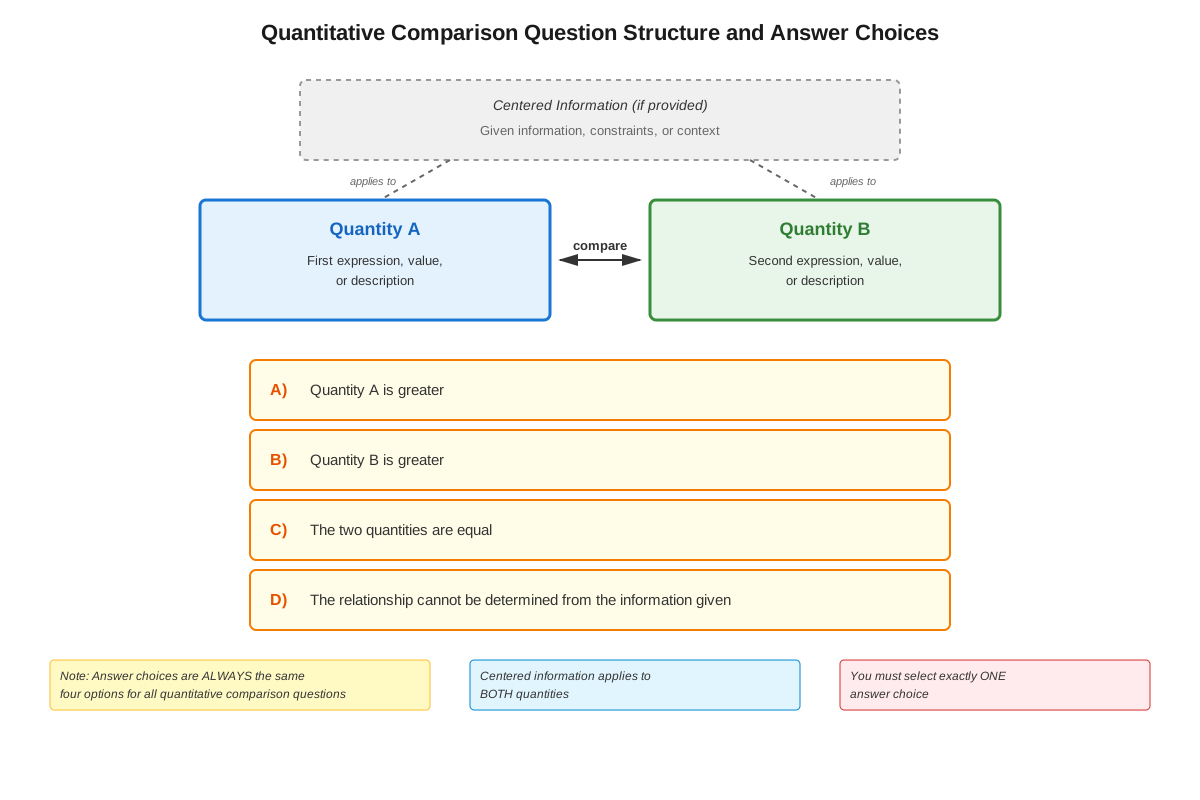
Every quantitative comparison question on the GRE presents exactly four answer choices, which remain constant across all questions of this type:
- (A) Quantity A is greater
- (B) Quantity B is greater
- (C) The two quantities are equal
- (D) The relationship cannot be determined from the information given
Understanding these choices is fundamental to the format. Choices A, B, and C represent definitive relationships that hold true in all cases given the constraints. Choice D indicates that the relationship varies depending on possible values within the given constraints—meaning that sometimes A is greater, sometimes B is greater, or sometimes they are equal, depending on which valid values are selected.
Structure of Quantitative Comparison Questions
A typical quantitative comparison question consists of three components:
- Centered information (optional): Additional facts, constraints, or context that apply to both quantities
- Quantity A: An expression, number, or description on the left
- Quantity B: An expression, number, or description on the right
The centered information may include variable definitions, geometric diagrams, word problem scenarios, or mathematical constraints. This information is crucial and applies to both quantities equally. Some questions provide no centered information, meaning the quantities must be compared based solely on what is presented in each column.
The Fundamental Comparison Principle
The core strategy underlying all quantitative comparison questions is direct comparison without unnecessary calculation. Rather than computing the exact value of each quantity independently, efficient test-takers manipulate both quantities simultaneously using valid mathematical operations. This approach saves time and reduces computational errors.
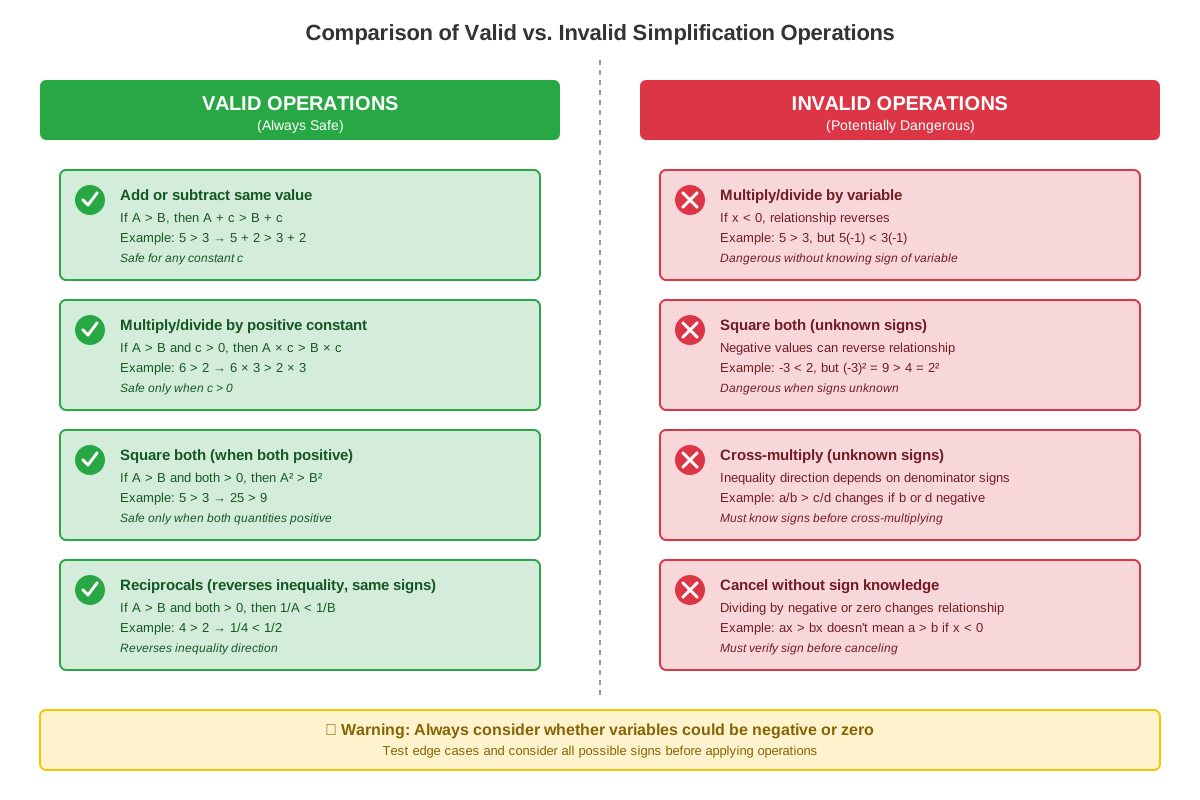
Valid operations that preserve relationships include:
- Adding or subtracting the same value from both quantities
- Multiplying or dividing both quantities by the same positive number
- Squaring both quantities when both are known to be positive
- Simplifying expressions using algebraic properties
Critical restriction: Multiplying or dividing by a negative number reverses the inequality, so this operation should be avoided unless the sign is certain, or the quantities should be analyzed for different sign scenarios.
The "Cannot Be Determined" Decision
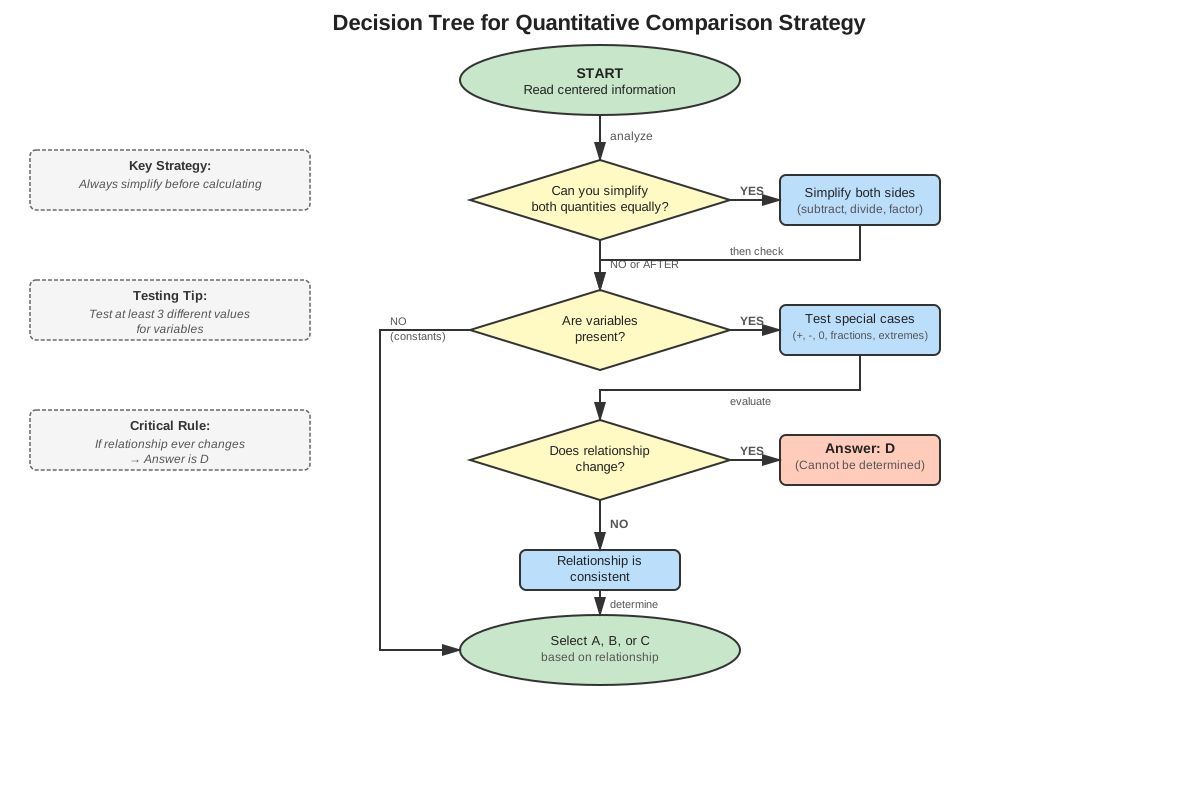
Choice D is correct when the relationship between quantities changes based on different valid values of variables or parameters. To identify when D is correct, test-takers should:
- Plug in different values that satisfy all given constraints
- Look for cases where Quantity A is greater
- Look for cases where Quantity B is greater (or where they are equal)
- If multiple relationships occur, the answer is D
If only one relationship holds across all valid test cases, then A, B, or C is correct. The presence of variables does not automatically mean the answer is D—many questions with variables have determinable relationships.
Strategic Simplification Techniques
| Technique | When to Use | Example |
|---|---|---|
| Subtract common terms | Both quantities share identical components | If A = x + 5 and B = x + 3, subtract x from both |
| Factor expressions | Quantities contain common factors | If A = 3x and B = 3y, factor out 3 (if positive) |
| Compare piece by piece | Quantities are sums of multiple terms | Compare term-by-term when possible |
| Use estimation | Exact values are unnecessary | Compare √50 to 7 by noting 7² = 49 |
| Test boundary cases | Variables have constraints | Test minimum, maximum, and special values |
Handling Variables and Constraints
When quantitative comparison questions include variables, the constraints provided in the centered information become critical. Consider these scenarios:
Scenario 1: Unconstrained variable
- If x can be any real number and no restrictions apply, test positive, negative, and zero values
- Often leads to answer choice D
Scenario 2: Constrained variable
- If x > 0 or 0 < x < 1 or x is an integer, these constraints limit possible values
- May allow definitive comparison despite the variable
Scenario 3: Multiple variables
- Test combinations of values
- Look for relationships between variables that determine the comparison
Geometric Comparisons
Quantitative comparison questions frequently involve geometric figures. Key principles include:
- Never assume measurements from visual appearance alone
- Use only information explicitly stated or marked in the diagram
- Apply geometric formulas to establish relationships
- Consider that figures may not be drawn to scale unless stated otherwise
When comparing geometric quantities, look for relationships such as triangle inequality theorems, properties of similar figures, or area/perimeter relationships that allow comparison without exact calculation.
Concept Relationships
The quantitative comparison format serves as an integrative framework connecting multiple mathematical concepts. The four answer choices form the foundation, determining how all other concepts are applied. The fundamental comparison principle guides the strategic approach, leading to simplification techniques that make comparisons efficient. These techniques branch into specific applications: handling variables (which connects to the "cannot be determined" decision), geometric comparisons (which requires prerequisite geometry knowledge), and algebraic manipulation (which enables simplification).
The relationship flows as follows:
Question Structure → Identify constraints and given information → Apply comparison principle → Choose appropriate simplification technique → Test critical cases if variables present → Make determination → Select answer choice
The "cannot be determined" decision point acts as a critical checkpoint in this flow. When variables appear, the process branches: either the constraints allow definitive comparison (leading to A, B, or C) or multiple relationships are possible (leading to D). This decision point connects back to prerequisite knowledge of inequalities and number properties, as understanding how different values affect relationships is essential.
Quantitative comparison format also connects forward to broader GRE strategies: time management (since comparisons can be faster than full calculations), process of elimination (since testing one counterexample can eliminate three answer choices), and strategic guessing (understanding when D is more or less likely based on question structure).
High-Yield Facts
⭐ Quantitative comparison questions always have exactly four answer choices, and these choices are identical for every question of this type
⭐ Choice D ("cannot be determined") is correct only when different valid values produce different relationships between the quantities
⭐ You can add or subtract the same value from both quantities without changing their relationship
⭐ Multiplying or dividing both quantities by a negative number reverses the inequality relationship
⭐ The presence of variables does not automatically mean the answer is D—many variable questions have determinable relationships
- Approximately one-third of all GRE Quantitative Reasoning questions use the quantitative comparison format
- Centered information, when provided, applies equally to both Quantity A and Quantity B
- Geometric figures in quantitative comparison questions should not be assumed to scale unless explicitly stated
- Squaring both quantities is valid only when both quantities are known to be positive (or both negative)
- Testing x = 0, x = 1, and x = -1 often reveals whether a relationship is determinable for variable questions
- Comparing quantities directly is almost always faster than calculating exact values for each quantity separately
- If you can find even one valid case where A > B and one valid case where B > A, the answer must be D
- Simplification should preserve the relationship—any operation that might change the inequality requires careful consideration
Quick check — test yourself on Quantitative comparison format so far.
Try Flashcards →Common Misconceptions
Misconception: If a question contains variables, the answer must be D ("cannot be determined").
Correction: Many questions with variables have determinable relationships. For example, if Quantity A is x² and Quantity B is x² + 1, then B is always greater regardless of x's value. Variables require testing multiple cases, but often all cases yield the same relationship.
Misconception: Geometric figures are drawn to scale, so visual estimation is reliable.
Correction: GRE geometric figures are not necessarily drawn to scale unless explicitly stated. Comparisons must be based on given measurements, marked angles, and geometric principles, not visual appearance. An angle that looks like 90° might actually be 89° or 91°.
Misconception: You must calculate the exact value of both quantities before comparing them.
Correction: The quantitative comparison format rewards strategic comparison without full calculation. Simplifying both quantities simultaneously or comparing piece-by-piece is more efficient and reduces computational errors.
Misconception: If Quantity A and Quantity B look very similar, they must be equal (Choice C).
Correction: Subtle differences in expressions can lead to different values. For example, (x + 1)² and x² + 1 are not equal for most values of x. Careful algebraic analysis is required rather than pattern matching.
Misconception: Testing one value for a variable is sufficient to determine the relationship.
Correction: To confirm that a relationship holds for all valid values, test multiple cases including boundary values, positive and negative numbers, fractions between 0 and 1, and special values like 0 and 1. A single test case can prove D is correct (by finding a counterexample) but cannot prove A, B, or C is correct.
Misconception: Choice D is rare and should be avoided when guessing.
Correction: Choice D appears with roughly equal frequency to the other choices. The GRE is carefully balanced, and no answer choice is systematically more or less common. Select D when the relationship genuinely varies with different valid values.
Misconception: You can multiply both quantities by a variable without considering its sign.
Correction: Multiplying by a variable of unknown sign is dangerous because if the variable is negative, the inequality reverses. Either determine the variable's sign first, or test cases for positive and negative values separately.
Worked Examples
Example 1: Algebraic Comparison with Variables
Centered Information: x > 0
Quantity A: (x + 3)²
Quantity B: x² + 9
Solution:
Rather than expanding and calculating for specific values, use strategic simplification:
Step 1: Expand Quantity A
- (x + 3)² = x² + 6x + 9
Step 2: Set up the comparison
- Quantity A: x² + 6x + 9
- Quantity B: x² + 9
Step 3: Subtract x² + 9 from both quantities (valid operation)
- Quantity A becomes: 6x
- Quantity B becomes: 0
Step 4: Compare the simplified quantities
- Since x > 0 (given constraint), we know 6x > 0
- Therefore, Quantity A > Quantity B
Answer: A
Key Insight: This example demonstrates the power of algebraic manipulation and the fundamental comparison principle. By subtracting common terms, we reduced the comparison to 6x versus 0, making the relationship immediately clear given the constraint x > 0. This approach is much faster than plugging in multiple values of x.
Example 2: Testing Cases with Multiple Variables
Centered Information: x and y are integers, and x > y
Quantity A: x² - y²
Quantity B: x - y
Solution:
This question requires testing multiple cases because the relationship might vary:
Step 1: Test positive integers where x > y
- Let x = 3, y = 1
- Quantity A: 3² - 1² = 9 - 1 = 8
- Quantity B: 3 - 1 = 2
- In this case, A > B
Step 2: Test another case with smaller difference
- Let x = 2, y = 1
- Quantity A: 2² - 1² = 4 - 1 = 3
- Quantity B: 2 - 1 = 1
- In this case, A > B
Step 3: Test case with negative numbers
- Let x = 1, y = -1
- Quantity A: 1² - (-1)² = 1 - 1 = 0
- Quantity B: 1 - (-1) = 2
- In this case, B > A
Step 4: Analyze the results
- We found cases where A > B and cases where B > A
- The relationship changes depending on the values chosen
Answer: D
Key Insight: This example illustrates when "cannot be determined" is correct. The presence of the constraint x > y is not sufficient to establish a consistent relationship. Testing diverse cases—including negative numbers—revealed that the relationship varies. The algebraic approach (factoring x² - y² = (x+y)(x-y)) also shows that the relationship depends on the value of (x+y), which varies.
Exam Strategy
Systematic Approach to Quantitative Comparison Questions
- Read centered information carefully: Identify all constraints, variable definitions, and given facts before looking at the quantities
- Assess the quantities: Determine whether they involve pure numbers, variables, or geometric elements
- Look for simplification opportunities: Before calculating, check if common terms can be eliminated
- Consider the "cannot be determined" possibility: If variables are present with minimal constraints, D is more likely
- Test strategic values: For variable questions, test 0, 1, -1, fractions between 0 and 1, and boundary values
- Avoid unnecessary calculation: Compare rather than compute whenever possible
Trigger Words and Phrases
Watch for these indicators in quantitative comparison questions:
- "x is a positive integer": Limits testing to 1, 2, 3, ... (eliminates fractions and negatives)
- "0 < x < 1": Signals that x² < x and 1/x > x (counterintuitive behavior)
- "x ≠ 0": Allows both positive and negative values (often suggests D)
- "The figure is not drawn to scale": Reinforces that visual estimation is unreliable
- "x and y are different": Means x ≠ y but doesn't specify which is larger
Process of Elimination Tips
- Eliminate three choices with one counterexample: If you find valid values where A > B, eliminate choices B, C, and D. If you then find values where B > A, you've proven D is correct.
- Use sign analysis: If you can determine that one quantity is always positive and the other always negative, eliminate D immediately.
- Check for identical expressions: If algebraic simplification shows the quantities are identical, the answer must be C.
- Boundary testing eliminates choices: Testing extreme values often reveals which relationships are impossible.
Time Allocation
Quantitative comparison questions should generally take less time than problem-solving questions—typically 60-90 seconds versus 90-120 seconds. The format is designed to reward strategic thinking over computation. If you find yourself performing lengthy calculations, pause and reconsider whether a comparison approach would be more efficient. However, don't rush—careful analysis of constraints and thorough testing of cases for variable questions is essential for accuracy.
Exam Tip: If you're stuck between two answer choices, test one more extreme case. For example, if you've tested x = 1 and x = 2, try x = 100 or x = 0.5 to see if the pattern holds.
Memory Techniques
The "COMP" Framework
Constraints: Identify all given information and limitations
Operations: Apply valid operations to simplify both quantities
Multiple cases: Test diverse values when variables are present
Pick the relationship: Choose A, B, C, or D based on analysis
The "Four Faces" Mnemonic
Remember the four answer choices as four faces showing different expressions:
- Face A: Smiling up (A is greater, pointing up)
- Face B: Smiling down (B is greater, pointing down)
- Face C: Neutral equal (C means equal, balanced face)
- Face D: Question mark (D means uncertain, confused face)
The "SAME Operations" Rule
Subtract the same value from both
Add the same value to both
Multiply by the same positive number
Eliminate common positive factors
These operations are always safe and preserve the relationship.
The "DANGER" Operations
Dividing by variables (might be zero)
Assuming from appearance (figures not to scale)
Negative multiplication (reverses inequality)
Guessing without testing (need multiple cases)
Expanding unnecessarily (compare first)
Rushing to calculate (simplify instead)
Summary
The quantitative comparison format is a distinctive GRE question type that requires test-takers to determine the relationship between two quantities rather than calculate exact values. Mastering this format involves understanding the four consistent answer choices, recognizing when relationships can be determined versus when they vary with different values, and applying strategic simplification techniques that avoid unnecessary calculation. The fundamental principle is direct comparison through valid mathematical operations—adding or subtracting the same value from both quantities, multiplying or dividing by positive numbers, and simplifying algebraically. When variables appear, testing multiple cases including boundary values, zero, positive and negative numbers, and fractions reveals whether the relationship is consistent or variable. Choice D ("cannot be determined") is correct only when different valid values produce different relationships. Efficient test-takers leverage the format's structure to save time while maintaining accuracy, using algebraic manipulation and strategic reasoning rather than brute-force computation. Success requires both mathematical knowledge and analytical thinking—understanding not just how to solve problems but how to compare quantities intelligently.
Key Takeaways
- Quantitative comparison questions represent approximately one-third of GRE Quantitative Reasoning questions, making format mastery essential for score optimization
- The four answer choices are consistent across all questions: A is greater, B is greater, equal, or cannot be determined
- Strategic comparison through simplification is faster and more accurate than calculating exact values for each quantity independently
- Choice D is correct when and only when the relationship between quantities changes with different valid values of variables or parameters
- Valid operations that preserve relationships include adding/subtracting the same value and multiplying/dividing by positive numbers; multiplying by negatives reverses inequalities
- Testing multiple diverse cases (positive, negative, zero, fractions, boundary values) is essential for variable questions to determine whether relationships are consistent
- Geometric comparisons must rely on stated information and geometric principles, never on visual appearance, as figures are not necessarily drawn to scale
Related Topics
Problem Solving Format: The other major question type in GRE Quantitative Reasoning, requiring exact numerical answers or selection from five choices. Mastering quantitative comparison format provides strategic advantages for problem-solving questions through enhanced comparative reasoning skills.
Inequalities and Absolute Values: Advanced understanding of inequality manipulation and absolute value properties directly enhances quantitative comparison performance, particularly for questions involving variable expressions and constraints.
Number Properties: Deep knowledge of how integers, fractions, positive/negative numbers, and zero behave under various operations is fundamental to predicting relationships in quantitative comparison questions.
Algebraic Manipulation: Factoring, expanding, and simplifying expressions are core skills for efficient quantitative comparison, enabling strategic simplification that reveals relationships without full calculation.
Geometric Relationships: Understanding properties of angles, triangles, circles, and other figures allows for comparison of geometric quantities based on principles rather than measurement, essential for geometry-based quantitative comparison questions.
Practice CTA
Now that you understand the quantitative comparison format, it's time to apply these strategies to actual GRE-style questions. The practice questions and flashcards are specifically designed to reinforce the concepts covered in this guide, helping you internalize the strategic approach and build confidence with this high-yield question type. Remember: quantitative comparison questions reward smart thinking over lengthy calculation, so focus on developing your comparative reasoning skills. Each practice question is an opportunity to refine your technique and increase your speed. You've learned the framework—now make it automatic through deliberate practice!
Sign up free to keep reading
Create a free AnvayaPrep account to finish this GRE guide on Quantitative comparison format — plus flashcards and practice questions.