Overview
Quantity A and Quantity B questions represent one of the most distinctive and strategically important question types on the GRE Quantitative Reasoning section. These Quantitative Comparison questions require test-takers to compare two mathematical expressions or values and determine their relationship rather than calculate a specific numerical answer. This format appears in approximately 13-15 questions per Quantitative section, accounting for roughly one-third of all quantitative questions on the exam. Mastering this question type is essential for achieving a competitive score, as these questions reward strategic thinking, estimation skills, and the ability to recognize mathematical relationships quickly.
Unlike traditional problem-solving questions that ask for a specific numerical solution, GRE Quantity A and Quantity B questions present two quantities side by side and ask test-takers to determine whether one is greater, whether they are equal, or whether the relationship cannot be determined from the given information. This unique format demands a different cognitive approach: rather than computing exact values, successful test-takers learn to compare, estimate, manipulate, and sometimes plug in strategic values to establish relationships efficiently. The four-answer-choice format remains constant across all quantitative comparison questions, making pattern recognition and strategic elimination particularly valuable skills.
Within the broader Quantitative Reasoning framework, quantitative comparison questions integrate concepts from arithmetic, algebra, geometry, and data analysis. They test not only mathematical knowledge but also logical reasoning, number sense, and the ability to work with variables and constraints. These questions often combine multiple mathematical concepts in a single problem, requiring students to synthesize knowledge across different areas while maintaining focus on comparison rather than calculation. Understanding the strategic approaches specific to this question type can significantly improve both accuracy and time management throughout the Quantitative Reasoning sections.
Learning Objectives
- [ ] Identify when Quantity A and Quantity B is being tested
- [ ] Explain the core rule or strategy behind Quantity A and Quantity B
- [ ] Apply Quantity A and Quantity B to GRE-style questions accurately
- [ ] Distinguish between situations where the relationship can be determined versus when it cannot
- [ ] Execute strategic value substitution to test relationships efficiently
- [ ] Recognize common trap patterns that lead to incorrect answer choices
- [ ] Apply algebraic manipulation techniques specific to quantitative comparison
Prerequisites
- Basic algebraic manipulation: Essential for simplifying and comparing expressions without calculating exact values
- Number properties: Understanding positive/negative numbers, fractions, and zero is critical for testing relationships
- Inequality rules: Necessary for maintaining correct relationships when multiplying or dividing by variables
- Geometric formulas: Required for comparing areas, perimeums, volumes, and angle relationships
- Exponent and radical rules: Needed to compare expressions involving powers and roots accurately
Why This Topic Matters
Quantitative comparison questions assess mathematical reasoning in ways that mirror real-world decision-making scenarios. In professional contexts, determining whether one option is superior to another without exhaustive calculation is a valuable skill—whether comparing investment returns, evaluating project timelines, or assessing resource allocations. The ability to establish relationships through strategic analysis rather than brute-force computation demonstrates higher-order mathematical thinking that graduate programs value.
On the GRE specifically, quantitative comparison questions appear with remarkable consistency. Each Quantitative Reasoning section contains approximately 7-8 quantitative comparison questions out of 20 total questions, making them the single most common question type. These questions typically appear interspersed throughout the section rather than grouped together, requiring test-takers to shift mental frameworks multiple times during the exam. The scoring algorithm treats these questions with equal weight to other question types, but their strategic nature means that students who master the specific approaches can answer them more quickly, creating valuable time for more calculation-intensive problems.
Common manifestations include comparing algebraic expressions with variables, geometric measurements under different conditions, statistical measures from data sets, and numerical relationships involving special cases like zero or negative numbers. The GRE frequently tests whether students can recognize when additional information is needed versus when a definitive relationship exists. Questions may present seemingly complex expressions that simplify dramatically, or deceptively simple comparisons that depend critically on the sign or magnitude of variables. Understanding these patterns transforms quantitative comparison from a challenging question type into a high-yield opportunity for efficient point accumulation.
Core Concepts
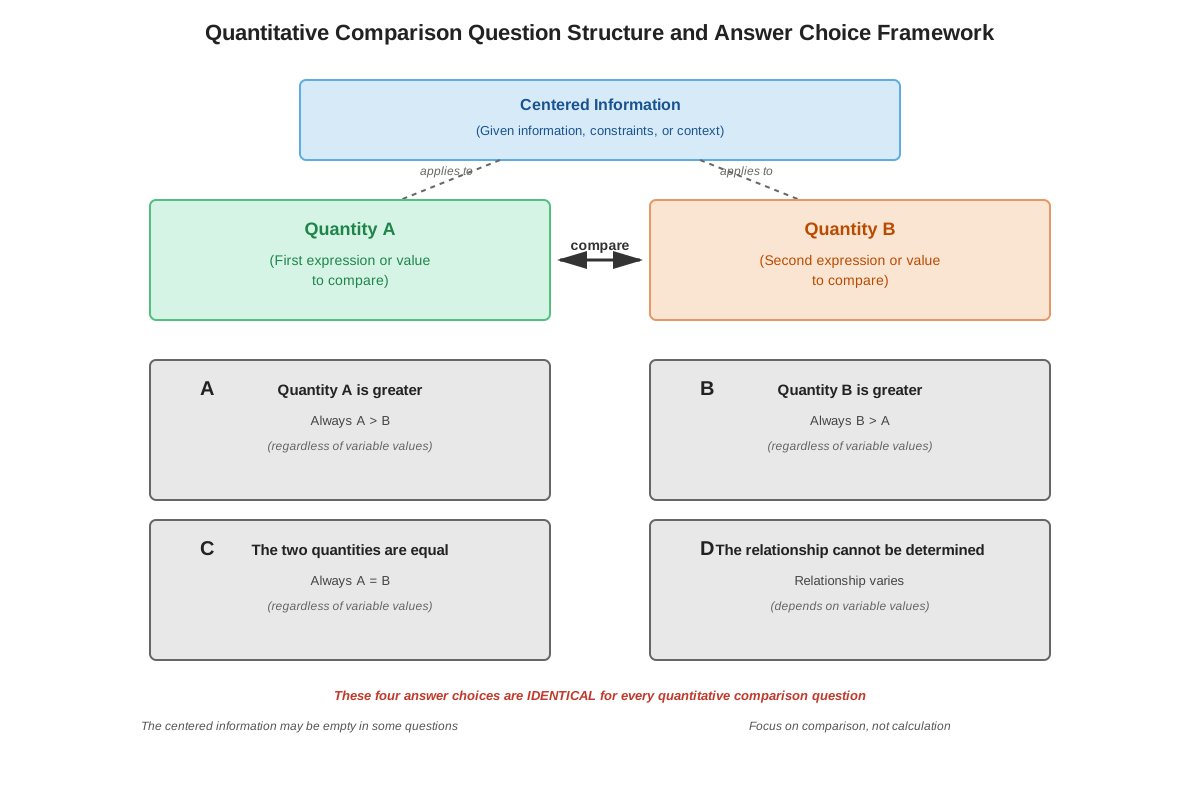
The Four Answer Choices
Every quantitative comparison question on the GRE presents exactly the same four answer choices, which never vary:
- (A) Quantity A is greater
- (B) Quantity B is greater
- (C) The two quantities are equal
- (D) The relationship cannot be determined from the information given
This consistency is strategically significant. Unlike other GRE question types where answer choices vary, memorizing these four options allows test-takers to focus entirely on the comparison itself. The presence of choice (D) is particularly important—it exists only when variables or unknowns could take different values that would change the relationship between the quantities.
The Fundamental Comparison Strategy
The core principle underlying all quantitative comparison questions is this: never calculate more than necessary. The goal is to determine a relationship, not to find specific values. This fundamental shift in approach separates efficient test-takers from those who waste time on unnecessary computation.
Key strategic principles include:
- Simplify both quantities simultaneously: Perform the same operation on both sides to maintain the relationship
- Compare piece by piece: Break complex expressions into components and compare each part
- Test strategic values: When variables are present, substitute values that reveal the relationship
- Recognize when information is insufficient: If different values produce different relationships, choose (D)
Algebraic Manipulation in Comparisons
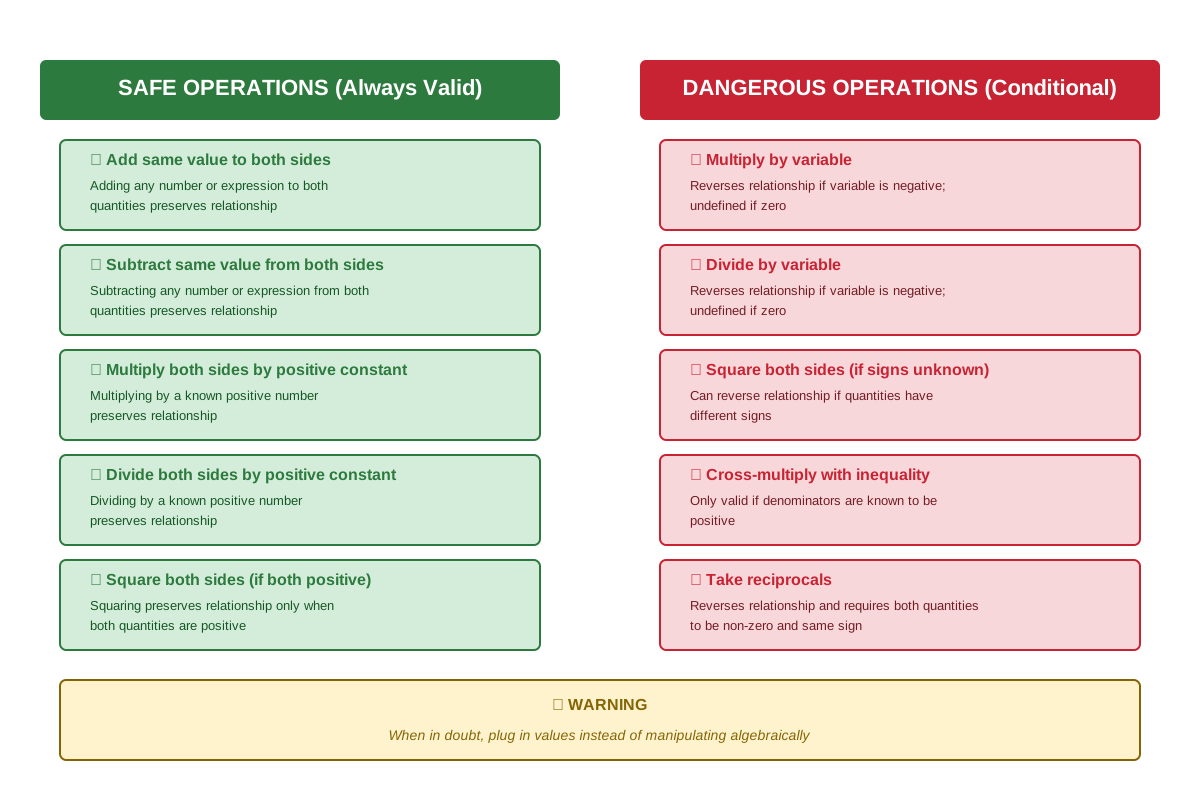
When comparing algebraic expressions, test-takers can perform identical operations on both quantities without changing their relationship, similar to working with equations or inequalities:
Permitted operations (that preserve the relationship):
- Adding or subtracting the same value from both quantities
- Multiplying or dividing both quantities by the same positive number
- Squaring both quantities when both are known to be positive
- Taking square roots of both quantities when both are non-negative
Dangerous operations (that may reverse or complicate the relationship):
- Multiplying or dividing by a negative number (reverses the inequality)
- Multiplying or dividing by a variable that could be positive, negative, or zero
- Squaring when signs are unknown (negative numbers become positive)
- Cross-multiplying when denominators could be negative
The Strategic Value Substitution Method
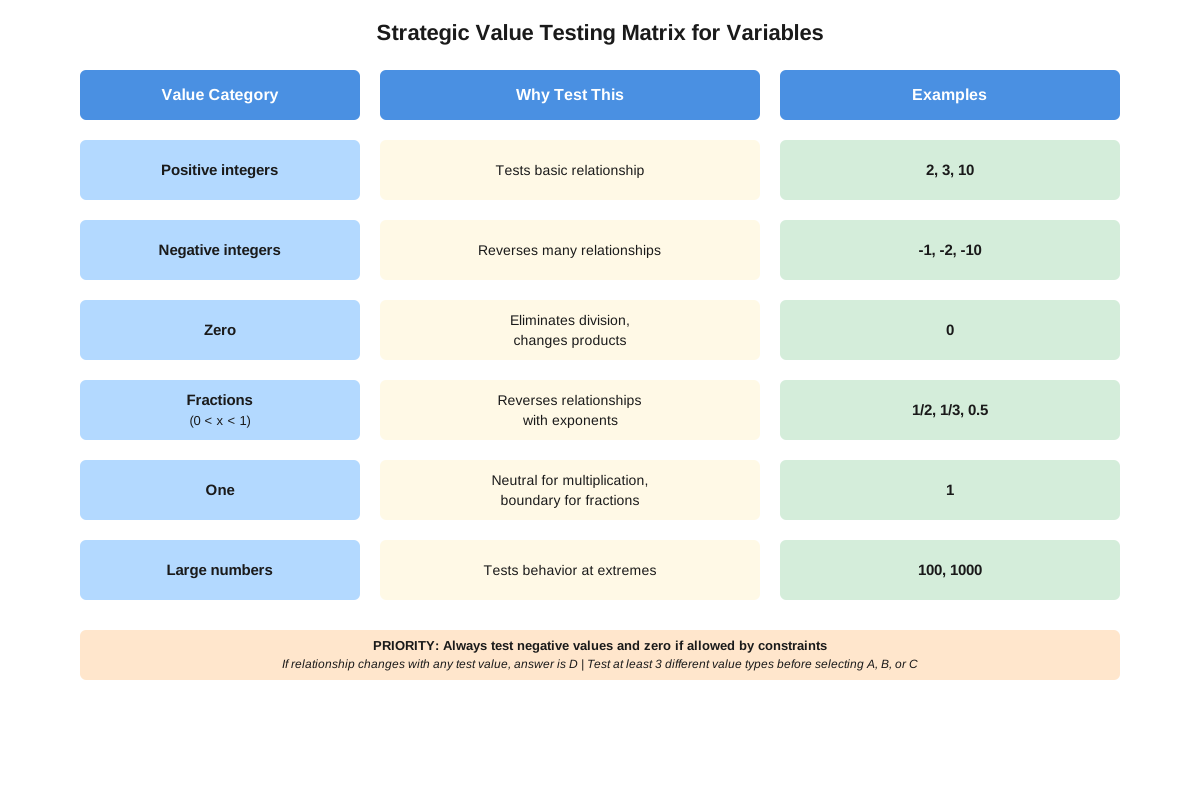
When quantities contain variables without sufficient constraints to determine a unique relationship, strategic value substitution becomes essential. The goal is to test whether different permissible values for the variables produce different relationships.
The systematic approach:
- Identify the variable(s) and any constraints given in the problem
- Test special values first: 0, 1, -1, fractions between 0 and 1, large numbers
- If two different test values produce different relationships, the answer is (D)
- If all reasonable test values produce the same relationship, that relationship likely holds generally
Why these special values matter:
| Test Value | Why It's Strategic |
|---|---|
| 0 | Eliminates terms, reveals constant relationships |
| 1 | Simplifies exponents and multiplication |
| -1 | Tests behavior with negative numbers |
| 2 | Simple positive integer for general behavior |
| 1/2 | Tests fractional behavior (squares become smaller) |
| -2 | Tests negative integers |
Recognizing "Cannot Be Determined" Situations
Choice (D) appears when the relationship between quantities depends on unknown information. This occurs when:
- Variables can take different values that produce different relationships
- Insufficient constraints are provided to pin down the relationship
- The problem involves ranges rather than specific values
Critical insight: If you can find even one legitimate example where Quantity A is greater and another where Quantity B is greater, the answer must be (D).
Geometric Comparisons
Geometric quantitative comparisons frequently test spatial reasoning and formula knowledge. Common patterns include:
Area and perimeter relationships: Figures with equal perimeters can have different areas, and vice versa. Never assume one determines the other without calculation.
Angle relationships: Use properties of triangles (angles sum to 180°), parallel lines (corresponding and alternate angles), and circles (inscribed angles) to establish relationships.
Three-dimensional comparisons: Volume and surface area relationships often require careful formula application and may depend on specific dimensions.
Working with Inequalities and Constraints
When the problem provides inequalities or constraints (e.g., "x > 0" or "a < b < c"), these dramatically narrow the possibilities:
- Use constraints to eliminate impossible test values
- Recognize when constraints make a relationship definite
- Be cautious about boundary cases (what happens at the extreme values allowed?)
The "Simplify to Zero" Technique
A powerful approach for many algebraic comparisons:
- Subtract Quantity B from both sides (or subtract Quantity A from both sides)
- Simplify the resulting expression
- Determine whether the result is positive, negative, zero, or indeterminate
This transforms the comparison into determining the sign of a single expression, often simpler than comparing two separate expressions.
Concept Relationships
The quantitative comparison question type serves as an integrative framework that connects multiple mathematical domains. Algebraic manipulation forms the foundation, enabling test-takers to simplify and transform expressions while preserving relationships. This leads directly to strategic value substitution, which becomes necessary when algebraic methods alone cannot determine a definitive relationship.
Number properties interact constantly with comparison strategies—understanding how operations affect positive versus negative numbers, or how fractions behave differently from integers, determines which test values to choose and how to interpret results. This knowledge feeds into inequality reasoning, which governs when relationships can be reversed or preserved during manipulation.
Geometric concepts often appear in quantitative comparisons, requiring test-takers to apply formula knowledge and spatial reasoning to establish relationships between measurements. These geometric comparisons frequently connect back to algebraic manipulation when expressions for areas, volumes, or lengths must be compared symbolically.
The relationship map flows as follows:
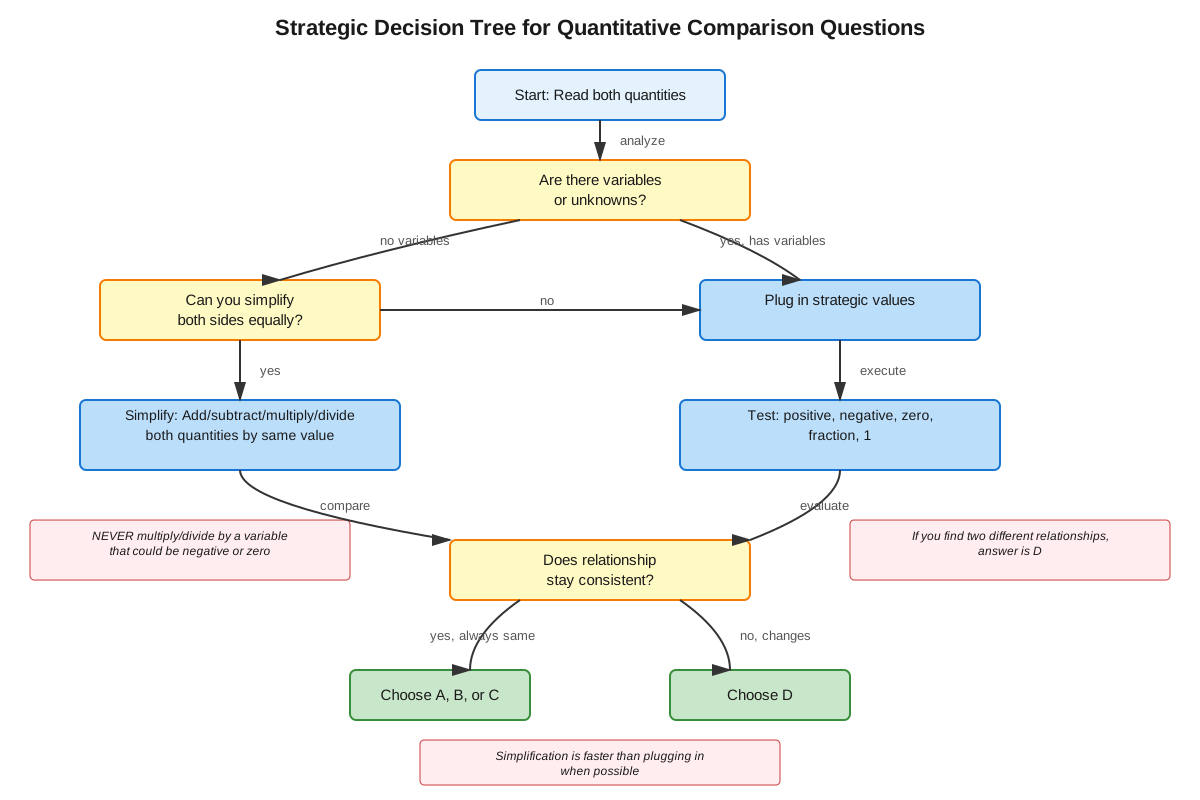
Problem Recognition → Identify variables and constraints → Choose approach: [Algebraic Simplification OR Strategic Value Testing] → Apply number properties and inequality rules → Determine relationship → Verify with edge cases if uncertain → Select answer choice
The critical decision point occurs when choosing between algebraic simplification and value substitution. Problems with sufficient constraints favor algebraic approaches, while those with unconstrained variables require testing multiple values to determine whether choice (D) applies.
High-Yield Facts
⭐ Every quantitative comparison question has exactly four answer choices that never change: (A) Quantity A is greater, (B) Quantity B is greater, (C) The two quantities are equal, (D) The relationship cannot be determined.
⭐ Choice (D) exists only when variables or unknowns could take different values that change the relationship—if no variables appear or all variables are fully constrained, (D) cannot be correct.
⭐ You can perform the same operation on both quantities simultaneously (add, subtract, multiply by positive numbers) without changing their relationship, just like with equations.
⭐ Never multiply or divide both quantities by a variable unless you know its sign—this is the most common error leading to wrong answers.
⭐ Test special values systematically: 0, 1, -1, 2, -2, and 1/2 reveal most relationships involving variables.
- If two different test values produce different relationships (one makes A greater, another makes B greater), the answer must be (D).
- Squaring both quantities is only safe when both are known to be positive—negative numbers become positive when squared, potentially reversing relationships.
- Geometric figures are not necessarily drawn to scale in quantitative comparison questions—never rely on visual estimation alone.
- Simplifying to zero is often faster than comparing: subtract one quantity from both sides and determine if the result is positive, negative, zero, or indeterminate.
- Fractions between 0 and 1 behave counterintuitively: their squares are smaller than the original number, and their reciprocals are larger.
- When comparing expressions with exponents, the base and exponent values critically determine the relationship—test both small and large values.
- Equal perimeters do not imply equal areas, and equal areas do not imply equal perimeters—these are independent properties.
- The sum of two quantities can be determined even when individual values cannot—look for relationships between the quantities themselves.
- Absolute value comparisons require considering both positive and negative cases for the expression inside the absolute value bars.
- Percentage comparisons depend on the base—10% of a large number may exceed 50% of a small number.
Quick check — test yourself on Quantity A and Quantity B so far.
Try Flashcards →Common Misconceptions
Misconception: If a problem contains variables, the answer must be (D) because the relationship cannot be determined.
Correction: Many problems with variables have sufficient constraints or algebraic relationships that definitively determine which quantity is greater. Choice (D) only applies when different permissible values for variables produce different relationships. For example, if Quantity A is x² and Quantity B is x, and we're told x > 1, then Quantity A is always greater despite the presence of a variable.
Misconception: Figures in quantitative comparison questions are drawn to scale, so visual estimation is reliable.
Correction: The GRE explicitly states that figures are not necessarily drawn to scale unless specifically indicated. Relying on visual appearance leads to systematic errors. Always use geometric properties, formulas, and given measurements rather than visual estimation.
Misconception: You must calculate exact numerical values for both quantities before comparing them.
Correction: The fundamental strategy for quantitative comparison is to determine the relationship without unnecessary calculation. Often, simplifying both quantities simultaneously or comparing piece-by-piece reveals the relationship without computing specific values, saving valuable time.
Misconception: Multiplying or dividing both quantities by the same expression is always safe, just like with equations.
Correction: This operation is only safe when multiplying or dividing by a positive number. Multiplying or dividing by a negative number reverses the inequality relationship, and multiplying or dividing by zero is undefined. When the sign of an expression is unknown, this operation is dangerous and often leads to incorrect answers.
Misconception: If testing one value shows Quantity A is greater, then Quantity A is always greater.
Correction: A single test value is insufficient to establish a general relationship. You must test multiple strategic values, particularly special cases like 0, 1, -1, and fractions. Only if all permissible test values produce the same relationship can you confidently select (A), (B), or (C).
Misconception: Squaring both quantities is a safe way to eliminate square roots or simplify comparisons.
Correction: Squaring is only safe when both quantities are known to be non-negative. If either quantity could be negative, squaring changes the relationship because negative numbers become positive. For example, if Quantity A is -3 and Quantity B is 2, then A < B, but A² = 9 > 4 = B², reversing the relationship.
Misconception: In geometric problems, if two figures have the same perimeter, they must have the same area.
Correction: Perimeter and area are independent properties. A long, thin rectangle and a square can have identical perimeters but vastly different areas. Similarly, different shapes can have the same area but different perimeters. Each property must be calculated or compared independently.
Worked Examples
Example 1: Algebraic Comparison with Simplification
Problem:
Quantity A: (x + 3)(x - 3)
Quantity B: x² - 6
Given: x is a real number
Solution:
Rather than expanding and calculating for specific values of x, we'll simplify both quantities simultaneously.
Step 1: Expand Quantity A using the difference of squares formula:
- Quantity A = (x + 3)(x - 3) = x² - 9
Step 2: Now compare:
- Quantity A: x² - 9
- Quantity B: x² - 6
Step 3: Subtract x² from both quantities (performing the same operation on both sides):
- Quantity A becomes: -9
- Quantity B becomes: -6
Step 4: Compare -9 and -6:
- Since -9 < -6, Quantity A is less than Quantity B
Answer: (B) Quantity B is greater
Key insight: This problem demonstrates the power of algebraic simplification. By expanding Quantity A and then subtracting the common term (x²) from both quantities, we reduced the comparison to simple constants. No value substitution was necessary because the relationship holds for all real numbers x.
Connection to learning objectives: This example shows how to apply algebraic manipulation strategies specific to quantitative comparison, avoiding unnecessary calculation while maintaining accuracy.
Example 2: Strategic Value Substitution
Problem:
Quantity A: x³
Quantity B: x²
Given: x ≠ 0
Solution:
This problem contains a variable with minimal constraints (only that x ≠ 0), suggesting we should test strategic values.
Step 1: Test x = 2 (positive integer greater than 1):
- Quantity A: 2³ = 8
- Quantity B: 2² = 4
- Result: A > B
Step 2: Test x = 1 (special case):
- Quantity A: 1³ = 1
- Quantity B: 1² = 1
- Result: A = B
Step 3: Test x = 1/2 (fraction between 0 and 1):
- Quantity A: (1/2)³ = 1/8
- Quantity B: (1/2)² = 1/4
- Result: A < B (since 1/8 < 1/4)
Step 4: Test x = -1 (negative number):
- Quantity A: (-1)³ = -1
- Quantity B: (-1)² = 1
- Result: A < B
Step 5: Analyze results:
- We found cases where A > B (x = 2)
- We found cases where A = B (x = 1)
- We found cases where A < B (x = 1/2 and x = -1)
Since different permissible values of x produce different relationships, the relationship cannot be determined from the given information.
Answer: (D) The relationship cannot be determined
Key insight: This problem illustrates why testing multiple strategic values is essential. The relationship between x³ and x² depends critically on whether x is greater than 1, equal to 1, between 0 and 1, or negative. Each range produces a different relationship.
Connection to learning objectives: This example demonstrates how to distinguish situations where the relationship cannot be determined and how to execute strategic value substitution efficiently. The choice of test values (2, 1, 1/2, -1) was deliberate, targeting the critical ranges where the relationship changes.
Exam Strategy
Immediate Recognition Triggers
When you encounter a quantitative comparison question, immediately note:
- The presence of variables: If variables appear, prepare to either simplify algebraically or test strategic values
- Given constraints: Any inequalities or conditions dramatically narrow the possibilities
- The complexity of expressions: Simple expressions favor direct comparison; complex ones favor simplification first
The Decision Tree Approach
First 5 seconds: Scan for variables and constraints
- No variables or fully constrained variables → Choice (D) is impossible → Focus on (A), (B), or (C)
- Variables with minimal constraints → Choice (D) is likely → Prepare to test values
Next 10-15 seconds: Choose your method
- Algebraic expressions → Try simplification first (subtract, factor, expand)
- Geometric figures → Apply formulas and properties
- Numbers only → Direct comparison or quick calculation
If stuck after 20 seconds: Test strategic values (0, 1, -1, 2, 1/2)
Time Management Principles
Quantitative comparison questions should typically take 60-90 seconds each, less than the average for problem-solving questions. If you're spending more than 90 seconds:
- You're likely over-calculating
- Step back and look for a simpler comparison method
- Consider testing values instead of pursuing complex algebra
Process of Elimination Specific to This Question Type
Eliminate (D) when:
- No variables appear in either quantity
- All variables are fully constrained by the given information
- The problem involves only constants or fully determined values
Eliminate (C) when:
- Testing any single value shows the quantities are unequal
- The expressions have different forms that cannot simplify to equality
Suspect (D) when:
- Variables appear with minimal constraints
- The problem seems too simple (might be testing whether you recognize insufficient information)
- Different operations on the variable produce different results
Common Trigger Phrases
Watch for these phrases that signal specific approaches:
- "x is a positive integer": Constrains the variable significantly; test small positive integers
- "x ≠ 0": Minimal constraint; test positive, negative, and fractional values
- "The figure is not drawn to scale": Never rely on visual estimation
- "x > y": Use this inequality to guide algebraic manipulation
- "x and y are positive": Eliminates concerns about negative numbers; simplifies squaring and division
The "Sanity Check" Before Selecting
Before finalizing your answer:
- If you chose (D): Did you actually find two different values that produce different relationships?
- If you chose (A), (B), or (C): Are you certain this relationship holds for ALL permissible values?
- If you chose (C): Did you verify equality rather than just approximate similarity?
Memory Techniques
The "SAME" Acronym for Safe Operations
Subtract or add the same value to both quantities
Always check signs before multiplying/dividing
Multiply or divide by positive numbers only
Expand or factor to reveal relationships
The "ZONTO" Special Values Mnemonic
When testing values for variables, remember ZONTO:
Zero
One
Negative one
Two
One-half
These five values reveal most relationships involving variables.
Visualization for Squaring Safety
Picture a number line with a "safe zone" marked in green for positive numbers. Only when both quantities are in the green zone is squaring safe. If either could be in the red zone (negative), squaring is dangerous.
The "Relationship Reversal" Rhyme
"Multiply by negative, flip the sign; multiply by positive, you're doing fine."
This simple rhyme reinforces the critical rule about maintaining versus reversing inequality relationships.
The "D for Different" Memory Aid
Choice (D) stands for "Different values give Different relationships." If you can find different permissible values that produce different comparisons, (D) is correct.
Summary
Quantitative comparison questions, featuring Quantity A and Quantity B, represent approximately one-third of GRE Quantitative Reasoning questions and demand a strategic approach fundamentally different from traditional problem-solving. The core principle is determining relationships rather than calculating exact values, achieved through algebraic simplification, strategic value substitution, or direct comparison. The four answer choices remain constant across all questions, with choice (D) appearing only when variables or unknowns could take different values that change the relationship. Successful test-takers master safe algebraic operations (adding, subtracting, multiplying by positive numbers), recognize when to test strategic values (0, 1, -1, 2, 1/2), and avoid common traps like multiplying by variables of unknown sign or assuming figures are drawn to scale. The key to efficiency is recognizing that most comparisons can be resolved without full calculation—through simplification, piece-by-piece comparison, or testing a few well-chosen values. Understanding when choice (D) applies versus when a definitive relationship exists separates high scorers from average performers on this high-yield question type.
Key Takeaways
- Quantitative comparison questions have four unchanging answer choices, with (D) existing only when the relationship depends on unknown variable values
- Never calculate more than necessary—focus on determining the relationship through simplification, not computation
- Perform identical operations on both quantities to simplify comparisons, but never multiply or divide by variables of unknown sign
- Test strategic values systematically (0, 1, -1, 2, 1/2) when variables appear, and if two values produce different relationships, choose (D)
- Algebraic simplification often reveals relationships that seem complex initially—subtract one quantity from both sides to simplify to zero
- Geometric figures are not drawn to scale—rely on properties, formulas, and given measurements rather than visual estimation
- Master the distinction between insufficient information (D) and definitive relationships (A, B, or C) by understanding how constraints affect variables
Related Topics
Inequalities and Absolute Value: Mastering quantitative comparison builds directly into more complex inequality problems, where determining relationships between expressions becomes essential for solving systems and optimization problems.
Algebraic Manipulation and Factoring: The simplification techniques used in quantitative comparison—factoring, expanding, combining like terms—are fundamental skills that apply across all algebraic problem types on the GRE.
Number Properties and Special Cases: Understanding how different types of numbers (positive, negative, fractions, integers) behave under various operations is critical for both quantitative comparison and data interpretation questions.
Geometric Relationships and Formulas: Many quantitative comparison questions test geometric concepts, and mastering these comparisons strengthens overall geometric reasoning for more complex problem-solving questions.
Data Interpretation and Estimation: The comparison and estimation skills developed through quantitative comparison questions transfer directly to data interpretation, where determining relative magnitudes quickly is essential.
Practice CTA
Now that you've mastered the strategies and concepts behind Quantity A and Quantity B comparisons, it's time to put your knowledge into action. Work through the practice questions to reinforce these techniques, paying special attention to when you can simplify algebraically versus when you need to test values. Use the flashcards to drill the key rules and common traps until they become automatic. Remember: quantitative comparison questions reward strategic thinking over calculation speed, so focus on recognizing patterns and applying the right approach efficiently. With consistent practice, these questions will become one of your strongest areas on the GRE Quantitative Reasoning section!
Sign up free to keep reading
Create a free AnvayaPrep account to finish this GRE guide on Quantity A and Quantity B — plus flashcards and practice questions.