Overview
Equal quantities is a fundamental concept tested extensively in the GRE Quantitative Comparison question type, where test-takers must determine the relationship between two mathematical expressions or values. This topic represents one of the four possible answer choices in Quantitative Comparison questions: when Quantity A equals Quantity B, the correct answer is always "The two quantities are equal" (Choice C). Understanding when and how to identify GRE equal quantities scenarios is critical for achieving a competitive score, as Quantitative Comparison questions constitute approximately one-third of all Quantitative Reasoning questions on the exam.
The ability to recognize equal quantities requires more than simple calculation—it demands algebraic manipulation skills, pattern recognition, and strategic thinking. Students must learn to simplify complex expressions, identify equivalent forms of the same value, and recognize when different-looking mathematical statements actually represent identical quantities. This skill bridges multiple mathematical domains including algebra, arithmetic, geometry, and number properties, making it one of the most integrative topics in GRE preparation.
Mastering equal quantities connects directly to broader Quantitative Reasoning competencies such as algebraic simplification, equation solving, and logical comparison. Success with this topic enhances performance not only on Quantitative Comparison questions but also on Problem Solving questions that require recognizing equivalent expressions, simplifying complex fractions, and identifying mathematical relationships. The strategic advantage of quickly identifying equal quantities can save valuable time during the exam, allowing students to allocate more attention to genuinely challenging problems.
Learning Objectives
- [ ] Identify when Equal quantities is being tested in GRE Quantitative Comparison questions
- [ ] Explain the core rule or strategy behind Equal quantities recognition and verification
- [ ] Apply Equal quantities concepts to GRE-style questions accurately and efficiently
- [ ] Simplify algebraic expressions to determine whether two quantities are equivalent
- [ ] Recognize common mathematical transformations that preserve equality
- [ ] Distinguish between situations where quantities are always equal versus conditionally equal
- [ ] Develop systematic approaches to verify equality without complete calculation
Prerequisites
- Basic algebraic manipulation: Essential for simplifying expressions to compare quantities effectively
- Order of operations (PEMDAS): Required to evaluate expressions correctly before comparison
- Properties of equality: Understanding that performing the same operation on both sides maintains equality
- Fraction operations: Necessary for comparing quantities involving rational expressions
- Exponent rules: Critical for recognizing equivalent exponential expressions
- Factoring techniques: Enables recognition of equivalent polynomial forms
Why This Topic Matters
Equal quantities questions appear in approximately 8-12 questions per GRE Quantitative Reasoning section, making them one of the most frequently tested concepts. These questions assess mathematical reasoning and efficiency rather than computational prowess, aligning with the GRE's emphasis on analytical thinking. Students who master equal quantities recognition can often answer these questions in 30-45 seconds rather than the standard 1.5-2 minutes, creating a significant time advantage.
In real-world applications, recognizing equal quantities underlies critical thinking in fields such as economics (equivalent cost structures), engineering (equivalent circuit configurations), computer science (algorithmic complexity equivalence), and data analysis (equivalent statistical measures). The skill of determining whether two different-looking formulations represent the same underlying value is fundamental to problem-solving across quantitative disciplines.
On the GRE, equal quantities questions typically appear as Quantitative Comparison problems where both quantities simplify to the same value, or where algebraic manipulation reveals that the expressions are identical. Common presentations include: comparing algebraic expressions with different forms, geometric measurements that appear different but are equivalent, percentage calculations that yield identical results, and number property relationships that produce equal outcomes. The exam frequently disguises equal quantities through complex notation, multiple variables, or multi-step calculations to test whether students can see through surface complexity to underlying equivalence.
Core Concepts
Fundamental Definition of Equal Quantities
Two quantities are equal when they have precisely the same numerical value under all conditions specified in the problem. In GRE Quantitative Comparison questions, recognizing equal quantities means identifying when Quantity A and Quantity B represent the same value, leading to the correct answer choice C: "The two quantities are equal." This determination requires either simplifying both expressions to reveal identical values or demonstrating through algebraic manipulation that the expressions are equivalent forms of the same mathematical statement.
The key distinction in equal quantities problems is between always equal (unconditionally equal for all permissible values) and sometimes equal (equal only under specific conditions). For GRE purposes, quantities are considered equal only when they are always equal given the problem constraints. If quantities are equal for some values but not others, the correct answer is D: "The relationship cannot be determined from the information given."
Algebraic Equivalence
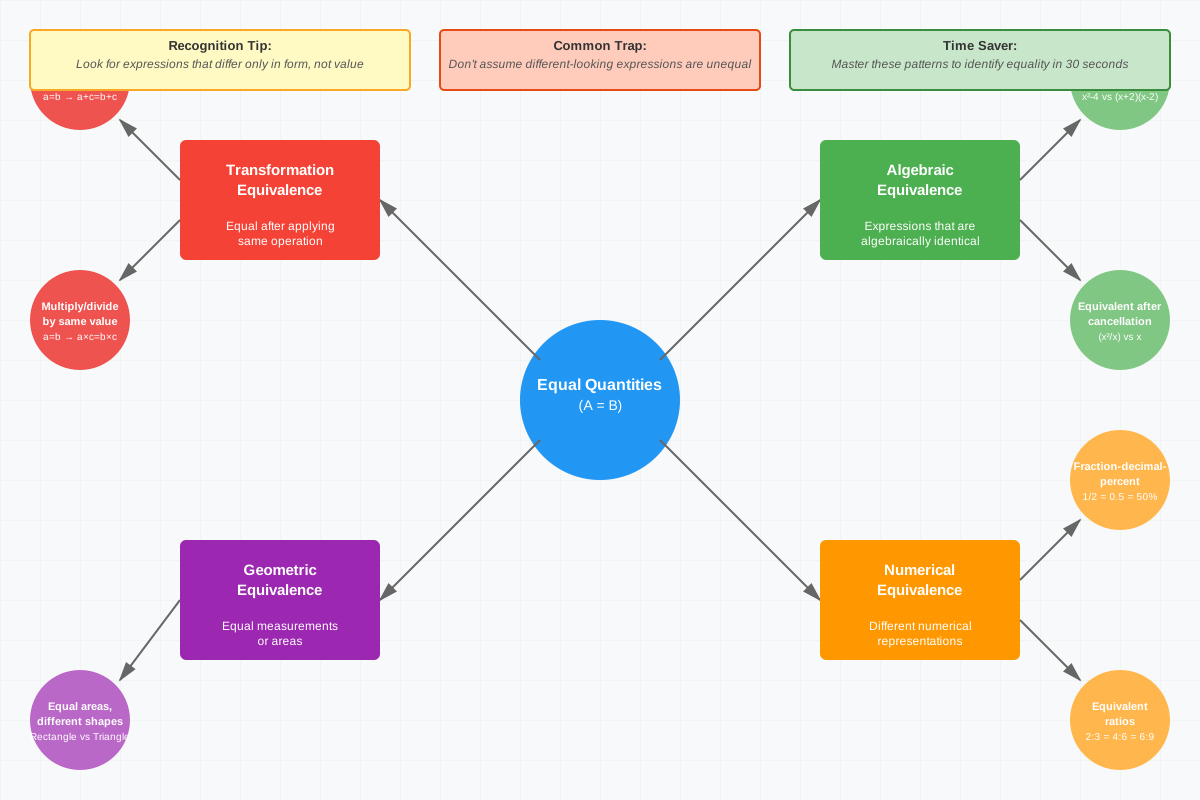
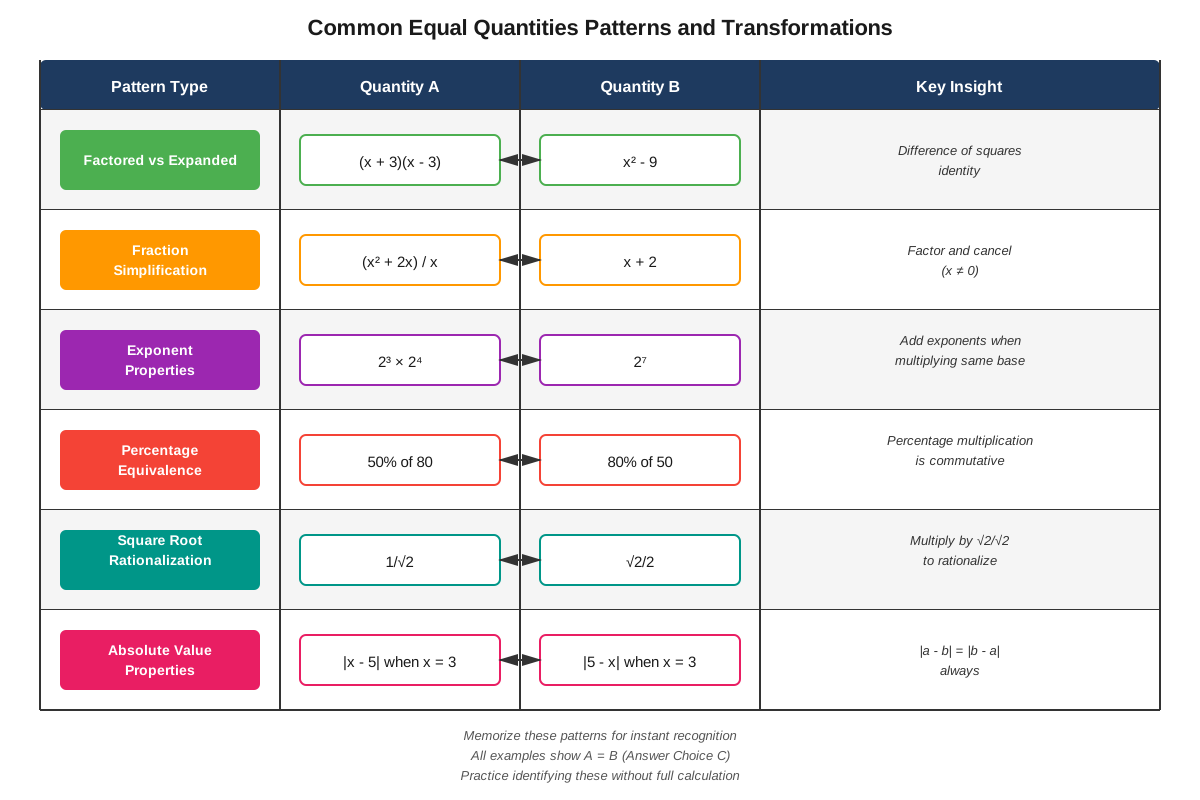
Algebraic equivalence forms the foundation of most equal quantities recognition. Two algebraic expressions are equivalent when they produce the same output for all valid input values. Common equivalence patterns include:
Distributive property applications: The expression 3(x + 2) equals 3x + 6 for all values of x. Recognizing these equivalent forms prevents unnecessary calculation.
Factored versus expanded forms: The expression x² - 4 equals (x + 2)(x - 2) for all x values. Both represent identical quantities despite appearing different.
Fraction simplification: The expression (2x + 4)/(x + 2) equals 2 for all x ≠ -2. Simplifying complex fractions often reveals equality.
Combining like terms: The expression 2x + 3x - x equals 4x for all x. Proper term combination is essential for recognizing equality.
Strategic Simplification Approaches
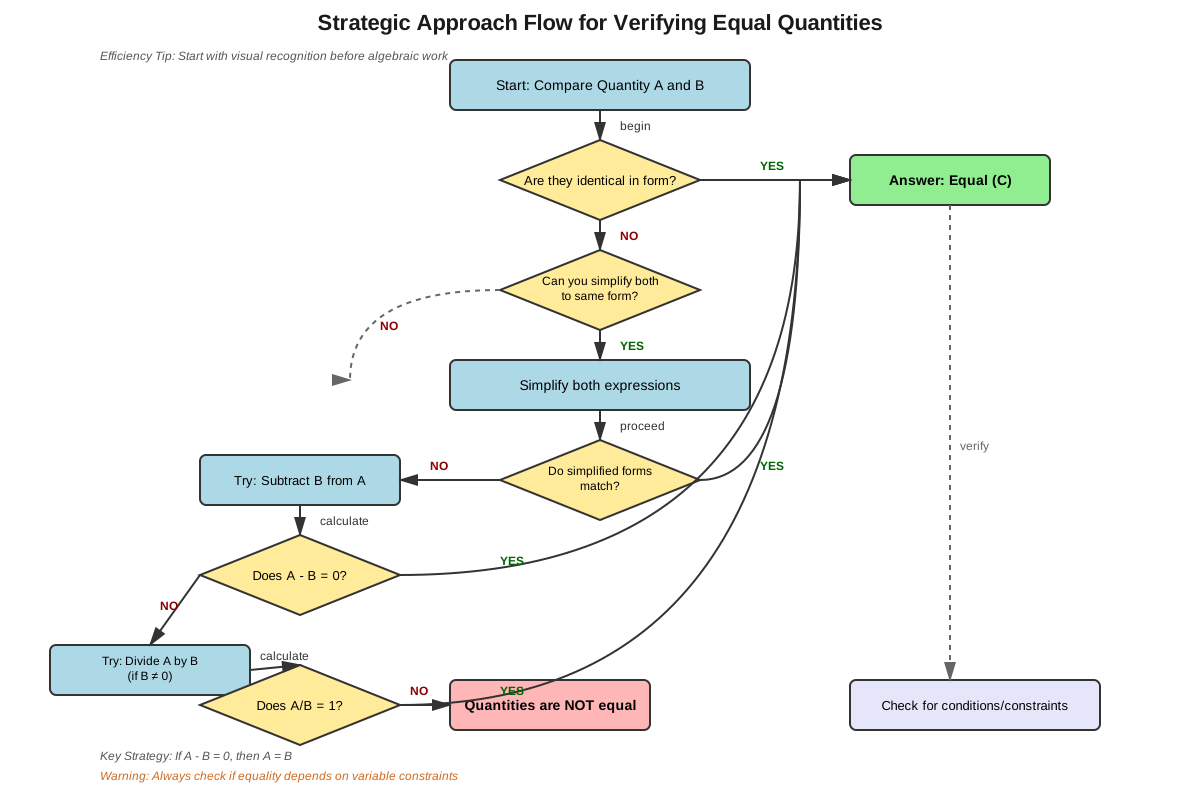
Rather than calculating exact values, strategic simplification focuses on transforming both quantities into comparable forms. The most effective approaches include:
- Subtract one quantity from the other: If Quantity A - Quantity B = 0, the quantities are equal
- Factor both expressions: Common factors often reveal hidden equality
- Find common denominators: Essential for comparing fractional expressions
- Expand or factor strategically: Choose the direction that makes comparison clearer
- Substitute simple values: Test with specific numbers to identify patterns (though this alone cannot prove equality)
Numerical Equivalence Patterns
Certain numerical patterns frequently appear in equal quantities questions:
| Pattern Type | Example | Explanation |
|---|---|---|
| Percentage equivalence | 50% of 80 vs. 40% of 100 | Both equal 40 |
| Ratio equivalence | 3:4 vs. 6:8 | Proportionally identical |
| Exponential equivalence | 2³ × 2² vs. 2⁵ | Both equal 32 |
| Fraction equivalence | 3/4 vs. 0.75 | Different representations of same value |
| Negative equivalence | -(-5) vs. 5 | Double negation equals positive |
Geometric Equal Quantities
Geometric problems often present equal quantities through different formulations:
Perimeter relationships: A square with side length 4 has the same perimeter as a rectangle with dimensions 2 × 6 (both equal 16).
Area equivalence: Different shapes can have equal areas despite different dimensions. A rectangle 3 × 4 has the same area as a rectangle 2 × 6 (both equal 12).
Angle relationships: Vertical angles are always equal; complementary angles that are both 45° are equal to each other.
Coordinate geometry: The distance from (0,0) to (3,4) equals the distance from (0,0) to (4,3), both equal 5 units.
Variable Constraints and Equality
When variables appear in equal quantities problems, constraints determine whether equality holds:
Unconditional equality: If Quantity A is x² - 2x + 1 and Quantity B is (x - 1)², these are equal for all x values because they are algebraically identical.
Conditional equality: If Quantity A is x and Quantity B is |x|, these are equal only when x ≥ 0. This represents "sometimes equal," making the answer D.
Constrained domains: When problems specify conditions like "x > 0" or "n is a positive integer," these constraints may create or eliminate equality scenarios.
Verification Techniques
To confirm equal quantities without extensive calculation:
Cross-multiplication for fractions: If a/b = c/d, then ad = bc. This technique quickly verifies fractional equality.
Substitution testing: While not proof, testing multiple values (including positive, negative, zero, and fractions) can reveal whether quantities might be equal.
Dimensional analysis: Quantities with different units or dimensions cannot be equal (e.g., area cannot equal perimeter).
Symmetry recognition: Symmetric expressions often indicate equality (e.g., xy and yx are always equal).
Concept Relationships
The core concepts within equal quantities form an interconnected system where algebraic equivalence serves as the foundation. Algebraic equivalence → enables → strategic simplification approaches, which in turn → facilitate → recognition of numerical equivalence patterns. These patterns → apply to → geometric equal quantities, creating a unified framework for identifying equality across mathematical domains.
Variable constraints and equality → determine → when algebraic equivalence holds universally versus conditionally, which → affects → the choice between answer C (always equal) and answer D (relationship cannot be determined). Verification techniques → validate → conclusions drawn from strategic simplification, creating a feedback loop that ensures accuracy.
This topic connects to prerequisite knowledge through direct application: basic algebraic manipulation → provides tools for → algebraic equivalence recognition; order of operations → ensures correct → strategic simplification; properties of equality → justify → verification techniques. The relationship extends to broader Quantitative Comparison strategies, where equal quantities recognition represents one of four possible relationship outcomes (A > B, A < B, A = B, or indeterminate).
High-Yield Facts
- ⭐ Two quantities are equal (answer C) only when they have the same value for ALL permissible values of any variables involved
- ⭐ Subtracting Quantity B from Quantity A and checking if the result equals zero is the most reliable method for verifying equality
- ⭐ Algebraically equivalent expressions (like x² - 4 and (x-2)(x+2)) are always equal quantities
- ⭐ If quantities are equal for some variable values but not others, the answer is D (cannot be determined), not C
- ⭐ Simplifying both quantities to their most reduced form before comparison prevents calculation errors
- Percentage of different bases can yield equal quantities (e.g., 25% of 80 = 50% of 40 = 20)
- Geometric figures with different shapes can have equal perimeters, areas, or volumes
- The order of operations in multiplication and addition does not affect equality (commutative property)
- Equivalent fractions (3/4 = 6/8 = 0.75) represent equal quantities despite different appearances
- Exponential expressions with the same base can be compared by comparing exponents when the quantities are equal
- Absolute value creates conditional equality: |x| = x only when x ≥ 0
- Factored and expanded forms of the same polynomial are always equal quantities
- Cross-multiplication preserves equality relationships in fractional comparisons
- Symmetric expressions (like a + b and b + a) are always equal by the commutative property
Quick check — test yourself on Equal quantities so far.
Try Flashcards →Common Misconceptions
Misconception: If two expressions look different, they cannot be equal quantities.
Correction: Algebraically equivalent expressions are equal even when they appear different. The expression 2(x + 3) equals 2x + 6 for all x values despite different forms. Always simplify before concluding inequality.
Misconception: Testing one or two values that produce equal results proves the quantities are always equal.
Correction: Testing specific values can suggest equality but never proves it. The quantities x and x² are equal when x = 0 and x = 1, but unequal for all other values. Only algebraic proof or simplification to identical forms establishes universal equality.
Misconception: Equal quantities must have the same variables and terms in the same order.
Correction: The commutative and associative properties mean that x + y equals y + x, and (a + b) + c equals a + (b + c). Order and grouping do not affect equality in addition and multiplication.
Misconception: If quantities are equal for all positive values, they are equal quantities (answer C).
Correction: Quantities must be equal for ALL permissible values, not just positive ones. If x² and x are equal for positive x but unequal for negative x, the answer is D, not C, unless the problem explicitly restricts x to positive values only.
Misconception: Complex expressions are less likely to be equal than simple ones.
Correction: Complexity of appearance does not correlate with equality likelihood. The GRE frequently presents equal quantities in complex forms to test simplification skills. The expression (x³ - x)/(x² + x) equals x - 1 for all x ≠ 0 and x ≠ -1, despite appearing complex.
Misconception: Geometric figures that look different cannot have equal measurements.
Correction: Different shapes can have equal perimeters, areas, or volumes. A circle with radius 2 has approximately the same area (12.57) as a square with side length 3.54. Visual appearance does not determine numerical equality.
Worked Examples
Example 1: Algebraic Expression Comparison
Problem:
- Quantity A: (x + 3)² - (x - 3)²
- Quantity B: 12x
Solution:
Step 1: Recognize that direct calculation would be time-consuming. Instead, expand Quantity A using the formula (a + b)² = a² + 2ab + b².
Quantity A: (x + 3)² - (x - 3)²
= (x² + 6x + 9) - (x² - 6x + 9)
= x² + 6x + 9 - x² + 6x - 9
Step 2: Combine like terms in Quantity A.
= (x² - x²) + (6x + 6x) + (9 - 9)
= 0 + 12x + 0
= 12x
Step 3: Compare the simplified Quantity A with Quantity B.
Quantity A: 12x
Quantity B: 12x
Step 4: Since both quantities simplify to exactly 12x for all values of x, they are equal for all x.
Answer: C (The two quantities are equal)
Connection to Learning Objectives: This example demonstrates applying equal quantities concepts through algebraic simplification (Objective 3) and recognizing when equality is being tested through complex algebraic forms (Objective 1). The strategic expansion and simplification illustrate the core strategy of transforming expressions to comparable forms (Objective 2).
Example 2: Geometric Comparison with Variables
Problem:
A rectangle has length L and width W, where L = 2W.
- Quantity A: The perimeter of the rectangle
- Quantity B: 6W
Solution:
Step 1: Write the formula for the perimeter of a rectangle.
Perimeter = 2L + 2W
Step 2: Substitute the given relationship L = 2W into the perimeter formula.
Quantity A = 2(2W) + 2W
= 4W + 2W
= 6W
Step 3: Compare with Quantity B.
Quantity A: 6W
Quantity B: 6W
Step 4: Check if this equality holds for all permissible values of W. Since W represents a width, W > 0, and the equality 6W = 6W holds for all positive W values.
Answer: C (The two quantities are equal)
Connection to Learning Objectives: This example shows identifying equal quantities in geometric contexts (Objective 1), applying the core strategy of substitution and simplification (Objective 2), and recognizing that equality holds under the given constraints (Objective 6). The problem demonstrates how different-looking quantities (a perimeter formula versus a simple expression) can be equal.
Exam Strategy
When approaching GRE Quantitative Comparison questions that may involve equal quantities, follow this systematic process:
Initial Assessment (5-10 seconds): Quickly scan both quantities to identify their mathematical form. Look for expressions that might be algebraically equivalent, geometric relationships that could yield equal measurements, or numerical calculations that might produce the same result.
Trigger Words and Phrases: Watch for these indicators that equal quantities might be the answer:
- "Simplified form" or "reduced form" in the problem setup
- Expressions with obvious algebraic relationships (factored vs. expanded)
- Geometric figures with related dimensions (e.g., "the width is half the length")
- Percentage or ratio problems with different bases
- Problems involving properties like commutativity or associativity
Strategic Approach:
- Don't calculate immediately: Resist the urge to compute exact numerical values. Instead, look for structural similarities.
- Simplify strategically: Transform the more complex quantity toward the simpler one's form, or simplify both to a common form.
- Use the subtraction method: Mentally or on paper, compute Quantity A - Quantity B. If this equals zero, the quantities are equal.
- Test boundary cases: If variables are involved, consider what happens at x = 0, x = 1, x = -1, and very large values. If quantities are equal at all test points AND you can see algebraic equivalence, answer C is likely correct.
- Verify universality: Before selecting C, confirm that equality holds for ALL permissible values, not just some values.
Process of Elimination:
- Eliminate A if you find any value where B ≥ A
- Eliminate B if you find any value where A ≥ B
- Eliminate C if you find any value where A ≠ B
- If you've eliminated A and B but found some values where A = B and others where A ≠ B, choose D
Time Allocation: Allocate 45-60 seconds for equal quantities questions. If simplification isn't revealing equality within 30 seconds, consider whether the answer might be D (relationship cannot be determined) or whether one quantity is consistently larger. Don't spend more than 90 seconds on any single Quantitative Comparison question.
Common Traps: The GRE often presents equal quantities in deliberately obscure forms to test whether you'll perform unnecessary calculations. If a problem seems to require extensive computation, step back and look for algebraic shortcuts or equivalence patterns.
Memory Techniques
SAFE Mnemonic for Equal Quantities Verification:
- Simplify both expressions to comparable forms
- Algebraic equivalence check (are they the same expression?)
- Factor or expand to reveal hidden equality
- Evaluate: subtract one from the other to check for zero
Visualization Strategy: Picture equal quantities as two different paths leading to the same destination. Just as you can reach a location via different routes, mathematical expressions can take different forms while representing the same value. When you see complex expressions, visualize "unwrapping" them to reveal the common core value inside.
The "Same Value, Different Outfit" Analogy: Think of algebraically equivalent expressions as the same person wearing different outfits. The expression 2(x + 3) and 2x + 6 are the same mathematical "person" in different "clothing." Your job is to recognize the person regardless of the outfit.
Acronym for Common Equal Patterns - PERFECT:
- Percentages of different bases
- Expanded vs. factored forms
- Ratios in different forms
- Fractions in equivalent forms
- Exponents with same base
- Commutative property applications
- Transformations preserving equality
The Zero Test Rhyme: "When in doubt, subtract it out—if you get zero, they're equal, no doubt!" This reminds you that Quantity A - Quantity B = 0 is the definitive test for equality.
Summary
Equal quantities represent a critical concept in GRE Quantitative Comparison questions, requiring test-takers to recognize when two different-looking mathematical expressions represent the same value. Mastery involves understanding that algebraic equivalence, strategic simplification, and systematic verification are more valuable than brute-force calculation. The key principle is that quantities are equal (answer C) only when they have identical values for ALL permissible values of any variables involved—conditional equality leads to answer D instead. Success requires recognizing common patterns including factored versus expanded forms, equivalent fractions, percentage calculations with different bases, and geometric measurements that appear different but are numerically identical. The most reliable verification method is simplifying both quantities to comparable forms or subtracting one from the other to check for zero. Students must distinguish between expressions that are always equal (algebraically equivalent) and those that are sometimes equal (conditionally equivalent), as this distinction determines the correct answer choice. Efficient equal quantities recognition saves valuable exam time and demonstrates the analytical reasoning skills the GRE is designed to assess.
Key Takeaways
- Equal quantities (answer C) requires equality for ALL permissible values, not just some values; conditional equality means answer D
- Algebraically equivalent expressions are always equal even when they appear different—simplify to reveal equivalence
- The subtraction method (Quantity A - Quantity B = 0?) is the most reliable verification technique
- Never rely solely on testing specific values to prove equality; algebraic verification is essential
- Common equal quantity patterns include factored/expanded forms, equivalent fractions, percentages of different bases, and commutative property applications
- Strategic simplification saves time—transform expressions to comparable forms rather than calculating exact values
- Geometric figures with different appearances can have equal measurements (perimeter, area, volume)
Related Topics
Quantitative Comparison Strategies: Understanding equal quantities is one component of the broader skill set for Quantitative Comparison questions, which also includes recognizing when one quantity is always greater, always less, or when the relationship cannot be determined. Mastering equal quantities provides the foundation for the complete Quantitative Comparison approach.
Algebraic Manipulation and Simplification: Advanced algebraic techniques including factoring, expanding, and rational expression simplification directly enable equal quantities recognition. Deepening these skills increases speed and accuracy in identifying equivalence.
Inequalities and Comparison: While equal quantities focuses on when expressions are identical, understanding inequalities helps distinguish between equal and unequal scenarios, particularly in determining when answer D (cannot be determined) is correct.
Number Properties and Equivalence: Exploring properties of integers, fractions, and real numbers reveals additional patterns of equality, such as equivalent representations of rational numbers and exponential expressions.
Geometric Relationships: Extending equal quantities concepts to geometric contexts involves understanding when different configurations yield equal measurements, connecting to topics like similar figures, area formulas, and coordinate geometry.
Practice CTA
Now that you've mastered the core concepts of equal quantities, it's time to solidify your understanding through active practice. Attempt the practice questions designed specifically for this topic, focusing on applying the strategic simplification approaches and verification techniques you've learned. Use the flashcards to reinforce high-yield facts and common patterns until recognition becomes automatic. Remember, the GRE rewards not just knowledge but efficient application—your goal is to identify equal quantities quickly and confidently, saving time for more complex problems. Each practice question you complete strengthens your pattern recognition and builds the analytical skills that lead to score improvements. Start practicing now to transform these concepts from theoretical knowledge into practical exam-day competence!
Sign up free to keep reading
Create a free AnvayaPrep account to finish this GRE guide on Equal quantities — plus flashcards and practice questions.