Overview
Always greater is a critical concept within GRE Quantitative Comparison questions that tests a student's ability to recognize when one quantity will consistently exceed another across all possible values of the variables involved. This concept appears frequently on the GRE and represents a fundamental reasoning skill that separates high-scoring test-takers from average performers. Understanding when one expression is always greater than another requires mastery of algebraic manipulation, inequality properties, and strategic thinking about variable constraints.
The GRE always greater strategy is essential because Quantitative Comparison questions make up approximately one-third of all Quantitative Reasoning questions on the exam. These questions present two quantities—Quantity A and Quantity B—and ask test-takers to determine their relationship. One of the four possible answer choices is "Quantity A is greater," which should only be selected when Quantity A is definitively, universally greater than Quantity B regardless of any variable values within the given constraints. Mastering this concept prevents costly errors where students incorrectly assume a relationship holds universally when it only applies to specific cases.
This topic connects directly to fundamental algebraic reasoning, inequality manipulation, and the broader Quantitative Comparison question format. Students who excel at identifying "always greater" relationships demonstrate strong conceptual understanding of how mathematical expressions behave across different domains, which is precisely the type of reasoning the GRE aims to assess. This skill also reinforces critical thinking about edge cases, special values, and the difference between "sometimes true" and "always true" mathematical statements.
Learning Objectives
- [ ] Identify when Always greater is being tested in Quantitative Comparison questions
- [ ] Explain the core rule or strategy behind Always greater determinations
- [ ] Apply Always greater reasoning to GRE-style questions accurately
- [ ] Distinguish between "always greater," "sometimes greater," and "never greater" relationships
- [ ] Test strategic values to disprove or confirm "always greater" claims
- [ ] Recognize algebraic transformations that preserve or reveal "always greater" relationships
- [ ] Avoid premature conclusions by systematically checking edge cases and special values
Prerequisites
- Basic algebra and equation manipulation: Essential for transforming expressions to compare quantities directly
- Understanding of inequalities: Required to determine when one expression exceeds another and how inequality signs behave under various operations
- Properties of positive and negative numbers: Critical for understanding how signs affect comparisons and when expressions change relative magnitude
- Exponent and square root rules: Necessary because many "always greater" questions involve powers and roots where behavior differs for values between 0 and 1 versus values greater than 1
- Quantitative Comparison question format: Students must understand the four answer choices and what each represents
Why This Topic Matters
The "always greater" concept is not merely an academic exercise—it represents fundamental logical reasoning applicable to data analysis, financial decision-making, and scientific research. In real-world contexts, professionals must frequently determine whether one option consistently outperforms another across all scenarios or only under specific conditions. This type of universal versus conditional reasoning is essential in fields ranging from economics to engineering.
On the GRE specifically, Quantitative Comparison questions constitute approximately 13 of the 40 questions in the Quantitative Reasoning sections (roughly 33%). Within these questions, "always greater" scenarios appear in an estimated 30-40% of problems, making this one of the highest-yield concepts for test preparation. The GRE deliberately designs these questions to trap students who make hasty generalizations based on testing only one or two values, or who fail to consider edge cases like zero, one, negative numbers, or fractions.
This topic commonly appears in questions involving: algebraic expressions with variables and constraints, geometric comparisons where relationships depend on specific conditions, number property questions involving even/odd or prime numbers, and statistical measures like mean versus median. The test-makers specifically craft "always greater" questions to reward systematic, thorough reasoning while penalizing intuitive but incomplete analysis.
Core Concepts
The Fundamental Definition of Always Greater
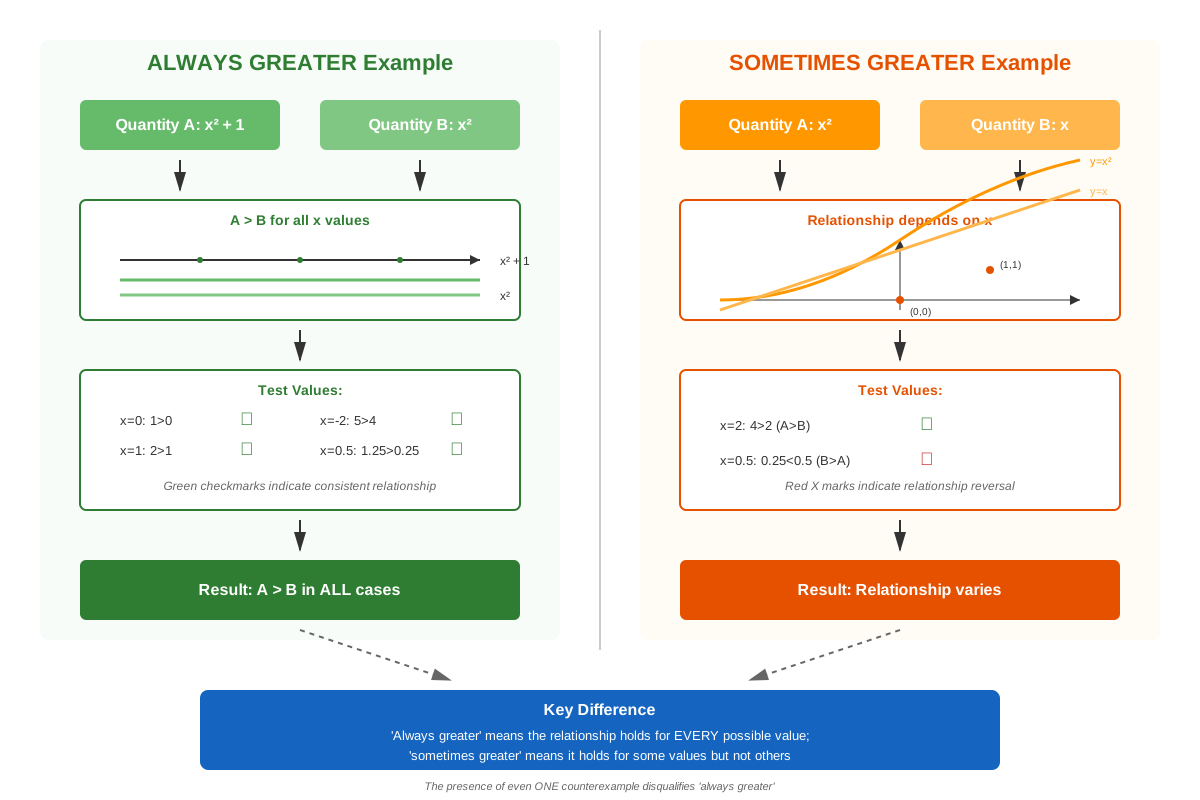
When we say Quantity A is always greater than Quantity B, we mean that for every possible value of any variables involved (within stated constraints), Quantity A exceeds Quantity B without exception. This is a universal claim requiring absolute certainty. A single counterexample—one case where Quantity A equals or is less than Quantity B—completely invalidates an "always greater" conclusion.
The mathematical notation for this concept is: A > B for all valid values of variables. This differs fundamentally from "A ≥ B" (greater than or equal to) or "A > B for some values" (sometimes greater). The GRE tests whether students understand this distinction and can verify universal claims through systematic analysis.
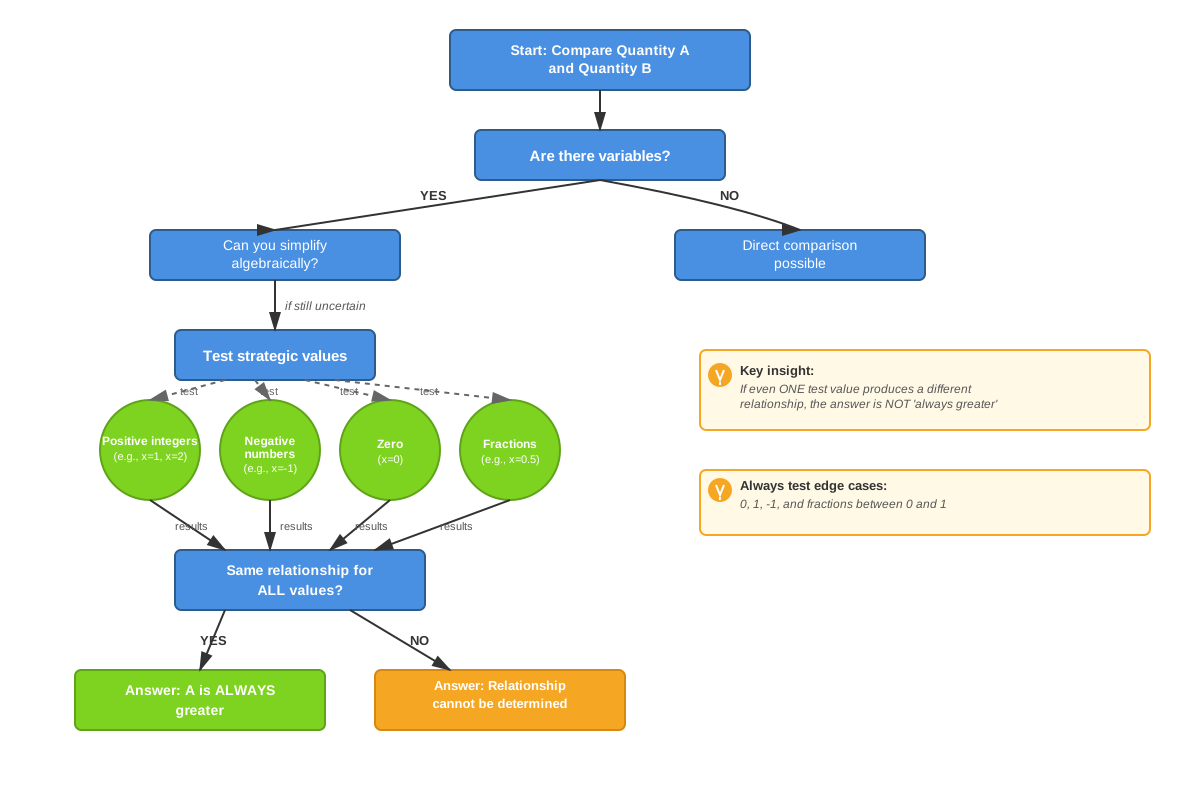
The Core Strategy: Strategic Value Testing
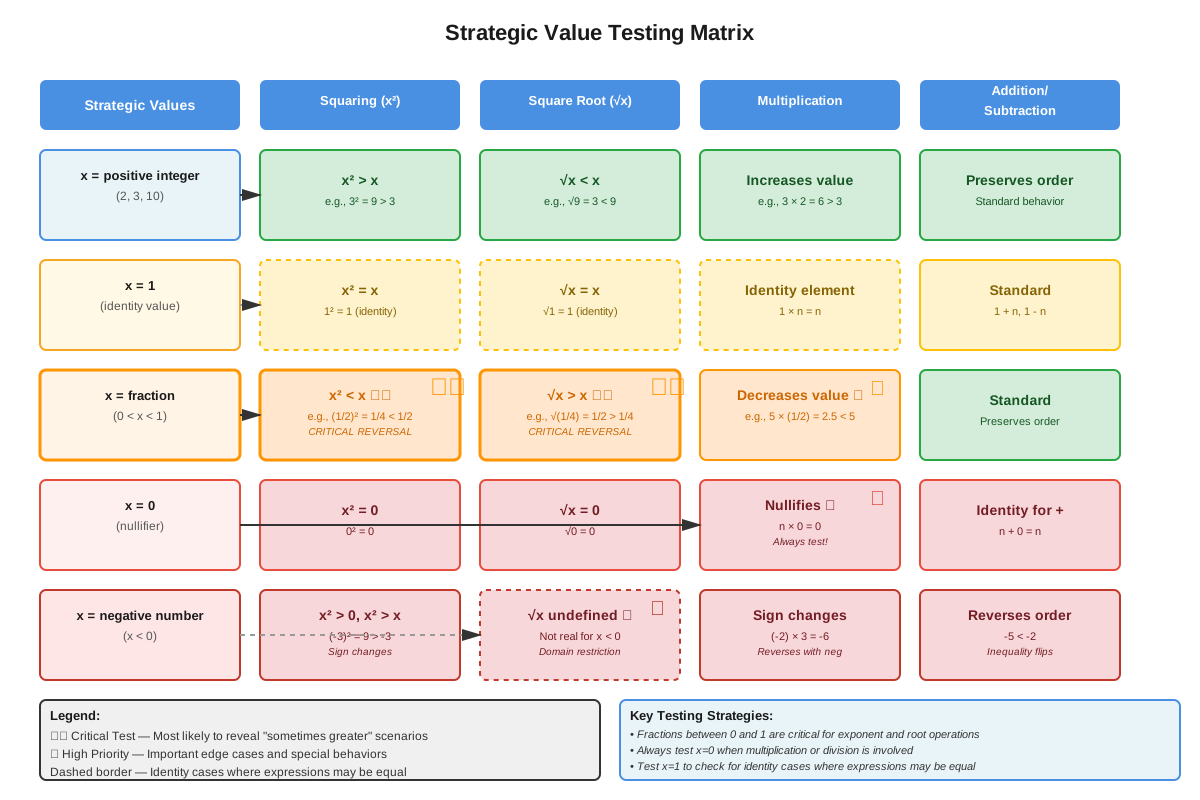
The primary method for determining "always greater" relationships involves strategic value testing—selecting specific values for variables that are most likely to reveal exceptions to a proposed relationship. Rather than randomly choosing values, expert test-takers systematically test:
- Zero: Often creates unexpected behavior in expressions
- One: The boundary where powers and roots behave differently
- Negative numbers: Reverse inequality relationships in many contexts
- Fractions between 0 and 1: Behave counterintuitively with exponents
- Very large numbers: Test behavior at extremes
- Very small numbers: Test behavior approaching zero
- Boundary values: Any limits specified in the problem constraints
If testing these strategic values produces even one case where Quantity A does not exceed Quantity B, then "Quantity A is always greater" cannot be the correct answer.
Algebraic Transformation Method
An alternative approach involves algebraically manipulating the comparison to create a definitive inequality. This method works by:
- Subtracting Quantity B from both sides to create: (Quantity A) - (Quantity B) compared to 0
- Simplifying the resulting expression
- Determining whether the simplified expression is always positive, always negative, or sign-dependent
For example, if Quantity A = x² + 4 and Quantity B = 2x where x is any real number:
- Form the difference: (x² + 4) - (2x) = x² - 2x + 4
- Complete the square: (x - 1)² + 3
- Since (x - 1)² ≥ 0 for all real x, we have (x - 1)² + 3 ≥ 3 > 0
- Therefore, Quantity A is always greater than Quantity B
Recognizing "Always Greater" Indicators
Certain mathematical structures reliably produce "always greater" relationships:
| Structure | Example | Why It's Always Greater | ||
|---|---|---|---|---|
| Positive constant added to expression | x² + 5 vs. x² | Adding positive value always increases result | ||
| Squared expression vs. zero | (x - 3)² vs. 0 | Squares are always non-negative, positive except at one point | ||
| Absolute value vs. negative | \ | x\ | vs. -5 | Absolute values are non-negative, always exceed negative numbers |
| Sum of positives vs. single positive | a² + b² + 1 vs. a² (where a, b real) | Additional positive terms increase sum |
The Danger of Insufficient Testing
The most common error in "always greater" questions is testing too few values or testing non-strategic values. Consider: Quantity A = x² and Quantity B = x, where x > 0.
A student might test x = 2: Quantity A = 4, Quantity B = 2, so A > B
Then test x = 3: Quantity A = 9, Quantity B = 3, so A > B
Based on these tests, the student might incorrectly conclude Quantity A is always greater. However, testing x = 0.5 reveals: Quantity A = 0.25, Quantity B = 0.5, so B > A. This single counterexample proves Quantity A is not always greater, making the correct answer "The relationship cannot be determined from the information given."
Constraint Analysis
Many GRE questions include constraints on variables (e.g., "x > 5" or "n is a positive integer"). These constraints fundamentally affect "always greater" determinations. The relationship must hold for all values within the constraints, but values outside the constraints are irrelevant.
For instance, if x > 1 is given as a constraint, then x² > x is indeed always true within that constraint, even though it fails for 0 < x < 1. The key is recognizing what domain the "always" applies to—it's always within the stated constraints, not necessarily for all real numbers.
Special Cases and Edge Behavior
Certain values create special behavior that often determines whether "always greater" holds:
- Zero in denominators: Creates undefined expressions
- Zero in exponents: Any non-zero base to the zero power equals 1
- Negative bases with even vs. odd exponents: Affects sign of result
- Comparing expressions near boundaries: Behavior at x = 1 often differs from x = 1.1 or x = 0.9
Concept Relationships
The "always greater" concept serves as the foundation for correctly answering Quantitative Comparison questions, which in turn requires integration of multiple mathematical domains. The logical flow proceeds as follows:
Algebraic manipulation → enables → Expression simplification → reveals → Always greater relationships
Inequality properties → govern → How comparisons change under operations → determines → Valid transformation methods
Strategic value testing → identifies → Counterexamples → disproves → Incorrect "always greater" claims
The concept connects backward to prerequisite knowledge of basic algebra and inequalities, which provide the tools for manipulation and comparison. It connects forward to more advanced Quantitative Reasoning topics like optimization, where determining maximum and minimum values requires understanding when one expression consistently exceeds another.
Within the topic itself, the algebraic transformation method and strategic value testing method complement each other: algebraic transformation provides definitive proof when successful, while strategic value testing offers a practical approach when algebraic manipulation becomes complex. Both methods rely on understanding special cases and constraint analysis to avoid errors.
Quick check — test yourself on Always greater so far.
Try Flashcards →High-Yield Facts
⭐ A single counterexample completely disproves an "always greater" claim—if Quantity A is not greater than Quantity B for even one valid value, "Quantity A is greater" cannot be the answer.
⭐ Always test x = 0, x = 1, x = -1, and fractions between 0 and 1 when variables are involved—these values reveal the majority of exceptions to proposed "always greater" relationships.
⭐ Squared expressions are always non-negative—(expression)² ≥ 0 for all real values, which often creates "always greater" relationships when compared to negative quantities.
⭐ For 0 < x < 1, higher powers are smaller: x² < x < √x, which reverses the typical relationship seen when x > 1.
⭐ Adding a positive constant to an expression always increases it—if Quantity A = (expression) + k where k > 0, and Quantity B = (expression), then Quantity A is always greater.
- Absolute values are always non-negative—|x| ≥ 0 for all real x, making |x| always greater than any negative number.
- When comparing expressions with variables, constraints matter critically—x² > x is not always true for all real x, but is always true when x > 1.
- Multiplying both sides of an inequality by a negative number reverses the inequality sign—this affects how you can manipulate comparisons algebraically.
- The sum of positive quantities always exceeds any single component—if a > 0 and b > 0, then a + b > a and a + b > b.
- Even powers eliminate sign information—x² = (-x)², so comparisons involving even powers require careful consideration of whether the original value was positive or negative.
Common Misconceptions
Misconception: If Quantity A is greater than Quantity B for several tested values, then Quantity A is always greater.
Correction: Testing confirms "always greater" only if you test all possible values (impossible) or use strategic values likely to reveal exceptions. A few confirmatory tests never prove a universal claim; they only fail to disprove it yet. You must either test all critical special values or use algebraic proof.
Misconception: When x² appears in Quantity A and x appears in Quantity B, x² is always greater because squaring makes numbers bigger.
Correction: Squaring makes numbers larger in absolute value only when |x| > 1. For 0 < x < 1, squaring makes numbers smaller (e.g., 0.5² = 0.25 < 0.5). For -1 < x < 0, x² is positive while x is negative, so x² > x, but for x < -1, the relationship depends on the specific value.
Misconception: If the problem states x > 0, then x must be a positive integer.
Correction: Unless explicitly stated as an integer, x > 0 includes all positive real numbers: integers, fractions, decimals, and irrational numbers. Always consider fractions between 0 and 1 when testing, as they often behave differently than integers.
Misconception: Algebraic manipulation always preserves the inequality relationship.
Correction: Most operations preserve inequalities (adding/subtracting the same value to both sides, multiplying/dividing by positive values), but multiplying or dividing both sides by a negative number reverses the inequality sign. Additionally, squaring both sides only preserves the inequality if both sides are known to be positive.
Misconception: If Quantity A equals Quantity B for one value, then the answer must be "The two quantities are equal."
Correction: The answer "The two quantities are equal" means they are equal for all possible values within the constraints. If they're equal for some values but not others, the correct answer is "The relationship cannot be determined from the information given."
Misconception: Complex expressions are more likely to be "always greater" than simple ones.
Correction: Complexity has no correlation with "always greater" relationships. Simple expressions like x² can fail to be always greater than x, while complex expressions might consistently exceed simpler ones. The mathematical structure, not the complexity, determines the relationship.
Worked Examples
Example 1: Algebraic Expression with Constraint
Problem:
- Quantity A: n² + 2n + 5
- Quantity B: n² + 10
- Given: n is a real number
Solution:
Step 1: Recognize this as an "always greater" test. We need to determine if one quantity consistently exceeds the other for all real numbers n.
Step 2: Use the algebraic transformation method. Subtract Quantity B from Quantity A:
(n² + 2n + 5) - (n² + 10) = 2n + 5 - 10 = 2n - 5
Step 3: Determine when 2n - 5 is positive, negative, or zero:
- 2n - 5 > 0 when n > 2.5 (Quantity A is greater)
- 2n - 5 = 0 when n = 2.5 (Quantities are equal)
- 2n - 5 < 0 when n < 2.5 (Quantity B is greater)
Step 4: Since the relationship changes depending on n's value, neither quantity is always greater.
Answer: The relationship cannot be determined from the information given.
Connection to Learning Objectives: This example demonstrates how to identify when "always greater" is being tested (Objective 1), apply the core algebraic transformation strategy (Objective 2), and recognize that variable behavior prevents an "always greater" conclusion (Objective 3).
Example 2: Testing Strategic Values
Problem:
- Quantity A: x³
- Quantity B: x²
- Given: x ≠ 0
Solution:
Step 1: Identify that this tests "always greater" with a variable and constraint. The constraint x ≠ 0 means we must consider positive, negative, and fractional values, but not zero.
Step 2: Apply strategic value testing:
Test x = 2 (positive integer > 1):
- Quantity A: 2³ = 8
- Quantity B: 2² = 4
- Result: A > B
Test x = 0.5 (fraction between 0 and 1):
- Quantity A: (0.5)³ = 0.125
- Quantity B: (0.5)² = 0.25
- Result: B > A (This is a counterexample!)
Step 3: Since we found a value where Quantity B is greater, Quantity A is not always greater.
Step 4: Test another value to confirm the relationship varies:
Test x = -2 (negative number):
- Quantity A: (-2)³ = -8
- Quantity B: (-2)² = 4
- Result: B > A
Answer: The relationship cannot be determined from the information given.
Connection to Learning Objectives: This example shows how to identify "always greater" testing (Objective 1), apply strategic value testing as the core strategy (Objective 2), distinguish between "sometimes greater" and "always greater" (Objective 4), and use strategic values to disprove universal claims (Objective 5).
Exam Strategy
Primary Strategy: Never select "Quantity A is greater" or "Quantity B is greater" unless you have either algebraically proven the relationship holds universally or systematically tested all critical special values without finding a counterexample.
Trigger Words and Phrases
Watch for these indicators that "always greater" reasoning is being tested:
- Questions with variables and minimal constraints
- Expressions involving powers, roots, or absolute values
- Phrases like "for all values" or "for any value"
- Comparisons between similar expressions with small differences
- Problems where the quantities look similar but have subtle variations
Systematic Approach
- Identify the domain (2 seconds): What values can the variables take? Are there constraints?
- Look for obvious relationships (5 seconds): Can you immediately see that one quantity is the other plus something positive?
- Test strategic values (20-30 seconds): Test in this order:
- Zero (if allowed)
- One
- A fraction between 0 and 1
- A negative number (if allowed)
- A number greater than 1
- If all tests point the same direction, verify algebraically (20 seconds): Subtract one quantity from the other and determine if the result is always positive or always negative.
- Select your answer (5 seconds): Choose based on your findings.
Process of Elimination
- Eliminate "The two quantities are equal" unless they're identical expressions or you've proven equality for all values
- Eliminate "Quantity A is greater" or "Quantity B is greater" if you find even one counterexample
- Default to "The relationship cannot be determined" when in doubt, especially if you found the relationship changes for different values
Time Allocation
Spend no more than 60-90 seconds on Quantitative Comparison questions. If strategic value testing doesn't quickly reveal a pattern within 30 seconds, and algebraic manipulation isn't immediately obvious, make an educated guess and move on. These questions are designed to be solved quickly by those who know the strategies, not through exhaustive analysis.
Memory Techniques
ZONES Mnemonic for strategic values to test:
- Zero
- One
- Negative numbers
- Extremes (very large or very small)
- Small fractions (between 0 and 1)
"Square Root Reversal" Visualization: Picture a number line with 1 as the dividing point. For values to the right of 1, squaring moves you further right (makes bigger). For values between 0 and 1, squaring moves you left toward zero (makes smaller). This visual helps remember that x² > x only when x > 1 or x < 0.
"ONE Exception Ends Everything" Rule: Remember that just ONE counterexample completely destroys an "always greater" claim. Visualize a chain where one broken link breaks the entire chain—that's how universal claims work.
PANS Acronym for algebraic transformation:
- Positive result means first quantity always greater
- Always simplify the difference completely
- Negative result means second quantity always greater
- Sign-dependent result means relationship cannot be determined
Summary
The "always greater" concept is fundamental to success on GRE Quantitative Comparison questions, requiring students to distinguish between universal mathematical relationships and conditional ones. Mastery involves two complementary approaches: strategic value testing and algebraic transformation. Strategic value testing involves systematically checking special values—particularly zero, one, negative numbers, and fractions between zero and one—to identify counterexamples that disprove proposed "always greater" relationships. Algebraic transformation involves manipulating expressions to definitively prove whether one quantity consistently exceeds another. The critical insight is that a single counterexample completely invalidates an "always greater" claim, making thorough testing essential. Students must recognize that constraints on variables define the domain over which "always" applies, and that certain mathematical structures (like squared expressions plus positive constants) reliably create "always greater" relationships. Success requires avoiding the common trap of generalizing from insufficient testing and understanding how different types of numbers (integers, fractions, negatives) behave differently in expressions involving powers, roots, and other operations.
Key Takeaways
- One counterexample destroys any "always greater" claim—systematic testing of strategic values (0, 1, -1, fractions) is essential before concluding one quantity is always greater
- The algebraic transformation method provides definitive proof—subtracting one quantity from another and determining if the result is always positive or negative eliminates uncertainty
- Constraints define the domain of "always"—a relationship can be "always greater" within stated constraints even if it fails outside them
- Fractions between 0 and 1 behave counterintuitively—they become smaller when squared and larger when square-rooted, opposite to integers greater than 1
- Squared expressions plus positive constants create reliable "always greater" relationships—structures like (x - a)² + b where b > 0 are always positive
- Never generalize from testing only positive integers—the GRE specifically designs questions to trap students who don't test negative numbers and fractions
- When in doubt, the answer is usually "The relationship cannot be determined"—if you find different results for different test values, neither quantity is always greater
Related Topics
Quantitative Comparison Question Format: Understanding the four answer choices and when each applies is essential context for "always greater" reasoning. Mastering this topic enables more efficient analysis of all Quantitative Comparison questions.
Inequality Manipulation: Advanced techniques for solving and transforming inequalities directly support algebraic approaches to "always greater" problems. This includes understanding how operations affect inequality signs.
Function Behavior and Domain Analysis: Deeper study of how functions behave across different domains extends "always greater" reasoning to more complex mathematical relationships tested in higher-difficulty GRE questions.
Number Properties: Understanding how different categories of numbers (integers, rationals, reals, primes, even/odd) behave in expressions enhances strategic value testing and helps identify which test values are most revealing.
Algebraic Expressions and Factoring: Advanced factoring techniques and expression manipulation enable more sophisticated algebraic transformation approaches to proving "always greater" relationships.
Practice CTA
Now that you understand the "always greater" concept and strategies, it's time to cement your knowledge through practice. Attempt the practice questions associated with this topic, focusing on applying both strategic value testing and algebraic transformation methods. Use the flashcards to reinforce the high-yield facts and special cases that frequently appear on the GRE. Remember: mastery comes not from passive reading but from active problem-solving. Each practice question you work through builds the pattern recognition and strategic thinking that will enable you to quickly and accurately handle "always greater" questions on test day. You've learned the strategies—now prove to yourself that you can execute them under exam conditions!
Sign up free to keep reading
Create a free AnvayaPrep account to finish this GRE guide on Always greater — plus flashcards and practice questions.