Overview
Testing numbers is one of the most powerful and frequently used strategies in GRE Quantitative Reasoning, particularly within Quantitative Comparison questions. This technique involves strategically selecting specific values to substitute into algebraic expressions, inequalities, or abstract statements to determine relationships between quantities or to evaluate the truth of mathematical claims. Rather than attempting to solve problems algebraically—which can be time-consuming or unnecessarily complex—testing numbers allows test-takers to quickly assess relationships by examining concrete examples.
The GRE testing numbers strategy is essential because the exam frequently presents questions where the relationship between two quantities depends on the properties of the numbers involved. For instance, a relationship that holds true for positive integers might fail for negative numbers, fractions, or zero. By systematically testing different categories of numbers (positive, negative, zero, fractions, etc.), students can either confirm that a relationship always holds or find a counterexample that disproves it. This approach is particularly valuable in Quantitative Comparison questions, where the goal is to determine whether Quantity A is greater, Quantity B is greater, the quantities are equal, or the relationship cannot be determined.
Within the broader context of Quantitative Reasoning, testing numbers bridges algebraic thinking and number sense. It requires understanding number properties (odd/even, positive/negative, fractions/integers) while applying them to solve problems efficiently. This strategy complements algebraic manipulation but often provides faster solutions, making it indispensable for time management on the GRE. Mastering this technique enhances overall problem-solving flexibility and builds confidence in tackling abstract mathematical relationships.
Learning Objectives
- [ ] Identify when testing numbers is being tested
- [ ] Explain the core rule or strategy behind testing numbers
- [ ] Apply testing numbers to GRE-style questions accurately
- [ ] Determine which categories of numbers to test based on question context
- [ ] Recognize when testing numbers yields a definitive answer versus when it reveals indeterminacy
- [ ] Combine testing numbers with algebraic reasoning to verify conclusions
- [ ] Avoid common pitfalls such as testing insufficient cases or drawing premature conclusions
Prerequisites
- Basic algebra: Understanding variables, expressions, and equation manipulation is necessary because testing numbers involves substituting values into algebraic expressions
- Number properties: Knowledge of integers, fractions, positive/negative numbers, zero, and their behaviors under operations is essential for selecting appropriate test values
- Quantitative Comparison format: Familiarity with the four answer choices (A: Quantity A is greater, B: Quantity B is greater, C: The two quantities are equal, D: The relationship cannot be determined) is required to apply the strategy effectively
Why This Topic Matters
Testing numbers represents a critical thinking skill that extends beyond standardized testing into real-world problem-solving. In fields such as engineering, computer science, and data analysis, professionals regularly test edge cases and specific values to verify whether algorithms, formulas, or models work correctly under various conditions. This same logical approach—checking whether a general statement holds by examining particular instances—forms the foundation of mathematical proof by counterexample.
On the GRE, testing numbers appears in approximately 20-30% of Quantitative Comparison questions and frequently in Problem Solving questions involving inequalities, absolute values, or algebraic expressions with variables. The strategy is particularly prevalent in medium to hard difficulty questions where algebraic solutions become cumbersome or where the test-makers deliberately design problems to reward strategic thinking over computational prowess.
Common question formats include: comparing expressions with variables where no specific values are given; evaluating statements about number properties; determining whether inequalities always hold; and analyzing relationships that depend on the sign or magnitude of variables. The GRE specifically designs questions where naive algebraic approaches lead to errors, making testing numbers not just helpful but often necessary for accurate answers. Questions may present scenarios like "If x > y, compare x² and y²" where the relationship depends critically on whether the numbers are positive, negative, or include zero.
Core Concepts
The Fundamental Strategy
Testing numbers is a problem-solving technique where specific numerical values are substituted for variables to evaluate mathematical relationships or statements. Rather than working abstractly with variables, this approach grounds the problem in concrete examples. The core principle is that if a mathematical relationship is claimed to always be true, finding even one counterexample disproves it. Conversely, if testing multiple diverse cases consistently yields the same result, this provides strong evidence (though not absolute proof) that the relationship holds generally.
The strategy is particularly powerful because it transforms abstract algebraic problems into arithmetic calculations, which are typically faster and less error-prone. However, the technique requires careful selection of test values and systematic coverage of different number categories to ensure reliable conclusions.
Categories of Numbers to Test
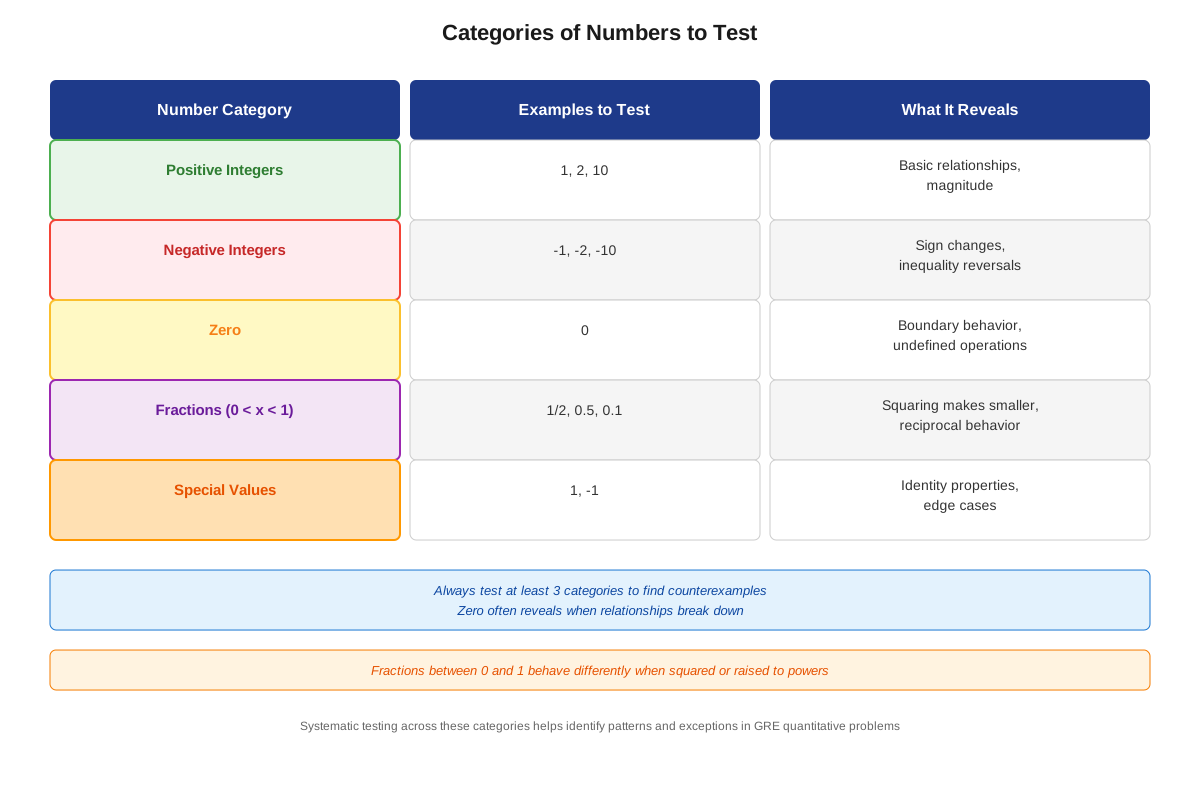
Effective application of testing numbers requires understanding which values to choose. The GRE exploits differences in how various number types behave under mathematical operations. The essential categories include:
| Number Category | Examples | Why Test These |
|---|---|---|
| Positive integers | 1, 2, 3, 10 | Most intuitive; often the first values tested |
| Negative integers | -1, -2, -5 | Behavior changes dramatically (e.g., squaring makes positive) |
| Zero | 0 | Unique properties (multiplication yields zero, division undefined) |
| Positive fractions | 1/2, 0.5, 3/4 | Squaring makes smaller; different from integers |
| Negative fractions | -1/2, -0.25 | Combines fraction and negative properties |
| One | 1 | Identity for multiplication; special exponent behavior |
| Negative one | -1 | Sign-changing properties; special exponent behavior |
When to Apply Testing Numbers
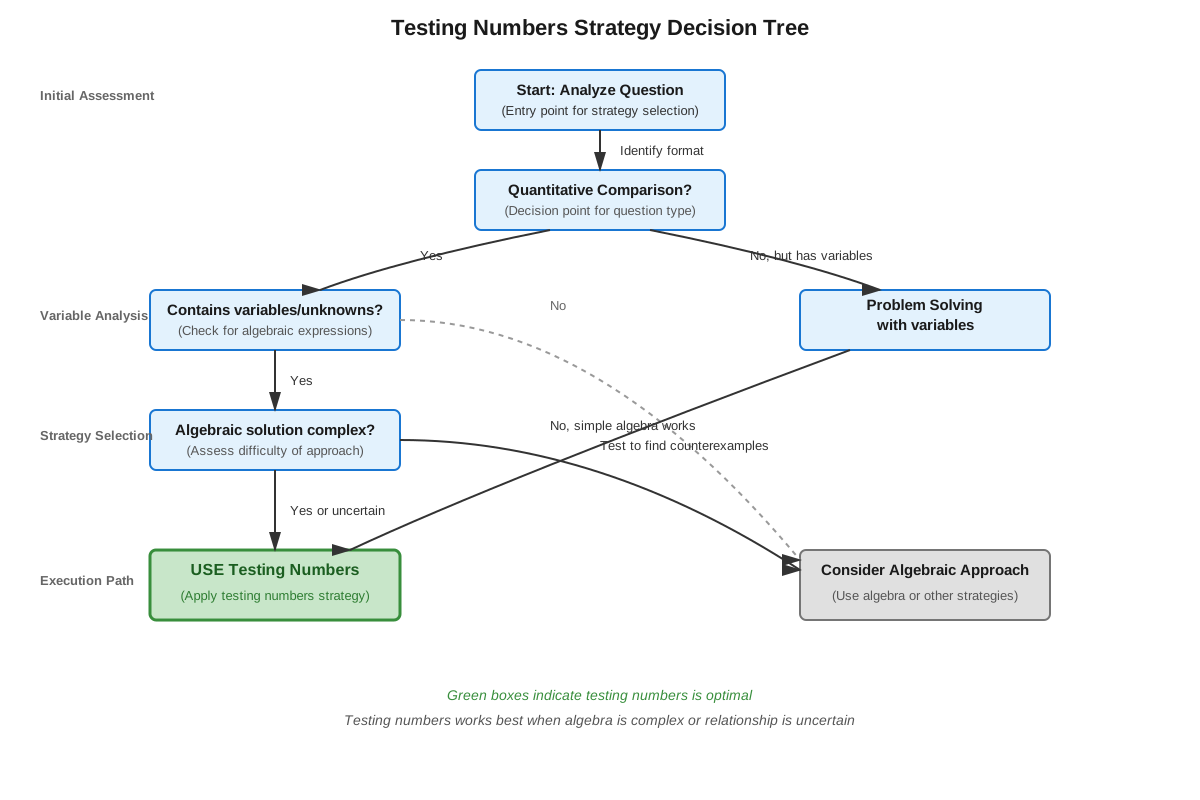
Recognizing appropriate situations for testing numbers is crucial. Key indicators include:
- Variables without specified values: When a problem presents expressions with x, y, or other variables but provides only relationships (like x > 0 or x > y) rather than specific values
- Quantitative Comparison questions: Especially when comparing two algebraic expressions
- "Must be true" or "could be true" questions: Where you need to verify whether statements hold universally or find counterexamples
- Complex algebraic expressions: When direct algebraic manipulation would be time-consuming or error-prone
- Questions involving inequalities: Where the relationship between quantities depends on number properties
The Systematic Testing Process
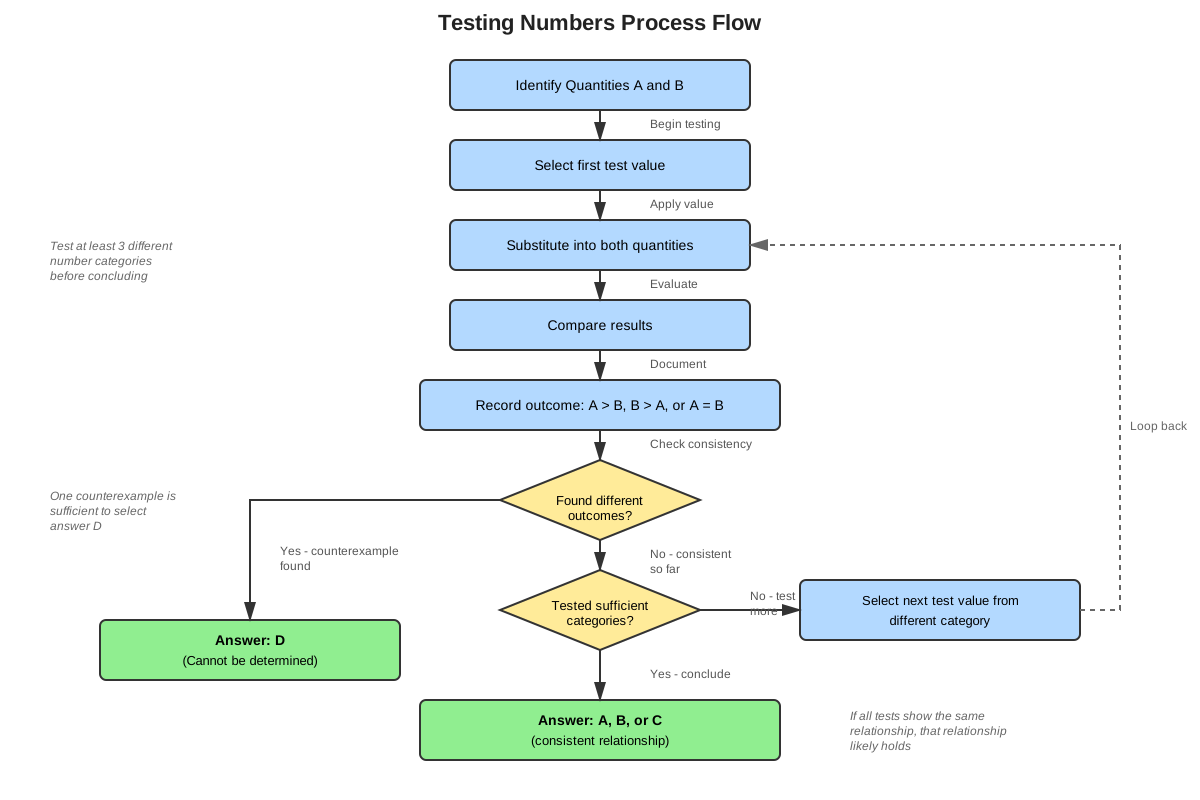
To apply testing numbers effectively, follow this structured approach:
- Identify the constraint: Determine what restrictions apply to the variables (e.g., x > 0, x and y are integers, x ≠ y)
- Select diverse test values: Choose numbers from different categories that satisfy the constraints
- Calculate both quantities: Substitute each test value and compute the results
- Compare results: Determine the relationship for each test case
- Analyze patterns: Look for consistency or variation across test cases
- Draw conclusions: Decide whether the relationship is always the same (answer A, B, or C) or varies (answer D)
Critical Insight: Proving vs. Disproving
Understanding the logical asymmetry in testing numbers is essential:
- To disprove a universal claim: Only one counterexample is needed. If testing reveals that Quantity A is greater for one value but Quantity B is greater for another, the answer is definitively D (relationship cannot be determined)
- To prove a universal claim: Testing multiple cases provides evidence but not absolute proof. However, on the GRE, if systematic testing of diverse number types consistently yields the same relationship, this is typically sufficient to select answers A, B, or C with confidence
This asymmetry means testing numbers is most powerful for identifying answer D situations. When testing reveals different relationships for different values, you can confidently select D immediately.
Special Values with Unique Properties
Certain numbers have properties that make them particularly valuable test cases:
- Zero: Additive identity; makes products zero; undefined in denominators; neither positive nor negative
- One: Multiplicative identity; any number to the first power equals itself; 1² = 1
- Negative one: Changes signs; (-1)² = 1 but (-1)³ = -1
- Fractions between 0 and 1: Squaring makes them smaller (0.5² = 0.25)
- Fractions between -1 and 0: Squaring makes them positive and smaller in absolute value
Combining Testing Numbers with Algebra
While testing numbers is powerful, combining it with algebraic reasoning provides the most robust approach:
- Use testing numbers to quickly assess the relationship
- If testing suggests a consistent pattern, verify algebraically if time permits
- If testing reveals answer D, no further verification is needed
- Use algebra to understand why certain patterns emerge from testing
Concept Relationships
The testing numbers strategy connects intimately with several mathematical concepts. At its foundation, it relies on number properties—understanding how different types of numbers (integers, fractions, positive, negative, zero) behave under operations like addition, multiplication, and exponentiation. This knowledge determines which test values to select.
Testing numbers directly supports Quantitative Comparison problem-solving by providing a systematic method to evaluate the four possible relationships between quantities. The strategy transforms abstract comparisons into concrete calculations, making the comparison format more accessible.
The technique also connects to algebraic reasoning in a complementary relationship: testing numbers → generates hypotheses about relationships → algebraic proof confirms or explains patterns. Conversely, when algebra becomes too complex, testing numbers → provides alternative solution path → yields answer more efficiently.
Within problem-solving methodology, the flow is: identify variable constraints → select appropriate test values → calculate and compare → recognize patterns → draw conclusions. Each step depends on the previous one, creating a logical chain that leads to the correct answer.
The strategy also relates to logical reasoning and proof techniques. Testing numbers employs proof by counterexample (finding one case that disproves a claim) and inductive reasoning (observing patterns across multiple cases to form conclusions).
Quick check — test yourself on Testing numbers so far.
Try Flashcards →High-Yield Facts
⭐ Testing numbers is most valuable in Quantitative Comparison questions where variables lack specific values
⭐ Finding two test cases that yield different relationships (A is greater in one case, B is greater in another) definitively proves the answer is D
⭐ Always test zero, positive, negative, and fractional values when no constraints exclude them
⭐ Fractions between 0 and 1 behave differently from integers: squaring makes them smaller
⭐ Negative numbers change relationships when squared (become positive) or cubed (remain negative)
- Testing one or two values is rarely sufficient; systematic testing across number categories is essential
- The numbers 0, 1, -1, 2, and 1/2 are the most frequently useful test values
- When constraints specify "positive integers," you cannot test fractions, zero, or negative numbers
- If testing consistently shows Quantity A is greater across all valid test cases, answer A is likely correct
- Testing numbers does not constitute mathematical proof but provides strong evidence on timed exams
Common Misconceptions
Misconception: Testing one or two convenient numbers (like 1 and 2) is sufficient to determine the relationship.
Correction: The GRE specifically designs questions where relationships change based on number properties. You must test diverse categories including negative numbers, fractions, and zero (when allowed) to avoid incorrect conclusions.
Misconception: If testing shows the same relationship three times, the relationship must always hold.
Correction: While consistent results across diverse test cases provide strong evidence, you must ensure your test values represent different number categories. Testing 2, 3, and 4 (all positive integers) doesn't reveal how negative numbers or fractions behave.
Misconception: Testing numbers works for all GRE math questions.
Correction: Testing numbers is most effective for Quantitative Comparisons and questions with variables. For questions requiring specific numerical answers or those involving defined values, direct calculation or algebraic methods are more appropriate.
Misconception: When testing reveals answer D, you should continue testing more numbers to be certain.
Correction: Once you find two cases yielding different relationships, you have definitively proven the answer is D. Further testing wastes valuable time.
Misconception: You should always test the same standard set of numbers regardless of the problem.
Correction: The constraints in each problem determine which numbers are valid test cases. If a problem states "x > 5," testing x = 2 is meaningless. Always respect the given constraints when selecting test values.
Misconception: Testing numbers is a "guessing strategy" or less rigorous than algebra.
Correction: Testing numbers is a legitimate mathematical technique (proof by counterexample) that is often more efficient and less error-prone than complex algebraic manipulation on timed exams.
Worked Examples
Example 1: Classic Quantitative Comparison
Question: Given that x ≠ 0
Quantity A: x²
Quantity B: x
Solution:
Step 1: Identify the constraint
The only restriction is x ≠ 0, so we can test positive numbers, negative numbers, and fractions (but not zero).
Step 2: Test a positive integer
Let x = 2
- Quantity A: 2² = 4
- Quantity B: 2
- Result: Quantity A is greater
Step 3: Test a positive fraction
Let x = 1/2
- Quantity A: (1/2)² = 1/4
- Quantity B: 1/2
- Result: Quantity B is greater (since 1/4 < 1/2)
Step 4: Analyze results
We found two different relationships: A is greater when x = 2, but B is greater when x = 1/2.
Step 5: Draw conclusion
Since the relationship changes depending on the value of x, the answer is D (the relationship cannot be determined).
Connection to learning objectives: This example demonstrates identifying when testing numbers applies (variables without specific values), applying the strategy systematically, and recognizing that different test values yield different relationships, indicating answer D.
Example 2: Testing with Constraints
Question: Given that x > y > 0
Quantity A: x/y
Quantity B: 1
Solution:
Step 1: Identify constraints
Both x and y are positive, and x is greater than y. We cannot test negative numbers or zero.
Step 2: Test case where x is much larger than y
Let x = 10, y = 2
- Quantity A: 10/2 = 5
- Quantity B: 1
- Result: Quantity A is greater
Step 3: Test case where x and y are close
Let x = 1.5, y = 1
- Quantity A: 1.5/1 = 1.5
- Quantity B: 1
- Result: Quantity A is greater
Step 4: Test case with fractions
Let x = 0.6, y = 0.5
- Quantity A: 0.6/0.5 = 1.2
- Quantity B: 1
- Result: Quantity A is greater
Step 5: Consider the mathematical principle
Since x > y and both are positive, x/y must be greater than y/y = 1. Every test case confirms this.
Step 6: Draw conclusion
All test cases consistently show Quantity A is greater, and the mathematical reasoning supports this. The answer is A (Quantity A is greater).
Connection to learning objectives: This example shows how to respect constraints when selecting test values, demonstrates testing diverse cases within those constraints, and illustrates when consistent results across multiple tests indicate a definitive answer (A, B, or C rather than D).
Exam Strategy
When approaching GRE questions where testing numbers applies, follow this strategic framework:
Recognition triggers: Watch for these phrases and formats that signal testing numbers opportunities:
- "Given that x > 0" or similar constraint statements without specific values
- Quantitative Comparison questions with algebraic expressions containing variables
- Questions asking "which must be true" or "which could be false"
- Expressions involving exponents, absolute values, or operations where sign matters
Time allocation: Testing numbers typically takes 30-60 seconds when done efficiently. If you find yourself testing more than 4-5 values, you may be overthinking—either the pattern should be clear, or you've found answer D.
Strategic selection process:
- Start with simple positive integers (like 2 or 3) to get initial sense
- Immediately test a fraction between 0 and 1 (like 1/2) since behavior often differs
- Test a negative number (like -2) if constraints allow
- Test zero if constraints allow and it's not in a denominator
- Consider special values (1, -1) if relevant to the operations involved
Process of elimination approach:
- If your first two test values yield different relationships, immediately select D without further testing
- If three diverse test values (positive integer, fraction, negative) all yield the same relationship, confidently select A, B, or C
- If constraints severely limit options (like "positive integers only"), test fewer values but ensure you cover small and large cases
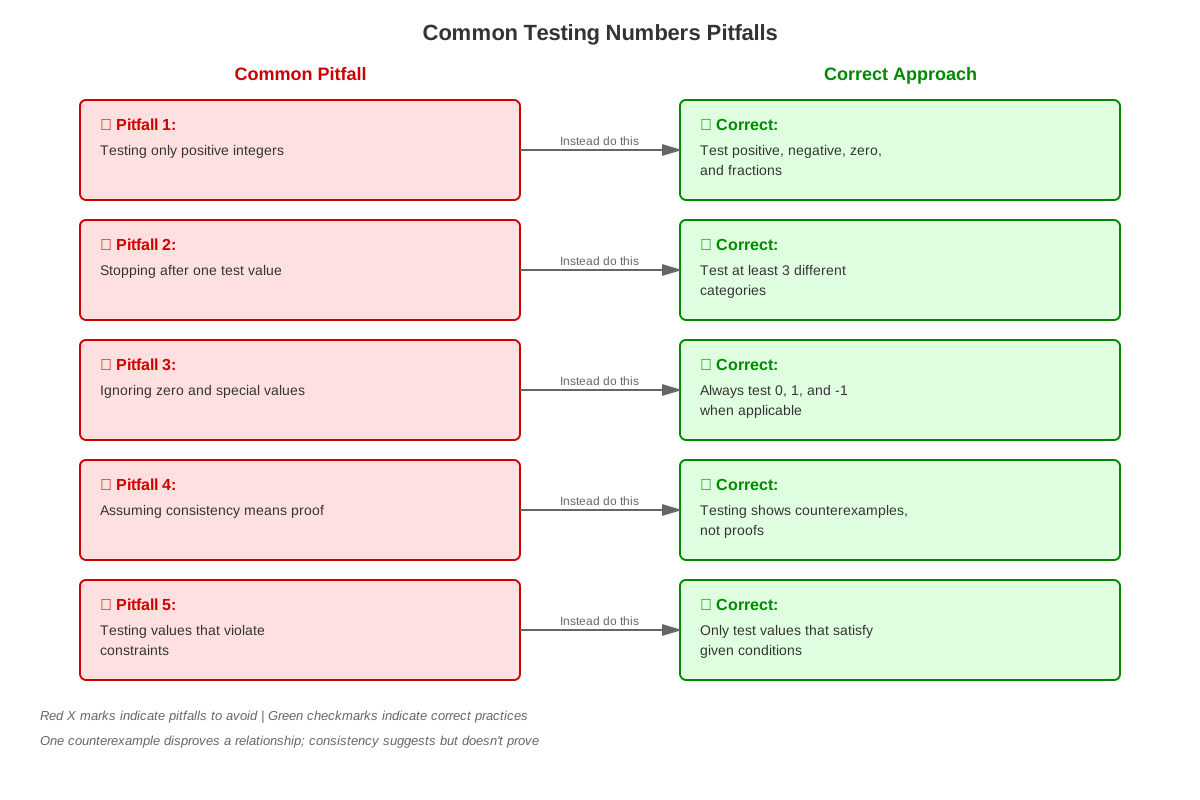
Common traps to avoid:
- Don't test only positive integers; the GRE exploits differences between integers and fractions
- Don't forget zero—it has unique properties that often reveal answer D
- Don't ignore negative numbers unless explicitly excluded
- Don't assume a pattern from similar test values (testing 2, 3, 4 doesn't reveal fraction behavior)
Exam Tip: If you're unsure whether you've tested enough values, ask yourself: "Have I tested numbers from fundamentally different categories?" If you've tested positive, negative, fraction, and integer cases, you've likely covered the essential ground.
Memory Techniques
ZOPNIF Acronym: When deciding which numbers to test, remember Z-O-P-N-I-F:
- Zero (if allowed)
- One (special multiplicative properties)
- Positive integers (2, 3, 5)
- Negative integers (-1, -2)
- Intermediate fractions (1/2, 3/4)
- Fractional negatives (-1/2)
The "Different Relationships = D" Rule: Visualize a fork in the road—if your test values lead to different relationships (one path shows A > B, another shows B > A), you've reached answer D. This mental image reinforces that finding divergent results immediately determines the answer.
The "Fraction Flip" Reminder: Remember that fractions between 0 and 1 behave "opposite" to integers greater than 1:
- Squaring integers makes them bigger (2² = 4)
- Squaring small fractions makes them smaller (0.5² = 0.25)
- This "flip" is why testing fractions is crucial
The "Sign Switch" Visualization: For negative numbers, visualize operations as switches:
- Squaring: flips negative to positive (light switch ON)
- Cubing: keeps negative (switch stays OFF)
- Multiplying by negative: flips sign (toggle switch)
The "Three-Category Minimum" Rule: Hold up three fingers to remember you need at least three fundamentally different test cases: one positive, one negative (if allowed), and one fraction (if allowed). This physical reminder helps ensure thorough testing.
Summary
Testing numbers is an essential GRE Quantitative Reasoning strategy that involves substituting specific numerical values for variables to evaluate mathematical relationships and expressions. This technique is particularly powerful in Quantitative Comparison questions where algebraic manipulation would be time-consuming or where relationships depend on number properties. The core principle is systematic: select diverse test values from different categories (positive integers, negative integers, zero, fractions) that satisfy any given constraints, calculate the resulting quantities, and analyze whether the relationship remains consistent or varies. Finding even one case where the relationship differs from others definitively proves answer D (relationship cannot be determined), while consistent results across diverse test cases provide strong evidence for answers A, B, or C. Success requires understanding which numbers to test, recognizing when the strategy applies, and avoiding the common pitfall of testing insufficient or overly similar values. By mastering testing numbers, students gain a flexible, efficient tool that complements algebraic reasoning and significantly improves accuracy and speed on GRE quantitative questions.
Key Takeaways
- Testing numbers transforms abstract algebraic problems into concrete arithmetic calculations, making them faster and less error-prone
- Always test diverse number categories: positive integers, negative integers, zero (if allowed), and fractions between 0 and 1
- Finding two test cases that yield different relationships immediately proves answer D in Quantitative Comparison questions
- Fractions between 0 and 1 behave fundamentally differently from integers greater than 1, especially under squaring operations
- Respect problem constraints when selecting test values—if x > 5, don't test x = 2
- Testing numbers is most valuable when variables lack specific values and in Quantitative Comparison formats
- Combine testing numbers with algebraic reasoning for the most robust problem-solving approach
Related Topics
Quantitative Comparison Strategies: Testing numbers is one of several specialized approaches for Quantitative Comparison questions. Mastering this topic enables progression to other strategies like picking numbers, algebraic manipulation, and estimation techniques that work synergistically with testing numbers.
Number Properties: Deep understanding of how integers, fractions, positive/negative numbers, and zero behave under various operations enhances testing numbers effectiveness. Further study of number properties reveals why certain test values expose different relationships.
Inequalities: Testing numbers frequently applies to inequality problems. Advanced study of inequality manipulation and solving provides algebraic verification for patterns discovered through testing numbers.
Exponents and Roots: Many testing numbers applications involve exponential expressions where behavior varies dramatically based on whether bases are positive, negative, greater than one, or between zero and one. Further study reveals systematic patterns.
Algebraic Expressions: Understanding how to manipulate and simplify algebraic expressions complements testing numbers by providing alternative solution methods and verification techniques.
Practice CTA
Now that you understand the testing numbers strategy, it's time to cement your mastery through practice. The concepts you've learned—selecting diverse test values, recognizing when relationships vary, and systematically evaluating quantities—become automatic only through application. Attempt the practice questions to experience how testing numbers accelerates your problem-solving and improves accuracy. Work through the flashcards to reinforce the key categories of numbers to test and the recognition triggers for this strategy. Remember: every GRE question you solve using testing numbers builds your confidence and speed for test day. You've gained a powerful tool—now sharpen it through deliberate practice!
Sign up free to keep reading
Create a free AnvayaPrep account to finish this GRE guide on Testing numbers — plus flashcards and practice questions.