Overview
Choosing strategic numbers is one of the most powerful and versatile problem-solving techniques for GRE Quantitative Reasoning, particularly within Quantitative Comparison questions. This approach involves selecting specific numerical values to test algebraic relationships, inequalities, and abstract mathematical statements. Rather than attempting to solve problems algebraically—which can be time-consuming and error-prone—strategic number selection allows test-takers to evaluate relationships quickly by substituting carefully chosen values that reveal the behavior of expressions under different conditions.
The technique is essential because many GRE questions, especially Quantitative Comparisons, present variables without specific values and ask students to determine relationships between two quantities. By systematically testing strategic numbers—including positive integers, negative integers, fractions, zero, and one—students can often determine whether a relationship always holds, never holds, or varies depending on the values chosen. This method transforms abstract algebraic problems into concrete numerical evaluations that are faster to compute and easier to verify.
GRE choosing strategic numbers connects to broader Quantitative Reasoning concepts including algebraic manipulation, inequality properties, number properties, and logical reasoning. It serves as a bridge between pure algebraic thinking and numerical intuition, allowing students to leverage both approaches. Mastery of this technique significantly improves accuracy and speed on Quantitative Comparison questions, which constitute approximately one-third of the Quantitative Reasoning section, making it a high-yield investment of study time.
Learning Objectives
- [ ] Identify when Choosing strategic numbers is being tested
- [ ] Explain the core rule or strategy behind Choosing strategic numbers
- [ ] Apply Choosing strategic numbers to GRE-style questions accurately
- [ ] Select the most revealing strategic numbers for different mathematical scenarios
- [ ] Recognize when strategic number testing proves a relationship is indeterminate
- [ ] Combine strategic number selection with algebraic reasoning for maximum efficiency
- [ ] Avoid common pitfalls when choosing numbers that fail to test edge cases
Prerequisites
- Basic algebra: Understanding variables, expressions, and equation manipulation is necessary because strategic numbers substitute into algebraic expressions
- Integer properties: Knowledge of positive/negative numbers, even/odd distinctions, and zero properties helps identify which strategic numbers to test
- Fraction and decimal operations: Competence with non-integer values is essential since many relationships behave differently with fractions than with whole numbers
- Inequality concepts: Understanding how inequalities work enables proper interpretation of results when testing strategic numbers
- Quantitative Comparison format: Familiarity with the four answer choices (A: Quantity A is greater, B: Quantity B is greater, C: The two quantities are equal, D: The relationship cannot be determined) is required to apply this technique effectively
Why This Topic Matters
Strategic number selection is not merely an academic exercise—it represents a fundamental problem-solving approach used in fields ranging from engineering to economics, where testing specific cases helps validate general principles. In software development, programmers use similar techniques called "boundary testing" to ensure code works correctly under extreme conditions. Scientists employ analogous methods when testing hypotheses with carefully selected experimental conditions.
On the GRE specifically, choosing strategic numbers appears in approximately 40-50% of Quantitative Comparison questions and 20-30% of Problem Solving questions involving variables. The Educational Testing Service (ETS) deliberately designs questions where algebraic manipulation is possible but time-consuming, rewarding students who can efficiently test strategic values. Questions involving this technique typically appear at all difficulty levels, from medium to very hard, making it essential for achieving scores above the 160 threshold.
Common question formats include: comparing algebraic expressions with unspecified variables; evaluating inequalities with multiple variables; determining properties of unknown numbers given certain constraints; and analyzing geometric relationships with variable dimensions. The technique is particularly prevalent in questions involving exponents, absolute values, and expressions where sign changes significantly affect outcomes. Students who master strategic number selection typically save 30-45 seconds per question compared to purely algebraic approaches, a significant advantage given the time pressure of the GRE.
Core Concepts
The Fundamental Strategy
Choosing strategic numbers involves selecting specific numerical values to substitute for variables in mathematical expressions or relationships. The core principle is that if a relationship holds for all possible values, testing several strategic cases should consistently support that relationship. Conversely, if even one strategic number produces a different result, the relationship does not always hold, and the answer must reflect this variability.
The technique works because mathematical relationships must be universally true to be definitive. If Quantity A is claimed to always be greater than Quantity B, this must hold for every permissible value. Finding even a single counterexample disproves the universal claim. This logical foundation makes strategic number testing both powerful and reliable when executed correctly.
Categories of Strategic Numbers
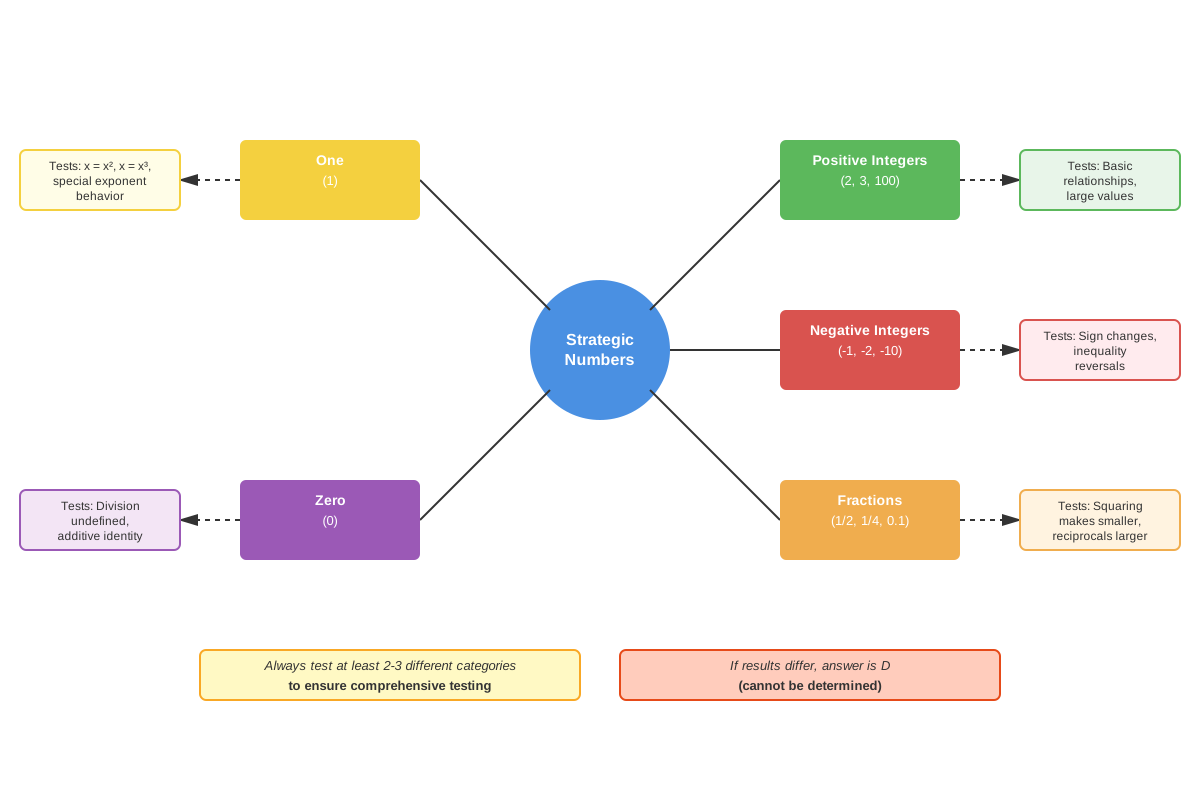
Not all numbers are equally revealing. The most strategic choices systematically test different mathematical behaviors:
| Number Type | Why Strategic | When to Use |
|---|---|---|
| 1 | Multiplicative identity; exponents behave uniquely | Expressions with exponents, multiplication |
| 0 | Additive identity; makes products zero | Addition, multiplication, testing if zero is allowed |
| -1 | Tests negative behavior; odd powers stay negative | Expressions with variables that could be negative |
| 2 | Simple positive integer; easy calculations | General positive integer testing |
| 1/2 | Tests fraction behavior between 0 and 1 | Expressions where fractions behave differently than integers |
| -2 | Simple negative integer | Testing negative integer behavior |
| Large numbers (100) | Tests behavior as values increase | Expressions with growth rates, comparisons |
| Small fractions (1/100) | Tests behavior approaching zero | Division, expressions with reciprocals |
The Systematic Testing Process
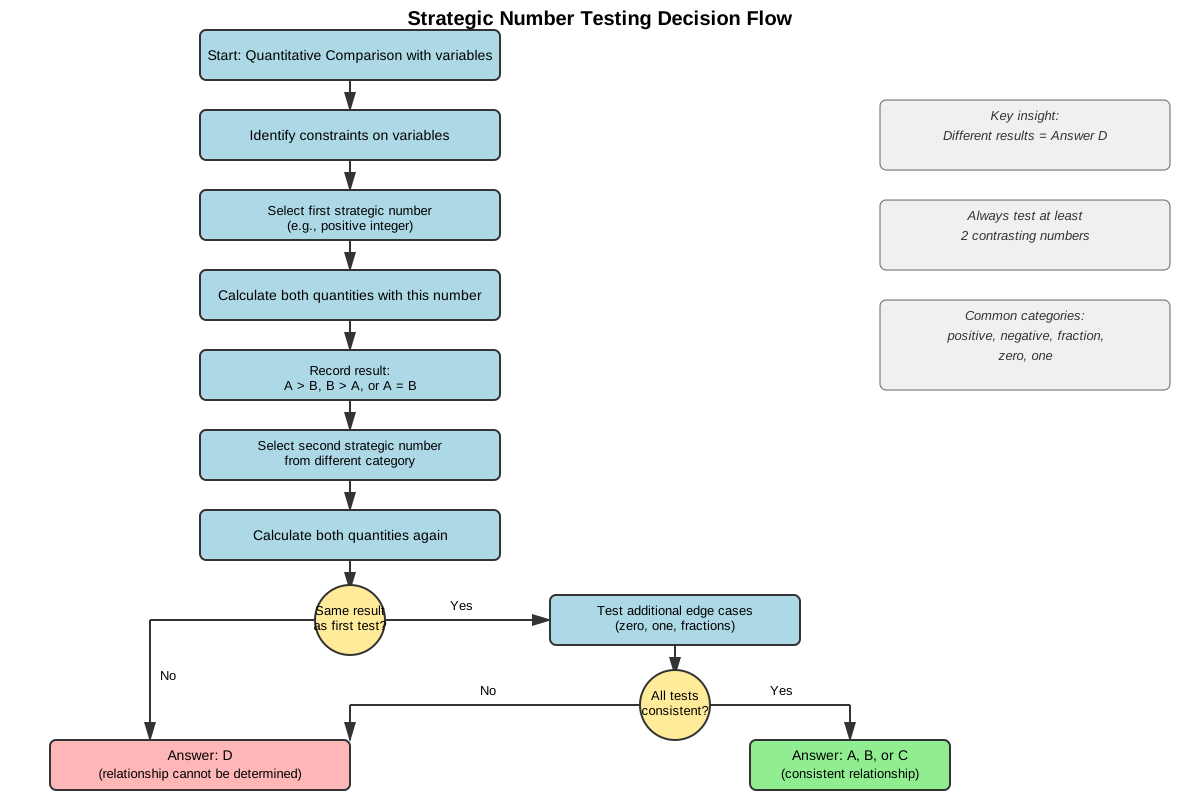
- Identify the variables: Determine which quantities are unspecified and what constraints apply (positive only, non-zero, integer, etc.)
- Select strategic numbers: Choose 3-5 values from different categories that respect the constraints
- Substitute and calculate: Compute both quantities for each strategic number
- Analyze patterns: Observe whether one quantity is consistently larger, whether they're equal, or whether the relationship changes
- Draw conclusions:
- If Quantity A is always larger → Answer A
- If Quantity B is always larger → Answer B
- If they're always equal → Answer C
- If the relationship changes → Answer D
Recognizing When to Use This Technique
Strategic number selection is most appropriate when:
- Variables appear without specific values: Questions present expressions like "x > 0" or "n is an integer" without giving exact values
- Algebraic manipulation seems complex: The algebraic approach would require multiple steps or advanced techniques
- Quantitative Comparison format: The question asks to compare two quantities rather than solve for a specific value
- Multiple variables interact: Expressions contain two or more variables whose relationship isn't immediately clear
- Time pressure exists: A quick numerical check would be faster than formal algebra
The technique is less appropriate when:
- Variables are already specified with exact values
- The question asks for a specific numerical answer from multiple choices
- Algebraic simplification is straightforward and quick
- The relationship involves complex functions where strategic numbers might miss subtle behaviors
Edge Cases and Boundary Testing
The most revealing strategic numbers often lie at boundaries or special cases:
- Zero: Tests whether expressions are defined at zero and how they behave
- One: Reveals whether exponents and multiplicative relationships behave as expected
- Negative values: Exposes sign-dependent behaviors, especially with even/odd powers
- Fractions between 0 and 1: Shows whether expressions increase or decrease with values less than one
- Very large/small values: Tests limiting behavior and dominance of terms
Effective strategic number selection prioritizes these edge cases because they most frequently reveal when relationships are indeterminate. For example, when comparing x² and x, testing x = 2 shows 4 > 2, but testing x = 1/2 shows 1/4 < 1/2, immediately proving the relationship varies (Answer D).
Common Patterns and Behaviors
Certain mathematical structures exhibit predictable patterns with strategic numbers:
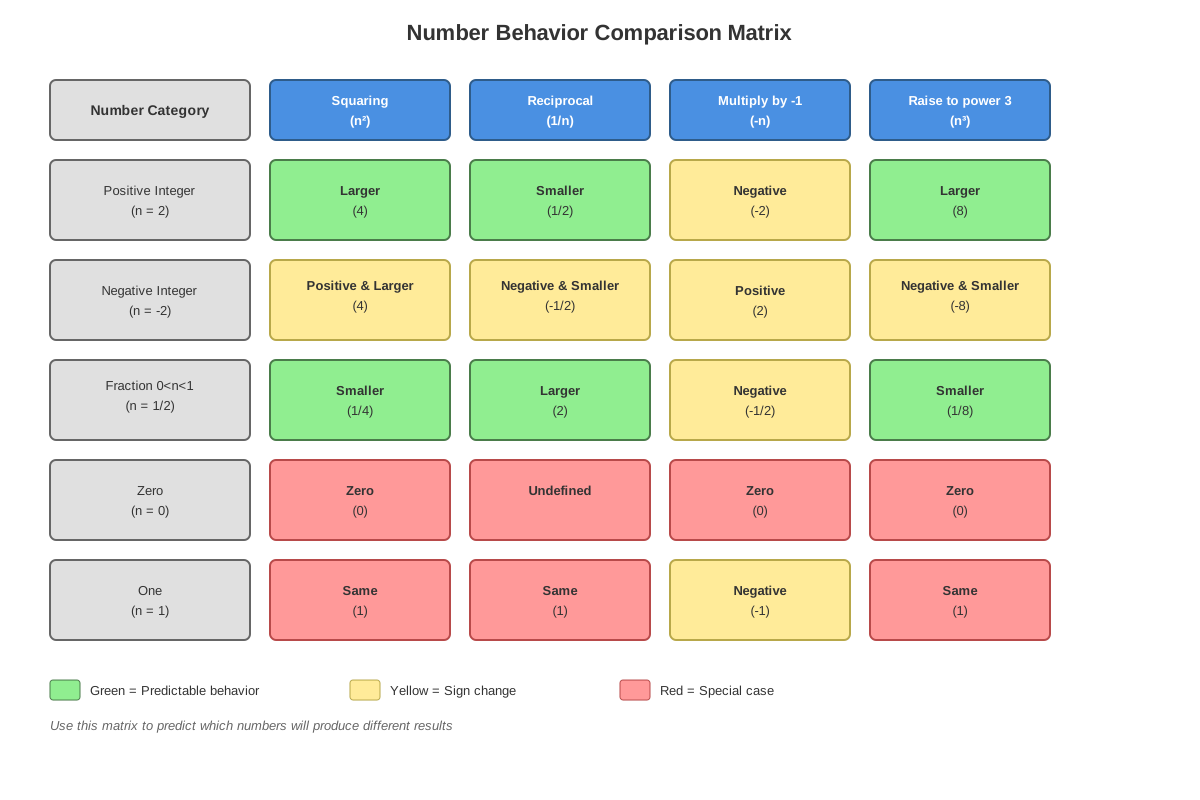
Exponents: When 0 < x < 1, higher powers decrease (x² < x < x^(1/2)). When x > 1, higher powers increase (x < x² < x³).
Products vs. Sums: For positive numbers greater than 1, products grow faster than sums. For fractions between 0 and 1, products decrease while sums increase.
Absolute values: These eliminate sign information, so testing both positive and negative values is essential.
Reciprocals: Large numbers have small reciprocals and vice versa, creating inverse relationships.
Concept Relationships
Strategic number selection builds directly on integer properties and algebraic manipulation skills. Understanding how different number types (positive, negative, fractions, zero) behave in operations is prerequisite knowledge that determines which strategic numbers to select. The technique connects to inequality reasoning because comparing quantities after substitution requires proper inequality interpretation.
Within Quantitative Comparison questions, strategic number selection often works in tandem with algebraic simplification. The optimal approach frequently involves simplifying expressions first, then testing strategic numbers on the simplified forms. This hybrid strategy combines the speed of numerical testing with the rigor of algebraic reasoning.
The relationship flow operates as follows:
Number Properties → inform → Strategic Number Selection → enables → Rapid Quantity Comparison → supports → Efficient Problem Solving
Additionally: Variable Constraints → restrict → Permissible Strategic Numbers → determine → Testing Strategy
Strategic number selection also connects forward to more advanced topics like function behavior analysis and optimization problems, where testing specific values helps understand general patterns. The logical reasoning developed through this technique—testing cases to prove or disprove universal claims—mirrors proof techniques used in higher mathematics.
Quick check — test yourself on Choosing strategic numbers so far.
Try Flashcards →High-Yield Facts
⭐ Testing just one strategic number that produces different results immediately proves the answer is D (relationship cannot be determined)
⭐ Always test at least three strategic numbers: a positive integer, a fraction between 0 and 1, and (if allowed) a negative number
⭐ Zero and one are the most revealing strategic numbers because they have unique mathematical properties
⭐ When variables can be negative, always test at least one negative value—many students forget this and choose wrong answers
⭐ If the problem states "x > 0" or similar constraints, respect these boundaries—testing disallowed values leads to incorrect conclusions
- Fractions between 0 and 1 behave opposite to integers greater than 1 in many expressions (especially with exponents and multiplication)
- Testing x = 2 and x = 1/2 catches approximately 70% of indeterminate relationships in Quantitative Comparison questions
- When expressions contain x², testing negative values is crucial because squaring eliminates sign differences
- Large numbers (like 100) help test which terms dominate in complex expressions
- If three different strategic numbers all produce the same relationship, the answer is likely A, B, or C (not D), though more testing may be needed for certainty
Common Misconceptions
Misconception: Testing one or two numbers is sufficient to determine a relationship definitively.
Correction: While one counterexample proves indeterminacy (Answer D), proving a relationship always holds requires testing multiple strategic numbers across different categories (positive, negative, fractions, etc.). Three to five well-chosen numbers provide reasonable confidence, but edge cases must be included.
Misconception: Any numbers can be chosen randomly for testing.
Correction: Strategic numbers are specifically selected to reveal different mathematical behaviors. Random choices like x = 3 and x = 7 are both positive integers and may miss how the relationship behaves with fractions, negatives, or special values like 0 and 1.
Misconception: If a relationship holds for several positive integers, it holds for all values.
Correction: Positive integers represent only one category of numbers. Relationships frequently change when testing fractions between 0 and 1, negative numbers, or values approaching zero. Always test across multiple number types.
Misconception: Strategic number selection replaces algebraic reasoning entirely.
Correction: The most efficient approach often combines both techniques—simplify algebraically first, then test strategic numbers on the simplified expression. Pure numerical testing without algebraic insight can miss subtle patterns or require excessive testing.
Misconception: When testing produces equal quantities multiple times, the answer must be C.
Correction: Consistent equality across well-chosen strategic numbers strongly suggests Answer C, but this must be verified by ensuring the tested numbers cover all relevant cases. If any constraint or number type wasn't tested, equality might not hold universally.
Misconception: Negative numbers and fractions don't matter for "real-world" problems.
Correction: The GRE tests mathematical relationships abstractly, not real-world scenarios. Even if a variable represents something that "should" be positive in reality, the mathematical relationship must be evaluated for all values the problem allows.
Worked Examples
Example 1: Exponent Comparison
Question:
- Quantity A: x³
- Quantity B: x²
- Given: x ≠ 0
Solution:
Step 1 - Identify the approach: This is a Quantitative Comparison with a variable and no specific value. Strategic number selection is appropriate.
Step 2 - Determine constraints: x can be any non-zero number (positive, negative, fraction, or integer).
Step 3 - Select strategic numbers:
- x = 2 (positive integer > 1)
- x = 1/2 (fraction between 0 and 1)
- x = -1 (negative number)
- x = 1 (special case, though technically allowed)
Step 4 - Test each value:
For x = 2:
- Quantity A: 2³ = 8
- Quantity B: 2² = 4
- Result: A > B
For x = 1/2:
- Quantity A: (1/2)³ = 1/8
- Quantity B: (1/2)² = 1/4
- Result: A < B (since 1/8 < 1/4)
Step 5 - Analyze: We found one case where A > B and another where A < B. The relationship changes depending on the value of x.
Answer: D (The relationship cannot be determined)
Connection to learning objectives: This example demonstrates identifying when strategic numbers should be used (variable without specific value), selecting revealing numbers (including fractions between 0 and 1), and recognizing that finding different results proves indeterminacy.
Example 2: Product vs. Sum with Constraints
Question:
- Quantity A: ab
- Quantity B: a + b
- Given: a > 1 and b > 1
Solution:
Step 1 - Identify constraints: Both variables must be greater than 1, so we cannot test zero, one, or negative values. We can test integers greater than 1 and fractions/decimals greater than 1.
Step 2 - Select strategic numbers:
- a = 2, b = 2 (simple integers)
- a = 2, b = 3 (different integers)
- a = 1.5, b = 1.5 (fractions just above 1)
- a = 10, b = 10 (larger values)
Step 3 - Test each case:
For a = 2, b = 2:
- Quantity A: 2 × 2 = 4
- Quantity B: 2 + 2 = 4
- Result: A = B
For a = 2, b = 3:
- Quantity A: 2 × 3 = 6
- Quantity B: 2 + 3 = 5
- Result: A > B
For a = 1.5, b = 1.5:
- Quantity A: 1.5 × 1.5 = 2.25
- Quantity B: 1.5 + 1.5 = 3
- Result: A < B
Step 4 - Analyze: The relationship varies. When both values are 2, they're equal. When values are larger integers, the product exceeds the sum. When values are close to 1, the sum exceeds the product.
Answer: D (The relationship cannot be determined)
Key insight: Even with constraints limiting the range, strategic testing reveals that the relationship between products and sums depends on specific values. Testing values close to the boundary (just above 1) was crucial for finding the case where the sum exceeded the product.
Exam Strategy
Trigger Recognition
Watch for these phrases that signal strategic number selection is appropriate:
- "x is a positive integer"
- "n ≠ 0"
- "where a and b are real numbers"
- "given that x > y"
- Any Quantitative Comparison with variables and no specific values
Systematic Approach
Exam Tip: Develop a consistent testing sequence. Always test in this order: (1) positive integer like 2, (2) fraction between 0 and 1 like 1/2, (3) negative value if allowed, (4) special cases like 0 or 1 if allowed. This systematic approach prevents forgetting critical cases under time pressure.
Time Management
Allocate approximately 30-45 seconds for strategic number testing on Quantitative Comparison questions. If testing three numbers doesn't reveal a pattern or produces inconsistent results, you've likely found Answer D. Don't waste time testing five or six numbers—three well-chosen values usually suffice.
Process of Elimination
- If your first strategic number makes Quantity A larger, immediately test a number from a different category (like a fraction if you started with an integer). If this also makes A larger, test one more type to confirm, then select Answer A.
- If two different strategic numbers produce opposite results (A > B for one, A < B for another), immediately select Answer D without further testing.
- If testing produces equality multiple times across different number types, verify you've tested edge cases before selecting Answer C.
Common Traps
The GRE deliberately designs questions where:
- Testing only positive integers suggests one answer, but fractions reveal indeterminacy
- Forgetting to test negative values leads to wrong conclusions
- Special cases like 0 or 1 behave differently than other numbers
Always ask: "Have I tested a fraction? Have I tested a negative? Are there special values I'm missing?"
Memory Techniques
The "ZONFP" Mnemonic
Remember the five most strategic numbers with ZONFP:
- Zero (if allowed)
- One
- Negative (like -1 or -2)
- Fraction (between 0 and 1, like 1/2)
- Positive integer (like 2)
The "Three-Category Rule"
Visualize three buckets: Positive Integers, Fractions (0 to 1), and Negatives. Always test at least one number from each bucket that the problem allows. This mental image helps ensure comprehensive testing.
The "Opposite Behavior" Principle
Remember: "Fractions flip it." When you multiply or raise fractions between 0 and 1, they get smaller (opposite of integers > 1). This principle helps predict when relationships might be indeterminate.
Acronym for Testing Sequence
PFSN: Positive, Fraction, Special (0 or 1), Negative. This sequence ensures systematic coverage of number types.
Summary
Choosing strategic numbers is a powerful GRE technique that transforms abstract algebraic comparisons into concrete numerical evaluations. By systematically testing carefully selected values—particularly zero, one, simple positive integers, fractions between zero and one, and negative numbers—students can quickly determine whether mathematical relationships always hold, never hold, or vary depending on values. The technique is especially valuable for Quantitative Comparison questions where variables lack specific values and algebraic manipulation would be time-consuming. Success requires understanding which numbers are most revealing (edge cases and boundary values), respecting problem constraints, and testing across multiple number categories. A single counterexample proves indeterminacy (Answer D), while consistent results across diverse strategic numbers suggest a definitive relationship (Answers A, B, or C). The most efficient approach combines strategic number selection with algebraic simplification, using each technique where it provides the greatest advantage.
Key Takeaways
- Strategic number selection is most powerful for Quantitative Comparison questions with unspecified variables
- Always test at least three number types: positive integers, fractions between 0 and 1, and (if allowed) negative values
- Zero and one are uniquely revealing because of their special mathematical properties
- Finding even one strategic number that produces a different result immediately proves Answer D
- Respect problem constraints—testing disallowed values leads to incorrect conclusions
- Combine strategic testing with algebraic simplification for maximum efficiency
- Edge cases and boundary values are more revealing than random number choices
Related Topics
Quantitative Comparison Strategies: Mastering strategic number selection enables more advanced comparison techniques, including algebraic manipulation combined with numerical testing, and recognizing when pure algebra is more efficient than testing.
Inequality Properties: Understanding how inequalities behave with different operations deepens the ability to predict which strategic numbers will be most revealing and interpret testing results correctly.
Function Analysis: Strategic number selection extends to analyzing function behavior, where testing specific input values reveals patterns in outputs, domains, and ranges.
Number Properties: Advanced understanding of even/odd properties, prime numbers, and divisibility rules enhances strategic number selection by identifying additional revealing test cases.
Algebraic Manipulation: Strengthening algebraic skills allows for pre-simplification before strategic testing, making the numerical evaluation faster and more reliable.
Practice CTA
Now that you understand the principles and strategies behind choosing strategic numbers, it's time to cement this knowledge through practice. Attempt the practice questions designed for this topic, focusing on systematically applying the ZONFP approach and testing across multiple number categories. Use the flashcards to reinforce the key strategic numbers and when to use each. Remember: this technique can save you 30-45 seconds per question on test day—time that translates directly into points. With deliberate practice, strategic number selection will become an automatic, reliable tool in your GRE arsenal. Start practicing now to build the confidence and speed you need for test day success!
Sign up free to keep reading
Create a free AnvayaPrep account to finish this GRE guide on Choosing strategic numbers — plus flashcards and practice questions.