Overview
Boundary values represent one of the most powerful yet frequently overlooked strategies in GRE Quantitative Reasoning, particularly within Quantitative Comparison questions. This technique involves testing extreme or special values—such as 0, 1, -1, fractions between 0 and 1, and very large or very small numbers—to determine whether a relationship between two quantities holds true under all conditions or only under certain circumstances. Rather than attempting to solve algebraically or making assumptions about variable behavior, testing boundary values allows test-takers to quickly identify cases where relationships break down or reverse.
The importance of GRE boundary values cannot be overstated for students aiming for top scores. Many Quantitative Comparison questions are specifically designed to trap students who make unwarranted assumptions about variables or who fail to consider the full range of possible values. By systematically testing boundary cases, students can often eliminate incorrect answer choices within seconds or confirm that a relationship holds universally. This strategy is particularly valuable because it transforms abstract algebraic relationships into concrete numerical comparisons that are easier to evaluate under time pressure.
Within the broader context of Quantitative Reasoning, boundary value testing connects to fundamental concepts of number properties, inequalities, and algebraic manipulation. It serves as a bridge between theoretical understanding and practical problem-solving, requiring students to think critically about the domain of variables and the behavior of mathematical operations under different conditions. Mastery of this technique enhances performance not only on Quantitative Comparison questions but also on Problem Solving questions involving inequalities, absolute values, and function behavior.
Learning Objectives
- [ ] Identify when Boundary values is being tested in GRE Quantitative Comparison questions
- [ ] Explain the core rule or strategy behind Boundary values and why it reveals hidden relationships
- [ ] Apply Boundary values to GRE-style questions accurately and efficiently
- [ ] Determine which boundary values are most relevant for different types of mathematical expressions
- [ ] Recognize when boundary value testing proves a relationship is indeterminate versus when it confirms a consistent relationship
- [ ] Combine boundary value testing with algebraic manipulation to maximize problem-solving efficiency
Prerequisites
- Basic algebra and variable manipulation: Essential for understanding how expressions change when different values are substituted
- Number properties (positive, negative, zero, fractions): Required to identify which boundary values are appropriate to test
- Inequality concepts: Necessary to interpret the results of boundary value comparisons
- Quantitative Comparison question format: Students must understand the four answer choices (A: Quantity A is greater, B: Quantity B is greater, C: The two quantities are equal, D: The relationship cannot be determined)
Why This Topic Matters
Boundary value testing represents a critical skill that separates high-scoring GRE test-takers from average performers. In real-world applications, this type of thinking appears in engineering stress testing, software quality assurance (edge case testing), financial risk modeling, and scientific hypothesis validation. The ability to identify conditions under which relationships hold or fail is fundamental to rigorous analytical thinking across disciplines.
On the GRE, boundary value questions appear with remarkable frequency—approximately 20-30% of Quantitative Comparison questions can be efficiently solved or verified using this technique. The test makers deliberately design questions where intuitive or hasty reasoning leads to incorrect conclusions, and boundary value testing serves as the primary defense against these traps. Questions involving variables with unspecified constraints, expressions with exponents, products of unknowns, or fractions are particularly likely to reward boundary value analysis.
Common manifestations include: comparing algebraic expressions where variables could be positive, negative, or zero; evaluating inequalities where the sign of terms matters; analyzing products or quotients where the magnitude of factors affects outcomes; and assessing exponential expressions where the base determines growth or decay behavior. The GRE frequently presents scenarios where a relationship appears consistent for "typical" values (like positive integers) but breaks down for fractions, negative numbers, or zero.
Core Concepts
What Are Boundary Values?
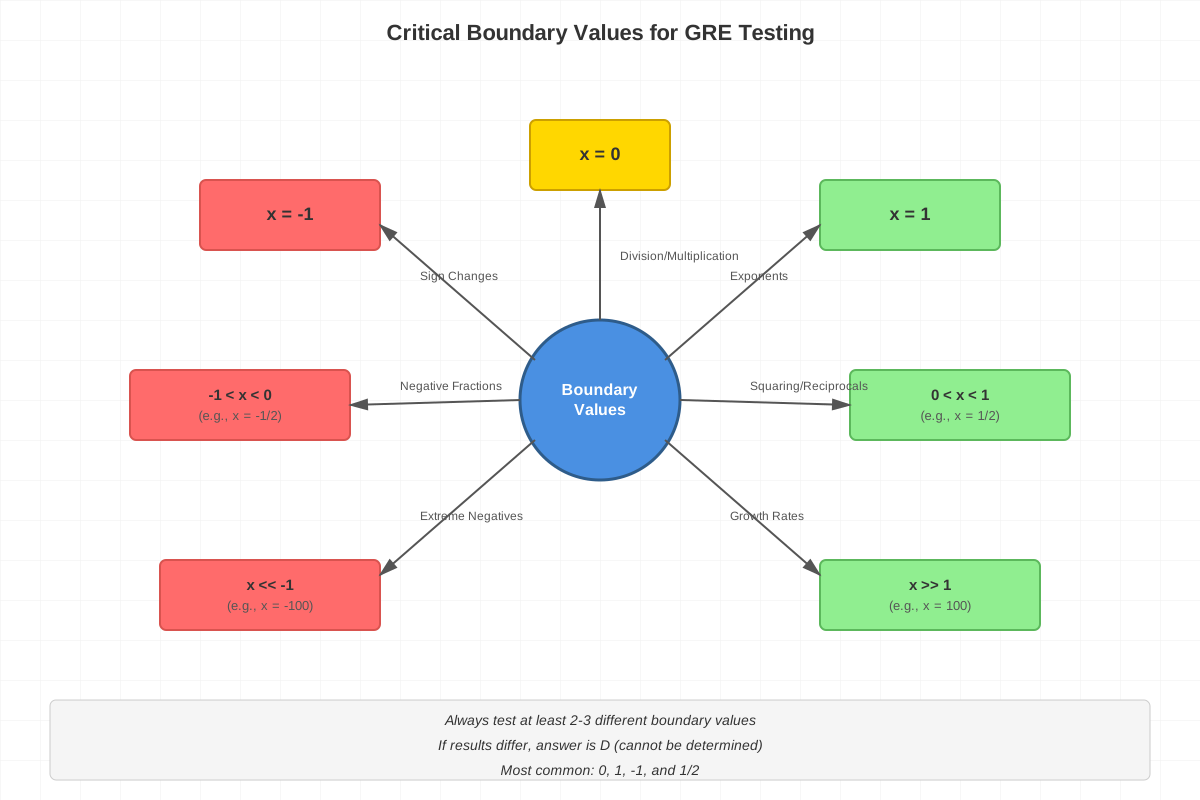
Boundary values are specific numbers that represent extreme, special, or transitional cases within the domain of possible values for a variable. Rather than testing arbitrary numbers, boundary value testing focuses on values where mathematical behavior often changes or where expressions exhibit unusual properties. The most commonly tested boundary values on the GRE include:
- Zero (0): The additive identity; changes sign behavior; makes products zero
- One (1): The multiplicative identity; special behavior in exponents
- Negative one (-1): Tests negative number behavior; special exponent properties
- Fractions between 0 and 1: Reverse typical growth patterns when multiplied or raised to powers
- Negative fractions: Combine fraction and negative number properties
- Very large positive numbers: Test asymptotic behavior and dominance
- Very small negative numbers: Test behavior at negative extremes
The Core Strategy
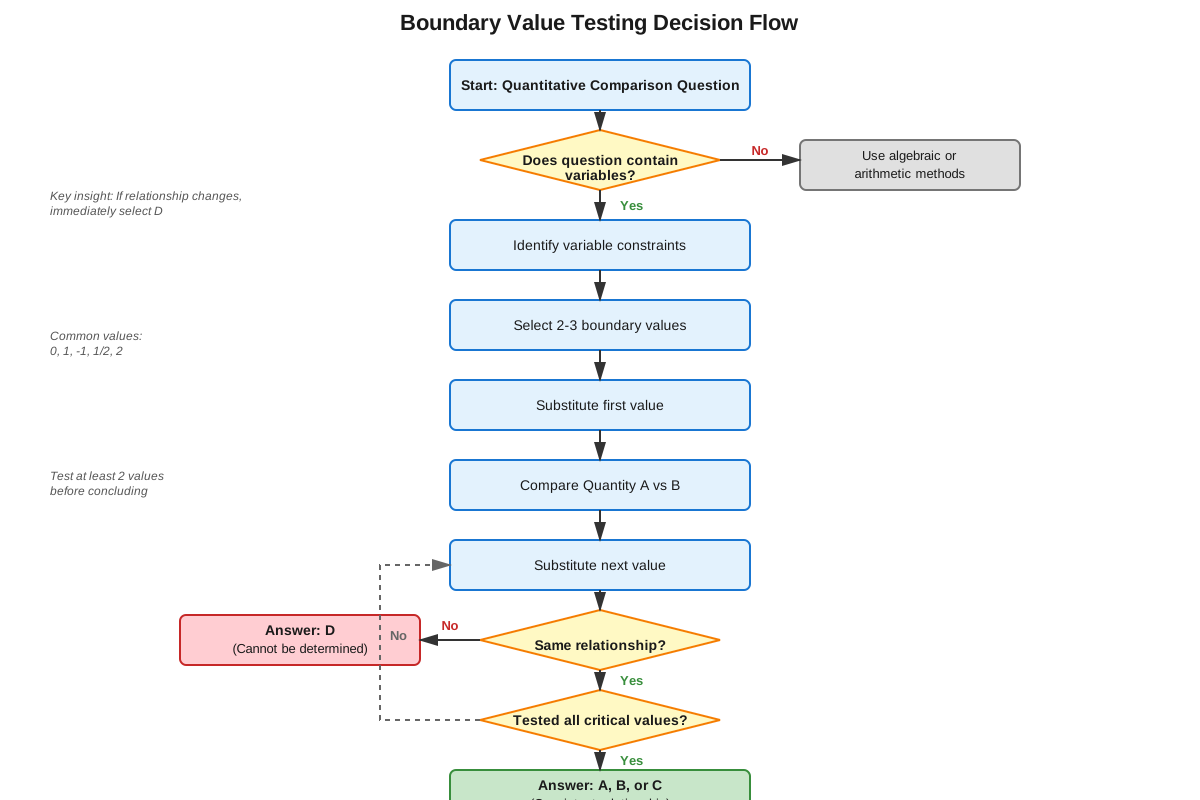
The fundamental principle behind boundary value testing is that if a relationship between two quantities depends on the value of a variable, testing boundary cases will reveal this dependency. For Quantitative Comparison questions, this strategy works as follows:
- Identify variables and their possible domains: Determine what values the variables can take based on any given constraints
- Select appropriate boundary values: Choose 2-4 strategic values that represent different categories (positive/negative, large/small, integer/fraction)
- Substitute and evaluate: Calculate both quantities for each boundary value
- Analyze results: If the relationship changes (Quantity A is greater for some values but Quantity B is greater for others), the answer is D (cannot be determined)
When to Apply Boundary Value Testing
Boundary value testing is most powerful when questions exhibit these characteristics:
Variables without explicit constraints: When a problem states "x is a number" or "n is an integer" without specifying positive/negative or providing bounds, boundary testing is essential.
Expressions involving multiplication or division: Products and quotients behave differently depending on whether factors are greater than 1, between 0 and 1, or negative.
Exponential expressions: The behavior of x^n depends critically on whether x is greater than 1, between 0 and 1, equal to 1, or negative.
Absolute value expressions: These create different relationships depending on whether the input is positive or negative.
Critical Boundary Values by Expression Type
| Expression Type | Key Boundary Values to Test | Why These Matter | ||||||||
|---|---|---|---|---|---|---|---|---|---|---|
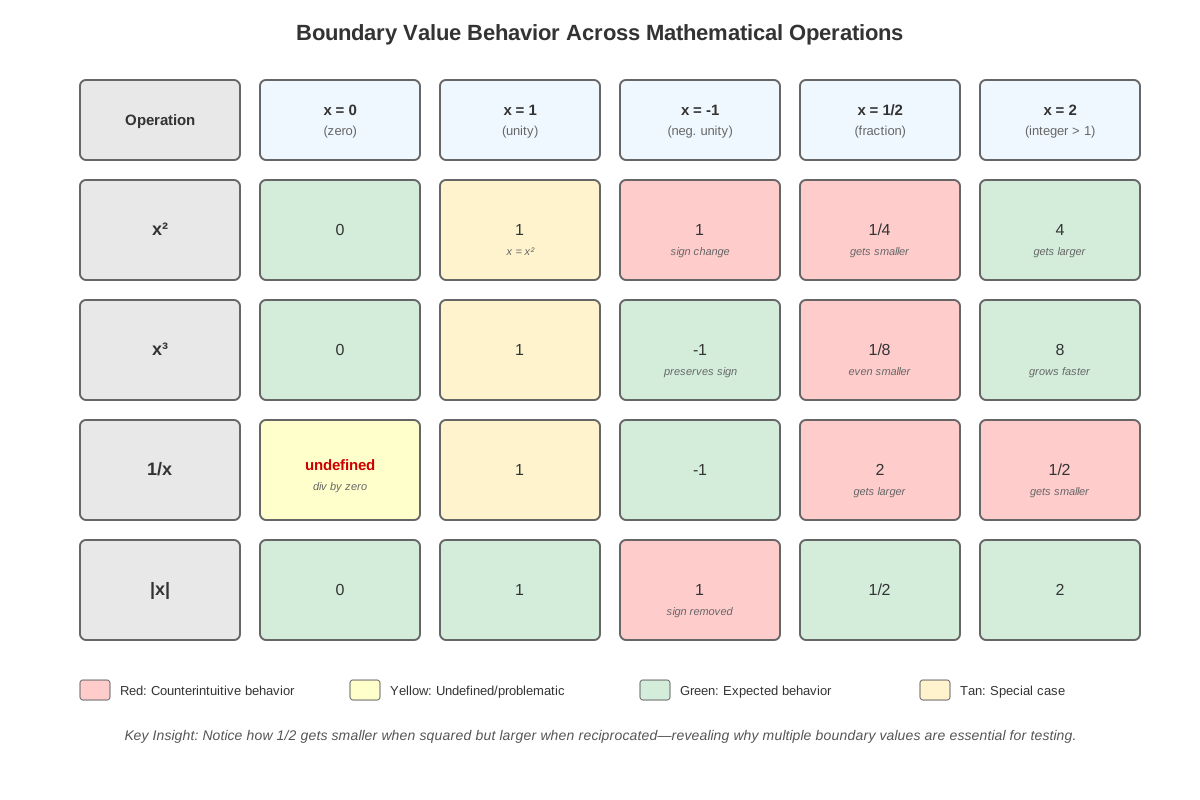
| x^2 vs. x | 0, 1, 2, 0.5, -1 | Squares exceed originals for | x | > 1; fall below for 0 < | x | < 1 | ||||
| xy (product) | Both positive, both negative, one zero, one of each sign | Sign and magnitude both matter | ||||||||
| x/y (quotient) | Same as product, plus values where | x | < | y | and | x | > | y | Division by fractions increases; by numbers > 1 decreases | |
| x^n (exponent) | Base: 0, 1, -1, 0.5, 2; Exponent: 0, 1, 2, negative | Base between 0 and 1 decreases with positive exponents | ||||||||
| x | (absolute value) | Positive, negative, zero | Changes sign behavior |
The Two-Value Minimum Rule
A critical principle: testing a single value can never prove a relationship holds universally; it can only disprove universality. If you test one boundary value and find Quantity A is greater, you cannot conclude the answer is A—you must test at least one more value to confirm consistency. However, if you test one value and find A is greater, then test another and find B is greater, you can immediately conclude the answer is D without further testing.
Combining Boundary Testing with Algebra
Advanced test-takers don't view boundary testing and algebraic manipulation as competing strategies but as complementary tools. Often, the most efficient approach involves:
- Simplifying expressions algebraically first
- Identifying remaining variables or uncertain relationships
- Testing boundary values for those specific uncertainties
- Using the results to select the correct answer with confidence
For example, if you can algebraically reduce "Quantity A: x^2 + 2x" and "Quantity B: x^2 + x" to comparing "2x vs. x," you've simplified the problem. Then boundary testing (x = 1, x = -1, x = 0) quickly reveals the relationship depends on x's sign and magnitude.
Concept Relationships
The boundary value strategy connects directly to several foundational mathematical concepts. Number properties form the basis for understanding why certain values behave as boundaries—zero's role as the dividing line between positive and negative, one's role as the threshold between growth and decay in multiplication, and fractions' counterintuitive behavior in repeated operations.
Algebraic manipulation and boundary testing work synergistically: algebra reduces complexity and isolates variables, while boundary testing handles cases where algebraic solutions are cumbersome or where the relationship's nature remains ambiguous after simplification. This relationship flows as: Complex Expression → Algebraic Simplification → Identification of Key Variables → Boundary Value Testing → Definitive Answer.
Inequality reasoning provides the framework for interpreting boundary test results. When testing reveals that Quantity A exceeds Quantity B for some values but not others, inequality concepts explain why the relationship is indeterminate. Conversely, when all boundary tests yield consistent results, inequality principles help confirm the relationship holds throughout the domain.
The connection to Quantitative Comparison strategy is direct: boundary testing specifically addresses the "D" answer choice (relationship cannot be determined). Many students under-select D because they fail to consider the full range of possible values. Boundary testing systematically explores this range, making D answers identifiable rather than merely guessable.
High-Yield Facts
⭐ Testing zero, one, and negative one will reveal the answer to approximately 60% of boundary-value-dependent Quantitative Comparison questions
⭐ If a Quantitative Comparison question contains variables without explicit positive/negative constraints, boundary value testing is almost always necessary
⭐ When comparing x^2 and x, the relationship reverses at x = 1: for |x| > 1, x^2 > x; for 0 < |x| < 1, x^2 < x
⭐ Products of two variables require testing all four sign combinations: (+,+), (+,-), (-,+), (-,-)
⭐ Fractions between 0 and 1 become smaller when raised to positive powers greater than 1
- Zero makes any product zero, which often creates equality between quantities that otherwise differ
- Negative one raised to even powers equals 1; raised to odd powers equals -1
- Very large numbers cause terms with higher exponents to dominate expressions
- When an expression contains both addition and multiplication of variables, test both small and large values
- If two boundary values yield the same relationship, test a third from a different category before concluding the relationship is consistent
- Absolute value expressions require testing both positive and negative inputs to understand behavior
- Division by fractions greater than zero but less than one increases the quotient
- When variables appear in denominators, zero is not a valid test value (undefined)
- Expressions with even exponents eliminate sign information, requiring careful testing of negative values
- The answer "D" (cannot be determined) requires finding at least two test values that yield different relationships
Quick check — test yourself on Boundary values so far.
Try Flashcards →Common Misconceptions
Misconception: Testing one value that makes Quantity A greater proves the answer is A.
Correction: A single test can only disprove universality, not prove it. You must test multiple boundary values from different categories to confirm a relationship holds consistently. One test showing A > B only eliminates answers C and possibly D; it doesn't confirm A.
Misconception: If a variable is described as "a number," it must be a positive integer.
Correction: Unless explicitly stated otherwise, "a number" includes negative numbers, zero, fractions, and irrational numbers. The GRE deliberately uses vague language to test whether students consider the full domain. Always test negative values and fractions unless constraints exclude them.
Misconception: Boundary value testing is only necessary when you can't solve algebraically.
Correction: Even when algebraic solutions are possible, boundary testing is often faster and less error-prone. Additionally, some relationships are genuinely indeterminate, and algebra alone won't reveal this—you need boundary testing to discover that the answer is D.
Misconception: Testing x = 2 and x = 3 provides sufficient variety to confirm a relationship.
Correction: Testing two similar values (both positive integers greater than 1) doesn't explore the boundary cases where behavior changes. You must test values from different categories: positive vs. negative, integer vs. fraction, large vs. small, etc.
Misconception: If algebraic manipulation shows Quantity A minus Quantity B equals x^2, Quantity A must always be greater since squares are positive.
Correction: This reasoning fails when x = 0, which makes x^2 = 0, meaning the quantities are equal. Zero is a critical boundary value that students frequently overlook, and it often determines whether the answer is A or C.
Misconception: Boundary values only matter for Quantitative Comparison questions.
Correction: While boundary testing is most systematically applied to Quantitative Comparison, the underlying principle—testing extreme cases to understand behavior—applies to Problem Solving questions involving inequalities, function domains, and optimization problems.
Worked Examples
Example 1: Exponential Expression Comparison
Question:
- Quantity A: n^3
- Quantity B: n^2
- Given: n is a number
Solution:
Step 1: Identify that variables lack constraints
The problem states "n is a number" without specifying positive, negative, integer, or any bounds. This is a clear signal that boundary value testing is necessary.
Step 2: Select strategic boundary values
We'll test: n = 0, n = 1, n = 2, n = 0.5, n = -1
Step 3: Evaluate for n = 0
- Quantity A: 0^3 = 0
- Quantity B: 0^2 = 0
- Result: Quantities are equal
Step 4: Evaluate for n = 1
- Quantity A: 1^3 = 1
- Quantity B: 1^2 = 1
- Result: Quantities are equal
Step 5: Evaluate for n = 2
- Quantity A: 2^3 = 8
- Quantity B: 2^2 = 4
- Result: Quantity A is greater
Step 6: Evaluate for n = 0.5
- Quantity A: (0.5)^3 = 0.125
- Quantity B: (0.5)^2 = 0.25
- Result: Quantity B is greater
Step 7: Analyze results
We found cases where A > B (n = 2) and cases where B > A (n = 0.5). The relationship changes depending on n's value.
Answer: D (The relationship cannot be determined)
Connection to learning objectives: This example demonstrates identifying when boundary testing is needed (no constraints on n), applying the strategy systematically, and recognizing that different boundary values yield different relationships, making the answer D.
Example 2: Product Comparison with Sign Ambiguity
Question:
- Quantity A: xy
- Quantity B: x + y
- Given: x and y are integers, and x < y
Solution:
Step 1: Recognize variable constraints
We know x and y are integers with x < y, but we don't know their signs or magnitudes. The constraint x < y doesn't tell us whether they're positive, negative, or mixed.
Step 2: Select boundary values respecting constraints
We'll test several cases:
- Case 1: x = 1, y = 2 (both positive, small)
- Case 2: x = -2, y = -1 (both negative)
- Case 3: x = -1, y = 1 (negative and positive)
- Case 4: x = 2, y = 10 (both positive, larger gap)
Step 3: Evaluate Case 1 (x = 1, y = 2)
- Quantity A: (1)(2) = 2
- Quantity B: 1 + 2 = 3
- Result: Quantity B is greater
Step 4: Evaluate Case 2 (x = -2, y = -1)
- Quantity A: (-2)(-1) = 2
- Quantity B: -2 + (-1) = -3
- Result: Quantity A is greater
Step 5: Conclusion after two tests
We've found that B > A in Case 1 but A > B in Case 2. The relationship depends on the specific values of x and y.
Answer: D (The relationship cannot be determined)
Connection to learning objectives: This example shows how boundary testing reveals that sign combinations matter critically. Testing both positive and negative cases (boundary categories) quickly identifies the indeterminate relationship. Students learn that constraints like x < y don't eliminate the need for boundary testing when signs are unspecified.
Exam Strategy
Trigger Recognition
Watch for these phrases that signal boundary value testing opportunities:
- "x is a number" or "n is an integer" without "positive" or "negative"
- "a and b are real numbers"
- Any variable in an exponent position
- Products or quotients of multiple variables
- Expressions where variables appear with different exponents
- Absolute value expressions with variables
Exam Tip: If you read a Quantitative Comparison question and think "this seems too simple," you're probably missing a boundary case. The GRE rarely asks straightforward questions—apparent simplicity usually means hidden complexity.
Systematic Approach
- Spend 5-10 seconds identifying constraints: Note what the problem explicitly states about variables
- List 3-4 boundary values before calculating: Write down which values you'll test (prevents forgetting negative cases)
- Test the "weird" values first: Start with 0, 1, -1, and 0.5 rather than "normal" integers like 2 or 3
- Stop as soon as you find different relationships: If one test shows A > B and another shows B > A, select D immediately
- If three diverse tests yield the same result, confidently select that answer: Three consistent results across different categories (positive/negative, large/small, integer/fraction) provide strong evidence
Time Management
Boundary value testing typically takes 30-60 seconds for most questions—faster than algebraic manipulation for complex expressions. Budget your time as follows:
- 10 seconds: Identify that boundary testing is needed
- 10 seconds: Select which values to test
- 30 seconds: Perform 2-3 calculations
- 10 seconds: Analyze results and select answer
If you find yourself testing more than four values, you're likely overthinking. Three well-chosen boundary values usually suffice.
Process of Elimination
Boundary testing naturally supports elimination:
- One test showing A > B eliminates C and B (but not D)
- One test showing B > A eliminates C and A (but not D)
- One test showing A = B eliminates A and B (but not D)
- Two tests showing different relationships confirms D
- Three diverse tests showing the same relationship eliminates D
Memory Techniques
The "ZONE-F" Mnemonic
Remember the five most critical boundary values with ZONE-F:
- Zero (0)
- One (1)
- Negative one (-1)
- Extreme (very large positive or very small negative)
- Fraction (between 0 and 1, typically 0.5 or 1/2)
The "Two Different = D" Rule
If two tests yield two different relationships, the answer is D. This simple rule prevents over-testing and saves time.
Visualization: The Number Line Zones
Imagine the number line divided into zones where mathematical behavior changes:
Large Negative | -1 | Negative Fraction | 0 | Positive Fraction | 1 | Large PositiveTest one value from at least three different zones to ensure comprehensive coverage.
The "Fraction Flip" Reminder
Fractions between 0 and 1 flip expectations: they get smaller when multiplied or raised to powers, and they make quotients larger when in denominators. Visualize a fraction as a "reverse gear" for typical number behavior.
Summary
Boundary value testing is an essential GRE Quantitative Reasoning strategy that involves systematically testing extreme, special, or transitional values—particularly 0, 1, -1, fractions between 0 and 1, and very large or small numbers—to determine whether relationships between quantities hold universally or vary depending on specific values. This technique is especially powerful for Quantitative Comparison questions where variables lack explicit constraints, expressions involve products or exponents, or relationships appear deceptively simple. By testing 2-4 strategically chosen boundary values, students can quickly identify whether the answer is A, B, C, or D, often more efficiently than through algebraic manipulation alone. The core principle is that if different boundary values yield different relationships between quantities, the answer must be D (cannot be determined), while consistent results across diverse boundary tests confirm a universal relationship. Mastery requires recognizing trigger situations, selecting appropriate boundary values for the expression type, and interpreting results correctly—skills that transform boundary testing from a backup strategy into a primary problem-solving tool.
Key Takeaways
- Boundary values (0, 1, -1, fractions, extremes) reveal where mathematical relationships change or break down
- Testing a single value can disprove but never prove a universal relationship; always test multiple diverse values
- If two boundary tests yield different relationships (A > B in one case, B > A in another), the answer is definitively D
- Variables described without explicit positive/negative constraints require boundary testing across sign categories
- Fractions between 0 and 1 exhibit counterintuitive behavior: they decrease when raised to powers and increase quotients when in denominators
- Boundary testing often provides faster, more reliable solutions than complex algebra, especially under time pressure
- The most efficient approach combines algebraic simplification with strategic boundary testing of remaining uncertainties
Related Topics
Quantitative Comparison Strategies: Boundary value testing is one component of a comprehensive Quantitative Comparison approach that includes algebraic manipulation, estimation, and answer choice elimination. Mastering boundary values enhances overall Quantitative Comparison performance.
Inequality Problem Solving: Understanding how relationships change across value ranges directly applies to solving and graphing inequalities, a frequent GRE topic.
Function Behavior and Domain Analysis: Boundary testing principles extend to understanding function domains, ranges, and behavior at critical points—skills tested in higher-level GRE questions.
Number Properties Deep Dive: Advanced understanding of how different number categories (integers, rationals, irrationals, positive, negative) behave under operations strengthens boundary value selection.
Algebraic Expression Manipulation: Combining strong algebraic skills with boundary testing creates a powerful toolkit for tackling the most challenging Quantitative Reasoning questions.
Practice CTA
Now that you understand the boundary value strategy, it's time to cement your mastery through deliberate practice. Attempt the practice questions associated with this topic, focusing on identifying trigger situations, selecting appropriate boundary values, and interpreting results efficiently. Use the flashcards to reinforce the key boundary values and their special properties until testing them becomes automatic. Remember: boundary value testing is a skill that improves dramatically with practice—each question you solve builds pattern recognition that makes the next question faster and easier. Your investment in mastering this technique will pay dividends across multiple question types and significantly boost your Quantitative Reasoning score. Start practicing now!
Sign up free to keep reading
Create a free AnvayaPrep account to finish this GRE guide on Boundary values — plus flashcards and practice questions.