Overview
The answer choice D strategy is one of the most critical decision-making frameworks for GRE Quantitative Comparison questions. Unlike traditional multiple-choice questions where students select a single correct answer, Quantitative Comparison questions present two quantities and ask test-takers to determine their relationship. Answer choice D—"The relationship cannot be determined from the information given"—represents a unique challenge that requires strategic thinking and systematic analysis.
Mastering the GRE answer choice D strategy is essential because it directly impacts scoring efficiency and accuracy. Many students either overuse or underuse choice D, leading to preventable errors. Understanding when the relationship between quantities genuinely depends on unknown variables versus when it can be definitively determined separates average performers from top scorers. This strategy requires recognizing patterns of variability, testing multiple cases, and identifying when insufficient information exists to establish a consistent relationship.
Within the broader context of Quantitative Reasoning, the answer choice D strategy connects to fundamental mathematical principles including variable behavior, inequality analysis, and logical reasoning. It builds upon algebraic manipulation skills while requiring higher-order thinking about mathematical relationships. This topic serves as a bridge between computational skills and analytical reasoning, making it indispensable for achieving competitive GRE scores in the 160+ range on the Quantitative section.
Learning Objectives
- [ ] Identify when Answer choice D strategy is being tested
- [ ] Explain the core rule or strategy behind Answer choice D strategy
- [ ] Apply Answer choice D strategy to GRE-style questions accurately
- [ ] Distinguish between questions requiring choice D versus those with determinable relationships
- [ ] Develop a systematic testing protocol to evaluate whether relationships vary
- [ ] Recognize common variable patterns that signal potential choice D scenarios
- [ ] Execute efficient case-testing to confirm or eliminate choice D within time constraints
Prerequisites
- Basic algebraic manipulation: Essential for simplifying expressions in both quantities to compare them effectively
- Understanding of positive and negative number properties: Critical because sign changes often create scenarios where relationships vary
- Familiarity with Quantitative Comparison question format: Necessary to understand what each answer choice (A, B, C, D) represents
- Inequality concepts: Required to determine when one quantity is consistently greater than, less than, or equal to another
- Variable substitution techniques: Fundamental for testing multiple cases to determine if relationships change
Why This Topic Matters
The answer choice D strategy appears in approximately 20-25% of all Quantitative Comparison questions on the GRE, making it one of the most frequently tested decision points. Unlike computational errors that might cost a single question, misunderstanding when to select choice D creates systematic scoring problems that compound across multiple questions. Students who master this strategy gain a significant competitive advantage, as these questions are specifically designed to separate test-takers who think critically from those who rely solely on calculation.
In real-world applications, the reasoning behind choice D mirrors decision-making under uncertainty—a skill valued in graduate-level research, business analysis, and scientific inquiry. The ability to recognize when available information is insufficient to draw conclusions reflects mature analytical thinking. On the GRE, this translates to questions involving variables with unspecified constraints, expressions that behave differently across number domains, or geometric figures without fixed dimensions.
Common manifestations include questions with variables lacking defined ranges, expressions involving both positive and negative possibilities, geometric comparisons without specific measurements, and algebraic relationships that change based on variable values. The GRE deliberately constructs these questions to appear solvable at first glance, testing whether students will rush to judgment or systematically verify their conclusions.
Core Concepts
The Fundamental Rule for Choice D
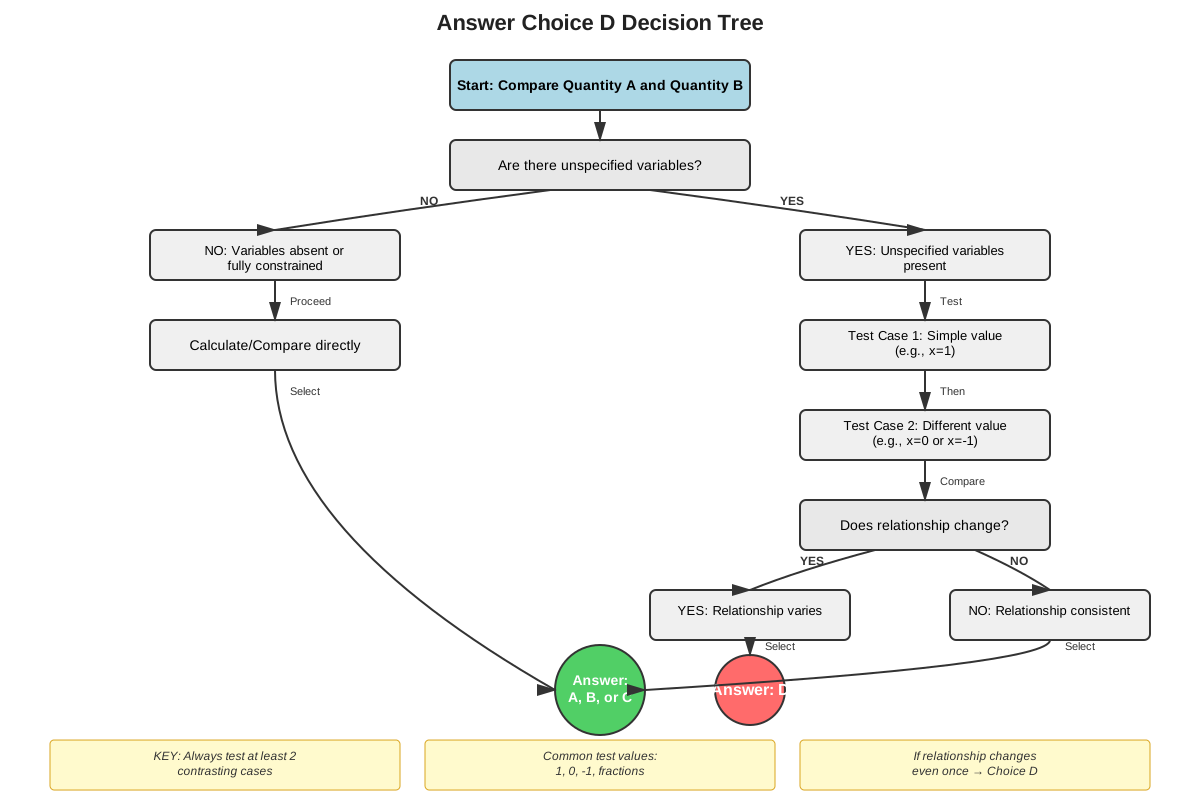
Answer choice D ("The relationship cannot be determined from the information given") should be selected when the relationship between Quantity A and Quantity B changes depending on the values of variables or parameters in the problem. The core principle is variability: if testing different valid values produces different relationships (sometimes A > B, sometimes B > A, or sometimes A = B), then choice D is correct.
The decision framework operates on a binary principle: either the relationship is consistent across all possible values (making A, B, or C correct), or the relationship varies (making D correct). There is no middle ground. This means that finding even one case where A > B and one case where B > A definitively proves that choice D is the answer.
The Two-Case Testing Method
The most reliable approach for evaluating potential choice D scenarios involves systematic case testing:
- Identify variables or unspecified parameters in the quantities
- Test extreme or special values (positive, negative, zero, one, fractions)
- Compare the relationship for each tested value
- Determine consistency: If all tests yield the same relationship, choice D is eliminated; if relationships differ, choice D is correct
This method works because GRE questions are designed with mathematical precision. When choice D is correct, the test-makers ensure that multiple valid scenarios produce different relationships. Conversely, when A, B, or C is correct, the relationship holds universally within the problem's constraints.
Critical Variable Behaviors That Signal Choice D
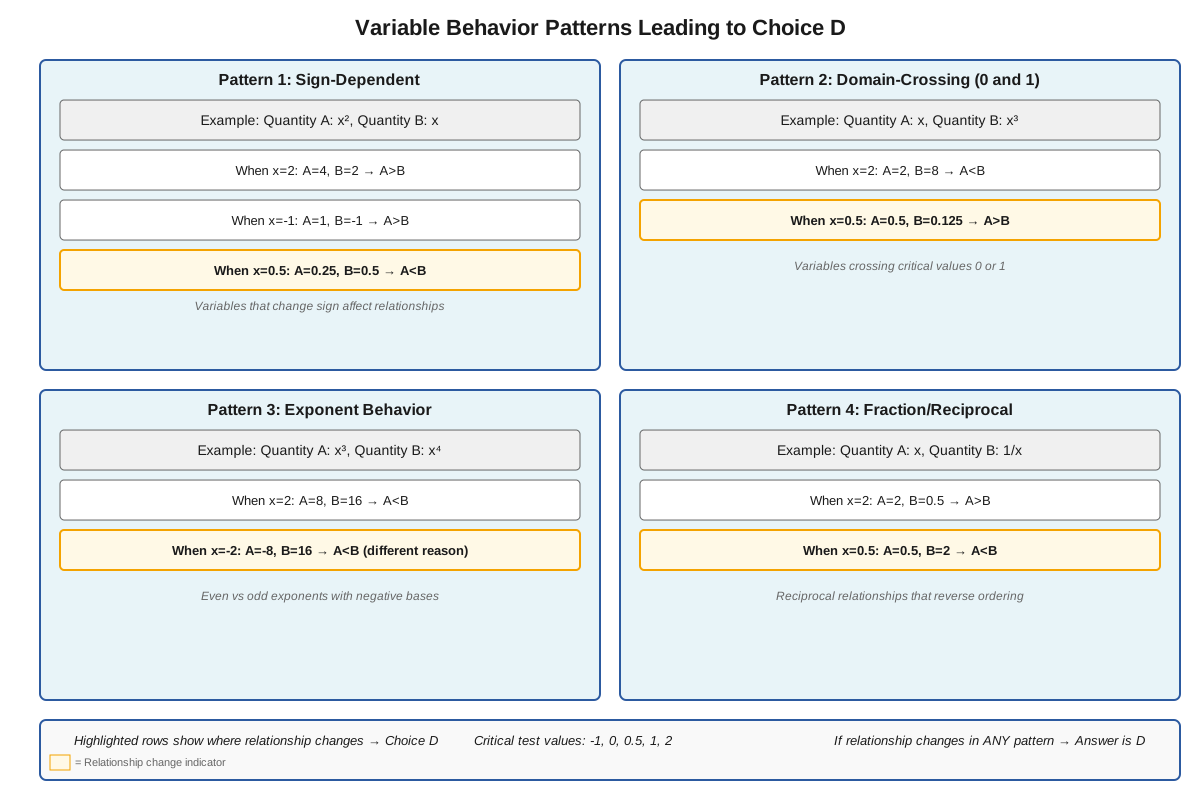
Certain mathematical patterns frequently indicate that choice D may be correct:
| Pattern Type | Example | Why It Signals D |
|---|---|---|
| Unspecified variable sign | x² vs. x³ | Behavior differs for positive vs. negative x |
| Variables in denominators | 1/x vs. 1/y | Relationship changes with magnitude and sign |
| Even vs. odd exponents | x² vs. x | Even exponents eliminate sign information |
| Products of unknowns | xy vs. x + y | Relationship depends on individual values |
| Geometric figures without measurements | Area comparisons without side lengths | Proportions can vary |
The Zero, One, and Negative Test Strategy
Three specific values prove particularly powerful for testing potential choice D scenarios:
Zero: Often produces equality or undefined expressions, revealing edge cases where relationships break down. Many expressions that appear unequal become equal when variables equal zero.
One: Serves as a neutral multiplier and helps identify whether relationships depend on magnitude. Expressions like x² and x are equal when x = 1, but differ otherwise.
Negative values: Critical for exposing sign-dependent relationships. Expressions involving odd powers, absolute values, or inequalities frequently behave differently for negative inputs.
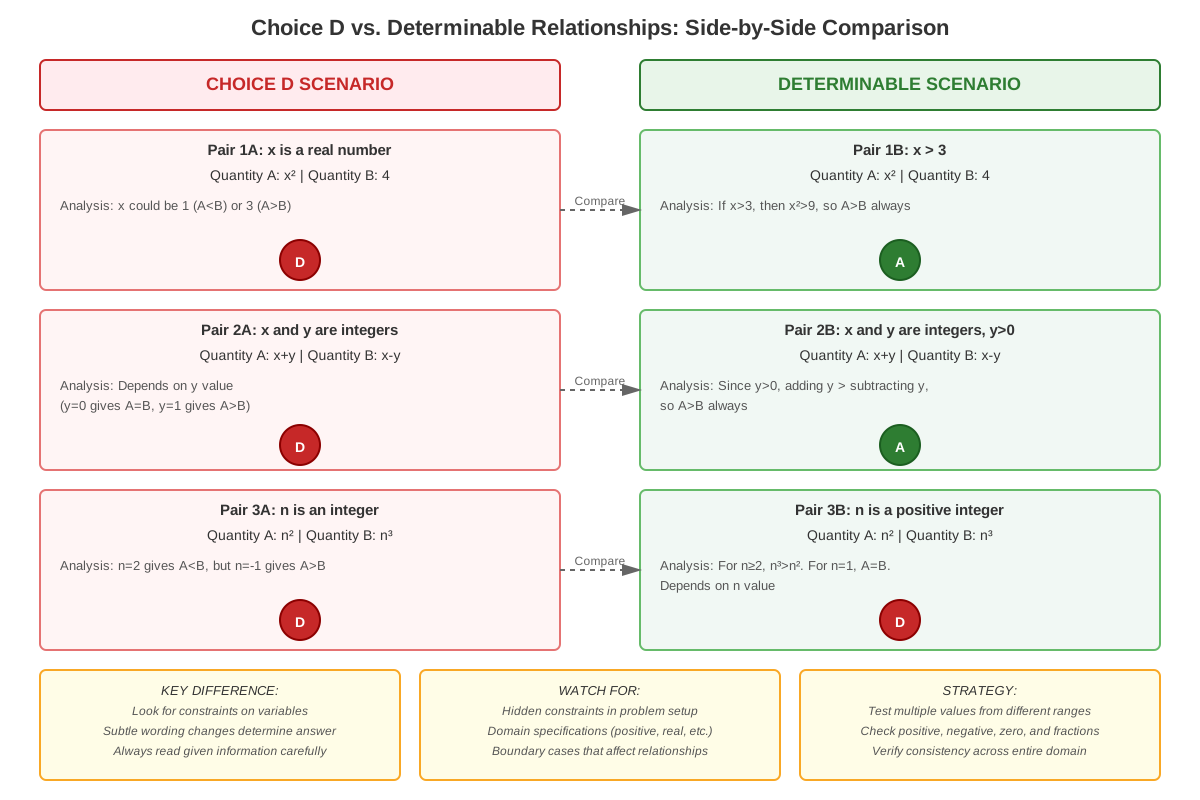
When Choice D is NOT Correct
Understanding when to eliminate choice D is equally important. Choice D is definitively wrong when:
- The quantities can be simplified to constants with no variables
- All variables cancel out during algebraic manipulation
- The problem provides sufficient constraints to determine exact values
- Mathematical properties guarantee a consistent relationship (e.g., x² ≥ 0 for all real x)
- The quantities are identical after simplification
The Constraint Recognition Principle
Some problems appear to have variables but actually provide hidden constraints that determine the relationship. For example, if a problem states "x is a positive integer less than 5," the variable x can only be 1, 2, 3, or 4. Testing all four values might reveal a consistent relationship, eliminating choice D. Recognizing explicit and implicit constraints prevents incorrectly selecting choice D when relationships are actually determinable.
The Algebraic Simplification First Approach
Before testing cases, always attempt algebraic simplification. Many apparent choice D scenarios resolve into determinable relationships through manipulation:
- Subtract the same expression from both quantities
- Factor common terms
- Combine like terms
- Apply algebraic identities
If simplification produces a clear inequality or equality that holds universally, choice D is eliminated without case testing. This approach saves time and reduces error risk.
Concept Relationships
The answer choice D strategy connects multiple analytical skills into a cohesive decision framework. The foundation begins with variable identification, which leads to constraint analysis (determining what values variables can assume). This analysis then branches into two paths: algebraic simplification (attempting to resolve the relationship definitively) and case testing (exploring whether relationships vary).
The relationship flows as: Variable Identification → Constraint Analysis → Algebraic Simplification (if possible) → Case Testing (if needed) → Relationship Determination → Answer Selection.
This strategy builds directly on prerequisite knowledge of algebraic manipulation (used in simplification), number properties (guiding case selection), and inequality reasoning (interpreting comparison results). It connects forward to broader test-taking strategies including time management (knowing when to test cases versus when to simplify) and process of elimination (systematically ruling out answer choices).
The strategy also relates to other Quantitative Comparison concepts such as estimation techniques (sometimes approximate values suffice to determine relationships) and geometric reasoning (where unspecified dimensions often create choice D scenarios). Understanding these connections helps students recognize that the answer choice D strategy isn't isolated—it's integrated into comprehensive quantitative reasoning.
High-Yield Facts
⭐ Choice D is correct when the relationship between quantities changes based on different valid values of variables
⭐ Testing zero, one, and a negative number catches most variable-dependent relationships
⭐ If algebraic simplification eliminates all variables, choice D is never correct
⭐ Finding one case where A > B and one case where B > A definitively proves choice D is correct
⭐ Variables in exponents, denominators, or under even powers frequently signal potential choice D scenarios
- Approximately 20-25% of Quantitative Comparison questions have choice D as the correct answer
- Choice D requires less computation than other choices but more strategic thinking
- Problems with multiple unspecified variables are more likely to be choice D than single-variable problems
- Geometric figures labeled "not drawn to scale" without specific measurements often lead to choice D
- If both quantities simplify to the same expression, choice C is correct, never choice D
- Testing only positive values is insufficient; negative values and zero must also be considered
- Time pressure causes students to under-select choice D by rushing to calculate rather than analyze
Quick check — test yourself on Answer choice D strategy so far.
Try Flashcards →Common Misconceptions
Misconception: If a problem contains variables, choice D is automatically correct.
Correction: Variables alone don't determine the answer. Many problems with variables have determinable relationships through algebraic manipulation or because constraints limit variable behavior to produce consistent relationships.
Misconception: Testing two cases is always sufficient to eliminate choice D.
Correction: While two cases showing different relationships prove choice D is correct, two cases showing the same relationship don't definitively eliminate choice D. Testing should include diverse cases (positive, negative, zero, fractions) to adequately explore the relationship space.
Misconception: Choice D is rare and should be avoided unless absolutely certain.
Correction: Choice D appears in approximately 20-25% of Quantitative Comparison questions, making it as common as any other answer choice. Avoiding it due to uncertainty leads to systematic errors on questions specifically designed to test this reasoning.
Misconception: If calculations become complex, choice D is probably correct.
Correction: Computational complexity doesn't indicate choice D. Some determinable relationships require extensive calculation, while some choice D questions are immediately apparent through simple case testing. Complexity relates to calculation difficulty, not relationship determinability.
Misconception: Geometric problems without measurements always require choice D.
Correction: Some geometric relationships hold regardless of specific measurements due to mathematical properties (e.g., the sum of angles in a triangle always equals 180°). Lack of measurements suggests investigating choice D, but doesn't guarantee it's correct.
Misconception: Once you find one case where A > B, you can select choice A.
Correction: Finding one case where A > B only eliminates choices B and C. You must verify that A > B for all possible cases before selecting choice A. If any case produces a different relationship, choice D is correct.
Worked Examples
Example 1: Variable Sign Dependency
Problem Setup:
Quantity A: x³
Quantity B: x²
Solution Process:
Step 1: Identify that both quantities contain the variable x with no specified constraints on its value.
Step 2: Recognize that the exponents differ (odd vs. even), which often signals sign-dependent behavior.
Step 3: Test strategic cases:
Case 1 (x = 2):
- Quantity A: 2³ = 8
- Quantity B: 2² = 4
- Relationship: A > B
Case 2 (x = 1):
- Quantity A: 1³ = 1
- Quantity B: 1² = 1
- Relationship: A = B
Case 3 (x = -2):
- Quantity A: (-2)³ = -8
- Quantity B: (-2)² = 4
- Relationship: A < B
Step 4: Analyze results. We found three different relationships: A > B (when x = 2), A = B (when x = 1), and A < B (when x = -2).
Step 5: Conclusion. Since the relationship varies depending on x's value, choice D is correct.
Connection to Learning Objectives: This example demonstrates identifying when choice D is tested (unspecified variable with different exponents), explaining the core rule (relationships that vary require choice D), and applying the strategy through systematic case testing.
Example 2: Algebraic Simplification Eliminates Choice D
Problem Setup:
Given: x > 0
Quantity A: (x + 3)² - x²
Quantity B: 6x + 9
Solution Process:
Step 1: Notice that both quantities contain x, but x has a constraint (x > 0).
Step 2: Before testing cases, attempt algebraic simplification of Quantity A:
- (x + 3)² - x²
- = (x² + 6x + 9) - x²
- = 6x + 9
Step 3: Compare simplified quantities:
- Quantity A: 6x + 9
- Quantity B: 6x + 9
Step 4: The quantities are identical for all values of x.
Step 5: Conclusion. Since the quantities are always equal regardless of x's value (within the given constraint), choice C is correct. Choice D is eliminated because the relationship is determinable and consistent.
Connection to Learning Objectives: This example shows how algebraic manipulation can definitively determine relationships, demonstrating when NOT to select choice D despite the presence of variables. It reinforces that systematic simplification should precede case testing.
Exam Strategy
When approaching Quantitative Comparison questions, implement this strategic protocol:
Step 1: Scan for variables and constraints (5 seconds). Immediately identify whether quantities contain variables and note any stated constraints. This initial scan determines whether choice D is even possible.
Step 2: Attempt quick simplification (10-15 seconds). Look for opportunities to subtract common terms, factor expressions, or apply algebraic identities. If quantities simplify to constants or identical expressions, choice D is eliminated.
Step 3: Identify choice D triggers (5 seconds). Watch for these high-probability indicators:
- Variables without specified ranges
- Expressions with different exponents
- Denominators containing variables
- Geometric figures without measurements
- Phrases like "x is a number" without further specification
Step 4: Execute strategic case testing (20-30 seconds if needed). Test in this order for maximum efficiency:
- Zero (if valid)
- One (if valid)
- A negative number (if valid)
- A fraction between 0 and 1 (if previous tests show consistent relationships)
Step 5: Make the decision. If any two cases produce different relationships, immediately select choice D. If all cases produce the same relationship, verify it makes mathematical sense, then select A, B, or C accordingly.
Exam Tip: If you're uncertain between choice D and another answer, test one more extreme case. Finding any case that contradicts your initial conclusion confirms choice D.
Time allocation: Spend no more than 60-75 seconds on Quantitative Comparison questions. If case testing extends beyond 30 seconds, you may be missing a simplification opportunity or overthinking the problem.
Trigger phrases that often indicate choice D scenarios:
- "x is a number"
- "n is an integer" (without range specification)
- "The figure is not drawn to scale"
- "k ≠ 0" (specifies what k is NOT, but not what it IS)
Process of elimination specific to choice D: If you can find even one valid scenario where the relationship is determinable, you've eliminated choice D. Conversely, if you find contradictory relationships in valid scenarios, you've confirmed choice D and eliminated A, B, and C simultaneously.
Memory Techniques
The "ZON" Mnemonic: Test Zero, One, and Negative values as your default case-testing sequence. This covers the most common scenarios where relationships vary.
The "VIPER" Acronym for choice D triggers:
- Variables without constraints
- Inequal exponents (especially odd vs. even)
- Products of unknowns
- Expressions in denominators
- Ratio comparisons without fixed values
Visualization Strategy: Picture a number line with your variable moving along it. If the relationship between quantities "flips" as the variable moves (from positive to negative, or across zero), visualize a see-saw tipping—this signals choice D.
The "Consistency Check" Mantra: Before selecting A, B, or C, mentally ask: "Does this relationship hold for ALL valid values?" If you hesitate, test another case.
The "Two Different, Done" Rule: If you find two cases producing different relationships (A > B in one case, B > A in another), you're done—choice D is correct. No further testing needed.
Summary
The answer choice D strategy represents a critical analytical skill for GRE Quantitative Comparison questions, requiring test-takers to determine when relationships between quantities vary based on unspecified variables or parameters. The fundamental principle is straightforward: choice D is correct when the relationship changes depending on valid values that variables can assume. Mastery requires systematic case testing—particularly using zero, one, and negative values—combined with algebraic simplification to eliminate variables when possible. Recognizing triggers such as unspecified variable constraints, different exponents, and geometric figures without measurements helps identify potential choice D scenarios efficiently. The strategy demands balancing thoroughness with time efficiency, testing enough cases to confirm variability without excessive calculation. Understanding when NOT to select choice D is equally important: when algebraic manipulation eliminates variables, when constraints determine exact values, or when mathematical properties guarantee consistent relationships. This strategy integrates algebraic skills, logical reasoning, and strategic thinking, making it essential for achieving competitive Quantitative Reasoning scores.
Key Takeaways
- Choice D is correct when and only when the relationship between quantities varies depending on valid values of variables or parameters
- Systematic testing of zero, one, and negative values catches the majority of variable-dependent relationships
- Always attempt algebraic simplification before case testing—many apparent choice D scenarios resolve into determinable relationships
- Finding even one case where A > B and one case where B > A definitively proves choice D is correct
- Choice D appears in approximately 20-25% of Quantitative Comparison questions and should neither be overused nor avoided
- Variables in exponents, denominators, or under even powers frequently signal potential choice D scenarios
- Time efficiency requires limiting case testing to 30 seconds maximum while ensuring adequate coverage of the variable space
Related Topics
Quantitative Comparison Algebraic Manipulation: Building on the answer choice D strategy, advanced algebraic techniques help simplify complex expressions to determine relationships more efficiently, reducing reliance on case testing.
Inequality Analysis in Quantitative Reasoning: Understanding how inequalities behave under various operations connects directly to determining when relationships are consistent versus variable, extending choice D reasoning to broader problem types.
Strategic Guessing and Process of Elimination: The answer choice D strategy integrates with broader test-taking approaches, particularly when time pressure requires making educated decisions with incomplete analysis.
Variable Constraint Recognition: Developing skills to identify explicit and implicit constraints on variables helps determine when seemingly variable relationships are actually determinable, refining choice D decision-making.
Mastering the answer choice D strategy creates a foundation for advanced Quantitative Comparison techniques and improves overall analytical reasoning across the GRE Quantitative section.
Practice CTA
Now that you understand the answer choice D strategy, it's time to cement this knowledge through deliberate practice. Attempt the practice questions designed specifically for this topic, focusing on implementing the systematic case-testing protocol and recognizing choice D triggers. Use the flashcards to reinforce key concepts and trigger patterns until they become automatic. Remember: the difference between knowing the strategy and executing it under timed conditions comes from repeated, focused practice. Each question you work through builds the pattern recognition and analytical reflexes that lead to confident, accurate performance on test day. Start practicing now to transform this knowledge into measurable score improvement!
Sign up free to keep reading
Create a free AnvayaPrep account to finish this GRE guide on Answer choice D strategy — plus flashcards and practice questions.