Overview
Quantitative comparison traps represent one of the most strategically important—and frequently misunderstood—aspects of the GRE Quantitative Reasoning section. Unlike traditional problem-solving questions that ask for a specific numerical answer, quantitative comparison questions require test-takers to determine the relationship between two quantities (Quantity A and Quantity B) and select from four standardized answer choices. The traps embedded in these questions are deliberate design features intended to exploit common reasoning errors, hasty assumptions, and incomplete analysis. Students who fail to recognize these traps often answer confidently but incorrectly, making this topic critical for score optimization.
The significance of mastering GRE quantitative comparison traps extends beyond simply avoiding wrong answers. These questions constitute approximately one-third of all Quantitative Reasoning questions on the GRE, making them a substantial portion of the exam. More importantly, quantitative comparison questions are designed to be answered more quickly than standard multiple-choice problems—typically in 90 seconds or less—which means that falling into traps not only costs points but also wastes precious time. Students who develop systematic approaches to identifying and avoiding these traps gain a significant competitive advantage, often improving their scores by 3-5 points in the Quantitative section.
Within the broader context of GRE Quantitative Reasoning, quantitative comparison questions test the same mathematical content as other question types (algebra, arithmetic, geometry, and data analysis), but they emphasize conceptual understanding and strategic thinking over computational skill. The traps are specifically designed to punish surface-level analysis and reward deeper mathematical reasoning. Understanding these traps connects directly to fundamental skills like testing special cases, recognizing when information is insufficient, avoiding unwarranted assumptions, and maintaining mathematical rigor under time pressure.
Learning Objectives
- [ ] Identify when Quantitative comparison traps is being tested
- [ ] Explain the core rule or strategy behind Quantitative comparison traps
- [ ] Apply Quantitative comparison traps to GRE-style questions accurately
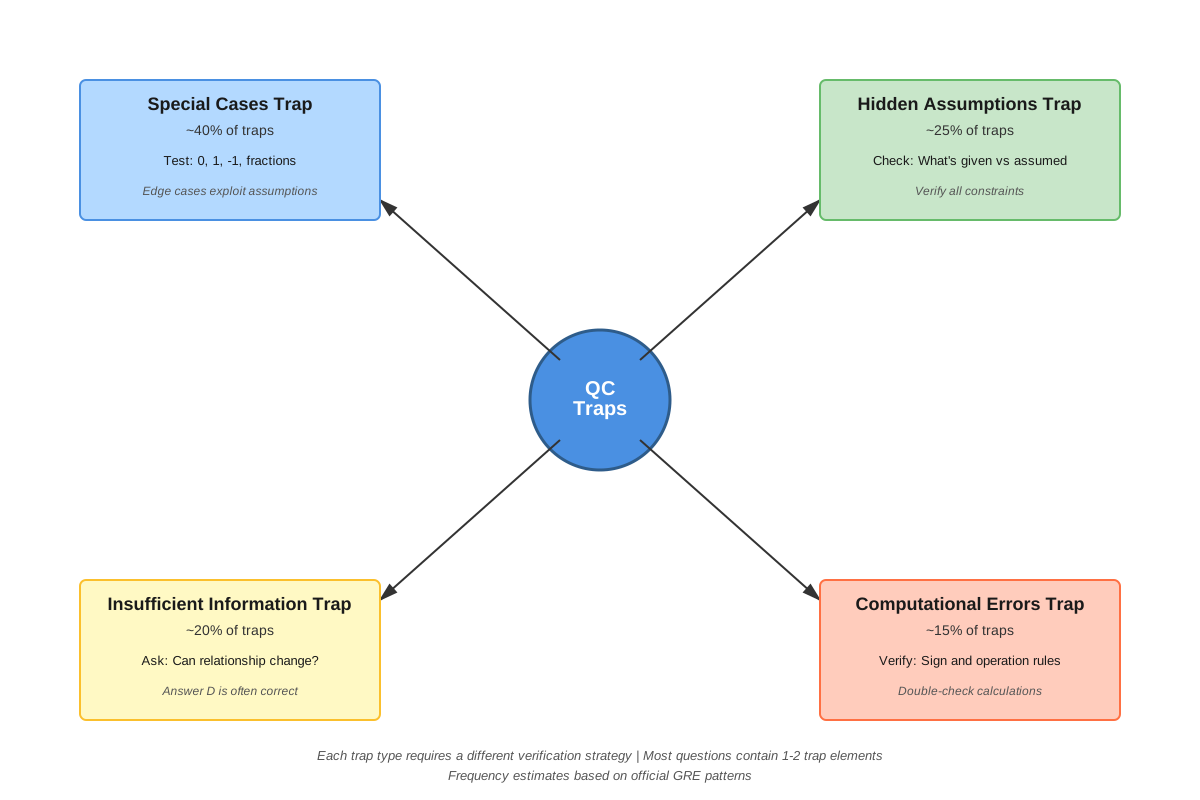
- [ ] Distinguish between the four major categories of quantitative comparison traps
- [ ] Systematically test special cases to reveal hidden trap conditions
- [ ] Recognize trigger phrases and question structures that signal potential traps
- [ ] Develop a step-by-step verification process to avoid trap answers
Prerequisites
- Basic algebra skills: Ability to manipulate equations, solve for variables, and work with inequalities is essential for evaluating the relationships between quantities
- Understanding of number properties: Knowledge of positive/negative numbers, fractions, zero, and special values is critical because many traps exploit these edge cases
- Familiarity with quantitative comparison format: Students must understand the four answer choices (A: Quantity A is greater, B: Quantity B is greater, C: The two quantities are equal, D: The relationship cannot be determined) before learning about traps
- Exponent and radical rules: Many traps involve squaring, square roots, or other operations that behave differently with negative numbers or fractions
- Geometric reasoning: Several trap types exploit assumptions about figure appearance or missing constraints in geometry problems
Why This Topic Matters
Quantitative comparison traps appear with remarkable consistency on the GRE, making them one of the highest-yield topics for focused study. Research on GRE question patterns indicates that approximately 60-70% of quantitative comparison questions contain at least one trap element designed to mislead test-takers. This means that students who cannot identify traps will consistently fall into predictable error patterns, severely limiting their score potential regardless of their mathematical knowledge.
In real-world applications, the skills developed through mastering quantitative comparison traps extend far beyond standardized testing. The ability to systematically test edge cases, avoid hasty generalizations, and verify conclusions under time pressure translates directly to analytical work in fields like data science, financial analysis, engineering, and research. The habit of asking "What if this variable were negative?" or "Have I considered all possible cases?" represents rigorous analytical thinking valued across quantitative disciplines.
On the GRE specifically, quantitative comparison questions appear in both the easier and harder Quantitative Reasoning sections, with trap complexity scaling with difficulty. In easier sections, traps might involve simple sign errors or forgetting to test negative numbers. In harder sections, traps become more sophisticated, involving multiple layers of misdirection or requiring recognition of subtle mathematical constraints. Common question types that feature traps include: algebraic comparisons with variables of unknown sign, geometric figures not drawn to scale, comparisons involving exponents or roots, questions with deliberately incomplete information, and problems that appear to require complex calculations but actually test conceptual understanding.
Core Concepts
The Four Standard Answer Choices
Every quantitative comparison question on the GRE presents exactly four answer choices, and understanding what each choice means is fundamental to recognizing traps:
- (A) Quantity A is greater: This answer is correct only if Quantity A is greater than Quantity B in ALL possible cases
- (B) Quantity B is greater: This answer is correct only if Quantity B is greater than Quantity A in ALL possible cases
- (C) The two quantities are equal: This answer is correct only if the quantities are equal in ALL possible cases
- (D) The relationship cannot be determined from the information given: This answer is correct if the relationship changes depending on which values are chosen for variables
The critical insight is that answers A, B, and C require universal truth—they must hold for every permissible value. If even one counterexample exists, these answers are wrong. This principle is the foundation of most quantitative comparison traps.
Trap Category 1: Assuming Variables Are Positive
The most common and highest-yield trap on the GRE involves variables without explicit constraints. When a problem presents a variable like x, n, or a without stating its sign, test-takers often unconsciously assume the variable is positive. This assumption leads directly to incorrect answers.
The Core Rule: Always test negative values, zero (when permitted), fractions between 0 and 1, and values greater than 1 for any unconstrained variable.
Consider this example structure:
Given: x ≠ 0
Quantity A: x²
Quantity B: x
The trap answer is (A), based on the assumption that x is positive and greater than 1. However:
- If x = 2, then x² = 4 > 2, so A is greater
- If x = 0.5, then x² = 0.25 < 0.5, so B is greater
- The relationship changes, so the correct answer is (D)
Trap Category 2: Figures Not Drawn to Scale
GRE quantitative comparison questions frequently include geometric figures with the warning "Figure not drawn to scale" or no figure at all. Test-takers often rely on visual appearance to make judgments, leading to trap answers.
The Core Rule: Never trust the appearance of a figure. Only use information explicitly stated in the problem or derivable through geometric principles.
Common manifestations include:
- Angles that appear right but aren't stated to be 90°
- Line segments that appear equal but have no marked congruence
- Triangles that appear equilateral but are only stated to be isosceles
- Figures where relative sizes are misleading
Trap Category 3: Hidden Constraints and Special Cases
Some traps involve mathematical operations that behave differently depending on the values involved. These traps exploit incomplete understanding of how operations work across different number domains.
Critical special cases to always test:
| Operation | Special Cases to Test | Why It Matters | ||||
|---|---|---|---|---|---|---|
| Squaring | Negative numbers, fractions (0,1) | x² < x when 0 < x < 1; squaring negatives makes them positive | ||||
| Square roots | Negative numbers (undefined in real numbers) | √x only defined for x ≥ 0 | ||||
| Division | Zero (undefined) | Cannot divide by zero; changes inequality direction | ||||
| Absolute value | Negative numbers | \ | x\ | = x when x ≥ 0, but \ | x\ | = -x when x < 0 |
| Exponents | Negative bases, fractional exponents | x^(1/2) different from √x for negative x |
Trap Category 4: Insufficient Information Disguised as Solvable
Perhaps the most sophisticated trap involves questions that appear to provide enough information to determine a relationship but actually don't. These questions are designed to reward answer choice (D), but test-takers often perform calculations and confidently select A, B, or C.
The Core Rule: Before calculating, ask whether the given information actually constrains the relationship. If variables can take on different values that change the relationship, the answer is (D).
Example structure:
Given: a + b = 10
Quantity A: a
Quantity B: b
The trap is to assume some relationship between a and b beyond their sum. However:
- If a = 7 and b = 3, then A > B
- If a = 3 and b = 7, then B > A
- The answer is (D)
Trap Category 5: Unnecessary Calculation Traps
Some quantitative comparison questions are designed to look computationally intensive, leading test-takers to waste time on complex calculations. The trap is performing the calculation at all—the relationship can often be determined through conceptual reasoning or simplification.
The Core Rule: Before calculating, look for ways to simplify, cancel terms, or compare conceptually. Quantitative comparison questions reward efficiency.
Example approach:
Quantity A: (47 × 89) + (47 × 11)
Quantity B: 47 × 100
Rather than calculating Quantity A, factor: 47(89 + 11) = 47(100) = Quantity B. Answer: (C)
The Systematic Testing Protocol
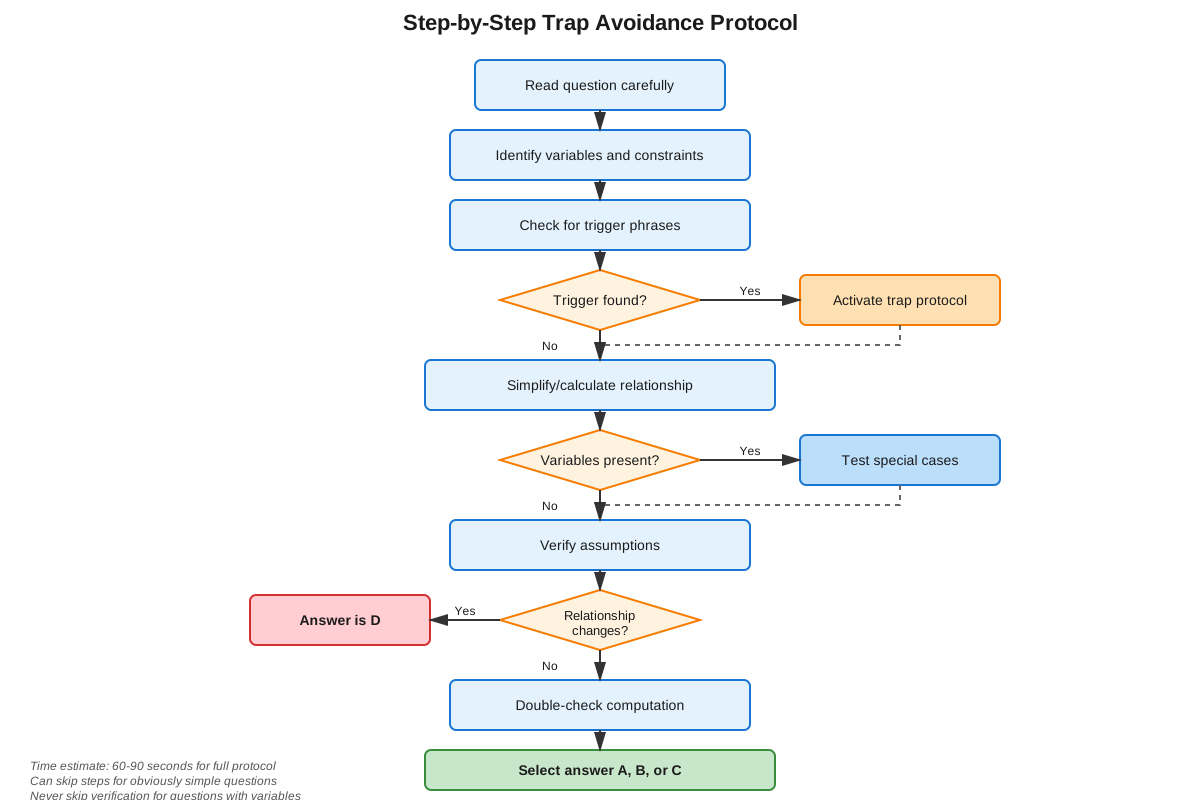
To avoid traps consistently, apply this protocol to every quantitative comparison question:
- Identify all variables and their constraints (or lack thereof)
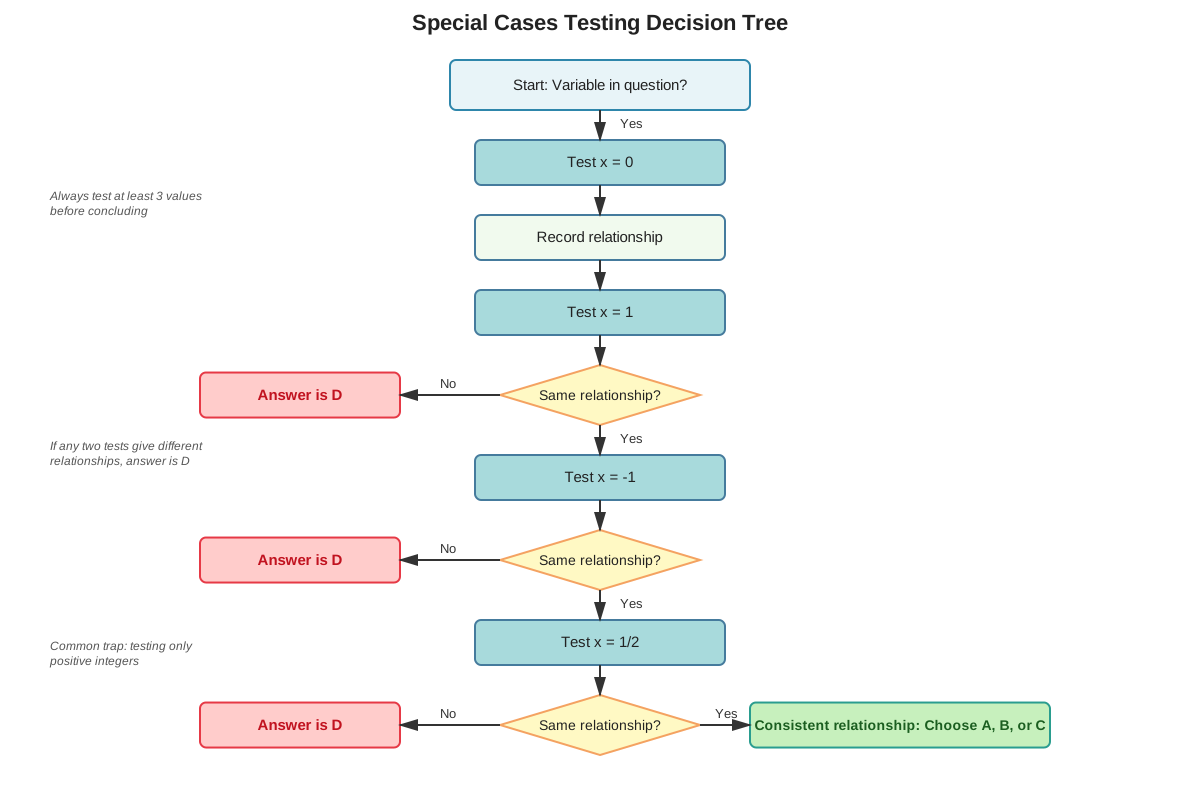
- Test at least three cases: a typical positive value, a negative value, and a special case (zero, fraction, or 1)
- Check for geometric assumptions if a figure is present
- Simplify before calculating to see if the relationship is obvious
- Verify that your answer holds for ALL cases, not just the one you tested first
Concept Relationships
The various trap categories are interconnected through the fundamental principle that quantitative comparison questions test whether a relationship holds universally. This principle connects to:
- Variable assumption traps → Special case testing: Recognizing that variables might be negative leads directly to the strategy of testing multiple cases
- Special case testing → Answer choice (D): When different test cases yield different relationships, the answer must be (D)
- Insufficient information traps → Variable assumption traps: Both exploit the tendency to assume more constraints than are actually given
- Unnecessary calculation traps → All other traps: By encouraging hasty calculation, these traps prevent the systematic analysis needed to avoid other traps
The relationship to prerequisite knowledge is direct: Number properties (positive/negative, fractions, zero) provide the special cases to test; Algebraic manipulation enables simplification before comparison; Geometric reasoning prevents visual assumption errors.
The progression of mastery follows this path:
Recognition of trap existence → Understanding trap categories → Systematic testing protocol → Automatic trap detection → Efficient, accurate answeringQuick check — test yourself on Quantitative comparison traps so far.
Try Flashcards →High-Yield Facts
⭐ Always test negative values for unconstrained variables—this is the single most common trap on the GRE
⭐ If you can find even one case where the relationship changes, the answer is (D)—you don't need to test exhaustively
⭐ Figures labeled "not drawn to scale" cannot be trusted for visual estimation—only use stated information
⭐ When squaring both sides of an inequality, the direction may reverse if values are negative—this creates frequent traps
⭐ Answer choice (D) is correct more often in quantitative comparison than random chance would predict—approximately 25-30% of questions
- Variables without explicit constraints can be positive, negative, zero (unless excluded), fractions, or any real number
- The phrase "x ≠ 0" is a red flag that zero is relevant to the problem and its exclusion is meaningful
- Absolute value comparisons almost always require testing both positive and negative cases
- When both quantities contain the same variable or expression, you can often subtract it from both sides to simplify
- Geometric figures without marked right angles should never be assumed to contain right angles
- The expression x² is greater than x only when x > 1 or x < 0; for 0 < x < 1, we have x² < x
- Division by a variable requires considering whether that variable could be negative (which reverses inequality direction)
- If a problem seems to require extensive calculation, look for a conceptual shortcut—quantitative comparison rewards efficiency
- The answer choices A, B, and C all make absolute claims; (D) is the "uncertainty" answer
- Testing x = 1 is particularly useful because many operations behave specially at 1 (x¹ = x, x⁰ = 1, etc.)
Common Misconceptions
Misconception: Variables in quantitative comparison questions are always positive unless stated otherwise.
Correction: Variables can be any real number unless explicitly constrained. Always test negative values, zero (if not excluded), and fractions for unconstrained variables.
Misconception: If Quantity A is greater for one value of a variable, then A is the correct answer.
Correction: Answer (A) is only correct if Quantity A is greater for ALL possible values. Finding one case where A is greater only eliminates answer (B) and possibly (C).
Misconception: Figures in quantitative comparison questions are drawn approximately to scale.
Correction: Figures are often deliberately misleading. Unless a figure is explicitly stated to be drawn to scale (rare on the GRE), use only the information given in text, not visual appearance.
Misconception: Answer choice (D) means "I don't know" or "this problem is too hard."
Correction: Answer (D) means the relationship definitively changes depending on which values are chosen. It's a mathematically precise answer, not an admission of uncertainty.
Misconception: Squaring both sides of an inequality is always safe and preserves the relationship.
Correction: Squaring both sides can reverse the inequality if one or both sides are negative. For example, -3 < -1, but (-3)² = 9 > 1 = (-1)².
Misconception: If both quantities look complicated, you must calculate both completely to compare them.
Correction: Often you can simplify, factor, or cancel common terms without full calculation. Quantitative comparison questions are designed to be answered more quickly than standard problems.
Misconception: The answer is (C) if the quantities are equal for the value I tested.
Correction: The quantities must be equal for ALL possible values for (C) to be correct. Test multiple cases to verify.
Misconception: Geometric figures without specific measurements cannot be solved.
Correction: Many geometric comparisons can be determined using properties, theorems, and relationships without knowing specific measurements.
Worked Examples
Example 1: Variable Sign Trap
Problem:
Given: n is an integer and n ≠ 0

Quantity A: n²
Quantity B: n³
Initial Reaction (Trap Thinking): "If n = 2, then n² = 4 and n³ = 8, so B is greater. Answer: (B)"
Systematic Analysis:
Step 1: Identify the variable and constraints. We have n as an integer, n ≠ 0. Notably, n is NOT stated to be positive.
Step 2: Test multiple cases systematically.
Case 1: n = 2 (positive, greater than 1)
- Quantity A: 2² = 4
- Quantity B: 2³ = 8
- Result: B > A
Case 2: n = 1 (special case)
- Quantity A: 1² = 1
- Quantity B: 1³ = 1
- Result: A = B
Case 3: n = -1 (negative)
- Quantity A: (-1)² = 1
- Quantity B: (-1)³ = -1
- Result: A > B
Step 3: Analyze results. In Case 1, B is greater. In Case 2, they're equal. In Case 3, A is greater. The relationship changes depending on the value of n.
Correct Answer: (D) The relationship cannot be determined from the information given.
Key Learning: This problem exploits the assumption that n is positive. The trap answer (B) comes from testing only positive values greater than 1. The systematic approach of testing negative values reveals that the relationship changes.
Example 2: Geometric Figure Trap
Problem:
[Figure shows a triangle with vertices labeled A, B, C.
Side AB appears to be horizontal.
Angle at B appears to be a right angle, but no right angle symbol is shown.
The length of AB is marked as 6.
The length of BC is marked as 8.]

Quantity A: The length of AC
Quantity B: 10
Initial Reaction (Trap Thinking): "This looks like a right triangle with legs 6 and 8, so by the Pythagorean theorem, AC = √(6² + 8²) = √(36 + 64) = √100 = 10. Answer: (C)"
Systematic Analysis:
Step 1: Check for the "not drawn to scale" warning or absence of right angle marking. The problem does NOT state that angle B is a right angle—it only appears that way.
Step 2: Consider what we actually know. We know AB = 6 and BC = 8. We do NOT know that angle ABC is 90°.
Step 3: Apply the triangle inequality and geometric constraints. In any triangle, the third side must be less than the sum of the other two sides and greater than their difference:
- AC < AB + BC = 6 + 8 = 14
- AC > |AB - BC| = |6 - 8| = 2
So: 2 < AC < 14
Step 4: Consider extreme cases:
- If angle B is very small (nearly 0°), AC approaches |8 - 6| = 2
- If angle B is 90°, AC = 10 (by Pythagorean theorem)
- If angle B is very large (approaching 180°), AC approaches 8 + 6 = 14
Step 5: Determine the relationship. Since AC could be anywhere from just over 2 to just under 14, it could be less than 10, equal to 10, or greater than 10.
Correct Answer: (D) The relationship cannot be determined from the information given.
Key Learning: This problem exploits the visual assumption that an angle is 90° when it's not marked as such. The trap answer (C) comes from assuming the Pythagorean theorem applies. Without confirmation that angle B is a right angle, we cannot determine AC's exact length.
Exam Strategy
Approaching Quantitative Comparison Questions
Step 1: Read carefully and identify constraints (15 seconds)
- Note what IS stated about variables
- Note what IS NOT stated (especially sign constraints)
- Identify any geometric markings or their absence
Step 2: Look for simplification opportunities (10 seconds)
- Can you subtract the same term from both quantities?
- Can you factor or cancel?
- Is there a conceptual relationship that avoids calculation?
Step 3: Test strategic cases (30-45 seconds)
- For unconstrained variables: test positive, negative, zero, fraction, and 1
- For geometric problems: consider extreme configurations
- Stop testing as soon as you find two cases with different relationships (answer is D)
Step 4: Verify your answer (10-15 seconds)
- If you chose A, B, or C: does this hold for ALL cases?
- If you chose D: did you find at least two cases with different relationships?
Trigger Words and Phrases
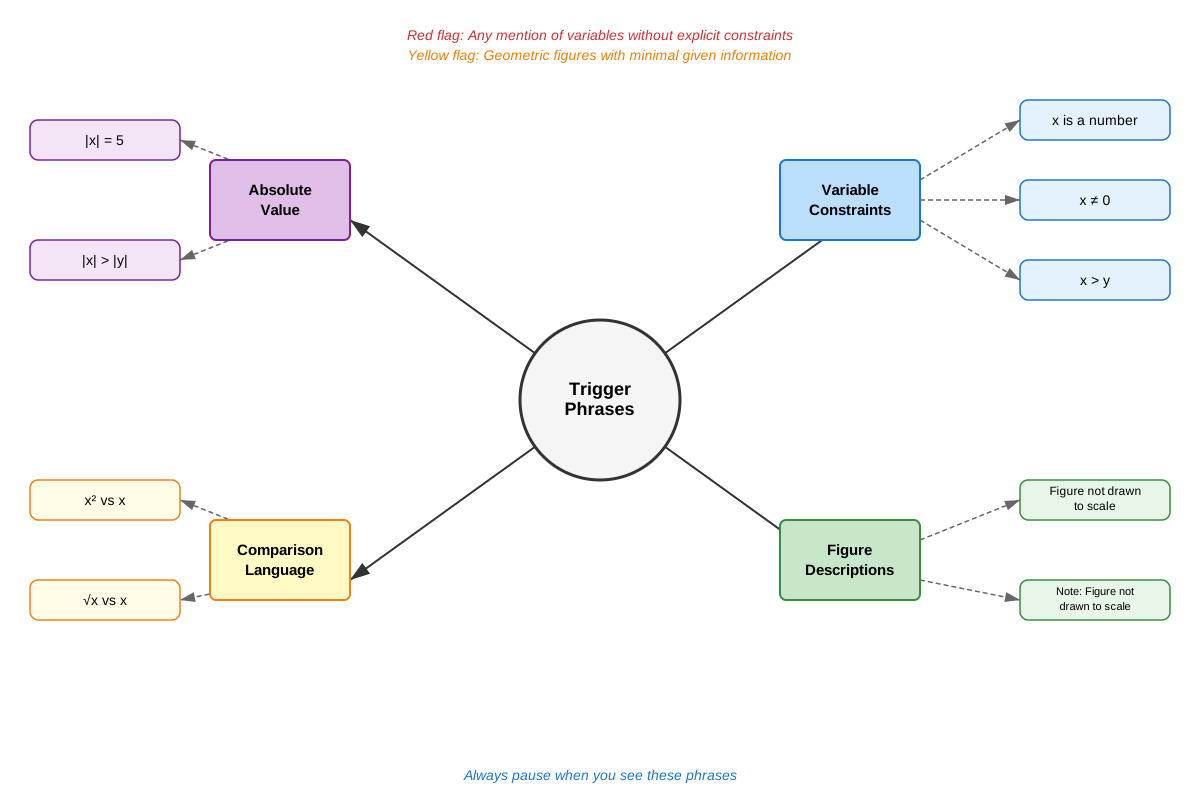
Watch for these red flags that signal potential traps:
- "x ≠ 0" or "n ≠ 0": Signals that zero is relevant; test values close to zero and negative values
- "integer" without "positive": Must test negative integers
- "Figure not drawn to scale": Ignore visual appearance completely
- No figure provided for a geometry problem: Cannot make assumptions about appearance
- "x²" or other even powers: Test negative values and fractions between 0 and 1
- "√x" or other roots: Consider domain restrictions
- "|x|" (absolute value): Always test both positive and negative
- Variables in denominators: Consider sign changes and division by negative numbers
Process of Elimination
Unlike standard multiple-choice questions, quantitative comparison has a unique elimination structure:
- Finding one case where A > B eliminates answers (B) and (C)
- Finding one case where B > A eliminates answers (A) and (C)
- Finding one case where A = B eliminates answers (A) and (B)
- Finding two cases with different relationships confirms answer (D)
This means you often don't need to test exhaustively—two strategic test cases can definitively answer the question.
Time Allocation
Quantitative comparison questions should take 60-90 seconds on average, less than standard multiple-choice problems. If you find yourself calculating for more than 90 seconds, stop and reconsider whether there's a conceptual shortcut or whether the answer might be (D) due to insufficient information.
Memory Techniques
The SNAP Mnemonic for Testing Cases
Special values (0, 1, -1)
Negative numbers
All constraints checked
Positive numbers (including fractions)
Use SNAP to remember which cases to test for any unconstrained variable.
The "Three Strikes" Rule
For any quantitative comparison question with variables, test at least three different values:
- A "normal" positive value (like 2 or 5)
- A negative value (like -2)
- A special case (0, 1, -1, or a fraction like 0.5)
If all three give the same relationship, you can be more confident in answers A, B, or C. If any two differ, the answer is D.
Visual Reminder: The "D-Zone"
Think of answer choice (D) as the "Different relationships zone." Whenever you find that the relationship Differs between cases, you're in the D-zone, and (D) is your answer.
The Squaring Danger Zones
Remember: "Squaring flips fractions, fixes negatives"
- Fractions between 0 and 1 get smaller when squared (0.5² = 0.25)
- Negative numbers become positive when squared ((-3)² = 9)
Summary
Quantitative comparison traps represent systematic patterns of misdirection designed to exploit common reasoning errors on the GRE. The most critical insight is that answers A, B, and C require universal truth—the relationship must hold for ALL possible values—while answer D indicates that the relationship changes depending on which values are chosen. The five major trap categories are: assuming variables are positive, trusting figures not drawn to scale, overlooking special cases in mathematical operations, mistaking insufficient information for solvable problems, and performing unnecessary calculations. Mastery requires developing a systematic testing protocol: identify all variables and constraints, test multiple strategic cases (especially negative values, zero, and fractions), check for geometric assumptions, simplify before calculating, and verify that your answer holds universally. The highest-yield strategy is always testing negative values for unconstrained variables, as this single technique avoids the most common trap on the exam. Success in quantitative comparison questions comes not from computational speed but from methodical analysis, strategic case testing, and rigorous verification.
Key Takeaways
- Always test negative values, zero, and fractions for any variable without explicit positive constraints—this avoids the most common trap
- Answer choices A, B, and C require the relationship to hold in ALL cases; finding one counterexample makes the answer D
- Never trust the visual appearance of geometric figures unless explicitly stated to be drawn to scale
- Test at least three strategic cases for any problem with variables: a typical value, a negative value, and a special case
- Look for simplification opportunities before calculating—quantitative comparison rewards conceptual understanding over computation
- The phrase "x ≠ 0" is a red flag indicating that zero is relevant and its exclusion is meaningful
- If you find yourself calculating for more than 90 seconds, reconsider whether there's a conceptual shortcut or whether the answer is D
Related Topics
Algebraic Inequalities: Understanding how to manipulate inequalities properly (especially when multiplying or dividing by negative numbers) directly supports avoiding quantitative comparison traps involving variables.
Number Properties and Special Cases: Deep knowledge of how operations behave with negative numbers, fractions, and zero is essential for systematic case testing in quantitative comparison questions.
Geometric Reasoning Without Figures: Many quantitative comparison geometry problems require determining relationships using only stated properties, not visual information, which builds on pure geometric reasoning skills.
Strategic Guessing and Answer Choice Analysis: Understanding the statistical distribution of answer choices in quantitative comparison (especially the slightly elevated frequency of answer D) can inform strategic guessing when necessary.
Mastering quantitative comparison traps provides a foundation for efficient problem-solving across all GRE Quantitative Reasoning question types, as the habits of testing edge cases and avoiding unwarranted assumptions apply universally.
Practice CTA
Now that you understand the systematic approaches to identifying and avoiding quantitative comparison traps, it's time to put these strategies into practice. Work through the practice questions for this topic, applying the SNAP mnemonic and three-case testing protocol to each problem. Pay special attention to problems where your first instinct differs from the correct answer—these reveal your personal trap vulnerabilities. Review the flashcards to reinforce trigger phrases and special cases that signal traps. Remember: every trap you learn to recognize is a point you'll save on test day. Your investment in mastering these patterns will pay dividends throughout the Quantitative Reasoning section!
Sign up free to keep reading
Create a free AnvayaPrep account to finish this GRE guide on Quantitative comparison traps — plus flashcards and practice questions.