Overview
When to simplify is a critical strategic concept in GRE Quantitative Comparison questions that determines whether algebraic manipulation will lead to a correct answer or introduce errors. Unlike standard problem-solving questions where simplification almost always helps, Quantitative Comparison questions require careful analysis before performing operations. The core challenge lies in recognizing that certain algebraic operations—particularly multiplication, division, and squaring—can fundamentally change the relationship between two quantities when variables or unknowns are involved.
This topic represents one of the most frequently tested strategic concepts on the GRE because it directly assesses mathematical reasoning rather than computational ability. Students who automatically simplify without considering the constraints often fall into carefully constructed traps. The test makers deliberately design questions where intuitive simplification leads to incorrect conclusions, making this skill essential for achieving a competitive Quantitative Reasoning score. Mastering GRE when to simplify strategies can improve accuracy by 20-30% on Quantitative Comparison questions according to test preparation research.
Understanding when to simplify connects directly to broader Quantitative Reasoning concepts including inequality properties, algebraic manipulation, and logical reasoning. This topic serves as a bridge between pure computational skills and strategic test-taking, requiring students to pause and analyze the mathematical structure before proceeding. The ability to recognize safe versus unsafe simplification operations distinguishes high-scoring test-takers from those who struggle with the unique format of Quantitative Comparison questions.
Learning Objectives
- [ ] Identify when When to simplify is being tested in GRE Quantitative Comparison questions
- [ ] Explain the core rule or strategy behind When to simplify, including safe and unsafe operations
- [ ] Apply When to simplify to GRE-style questions accurately and efficiently
- [ ] Distinguish between operations that preserve relationships and those that may alter them
- [ ] Recognize the role of variable signs and constraints in simplification decisions
- [ ] Evaluate when substitution strategies are preferable to algebraic simplification
- [ ] Demonstrate mastery by avoiding common simplification traps on practice questions
Prerequisites
- Basic algebraic manipulation: Understanding how to add, subtract, multiply, and divide algebraic expressions is essential for recognizing which operations are being considered
- Inequality properties: Knowledge of how inequalities behave under different operations provides the foundation for understanding why certain simplifications are unsafe
- Quantitative Comparison format: Familiarity with the four answer choices (A, B, C, D) and the goal of comparing two quantities is necessary to apply simplification strategies
- Properties of positive and negative numbers: Understanding how signs affect multiplication and division is crucial for determining when simplification preserves relationships
Why This Topic Matters
In real-world applications, knowing when to simplify mathematical expressions relates to engineering constraints, financial modeling, and scientific analysis where certain operations are only valid under specific conditions. Professionals regularly encounter situations where transforming an equation or inequality requires verification that the transformation preserves the original relationship—a skill directly parallel to GRE simplification strategies.
On the GRE, Quantitative Comparison questions constitute approximately 40% of the Quantitative Reasoning section, with roughly 30-40% of these questions specifically testing whether students understand when simplification is appropriate. This translates to 3-5 questions per test section where this skill is the primary discriminator between correct and incorrect answers. The topic appears with "High" importance because it represents a strategic skill that, once mastered, immediately improves performance across multiple question types.
Common manifestations include: comparing algebraic expressions with unknown variables, comparing quantities involving squared terms, comparing fractions with variable denominators, and comparing products where factor signs are unknown. The GRE frequently presents scenarios where the most obvious simplification path leads to answer choice (C) "The relationship cannot be determined," when in fact one quantity is definitively larger. Conversely, questions may tempt students to conclude one quantity is larger when the correct answer is actually (C) because they simplified without considering all possible values.
Core Concepts
The Fundamental Principle of Safe Simplification
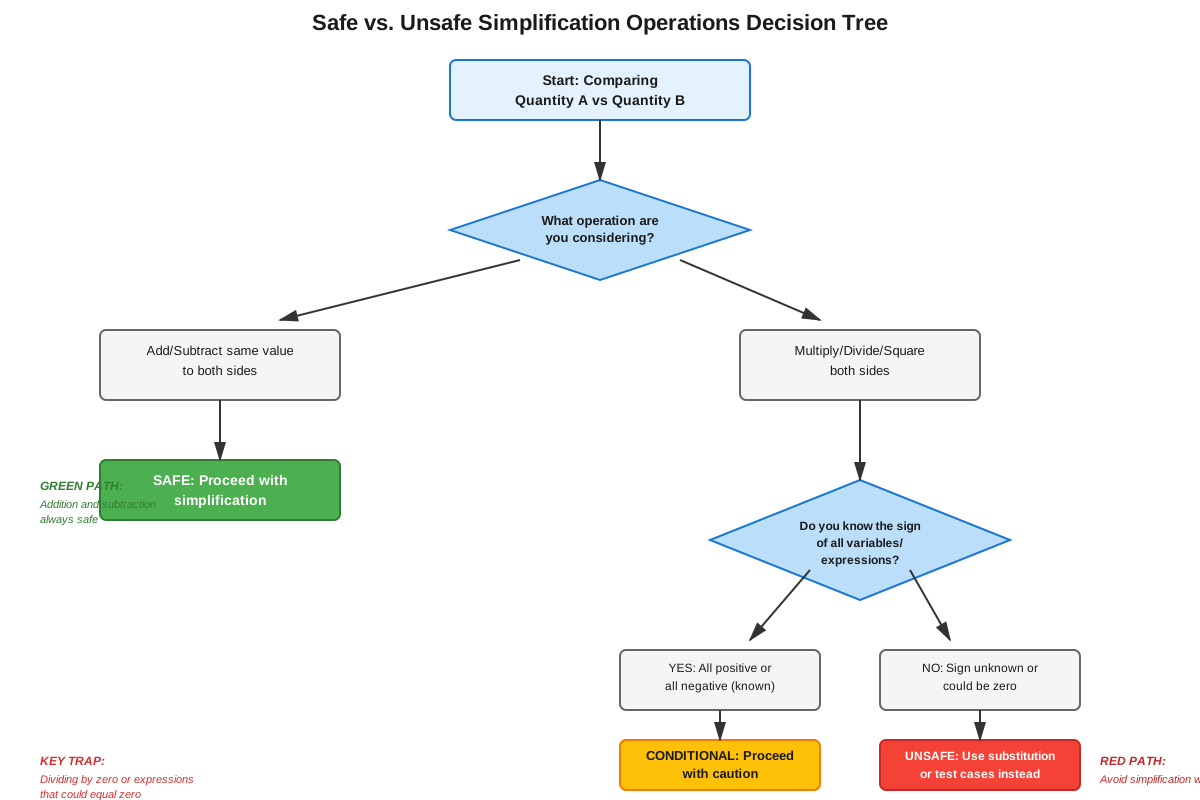
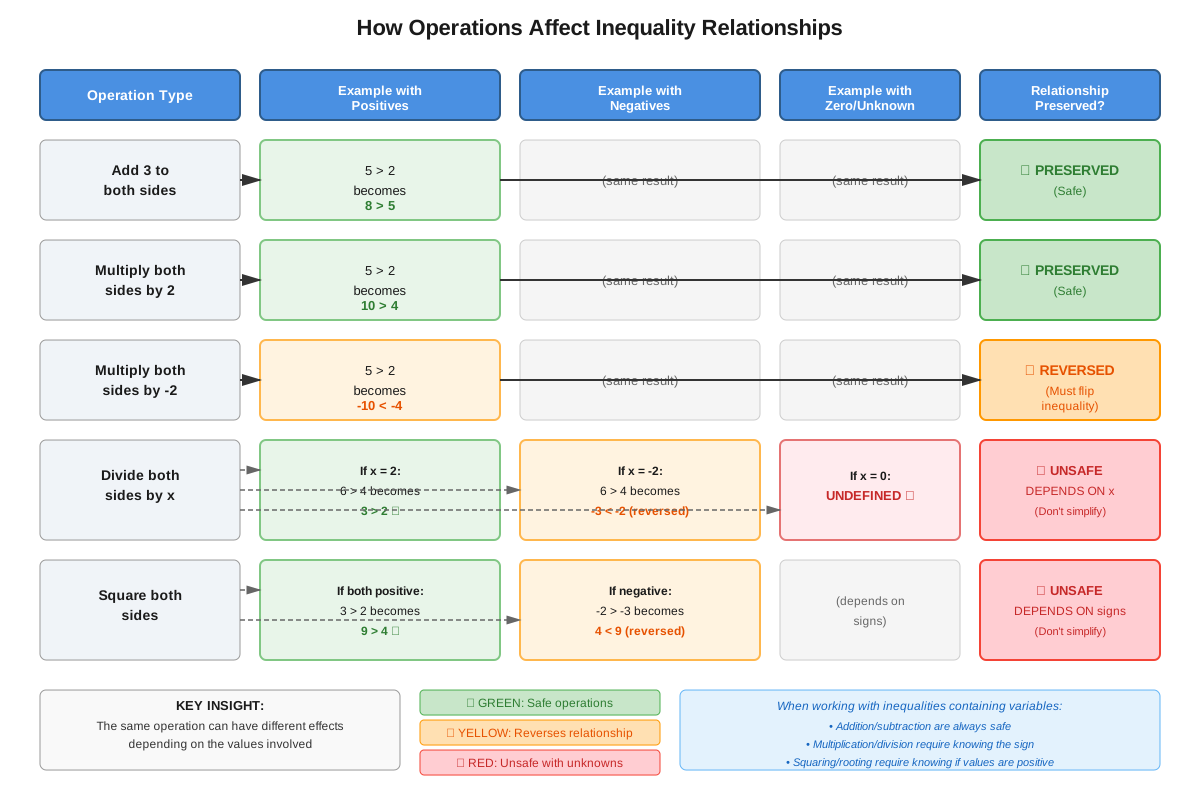
The cornerstone of when to simplify strategy is understanding that certain operations preserve the relationship between two quantities while others may change it. Safe operations include adding or subtracting the same value from both quantities, regardless of whether that value is positive, negative, or zero. These operations maintain the inequality relationship because they shift both quantities equally along the number line.
For example, if Quantity A is x + 5 and Quantity B is x + 3, subtracting x from both quantities yields 5 and 3 respectively, preserving the relationship that A > B. This works because addition and subtraction are relationship-preserving operations under all circumstances.
Unsafe Operations: Multiplication and Division
Unsafe operations include multiplying or dividing both quantities by an expression containing variables or by any value whose sign is unknown. The critical issue is that multiplying or dividing by a negative number reverses inequality relationships, while multiplying or dividing by zero is undefined or creates equality.
Consider comparing x² versus 2x. A student might be tempted to divide both sides by x to get x versus 2, concluding that the relationship depends on whether x > 2 or x < 2. However, this simplification is invalid because:
- If x > 0, dividing by x preserves the inequality direction
- If x < 0, dividing by x reverses the inequality direction
- If x = 0, division is undefined
The correct approach requires testing multiple values or recognizing that the relationship genuinely cannot be determined without additional constraints.
The Sign-Constraint Rule
A multiplication or division simplification becomes safe only when you can definitively establish that the multiplier/divisor is:
- Always positive (including when explicitly stated or logically derived)
- Always negative (allowing you to reverse the inequality)
- Never zero (avoiding undefined operations)
| Operation Type | When Safe | When Unsafe | Example |
|---|---|---|---|
| Add/Subtract same value | Always | Never | A: x+5, B: x+3 → subtract x |
| Multiply/Divide by positive constant | Always | Never | A: 3x, B: 6x → divide by 3 |
| Multiply/Divide by variable | When sign is known | When sign unknown | A: x², B: 3x → cannot divide by x |
| Square both sides | When both quantities have same sign | When signs differ or unknown | A: -3, B: -5 → squaring reverses relationship |
The Testing Values Strategy
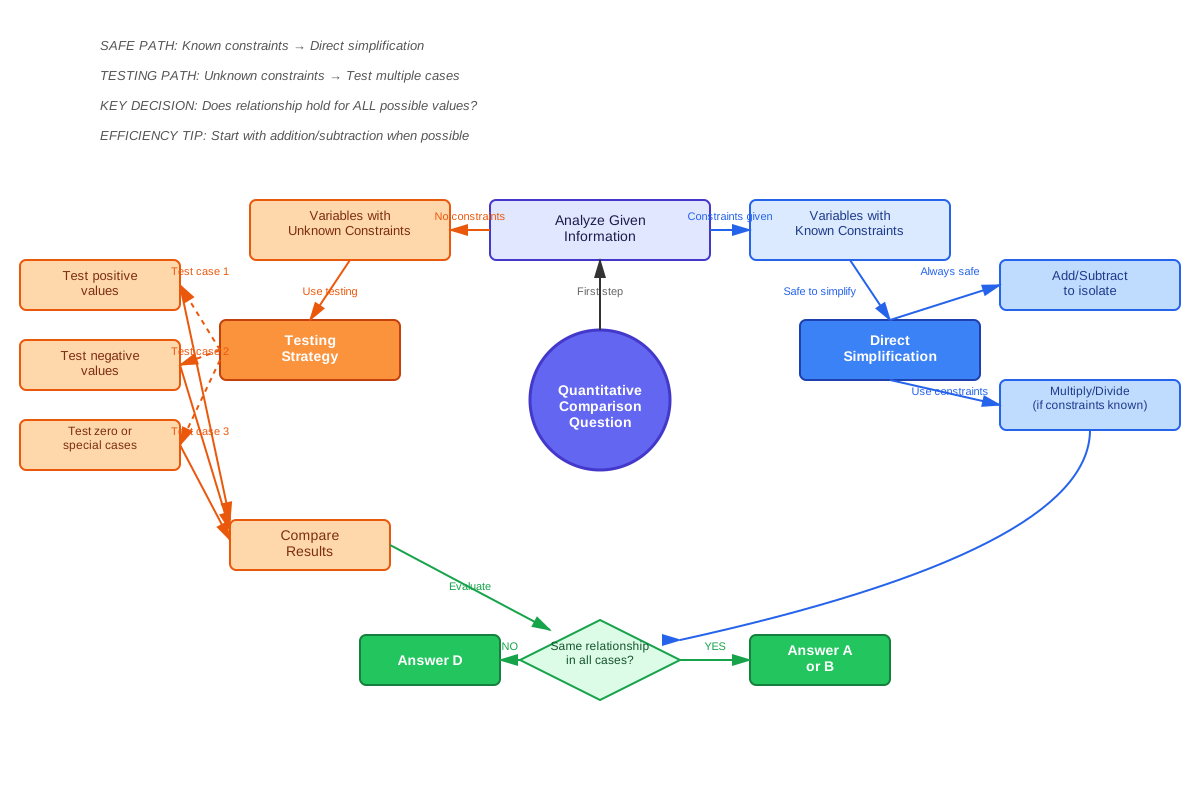
When simplification appears unsafe, the testing values strategy provides an alternative approach. This involves substituting specific numbers that satisfy any given constraints to determine whether the relationship is consistent or variable.
The systematic approach involves:
- Test a positive value (often 1 or 2)
- Test a negative value (often -1 or -2)
- Test zero (if allowed by constraints)
- Test a fraction between 0 and 1 (often 1/2)
- Test a large value (often 10 or 100)
If all tested values yield the same relationship (A always larger, or B always larger), that relationship likely holds. If different values produce different relationships, the answer is (C) "The relationship cannot be determined."
Recognizing Simplification Traps
The GRE deliberately constructs questions where the obvious simplification is invalid. Common trap patterns include:
Trap Pattern 1: Presenting expressions like x²y versus xy³ where dividing by xy seems natural but requires knowing that both x and y are non-zero and considering their signs.
Trap Pattern 2: Comparing fractions like a/b versus c/d where cross-multiplication (multiplying both sides by bd) is only safe if you know bd > 0.
Trap Pattern 3: Comparing squared expressions where taking square roots seems logical but fails when the original quantities have opposite signs.
The Factoring Alternative
Sometimes factoring provides insight without unsafe operations. When comparing expressions like x² - 4 versus x² - 9, subtracting x² from both sides (safe operation) yields -4 versus -9, immediately showing that Quantity A is larger. This approach avoids the temptation to factor and divide by (x-2) or (x-3), which would be unsafe.
Constraint Analysis
Given constraints in the question stem dramatically affect simplification safety. If told "x > 0," then dividing by x becomes safe. If told "ab > 0," then a and b have the same sign, enabling certain multiplications. Constraint analysis must precede any simplification decision.
The process:
- Read all constraints carefully
- Determine what these constraints reveal about signs and zero-possibilities
- Identify which operations become safe under these constraints
- Proceed with simplification only when safety is confirmed
Concept Relationships
The core concepts within this topic form a logical hierarchy: The Fundamental Principle of Safe Simplification establishes the foundation → which leads to → identifying Unsafe Operations (multiplication/division by unknowns) → which requires → The Sign-Constraint Rule to determine safety → when safety cannot be established → The Testing Values Strategy provides an alternative → throughout this process → Recognizing Simplification Traps prevents common errors → and Constraint Analysis modifies what operations are permissible.
This topic connects to prerequisite knowledge of inequality properties because the reason multiplication by negatives is unsafe stems from the fundamental inequality rule that multiplying both sides by a negative reverses the inequality. The connection to basic algebraic manipulation appears in recognizing which operations are being considered and executing them correctly when deemed safe.
The relationship to broader Quantitative Comparison strategy is direct: this topic represents the analytical phase that must occur before computation. It connects forward to more advanced topics like comparing complex algebraic expressions, working with absolute values in comparisons, and analyzing geometric relationships where algebraic representation is involved.
Quick check — test yourself on When to simplify so far.
Try Flashcards →High-Yield Facts
⭐ Adding or subtracting the same value from both quantities is always safe, regardless of whether the value is positive, negative, zero, or contains variables
⭐ Multiplying or dividing both quantities by a variable or expression is unsafe unless you can definitively determine the sign and confirm it's non-zero
⭐ Multiplying or dividing by a positive constant is always safe and preserves the inequality direction
⭐ If testing different values produces different relationships (sometimes A > B, sometimes B > A), the answer is always (C) "The relationship cannot be determined"
⭐ Squaring both sides is unsafe when the quantities might have opposite signs, as squaring can reverse relationships between negative numbers
- Dividing by a variable that could equal zero is never safe, even if you know its sign when non-zero
- Cross-multiplying to compare fractions a/b and c/d requires knowing that bd > 0 (same sign and non-zero)
- When constraints specify a variable is positive or negative, immediately note which operations become safe
- The GRE frequently tests whether students will incorrectly divide by a variable, making this the single most common trap
- If simplification seems to lead to answer (C) but required an unsafe operation, reconsider the approach—the actual answer may be (A) or (B)
- Factoring expressions before comparing can sometimes reveal relationships without requiring unsafe operations
- When both quantities are clearly positive or clearly negative, additional operations become safe
Common Misconceptions
Misconception: Dividing both sides by a variable is acceptable as long as you "consider different cases" afterward → Correction: Once you perform an unsafe operation, you've potentially altered the relationship in ways that cannot be recovered by case analysis. The testing values strategy must be used instead of simplification, not after invalid simplification.
Misconception: If a variable appears in both quantities, it can be canceled out → Correction: Variables can only be eliminated through addition/subtraction (safe) or through multiplication/division when their sign and non-zero status are confirmed. The mere presence in both quantities doesn't make cancellation safe.
Misconception: Squaring both sides is safe because it's a standard algebraic technique → Correction: Squaring is only safe when both quantities are known to be non-negative or both known to be non-positive. Squaring -5 and -3 gives 25 and 9, reversing the original relationship.
Misconception: When testing values produces the same result twice, that relationship must hold for all values → Correction: Comprehensive testing requires checking positive, negative, zero, fractional, and large values. Two tests are insufficient; relationships can change at boundary values or with fractions.
Misconception: If the problem seems too simple after simplification, the simplification must be wrong → Correction: Some Quantitative Comparison questions are straightforward after proper simplification. The key is ensuring the simplification was safe, not second-guessing correct work. Conversely, if simplification required unsafe operations, the apparent simplicity is indeed a red flag.
Worked Examples
Example 1: Recognizing Unsafe Division
Question:
- Quantity A: x³
- Quantity B: x²
- Given: x ≠ 0
Incorrect Approach: Divide both quantities by x² to get x versus 1, concluding that the relationship depends on whether x > 1 or x < 1, so answer (C).
Correct Approach:
Step 1: Consider dividing by x². Since x ≠ 0, we know x² ≠ 0. Additionally, x² is always positive (whether x is positive or negative), so dividing by x² is SAFE.
Step 2: After dividing by x²: Quantity A becomes x, Quantity B becomes 1.
Step 3: Now we must determine the relationship between x and 1. Since no constraints tell us about x's value relative to 1, we test values:
- If x = 2: A = 2, B = 1, so A > B
- If x = 0.5: A = 0.5, B = 1, so B > A
- If x = -2: A = -2, B = 1, so B > A
Step 4: Different values produce different relationships, so the answer is (C) The relationship cannot be determined.
Key Insight: The division was safe because x² is always positive, but this doesn't mean the final relationship is determinable. The simplification was valid; the indeterminate relationship is the correct conclusion.
Example 2: Safe Simplification Leading to Definite Answer
Question:
- Quantity A: (x + 3)² + 5
- Quantity B: (x + 3)² + 2
- Given: No constraints
Approach:
Step 1: Notice both quantities contain (x + 3)². Subtracting this expression from both quantities is safe (subtraction is always safe).
Step 2: After subtracting (x + 3)²:
- Quantity A: 5
- Quantity B: 2
Step 3: Compare 5 versus 2. Clearly 5 > 2.
Answer: (A) Quantity A is greater.
Key Insight: Even though (x + 3)² contains a variable, subtracting it from both sides is safe because subtraction doesn't depend on the value's sign or magnitude. This example demonstrates that variable expressions can be eliminated when using safe operations.
Example 3: The Squaring Trap
Question:
- Quantity A: -2x
- Quantity B: -3x
- Given: x > 0
Incorrect Approach: Square both quantities to eliminate negatives, getting 4x² versus 9x², concluding B > A.
Correct Approach:
Step 1: Given x > 0, we can multiply both quantities by positive constants safely. However, squaring is not the same as multiplying by a constant.
Step 2: Better approach—factor out the negative: both quantities are negative (since x > 0). We're comparing -2x versus -3x.
Step 3: Add 3x to both sides (safe operation):
- Quantity A: -2x + 3x = x
- Quantity B: -3x + 3x = 0
Step 4: Since x > 0, we have x > 0, so A > B.
Answer: (A) Quantity A is greater.
Key Insight: Squaring would have reversed the relationship because both quantities are negative. When both quantities are negative, the one with smaller absolute value is actually larger. The safe approach used addition rather than squaring.
Exam Strategy
When approaching Quantitative Comparison questions, implement this systematic process:
Step 1: Read constraints first. Before looking at the quantities, identify all given information about variables, including ranges, signs, and relationships. Mark these constraints clearly.
Step 2: Identify variable signs. Determine whether each variable or expression is definitely positive, definitely negative, possibly either, or possibly zero. This analysis determines which operations are safe.
Step 3: Look for safe simplifications. Check whether adding or subtracting expressions will simplify the comparison. This is always the first simplification to attempt.
Step 4: Evaluate multiplication/division carefully. Before multiplying or dividing, explicitly ask: "Is this value definitely positive?" or "Is this value definitely negative?" If the answer is uncertain, do not perform the operation.
Step 5: Use testing values when simplification is unsafe. Select strategic values: positive, negative, zero, fractions, and large numbers. Track whether the relationship remains consistent.
Trigger phrases to watch for:
- "x ≠ 0" suggests division might be tempting but still requires sign analysis
- "x > 0" or "x < 0" explicitly makes certain operations safe
- "xy > 0" means x and y have the same sign
- No constraints on a variable means testing values is likely necessary
Process-of-elimination tips:
- If you performed an unsafe operation and got (A) or (B), reconsider—the answer might be (C)
- If testing two values gives different relationships, immediately select (C) without further testing
- If the question seems trivially easy after one step, verify that step was safe
Time allocation: Spend 10-15 seconds analyzing safety before performing any operations. This upfront investment prevents the 30-60 seconds wasted on invalid approaches and the potential wrong answer.
Memory Techniques
Mnemonic for safe operations: "ASAP" - Add and Subtract are Always Permissible
Visualization strategy: Picture a balance scale. Adding or subtracting the same weight from both sides keeps the balance relationship the same. Multiplying by a negative is like flipping the scale upside down—the heavier side becomes the lighter side.
Acronym for testing values: "PNZFL" - Positive, Negative, Zero, Fraction, Large. Test values in this order for comprehensive coverage.
Sign-check mantra: Before multiplying or dividing, mentally ask "Positive, Negative, or Unknown?" (PNU). Only proceed if the answer is definitively P or N.
The "Red Flag" rule: If you're about to divide by a variable, visualize a red flag. This pause triggers the safety check: "Do I know this is non-zero? Do I know its sign?"
Summary
When to simplify is a strategic decision-making skill essential for GRE Quantitative Comparison questions. The fundamental principle distinguishes safe operations (addition and subtraction of any value) from unsafe operations (multiplication and division by variables or expressions with unknown signs). Students must analyze constraints to determine what information is known about variable signs and zero-possibilities before performing algebraic manipulations. When simplification safety cannot be established, the testing values strategy provides a reliable alternative by checking whether the relationship remains consistent across positive, negative, zero, fractional, and large values. The GRE frequently constructs traps where intuitive simplification is invalid, making this analytical pause before computation a critical skill. Mastery requires recognizing that the goal is not to simplify whenever possible, but rather to simplify only when doing so preserves the mathematical relationship being compared. This topic represents the intersection of algebraic knowledge and strategic reasoning, directly impacting performance on approximately 40% of Quantitative Reasoning questions.
Key Takeaways
- Addition and subtraction are always safe operations; multiplication and division by variables or unknowns are unsafe unless sign and non-zero status are confirmed
- Analyze all given constraints before attempting any simplification to determine which operations become safe
- When simplification is unsafe, use the testing values strategy with positive, negative, zero, fractional, and large numbers
- If different test values produce different relationships, the answer is always (C) "The relationship cannot be determined"
- The most common GRE trap involves tempting students to divide by a variable without considering sign or zero-possibility
- Squaring both sides is unsafe when quantities might have opposite signs, as it can reverse relationships between negative numbers
- Spending 10-15 seconds on safety analysis before simplifying prevents errors and saves time overall
Related Topics
Inequality Properties and Manipulation: Understanding the formal rules governing inequalities provides the mathematical foundation for why certain simplification operations are unsafe. Mastering when to simplify enables more sophisticated work with complex inequalities.
Algebraic Expression Comparison: Advanced Quantitative Comparison questions involve comparing complex algebraic expressions where multiple simplification decisions must be made sequentially. The when to simplify skill is prerequisite to this higher-level work.
Absolute Value in Comparisons: Absolute value expressions introduce additional complexity to sign analysis, requiring integration of when to simplify principles with absolute value properties.
Systems of Inequalities: When comparing quantities that satisfy multiple inequality constraints, the simplification strategy must account for the interaction between constraints, building on the foundational when to simplify skills.
Practice CTA
Now that you understand the strategic principles behind when to simplify, it's time to reinforce this knowledge through deliberate practice. Attempt the practice questions associated with this topic, focusing not just on getting correct answers but on articulating why each simplification decision is safe or unsafe. Use the flashcards to drill the key distinctions between safe and unsafe operations until the analysis becomes automatic. Remember: every expert test-taker once struggled with these concepts, but consistent practice with strategic awareness transforms this challenging topic into a reliable source of correct answers. Your investment in mastering when to simplify will pay dividends across the entire Quantitative Comparison section!
Sign up free to keep reading
Create a free AnvayaPrep account to finish this GRE guide on When to simplify — plus flashcards and practice questions.