Overview
GRE QC pacing refers to the strategic time management and decision-making approach specifically tailored for Quantitative Comparison questions on the GRE. Unlike traditional problem-solving questions that require calculating exact values, Quantitative Comparison questions ask test-takers to determine the relationship between two quantities—whether Quantity A is greater, Quantity B is greater, the two are equal, or the relationship cannot be determined. This unique question format demands a specialized pacing strategy that prioritizes comparison over calculation, estimation over precision, and strategic elimination over exhaustive computation.
Mastering gre qc pacing is essential because Quantitative Comparison questions constitute approximately 40% of the Quantitative Reasoning section, appearing as roughly 7-8 questions per section. Students who approach these questions with the same methodical calculation mindset used for Problem Solving questions often waste precious time computing exact values when only relative comparisons are needed. Effective pacing in QC questions can save 30-45 seconds per question, creating a cumulative time advantage of 3-5 minutes per section—time that can be redirected toward more challenging problems or used for careful review.
The relationship between gre gre qc pacing and broader Quantitative Reasoning success is fundamental. QC questions test the same mathematical concepts as Problem Solving questions—algebra, arithmetic, geometry, and data analysis—but reward different cognitive skills: pattern recognition, strategic thinking, and the ability to make comparisons without complete calculations. Students who develop strong QC pacing habits demonstrate superior test-taking efficiency, reduced anxiety, and higher overall scores. This topic serves as a bridge between mathematical knowledge and strategic test execution, transforming content mastery into score optimization.
Learning Objectives
- [ ] Identify when GRE QC pacing is being tested
- [ ] Explain the core rule or strategy behind GRE QC pacing
- [ ] Apply GRE QC pacing to GRE-style questions accurately
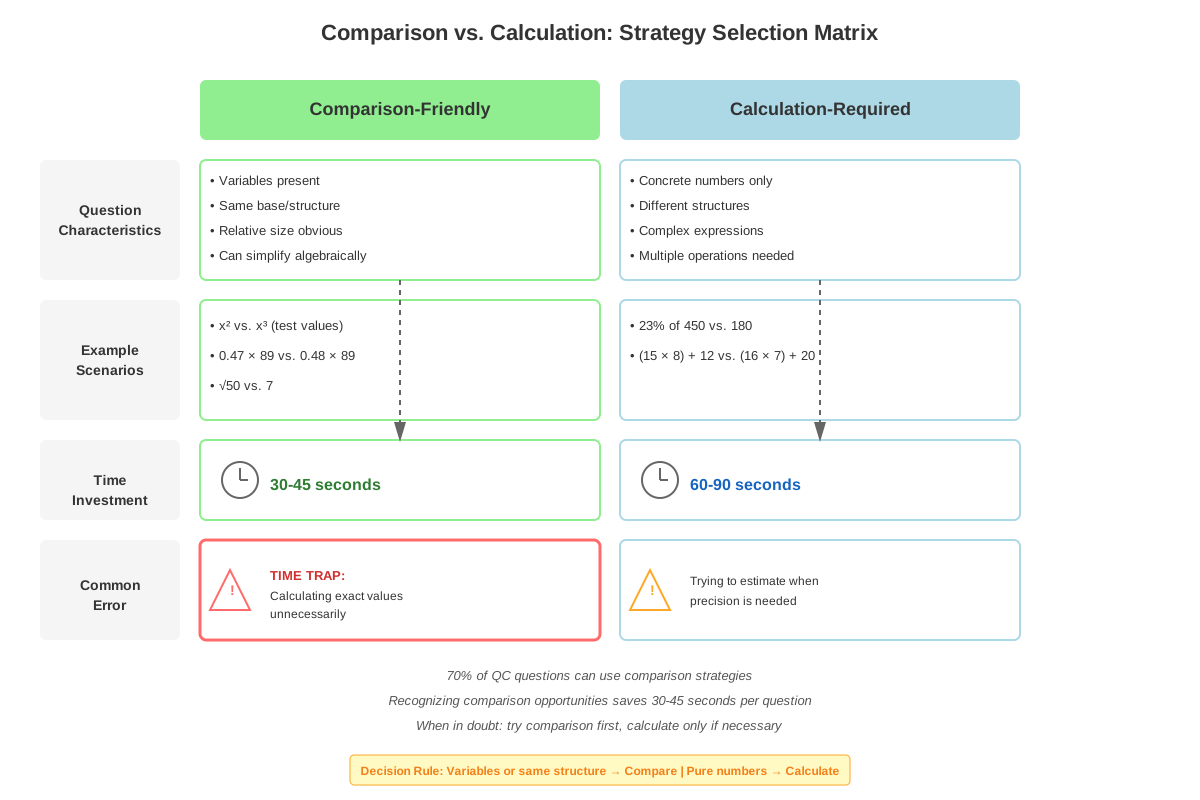
- [ ] Distinguish between questions requiring calculation versus comparison-only approaches
- [ ] Execute the "plug-in" strategy to test relationships in under 30 seconds
- [ ] Recognize time-trap scenarios that encourage unnecessary computation
- [ ] Implement a systematic 60-90 second per question pacing framework
Prerequisites
- Basic arithmetic operations: Essential for quick mental calculations and estimations that support rapid comparisons without formal computation
- Algebraic manipulation fundamentals: Required to simplify expressions and isolate variables when comparing quantities symbolically
- Understanding of inequalities: Necessary to determine relationships between quantities and recognize when relationships change based on variable values
- Familiarity with QC answer choices: Knowledge that QC questions always have the same four answer options (A: Quantity A is greater, B: Quantity B is greater, C: The two quantities are equal, D: The relationship cannot be determined)
Why This Topic Matters
Quantitative Comparison questions represent a unique challenge in standardized testing because they reward strategic thinking over computational prowess. In real-world applications, professionals frequently need to make comparative judgments without complete information—determining which investment option offers better returns, which engineering solution is more cost-effective, or which dataset shows stronger trends. The analytical skills developed through QC pacing translate directly to business analysis, scientific research, and data-driven decision-making.
On the GRE specifically, QC questions appear in approximately 15-16 of the 40 total Quantitative Reasoning questions across both sections. These questions are strategically distributed throughout each section, often appearing in clusters of 2-4 consecutive questions. The ETS (Educational Testing Service) designs QC questions to test both mathematical knowledge and test-taking efficiency simultaneously. Students who lack effective pacing strategies typically spend 2-3 minutes per QC question, leaving insufficient time for the more complex Problem Solving questions that appear later in each section.
Common manifestations of QC pacing challenges include: questions with deliberately complex-looking expressions that simplify dramatically; problems presenting extensive calculations that become unnecessary once comparison strategies are applied; scenarios with multiple variables designed to test whether students recognize when "the relationship cannot be determined"; and time-trap questions featuring familiar calculation patterns that seduce students into unnecessary work. Approximately 60% of QC questions can be solved in under 60 seconds using proper pacing strategies, while students using calculation-heavy approaches often require 90-120 seconds for the same questions.
Core Concepts
The Comparison-First Principle
The foundational concept of gre qc pacing is the comparison-first principle: always seek to compare quantities directly rather than calculating their individual values. This represents a paradigm shift from traditional mathematics education, where finding exact answers is the goal. In QC questions, the answer choices never ask "What is the value of Quantity A?" but rather "How does Quantity A relate to Quantity B?" This distinction is critical for efficient pacing.
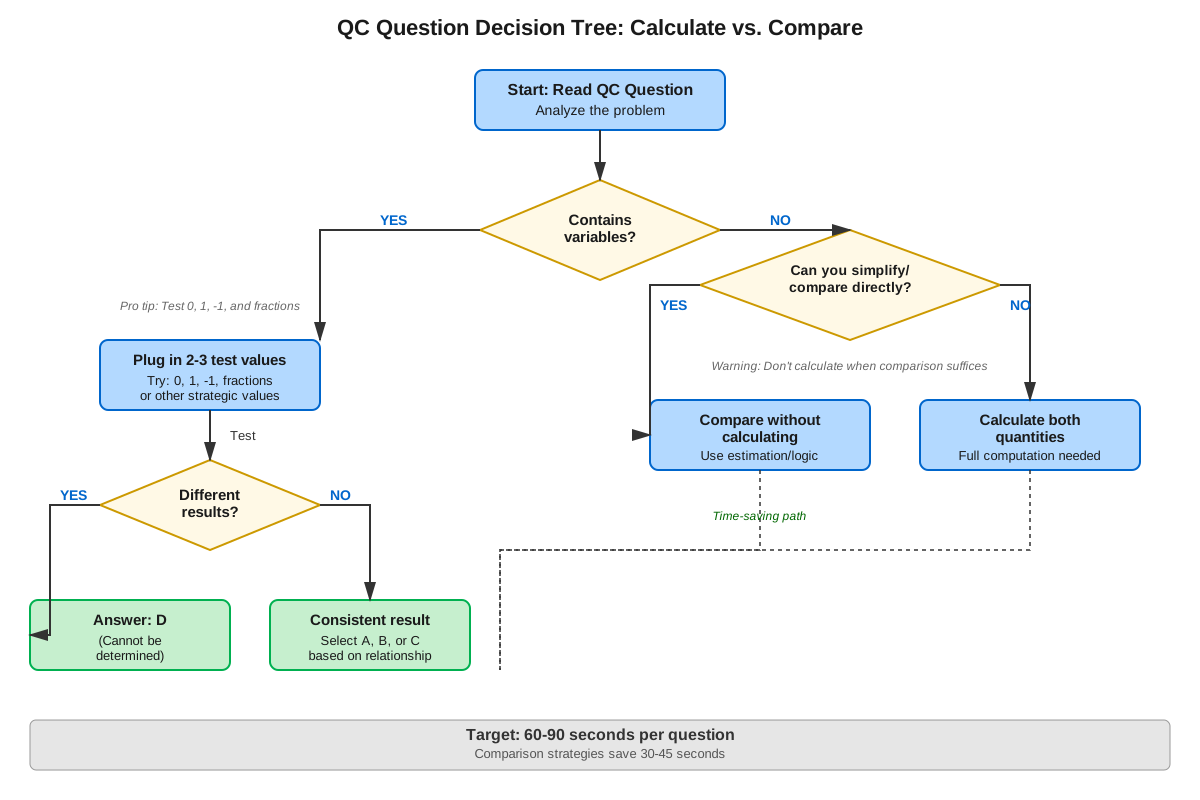
When applying the comparison-first principle, students should ask three sequential questions: (1) Can I compare these quantities without any calculation? (2) Can I simplify both quantities using the same operation? (3) Do I need to test specific values to determine the relationship? Only if all three questions yield negative results should full calculation be considered—and even then, estimation often suffices.
The 60-90 Second Rule
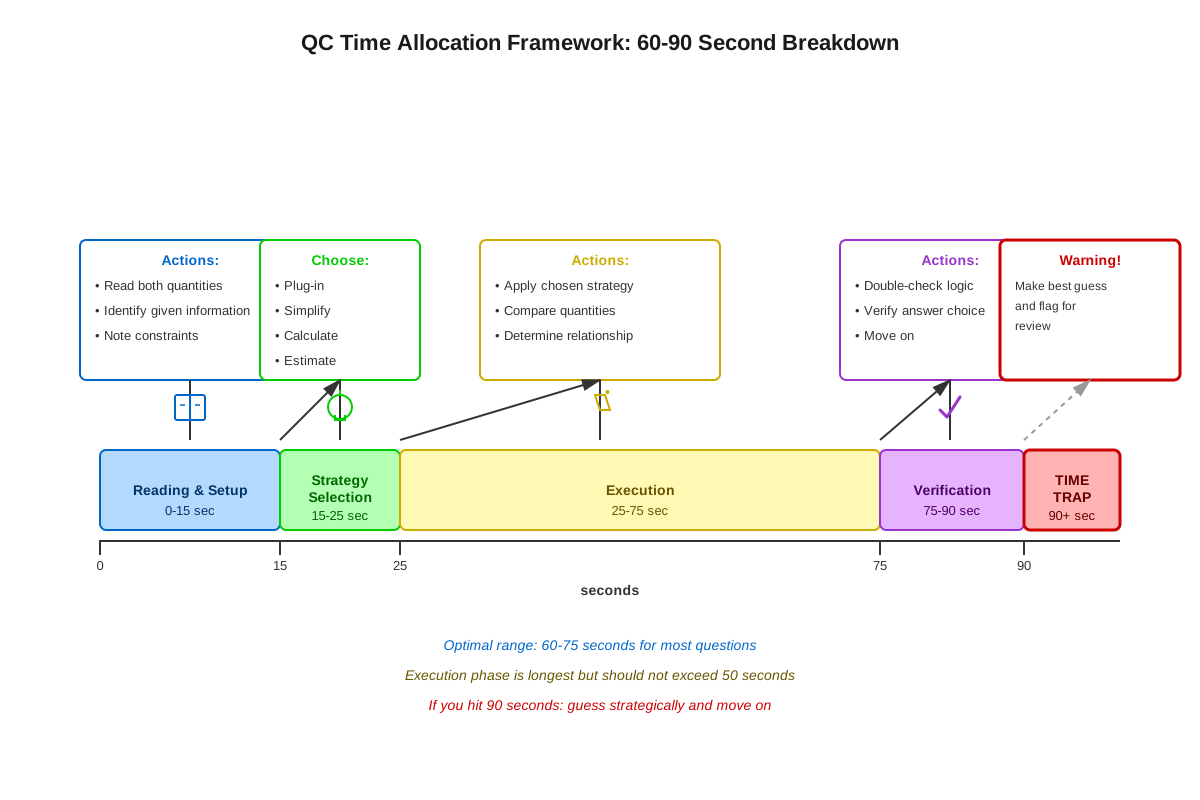
Effective gre gre qc pacing operates on a strict time budget: spend 60-90 seconds per QC question on average. This timing allows completion of all Quantitative Reasoning questions with 2-3 minutes remaining for review. The breakdown within this timeframe should be: 10-15 seconds reading and understanding both quantities, 30-60 seconds applying comparison strategies, and 10-15 seconds selecting and confirming the answer.
Questions that exceed 90 seconds should trigger an immediate strategic decision: either make an educated guess based on partial analysis or employ the "plug-in and move on" strategy (testing one or two simple values, selecting the most likely answer, and proceeding). The psychological discipline to abandon a question after 90 seconds is as important as the mathematical skills to solve it.
Simplification Strategies
Simultaneous simplification is the most powerful time-saving technique in QC pacing. When both quantities contain similar terms or factors, these can be eliminated or simplified together without affecting the relationship. Legal operations that preserve relationships include: adding or subtracting the same value from both quantities, multiplying or dividing both quantities by the same positive number, and squaring both quantities when both are known to be positive.
Critical warning: multiplying or dividing by negative numbers or variables that could be negative reverses inequality relationships. This is a common trap in QC questions designed to test pacing discipline—students who rush through simplification without checking sign conditions will select incorrect answers despite using proper techniques.
The Plug-In Strategy
When quantities contain variables and the relationship might change based on different values, the plug-in strategy provides rapid assessment. The systematic approach involves testing three categories of values: (1) positive integers (typically 1 and 2), (2) zero (if permitted), and (3) negative integers (typically -1). If different test values yield different relationships (e.g., Quantity A is greater when x=1 but Quantity B is greater when x=-1), the answer is immediately "D: The relationship cannot be determined."
The plug-in strategy should take no more than 30-45 seconds total. Test the first value, note the relationship, test the second value, and if the relationship changes, select D immediately without testing further. This approach prevents the time trap of exhaustive testing or attempting to solve algebraically when the relationship is variable-dependent.
Pattern Recognition for Answer Choice D
Approximately 25% of QC questions have answer D as the correct response. These questions share identifiable characteristics: presence of variables without sufficient constraints, expressions involving even powers (which behave differently for positive and negative values), scenarios with multiple unknowns and only one equation, and comparisons involving absolute values or other operations that produce different results across number domains.
Developing rapid recognition of "D-type questions" is essential for pacing. When a question presents variables without clear constraints, the immediate strategy should be plug-in testing rather than algebraic manipulation. This recognition saves 30-60 seconds per question by preventing futile attempts to establish a definitive relationship algebraically.
Estimation and Approximation
Many QC questions are designed so that estimation provides sufficient precision to determine the relationship. When exact calculation would require extensive computation, strategic estimation often reveals the answer in seconds. Techniques include: rounding to convenient numbers, using benchmark fractions (1/2, 1/3, 1/4), approximating square roots and powers, and comparing orders of magnitude before detailed calculation.
The key principle is "estimate to discriminate"—calculate only as precisely as needed to determine which quantity is larger. If Quantity A is approximately 47 and Quantity B is approximately 53, no further precision is needed to select answer B. Students who calculate exact values (47.3 and 52.8) waste 20-30 seconds without improving accuracy.
The "Same or Different" Framework
A rapid diagnostic for QC pacing is the "same or different" framework: determine whether the quantities will always have the same relationship or whether the relationship could differ under different conditions. Questions where the relationship is constant (always A greater, always B greater, or always equal) typically involve concrete numbers or fully constrained variables. Questions where the relationship varies involve unconstrained variables or conditional scenarios.
This framework provides immediate strategic direction: "same relationship" questions require comparison or simplification strategies, while "different relationship" questions require plug-in testing to demonstrate variability. Making this determination in the first 10-15 seconds of reading the question optimizes the remaining time allocation.
Concept Relationships
The core concepts of GRE QC pacing form an integrated decision-making framework. The process begins with the comparison-first principle, which establishes the fundamental mindset shift from calculation to comparison. This principle directly enables simplification strategies, as students trained to compare rather than calculate naturally look for common elements to eliminate. When simplification proves insufficient or impossible, the framework branches to either estimation techniques (for questions with concrete numbers) or the plug-in strategy (for questions with variables).
The 60-90 second rule serves as the temporal constraint governing all other strategies, creating urgency that prevents over-analysis and calculation paralysis. This time pressure makes pattern recognition for answer choice D particularly valuable, as identifying D-type questions in 10-15 seconds allows immediate deployment of the plug-in strategy without wasting time on algebraic approaches. The "same or different" framework acts as the meta-strategy that determines which specific technique to apply, functioning as the decision tree root from which all other strategies branch.
These concepts connect to prerequisite knowledge through practical application: algebraic manipulation skills enable rapid simplification, inequality understanding supports comparison logic, and arithmetic fluency facilitates quick plug-in testing. The relationship flows outward to broader Quantitative Reasoning success, as time saved on QC questions through effective pacing creates capacity for tackling complex Problem Solving questions and Data Interpretation sets that require more extensive calculation.
Quick check — test yourself on GRE QC pacing so far.
Try Flashcards →High-Yield Facts
- ⭐ QC questions constitute approximately 40% of Quantitative Reasoning questions, making pacing strategies high-impact for overall scores
- ⭐ The optimal time allocation for QC questions is 60-90 seconds per question, compared to 90-120 seconds for Problem Solving questions
- ⭐ Approximately 60% of QC questions can be solved through comparison and simplification without calculating exact values
- ⭐ When plugging in values to test relationships, testing just 2-3 strategic values (positive, zero, negative) is sufficient to determine if answer D is correct
- ⭐ Multiplying or dividing both quantities by the same positive number preserves the relationship; doing so with negative numbers reverses it
- Answer choice D ("The relationship cannot be determined") is correct for approximately 25% of QC questions
- Questions with unconstrained variables or multiple unknowns with insufficient equations are strong candidates for answer D
- Estimation to within 10-20% accuracy is typically sufficient to determine which quantity is greater
- Adding or subtracting the same value from both quantities never changes the relationship between them
- Squaring both quantities preserves the relationship only when both quantities are known to be positive
- QC questions never require calculations beyond basic arithmetic, algebra, and geometry—complex computation suggests a missed shortcut
- The four answer choices for QC questions are always identical: A (Quantity A greater), B (Quantity B greater), C (Equal), D (Cannot be determined)
- Spending more than 2 minutes on a single QC question indicates inefficient strategy and should trigger an immediate guess-and-move decision
Common Misconceptions
Misconception: QC questions require calculating the exact value of both quantities before comparing them. → Correction: The vast majority of QC questions are designed to be solved through direct comparison, simplification, or strategic value testing without ever determining exact values. Calculating both quantities fully is usually the least efficient approach and often a deliberate time trap.
Misconception: If both quantities contain the same variable, the relationship between them is constant regardless of the variable's value. → Correction: The relationship can vary dramatically based on the variable's value, particularly when the variable appears with different exponents, inside different functions, or in denominators. Always test multiple values (positive, zero, negative) to verify consistency before ruling out answer D.
Misconception: Answer choice D should be selected when the problem seems too difficult to solve. → Correction: Answer D means "the relationship cannot be determined from the given information," not "I cannot determine the relationship." D is correct only when the relationship genuinely varies based on different possible values of variables, not when the problem is challenging but has a definite answer.
Misconception: Simplification must be done algebraically and formally to be valid. → Correction: Informal simplification through mental math, estimation, and visual comparison is not only valid but often faster and less error-prone than formal algebraic manipulation. The goal is determining the relationship, not showing work.
Misconception: More complex-looking expressions always require more time to evaluate. → Correction: ETS deliberately designs many QC questions with intimidating-looking expressions that simplify dramatically or cancel out entirely. Complex appearance often signals an opportunity for rapid simplification rather than a genuinely difficult calculation.
Misconception: Testing one value is sufficient to determine the relationship when variables are present. → Correction: Testing a single value can only suggest a relationship, not confirm it. At minimum, test values from different number domains (positive, zero, negative) to verify the relationship holds consistently or to discover that it varies (indicating answer D).
Worked Examples
Example 1: Simplification Strategy
Question:
- Quantity A: (x + 3)(x - 3)
- Quantity B: x² - 6
Given: x is a real number
Step 1 - Initial Assessment (10 seconds): Both quantities contain x², suggesting algebraic simplification might reveal the relationship. No obvious reason the relationship would vary with x, so answer D seems unlikely.
Step 2 - Expand Quantity A (15 seconds): Using the difference of squares formula: (x + 3)(x - 3) = x² - 9
Step 3 - Compare Simplified Forms (10 seconds):
- Quantity A: x² - 9
- Quantity B: x² - 6
Step 4 - Subtract x² from Both (15 seconds): Since we can subtract the same value from both quantities without changing the relationship:
- Quantity A becomes: -9
- Quantity B becomes: -6
Step 5 - Determine Relationship (10 seconds): -9 < -6, so Quantity A is less than Quantity B for all values of x.
Answer: B (Quantity B is greater)
Total Time: 60 seconds
Key Pacing Insight: This problem demonstrates the comparison-first principle. Rather than plugging in values for x (which would require testing multiple values and still might not feel conclusive), algebraic simplification reveals that the relationship is constant regardless of x's value. The critical time-saver is recognizing that subtracting x² from both sides eliminates the variable entirely.
Example 2: Plug-In Strategy
Question:
- Quantity A: x³
- Quantity B: x²
Given: x ≠ 0
Step 1 - Initial Assessment (10 seconds): Both quantities involve powers of x. The relationship likely depends on x's value, suggesting answer D or requiring value testing. The constraint x ≠ 0 prevents testing zero but allows positive and negative values.
Step 2 - Test x = 2 (10 seconds):
- Quantity A: 2³ = 8
- Quantity B: 2² = 4
- Result: Quantity A is greater
Step 3 - Test x = 1 (10 seconds):
- Quantity A: 1³ = 1
- Quantity B: 1² = 1
- Result: The quantities are equal
Step 4 - Recognize Varying Relationship (5 seconds): Since we found one case where A is greater and another where they're equal, the relationship is not constant.
Step 5 - Test x = -1 for Confirmation (10 seconds):
- Quantity A: (-1)³ = -1
- Quantity B: (-1)² = 1
- Result: Quantity B is greater
Step 6 - Conclusion (5 seconds): The relationship varies depending on x's value (A greater when x = 2, equal when x = 1, B greater when x = -1).
Answer: D (The relationship cannot be determined)
Total Time: 50 seconds
Key Pacing Insight: This example demonstrates efficient plug-in strategy execution. After finding different relationships with just two test values (x = 2 and x = 1), answer D is confirmed. Testing x = -1 provides additional confirmation but wasn't strictly necessary—the moment two different relationships appear, D is correct. The critical pacing skill is stopping immediately after discovering variability rather than testing exhaustively.
Exam Strategy
When approaching QC questions on the GRE, implement a systematic three-phase process. Phase 1 (10-15 seconds): Read both quantities and any given information, identify what mathematical concepts are being tested, and make an initial determination whether the relationship appears constant or variable. Phase 2 (30-60 seconds): Apply the appropriate strategy based on Phase 1 assessment—simplification for constant relationships with algebraic expressions, estimation for concrete numbers, or plug-in testing for variable relationships. Phase 3 (10-15 seconds): Select the answer and perform a quick sanity check by asking "Does this answer make sense given what I found?"
Trigger words and phrases that signal specific strategies include: "for all values" or "for any value" (suggesting the relationship is constant and simplification may work), "x is a positive integer" or similar constraints (indicating plug-in strategy with constrained values), "x is a real number" without further constraints (suggesting answer D is possible), and "which of the following" in the given information (indicating you may need to consider multiple cases).
Process-of-elimination tips specific to QC questions: Eliminate answer C (equal) first if the quantities have different structures that don't obviously simplify to the same expression. Eliminate answers A and B if you find even one case where the opposite relationship holds, leaving only D. If you've simplified to concrete numbers and they're clearly different, eliminate both C and D immediately. If variables remain after all possible simplification and no constraints are given, D is often correct.
Time allocation advice: Set a mental timer at 60 seconds for each QC question. If you haven't identified a clear path to the answer by 60 seconds, either make an educated guess based on partial analysis or test one quick value and select the most likely answer. Never spend more than 90 seconds on a QC question during first-pass completion. Mark questions that required guessing and return to them only if time remains after completing all other questions. Remember that QC questions are worth the same points as more time-intensive Problem Solving questions—spending 3 minutes on a QC question to ensure correctness is poor resource allocation.
Memory Techniques
SCOPED - A mnemonic for the systematic QC approach:
- Simplify: Look for common terms to eliminate
- Compare: Seek direct comparison before calculating
- Operations: Apply legal operations (add/subtract same value, multiply/divide by positive)
- Plug-in: Test strategic values if variables present
- Estimate: Approximate when exact calculation is complex
- Determine: Check if relationship varies (answer D)
The Traffic Light Visualization: Imagine three colored zones for time management. Green zone (0-60 seconds): Optimal pacing, stay calm and systematic. Yellow zone (60-90 seconds): Caution, consider whether continued work is productive or if guessing is wiser. Red zone (90+ seconds): Stop immediately, make best guess, move on. Visualizing these zones during practice builds automatic time awareness during the actual exam.
"PENZ" for Plug-In Values: When testing variable relationships, remember to test Positive, Equal (zero), Negative, and Zero (yes, zero appears twice because it's both equal to zero and the boundary between positive and negative). This redundancy helps ensure you don't forget to test zero when permitted.
The "Same Operation, Same Relationship" Rule: Visualize a balance scale. Whatever you do to one side, do to the other, and the balance (relationship) stays the same—with the critical exception of multiplying/dividing by negatives, which flips the scale. This visual reinforces legal simplification operations.
Summary
GRE QC pacing represents the strategic approach to Quantitative Comparison questions that prioritizes comparison over calculation, enabling test-takers to solve approximately 40% of Quantitative Reasoning questions in 60-90 seconds each rather than the 2+ minutes required by calculation-heavy approaches. The foundation is the comparison-first principle: always seek to determine the relationship between quantities without calculating their individual values. Core strategies include simultaneous simplification (eliminating common terms from both quantities), strategic plug-in testing (using 2-3 values to determine if relationships vary), and estimation (calculating only as precisely as needed to discriminate between quantities). Effective pacing requires recognizing when answer D ("The relationship cannot be determined") is correct—typically when variables lack sufficient constraints or when testing reveals varying relationships. The discipline to abandon questions after 90 seconds and make educated guesses is as critical as the mathematical techniques themselves. Mastering these strategies creates a cumulative time advantage of 3-5 minutes per Quantitative section, enabling more thorough work on complex Problem Solving questions and reducing overall test anxiety.
Key Takeaways
- Allocate 60-90 seconds per QC question; spending more indicates missed shortcuts or the need to guess and move on
- Apply the comparison-first principle: seek to compare quantities directly rather than calculating exact values
- Use simultaneous simplification by adding/subtracting the same value or multiplying/dividing by the same positive number
- Test 2-3 strategic values (positive, zero, negative) to determine if relationships vary, indicating answer D
- Recognize that approximately 60% of QC questions can be solved without calculating exact values
- Answer D is correct for roughly 25% of QC questions, typically those with unconstrained variables
- Estimation to within 10-20% accuracy usually suffices to determine which quantity is greater
Related Topics
Problem Solving Pacing Strategies: While QC pacing emphasizes comparison over calculation, Problem Solving questions require different time management approaches focused on strategic calculation and answer choice elimination. Mastering QC pacing creates time reserves for these more calculation-intensive questions.
Algebraic Manipulation for QC: Advanced simplification techniques including factoring, expanding, and working with rational expressions enable faster QC question solving. Strong algebra skills directly translate to improved QC pacing.
Strategic Value Selection: A deeper exploration of which values to test when using the plug-in strategy, including fractions, large numbers, and boundary values. This advanced skill builds on basic QC pacing to handle the most challenging variable-based comparisons.
Data Sufficiency Reasoning: Similar to QC questions, Data Sufficiency problems (common on the GMAT but appearing in modified forms on the GRE) reward determining what can be known rather than calculating exact values. The reasoning skills developed through QC pacing transfer directly to these question types.
Practice CTA
Now that you understand the strategic framework for GRE QC pacing, it's time to transform this knowledge into automatic execution. Access the practice questions to apply these strategies under timed conditions, focusing on maintaining the 60-90 second pace even when questions seem to demand more time. Use the flashcards to reinforce trigger word recognition and strategy selection until your response becomes instinctive. Remember: every second saved on QC questions through efficient pacing is a second gained for the questions where calculation truly matters. Your goal isn't just to answer QC questions correctly—it's to answer them correctly and quickly, building the time reserves that separate good scores from great ones.
Sign up free to keep reading
Create a free AnvayaPrep account to finish this GRE guide on GRE QC pacing — plus flashcards and practice questions.