Overview
The when to plug in strategy is one of the most powerful and versatile problem-solving techniques for GRE Quantitative Reasoning, particularly within Quantitative Comparison questions. This approach involves substituting specific numerical values for variables to test relationships, evaluate expressions, and eliminate answer choices systematically. Rather than attempting to solve algebraically or manipulate abstract expressions, plugging in allows test-takers to transform abstract problems into concrete arithmetic, making complex relationships immediately visible and testable.
Understanding when to plug in is essential because it serves as both a primary solution method and a verification tool. On the GRE, many questions are deliberately designed to be time-consuming or algebraically complex when approached traditionally, but become straightforward when strategic number substitution is employed. This technique is especially valuable in Quantitative Comparison questions where the goal is not to find an exact answer but rather to determine a relationship between two quantities. By testing carefully chosen values, students can often determine whether Quantity A is greater, Quantity B is greater, the quantities are equal, or the relationship cannot be determined—all without extensive algebraic manipulation.
The plug-in strategy connects fundamentally to other Quantitative Reasoning concepts including algebraic reasoning, number properties, and strategic test-taking. It requires understanding which types of numbers to test (positive, negative, zero, fractions, etc.) and recognizing when a single counterexample is sufficient to eliminate an answer choice. Mastery of this topic significantly improves both accuracy and speed, making it a high-yield investment of study time for any GRE test-taker aiming for a competitive quantitative score.
Learning Objectives
- [ ] Identify when When to plug in is being tested
- [ ] Explain the core rule or strategy behind When to plug in
- [ ] Apply When to plug in to GRE-style questions accurately
- [ ] Determine which types of numbers to plug in for maximum efficiency
- [ ] Recognize when plugging in is more efficient than algebraic approaches
- [ ] Distinguish between situations requiring single versus multiple test values
- [ ] Evaluate when a counterexample definitively eliminates answer choices
Prerequisites
- Basic algebraic manipulation: Understanding variables, expressions, and equations is necessary to recognize what values can be substituted and how expressions will evaluate
- Number properties: Knowledge of positive/negative numbers, fractions, zero, and special values (like 1 and -1) is essential for choosing strategic test values
- Quantitative Comparison format: Familiarity with the four answer choices (A, B, C, D) and what each represents is required to apply the strategy effectively
- Order of operations: Correct evaluation of expressions after substitution depends on proper application of PEMDAS/BODMAS
Why This Topic Matters
The plug-in strategy appears in approximately 30-40% of GRE Quantitative Comparison questions and is applicable to many Problem Solving questions as well. This technique is particularly valuable because it levels the playing field—students don't need to be algebra experts to solve problems correctly when they can test concrete values. The GRE deliberately includes questions where algebraic solutions are possible but time-consuming, rewarding test-takers who recognize opportunities to plug in instead.
In real-world applications, the plug-in approach mirrors how professionals test hypotheses and validate assumptions: rather than relying solely on theoretical models, they test specific cases to verify relationships. Engineers test prototypes with specific parameters, financial analysts run scenarios with particular values, and scientists conduct experiments with controlled variables. This concrete-before-abstract thinking is a valuable problem-solving skill beyond standardized testing.
On the exam, this topic most commonly appears in Quantitative Comparison questions involving variables with constraints (e.g., "x > 0" or "n is an integer"), algebraic expressions being compared, and problems involving number properties. It also appears in Problem Solving questions with answer choices containing variables, word problems where picking numbers simplifies the scenario, and percentage/ratio problems where concrete values make relationships clearer.
Core Concepts
The Fundamental Plug-In Strategy
When to plug in refers to the strategic decision to substitute specific numerical values for variables rather than solving algebraically. This approach transforms abstract relationships into concrete arithmetic that can be evaluated directly. The core principle is that if a relationship holds for all valid values of a variable, testing specific values can reveal that relationship. Conversely, finding even one counterexample proves that a relationship doesn't always hold.
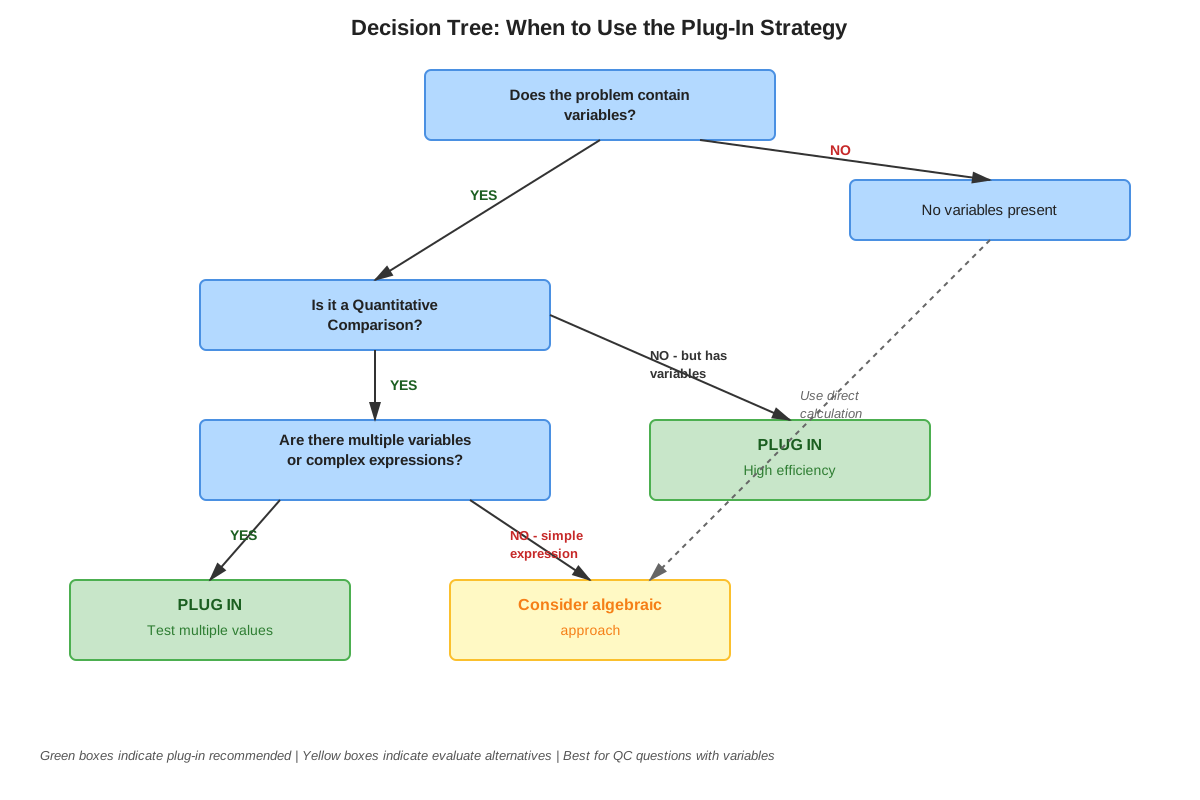
The strategy is most effective when:
- Variables appear in both quantities being compared
- The problem involves inequalities or constrained variables
- Algebraic manipulation would be complex or time-consuming
- Answer choices in Problem Solving contain variables
- The question asks about relationships rather than specific values
Strategic Number Selection
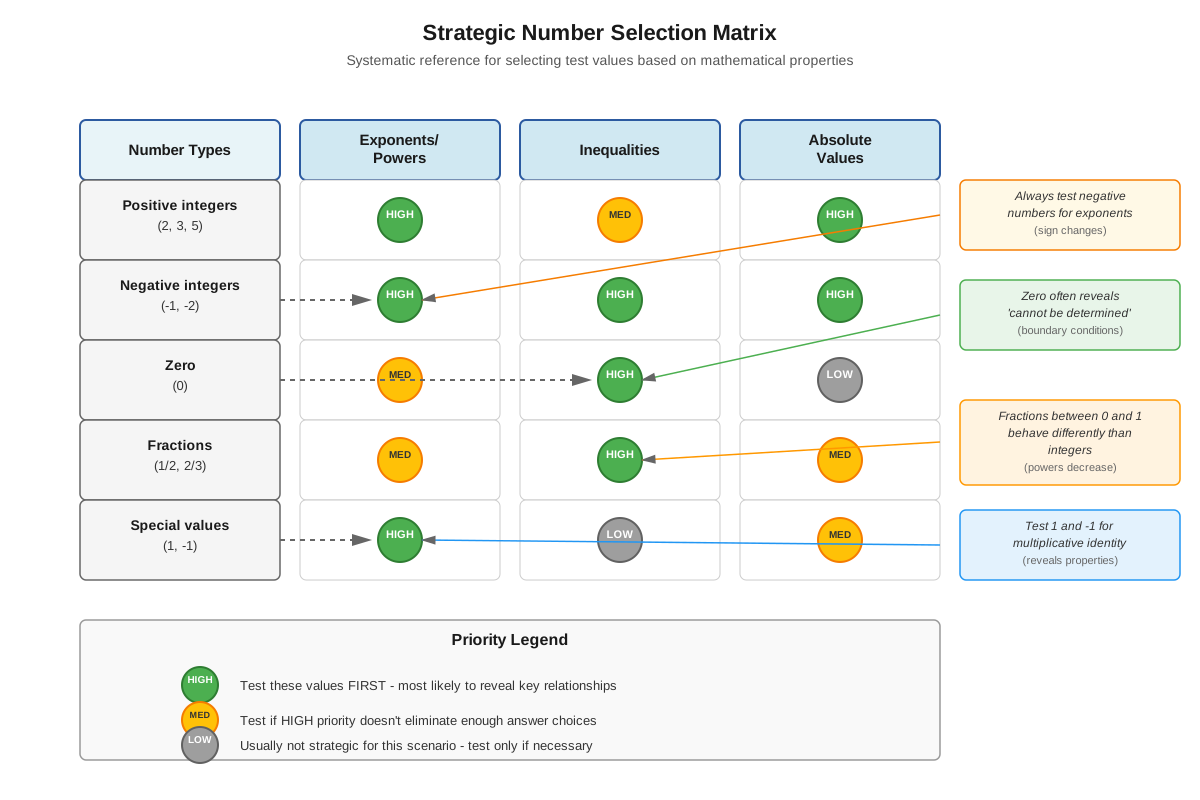
The effectiveness of plugging in depends critically on which numbers are chosen. GRE when to plug in questions often hinge on testing values that reveal different behaviors:
| Number Type | When to Test | Why It Matters |
|---|---|---|
| Positive integers (2, 3) | Almost always | Most intuitive; reveals basic relationships |
| 1 | Frequently | Unique properties (x¹ = x, 1/1 = 1) |
| 0 | When allowed | Often changes relationships dramatically |
| Negative integers (-1, -2) | When no restriction | Reverses inequalities, affects even/odd patterns |
| Fractions (1/2, 2/3) | When no integer restriction | Behaves differently than integers in multiplication/division |
| Large numbers (100) | For percentage/ratio problems | Makes calculations clearer |
| -1 | When negatives allowed | Combines negative and special properties of 1 |
The Multiple-Value Test
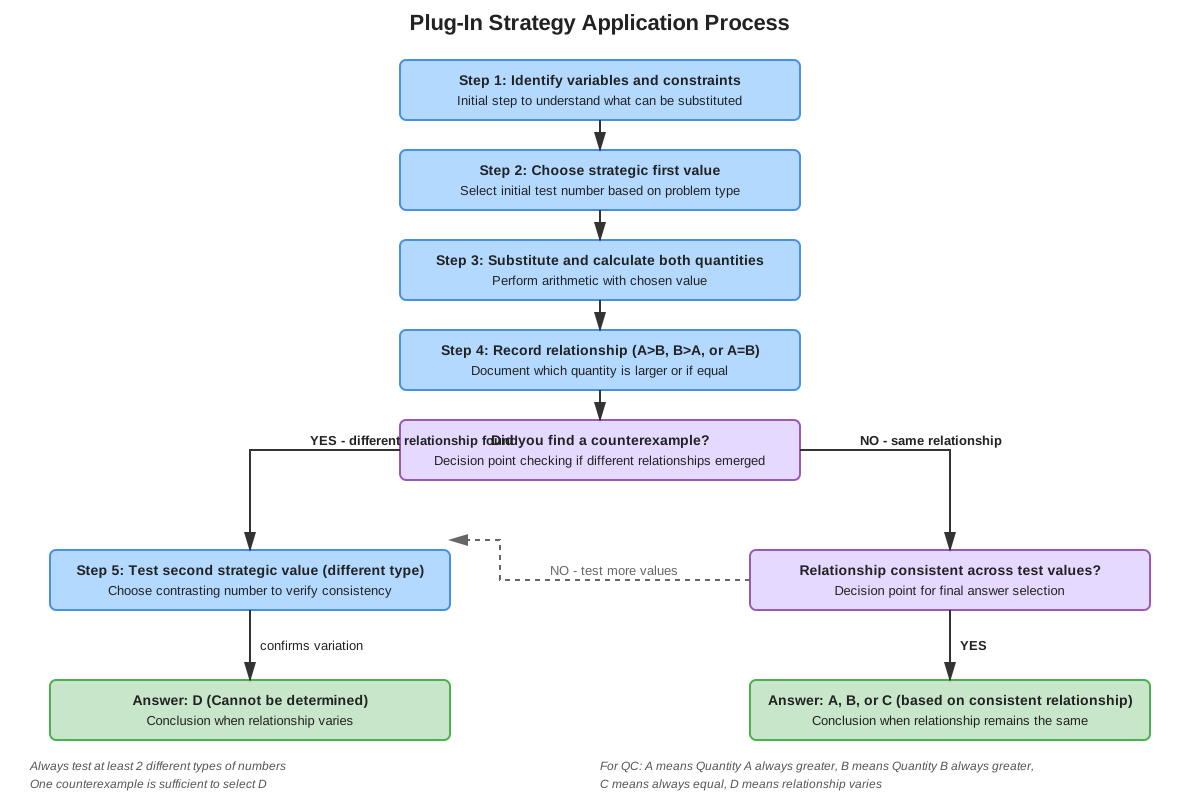
For Quantitative Comparison questions, a single test value can never prove that quantities are "always equal" (Choice C) or that one is "always greater" (Choice A or B). However, a single counterexample can definitively eliminate these choices. The systematic approach involves:
- First plug-in: Choose a simple, positive value (often 2 or 3)
- Evaluate both quantities: Determine which is larger with this value
- Second plug-in: Choose a strategically different value (different sign, fraction, zero, or 1)
- Compare results: If the relationship changes, the answer is D (cannot be determined)
- Third plug-in (if needed): Test additional edge cases if the relationship has remained consistent
Recognizing Plug-In Opportunities
Certain question characteristics signal that plugging in will be efficient:
- Constraint statements: "Given that x > 0" or "n is a positive integer" indicate the problem is designed for testing values
- Abstract expressions: When you see x² + 2x compared to x² + x, concrete values make the comparison immediate
- "Could be" or "must be" language: These questions are asking about possibilities, perfect for counterexample testing
- Multiple variables with relationships: "If a > b > 0" suggests testing specific values that satisfy the constraint
- Percentage/fraction of unknown quantities: Picking 100 or another convenient base simplifies calculations
When NOT to Plug In
Understanding limitations is equally important:
- When algebra is faster: Simple linear equations (2x + 3 = 11) are quicker to solve directly
- When infinite possibilities exist: If no constraints are given and the relationship could genuinely vary
- When the question asks for a specific value: Plugging in won't find "the value of x"
- When all answer choices are numerical: The question requires calculation, not testing
- When time is extremely limited: If you're behind pace, sometimes educated guessing is more strategic
The Counterexample Principle
In Quantitative Comparison, finding a counterexample is definitive proof. If you test x = 2 and Quantity A is larger, then test x = -1 and Quantity B is larger, you've proven the answer must be D (the relationship cannot be determined from the information given). This principle makes plugging in particularly powerful: you don't need to test every possible value, just enough to establish whether the relationship is consistent or variable.
Concept Relationships
The plug-in strategy builds directly on number properties knowledge—understanding how different types of numbers behave is essential for choosing effective test values. It connects to algebraic reasoning as an alternative approach; recognizing when plugging in is more efficient than algebra is a meta-skill that improves with practice.
Within the topic itself, the concepts flow logically: Fundamental Strategy → establishes what plugging in means → Strategic Number Selection → determines which values to test → Multiple-Value Test → provides the systematic process → Recognizing Opportunities → helps identify when to apply the strategy → Counterexample Principle → explains why the method works mathematically.
The strategy also connects forward to data interpretation and word problems, where choosing convenient numbers can simplify complex scenarios. It relates to process of elimination techniques, as each test value can eliminate answer choices. Understanding when to plug in enhances overall time management on the quantitative section by preventing time-consuming algebraic dead ends.
Quick check — test yourself on When to plug in so far.
Try Flashcards →High-Yield Facts
⭐ Testing a single value can never prove a relationship is "always" true, but can prove it's not always true
⭐ Always test at least two strategically different values in Quantitative Comparison questions with variables
⭐ Zero, one, and negative one are the most revealing test values due to their special properties
⭐ If the relationship between quantities changes with different test values, the answer is always D (cannot be determined)
⭐ When variables have constraints (e.g., "x > 0"), only test values that satisfy those constraints
- Fractions between 0 and 1 behave differently than integers when squared or multiplied
- Testing 100 as a base value simplifies percentage and ratio problems dramatically
- If both quantities contain the same variable term, that term often cancels in comparison
- Negative numbers reverse inequality relationships when multiplied or divided
- When answer choices contain variables in Problem Solving, plug in for the variable in the question, then test which answer choice matches
Common Misconceptions
Misconception: Plugging in one value that makes the quantities equal proves they're always equal (Choice C).
Correction: A single test showing equality only demonstrates the quantities can be equal. To confirm they're always equal, you must test multiple diverse values and verify the relationship holds consistently, or recognize algebraically that the expressions are identical.
Misconception: Any random numbers can be plugged in with equal effectiveness.
Correction: Strategic selection is crucial. Testing 2, 3, and 4 provides little new information since they're all small positive integers. Instead, test values from different categories: positive, negative, zero, fractions, and special values like 1.
Misconception: If a problem has variables, you must plug in to solve it.
Correction: Plugging in is a tool, not a requirement. Sometimes algebraic manipulation is faster and more definitive. For example, if comparing x² + 5 to x² + 3, recognizing that the first is always 2 greater is faster than testing values.
Misconception: When plugging in for Problem Solving questions, the first answer choice that matches your result is correct.
Correction: Multiple answer choices might work for your specific test value. You must either test a second value to eliminate the incorrect choices, or verify algebraically that your answer works for all valid values.
Misconception: Constraints like "x > 0" are suggestions rather than requirements.
Correction: Constraints define the valid domain. Testing x = -2 when told x > 0 will lead to incorrect conclusions because you're testing values outside the problem's scope. Always respect stated constraints.
Worked Examples
Example 1: Quantitative Comparison with Constrained Variable
Question: Given that n is a positive integer.
Quantity A: n² + n
Quantity B: n² + 2
Solution:
Step 1: Recognize this is a plug-in opportunity because we have a variable with a constraint and two algebraic expressions to compare.
Step 2: First plug-in with a simple positive integer. Let n = 2:
- Quantity A: 2² + 2 = 4 + 2 = 6
- Quantity B: 2² + 2 = 4 + 2 = 6
- Result: Quantities are equal with n = 2
Step 3: Since they're equal with our first value, test a different positive integer to see if this always holds. Let n = 3:
- Quantity A: 3² + 3 = 9 + 3 = 12
- Quantity B: 3² + 2 = 9 + 2 = 11
- Result: Quantity A is greater with n = 3
Step 4: The relationship changed (equal → A greater), so the answer is D (the relationship cannot be determined).
This example demonstrates the multiple-value test principle and shows why testing diverse values is essential. The relationship depends on the specific value of n.
Example 2: Problem Solving with Variables in Answer Choices
Question: A store increases all prices by 20%, then decreases the new prices by 20%. If an item originally cost p dollars, what is its final price?
(A) p
(B) 0.96p
(C) 0.80p
(D) 1.04p
(E) 1.20p
Solution:
Step 1: Recognize that answer choices contain the variable p, signaling a plug-in opportunity.
Step 2: Choose a convenient value for p. Let p = 100 (easy for percentage calculations):
- After 20% increase: 100 + 0.20(100) = 100 + 20 = 120
- After 20% decrease of new price: 120 - 0.20(120) = 120 - 24 = 96
- Final price: 96
Step 3: Test which answer choice equals 96 when p = 100:
- (A) 100 ✗
- (B) 0.96(100) = 96 ✓
- (C) 0.80(100) = 80 ✗
- (D) 1.04(100) = 104 ✗
- (E) 1.20(100) = 120 ✗
Step 4: Only choice (B) matches, so the answer is B (0.96p).
This example shows how plugging in 100 for percentage problems creates simple arithmetic and makes the correct answer immediately apparent. The strategy transformed a potentially confusing percentage problem into straightforward calculation.
Exam Strategy
When approaching GRE questions, develop a systematic decision process for when to plug in:
Trigger words and phrases to watch for:
- "Given that [variable] is [constraint]" → Strong plug-in signal
- "Could be" or "must be" → Testing counterexamples is efficient
- "For all values of x" → Test multiple values to verify or find counterexample
- "If x > y > 0" → Relationship constraints suggest testing specific values
- Answer choices containing variables → Classic plug-in scenario
Process-of-elimination approach:
- In Quantitative Comparison, eliminate C (equal) if one test value shows inequality
- Eliminate A or B if any test value shows the opposite relationship
- Choose D if you find two test values that produce different relationships
- In Problem Solving, eliminate answer choices that don't match your test value result
Time allocation advice:
- Spend 10-15 seconds deciding whether to plug in or solve algebraically
- For Quantitative Comparison, budget 60-90 seconds total including 2-3 test values
- If your first two test values show the same relationship, consider a third edge case before committing
- If plugging in isn't revealing a clear pattern after 45 seconds, switch to algebraic analysis
Exam Tip: In Quantitative Comparison, if you test two very different values (like 2 and -1) and get the same relationship both times, you can be fairly confident in choosing A, B, or C. The GRE rarely requires testing more than three values.
Memory Techniques
ZONE Mnemonic for essential test values:
- Zero (when allowed)
- One (special properties)
- Negative (reverses relationships)
- Extremes (very large/small, fractions)
"Two Different Worlds" Visualization: Picture testing values from two different "worlds"—the positive integer world (2, 3, 10) and the "special" world (0, 1, -1, 1/2). If both worlds give the same relationship, it's likely consistent.
PINT Acronym for when to plug in:
- Problem has variables in both quantities
- Inequalities or constraints are present
- Numbers in answer choices contain variables
- Testing seems faster than algebra
The Counterexample Rule: Remember "One to break, many to make"—one counterexample breaks a claim that something is "always" true, but many consistent examples are needed to support (though not prove) that it's always true.
Summary
The when to plug in strategy is a fundamental GRE Quantitative Reasoning technique that transforms abstract algebraic problems into concrete arithmetic by substituting specific numerical values for variables. This approach is particularly powerful in Quantitative Comparison questions where determining relationships is more important than finding exact values. Success with this strategy requires understanding which types of numbers to test (especially zero, one, negatives, and fractions), recognizing when plugging in is more efficient than algebra, and applying the multiple-value test systematically. The counterexample principle is central: a single test value showing a different relationship definitively eliminates answer choices claiming a relationship is "always" true. Strategic number selection—testing values from different categories rather than similar numbers—maximizes the information gained from each test. While powerful, the technique has limitations and should be balanced with algebraic approaches based on question characteristics and time constraints.
Key Takeaways
- Always test at least two strategically different values in Quantitative Comparison questions with variables to determine if relationships are consistent or variable
- Zero, one, negative one, and fractions between 0 and 1 are the most revealing test values due to their special mathematical properties
- A single counterexample definitively proves a relationship is not always true, making the answer D in Quantitative Comparison
- Plugging in is most efficient when variables appear in both quantities, constraints are present, or answer choices contain variables
- Respect all stated constraints (like "x > 0") when selecting test values, as testing outside the valid domain leads to incorrect conclusions
- In Problem Solving with variables in answer choices, plug in for the question variable first, then test which answer choice matches your result
- Balance plugging in with algebraic approaches—sometimes direct algebraic manipulation is faster and more definitive
Related Topics
Number Properties and Special Values: Deepening understanding of how different number types (integers, fractions, negatives, zero) behave in operations enhances strategic value selection for plugging in.
Algebraic Manipulation Techniques: Mastering when to use algebra versus plugging in requires understanding both approaches; these topics are complementary rather than competing.
Quantitative Comparison Advanced Strategies: Building on plug-in techniques, advanced strategies include recognizing when quantities can be manipulated directly without solving.
Inequality Properties: Understanding how inequalities behave with different operations (especially multiplication by negatives) improves ability to predict which test values will be most revealing.
Word Problem Translation: Plugging in concrete values often simplifies complex word problems, making this strategy applicable beyond pure algebraic questions.
Practice CTA
Now that you understand the when to plug in strategy, it's time to cement your mastery through deliberate practice. Attempt the practice questions associated with this topic, focusing on identifying plug-in opportunities quickly and selecting strategic test values efficiently. Use the flashcards to reinforce the key decision points: which numbers to test, when plugging in is more efficient than algebra, and how to apply the counterexample principle. Remember, this strategy appears in 30-40% of Quantitative Comparison questions—mastering it will significantly improve both your accuracy and speed. Each practice problem is an opportunity to refine your intuition for when and how to plug in effectively. Start practicing now to transform this knowledge into automatic, test-day skills!
Sign up free to keep reading
Create a free AnvayaPrep account to finish this GRE guide on When to plug in — plus flashcards and practice questions.