Overview
Data sufficiency reasoning is a critical analytical skill tested throughout the GRE Quantitative Reasoning section, though it manifests differently than on other standardized exams like the GMAT. On the GRE, GRE data sufficiency reasoning requires test-takers to determine whether the information provided in a problem is adequate to answer the question being asked. Unlike explicit data sufficiency questions with labeled statements, the GRE integrates this skill into Quantitative Comparison questions and standard problem-solving questions where students must recognize when they have enough information to solve versus when additional data would be needed.
This reasoning skill is fundamental because approximately 40% of GRE Quantitative questions are Quantitative Comparisons, which inherently test whether you can determine relationships between quantities with limited information. Additionally, many standard multiple-choice questions include answer choices like "Cannot be determined from the information given," requiring explicit data sufficiency analysis. Mastering this topic means developing the metacognitive awareness to recognize what you know, what you need to know, and whether the gap can be bridged with the given information.
Data sufficiency reasoning connects deeply to algebraic manipulation, logical reasoning, and strategic test-taking. It requires understanding the difference between necessary and sufficient conditions, recognizing when multiple solution paths exist, and knowing when to stop calculating because you've determined sufficiency without finding an exact answer. This skill amplifies efficiency on the GRE by preventing wasted time on unsolvable problems and enabling strategic shortcuts in Quantitative Comparison questions.
Learning Objectives
- [ ] Identify when data sufficiency reasoning is being tested
- [ ] Explain the core rule or strategy behind data sufficiency reasoning
- [ ] Apply data sufficiency reasoning to GRE-style questions accurately
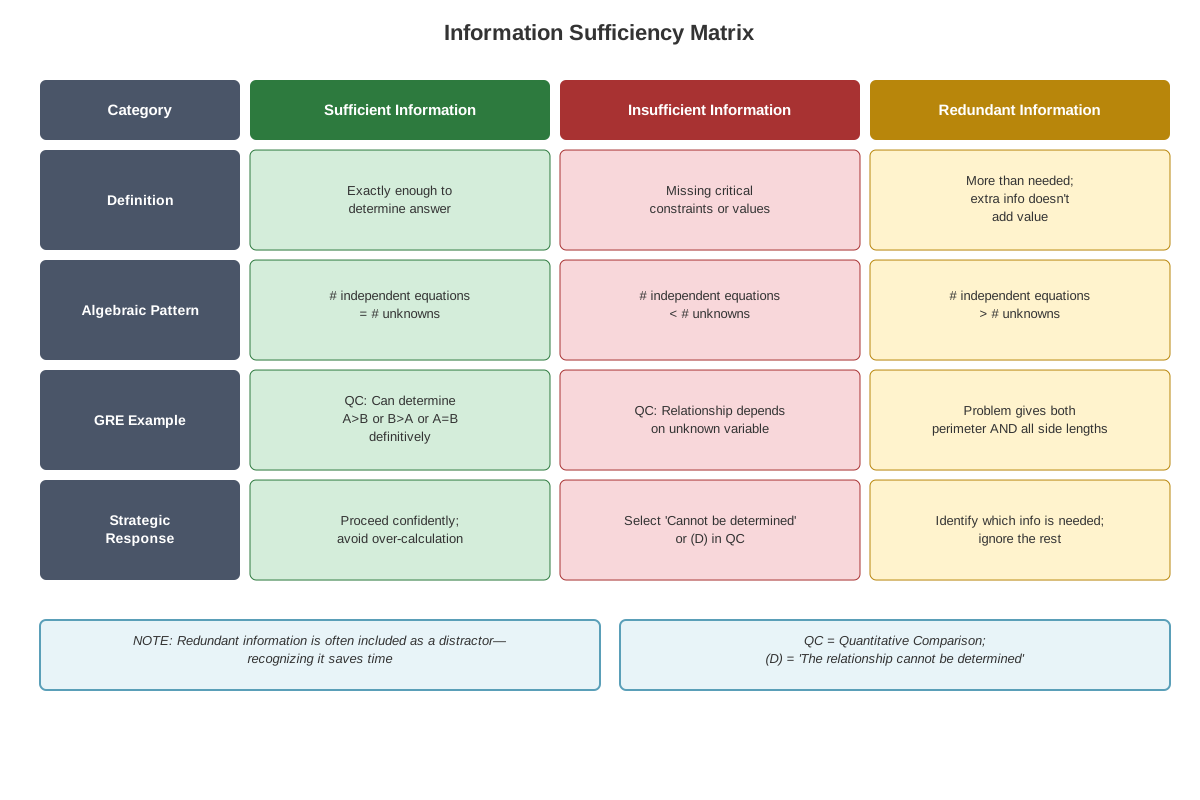
- [ ] Distinguish between sufficient information, insufficient information, and redundant information in problem contexts
- [ ] Recognize the specific information requirements for different question types (exact values vs. relationships vs. ranges)
- [ ] Evaluate whether additional constraints or assumptions would change sufficiency determinations
Prerequisites
- Basic algebra and equation solving: Data sufficiency often requires determining how many equations are needed to solve for how many unknowns
- Understanding of variables and constants: Recognizing what values are fixed versus what remains unknown is essential for sufficiency analysis
- Inequality reasoning: Many sufficiency questions involve determining whether relationships can be established without exact values
- Number properties (even/odd, positive/negative, prime): These properties often provide the "hidden" information that makes data sufficient
- Quantitative Comparison question format: Understanding this question type is crucial since it's the primary vehicle for testing data sufficiency on the GRE
Why This Topic Matters
Data sufficiency reasoning represents a higher-order thinking skill that separates top-scoring test-takers from average performers. In real-world applications, professionals constantly face situations where they must determine whether available information is adequate for decision-making—from engineers assessing whether specifications are complete to researchers determining if experimental data can support conclusions. This analytical framework applies across disciplines and represents genuine critical thinking rather than mere calculation.
On the GRE specifically, data sufficiency reasoning appears in approximately 15-20 questions per Quantitative section when counting both explicit "Cannot be determined" questions and Quantitative Comparisons. Research on GRE performance indicates that students who master data sufficiency reasoning gain 2-3 additional points on the 130-170 Quantitative scale compared to peers with similar computational skills. This topic is particularly high-yield because it enables time savings—recognizing insufficiency early prevents wasted minutes on impossible calculations.
The GRE tests data sufficiency through three primary mechanisms: (1) Quantitative Comparison questions where you must determine if a relationship can be established or if it depends on unknown values; (2) multiple-choice questions with "Cannot be determined" as an answer choice; and (3) word problems that provide seemingly incomplete information, testing whether you recognize that the given data is actually sufficient through indirect reasoning or property application. Unlike the GMAT's explicit two-statement format, GRE data sufficiency is integrated into standard question types, making recognition of when it's being tested a crucial first skill.
Core Concepts
The Fundamental Principle of Data Sufficiency
The core principle underlying all data sufficiency reasoning is this: information is sufficient if and only if it enables you to answer the specific question being asked with certainty. This principle has three critical components that students must internalize:
- Specificity to the question: Information might be sufficient to determine one thing but insufficient for another. For example, knowing that x > 0 is sufficient to determine that x² > 0, but insufficient to determine the exact value of x.
- Certainty requirement: Sufficiency requires definitive answers, not probable answers. If information allows multiple possible answers to the question, it is insufficient.
- Implicit information counts: Data sufficiency includes not just explicitly stated information, but also logical implications, mathematical properties, and constraints inherent in the problem setup.
Types of Information Sufficiency
Understanding the different categories of sufficiency helps systematize your analysis:
| Sufficiency Type | Definition | Example | ||
|---|---|---|---|---|
| Directly Sufficient | Given information immediately answers the question | "If x = 5, what is x?" | ||
| Indirectly Sufficient | Given information allows derivation of the answer through calculation or logic | "If 2x + 3 = 13, what is x?" | ||
| Conditionally Sufficient | Information is sufficient only under certain conditions or interpretations | "If x² = 9, what is x?" (sufficient for | x | but not for x itself) |
| Insufficient | No amount of valid manipulation yields a definitive answer | "If x > 0, what is x?" | ||
| Redundantly Sufficient | Multiple pieces of information each independently provide sufficiency | "If x = 5 and x + 2 = 7, what is x?" |
The Equation-Variable Relationship
A fundamental framework for data sufficiency in algebraic contexts is the equation-variable principle: To solve for n distinct variables, you generally need n independent equations. This principle provides a quick sufficiency check:
- One variable, one equation: Usually sufficient (e.g., "2x + 5 = 11" is sufficient to find x)
- Two variables, one equation: Usually insufficient (e.g., "x + y = 10" is insufficient to find x or y individually)
- Two variables, two independent equations: Usually sufficient (e.g., "x + y = 10 and x - y = 2" is sufficient)
However, critical exceptions exist:
- Special questions: If asked "What is x + y?" rather than "What is x?", then "x + y = 10" alone is sufficient
- Constrained domains: If variables must be positive integers, "x + y = 3" might be sufficient because only limited combinations exist
- Dependent equations: Two equations that are multiples of each other (like "x + y = 10" and "2x + 2y = 20") count as only one independent equation
Quantitative Comparison and Data Sufficiency
Quantitative Comparison questions are the GRE's primary data sufficiency vehicle. These questions present two quantities (Quantity A and Quantity B) and ask which is greater. The answer choices are always:
- (A) Quantity A is greater
- (B) Quantity B is greater
- (C) The two quantities are equal
- (D) The relationship cannot be determined from the information given
The key insight: Choice (D) is correct if and only if the given information is insufficient to establish a consistent relationship. This occurs when different valid values for variables produce different relationships. The strategic approach involves:
- Test extreme cases: Try boundary values (0, 1, -1, very large, very small)
- Look for relationship changes: If one case makes A > B and another makes B > A, the answer is (D)
- Recognize sufficiency patterns: If all valid cases produce the same relationship, the information is sufficient
The "Cannot Be Determined" Answer Choice
In standard multiple-choice questions, "Cannot be determined from the information given" appears as an answer choice in approximately 10-15% of questions. This choice is correct when:
- The problem provides insufficient constraints to narrow down to a single answer
- Multiple values satisfy all given conditions but produce different answers to the question
- The question asks for a specific value but only relationships or ranges can be determined
Critical strategy: Never select "Cannot be determined" simply because the problem seems difficult. This choice should be selected only after systematic analysis confirms that the given information genuinely cannot yield a definitive answer.
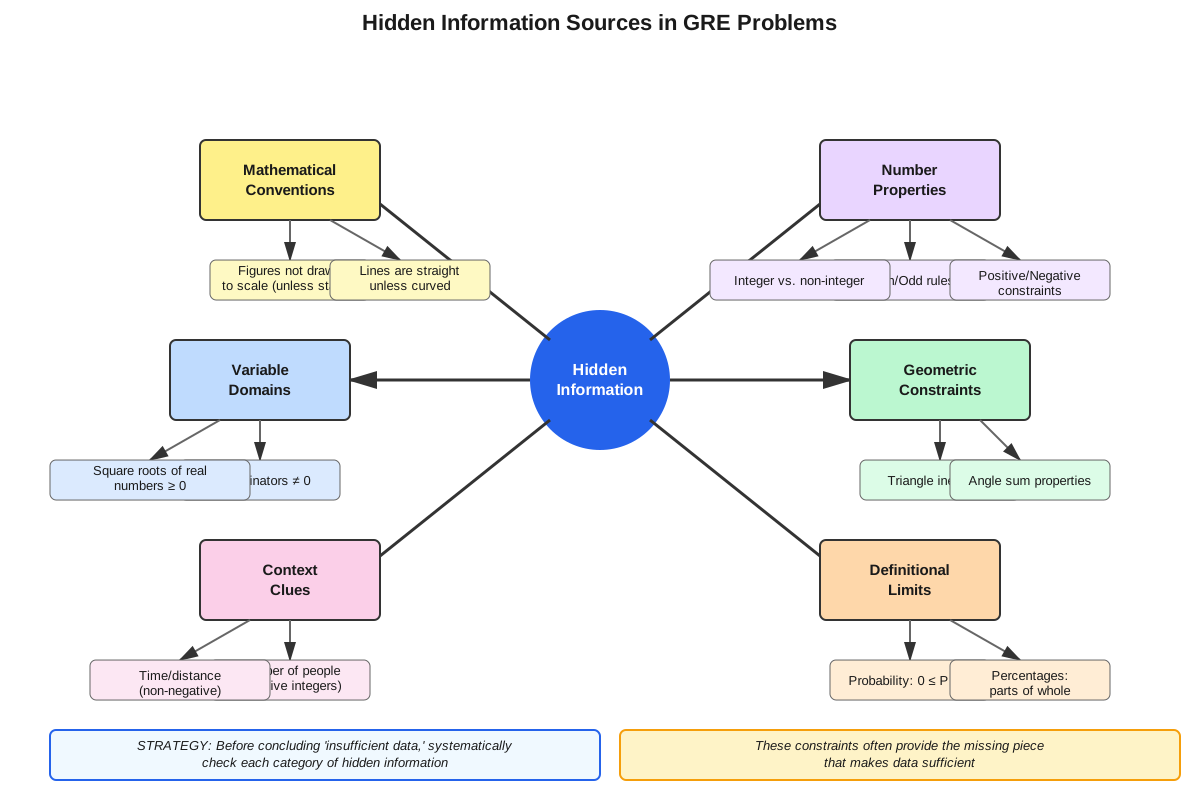
Implicit Information and Hidden Constraints
Advanced data sufficiency reasoning requires recognizing information that isn't explicitly stated:
- Geometric constraints: In a triangle, angles sum to 180°; this is given information even if unstated
- Domain restrictions: Variables representing "number of people" must be non-negative integers
- Definition-based information: If x is defined as "the average of five test scores," then x must be between the minimum and maximum scores
- Figure-based information: Even when figures are marked "not drawn to scale," certain relationships (like point order on a line) remain valid
Sufficiency Through Elimination
Sometimes information is sufficient not because it directly provides an answer, but because it eliminates all but one possibility:
- If x is a prime number less than 10 and greater than 5, then x must be 7 (sufficient through elimination)
- If a two-digit number has digits that sum to 9 and the tens digit is twice the units digit, only 63 satisfies both conditions
This principle is particularly powerful when combined with answer choice analysis—if four answer choices can be eliminated as inconsistent with given information, the remaining choice must be correct even without direct calculation.
Concept Relationships
Data sufficiency reasoning serves as a meta-skill that integrates multiple mathematical domains. The relationship flow operates as follows:
Algebraic Foundations → Equation-Variable Analysis → Sufficiency Determination → Strategic Question Approach
Within the topic itself, concepts connect hierarchically:
- The Fundamental Principle (information must answer the specific question with certainty) governs all other concepts
- Types of Sufficiency provide a classification framework for applying the fundamental principle
- Equation-Variable Relationship offers a specific tool for algebraic sufficiency questions
- Quantitative Comparison Strategy applies sufficiency reasoning to a particular question format
- Implicit Information Recognition expands what counts as "given information" in the fundamental principle
Connections to prerequisite topics include:
- Algebra: Provides the manipulation tools needed to determine what can be derived from given information
- Number Properties: Supply implicit constraints that often make seemingly insufficient information actually sufficient
- Inequality Reasoning: Enables sufficiency determination for relationship questions without requiring exact values
Connections to related topics:
- Problem-Solving Strategy: Data sufficiency reasoning informs when to invest time in calculation versus when to recognize impossibility
- Quantitative Comparison Techniques: This question type is essentially applied data sufficiency
- Word Problem Translation: Recognizing what information is provided versus what is being asked is a sufficiency skill
High-Yield Facts
⭐ Information is sufficient if it enables answering the specific question asked with certainty, not just providing related information
⭐ In Quantitative Comparison questions, answer choice (D) is correct when different valid values produce different relationships between quantities
⭐ To solve for n variables, you generally need n independent equations, but the question asked may require fewer variables
⭐ "Cannot be determined" should only be selected after confirming that no valid manipulation or property application yields a definitive answer
⭐ Implicit information (geometric properties, domain restrictions, definitions) counts as given information for sufficiency analysis
- Testing extreme values (0, 1, -1, very large, very small) is the most efficient way to check for sufficiency in Quantitative Comparisons
- Two equations that are multiples of each other count as only one independent equation and cannot solve for two variables
- If a question asks for a relationship (like "Is x > y?") rather than a value, less information may be sufficient than initially appears
- Sufficiency can be established through elimination when given constraints allow only one possibility
- In geometry problems, figures provide information even when marked "not drawn to scale" (point order, angle relationships, etc.)
- Integer constraints dramatically change sufficiency—"x + y = 5" with positive integers has only four solutions
- Recognizing that you have sufficient information to determine a relationship without calculating the exact answer saves significant time
Quick check — test yourself on Data sufficiency reasoning so far.
Try Flashcards →Common Misconceptions
Misconception: If I can't immediately see how to solve a problem, the information must be insufficient.
Correction: Difficulty in seeing the solution path doesn't indicate insufficiency. Information is insufficient only when no valid approach exists, not when the approach is non-obvious. Always check for indirect sufficiency through properties, substitution, or elimination.
Misconception: In Quantitative Comparison, if I can't calculate exact values for Quantity A and Quantity B, the answer must be (D).
Correction: Many Quantitative Comparisons are designed to be answered without calculating exact values. If you can establish a relationship (like "Quantity A is always positive and Quantity B is always negative"), that's sufficient even without specific numbers.
Misconception: Two equations always provide enough information to solve for two variables.
Correction: The equations must be independent. If one equation is a multiple or combination of the other (like "x + y = 10" and "2x + 2y = 20"), they provide only one piece of independent information and cannot solve for both variables.
Misconception: "Cannot be determined" is a safe guess when a problem seems hard.
Correction: This answer choice appears in only 10-15% of questions where it's offered. It should be selected only after systematic analysis confirms genuine insufficiency. Test-makers design problems to seem harder than they are, and "Cannot be determined" is often a trap for students who give up too quickly.
Misconception: If a problem doesn't give me a specific value for a variable, I don't have enough information.
Correction: Many questions can be answered using relationships, properties, or ranges without knowing exact values. For example, knowing "x is a positive even integer less than 5" is sufficient to determine that x ∈ {2, 4}, which may be enough to answer the question.
Misconception: Information stated in the question stem is separate from information in the answer choices when evaluating sufficiency.
Correction: All information provided anywhere in the problem (stem, constraints, figures, answer choices) contributes to sufficiency analysis. Sometimes the answer choices themselves reveal constraints that make information sufficient.
Worked Examples
Example 1: Quantitative Comparison with Algebraic Variables
Question:
Given: x and y are integers, and x² + y² = 25

Quantity A: x + y
Quantity B: 5

Which quantity is greater?
(A) Quantity A is greater
(B) Quantity B is greater
(C) The two quantities are equal
(D) The relationship cannot be determined
Solution with Data Sufficiency Analysis:
Step 1: Identify what we're testing—we need to determine if the given information is sufficient to establish a consistent relationship between x + y and 5.
Step 2: Recognize the constraint—since x and y are integers and x² + y² = 25, we can list all possible pairs:
- (5, 0): x + y = 5
- (0, 5): x + y = 5
- (3, 4): x + y = 7
- (4, 3): x + y = 7
- (-3, 4): x + y = 1
- (-4, 3): x + y = -1
- (3, -4): x + y = -1
- (4, -3): x + y = 1
- (-5, 0): x + y = -5
- (0, -5): x + y = -5
- (-3, -4): x + y = -7
- (-4, -3): x + y = -7
Step 3: Analyze sufficiency—we found that x + y can equal 7, 5, 1, -1, -5, or -7. Since x + y takes multiple different values, sometimes greater than 5, sometimes equal to 5, and sometimes less than 5, the relationship changes depending on which valid pair we choose.
Step 4: Conclude—the information is insufficient to determine a consistent relationship.
Answer: (D) The relationship cannot be determined
Learning Objective Connection: This example demonstrates identifying when data sufficiency is being tested (Quantitative Comparison format), applying the core strategy (testing multiple valid cases), and reaching an accurate conclusion about insufficiency.
Example 2: Standard Multiple Choice with "Cannot Be Determined"
Question:
A rectangle has a perimeter of 40 inches. What is the area of the rectangle?

(A) 75 square inches
(B) 96 square inches
(C) 100 square inches
(D) 144 square inches
(E) Cannot be determined from the information given
Solution with Data Sufficiency Analysis:
Step 1: Identify the sufficiency question—we have one constraint (perimeter = 40) and need to find area. We must determine if this is sufficient.
Step 2: Set up the equation framework—for a rectangle with length L and width W:
- Perimeter: 2L + 2W = 40, which simplifies to L + W = 20
- Area: A = L × W
Step 3: Apply the equation-variable principle—we have one equation (L + W = 20) but two unknowns (L and W). We're asked for A = L × W, which is a function of both variables. This suggests insufficiency, but we must verify.
Step 4: Test specific cases to confirm:
- If L = 10 and W = 10: A = 100 square inches
- If L = 15 and W = 5: A = 75 square inches
- If L = 12 and W = 8: A = 96 square inches
Step 5: Analyze the results—different valid rectangles (all with perimeter 40) produce different areas. The given information constrains the sum L + W but not the product L × W.
Step 6: Conclude—the information is insufficient to determine a unique area value.
Answer: (E) Cannot be determined from the information given
Key Insight: This problem illustrates that having one equation with two variables is typically insufficient when the question asks for a function of both variables (unless that function happens to be the same expression as the constraint, which it isn't here).
Learning Objective Connection: This demonstrates explaining the core strategy (equation-variable analysis), identifying when sufficiency is being tested (presence of "Cannot be determined" option), and applying reasoning accurately to reach the correct conclusion.
Exam Strategy
Recognition Triggers
Watch for these phrases and formats that signal data sufficiency is being tested:
- Quantitative Comparison questions (always involve sufficiency reasoning)
- "Cannot be determined from the information given" as an answer choice
- Questions asking "Which of the following MUST be true?" (testing whether information is sufficient to establish certainty)
- "Could be" or "might be" language (suggesting multiple possibilities, indicating potential insufficiency)
- Phrases like "If possible, determine..." (explicitly asking about sufficiency)
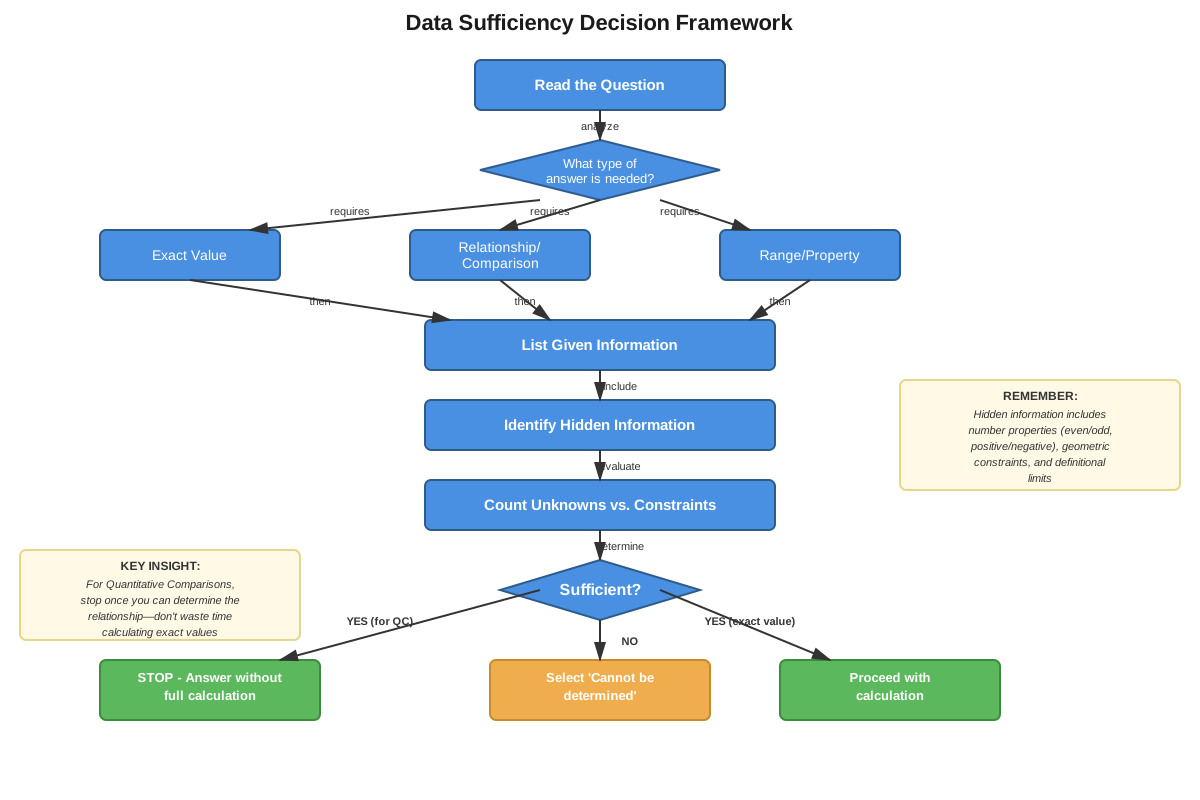
Strategic Approach Process
- Read the question first: Identify exactly what's being asked before analyzing given information
- Inventory your information: List all constraints, including implicit ones from definitions, properties, and figures
- Apply the equation-variable check: Count unknowns versus independent constraints
- Test boundary cases: For Quantitative Comparisons, try extreme values to check if relationships change
- Look for indirect sufficiency: Consider whether properties or elimination provide answers without direct calculation
- Verify before selecting "Cannot be determined": Ensure you haven't missed implicit information or indirect solution paths
Time Management
- Quantitative Comparisons: Allocate 60-90 seconds; if you can't establish sufficiency or insufficiency in this time, make an educated guess
- "Cannot be determined" questions: Spend up to 2 minutes, but if you find yourself calculating extensively without progress, this may signal genuine insufficiency
- Don't over-calculate: If you've determined sufficiency (you can find the answer), you don't need to complete the calculation unless required for the answer
Process of Elimination Tips
- In Quantitative Comparisons: If you find even one valid case where A > B and one where B > A, immediately select (D) without testing further
- For "Cannot be determined" questions: Eliminate answer choices that contradict given constraints; if four choices can be eliminated, the fifth must be correct
- Use answer choice analysis: Sometimes the presence of specific answer choices reveals constraints (e.g., if all numerical choices are positive, the answer likely is positive)
Common Traps to Avoid
- Assuming figures are drawn to scale: Unless stated otherwise, don't rely on visual appearance for measurements
- Forgetting negative solutions: When solving x² = 9, remember both x = 3 and x = -3 are valid
- Ignoring domain restrictions: "Number of students" must be a non-negative integer, which may make information sufficient through elimination
- Selecting (D) or "Cannot be determined" prematurely: These are often trap answers for students who don't recognize indirect sufficiency
Memory Techniques
The SUFFICE Acronym
Specific question - What exactly is being asked?
Unknowns counted - How many variables need values?
Facts listed - What's explicitly given?
Further implications - What's implicitly given?
Independent equations - How many constraints exist?
Cases tested - Do different valid scenarios give different answers?
Evaluate - Is information sufficient or insufficient?
Visualization Strategy for Quantitative Comparisons
Picture a balance scale:
- Left pan: Quantity A
- Right pan: Quantity B
- Question: Does the scale consistently tip one way, balance, or does it change?
If the scale tips differently with different valid values, the answer is (D).
The "Two-Two Rule"
Two variables, two equations → Usually sufficient
Two variables, one equation → Usually insufficient (unless the question asks for that exact expression)
Mnemonic for Implicit Information: "GRID"
Geometric properties (angle sums, parallel line relationships)
Restrictions from definitions (averages must be between min and max)
Integer constraints (whole numbers limit possibilities)
Domain limitations (counts must be non-negative)
Summary
Data sufficiency reasoning is the analytical skill of determining whether given information is adequate to answer a specific question with certainty. On the GRE, this skill is tested primarily through Quantitative Comparison questions and through standard questions offering "Cannot be determined" as an answer choice. The fundamental principle is that information is sufficient if and only if it enables answering the precise question asked with definitive certainty—not just providing related information. Key strategies include applying the equation-variable principle (n independent equations for n unknowns), testing extreme cases in Quantitative Comparisons to check if relationships change, recognizing implicit information from properties and constraints, and distinguishing between genuine insufficiency and non-obvious solution paths. Mastery requires understanding that sufficiency can be established indirectly through properties, elimination, or relationship determination without exact calculation. The most common errors involve selecting "Cannot be determined" prematurely, forgetting implicit constraints, and failing to recognize that questions asking for relationships or expressions may require less information than questions asking for individual variable values.
Key Takeaways
- Data sufficiency reasoning determines whether given information can definitively answer the specific question asked, not whether it provides related information
- Quantitative Comparison answer choice (D) is correct when different valid values produce different relationships between the quantities
- The equation-variable principle provides a quick check: n independent equations are generally needed for n unknowns, but the question asked may require fewer
- Implicit information from geometric properties, domain restrictions, and definitions must be included in sufficiency analysis
- "Cannot be determined" should only be selected after systematic analysis confirms genuine insufficiency, not merely difficulty
- Testing extreme values (0, 1, -1, large, small) efficiently reveals whether information is sufficient in Quantitative Comparisons
- Sufficiency can be established through indirect methods including property application, elimination, and relationship determination without exact calculation
Related Topics
Quantitative Comparison Strategies: Mastering data sufficiency reasoning is prerequisite to advanced Quantitative Comparison techniques, as these questions fundamentally test whether relationships can be determined from given information.
Systems of Equations: Understanding when systems have unique solutions, infinite solutions, or no solutions directly applies the equation-variable principle central to data sufficiency.
Inequality Problem Solving: Many data sufficiency questions involve determining whether relationships can be established without exact values, making inequality reasoning a natural extension.
Word Problem Translation: Identifying what information is given versus what is asked requires the same analytical framework as data sufficiency reasoning.
Number Properties and Constraints: Recognizing how properties (even/odd, prime, integer restrictions) provide implicit information enhances data sufficiency analysis.
Practice CTA
Now that you understand the principles and strategies of data sufficiency reasoning, it's time to apply these skills to actual GRE-style questions. Work through the practice questions systematically, using the SUFFICE acronym to guide your analysis. Pay special attention to Quantitative Comparison questions, testing extreme values before concluding about sufficiency. Review the flashcards to reinforce recognition of sufficiency patterns and common traps. Remember: data sufficiency reasoning is a skill that improves dramatically with deliberate practice—each question you analyze strengthens your ability to recognize what information is truly necessary versus what is merely provided. Your investment in mastering this high-yield topic will pay dividends across the entire Quantitative Reasoning section!
Sign up free to keep reading
Create a free AnvayaPrep account to finish this GRE guide on Data sufficiency reasoning — plus flashcards and practice questions.