Overview
Fractions and decimals testing is a critical skill set within GRE Quantitative Reasoning that extends far beyond simple arithmetic. This topic focuses on the strategic comparison and manipulation of fractional and decimal values, particularly within the context of Quantitative Comparison questions where test-takers must determine relationships between two quantities without necessarily calculating exact values. The GRE frequently presents scenarios where converting between fractions and decimals, estimating relative magnitudes, and recognizing patterns in rational numbers becomes essential for efficient problem-solving.
Understanding GRE fractions and decimals testing requires both computational fluency and conceptual insight. Test-makers design questions that reward students who can quickly assess whether a fraction is greater than, less than, or equal to another value—often a decimal or another fraction—without performing lengthy calculations. This skill becomes particularly valuable in the Quantitative Comparison format, where four answer choices remain constant: (A) Quantity A is greater, (B) Quantity B is greater, (C) The two quantities are equal, or (D) The relationship cannot be determined from the information given.
The relationship between fractions and decimals testing and broader Quantitative Reasoning concepts is foundational. Mastery of this topic enables efficient work with ratios, proportions, percentages, and algebraic expressions involving rational numbers. Additionally, the estimation and comparison strategies developed here transfer directly to data interpretation questions, where quick magnitude assessments of fractional changes or decimal values can save precious testing time. This topic represents a convergence point where number sense, strategic thinking, and computational efficiency must work in harmony.
Learning Objectives
- [ ] Identify when fractions and decimals testing is being tested in GRE questions
- [ ] Explain the core rule or strategy behind fractions and decimals testing
- [ ] Apply fractions and decimals testing to GRE-style questions accurately
- [ ] Convert efficiently between fractions and decimals without a calculator
- [ ] Compare fractional and decimal values using benchmark values and estimation techniques
- [ ] Recognize when exact calculation is unnecessary and strategic comparison suffices
- [ ] Identify trap answers that exploit common conversion errors
Prerequisites
- Basic fraction operations (addition, subtraction, multiplication, division): Essential for manipulating fractional expressions and finding common denominators during comparisons
- Decimal place value understanding: Required to accurately interpret and compare decimal values and understand the magnitude of decimal numbers
- Order of operations: Necessary when evaluating complex expressions containing both fractions and decimals
- Basic percentage concepts: Percentages are intimately related to fractions and decimals, often appearing in the same questions
- Number line visualization: Helps conceptualize the relative positions of fractions and decimals for comparison purposes
Why This Topic Matters
Fractions and decimals testing appears with remarkable frequency on the GRE Quantitative Reasoning section, particularly in Quantitative Comparison questions where approximately 30-40% of problems involve comparing rational numbers in various forms. The Educational Testing Service (ETS) deliberately includes these questions because they assess both mathematical knowledge and strategic thinking—two qualities essential for graduate-level academic work.
In real-world applications, professionals across fields regularly compare fractional data, interpret decimal measurements, and make quick magnitude assessments. Scientists compare experimental ratios, business analysts evaluate fractional market shares, and researchers interpret statistical results presented in decimal form. The ability to quickly assess whether 7/12 is greater than 0.58 or whether 0.375 represents a value closer to 1/3 or 2/5 reflects practical quantitative literacy.
On the GRE, this topic commonly appears in several formats: direct Quantitative Comparisons between a fraction and a decimal, word problems requiring conversion between forms, data interpretation questions presenting mixed formats, and algebraic expressions where fractional coefficients must be compared to decimal values. Questions may also embed fractions and decimals within geometry problems (comparing fractional parts of areas) or statistics questions (comparing decimal probabilities to fractional odds). The test-makers favor this topic because it efficiently discriminates between students who have developed true number sense and those who rely solely on mechanical calculation.
Core Concepts
Understanding Fraction-Decimal Equivalence
The foundation of fractions and decimals testing lies in recognizing that fractions and decimals are simply different representations of the same rational numbers. A fraction represents division: 3/4 means "3 divided by 4," which equals 0.75. However, the GRE rarely requires students to perform this division explicitly. Instead, questions reward those who recognize common equivalences instantly.
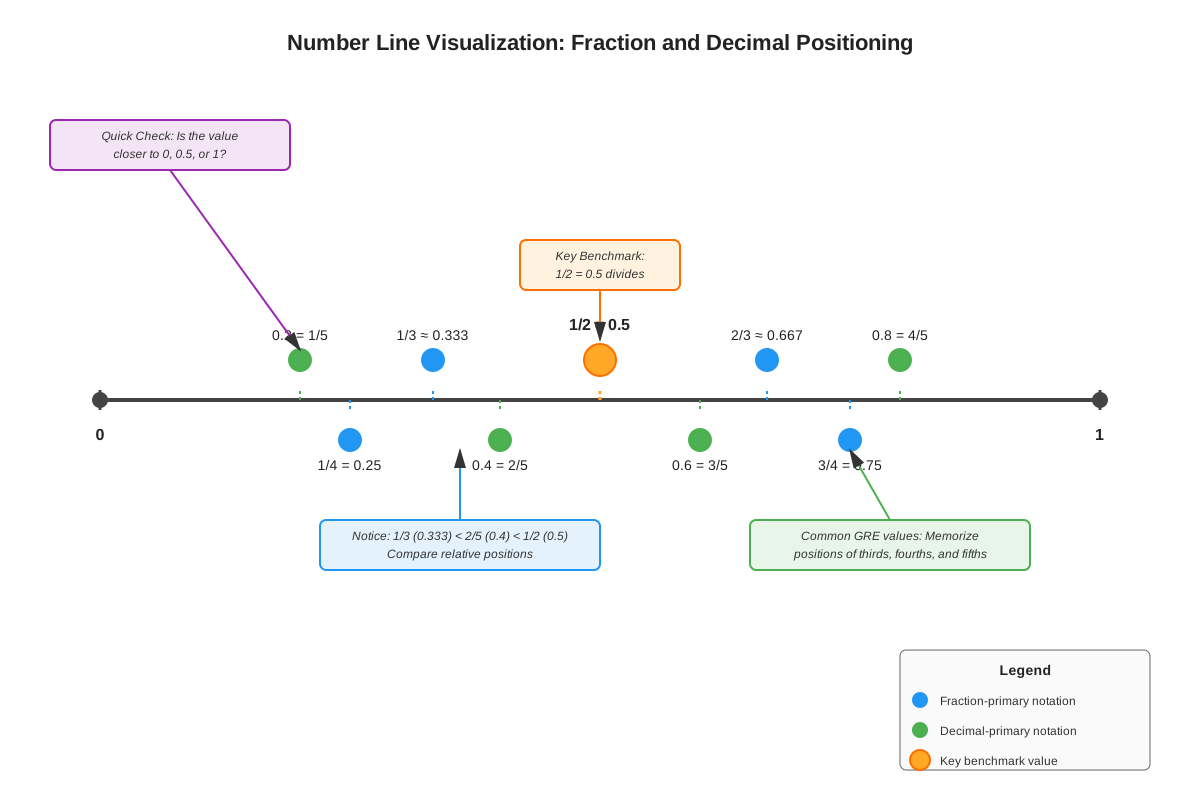
Key benchmark fractions and their decimal equivalents include:
- 1/2 = 0.5
- 1/3 ≈ 0.333... (repeating)
- 2/3 ≈ 0.666... (repeating)
- 1/4 = 0.25
- 3/4 = 0.75
- 1/5 = 0.2
- 1/8 = 0.125
- 1/10 = 0.1
Memorizing these benchmarks enables rapid comparison without calculation. When encountering 5/8 versus 0.6, recognizing that 5/8 = 0.625 (since 1/8 = 0.125, and 5 × 0.125 = 0.625) allows immediate determination that 5/8 > 0.6.
Strategic Comparison Techniques
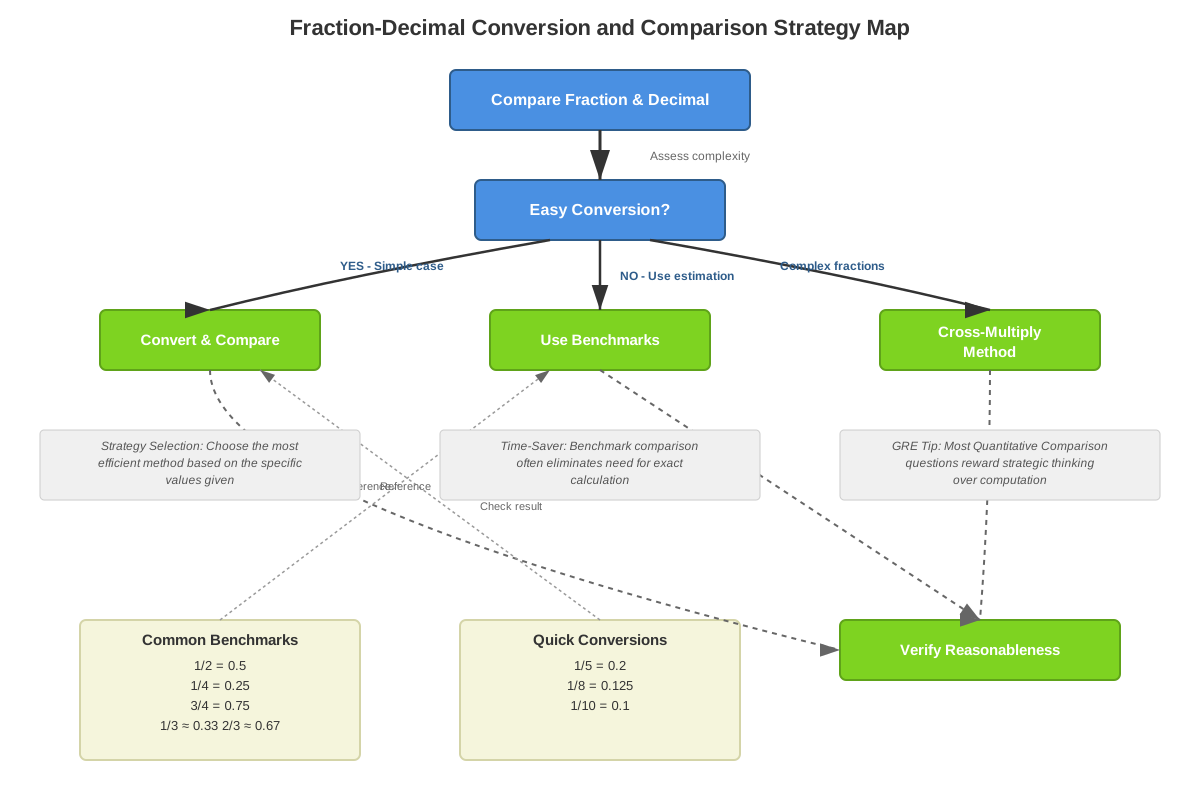
Rather than converting every fraction to a decimal or vice versa, efficient test-takers employ several strategic approaches:
Cross-multiplication for fraction comparison: When comparing two fractions a/b and c/d, cross-multiply to get ad and bc. If ad > bc, then a/b > c/d. This technique avoids finding common denominators.
Benchmark comparison: Compare both values to a convenient benchmark like 0.5 or 1/2. If comparing 4/9 to 0.43, note that 4/9 is slightly less than 4/8 = 1/2 = 0.5, while 0.43 is also less than 0.5. More precise analysis shows 4/9 ≈ 0.444..., making 4/9 > 0.43.
Decimal estimation for fractions: Rather than exact conversion, estimate the decimal value. For 7/13, recognize that 7/14 = 1/2 = 0.5, so 7/13 must be slightly larger than 0.5 (approximately 0.538).
Reciprocal relationships: Understanding that smaller denominators create larger fractions (when numerators are equal) and that 1/x decreases as x increases helps with quick comparisons.
Converting Between Forms
While memorization of common equivalents is ideal, systematic conversion remains necessary for unfamiliar values:
Fraction to decimal: Divide the numerator by the denominator. For 5/8, calculate 5 ÷ 8 = 0.625. On the GRE (where calculators are provided), this is straightforward, but mental math shortcuts accelerate the process.
Decimal to fraction: Place the decimal digits over the appropriate power of 10, then simplify. For 0.375, write 375/1000, then reduce by dividing both numerator and denominator by their GCD (125), yielding 3/8.
Repeating decimals: Recognize patterns like 0.333... = 1/3, 0.142857142857... = 1/7. The GRE occasionally tests recognition of repeating decimal patterns.
Magnitude Estimation and Number Sense
Developing strong number sense for fractions and decimals means instantly recognizing approximate values without calculation:
| Fraction Range | Decimal Range | Quick Recognition |
|---|---|---|
| 0 < x < 1/4 | 0 < x < 0.25 | Small fractions/decimals |
| 1/4 ≤ x < 1/2 | 0.25 ≤ x < 0.5 | Between quarter and half |
| 1/2 ≤ x < 3/4 | 0.5 ≤ x < 0.75 | Between half and three-quarters |
| 3/4 ≤ x < 1 | 0.75 ≤ x < 1 | Close to one |
This framework enables rapid classification. When comparing 11/17 to 0.7, recognize that 11/17 is slightly less than 11/16.5 = 2/3 ≈ 0.667, making it less than 0.7.
Special Cases and Edge Conditions
Certain scenarios require particular attention:
Negative fractions and decimals: When both quantities are negative, the comparison reverses. -1/3 > -0.4 because -0.333... is closer to zero than -0.4.
Mixed numbers versus decimals: Convert mixed numbers to improper fractions or decimals. For 2 3/5 versus 2.58, convert 3/5 = 0.6, so 2 3/5 = 2.6 > 2.58.
Very small differences: Questions may present values like 0.666 versus 2/3 (0.666...), where careful attention to repeating decimals matters.
Zero and one as boundaries: Determining whether a value is less than zero, between zero and one, or greater than one often provides sufficient information for Quantitative Comparison questions.
Concept Relationships
The concepts within fractions and decimals testing form an interconnected web of skills. Fraction-decimal equivalence serves as the foundation, enabling all other techniques. From this base, strategic comparison techniques emerge as the practical application layer, allowing test-takers to avoid unnecessary calculation. These techniques rely heavily on magnitude estimation and number sense, which develops through practice and memorization of benchmark values.
Converting between forms acts as both a prerequisite skill and a fallback strategy when other approaches prove insufficient. The conversion process reinforces understanding of equivalence while providing a systematic method for unfamiliar values. Special cases and edge conditions represent the refinement layer, where conceptual understanding prevents common errors.
The relationship map flows as follows:
Fraction-Decimal Equivalence → Benchmark Memorization → Strategic Comparison → Magnitude Estimation → Efficient Problem Solving
This topic connects to prerequisite knowledge of basic fraction operations by extending simple arithmetic into comparative analysis. It links forward to percentage problems (since percentages are fractions with denominator 100), ratio and proportion questions (which often require comparing fractional relationships), and algebraic manipulation (where fractional coefficients must be compared or combined with decimal values).
Quick check — test yourself on Fractions and decimals testing so far.
Try Flashcards →High-Yield Facts
⭐ 1/2 = 0.5 serves as the most useful benchmark for fraction-decimal comparisons on the GRE
⭐ When comparing fractions with the same numerator, the fraction with the smaller denominator is larger (e.g., 3/7 > 3/8)
⭐ When comparing fractions with the same denominator, the fraction with the larger numerator is larger (e.g., 5/9 > 4/9)
⭐ Cross-multiplication allows fraction comparison without finding common denominators: to compare a/b and c/d, compare ad with bc
⭐ Common fraction-decimal equivalents must be memorized: 1/3 ≈ 0.333, 2/3 ≈ 0.667, 1/4 = 0.25, 3/4 = 0.75, 1/5 = 0.2, 1/8 = 0.125
- Repeating decimals indicate fractions with denominators containing prime factors other than 2 and 5
- To convert a terminating decimal to a fraction, place digits over the appropriate power of 10 and simplify
- Fractions with denominators of 2, 4, 5, 8, 10, 16, 20, 25, 50, and 100 convert to terminating decimals
- When both quantities are negative, the fraction or decimal closer to zero is greater
- Estimation often suffices for Quantitative Comparison questions; exact calculation may waste time
- The decimal 0.1 = 1/10, making it easy to convert decimals like 0.3 = 3/10 or 0.7 = 7/10
- Mixed numbers should be converted to improper fractions or decimals before comparison
Common Misconceptions
Misconception: Larger denominators always mean larger fractions → Correction: When numerators are equal, larger denominators create smaller fractions. 1/8 < 1/5 because dividing by a larger number yields a smaller result.
Misconception: 0.3 equals 1/3 → Correction: 0.3 = 3/10 = 0.300, while 1/3 = 0.333... (repeating). The difference is approximately 0.033, which can affect comparison outcomes.
Misconception: Adding the same number to both numerator and denominator doesn't change a fraction's value → Correction: This operation changes the fraction's value. (2+1)/(3+1) = 3/4 ≠ 2/3. Only multiplying both numerator and denominator by the same non-zero number preserves value.
Misconception: When comparing negative fractions and decimals, the same rules apply as for positive values → Correction: With negative values, the comparison reverses. While 1/4 < 1/3 for positive values, -1/4 > -1/3 because -0.25 is closer to zero than -0.333...
Misconception: All fractions can be expressed as terminating decimals → Correction: Only fractions whose denominators (in lowest terms) have prime factors of only 2 and/or 5 terminate. Fractions like 1/3, 1/7, or 1/9 produce repeating decimals.
Misconception: Converting to a common form is always necessary for comparison → Correction: Strategic techniques like benchmark comparison or cross-multiplication often provide faster solutions without full conversion.
Misconception: 0.5 is always exactly halfway between any two values → Correction: 0.5 is halfway between 0 and 1, but the midpoint between other values must be calculated. The midpoint between 0.3 and 0.8 is 0.55, not 0.5.
Worked Examples
Example 1: Quantitative Comparison with Strategic Benchmarking
Question: Compare Quantity A and Quantity B.
Quantity A: 7/12
Quantity B: 0.58
Solution:
Rather than converting 7/12 to a decimal through division, use strategic benchmarking.
Step 1: Identify a useful benchmark. Since both values are between 0.5 and 1, use 1/2 = 0.5 as a reference point.
Step 2: Assess Quantity A relative to the benchmark.
- 7/12 compared to 6/12 = 1/2
- 7/12 = 6/12 + 1/12 = 1/2 + 1/12
- Since 1/12 ≈ 0.083, we have 7/12 ≈ 0.5 + 0.083 = 0.583
Step 3: Compare both quantities.
- Quantity A ≈ 0.583
- Quantity B = 0.58
- 0.583 > 0.58
Step 4: Verify with an alternative method (cross-multiplication approach).
- Convert 0.58 to a fraction: 58/100 = 29/50
- Compare 7/12 and 29/50 using cross-multiplication
- 7 × 50 = 350
- 29 × 12 = 348
- Since 350 > 348, we confirm 7/12 > 29/50
Answer: (A) Quantity A is greater
Connection to Learning Objectives: This example demonstrates identifying when fractions and decimals testing is being tested (Quantitative Comparison format), explaining the core strategy (benchmark comparison and cross-multiplication), and applying it accurately to reach the correct answer.
Example 2: Complex Comparison with Negative Values
Question: Compare Quantity A and Quantity B.
Quantity A: -3/8
Quantity B: -0.4
Solution:
This problem tests understanding of negative value comparisons, a common trap on the GRE.
Step 1: Recognize that both quantities are negative, so the value closer to zero is greater.
Step 2: Convert -3/8 to decimal form for direct comparison.
- 3/8 = 3 × (1/8) = 3 × 0.125 = 0.375
- Therefore, -3/8 = -0.375
Step 3: Compare the absolute values first.
- |-3/8| = 0.375
- |-0.4| = 0.4
- 0.375 < 0.4
Step 4: Apply the negative value rule.
- Since 0.375 < 0.4 in absolute value
- -0.375 is closer to zero than -0.4
- Therefore, -0.375 > -0.4
- Thus, -3/8 > -0.4
Step 5: Visualize on a number line to confirm.
-0.5    -0.4    -0.375    -0.3    -0.2    -0.1    0
(B) (A)Answer: (A) Quantity A is greater
Connection to Learning Objectives: This example illustrates a special case that tests deeper understanding of fractions and decimals testing, specifically how comparison rules change with negative values—a high-yield concept that frequently appears on the GRE.
Exam Strategy
When approaching GRE questions involving fractions and decimals testing, implement this systematic strategy:
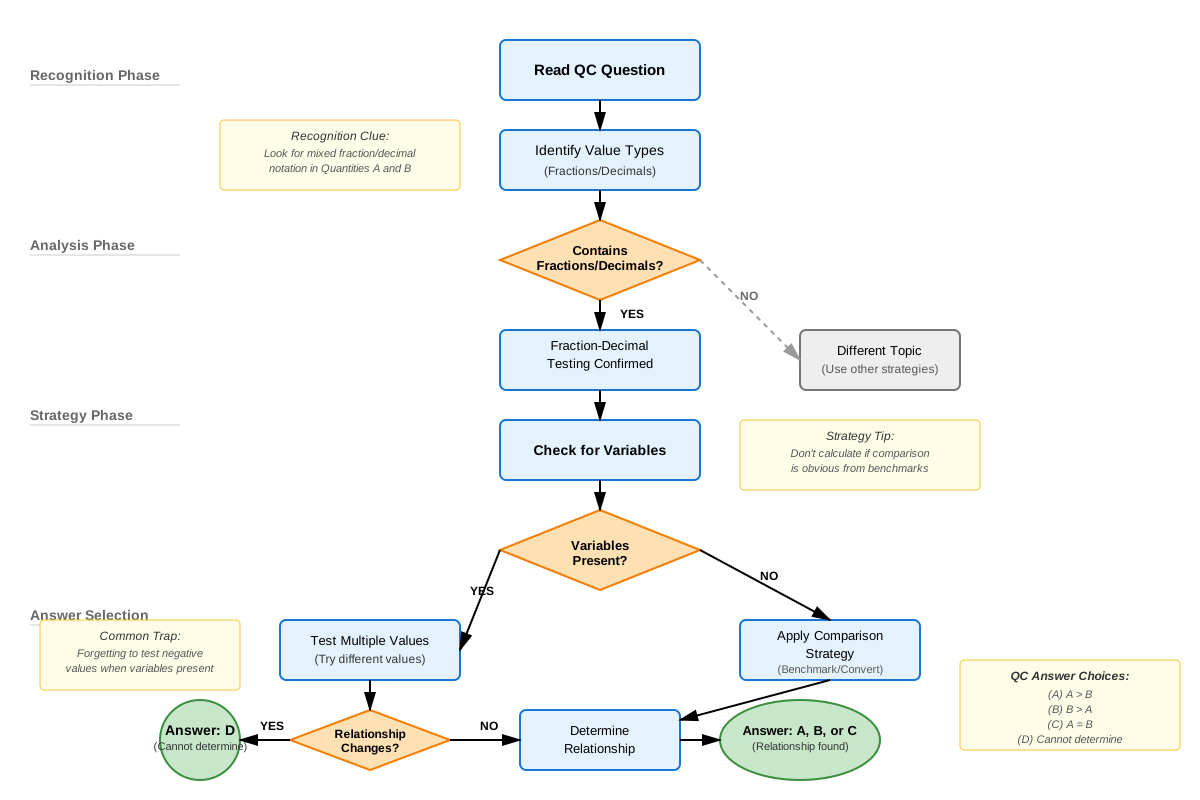
1. Identify the question type immediately: Quantitative Comparison questions require only determining the relationship, not calculating exact values. Problem Solving questions may require precise answers. Adjust your approach accordingly.
2. Look for trigger words and phrases:
- "Compare" or "which is greater" signals comparison strategy
- "Approximately" suggests estimation is acceptable
- "Exact value" or "calculate" requires precise conversion
- "Between" indicates benchmark thinking
3. Apply the decision tree:
- First, check if both values are clearly on the same side of an obvious benchmark (both less than 0.5, both greater than 0.5)
- Second, determine if memorized equivalents apply (1/4, 1/3, 1/2, etc.)
- Third, use cross-multiplication for fractions or quick mental division
- Finally, resort to calculator conversion only if other methods fail
4. Process of elimination for Quantitative Comparison:
- Eliminate (D) "cannot be determined" if no variables are present
- Eliminate (C) "equal" if quick estimation shows clear difference
- Test extreme cases when variables are involved
5. Time allocation: Spend no more than 1.5 minutes on any single fraction-decimal comparison question. If approaching this limit without a solution, make an educated guess and move forward. These questions reward quick thinking, not exhaustive calculation.
6. Common trap awareness: The GRE frequently presents:
- Values that appear equal but differ slightly (0.666 vs. 2/3)
- Negative values where comparison rules reverse
- Fractions with large numerators and denominators designed to intimidate
- Mixed numbers that seem complex but simplify easily
7. Calculator usage: The GRE's on-screen calculator can perform division, but typing takes time. Use it as a verification tool or last resort, not as the primary strategy.
Memory Techniques
Mnemonic for common fraction-decimal equivalents: "Half Quarter Eighth Tenth Fifth Third"
- Half: 1/2 = 0.5
- Quarter: 1/4 = 0.25, 3/4 = 0.75
- Eighth: 1/8 = 0.125, 3/8 = 0.375, 5/8 = 0.625, 7/8 = 0.875
- Tenth: 1/10 = 0.1
- Fifth: 1/5 = 0.2, 2/5 = 0.4, 3/5 = 0.6, 4/5 = 0.8
- Third: 1/3 = 0.333..., 2/3 = 0.666...
Visualization strategy: Picture a number line divided into common fractions. Mentally place any decimal on this line to see which fractions it falls between. This spatial representation aids quick comparison.
"CROSS" acronym for fraction comparison:
- Check if numerators or denominators are equal
- Recognize benchmark values
- Observe signs (positive/negative)
- Simplify if possible
- Solve using cross-multiplication if needed
Finger counting for eighths: Each finger represents 1/8 = 0.125. To find 5/8, count five fingers: 0.125 × 5 = 0.625. This kinesthetic technique reinforces memorization.
"Denominator Down, Value Down" rule: When numerators are equal, as the denominator goes down (gets smaller), the value goes up. Conversely, as the denominator goes up (gets larger), the value goes down. This helps avoid the common error of thinking larger denominators mean larger fractions.
Summary
Fractions and decimals testing on the GRE assesses the ability to efficiently compare and convert between fractional and decimal representations of rational numbers without relying solely on mechanical calculation. Success requires memorizing common fraction-decimal equivalents (particularly 1/2, 1/3, 1/4, 1/5, and 1/8 families), developing strategic comparison techniques (cross-multiplication, benchmark comparison, and magnitude estimation), and recognizing when exact calculation is unnecessary. The topic appears frequently in Quantitative Comparison questions where determining relationships matters more than computing precise values. Critical skills include understanding that smaller denominators create larger fractions (when numerators are equal), recognizing that negative value comparisons reverse normal ordering rules, and knowing which fractions produce terminating versus repeating decimals. Efficient test-takers avoid time-consuming conversions by leveraging number sense, using 0.5 as a primary benchmark, and applying cross-multiplication for fraction comparisons. Mastery of this topic provides foundational skills for percentage problems, ratio questions, and algebraic manipulation throughout the Quantitative Reasoning section.
Key Takeaways
- Memorize benchmark fraction-decimal equivalents (1/2, 1/3, 2/3, 1/4, 3/4, 1/5, 1/8) for instant recognition without calculation
- Use strategic comparison techniques rather than always converting to a common form; cross-multiplication and benchmark comparison save valuable time
- Smaller denominators create larger fractions when numerators are equal; this counterintuitive principle prevents common errors
- Negative value comparisons reverse: the fraction or decimal closer to zero is greater when both quantities are negative
- Quantitative Comparison questions reward relationship determination, not exact calculation; estimation often suffices
- Cross-multiplication enables fraction comparison without finding common denominators: compare ad with bc when comparing a/b and c/d
- Develop number sense by practicing magnitude estimation and recognizing whether values fall above or below key benchmarks like 0.5
Related Topics
Ratios and Proportions: Building on fraction comparison skills, ratios extend fractional thinking to relationships between quantities. Mastering fractions and decimals testing provides the foundation for solving complex proportion problems and scale factor questions.
Percentages: Since percentages are fractions with denominator 100, the conversion and comparison skills developed here transfer directly to percentage increase/decrease problems, a high-frequency GRE topic.
Algebraic Fractions: More advanced questions combine fraction-decimal testing with variables, requiring students to compare expressions like (x+1)/3 with 0.4x. The strategic thinking developed here enables efficient handling of these algebraic scenarios.
Data Interpretation: Charts and graphs frequently present data in mixed formats (some values as decimals, others as fractions). Quick comparison skills enable faster analysis of data sets and more efficient answering of multi-part data interpretation questions.
Number Properties: Understanding which fractions produce terminating versus repeating decimals connects to deeper number theory concepts about prime factorization and divisibility rules tested elsewhere on the GRE.
Practice CTA
Now that you've mastered the core concepts, strategies, and common pitfalls of fractions and decimals testing, it's time to solidify your understanding through active practice. Attempt the practice questions designed specifically for this topic, focusing on applying the strategic comparison techniques rather than defaulting to calculation. Use the flashcards to drill common fraction-decimal equivalents until recognition becomes automatic. Remember: the GRE rewards efficient thinking and number sense, not just computational ability. Each practice problem you solve strengthens the neural pathways that will help you recognize patterns and execute strategies quickly on test day. Your investment in deliberate practice now will translate directly into points on the Quantitative Reasoning section. You've got this!
Sign up free to keep reading
Create a free AnvayaPrep account to finish this GRE guide on Fractions and decimals testing — plus flashcards and practice questions.