Overview
Positive negative zero testing is a fundamental strategic approach used in GRE Quantitative Comparison questions to determine the relationship between two algebraic expressions. This technique involves systematically substituting specific test values—positive numbers, negative numbers, and zero—into algebraic expressions to evaluate how the quantities behave under different conditions. Rather than attempting to solve complex algebraic manipulations, this method leverages concrete numerical examples to reveal whether one quantity is consistently greater, consistently smaller, or whether the relationship varies depending on the values chosen.
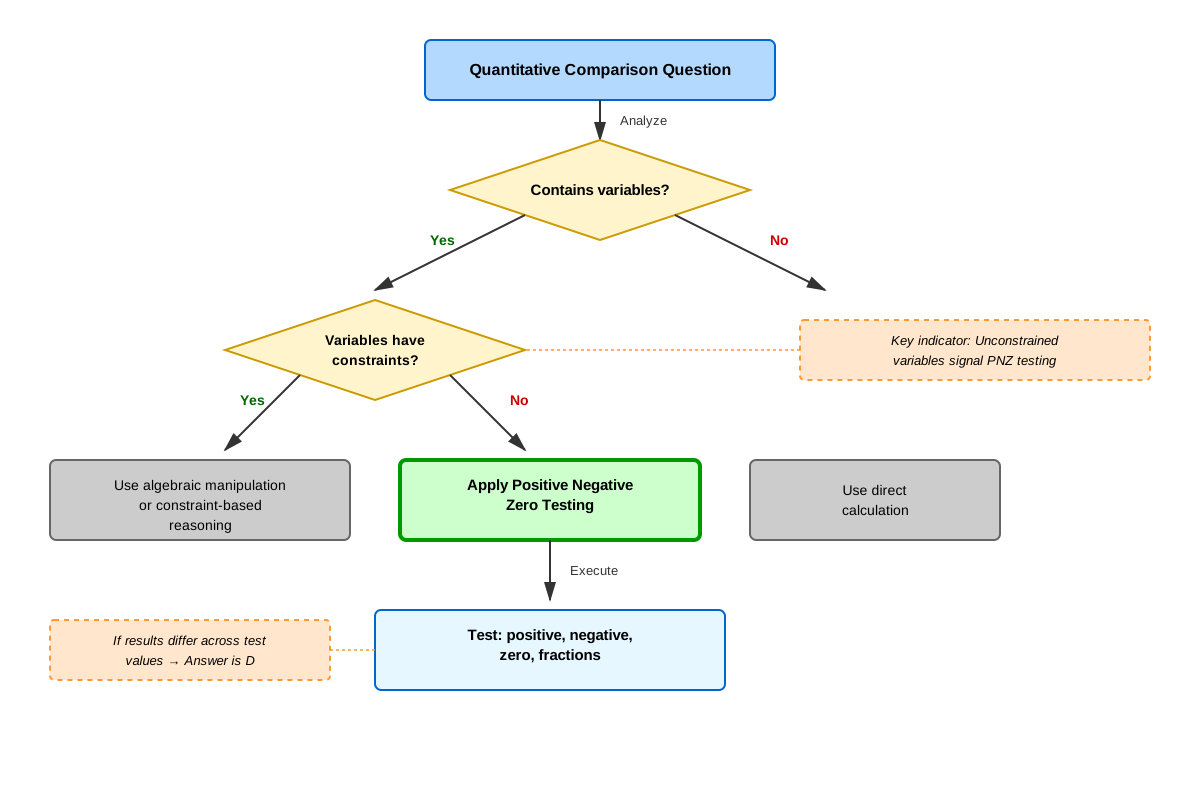
This topic is essential for the GRE because Quantitative Comparison questions constitute approximately one-third of all Quantitative Reasoning questions on the exam. Many of these questions are specifically designed to reward test-takers who can efficiently test strategic values rather than perform lengthy algebraic manipulations. The ability to recognize when GRE positive negative zero testing is the optimal approach can save precious time and prevent algebraic errors that commonly occur under test pressure. Questions involving variables without specified constraints are prime candidates for this technique.
Within the broader context of Quantitative Reasoning, positive negative zero testing connects directly to algebraic reasoning, inequality analysis, and strategic problem-solving. It represents a bridge between abstract algebraic thinking and concrete numerical reasoning, allowing test-takers to transform potentially intimidating variable expressions into manageable numerical comparisons. This technique also reinforces understanding of how mathematical operations behave differently with positive versus negative inputs—a conceptual foundation that appears throughout the GRE's mathematical content.
Learning Objectives
- [ ] Identify when positive negative zero testing is being tested
- [ ] Explain the core rule or strategy behind positive negative zero testing
- [ ] Apply positive negative zero testing to GRE-style questions accurately
- [ ] Determine which test values are most strategic for specific algebraic expressions
- [ ] Recognize when a single counterexample is sufficient to establish that the relationship cannot be determined
- [ ] Distinguish between situations requiring positive negative zero testing versus algebraic manipulation
Prerequisites
- Basic algebraic manipulation: Understanding how to substitute values into expressions and evaluate them is fundamental to applying this testing strategy effectively
- Understanding of inequality relationships: Recognizing greater than, less than, and equal relationships is necessary to interpret test results correctly
- Familiarity with GRE Quantitative Comparison format: Knowing the four answer choices (A: Quantity A is greater, B: Quantity B is greater, C: The two quantities are equal, D: The relationship cannot be determined) is essential for applying this technique strategically
- Properties of positive and negative numbers: Understanding how signs affect operations like multiplication, division, and exponentiation ensures accurate value selection and calculation
Why This Topic Matters
In real-world applications, the logical reasoning underlying positive negative zero testing extends far beyond standardized testing. Engineers test boundary conditions to ensure systems function across all possible inputs. Financial analysts evaluate investment scenarios under various market conditions—positive growth, negative returns, and stagnant periods. Scientists design experiments that test hypotheses across the full range of possible values. The habit of systematically testing edge cases and representative values is a hallmark of rigorous analytical thinking across disciplines.
On the GRE specifically, positive negative zero testing appears with high frequency. Approximately 25-35% of Quantitative Comparison questions can be efficiently solved using this technique, and many additional questions benefit from testing values as a verification strategy even when algebraic approaches are also viable. The technique appears most commonly in questions involving:
- Algebraic expressions with unspecified variables
- Comparisons involving exponents with variable bases
- Expressions with absolute values
- Fraction comparisons where numerators or denominators contain variables
- Questions involving products or quotients of multiple variables
Test-makers deliberately design questions where algebraic manipulation appears tempting but is actually more time-consuming or error-prone than strategic value testing. Recognizing these situations and confidently applying positive negative zero testing can provide a significant competitive advantage, both in accuracy and time management.
Core Concepts
The Fundamental Strategy
Positive negative zero testing is a systematic approach to evaluating the relationship between two quantities by substituting specific test values into algebraic expressions. The core principle is straightforward: if testing different values produces different relationships between Quantity A and Quantity B, then the relationship cannot be determined from the given information, and the answer must be (D). Conversely, if all valid test values produce the same relationship, that relationship is likely the correct answer.
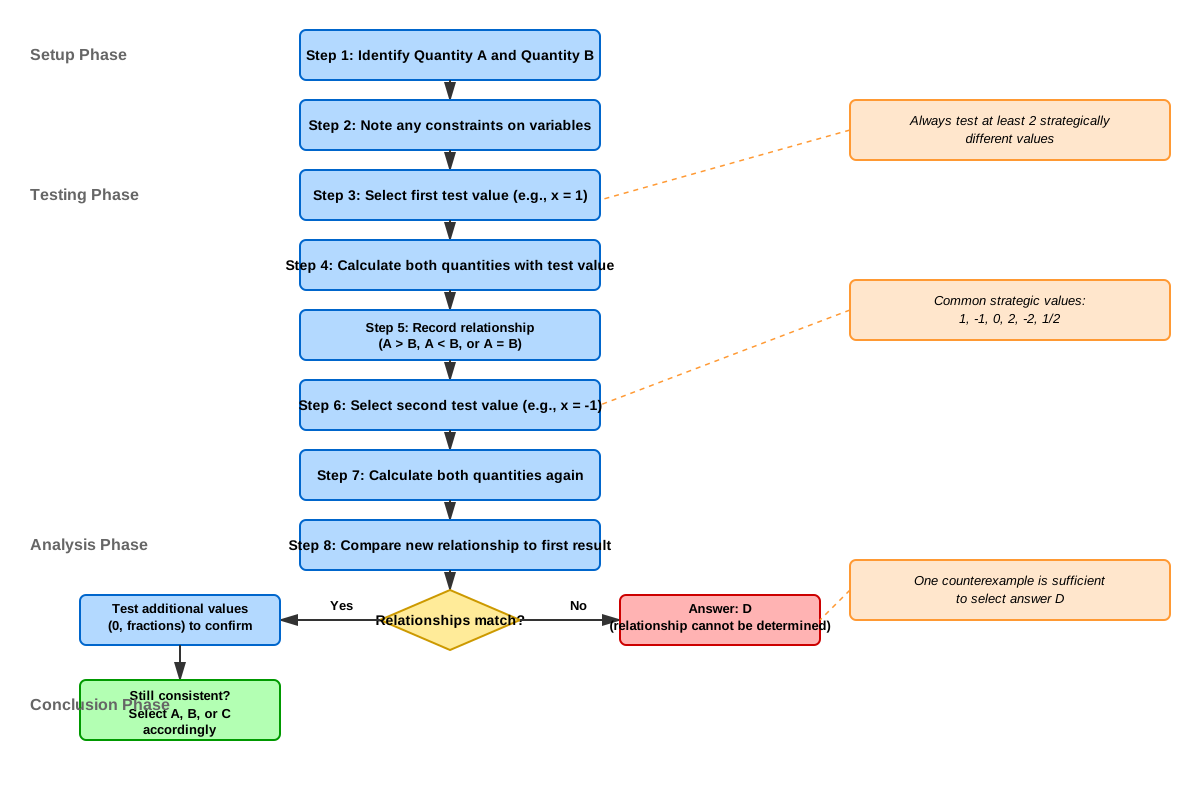
The technique derives its power from a fundamental logical principle: to prove that a relationship is always true, one would need to test all possible values (which is impossible), but to prove that a relationship is not always true, one needs only a single counterexample. This asymmetry makes the method particularly efficient for identifying (D) answers.
Selecting Strategic Test Values
The choice of which values to test is not arbitrary. The most strategic approach involves testing values that are likely to produce different behaviors in the expressions:
Standard test values include:
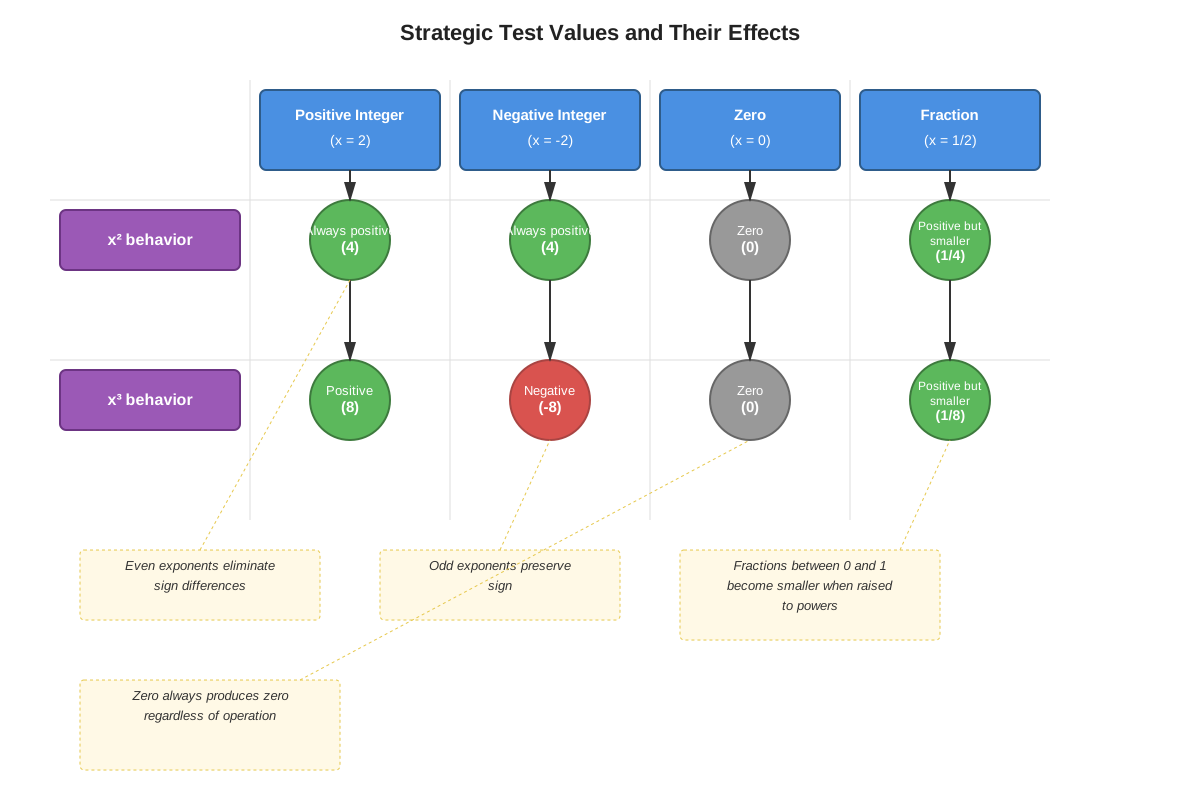
- Positive integers: Typically 1 and 2 (or sometimes a larger value like 10)
- Negative integers: Typically -1 and -2
- Zero: When permissible by the constraints
- Positive fractions: Typically 1/2 or 1/3
- Negative fractions: Typically -1/2
The rationale for these specific values:
- 1 and -1 are particularly useful because they preserve or reverse signs without changing magnitudes, and they behave uniquely in exponentiation
- 2 and -2 help reveal how expressions behave with magnitudes greater than 1
- Fractions between 0 and 1 are critical because squaring them makes them smaller (unlike integers), and they behave differently in division
- Zero often produces dramatically different results and can reveal whether expressions are undefined
The Testing Process
A systematic approach to positive negative zero testing follows these steps:
- Identify that testing is appropriate: Look for variables without sufficient constraints and expressions that would be cumbersome to manipulate algebraically
- Note any restrictions: Check whether variables must be positive, non-zero, integers, or have other constraints
- Select initial test values: Choose values that respect the constraints and are likely to produce different behaviors
- Substitute and evaluate: Calculate both Quantity A and Quantity B for each test value
- Compare results: Determine the relationship (A greater, B greater, or equal) for each test case
- Draw conclusions: If all tests produce the same relationship, that's likely the answer; if different tests produce different relationships, the answer is (D)
When Testing Reveals Answer Choice (D)
The most powerful application of positive negative zero testing is identifying when the relationship cannot be determined. This occurs when different test values produce different relationships:
| Test Value | Quantity A Result | Quantity B Result | Relationship |
|---|---|---|---|
| x = 1 | 5 | 3 | A > B |
| x = -1 | 3 | 5 | B > A |
In this scenario, the relationship changes depending on the value of x, definitively establishing that the answer is (D).
When Testing Suggests a Consistent Relationship
If multiple strategic test values all produce the same relationship, this suggests (but does not prove) that the relationship holds for all valid values. In practice, if you've tested positive, negative, zero (when allowed), and fractional values and all produce the same result, you can confidently select that answer on the GRE:
| Test Value | Quantity A Result | Quantity B Result | Relationship |
|---|---|---|---|
| x = 1 | 8 | 5 | A > B |
| x = 2 | 12 | 7 | A > B |
| x = -1 | 4 | 1 | A > B |
| x = 1/2 | 6 | 3 | A > B |
This pattern strongly indicates that Quantity A is always greater, making (A) the correct answer.
Special Considerations for Constrained Variables
When variables have explicit constraints (e.g., "x > 0" or "n is a positive integer"), the testing strategy must respect these limitations. For instance:
- If x > 0, do not test negative values or zero
- If n is an integer, do not test fractions
- If 0 < x < 1, focus on fractional values between 0 and 1
These constraints often provide crucial information about which answer is correct, as they eliminate certain behaviors that would otherwise make the relationship indeterminate.
Concept Relationships
The concepts within positive negative zero testing form a logical progression: recognizing appropriate situations → selecting strategic values → executing systematic testing → interpreting results → selecting the correct answer choice. Each step depends on the previous one, and weakness in any area can compromise the entire approach.
This topic connects directly to prerequisite knowledge of algebraic evaluation and inequality relationships. Without fluency in substituting values and calculating results, the testing process becomes slow and error-prone. The technique also builds upon understanding of number properties—particularly how operations affect positive versus negative numbers differently.
Positive negative zero testing relates closely to other Quantitative Comparison strategies, particularly algebraic manipulation and estimation. Often, these approaches complement each other: algebraic manipulation might simplify expressions before testing, or testing might verify conclusions reached algebraically. The relationship can be mapped as:
Problem Recognition → Strategy Selection → [Algebraic Simplification OR Direct Testing] → Value Testing (if needed) → Answer Selection
The technique also connects forward to more advanced problem-solving strategies involving functions, sequences, and optimization, where testing boundary values and representative cases remains a powerful analytical tool.
Quick check — test yourself on Positive negative zero testing so far.
Try Flashcards →High-Yield Facts
⭐ If different test values produce different relationships between quantities, the answer must be (D): The relationship cannot be determined
⭐ The most strategic test values are typically 1, -1, 2, -2, 0 (if allowed), and 1/2
⭐ Always check for variable constraints before selecting test values—they may eliminate certain possibilities
⭐ Testing positive and negative values is especially important for expressions involving odd exponents, which preserve sign
⭐ Fractions between 0 and 1 behave differently than integers when squared or raised to positive powers (they get smaller)
- Zero often produces dramatically different results and should be tested whenever not explicitly excluded
- When variables appear in denominators, zero is not a valid test value for those variables
- Testing 1 is particularly useful because 1 raised to any power equals 1, which can reveal special behaviors
- If an expression contains absolute values, testing both positive and negative values is essential to see how the absolute value affects the comparison
- For expressions with even exponents, negative and positive values of the same magnitude produce identical results, so testing both may be redundant
- When time is limited, prioritizing tests that are most likely to produce different relationships (positive vs. negative, integer vs. fraction) is more efficient than exhaustive testing
Common Misconceptions
Misconception: Testing one or two values is sufficient to prove a relationship holds for all values → Correction: Testing can only definitively prove that a relationship does NOT always hold (by finding a counterexample). While testing multiple strategic values that all produce the same result strongly suggests that relationship is correct, it doesn't constitute mathematical proof. On the GRE, however, testing 3-4 strategic values is practically sufficient.
Misconception: Any values can be tested randomly → Correction: Strategic value selection is crucial. Testing 2 and 3 (both positive integers) is less informative than testing 1 and -1 (which have opposite signs and different magnitudes). The goal is to test values that are likely to produce different behaviors if the relationship is not constant.
Misconception: If testing produces the same relationship twice, that must be the answer → Correction: Two tests with similar types of values (e.g., both positive integers) may not reveal the full picture. Always test across different categories: positive, negative, zero (if allowed), and fractions.
Misconception: Positive negative zero testing only works for simple linear expressions → Correction: This technique is actually most valuable for complex expressions involving exponents, products, quotients, and absolute values—precisely the situations where algebraic manipulation becomes cumbersome or error-prone.
Misconception: The answer is always (D) when variables are present without constraints → Correction: While unconstrained variables often lead to (D) answers, many expressions maintain consistent relationships regardless of variable values. For example, x² + 1 is always greater than x² regardless of what x equals.
Misconception: Testing must be done with exact arithmetic → Correction: For comparison purposes, estimation is often sufficient. If you're testing whether 3x² + 5 is greater than 2x² + 1, you don't need exact values—recognizing that one expression is clearly larger is enough.
Worked Examples
Example 1: Classic Positive Negative Zero Testing
Question:
Quantity A: x³ - x
Quantity B: 0
Solution:
This is an ideal candidate for positive negative zero testing because we have an algebraic expression with an unconstrained variable being compared to a constant.
Step 1: Identify that testing is appropriate. The variable x has no stated constraints, and the expression involves a cubic term that will behave differently for positive and negative values.
Step 2: Select test values. We'll test x = 0, x = 1, x = -1, and x = 2.
Step 3: Substitute and evaluate.
For x = 0:
- Quantity A: (0)³ - 0 = 0
- Quantity B: 0
- Relationship: A = B
For x = 1:
- Quantity A: (1)³ - 1 = 1 - 1 = 0
- Quantity B: 0
- Relationship: A = B
For x = -1:
- Quantity A: (-1)³ - (-1) = -1 + 1 = 0
- Quantity B: 0
- Relationship: A = B
For x = 2:
- Quantity A: (2)³ - 2 = 8 - 2 = 6
- Quantity B: 0
- Relationship: A > B
Step 4: Analyze results. We found different relationships: when x = 0, 1, or -1, the quantities are equal, but when x = 2, Quantity A is greater.
Step 5: Conclusion. Since different values produce different relationships, the answer is (D): The relationship cannot be determined.
Connection to learning objectives: This example demonstrates identifying when testing is appropriate (unconstrained variable), applying the systematic testing process, and recognizing that a single counterexample establishes answer (D).
Example 2: Testing with Constraints
Question:
Given: x > 1
Quantity A: x²
Quantity B: x³
Solution:
Step 1: Note the constraint. We're told x > 1, so we can only test values greater than 1. This eliminates negative values, zero, and fractions between 0 and 1.
Step 2: Select appropriate test values. We'll test x = 2 and x = 1.5 (to see if the relationship holds for non-integers as well).
Step 3: Substitute and evaluate.
For x = 2:
- Quantity A: (2)² = 4
- Quantity B: (2)³ = 8
- Relationship: B > A
For x = 1.5:
- Quantity A: (1.5)² = 2.25
- Quantity B: (1.5)³ = 3.375
- Relationship: B > A
Step 4: Consider the mathematical principle. When x > 1, multiplying by x (which is greater than 1) makes the value larger. Since x³ = x² × x, and x > 1, we have x³ > x².
Step 5: Conclusion. Both test values confirm that Quantity B is greater, and the mathematical reasoning supports this for all x > 1. The answer is (B): Quantity B is greater.
Connection to learning objectives: This example shows how to respect variable constraints when selecting test values and demonstrates that consistent results across strategic tests, combined with mathematical reasoning, indicate a definitive answer rather than (D).
Exam Strategy
When approaching GRE Quantitative Comparison questions, develop a systematic decision process for whether to use positive negative zero testing:
Trigger indicators for using this technique:
- Variables appear without sufficient constraints to determine their sign or magnitude
- Expressions involve operations that behave differently for positive vs. negative values (odd exponents, products, quotients)
- Algebraic manipulation would be complex or time-consuming
- The question seems designed to trap test-takers who assume variables are positive
Process-of-elimination strategy:
- Before testing any values, quickly assess whether the relationship might be constant or variable
- If you suspect (D), you only need to find two test values that produce different relationships—stop testing once you've found them
- If early tests suggest a consistent relationship, test at least one more value from a different category (e.g., if you tested positive integers, try a negative or fraction) to confirm
Time allocation:
- Spend 5-10 seconds deciding whether testing is the optimal approach
- Allocate 30-45 seconds for testing 2-3 values
- If testing isn't quickly revealing an answer, consider whether algebraic manipulation might be more efficient
- Don't test more than 4 values—if the pattern isn't clear by then, make an educated guess and move on
Common trigger phrases:
- "x is a number" (without further specification)
- "n is an integer" (but not specified as positive)
- No constraints given on variables
- "x ≠ 0" (which allows both positive and negative values)
Exam Tip: If you're uncertain between two answer choices after testing, test one more strategic value. If still uncertain, remember that on the GRE, answer choice (D) appears slightly less frequently than (A), (B), or (C) in Quantitative Comparison questions, though this should only be used as a last-resort tiebreaker.
Memory Techniques
Mnemonic for standard test values: "PNZF" - Positive, Negative, Zero, Fraction
Visualization strategy: Picture a number line with marked points at -2, -1, -1/2, 0, 1/2, 1, 2. When selecting test values, visualize picking points from different regions of this line to ensure comprehensive coverage.
Acronym for the testing process: "RSTC"
- Recognize the opportunity (unconstrained variables)
- Select strategic values
- Test and calculate
- Compare and conclude
Memory aid for when answer is (D): "Different tests, Different results = D"
Conceptual anchor: Think of positive negative zero testing as "stress testing" the relationship—just as engineers stress-test materials under extreme conditions, you're testing the mathematical relationship under different conditions (positive, negative, zero) to see if it holds or breaks.
Summary
Positive negative zero testing is an essential strategic technique for GRE Quantitative Comparison questions that involves systematically substituting specific test values—positive numbers, negative numbers, zero, and fractions—into algebraic expressions to determine the relationship between two quantities. The technique is most powerful when variables lack sufficient constraints and when algebraic manipulation would be cumbersome. The core logical principle is that finding even one counterexample (a test value that produces a different relationship) definitively establishes that the relationship cannot be determined, making (D) the correct answer. Conversely, when multiple strategic test values all produce the same relationship, that relationship is likely correct for all valid values. Success with this technique requires recognizing appropriate situations, selecting strategic test values that are likely to reveal different behaviors, executing calculations accurately, and correctly interpreting results. The most commonly useful test values are 1, -1, 2, -2, 0 (when permitted), and 1/2, as these values tend to produce distinct behaviors in algebraic expressions involving exponents, products, and quotients.
Key Takeaways
- Positive negative zero testing is the most efficient approach for Quantitative Comparison questions with unconstrained variables
- A single counterexample (different test values producing different relationships) definitively proves the answer is (D)
- The most strategic test values are 1, -1, 2, -2, 0 (if allowed), and 1/2, as they reveal different expression behaviors
- Always respect variable constraints when selecting test values—they often determine which answer is correct
- Testing 3-4 strategic values that all produce the same relationship provides practical certainty for the GRE, even though it doesn't constitute mathematical proof
- Fractions between 0 and 1 behave uniquely when squared or raised to powers (they decrease), making them essential test values
- Combine testing with algebraic reasoning when appropriate—the techniques complement rather than exclude each other
Related Topics
Algebraic Manipulation in Quantitative Comparisons: Understanding when to simplify expressions algebraically before or instead of testing values enhances overall strategy selection and efficiency.
Properties of Exponents and Roots: Deeper knowledge of how exponents behave with different bases (positive, negative, fractional, between 0 and 1) makes test value selection more strategic and interpretation more accurate.
Inequality Solving: Mastering algebraic inequality manipulation provides an alternative approach to some questions where positive negative zero testing applies, allowing flexible strategy selection.
Number Properties: Advanced understanding of integer properties, divisibility, and prime numbers extends the testing technique to more complex Quantitative Comparison scenarios.
Mastering positive negative zero testing creates a foundation for advanced problem-solving across all GRE Quantitative Reasoning question types, as the habit of testing boundary cases and representative values applies broadly to mathematical reasoning.
Practice CTA
Now that you've mastered the strategy and logic behind positive negative zero testing, it's time to cement your understanding through practice. Attempt the practice questions associated with this topic, focusing on recognizing when testing is the optimal approach and executing the technique efficiently. Use the flashcards to reinforce the key test values and decision criteria until they become automatic. Remember: this technique appears in approximately one-quarter of Quantitative Comparison questions, making it one of the highest-yield strategies you can master for test day. Your investment in practicing this approach will pay dividends in both accuracy and time management!
Sign up free to keep reading
Create a free AnvayaPrep account to finish this GRE guide on Positive negative zero testing — plus flashcards and practice questions.