Overview
Symmetry in comparisons is a powerful strategic concept unique to the Quantitative Comparison question format on the GRE. This technique leverages the inherent mathematical properties of symmetric expressions to quickly eliminate answer choices and identify correct responses without performing extensive calculations. When two quantities being compared have identical structures but with variables or terms reversed, swapped, or negated in a balanced way, the relationship between them can often be determined through logical reasoning rather than computation.
Understanding GRE symmetry in comparisons is essential because it represents one of the most efficient time-saving strategies available for Quantitative Comparison questions. These questions constitute approximately one-third of the Quantitative Reasoning section, and recognizing symmetric patterns can reduce solution time from 90+ seconds to under 30 seconds. The GRE test designers frequently construct questions that reward students who can identify symmetric relationships, making this a high-yield topic that directly impacts scoring efficiency.
This topic sits at the intersection of algebraic reasoning, number properties, and strategic test-taking. It builds upon fundamental concepts of equality, inequality, and variable manipulation while introducing a meta-cognitive layer of pattern recognition. Mastering symmetry in comparisons enhances overall quantitative reasoning by training students to look for structural relationships before diving into calculations—a skill that transfers to Problem Solving questions, Data Interpretation sets, and real-world analytical thinking.
Learning Objectives
- [ ] Identify when Symmetry in comparisons is being tested in GRE Quantitative Comparison questions
- [ ] Explain the core rule or strategy behind Symmetry in comparisons and why it works mathematically
- [ ] Apply Symmetry in comparisons to GRE-style questions accurately and efficiently
- [ ] Distinguish between true symmetric relationships and superficially similar expressions that are not symmetric
- [ ] Recognize the three main types of symmetry (additive, multiplicative, and exponential) in comparison contexts
- [ ] Combine symmetry recognition with other comparison strategies to solve complex problems
- [ ] Evaluate when symmetry analysis is more efficient than direct calculation
Prerequisites
- Basic algebraic manipulation: Essential for recognizing when expressions can be transformed to reveal symmetric structures
- Understanding of inequalities: Required to determine how symmetric operations affect the relationship between quantities
- Quantitative Comparison format familiarity: Necessary to understand the four answer choices (A, B, C, D) and when each applies
- Properties of operations: Knowledge of commutative, associative, and distributive properties helps identify symmetric patterns
- Number line concepts: Useful for visualizing symmetric relationships around zero or other reference points
Why This Topic Matters
Symmetry in comparisons appears in approximately 15-20% of all Quantitative Comparison questions on the GRE, making it one of the most frequently tested strategic concepts. Questions testing this skill often appear in the medium-to-hard difficulty range, meaning they significantly impact adaptive scoring. Students who master this technique gain a substantial competitive advantage, as they can solve these questions in a fraction of the time required by those using brute-force calculation methods.
In real-world applications, symmetric reasoning underlies optimization problems, economic equilibrium analysis, and engineering design principles. The ability to recognize when two scenarios are structurally equivalent—even when superficially different—is fundamental to scientific thinking, financial modeling, and logical argumentation. This cognitive skill extends far beyond test preparation.
On the GRE, symmetry in comparisons most commonly appears in questions involving: algebraic expressions with swapped variables; geometric figures with reflected or rotated elements; arithmetic sequences with reversed ordering; and probability scenarios with complementary events. The test designers favor these questions because they efficiently distinguish between students who think strategically and those who rely solely on computation. Recognizing the symmetry pattern immediately reveals that the answer must be either C (the quantities are equal) or D (the relationship cannot be determined), eliminating half the answer choices instantly.
Core Concepts
The Fundamental Principle of Symmetry
Symmetry in comparisons refers to situations where Quantity A and Quantity B have identical mathematical structures with elements that are interchangeable or balanced. When true symmetry exists, the two quantities must be equal (Answer C) unless additional constraints break the symmetry. The core insight is that if you can swap, reverse, or transform elements between the two quantities without changing their fundamental relationship, they are symmetric.
The mathematical foundation rests on the principle that operations applied identically to symmetric elements yield symmetric results. For example, if variables x and y appear in symmetric positions in two expressions, and no additional information distinguishes x from y, then the expressions must have equal values. This principle extends to more complex scenarios involving functions, exponents, and geometric relationships.
Types of Symmetry in GRE Questions
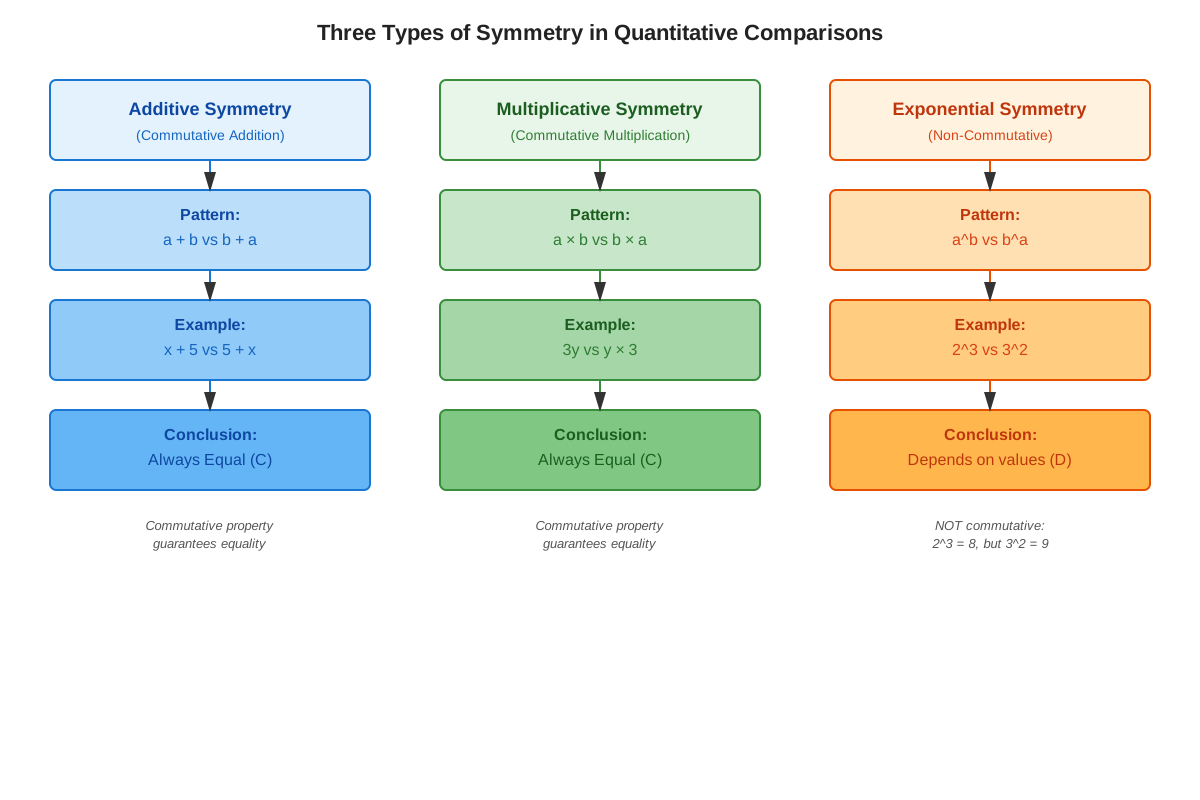
Additive Symmetry occurs when two quantities differ only by the order of addition or subtraction. Consider Quantity A: (x + y) and Quantity B: (y + x). By the commutative property of addition, these are always equal. More subtle examples include Quantity A: (a - b + c) and Quantity B: (c - b + a), which are also equal because addition is commutative and subtraction can be rewritten as adding a negative.
Multiplicative Symmetry involves products where factors appear in different orders. Quantity A: (xy)(z) and Quantity B: (xz)(y) are symmetric because multiplication is commutative. This extends to division when carefully analyzed: Quantity A: x/y and Quantity B: y/x are NOT symmetric in value (they're reciprocals), but they ARE symmetric in structure, which tells us the relationship depends on the values of x and y.
Exponential and Power Symmetry appears when bases and exponents are swapped. Quantity A: x^y and Quantity B: y^x represent symmetric structures. Without additional constraints, we cannot determine which is larger—the answer is D. For example, 2^3 = 8 while 3^2 = 9, but 4^2 = 16 while 2^4 = 16. This structural symmetry signals that the relationship varies depending on specific values.
Recognizing Symmetric Patterns
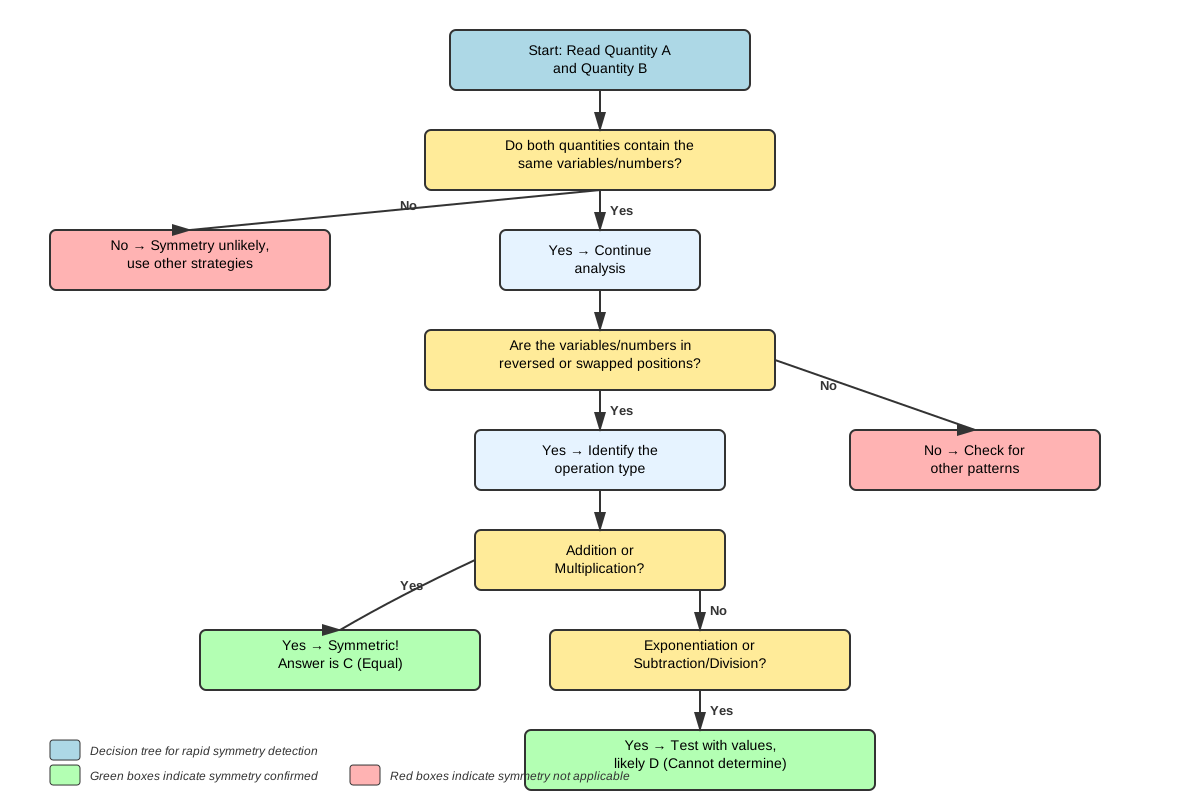
The key to identifying symmetry is looking for structural equivalence rather than superficial similarity. Ask three diagnostic questions:
- Can the variables or terms be swapped to transform Quantity A into Quantity B? If yes, and no constraints distinguish the variables, the quantities are equal.
- Do both quantities have the same operations applied in the same sequence? Operations must match exactly for true symmetry.
- Are there any asymmetric constraints in the given information? A statement like "x > y" breaks symmetry between x and y, even if they appear in symmetric positions.
The Symmetry Decision Tree
When symmetry is detected, follow this logical sequence:
| Observation | Conclusion | Answer |
|---|---|---|
| Perfect symmetry + no distinguishing constraints | Quantities must be equal | C |
| Perfect symmetry + constraint breaks symmetry | Relationship depends on constraint | A, B, or D |
| Structural symmetry but non-commutative operation | Relationship varies with values | D |
| Apparent symmetry but hidden asymmetry | Requires careful analysis | Any answer |
Breaking Symmetry: Critical Constraints
Symmetry can be broken by several types of constraints:
- Inequality constraints: "x > y" distinguishes x from y, breaking their symmetry
- Domain restrictions: "x is positive, y is negative" creates asymmetry
- Functional constraints: "x is even, y is odd" differentiates the variables
- Positional constraints: In geometry, "point A is above point B" breaks vertical symmetry
When a constraint breaks symmetry, the problem transforms from a symmetry question into a standard comparison requiring analysis of the specific constraint's effect.
Pseudo-Symmetry: Common Traps
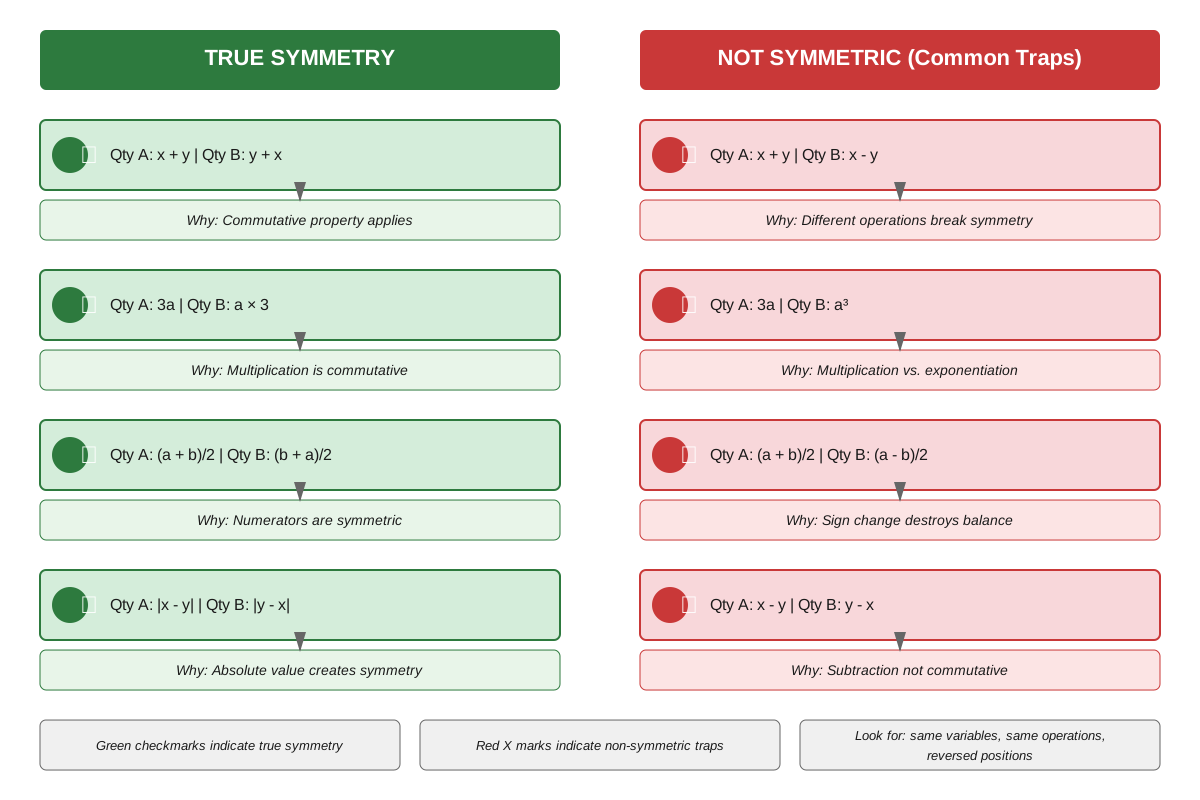
Pseudo-symmetry occurs when expressions appear symmetric but contain subtle asymmetries. For example, Quantity A: x² + y and Quantity B: y² + x look symmetric, but the squaring operation applies to different variables. This is NOT true symmetry because swapping x and y doesn't preserve the structure—you'd need to swap both the squared and unsquared terms simultaneously.
Another trap involves symmetric expressions with asymmetric domains. Quantity A: √x + √y and Quantity B: √y + √x are symmetric in structure, but if given "x > 0 and y < 0," the domain constraint makes Quantity A defined while Quantity B is undefined (assuming real numbers), breaking the symmetry.
Concept Relationships
The concept of symmetry in comparisons builds directly on the commutative and associative properties of arithmetic operations. These algebraic foundations enable the recognition that certain rearrangements preserve value. The connection flows: basic operation properties → structural equivalence → symmetry recognition → strategic answer elimination.
Symmetry analysis connects to inequality reasoning because breaking symmetry often involves determining which of two symmetric expressions becomes larger when a constraint is applied. For instance, if x > y, then in Quantity A: x + 5 versus Quantity B: y + 5, the symmetry is broken by the inequality, leading to A > B.
The relationship map: Variable properties → Symmetric structure recognition → Constraint analysis → Symmetry preservation or breaking → Answer determination. Each step depends on the previous one, and skipping constraint analysis is the most common error pathway.
This topic also relates to substitution strategies in Quantitative Comparison. When symmetry suggests D (relationship cannot be determined), testing specific values that respect the symmetry can confirm this conclusion. Conversely, if substitution yields different relationships for different values, it confirms the symmetric structure's prediction.
High-Yield Facts
- ⭐ When two quantities have identical structures with only variable positions swapped, and no constraints distinguish the variables, the answer is always C (equal)
- ⭐ Structural symmetry with non-commutative operations (like subtraction or division) typically yields answer D (cannot be determined)
- ⭐ A single inequality constraint (like x > y) breaks symmetry between x and y, requiring analysis of how the constraint affects each quantity
- ⭐ If you can swap all instances of variable x with variable y in both quantities and get the opposite comparison, the answer must be C or D
- ⭐ Exponential symmetry (x^y vs. y^x) almost always yields answer D unless specific values are given
- The commutative property applies to addition and multiplication but NOT to subtraction and division
- Symmetric expressions with even exponents (like x² and y²) remain symmetric even when variables can be negative
- Geometric symmetry (reflection, rotation) in comparison questions often signals equal areas, perimeters, or angles
- When both quantities equal zero under symmetric conditions, this confirms answer C
- Symmetry can exist in complex expressions involving multiple operations if each operation is applied symmetrically
- Testing x = y in symmetric expressions should yield equal quantities; if not, the symmetry is broken or pseudo-symmetric
- Absolute value operations preserve symmetry: |x - y| equals |y - x|
Quick check — test yourself on Symmetry in comparisons so far.
Try Flashcards →Common Misconceptions
Misconception: If two expressions look similar, they must be symmetric.
Correction: True symmetry requires that swapping variables or terms produces an equivalent expression. Similarity in appearance doesn't guarantee structural equivalence. For example, x² + y and x + y² are similar-looking but not symmetric because the squaring applies to different variables.
Misconception: Symmetric expressions always mean the quantities are equal (Answer C).
Correction: Symmetry in structure can lead to either Answer C (when no constraints break the symmetry) or Answer D (when the symmetric structure means the relationship varies with different values). For instance, x/y and y/x are structurally symmetric but not equal in value unless x = y.
Misconception: If variables appear the same number of times in each quantity, the expressions are symmetric.
Correction: Frequency of appearance doesn't determine symmetry; the structural role of each variable matters. Quantity A: x²y and Quantity B: xy² both contain x once and y once, but they're only equal when x = y, not in general.
Misconception: Breaking symmetry always makes one quantity definitively larger.
Correction: Some symmetry-breaking constraints still leave the relationship indeterminate. For example, knowing "x ≠ y" breaks symmetry but doesn't tell us which is larger, so the answer could still be D.
Misconception: Symmetry only applies to algebraic expressions, not geometric or data-based questions.
Correction: Symmetry appears across all quantitative question types. Geometric figures can have symmetric properties (equal sides, angles), and data sets can have symmetric distributions. The principle applies universally.
Misconception: If testing one pair of values shows equality, the quantities are always equal.
Correction: Testing values can disprove equality (by finding a counterexample) but cannot prove it for all cases. Symmetric structure provides the logical proof needed for Answer C; testing merely confirms or explores the relationship.
Worked Examples
Example 1: Pure Algebraic Symmetry
Question:
- Quantity A: (x + y)(x - y)
- Quantity B: (y + x)(y - x)
- Given: x and y are real numbers
Solution:
Step 1: Identify the structure. Both quantities are products of a sum and a difference.
Step 2: Apply commutative property to Quantity B's first factor: (y + x) = (x + y)
Step 3: Analyze the second factors: (x - y) and (y - x). These are negatives of each other: (y - x) = -(x - y)
Step 4: Rewrite Quantity B: (x + y)[-(x - y)] = -(x + y)(x - y)
Step 5: Compare: Quantity A is (x + y)(x - y), while Quantity B is the negative of this expression.
Step 6: These are equal only when both equal zero (when x = y or x = -y). Otherwise, they're negatives of each other.
Step 7: Since no constraint forces them to be zero, and they're negatives of each other, the relationship depends on whether the expression is positive, negative, or zero.
Answer: D (The relationship cannot be determined from the information given)
Key Insight: This demonstrates pseudo-symmetry. The expressions appear symmetric but contain a hidden sign difference that makes them negatives rather than equals. This connects to Learning Objective 4 (distinguishing true from superficial symmetry).
Example 2: Symmetry with Constraint
Question:
- Quantity A: a³ + b³
- Quantity B: b³ + a³
- Given: a > b > 0
Solution:
Step 1: Recognize structural symmetry. Both quantities are sums of cubes with variables in swapped positions.
Step 2: Apply commutative property of addition: a³ + b³ = b³ + a³
Step 3: The quantities are algebraically identical regardless of the constraint.
Step 4: The constraint a > b > 0 does NOT break the symmetry because both quantities have exactly the same terms, just written in different order.
Step 5: Since addition is commutative, the order doesn't matter.
Answer: C (The quantities are equal)
Key Insight: This illustrates that not all constraints break symmetry. Only constraints that create functional differences between how variables appear in each quantity break symmetry. The inequality a > b distinguishes the variables but doesn't affect the commutative sum. This addresses Learning Objective 2 (explaining why symmetry works).
Example 3: Exponential Symmetry
Question:
- Quantity A: 2^n + 3^m
- Quantity B: 3^n + 2^m
- Given: m and n are positive integers
Solution:
Step 1: Identify the symmetric structure. The bases 2 and 3 are swapped between the two terms in each quantity.
Step 2: Test specific values to explore the relationship:
- If m = 1, n = 1: Quantity A = 2¹ + 3¹ = 5; Quantity B = 3¹ + 2¹ = 5 (Equal)
- If m = 2, n = 1: Quantity A = 2¹ + 3² = 2 + 9 = 11; Quantity B = 3¹ + 2² = 3 + 4 = 7 (A > B)
- If m = 1, n = 2: Quantity A = 2² + 3¹ = 4 + 3 = 7; Quantity B = 3² + 2¹ = 9 + 2 = 11 (B > A)
Step 3: The relationship changes depending on the values of m and n.
Step 4: The symmetric structure with non-equal bases and swapped exponents creates a situation where the relationship varies.
Answer: D (The relationship cannot be determined from the information given)
Key Insight: Exponential expressions with swapped bases and exponents exhibit structural symmetry that typically leads to Answer D. The symmetry tells us the relationship will vary rather than remain constant. This demonstrates Learning Objective 3 (applying symmetry to solve questions accurately).
Exam Strategy
When approaching Quantitative Comparison questions, implement this symmetry-first protocol: Before performing any calculations, spend 5-10 seconds scanning both quantities for symmetric patterns. Look for variables appearing in swapped positions, reversed operations, or mirrored structures. If symmetry is detected, immediately narrow your answer choices to C or D, eliminating A and B from consideration.
Trigger words and phrases that signal potential symmetry questions include:
- "x and y are real numbers" (with no distinguishing constraints)
- Expressions with clearly swapped variable positions
- Geometric descriptions mentioning "reflection," "rotation," or "congruent"
- Questions where both quantities have identical operation sequences
- Scenarios where two entities are described identically except for labels
Process of elimination strategy: If you identify perfect symmetry with no asymmetric constraints, confidently select C without calculation. If you identify structural symmetry but recognize that the relationship could vary (like with division or exponents), select D. This eliminates the need to test multiple values or perform complex algebra.
Time allocation: Symmetry questions should be among your fastest solves—target 30-45 seconds. If you find yourself calculating for more than one minute, pause and reassess whether you've missed a symmetric pattern. The GRE rewards pattern recognition over computation in these questions.
Exam Tip: When in doubt between C and D on a symmetric question, test the special case where all variables are equal (like x = y = 1). If the quantities are equal in this case AND you've confirmed structural symmetry, lean toward C. If they're equal but you're unsure about symmetry, test one more case where variables differ to confirm.
Red flag situations: Be extra cautious when you see:
- Symmetric-looking expressions with exponents or roots (often D)
- Subtraction or division in symmetric positions (check carefully)
- One additional constraint that might break obvious symmetry
- Absolute values that might hide sign differences
Memory Techniques
SWAP Mnemonic for identifying symmetry:
- Structure: Do both quantities have the same mathematical structure?
- Wap: Can you swap variables/terms to transform A into B?
- Asymmetric constraints: Are there any constraints that distinguish the variables?
- Property check: Are all operations commutative/associative?
The Mirror Test: Visualize Quantity A and Quantity B as mirror images. If you can "flip" one to get the other without changing mathematical meaning, they're symmetric. If the flip requires changing operations (like + to - or × to ÷), they're not truly symmetric.
C or D Decision Rule: "Symmetric structure + No breaking constraints = C; Symmetric structure + Varying relationship = D"
Acronym CAD for answer patterns:
- Commutative operations with swapped terms → Answer C
- Asymmetric constraints present → Answer A or B (analyze the constraint)
- Division/exponents with symmetry → Usually Answer D
Visualization Strategy: For geometric symmetry, mentally draw a line of symmetry. If both quantities describe measurements equidistant from this line, they're equal. For algebraic symmetry, imagine the variables as interchangeable tokens—if swapping tokens doesn't change the game, the quantities are equal.
Summary
Symmetry in comparisons is a high-leverage strategic concept that enables rapid solution of approximately 15-20% of GRE Quantitative Comparison questions. The core principle states that when two quantities have identical mathematical structures with interchangeable elements and no constraints distinguish those elements, the quantities must be equal (Answer C). When structural symmetry exists but involves non-commutative operations or the relationship varies with different values, the answer is D. Recognizing symmetry requires analyzing whether variables or terms can be swapped between quantities while preserving mathematical meaning, checking whether all operations are commutative or associative, and identifying any asymmetric constraints that break the symmetry. The most common symmetric patterns involve addition and multiplication with swapped terms (leading to C), and exponential or division expressions with swapped elements (leading to D). Mastering this concept requires distinguishing true symmetry from pseudo-symmetry, where superficial similarity masks underlying structural differences. The strategic value lies in eliminating answer choices instantly and avoiding time-consuming calculations, making symmetry recognition one of the most efficient test-taking skills for the Quantitative Reasoning section.
Key Takeaways
- Symmetry in comparisons allows instant elimination of answers A and B, narrowing choices to C or D based on structural analysis
- Perfect symmetry with commutative operations and no distinguishing constraints always yields Answer C (quantities are equal)
- Structural symmetry with non-commutative operations (division, subtraction, exponentiation) typically yields Answer D (relationship cannot be determined)
- Always check for asymmetric constraints (inequalities, domain restrictions) that break otherwise symmetric structures
- The symmetry-first approach (scan for patterns before calculating) saves significant time and improves accuracy
- Pseudo-symmetry—expressions that look symmetric but contain hidden asymmetries—is a common trap requiring careful analysis
- Testing the special case where all variables are equal can confirm symmetric relationships and validate Answer C
Related Topics
Quantitative Comparison Strategies: Mastering symmetry in comparisons provides a foundation for other QC techniques like picking numbers, simplification, and estimation. These strategies work synergistically—symmetry tells you when NOT to pick numbers (when Answer C is guaranteed), while picking numbers confirms when symmetry leads to Answer D.
Properties of Operations: Deeper study of commutative, associative, and distributive properties enhances symmetry recognition. Understanding which operations preserve equality under rearrangement is fundamental to identifying symmetric structures quickly.
Inequality Manipulation: Since asymmetric constraints often involve inequalities, strengthening skills in inequality reasoning helps determine how constraints break symmetry and affect quantity relationships.
Function Symmetry: Advanced topics include recognizing even and odd functions, which exhibit symmetry about the y-axis or origin. This extends the symmetry concept to functional relationships tested in higher-difficulty GRE questions.
Geometric Transformations: Understanding reflection, rotation, and translation symmetry in geometric figures builds spatial reasoning that applies to geometry-based Quantitative Comparison questions.
Practice CTA
Now that you've mastered the strategic concept of symmetry in comparisons, it's time to reinforce your learning through active practice. Attempt the practice questions designed specifically for this topic, focusing on identifying symmetric patterns within the first 10 seconds of reading each question. Use the flashcards to drill the key decision rules and trigger patterns until symmetry recognition becomes automatic. Remember: the goal isn't just to get questions right, but to solve them efficiently using pattern recognition rather than brute-force calculation. Each practice question you solve using symmetry principles strengthens your strategic thinking and builds the confidence needed to tackle these high-yield questions on test day. Your investment in mastering this concept will pay dividends across multiple questions on the actual GRE!
Sign up free to keep reading
Create a free AnvayaPrep account to finish this GRE guide on Symmetry in comparisons — plus flashcards and practice questions.