Overview
Recognizing insufficiency is a critical skill tested extensively in the GRE Quantitative Reasoning section, particularly within Quantitative Comparison questions. This concept requires test-takers to determine when the information provided in a problem is inadequate to establish a definitive relationship between two quantities. Unlike traditional problem-solving where every question has a calculable answer, recognizing insufficiency demands that students resist the urge to force a conclusion and instead acknowledge when multiple outcomes remain possible given the constraints.
The ability to identify insufficient information separates high-scoring test-takers from average performers. Many students struggle with this skill because it runs counter to their mathematical training—they've been conditioned to always find "the answer." However, on the GRE, approximately 20-30% of Quantitative Comparison questions are designed specifically to test whether students can recognize when they lack enough information to make a determination. Mastering GRE recognizing insufficiency prevents costly errors where students commit to an incorrect relationship based on assumptions rather than facts.
This topic sits at the intersection of logical reasoning and quantitative analysis within the broader Quantitative Reasoning framework. It connects directly to variable manipulation, inequality analysis, and case-based reasoning. Students who excel at recognizing insufficiency demonstrate sophisticated mathematical maturity—they understand that mathematics is not just about computation but about logical certainty. This skill also reinforces critical thinking applicable to Data Interpretation and Problem Solving questions, where identifying what can and cannot be determined from given information is equally valuable.
Learning Objectives
- [ ] Identify when recognizing insufficiency is being tested in GRE Quantitative Comparison questions
- [ ] Explain the core rule or strategy behind recognizing insufficiency
- [ ] Apply recognizing insufficiency to GRE-style questions accurately
- [ ] Distinguish between problems with insufficient information and those requiring multi-step analysis
- [ ] Generate counterexamples to test whether a relationship holds universally
- [ ] Recognize common trap patterns that exploit assumptions about insufficiency
- [ ] Evaluate whether additional constraints would resolve an insufficient comparison
Prerequisites
- Basic algebra and variable manipulation: Essential for testing different values and understanding how variables affect relationships
- Understanding of inequalities: Necessary to recognize when ranges of values produce different comparison outcomes
- Familiarity with Quantitative Comparison format: Students must know the four answer choices (A: Quantity A greater, B: Quantity B greater, C: Equal, D: Cannot be determined)
- Number properties (positive, negative, zero, fractions): Critical for generating diverse test cases that reveal insufficiency
- Exponent and radical rules: Many insufficiency problems involve expressions where sign and magnitude depend on these properties
Why This Topic Matters
Recognizing insufficiency represents a fundamental shift in mathematical thinking that the GRE explicitly tests. In academic and professional contexts, knowing the limits of available information is as important as solving problems with complete data. Scientists must acknowledge when experiments provide inconclusive results; business analysts must identify when additional data is needed before making recommendations. The GRE uses this skill to assess analytical maturity beyond mere computational ability.
From an exam perspective, insufficiency questions appear in approximately 25-35% of Quantitative Comparison sections, making them high-frequency items. These questions often appear in the medium-to-hard difficulty range and serve as discriminators between score bands. Test-takers who consistently miss insufficiency questions typically score below the 160 threshold, while those who master this skill regularly achieve scores of 165 or higher. The Educational Testing Service (ETS) deliberately includes these questions because they effectively measure mathematical reasoning rather than memorized procedures.
Common manifestations include: comparisons involving variables with unspecified signs or ranges; expressions where the relationship changes based on whether values are greater than or less than critical thresholds (like 1 or 0); geometric figures without specified measurements; and statistical scenarios with incomplete data sets. The GRE frequently embeds insufficiency within seemingly straightforward problems, testing whether students will make unwarranted assumptions about "typical" values or constraints not explicitly stated.
Core Concepts
The Fundamental Principle of Insufficiency
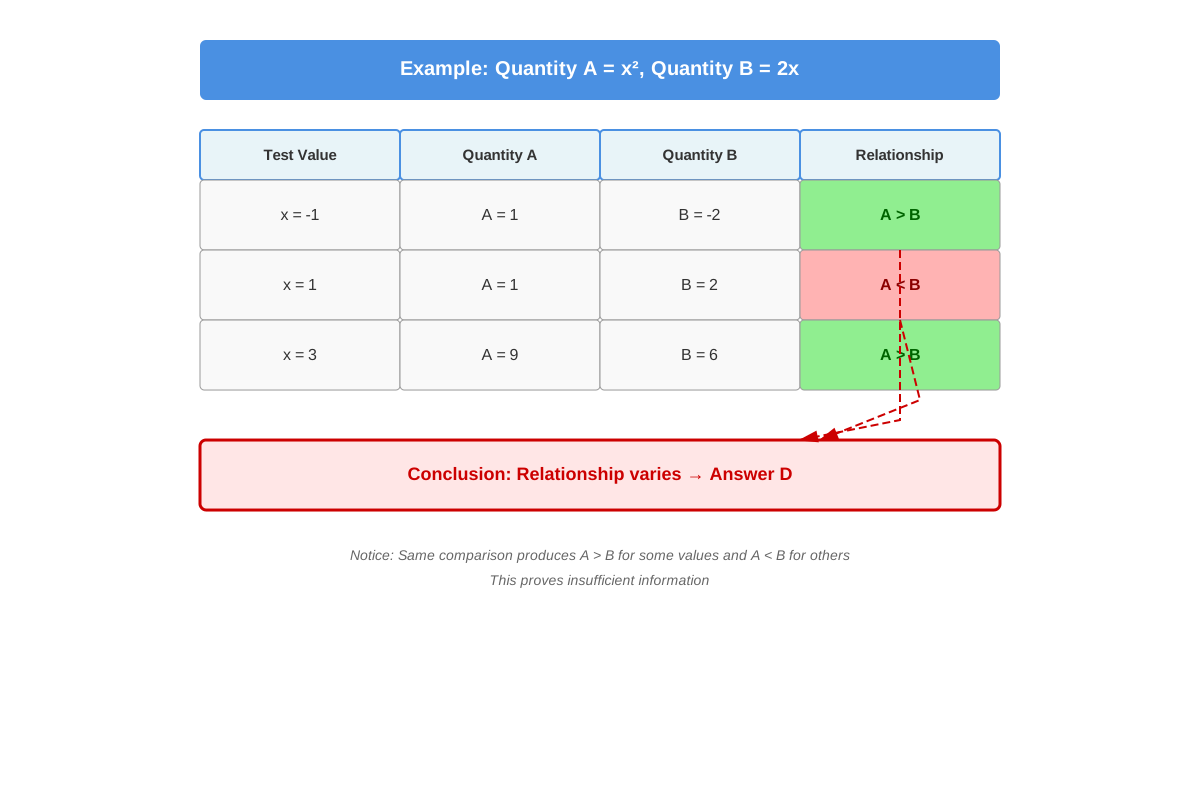
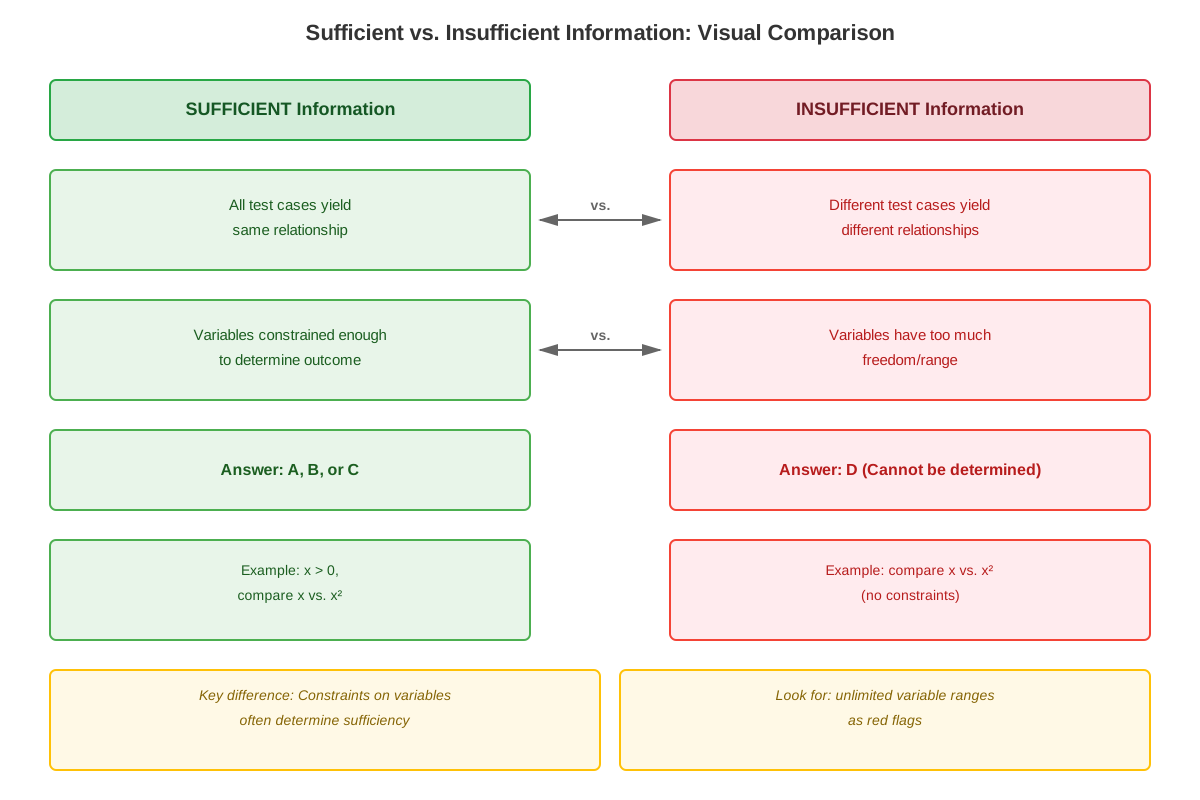
Recognizing insufficiency means identifying when the given information allows for multiple possible relationships between two quantities. The key principle is this: if you can find even one legitimate example where Quantity A is greater and another legitimate example where Quantity B is greater (or they're equal), then the answer must be "Cannot be determined from the information given" (Choice D in Quantitative Comparison format).
This principle requires rigorous logical thinking. A relationship is only determinable if it holds for all possible values that satisfy the given constraints. A single counterexample invalidates a universal claim. This mirrors mathematical proof by contradiction—to show that a relationship cannot be determined, you need to demonstrate that different scenarios yield different outcomes.
The Testing Strategy: Strategic Value Substitution
The most powerful technique for recognizing insufficiency involves strategic value substitution—systematically testing values that are likely to produce different outcomes. Rather than randomly selecting numbers, effective test-takers choose values from critical categories:
- Positive vs. negative values: Many expressions behave differently based on sign
- Values greater than 1 vs. between 0 and 1: Crucial for exponents and reciprocals
- Zero: Often a special case that changes relationships
- Extreme values: Very large or very small numbers can reveal patterns
- Integer vs. non-integer values: Some relationships depend on this distinction
For example, if comparing x² with x where x is unspecified, testing x = 2 gives 4 > 2 (Quantity A greater), but testing x = 0.5 gives 0.25 < 0.5 (Quantity B greater). This demonstrates insufficiency.
Constraint Analysis
Before testing values, analyze what constraints are explicitly stated versus what is merely implied or assumed. The GRE exploits common assumptions:
| Explicit Statement | What It Means | What It Does NOT Mean |
|---|---|---|
| "x is a number" | x can be any real number | x is NOT necessarily positive or an integer |
| "n is an integer" | n is a whole number (positive, negative, or zero) | n is NOT necessarily positive |
| "Triangle ABC" | A three-sided polygon | Sides are NOT necessarily equal; angles are NOT specified |
| "x > y" | x is greater than y | Neither x nor y has a determined sign |
Many insufficiency problems are designed around the gap between what students assume and what is actually stated. A figure that "looks" like a square might only be stated as a quadrilateral. A variable that "seems" positive might have no sign restriction.
The Relationship Dependency Test
Some comparisons depend on a critical threshold value. When an expression's behavior changes at a specific point, insufficiency often exists. Common thresholds include:
- x = 1: Separates where x² > x (when x > 1) from where x² < x (when 0 < x < 1)
- x = 0: Separates positive from negative behavior
- x = -1: Critical for odd vs. even powers of negative numbers
When you identify that a comparison's outcome depends on which side of a threshold the variable falls, and the problem doesn't specify this, you've found insufficiency.
Geometric Insufficiency Patterns
Geometric problems frequently test insufficiency through:
- Figures not drawn to scale: The GRE explicitly states this to prevent visual assumptions
- Missing measurements: A triangle with one angle given doesn't determine all side lengths
- Ambiguous configurations: A quadrilateral with certain properties might have multiple valid shapes
- Dependent vs. independent variables: Knowing the perimeter doesn't always determine the area
For geometric insufficiency, ask: "Could this figure be configured differently while still satisfying all stated conditions?" If yes, check whether different configurations yield different comparison outcomes.
The Sufficiency Checklist
To systematically evaluate whether information is sufficient:
- List all given constraints explicitly
- Identify the domain of each variable (what values are possible)
- Test boundary values (smallest, largest, zero, one)
- Test values on both sides of critical thresholds
- Check for special cases (zero, negative, fractions)
- Verify that your test values satisfy all constraints
If any two valid test cases produce different comparison outcomes, the information is insufficient.
Concept Relationships
The core concepts within recognizing insufficiency form a logical progression: Fundamental Principle (understanding what insufficiency means) → Constraint Analysis (determining what values are possible) → Strategic Value Substitution (testing whether different valid values produce different outcomes) → Relationship Dependency Test (identifying critical thresholds) → Sufficiency Checklist (systematic verification).
This topic connects to prerequisite knowledge of variable manipulation because testing values requires algebraic substitution and simplification. It builds on inequality understanding since many insufficiency problems involve determining whether expressions maintain consistent inequality relationships across value ranges. The skill also reinforces number properties as students must recall how different number types (positive, negative, fractions, integers) behave in various operations.
Recognizing insufficiency relates forward to Data Interpretation questions where students must identify what conclusions data supports versus what it doesn't. It also enhances Problem Solving by training students to verify that their solution approach accounts for all possible cases rather than just the first scenario they consider. The logical rigor developed here transfers to Reading Comprehension in the Verbal section, where distinguishing between what a passage states and what it implies is equally critical.
High-Yield Facts
⭐ If you can find two different valid values that produce different comparison outcomes, the answer is always "Cannot be determined"
⭐ Variables without explicit constraints can be positive, negative, or zero unless stated otherwise
⭐ The expression x² > x when x > 1 or x < 0, but x² < x when 0 < x < 1, making this a common insufficiency pattern
⭐ Geometric figures are not drawn to scale on the GRE; never assume measurements from visual appearance
⭐ "Integer" does not mean "positive integer"—negative integers and zero are included unless explicitly excluded
- When comparing expressions with variables, always test at least three values: a positive number greater than 1, a positive fraction between 0 and 1, and a negative number
- The phrase "x is a number" on the GRE means x can be any real number, including irrational numbers, unless further constrained
- Absolute value expressions often create insufficiency because |x| eliminates sign information
- If a problem gives you one equation with two variables, you typically cannot determine unique values (insufficient information)
- Percentages and ratios without absolute values often lead to insufficiency (knowing x is 50% more than y doesn't tell you actual magnitudes)
- Even powers (x², x⁴) are always non-negative, but odd powers (x³, x⁵) preserve the sign of the base
- The reciprocal relationship flips for fractions: if 0 < x < 1, then 1/x > x
- In probability and statistics, knowing one parameter (like mean) without others (like standard deviation or sample size) often creates insufficiency
- Geometric similarity provides proportional relationships but not absolute measurements
Quick check — test yourself on Recognizing insufficiency so far.
Try Flashcards →Common Misconceptions
Misconception: If a variable appears in both quantities, you can cancel it out to simplify the comparison.
Correction: You can only divide both sides by a variable if you know it's positive. If the variable could be negative or zero, dividing changes or invalidates the inequality. For example, comparing 3x with 5x: if x > 0, then 5x is greater, but if x < 0, then 3x is greater (since -15 > -25). This is a classic insufficiency situation.
Misconception: Geometric figures on the GRE are drawn to scale, so you can estimate relationships visually.
Correction: The GRE explicitly states that figures are not necessarily drawn to scale. A triangle that appears right-angled might only be stated as "triangle ABC" with no angle specifications. Always rely on stated information, not visual appearance. Many insufficiency questions exploit the gap between how a figure looks and what is actually specified.
Misconception: If you can't immediately see how to solve a problem, the information must be insufficient.
Correction: Insufficiency means multiple outcomes are possible, not that the problem is difficult. Some problems require multi-step reasoning but still have determinable answers. Before selecting "Cannot be determined," you must demonstrate that different valid scenarios yield different comparison outcomes, not just that the solution isn't obvious.
Misconception: "x is greater than y" means both x and y are positive.
Correction: The inequality x > y provides no information about the signs of x or y individually. Both could be negative (e.g., -2 > -5), both could be positive (e.g., 5 > 2), or they could have different signs (e.g., 3 > -1). Many insufficiency problems exploit assumptions about variable signs based on inequality relationships.
Misconception: If a problem involves variables, it's automatically insufficient.
Correction: Many problems with variables have determinable relationships. For example, comparing x² + 1 with x² will always show Quantity A is greater by exactly 1, regardless of x's value. The presence of variables doesn't guarantee insufficiency—what matters is whether the relationship between the quantities remains consistent across all possible values.
Misconception: Testing one or two values is enough to determine the relationship.
Correction: To prove sufficiency, you must verify the relationship holds for ALL possible values, which often requires algebraic reasoning rather than just testing cases. To prove insufficiency, you need at least two valid test cases that produce different outcomes. Testing only positive integers, for example, might miss the behavior with fractions or negative numbers.
Worked Examples
Example 1: Variable Expression Comparison
Problem:
- Quantity A: x³
- Quantity B: x²
- Given: x ≠ 0
Solution Process:
Step 1: Analyze the constraints. We know x ≠ 0, but x can be positive or negative, and can be any magnitude.
Step 2: Identify critical thresholds. The relationship between x³ and x² likely depends on whether x > 1, 0 < x < 1, or x < 0.
Step 3: Test strategic values.
Test x = 2 (positive, greater than 1):
- Quantity A: 2³ = 8
- Quantity B: 2² = 4
- Result: Quantity A is greater
Test x = 0.5 (positive, between 0 and 1):
- Quantity A: (0.5)³ = 0.125
- Quantity B: (0.5)² = 0.25
- Result: Quantity B is greater
Step 4: Conclusion. We found two valid values that satisfy all constraints (x ≠ 0) but produce different comparison outcomes. This demonstrates insufficiency.
Answer: Cannot be determined (Choice D)
Connection to Learning Objectives: This example demonstrates identifying when insufficiency is being tested (variable comparison without sufficient constraints), applying the core strategy (strategic value substitution across critical thresholds), and accurately determining the answer.
Example 2: Geometric Insufficiency
Problem:
- Quantity A: The area of rectangle ABCD
- Quantity B: 48
- Given: The perimeter of rectangle ABCD is 28
Solution Process:
Step 1: Analyze what's given. Perimeter = 28 means 2(length + width) = 28, so length + width = 14.
Step 2: Recognize the constraint. We have one equation (l + w = 14) but two unknowns. This suggests possible insufficiency.
Step 3: Test different valid configurations.
Configuration 1: length = 10, width = 4
- Check: 10 + 4 = 14 ✓
- Area: 10 × 4 = 40
- Result: Quantity B is greater (48 > 40)
Configuration 2: length = 7, width = 7 (square)
- Check: 7 + 7 = 14 ✓
- Area: 7 × 7 = 49
- Result: Quantity A is greater (49 > 48)
Configuration 3: length = 8, width = 6
- Check: 8 + 6 = 14 ✓
- Area: 8 × 6 = 48
- Result: Quantities are equal
Step 4: Conclusion. Three different rectangles all satisfy the perimeter constraint but produce three different comparison outcomes (A greater, B greater, and equal). This definitively proves insufficiency.
Answer: Cannot be determined (Choice D)
Connection to Learning Objectives: This example shows recognizing geometric insufficiency patterns, explaining why one constraint with two variables creates insufficiency, and applying systematic testing to verify that multiple outcomes are possible.
Exam Strategy
Approach Framework
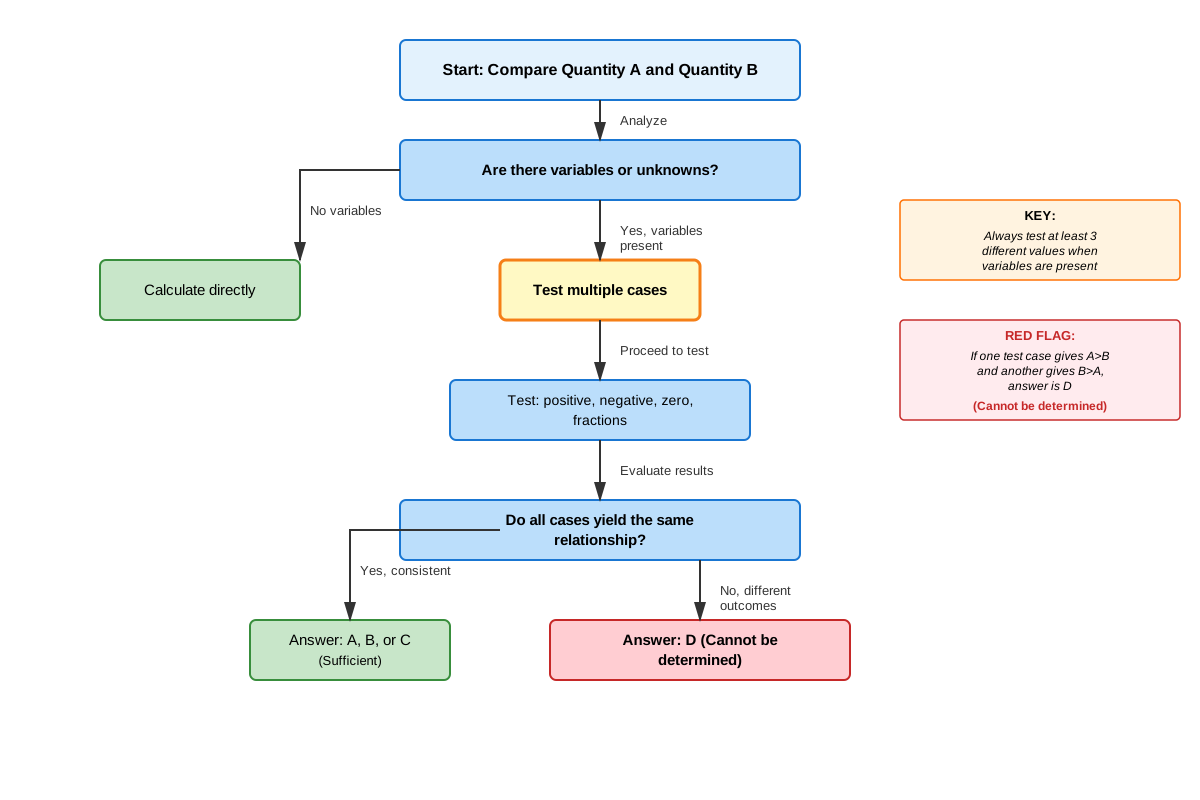
When encountering a Quantitative Comparison question, use this decision tree:
- Read carefully: Identify all explicit constraints and note what is NOT stated
- Check for variables: If variables are present without full specification, consider insufficiency
- Look for threshold dependencies: Does the relationship change at x = 0, x = 1, or x = -1?
- Apply the two-value test: Find two valid values that might produce different outcomes
- Verify your test values: Ensure they satisfy all stated constraints
- If outcomes differ: Select "Cannot be determined"
- If outcomes match: Test additional values or use algebraic reasoning to confirm the relationship holds universally
Trigger Words and Phrases
Watch for these insufficiency indicators:
- "x is a number" (no sign or magnitude specified)
- "n is an integer" (could be negative, zero, or positive)
- "Figure not drawn to scale" (don't trust visual appearance)
- One equation, multiple variables (typically insufficient)
- "The ratio of x to y" (proportions without absolute values)
- Geometric figures with minimal specifications (one angle doesn't determine all sides)
- "x ≠ 0" or "x ≠ 1" (often signals that these critical values matter)
Process of Elimination
Insufficiency questions have a unique elimination pattern:
- If you find even ONE pair of valid values that produce different outcomes, eliminate choices A, B, and C immediately
- If you can prove the relationship holds for all possible values, eliminate choice D
- Never eliminate based on difficulty—hard problems can still have determinable answers
- If you're making assumptions (like "x is probably positive"), you're likely missing insufficiency
Time Allocation
Spend approximately 1.5-2 minutes on insufficiency questions:
- 20-30 seconds: Read and identify constraints
- 30-45 seconds: Test 2-3 strategic values
- 30-45 seconds: Verify your reasoning and select answer
- If you can't find different outcomes after testing 3-4 well-chosen values, the relationship is likely determinable
Don't spend excessive time searching for insufficiency if your strategic values all produce the same outcome—this suggests the relationship is actually determinable.
Memory Techniques
The "SIGN-MAG-TYPE" Mnemonic
When testing for insufficiency, remember SIGN-MAG-TYPE:
- Sign: Test positive and negative values
- Integer: Test integers vs. non-integers if relevant
- Greater than one: Test values > 1
- Near zero: Test values between 0 and 1
- Magnitude: Test extreme values (very large/small)
- At thresholds: Test exactly at x = 0, 1, -1
- Given constraints: Verify all test values satisfy stated conditions
- Two outcomes: Need at least two different results
- Yes to insufficiency: If outcomes differ
- Prove it: Show your work
- Eliminate: Remove A, B, C when insufficient
The "ASSUME = LOSE" Principle
Assume nothing not stated
Sign is unspecified unless given
Scale in figures is unreliable
Universal truth requires all cases
Multiple variables need multiple equations
Explicit constraints only
Look for counterexamples
One difference proves insufficiency
Strategic values reveal patterns
Eliminate wrong assumptions
Visualization Strategy
Picture a number line with critical zones:
... negative | -1 | negative fractions | 0 | positive fractions | 1 | positive integers ...When testing insufficiency, mentally place your variable in different zones and check if the comparison outcome changes. If it does, you've found insufficiency.
Summary
Recognizing insufficiency is a sophisticated analytical skill that distinguishes high-performing GRE test-takers from average scorers. The fundamental principle is straightforward: if you can find legitimate values that satisfy all given constraints but produce different comparison outcomes, the relationship cannot be determined. Mastery requires systematic application of strategic value substitution—testing positive and negative values, numbers greater than and less than 1, zero, and extreme cases. The most common insufficiency patterns involve variables without specified signs or ranges, geometric figures with minimal constraints, expressions that behave differently across critical thresholds (especially x = 0 and x = 1), and situations with more unknowns than equations. Success demands rigorous attention to what is explicitly stated versus what is merely assumed, resistance to visual impressions in geometric figures, and disciplined testing of diverse value types. Students must develop the mathematical maturity to acknowledge when a definitive answer cannot be determined rather than forcing a conclusion based on incomplete analysis.
Key Takeaways
- Insufficiency exists when at least two valid scenarios produce different comparison outcomes—finding even one counterexample proves the relationship cannot be determined
- Never assume variable properties not explicitly stated—"x is a number" means x can be positive, negative, or zero; "n is an integer" includes negative integers
- Test strategic values systematically: positive vs. negative, greater than 1 vs. between 0 and 1, zero, and values at critical thresholds
- Geometric figures are not drawn to scale—rely only on stated measurements and properties, not visual appearance
- One equation with multiple variables typically creates insufficiency—you need as many independent equations as unknowns to determine unique values
- The relationship x² compared to x depends critically on x's value: x² > x when |x| > 1, but x² < x when 0 < x < 1
- Insufficiency questions appear in 25-35% of Quantitative Comparisons—mastering this skill is essential for achieving scores above 160
Related Topics
Quantitative Comparison Strategies: Recognizing insufficiency is one component of the broader skill set for Quantitative Comparison questions, which also includes simplification techniques, estimation methods, and algebraic manipulation. Mastering insufficiency enhances overall Quantitative Comparison performance.
Inequality Manipulation: Understanding how inequalities behave under various operations (multiplication by negatives, taking reciprocals) directly supports recognizing when relationships remain consistent or change based on variable values.
Number Properties and Special Cases: Deep knowledge of how different number types (integers, fractions, negatives, zero) behave in operations is essential for generating effective test cases to reveal insufficiency.
Data Sufficiency Reasoning: Though not explicitly labeled as such on the GRE, the logical framework of determining whether information is adequate to answer a question applies across Problem Solving and Data Interpretation questions.
Algebraic Reasoning with Constraints: Advanced problems combine insufficiency recognition with systems of equations, requiring students to determine when constraints uniquely determine values versus when multiple solutions exist.
Practice CTA
Now that you've mastered the concepts and strategies for recognizing insufficiency, it's time to solidify your understanding through deliberate practice. Work through the practice questions designed specifically for this topic, paying careful attention to testing strategic values and identifying when information is truly insufficient versus when problems simply require multi-step reasoning. Use the flashcards to reinforce the critical thresholds, common patterns, and trigger phrases that signal potential insufficiency. Remember: every insufficiency question you correctly identify on the GRE is a question you've protected yourself from getting wrong through unwarranted assumptions. This skill will directly contribute to achieving your target score—approach the practice with focus and confidence!
Sign up free to keep reading
Create a free AnvayaPrep account to finish this GRE guide on Recognizing insufficiency — plus flashcards and practice questions.