Overview
Comparing expressions is one of the most frequently tested skills in the GRE Quantitative Reasoning section, particularly within the Quantitative Comparison question format. This topic requires students to determine the relative size or value of two algebraic or numerical expressions without necessarily calculating their exact values. Unlike traditional problem-solving questions that ask for a specific numerical answer, comparing expressions demands strategic thinking, algebraic manipulation, and the ability to recognize mathematical relationships quickly. Mastery of this skill is essential because approximately 40% of the Quantitative Reasoning section consists of Quantitative Comparison questions, making it a high-impact area for score improvement.
The fundamental challenge in GRE comparing expressions lies in efficiently determining whether Quantity A is greater than Quantity B, whether they are equal, or whether the relationship cannot be determined from the given information. Students must resist the temptation to calculate exact values when comparison strategies can yield answers more quickly and reliably. This approach not only saves valuable time during the exam but also reduces computational errors that can occur when working with complex expressions.
This topic connects deeply to virtually every other area of GRE Quantitative Reasoning, including algebra, arithmetic, geometry, and data analysis. The skills developed through comparing expressions—such as algebraic manipulation, inequality reasoning, and strategic substitution—serve as foundational tools that enhance performance across all quantitative question types. Understanding how to compare expressions efficiently creates a multiplier effect on overall quantitative performance, making this one of the highest-yield topics for focused study.
Learning Objectives
- [ ] Identify when Comparing expressions is being tested
- [ ] Explain the core rule or strategy behind Comparing expressions
- [ ] Apply Comparing expressions to GRE-style questions accurately
- [ ] Determine when the relationship between two expressions cannot be determined from given information
- [ ] Execute algebraic manipulations that preserve inequality relationships
- [ ] Recognize when strategic substitution of values is more efficient than algebraic manipulation
- [ ] Identify expressions that can be simplified through factoring, combining like terms, or cancellation
Prerequisites
- Basic algebraic manipulation: Essential for simplifying expressions and isolating variables when comparing quantities
- Understanding of inequalities: Required to know which operations preserve or reverse inequality relationships
- Properties of operations: Necessary to recognize when addition, subtraction, multiplication, or division can be applied to both quantities
- Number properties: Important for understanding how positive, negative, zero, and fractional values affect comparisons
- Exponent rules: Needed when comparing expressions involving powers and roots
Why This Topic Matters
In real-world applications, comparing expressions without exact calculation mirrors decision-making scenarios in business, engineering, and data analysis where relative magnitude matters more than precise values. Professionals frequently need to determine which option is larger, more efficient, or more cost-effective without performing exhaustive calculations. This skill translates directly to optimization problems, resource allocation decisions, and comparative analysis across numerous fields.
On the GRE specifically, Quantitative Comparison questions account for approximately 15 of the 40 questions in the Quantitative Reasoning section (37.5% of total questions). Among these, comparing expressions represents the most common question subtype, appearing in roughly 60-70% of Quantitative Comparison questions. This means that mastering this single topic can directly impact performance on approximately 9-11 questions per exam, representing a potential score increase of 3-5 points on the 130-170 scale.
The GRE tests comparing expressions through several common formats: algebraic expressions with variables and given constraints, numerical expressions involving operations and exponents, geometric expressions involving area or perimeter relationships, and expressions involving fractions or ratios. Questions may present straightforward comparisons or embed the comparison within word problems requiring translation from verbal to mathematical form. The test makers specifically design these questions to reward strategic thinking over brute-force calculation, making methodological approach more important than computational speed.
Core Concepts
The Four Answer Choices in Quantitative Comparison
Every Quantitative Comparison question on the GRE presents two quantities (Quantity A and Quantity B) and asks which is greater. The answer choices are always identical:
- (A) Quantity A is greater
- (B) Quantity B is greater
- (C) The two quantities are equal
- (D) The relationship cannot be determined from the information given
Understanding when to select each answer is fundamental to comparing expressions. Choice (D) is only correct when the relationship between quantities changes depending on which permissible values are substituted for variables. If the relationship remains consistent across all valid values, choice (D) is never correct.
The Comparison Strategy Framework
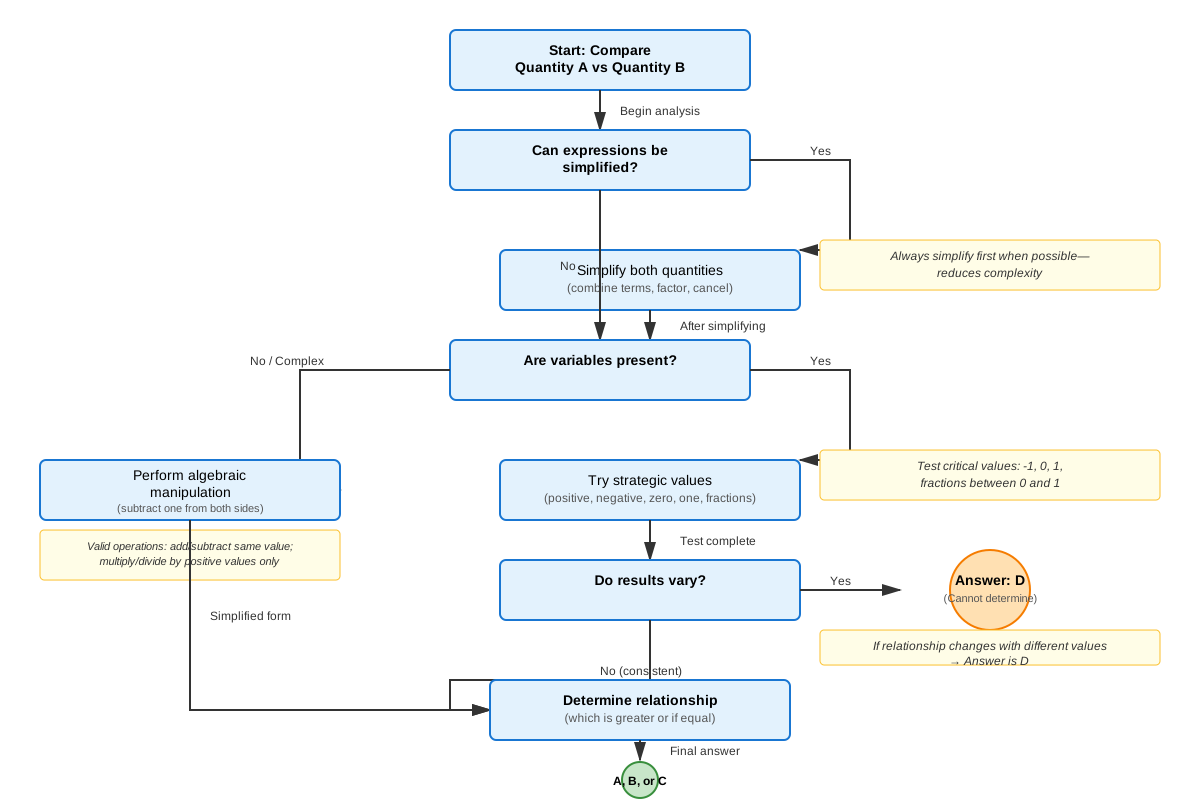
When comparing expressions, follow this systematic approach:
- Simplify both quantities using algebraic operations that preserve the relationship
- Subtract one quantity from the other to determine which is larger (if Quantity A - Quantity B > 0, then A is greater)
- Test strategic values when variables are present (positive, negative, zero, one, fractions)
- Look for patterns rather than calculating exact values
- Consider special cases that might change the relationship
Operations That Preserve Relationships
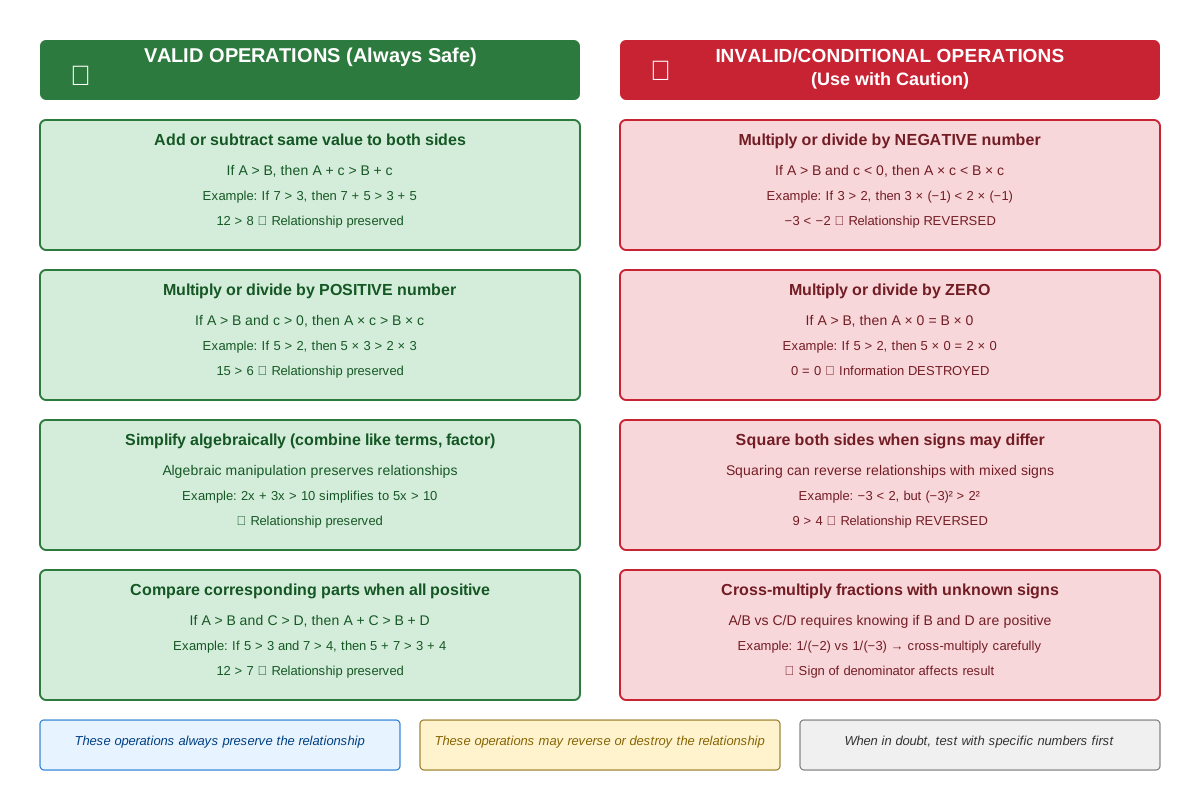
Certain mathematical operations can be applied to both quantities without changing their relative relationship:
| Operation | Condition | Effect on Relationship |
|---|---|---|
| Add/Subtract same value | Always valid | Preserves relationship |
| Multiply/Divide by positive | Value must be positive | Preserves relationship |
| Multiply/Divide by negative | Value must be negative | Reverses relationship |
| Square both sides | Both quantities same sign | Preserves relationship |
| Square both sides | Quantities opposite signs | May change relationship |
| Take reciprocals | Both quantities same sign | Reverses relationship |
The most powerful technique in comparing expressions is subtracting Quantity B from Quantity A. If the result is always positive, A is greater. If always negative, B is greater. If always zero, they're equal. If the sign varies, the relationship cannot be determined.
Strategic Value Substitution
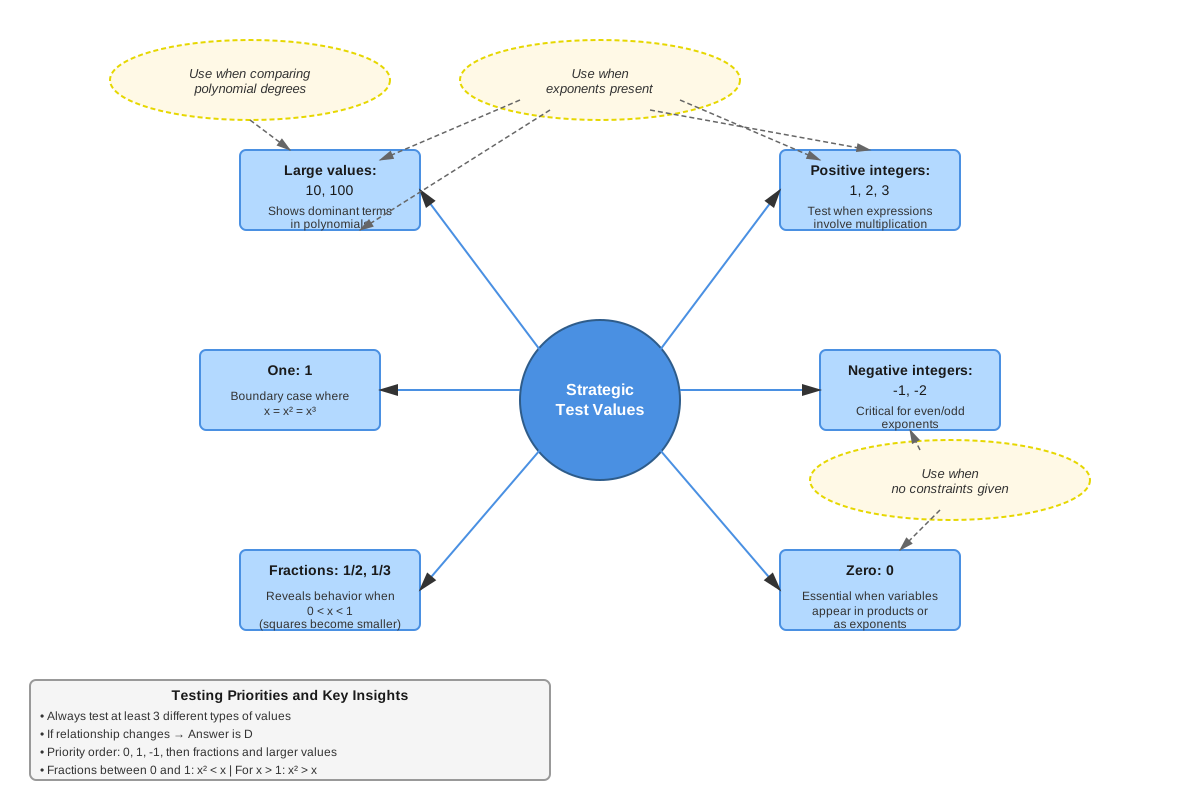
When expressions contain variables, testing strategic values helps determine whether the relationship is consistent or variable. The key values to test are:
- Positive integers (typically 1 and 2)
- Negative integers (typically -1 and -2)
- Zero (when permissible)
- Fractions between 0 and 1 (such as 1/2)
- Fractions between -1 and 0 (such as -1/2)
If testing two different permissible values yields different relationships (A greater for one value, B greater for another), the answer is immediately (D). If all tested values yield the same relationship, that relationship is likely correct, though algebraic verification provides certainty.
Recognizing "Cannot Be Determined" Situations
The relationship cannot be determined when:
- The relative size of quantities depends on which value a variable takes
- Insufficient information exists to establish a consistent relationship
- The sign of a critical expression is unknown
Common scenarios that lead to "cannot be determined":
- Comparing x² and x when x's sign is unknown
- Comparing expressions where a variable appears with different exponents
- Comparing products or quotients when signs of factors are unknown
Algebraic Simplification Techniques
Effective comparing expressions requires facility with these simplification methods:
Combining like terms: When both quantities share common terms, these can be eliminated through subtraction.
Factoring: Expressions that can be factored may reveal common factors that cancel or simplify comparison.
Expanding: Sometimes expanding products reveals relationships more clearly than factored forms.
Fraction operations: Finding common denominators or cross-multiplying (when denominators are positive) can simplify comparisons involving fractions.
Special Expression Types
Quadratic expressions: When comparing expressions involving x² and x, the relationship typically depends on whether x is between 0 and 1, equal to 0 or 1, or greater than 1.
Exponential expressions: Comparing expressions with different bases or exponents requires careful consideration of whether bases are greater than, equal to, or less than 1.
Absolute value expressions: The relationship may change depending on whether the expression inside the absolute value is positive or negative.
Radical expressions: Comparing expressions with square roots or other roots often benefits from squaring both sides (when both are positive) to eliminate radicals.
Concept Relationships
The core concepts in comparing expressions build upon each other in a logical progression. The four answer choices framework establishes the fundamental structure of every question, which then determines the appropriate comparison strategy to employ. This strategy relies heavily on understanding which operations preserve relationships, as these operations enable algebraic simplification without changing the comparison outcome.
When algebraic approaches become complex or time-consuming, strategic value substitution provides an alternative pathway, particularly for identifying "cannot be determined" situations. The ability to recognize "cannot be determined" situations depends on understanding how different variable values affect expression relationships, which connects back to the operations that preserve or reverse relationships.
Algebraic simplification techniques serve as the toolkit for implementing the comparison strategy, while special expression types represent common patterns where specific techniques prove most effective. The relationship flows: Framework → Strategy → Operations → Techniques → Application to Special Cases.
This topic connects to prerequisite knowledge of algebra and inequalities by extending basic manipulation skills to comparative contexts. It relates to other GRE topics by providing strategies applicable to word problems, geometry comparisons, and data interpretation questions where relative magnitude matters more than exact values.
High-Yield Facts
⭐ The answer choices for Quantitative Comparison questions are always identical: (A) Quantity A is greater, (B) Quantity B is greater, (C) The two quantities are equal, (D) The relationship cannot be determined
⭐ Subtracting Quantity B from Quantity A is the most reliable method for determining which is greater
⭐ Adding or subtracting the same value to both quantities always preserves their relationship
⭐ Multiplying or dividing both quantities by a negative number reverses their relationship
⭐ If testing two different permissible values for a variable yields different relationships, the answer is always (D)
- Squaring both quantities preserves the relationship only when both quantities have the same sign
- Taking reciprocals of both positive quantities reverses their relationship (if A > B > 0, then 1/A < 1/B)
- When comparing x² and x, the relationship depends on whether x is between 0 and 1, equal to 0 or 1, or outside this range
- Never assume variables are positive unless explicitly stated or constrained by context
- Multiplying or dividing both quantities by zero is invalid and provides no information about the relationship
- When both quantities are always positive, squaring both sides can eliminate square roots and simplify comparison
- Cross-multiplying to compare fractions is only valid when both denominators are positive
- If an expression's sign is unknown, the relationship often cannot be determined
Quick check — test yourself on Comparing expressions so far.
Try Flashcards →Common Misconceptions
Misconception: Variables always represent positive numbers unless stated otherwise → Correction: Variables can be positive, negative, or zero unless explicitly constrained. Always consider all permissible values, including negative numbers and zero when testing relationships.
Misconception: If Quantity A is greater for one value of x, it's greater for all values → Correction: The relationship may change for different values. Always test multiple strategic values (positive, negative, zero, fractions) to verify consistency before selecting (A), (B), or (C).
Misconception: Calculating exact values is necessary to compare quantities → Correction: Comparison often requires only determining relative magnitude, not exact values. Strategic simplification and algebraic manipulation are typically faster and more reliable than calculation.
Misconception: Multiplying both quantities by the same expression always preserves the relationship → Correction: Multiplying by a negative value reverses the relationship, and multiplying by zero makes both quantities equal regardless of their original relationship. Always verify the sign of any multiplier.
Misconception: If you can't determine the relationship immediately, the answer must be (D) → Correction: Choice (D) is only correct when the relationship genuinely varies with different permissible values. Difficult comparisons may require more sophisticated algebraic manipulation but still have a determinable relationship.
Misconception: Squaring both sides always preserves the relationship → Correction: Squaring preserves the relationship only when both quantities have the same sign. If one is positive and one is negative, squaring can reverse the relationship (e.g., -3 < 2, but 9 > 4).
Misconception: Cross-multiplying fractions always works for comparison → Correction: Cross-multiplication is only valid when both denominators are positive. If either denominator could be negative, cross-multiplication may reverse the inequality, leading to incorrect conclusions.
Worked Examples
Example 1: Algebraic Expression Comparison
Question: Given that x > 0
Quantity A: x² + 2x + 1
Quantity B: x² + 3x
Solution:
Step 1: Recognize that both quantities share x², suggesting subtraction will simplify comparison.
Step 2: Subtract Quantity B from Quantity A:
(x² + 2x + 1) - (x² + 3x) = x² + 2x + 1 - x² - 3x = -x + 1
Step 3: Determine when -x + 1 is positive, negative, or zero:
-x + 1 > 0 when x < 1
-x + 1 = 0 when x = 1
-x + 1 < 0 when x > 1
Step 4: Since x > 0 (given constraint), x can be between 0 and 1 (making A greater), equal to 1 (making them equal), or greater than 1 (making B greater).
Step 5: Because the relationship changes depending on x's value, the answer is (D) The relationship cannot be determined.
Connection to Learning Objectives: This example demonstrates applying the subtraction strategy to compare expressions and recognizing when the relationship cannot be determined based on variable values.
Example 2: Strategic Value Substitution
Question: Given that n is an integer and n ≠ 0
Quantity A: n³
Quantity B: n²
Solution:
Step 1: Recognize that the relationship between n³ and n² depends on n's value, suggesting strategic substitution.
Step 2: Test n = 1:
Quantity A: 1³ = 1
Quantity B: 1² = 1
Relationship: Equal
Step 3: Test n = 2:
Quantity A: 2³ = 8
Quantity B: 2² = 4
Relationship: A is greater
Step 4: Test n = -1:
Quantity A: (-1)³ = -1
Quantity B: (-1)² = 1
Relationship: B is greater
Step 5: Since different permissible values yield different relationships (equal for n=1, A greater for n=2, B greater for n=-1), the answer is (D) The relationship cannot be determined.
Connection to Learning Objectives: This example illustrates identifying when strategic substitution is appropriate and recognizing that different integer values produce different relationships, making the answer indeterminate.
Example 3: Simplification Through Factoring
Question:
Quantity A: (x + 3)(x - 3)
Quantity B: x² - 6
Solution:
Step 1: Expand Quantity A using the difference of squares pattern:
(x + 3)(x - 3) = x² - 9
Step 2: Now compare x² - 9 with x² - 6
Step 3: Subtract Quantity B from Quantity A:
(x² - 9) - (x² - 6) = x² - 9 - x² + 6 = -3
Step 4: Since the difference is always -3 (a negative constant), Quantity A is always 3 less than Quantity B.
Step 5: Therefore, Quantity B is always greater, and the answer is (B) Quantity B is greater.
Connection to Learning Objectives: This example demonstrates applying algebraic simplification techniques and recognizing that when the difference between quantities is a constant, the relationship is determinable regardless of variable values.
Exam Strategy
When approaching GRE Quantitative Comparison questions involving comparing expressions, begin by reading any given constraints carefully—these often determine whether choice (D) is possible. If no variables appear or all variables are fully constrained to single values, choice (D) is automatically eliminated.
Trigger words and phrases that indicate comparing expressions questions include: "Quantity A" and "Quantity B" labels, algebraic expressions with variables, phrases like "given that," "where x is," or "for all values of." The presence of variables with constraints (e.g., "x > 0" or "n is an integer") signals the need for strategic value testing.
Process-of-elimination strategy: First, determine if choice (D) is possible by checking whether variables exist and whether their values could affect the relationship. If the relationship must be consistent, eliminate (D) immediately. Next, try the simplest approach—often subtracting one quantity from the other. If this yields a constant, you've determined the relationship. If it yields an expression with variables, test strategic values to see if the relationship changes.
Time allocation: Spend no more than 60-90 seconds per Quantitative Comparison question. If algebraic manipulation doesn't yield quick insights within 30 seconds, switch to strategic value substitution. If testing two values produces different relationships, select (D) immediately without further testing. Avoid the trap of calculating exact values when comparison alone suffices.
Red flags that suggest choice (D): expressions with variables raised to different powers (x² vs. x), expressions where variable signs are unknown, expressions involving products or quotients of variables with unknown signs. When you see these patterns, immediately consider whether different values might produce different relationships.
Efficiency techniques: Look for common terms that can be eliminated through subtraction. Recognize special products (difference of squares, perfect square trinomials) that simplify quickly. When both quantities are positive, consider whether squaring both sides eliminates radicals or simplifies comparison. Always ask: "Can I simplify this without calculating?"
Memory Techniques
SAND Mnemonic for operations that preserve relationships:
- Subtract or add the same value (always preserves)
- Always check sign before multiplying/dividing
- Negative multiplier reverses relationship
- Divide or multiply by positive preserves relationship
PNZOF for strategic values to test:
- Positive integers (1, 2)
- Negative integers (-1, -2)
- Zero (when allowed)
- One (special case for exponents)
- Fractions (1/2, -1/2)
Visualization strategy: Picture a number line with both quantities as points. When you subtract one from the other, you're determining the distance and direction between them. A positive result means Quantity A is to the right (greater); negative means Quantity B is to the right (greater); zero means they're at the same point (equal).
The "Sign Check" acronym: Before multiplying or dividing both quantities by an expression, STOP:
- Sign: What's the sign of the multiplier?
- Test: Could it be negative, positive, or zero?
- Opposite: Will it reverse the relationship?
- Proceed: Only proceed if you're certain of the sign
Relationship reversal reminder: "Reciprocals Reverse, Negatives Negate" — Taking reciprocals of positive numbers reverses their order, and multiplying by negatives negates (reverses) the relationship.
Summary
Comparing expressions on the GRE requires strategic thinking rather than brute-force calculation. The fundamental approach involves simplifying both quantities through algebraic manipulation, typically by subtracting one from the other to determine which is greater. Understanding which operations preserve relationships (addition, subtraction, multiplication/division by positives) versus which reverse them (multiplication/division by negatives, taking reciprocals) is essential for accurate comparison. When expressions contain variables, strategic value substitution—testing positive, negative, zero, one, and fractional values—helps determine whether the relationship is consistent or variable. If different permissible values yield different relationships, the answer is always "cannot be determined." The key to success lies in recognizing patterns, applying efficient simplification techniques, and avoiding unnecessary calculation. Mastery of comparing expressions directly impacts performance on approximately 40% of Quantitative Reasoning questions, making this one of the highest-yield topics for GRE preparation.
Key Takeaways
- Subtract Quantity B from Quantity A to determine their relationship; if the result is always positive, A is greater; if always negative, B is greater; if always zero, they're equal; if the sign varies, the relationship cannot be determined
- Adding or subtracting the same value to both quantities always preserves their relationship, while multiplying or dividing by a negative value always reverses it
- Test strategic values (positive, negative, zero, one, fractions) when variables are present; if two different values produce different relationships, immediately select "cannot be determined"
- Never assume variables are positive unless explicitly stated; always consider negative values and zero when they're permissible
- Focus on relative magnitude rather than exact values; comparison strategies are faster and more reliable than calculation
- Recognize common patterns that signal "cannot be determined": expressions with variables at different powers, unknown signs in products/quotients, and insufficient constraints on variables
- Eliminate choice (D) immediately when no variables exist or when all variables are fully constrained to single values
Related Topics
Inequalities and Algebraic Manipulation: Mastering comparing expressions provides the foundation for solving complex inequalities, as both require understanding which operations preserve or reverse relationships. This topic extends the comparison skills to equation-solving contexts.
Exponents and Radicals: Many comparing expressions questions involve exponential or radical expressions. Deeper study of exponent rules and radical properties enhances the ability to simplify and compare these special expression types efficiently.
Number Properties and Special Cases: Understanding how different number types (integers, fractions, negatives, zero) behave in expressions is crucial for strategic value substitution. Further study of number properties strengthens the ability to identify which test values will most effectively reveal relationship patterns.
Word Problems and Translation: Comparing expressions skills apply directly to word problems that ask for relative comparisons rather than exact answers. Mastering this topic enables more efficient approaches to optimization and comparison word problems.
Practice CTA
Now that you've mastered the strategies for comparing expressions, it's time to cement your understanding through practice. Attempt the practice questions to apply these techniques to GRE-style problems, and use the flashcards to reinforce the key facts and strategies you've learned. Remember: comparing expressions appears in approximately 40% of Quantitative Reasoning questions, making your practice time here one of the highest-yield investments in your GRE preparation. Each question you practice builds the pattern recognition and strategic thinking that will save you valuable time and boost your accuracy on test day. You've got this!
Sign up free to keep reading
Create a free AnvayaPrep account to finish this GRE guide on Comparing expressions — plus flashcards and practice questions.