Overview
Checking reasonableness is a critical metacognitive skill that separates high-scoring GRE test-takers from those who struggle with Quantitative Reasoning. This technique involves evaluating whether an answer makes logical sense within the context of a problem before finalizing it. On the GRE, where time pressure is intense and computational errors are common, the ability to quickly verify that an answer is reasonable can prevent costly mistakes and boost confidence during the exam.
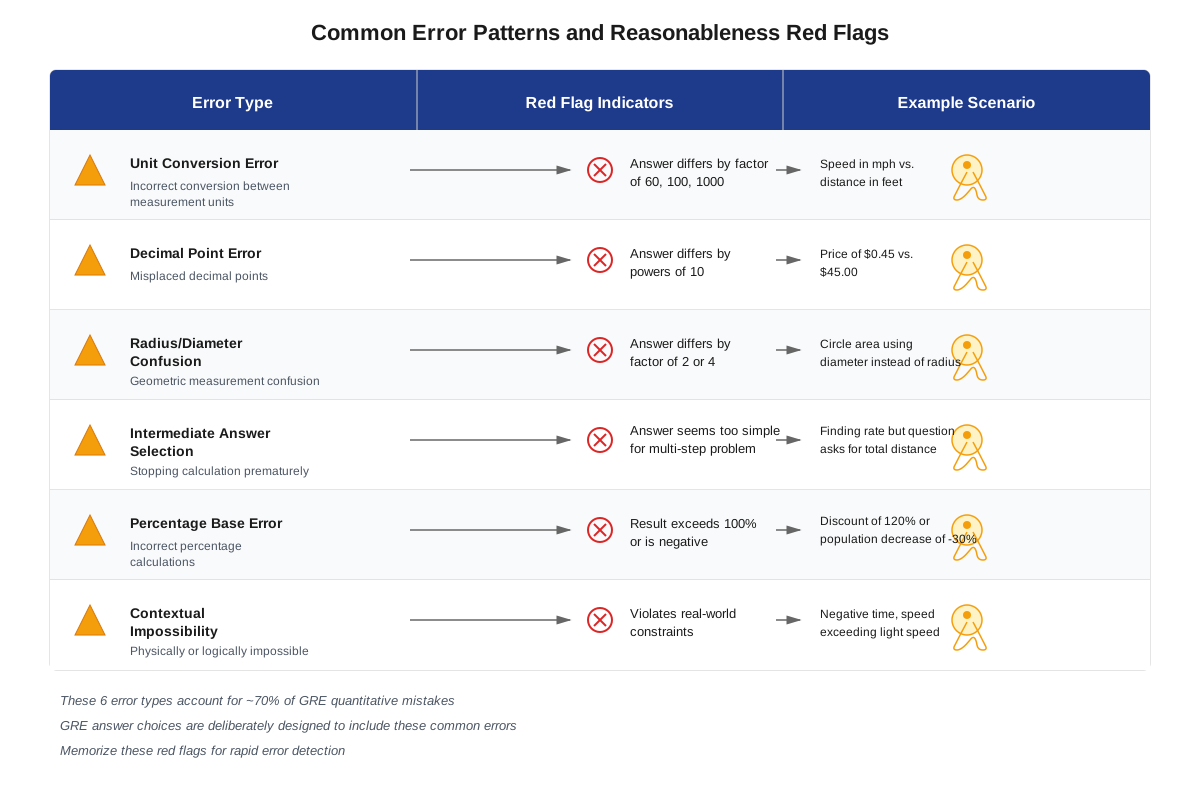
The GRE deliberately includes answer choices that result from common calculation errors, misread problem statements, or unit conversion mistakes. Test-makers know that students working under pressure often arrive at incorrect answers that "look right" mathematically but fail basic reasonableness checks. By systematically applying GRE checking reasonableness strategies, students can catch these errors before submitting their responses, effectively adding several points to their Quantitative score without solving additional problems correctly.
This topic integrates seamlessly with all other Quantitative Reasoning concepts because it serves as a final verification layer for every problem type—whether algebra, geometry, data interpretation, or word problems. Checking reasonableness doesn't replace mathematical problem-solving; rather, it complements computational skills by providing a safety net that catches errors in logic, calculation, or interpretation. Mastering this skill transforms students from passive answer-seekers into active critical thinkers who can evaluate their work with the same rigor that GRE question writers use to create distractors.
Learning Objectives
- [ ] Identify when Checking reasonableness is being tested
- [ ] Explain the core rule or strategy behind Checking reasonableness
- [ ] Apply Checking reasonableness to GRE-style questions accurately
- [ ] Develop systematic verification protocols for different question types
- [ ] Recognize common error patterns that reasonableness checks can catch
- [ ] Estimate expected answer ranges before performing detailed calculations
- [ ] Distinguish between mathematically correct but contextually unreasonable answers
Prerequisites
- Basic arithmetic operations: Reasonableness checks often involve quick mental math to verify order of magnitude
- Unit awareness: Understanding units (time, distance, money, percentages) is essential for context-based verification
- Estimation skills: Rounding and approximation techniques enable rapid reasonableness assessments
- Word problem comprehension: Interpreting what a problem asks is fundamental to determining what constitutes a reasonable answer
- Quantitative comparison logic: Understanding relative magnitudes helps evaluate whether answers make sense
Why This Topic Matters
In real-world applications, checking reasonableness prevents catastrophic errors in fields ranging from engineering (where miscalculations can compromise structural integrity) to medicine (where dosage errors can be fatal) to finance (where decimal point mistakes can cost millions). Professionals across disciplines routinely perform "sanity checks" on their calculations, making this skill valuable far beyond standardized testing.
On the GRE specifically, reasonableness checking appears in approximately 40-50% of Quantitative Reasoning questions, though not always explicitly. The exam frequently includes answer choices that result from predictable errors: forgetting to convert units, misplacing decimal points, confusing radius with diameter, or selecting an intermediate calculation rather than the final answer. Questions involving rates, percentages, ratios, and real-world scenarios are particularly susceptible to reasonableness testing because they have built-in contextual constraints (speeds can't be negative, percentages of totals can't exceed 100%, etc.).
The GRE tests this skill through several mechanisms: word problems with contextually absurd answer choices, quantitative comparison questions where estimation reveals the relationship without calculation, data interpretation questions where graph reading errors produce unreasonable values, and multi-step problems where intermediate errors compound. Students who skip reasonableness checks often select answers that are mathematically derived but logically impossible, such as a person's age being negative, a probability exceeding 1, or a part being larger than the whole.
Core Concepts
The Fundamental Principle of Reasonableness
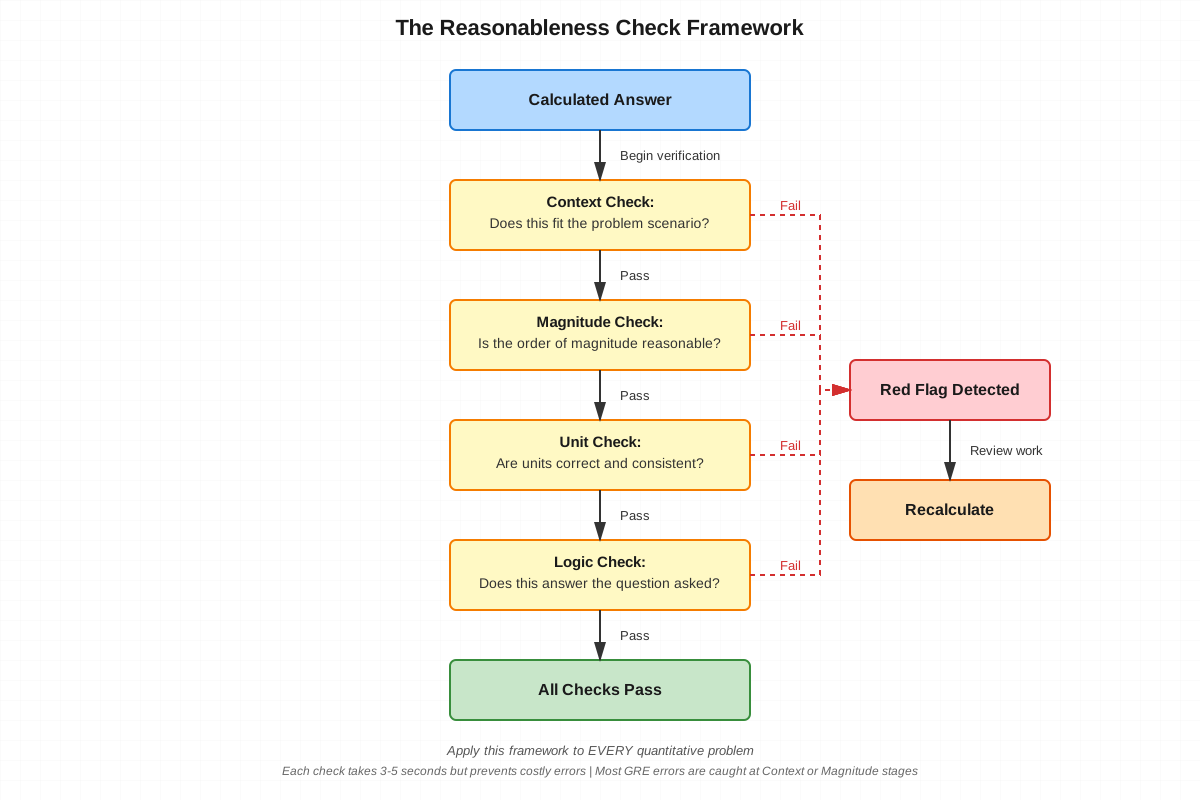
Checking reasonableness means evaluating whether an answer makes sense given the problem's context, constraints, and real-world logic. This involves three layers of verification: mathematical consistency (does the answer satisfy the equation?), contextual appropriateness (does it fit the scenario?), and magnitude plausibility (is the size of the answer sensible?).
The core strategy involves asking targeted questions before finalizing an answer:
- Does this answer have the correct units?
- Is the magnitude in the expected range?
- Does it satisfy all stated constraints?
- Could this value exist in the real-world context described?
- Does it answer the question that was actually asked?
Estimation as a Reasonableness Tool
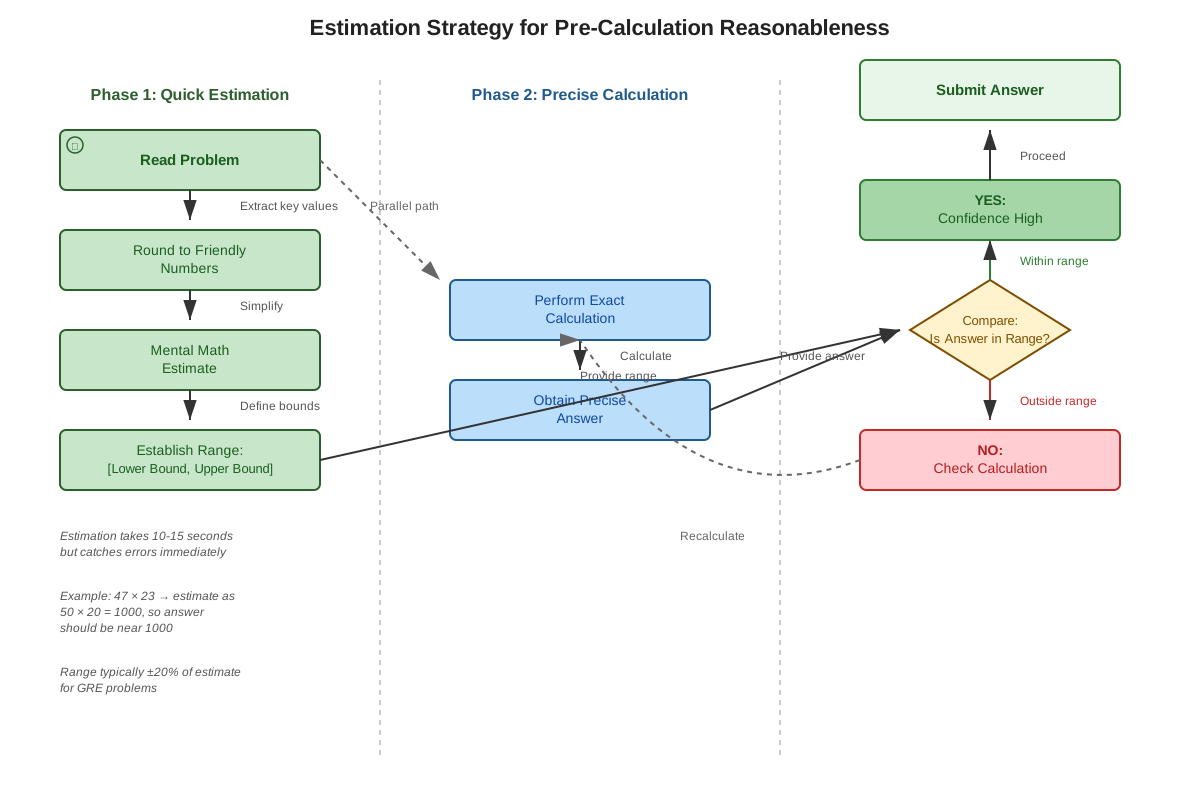
Before performing detailed calculations, skilled test-takers estimate the expected answer range. This creates a benchmark against which to evaluate the computed result. For example, if a problem asks for 23% of 487, estimation (roughly 25% of 500 = 125) immediately tells you the answer should be near 100-120, allowing you to reject answer choices like 1,121 or 11.2 without detailed verification.
Estimation techniques for reasonableness include:
- Rounding to friendly numbers: Convert 487 to 500, 23% to 25%
- Order of magnitude checks: Multiplying two 2-digit numbers yields a 3-4 digit result
- Boundary analysis: The answer must fall between certain limits (e.g., the average of five numbers must be between the smallest and largest)
- Benchmark comparisons: Relating unknowns to known quantities (e.g., "more than half" means >50%)
Contextual Constraints in Word Problems
Word problems embed implicit constraints that reasonable answers must satisfy. A problem about ages requires positive integers (usually between 0-120). A problem about percentages requires values between 0-100 (unless dealing with percentage change, which can exceed 100%). A problem about probabilities requires values between 0-1. Distance, time, and speed problems require positive values with appropriate units.
| Context Type | Typical Constraints | Unreasonable Examples |
|---|---|---|
| Age problems | Positive integers, typically 0-120 | Negative ages, ages >150 |
| Percentage of whole | 0% to 100% | 150% of a class passed |
| Probability | 0 to 1 (or 0% to 100%) | Probability of 1.5 |
| Distance/Speed | Positive values, realistic magnitudes | Negative distance, 500 mph walking speed |
| Money | Positive (usually), appropriate precision | $0.001 for a retail price |
| Time duration | Positive, appropriate units | -5 hours, 90 minutes for a 2-hour task |
Unit Consistency Verification
Many GRE errors stem from unit mismatches. A problem might give speed in miles per hour but ask for distance in feet, or provide time in minutes but require an answer in hours. Reasonableness checking includes verifying that the final answer uses the requested units and that all intermediate calculations maintain dimensional consistency.
The dimensional analysis approach treats units as algebraic quantities:
- If distance = speed × time, then miles = (miles/hour) × hours ✓
- If the calculation yields (miles/hour) × (minutes), the result has wrong units ✗
Comparative Reasonableness in Quantitative Comparisons
For Quantitative Comparison questions, reasonableness often means recognizing that precise calculation is unnecessary. If Quantity A is clearly positive and Quantity B is clearly negative, the relationship is determined without computing exact values. If both quantities are positive but one is obviously larger by order of magnitude, estimation suffices.
Answer Choice Analysis
GRE answer choices are strategically designed. Incorrect options typically include:
- The result of a common computational error
- An intermediate value rather than the final answer
- The answer to a different question than what was asked
- A value with incorrect units or decimal placement
- A contextually impossible value
Recognizing these patterns helps identify when an answer fails reasonableness checks. If your calculated answer matches an option that would result from forgetting a step, double-check your work.
The "Does This Answer the Question?" Check
A surprisingly common error is solving correctly but answering the wrong question. A problem might ask for John's age but students calculate Mary's age. It might ask for the percentage increase but students calculate the final value. It might ask for the area of a circle but students calculate the circumference. The final reasonableness check must always be: "Is this value what the question actually requested?"
Concept Relationships
The concepts within checking reasonableness form a hierarchical verification system. Estimation serves as the foundation, providing expected ranges before calculation begins. This feeds into magnitude plausibility checks after calculation. Simultaneously, contextual constraints and unit consistency operate as filters that eliminate impossible answers. All these elements converge in the final answer-question alignment verification.
The relationship flows as follows:
Problem Context → Estimation of Expected Range → Detailed Calculation → Unit Verification → Magnitude Check → Contextual Constraint Check → Question Alignment Verification → Final Answer
Checking reasonableness connects to prerequisite topics by applying them in verification mode. Estimation skills become tools for generating comparison benchmarks. Unit awareness transforms into unit verification protocols. Word problem comprehension enables contextual constraint identification. The topic also connects forward to test-taking strategy, as reasonableness checks inform when to move on confidently versus when to recalculate.
Within the broader Quantitative Reasoning framework, reasonableness checking acts as quality control for all other skills. It doesn't matter how sophisticated your algebraic manipulation or geometric reasoning is if you don't verify that the final answer makes sense. This makes checking reasonableness a meta-skill that enhances performance across all mathematical domains tested on the GRE.
High-Yield Facts
⭐ Answer choices on the GRE deliberately include results from common errors—if your answer seems too easy to obtain, verify it
⭐ Estimation before calculation provides a benchmark that catches order-of-magnitude errors
⭐ Contextual constraints (age > 0, probability ≤ 1, part < whole) eliminate impossible answers immediately
⭐ Unit mismatches are among the most common sources of unreasonable answers on the GRE
⭐ Always verify that you answered the actual question asked, not a related but different question
- Negative values for inherently positive quantities (distance, time, age, count) indicate calculation errors
- If a percentage of a whole exceeds 100%, either the calculation is wrong or the problem involves percentage change
- Answers that differ from your estimate by more than one order of magnitude warrant rechecking
- In rate problems, verify that distance = rate × time with consistent units
- Probabilities expressed as decimals must fall between 0 and 1; as percentages, between 0% and 100%
- Average values must fall between the minimum and maximum of the dataset
- In geometry problems, verify that calculated lengths, areas, or volumes are positive
- If the problem involves real money, answers should typically have at most two decimal places
- Speed values should be realistic for the mode of transportation (walking: 2-4 mph, driving: 25-70 mph, flying: 400-600 mph)
- When a problem asks for "how many more" or "how much less," the answer represents a difference, not an absolute value
Quick check — test yourself on Checking reasonableness so far.
Try Flashcards →Common Misconceptions
Misconception: If the math is correct, the answer must be right → Correction: Mathematically correct calculations can still produce unreasonable answers if the wrong formula was used, units weren't converted, or the wrong question was answered. Always verify contextual appropriateness.
Misconception: Reasonableness checking is only necessary for word problems → Correction: All GRE Quantitative questions benefit from reasonableness checks. Even pure algebra or geometry problems can have contextually unreasonable answers (negative lengths, impossible angle measures, etc.).
Misconception: Estimation is too imprecise to be useful for verification → Correction: Estimation doesn't need to be exact; it only needs to establish the correct order of magnitude and general range. An estimate of "around 120" is sufficient to reject answer choices of 12 or 1,200.
Misconception: If an answer choice matches my calculation, it must be correct → Correction: GRE test-makers specifically include answer choices that result from common errors. A match with an answer choice is necessary but not sufficient for correctness—reasonableness verification is still required.
Misconception: Checking reasonableness takes too much time → Correction: Effective reasonableness checks take 5-10 seconds and prevent the much greater time loss of getting a question wrong or having to completely redo a problem. The time investment has extremely high return.
Misconception: Decimal point errors are obvious and easy to catch → Correction: Under time pressure, decimal point errors are remarkably easy to miss without systematic checking. A reasonableness check that compares calculated values to estimated ranges catches these errors reliably.
Misconception: If the units in the answer choices match my answer's units, unit consistency is verified → Correction: Answer choices might all use the same units, but if those units don't match what the problem requested, the answer is still wrong. Always verify against the question's requirements, not just the answer choices.
Worked Examples
Example 1: Rate Problem with Unit Conversion
Problem: A train travels 240 miles in 4 hours. If it maintains the same speed, how many feet does it travel in 30 seconds?
Solution with Reasonableness Checking:
Step 1: Estimate before calculating
The train goes 240 miles in 4 hours, so about 60 mph. In 30 seconds (half a minute), it won't go very far—maybe a fraction of a mile, which would be hundreds or thousands of feet. Definitely not tens of feet or tens of thousands of feet.
Step 2: Calculate speed
Speed = 240 miles / 4 hours = 60 miles per hour
Step 3: Convert to feet per second
60 miles/hour × (5,280 feet/mile) × (1 hour/3,600 seconds) = 88 feet/second
Step 4: Calculate distance in 30 seconds
Distance = 88 feet/second × 30 seconds = 2,640 feet
Step 5: Reasonableness checks
- ✓ Units are correct (feet, as requested)
- ✓ Magnitude matches estimate (thousands of feet)
- ✓ Positive value (appropriate for distance)
- ✓ Answers the question asked (distance in 30 seconds, not speed)
- ✓ Dimensional analysis: (feet/second) × seconds = feet ✓
If we had made a common error and forgotten to convert hours to seconds, we might have gotten 60 × 5,280 × 30 = 9,504,000 feet, which fails the magnitude check (way too large for 30 seconds of travel).
Connection to Learning Objectives: This example demonstrates applying checking reasonableness to catch unit conversion errors and using estimation to establish expected ranges.
Example 2: Percentage Problem with Contextual Constraints
Problem: In a class of 40 students, 60% are female. If 5 female students leave the class and no other students leave or join, what percentage of the remaining class is female?
Solution with Reasonableness Checking:
Step 1: Estimate and identify constraints
Originally 60% female, then some females leave, so the percentage should decrease but still be positive. It should be less than 60% but more than 0%. The answer must be between 0% and 100%.
Step 2: Calculate original number of females
Females = 60% × 40 = 24 students
Step 3: Calculate after 5 leave
Remaining females = 24 - 5 = 19
Remaining total = 40 - 5 = 35
Step 4: Calculate new percentage
New percentage = (19/35) × 100% ≈ 54.3%
Step 5: Reasonableness checks
- ✓ Between 0% and 100% (valid percentage)
- ✓ Less than original 60% (makes sense since only females left)
- ✓ Still substantial (makes sense since only 5 of 24 females left)
- ✓ Answers the question asked (percentage of remaining class, not number of students)
If we had mistakenly calculated 19/40 instead of 19/35 (forgetting that the total also decreased), we'd get 47.5%, which would fail the reasonableness check because losing 5 out of 24 females (about 20%) shouldn't drop the percentage from 60% to 47.5% (a drop of more than 20% of the original percentage).
Connection to Learning Objectives: This example shows identifying contextual constraints (percentage bounds), explaining the strategy (comparing to expected direction of change), and applying it to catch calculation errors.
Exam Strategy
When approaching GRE questions with reasonableness checking in mind, implement this systematic protocol:
Before Calculating: Spend 5-10 seconds estimating the expected answer range. Ask: "Should this be big or small? Positive or negative? What order of magnitude?" This creates a mental benchmark.
Trigger Words to Watch For:
- "How many more/less" → Answer is a difference, not an absolute value
- "What percent" → Answer must be 0-100% (unless percentage change)
- "What is the average" → Answer must be between min and max values
- "How long/far/fast" → Check unit consistency carefully
- "What is the probability" → Answer must be 0-1 or 0%-100%
After Calculating: Apply the five-question verification protocol:
- Correct units? (matches what the question asks for)
- Reasonable magnitude? (matches your estimate)
- Satisfies constraints? (positive where required, within bounds)
- Contextually possible? (could exist in the real-world scenario)
- Answers the actual question? (not a related but different value)
Process of Elimination Strategy: Use reasonableness to eliminate answer choices before calculating. If a problem asks for the area of a small rectangle and one answer choice is 10,000 square feet, eliminate it immediately. This increases your odds even if you must guess.
Time Allocation: Budget 5-10 seconds per question for reasonableness checking. This seems like a lot, but it prevents the 60+ seconds lost when you must redo an entire problem after realizing your answer doesn't make sense. The net time savings is substantial.
Red Flags That Demand Extra Scrutiny:
- Your answer matches the first answer choice you see
- Your calculation was unusually quick or simple
- Your answer differs from your estimate by more than 2-3x
- The problem involved multiple unit conversions
- You're uncertain about what the question asked
For Quantitative Comparisons: Often, reasonableness checking through estimation is sufficient to determine the relationship without exact calculation. If Quantity A is clearly "around 50" and Quantity B is clearly "around 200," you don't need precise values.
Memory Techniques
MUCA Mnemonic for the four essential reasonableness checks:
- Magnitude: Is the size of the answer sensible?
- Units: Are the units correct and consistent?
- Constraints: Does it satisfy contextual limits?
- Actual question: Does it answer what was asked?
The "Sanity Second": Visualize taking one deep breath before selecting your answer. During this breath, ask: "Does this make sense?" This physical pause creates space for reasonableness checking.
Unit Conversion Visualization: Picture a "unit pipeline" where quantities flow through conversions. Each conversion must maintain dimensional consistency—if something doesn't cancel properly, you've made an error.
The Goldilocks Principle: Your answer should be "just right"—not too big, not too small, but in the expected range. If it feels like the "too hot" or "too cold" porridge, investigate further.
Constraint Checklist Acronym - PAWN:
- Positive where required (age, distance, count)
- Appropriate precision (money has 2 decimals, counts are integers)
- Within bounds (percentages 0-100%, probabilities 0-1)
- Not negative where impossible (time, speed, quantity)
Summary
Checking reasonableness is the critical final verification step that transforms good GRE test-takers into great ones. This metacognitive skill involves evaluating whether calculated answers make logical sense within the problem's context, constraints, and real-world applicability. The core strategy combines pre-calculation estimation to establish expected ranges, systematic verification of units and magnitude, application of contextual constraints, and confirmation that the answer addresses the actual question asked. The GRE deliberately includes answer choices that result from common errors—decimal point mistakes, unit conversion failures, intermediate values, and solutions to related but different questions. By implementing the MUCA framework (Magnitude, Units, Constraints, Actual question) and spending 5-10 seconds on verification, students can catch these errors before finalizing answers. This skill integrates with all other Quantitative Reasoning topics, serving as quality control that prevents costly mistakes under time pressure. Mastery requires developing the habit of always asking "Does this make sense?" before moving to the next question, treating reasonableness checking not as optional but as an essential component of mathematical problem-solving.
Key Takeaways
- Estimation before calculation creates a benchmark that catches order-of-magnitude errors and guides reasonableness verification
- The MUCA framework (Magnitude, Units, Constraints, Actual question) provides a systematic 5-10 second verification protocol for every answer
- Contextual constraints (age > 0, probability ≤ 1, part < whole, percentage of whole ≤ 100%) immediately eliminate impossible answers
- GRE answer choices deliberately include common error results—matching an answer choice is necessary but not sufficient for correctness
- Unit consistency verification prevents one of the most common sources of unreasonable answers on rate, distance, and conversion problems
- Always confirm you answered the actual question asked, not a related value—this catches "right answer to wrong question" errors
- Reasonableness checking saves time overall by preventing the much larger time loss of getting questions wrong or needing to redo entire problems
Related Topics
Estimation and Approximation Techniques: Deepens the pre-calculation estimation skills that enable effective reasonableness checking; mastering this topic makes reasonableness verification faster and more accurate.
Unit Conversion and Dimensional Analysis: Provides systematic methods for handling the unit consistency component of reasonableness checking; essential for rate, distance, and measurement problems.
Word Problem Translation: Enhances the ability to identify contextual constraints and understand what constitutes a reasonable answer in different scenarios; directly supports the "Actual question" component of MUCA.
Quantitative Comparison Strategies: Applies reasonableness checking through estimation to determine relationships without exact calculation; shows how reasonableness thinking can replace computation entirely.
Error Pattern Recognition: Studies common GRE error types and how test-makers construct distractors; understanding these patterns makes reasonableness checks more targeted and effective.
Practice CTA
Now that you understand the principles and strategies of checking reasonableness, it's time to cement this skill through deliberate practice. Attempt the practice questions with special focus on implementing the MUCA framework before finalizing each answer. Use the flashcards to internalize common contextual constraints and trigger words that signal when reasonableness checking is especially critical. Remember: every question you verify for reasonableness is building a habit that will serve you throughout the exam. The few seconds you invest in verification will pay dividends in points gained and confidence earned. Start practicing now—your future GRE score will thank you!
Sign up free to keep reading
Create a free AnvayaPrep account to finish this GRE guide on Checking reasonableness — plus flashcards and practice questions.