Overview
Ratio word problems are among the most frequently tested quantitative concepts on the GRE, appearing in approximately 10-15% of all Quantitative Reasoning questions. These problems require test-takers to interpret relationships between quantities expressed as ratios and apply algebraic reasoning to solve for unknown values. Unlike straightforward arithmetic questions, ratio word problems embed mathematical relationships within real-world scenarios—mixing solutions, comparing populations, distributing resources, or analyzing proportional relationships—demanding both conceptual understanding and strategic problem-solving skills.
Mastering GRE ratio word problems is essential because they serve as a bridge between basic arithmetic operations and more complex algebraic reasoning. The GRE tests ratio concepts in multiple formats: Quantitative Comparison questions that ask students to evaluate relative sizes, Multiple Choice questions requiring precise calculations, and Numeric Entry questions where no answer choices provide guidance. These problems often combine ratios with other mathematical concepts such as percentages, rates, and algebraic equations, making them particularly high-yield for comprehensive score improvement.
The strategic importance of ratio problems extends beyond their direct appearance on the exam. Understanding ratios strengthens proportional reasoning skills that underpin geometry problems (similar triangles, scale factors), data interpretation questions (comparing quantities in charts), and even some probability scenarios. Students who develop fluency with ratio manipulation, part-to-part versus part-to-whole relationships, and the algebraic representation of ratios gain a significant advantage across multiple question types, making this topic one of the highest-return investments of study time for GRE preparation.
Learning Objectives
- [ ] Identify when Ratio word problems is being tested
- [ ] Explain the core rule or strategy behind Ratio word problems
- [ ] Apply Ratio word problems to GRE-style questions accurately
- [ ] Convert between part-to-part ratios and part-to-whole relationships fluently
- [ ] Set up and solve algebraic equations from ratio word problem scenarios
- [ ] Recognize and avoid common ratio problem traps and misconceptions
- [ ] Distinguish between scenarios requiring ratio preservation versus ratio change
Prerequisites
- Basic fraction operations: Ratios are fundamentally fractional relationships, requiring comfort with simplification, multiplication, and division of fractions
- Linear equation solving: Most ratio problems reduce to solving one or more algebraic equations for unknown variables
- Proportional reasoning: Understanding that equivalent ratios maintain the same multiplicative relationship is foundational to all ratio work
- Word problem translation: Converting verbal descriptions into mathematical expressions is the critical first step in ratio problems
Why This Topic Matters
Ratio problems appear in diverse real-world contexts that the GRE uses to assess quantitative literacy. Professionals encounter ratios when analyzing financial statements (debt-to-equity ratios), interpreting scientific data (concentration ratios in chemistry), making business decisions (employee-to-manager ratios), and evaluating statistical information (signal-to-noise ratios). The GRE leverages these practical applications to create authentic problem scenarios that test both mathematical competence and reading comprehension under time pressure.
Statistical analysis of GRE questions reveals that ratio problems appear in approximately 2-3 questions per Quantitative Reasoning section, making them one of the most reliable question types. These problems typically fall into the medium difficulty range (50-70th percentile), though they can scale to very difficult when combined with multiple steps, abstract scenarios, or counterintuitive setups. The question formats vary: roughly 40% appear as standard Multiple Choice, 30% as Quantitative Comparison, 20% as Multiple Answer (select all that apply), and 10% as Numeric Entry.
Common GRE ratio scenarios include mixture problems (combining solutions with different concentrations), distribution problems (dividing quantities according to specified ratios), scaling problems (recipes, maps, or models), comparison problems (relating two or more quantities), and change problems (how ratios shift when quantities are added or removed). The exam frequently embeds these scenarios in business contexts (profit sharing among partners), academic settings (student-to-faculty ratios), or everyday situations (ingredient proportions in cooking), requiring students to extract mathematical relationships from narrative descriptions.
Core Concepts
Understanding Ratios: Part-to-Part vs. Part-to-Whole
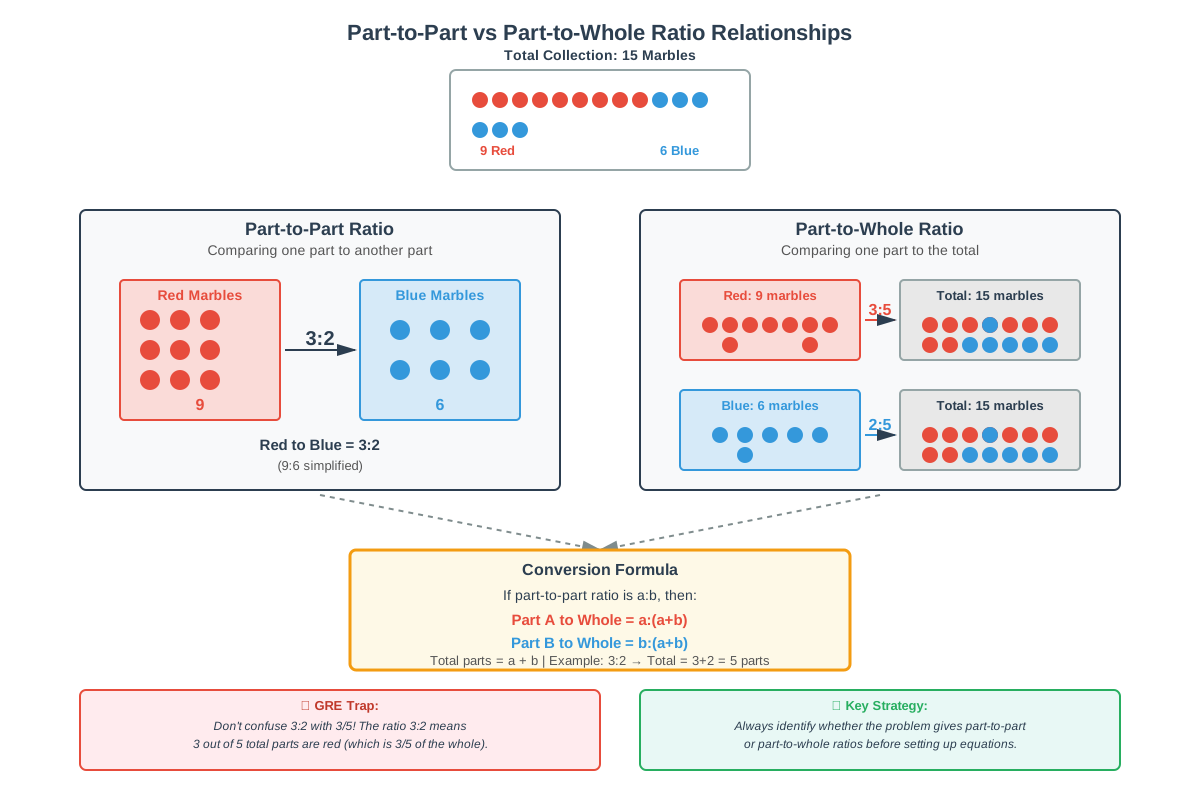
A ratio expresses the multiplicative relationship between two or more quantities. The fundamental distinction in ratio problems is between part-to-part ratios and part-to-whole ratios. A part-to-part ratio compares different components of a whole (e.g., "the ratio of men to women is 3:2"), while a part-to-whole ratio compares one component to the total (e.g., "men comprise 3/5 of the group").
Consider a classroom with students in the ratio of juniors to seniors of 4:5. This part-to-part ratio tells us that for every 4 juniors, there are 5 seniors. The total number of "ratio units" is 4 + 5 = 9. Therefore:
- Juniors represent 4/9 of the total (part-to-whole)
- Seniors represent 5/9 of the total (part-to-whole)
- The ratio of juniors to the total is 4:9
- The ratio of seniors to the total is 5:9
This conversion between part-to-part and part-to-whole representations is critical because GRE questions often provide information in one format and ask for answers in another format, testing whether students truly understand the underlying relationships.
The Ratio Multiplier Method
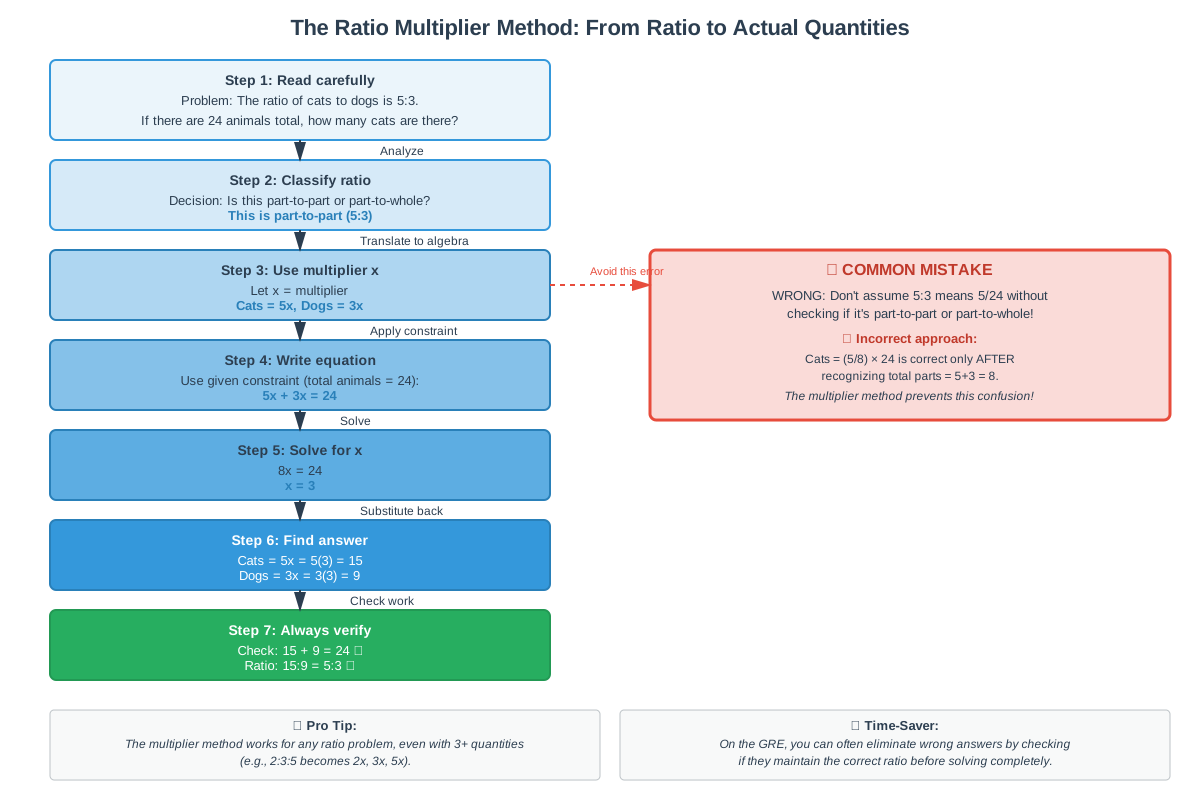
The most powerful technique for solving ratio word problems is the ratio multiplier method. When a ratio is given as a:b, we can represent the actual quantities as ax and bx, where x is the unknown multiplier. This approach transforms ratio problems into algebraic equations.
For example, if the ratio of cats to dogs is 3:7 and there are 40 total animals:
- Let cats = 3x and dogs = 7x
- Total: 3x + 7x = 40
- 10x = 40
- x = 4
- Therefore: cats = 3(4) = 12 and dogs = 7(4) = 28
This method works because ratios describe proportional relationships. The multiplier x represents the "size" of each ratio unit, and finding x allows us to determine all actual quantities. This technique is particularly valuable for problems involving three or more quantities in ratio relationships.
Ratio Scaling and Equivalent Ratios
Ratios can be scaled up or down by multiplying or dividing all terms by the same non-zero number, creating equivalent ratios. The ratio 2:3 is equivalent to 4:6, 6:9, 10:15, and infinitely many other ratios. This property allows us to:
- Simplify ratios by dividing by the greatest common factor (GCF)
- Find common denominators when combining ratios
- Scale ratios to match given constraints
When the GRE asks "which of the following ratios is equivalent to 15:25?", the correct approach is to simplify by dividing both terms by their GCF (5), yielding 3:5. Conversely, when combining ratios with different scales, we must find equivalent ratios with compatible terms.
Combining and Comparing Ratios
GRE ratio word problems frequently involve combining two or more separate ratios into a unified relationship. Consider: "In Group A, the ratio of men to women is 2:3. In Group B, the ratio of men to women is 3:4. If Group A has 30 people and Group B has 35 people, what is the ratio of men to women in the combined groups?"
The solution requires:
- Finding actual quantities in each group using the ratio multiplier method
- Adding corresponding quantities across groups
- Expressing the combined quantities as a new ratio
For Group A: 2x + 3x = 30, so x = 6, giving 12 men and 18 women
For Group B: 3y + 4y = 35, so y = 5, giving 15 men and 20 women
Combined: 27 men and 38 women, ratio = 27:38
This type of problem tests whether students understand that ratios cannot simply be added (2:3 + 3:4 ≠ 5:7) but must be converted to actual quantities first.
Ratio Change Problems
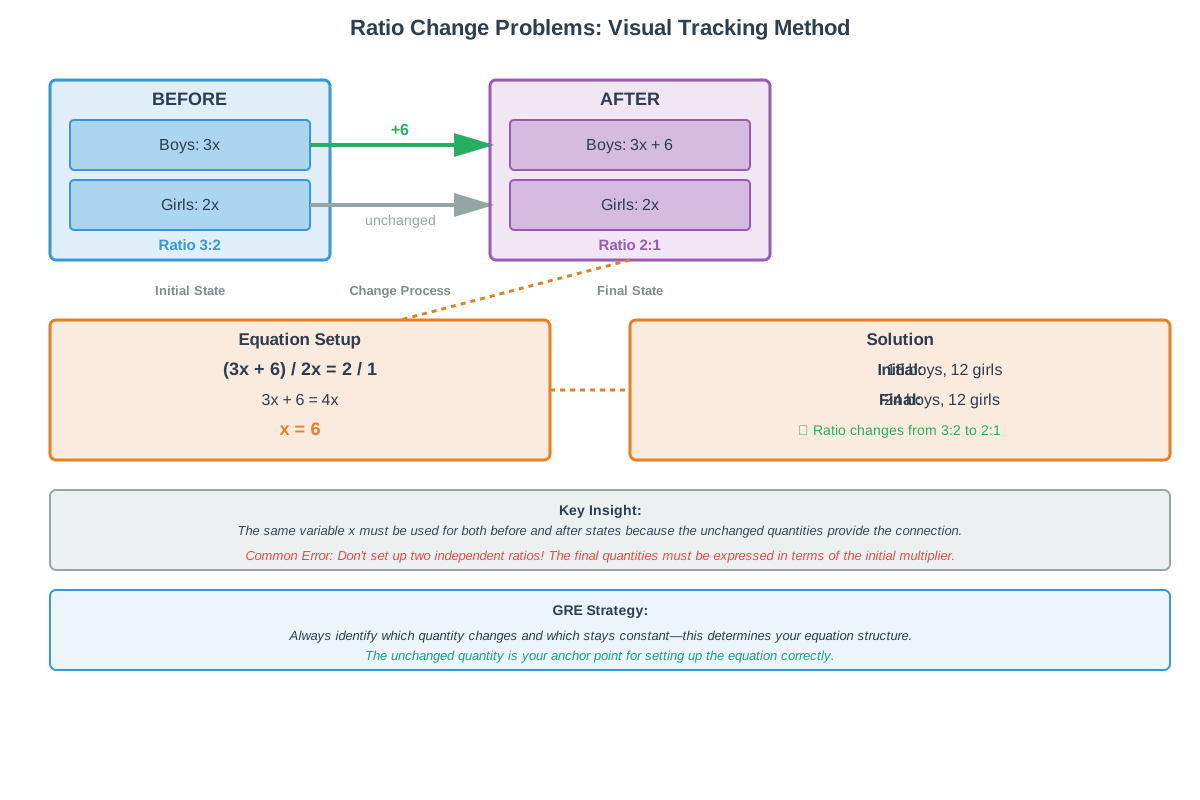
A particularly challenging category involves scenarios where quantities change and ratios shift accordingly. These problems require careful tracking of what changes and what remains constant. The key strategy is to set up equations that represent both the initial state and the final state.
Example framework: "A container has red and blue marbles in the ratio 5:3. After adding 10 red marbles, the ratio becomes 3:1. How many blue marbles are in the container?"
Let initial red marbles = 5x and blue marbles = 3x
After adding 10 red marbles: (5x + 10)/3x = 3/1
Cross-multiply: 5x + 10 = 9x
Solve: 10 = 4x, so x = 2.5
Blue marbles = 3(2.5) = 7.5... but this yields a non-integer, suggesting we need to reconsider the problem setup or check for calculation errors.
Inverse Ratios and Reciprocal Relationships
Some GRE problems test understanding of inverse relationships. If the ratio of A to B is 3:4, then the ratio of B to A is 4:3. This reciprocal relationship extends to more complex scenarios: if three quantities are in the ratio 2:3:5, then their reciprocals are in the ratio 1/2:1/3:1/5, which simplifies to 15:10:6 (by multiplying all terms by 30, the LCM of denominators).
Inverse ratio problems often appear in rate contexts: if Worker A completes a task in 3 hours and Worker B in 4 hours, their work rates are in the ratio 4:3 (inverse of time), not 3:4.
Concept Relationships
The core concepts in ratio word problems form an interconnected hierarchy. Understanding part-to-part versus part-to-whole relationships serves as the foundation, enabling students to correctly interpret problem statements and convert between different ratio representations. This foundational understanding → enables application of the ratio multiplier method, which transforms qualitative ratio relationships into quantitative algebraic equations.
The ratio multiplier method → connects directly to ratio scaling and equivalent ratios, as finding the multiplier often requires first simplifying ratios or scaling them to match given constraints. Both of these concepts → are prerequisites for combining and comparing ratios, where multiple ratio relationships must be unified through finding actual quantities.
Ratio change problems represent the synthesis of all previous concepts, requiring students to set up multiple equations representing different states, apply the multiplier method to each state, and track how changes in one quantity affect the overall ratio. Inverse ratios connect back to the foundational part-to-part understanding, testing whether students can mentally reverse relationships and recognize reciprocal patterns.
These ratio concepts connect to prerequisite knowledge of linear equations (every ratio multiplier problem becomes an equation-solving exercise), fractions (ratios are fractional relationships), and proportional reasoning (equivalent ratios are proportions). They extend forward to more advanced topics like rates and work problems (which are specialized ratio applications), mixture problems (combining ratios with weighted averages), and geometric similarity (ratios of corresponding sides).
Quick check — test yourself on Ratio word problems so far.
Try Flashcards →High-Yield Facts
⭐ A ratio a:b means for every a units of the first quantity, there are b units of the second quantity; actual amounts are ax and bx where x is the multiplier
⭐ In a ratio a:b, the first quantity represents a/(a+b) of the total and the second represents b/(a+b) of the total
⭐ Ratios can be simplified by dividing all terms by their greatest common factor, just like fractions
⭐ When combining groups with different ratios, you must find actual quantities first—you cannot add ratios directly
⭐ If a ratio changes after adding or removing quantities, set up equations for both the before and after states
- The ratio a:b:c means the quantities are in the relationship ax:bx:cx, and the total is (a+b+c)x
- Equivalent ratios are created by multiplying or dividing all terms by the same non-zero constant
- The ratio of A to B is the reciprocal of the ratio of B to A (if A:B = 3:4, then B:A = 4:3)
- In mixture problems, the ratio of components determines the concentration, and total volume equals the sum of all parts
- When a problem states "the ratio of A to B to C is 2:3:5," this provides two independent pieces of information (A:B and B:C)
- Ratio problems often include extraneous information; identify which quantities are actually needed to solve
- If a ratio is given as a fraction (e.g., "A is 3/4 of B"), convert to ratio form (A:B = 3:4) for easier manipulation
Common Misconceptions
Misconception: When combining two groups with ratios 2:3 and 4:5, the combined ratio is 6:8 (adding the ratios directly).
Correction: Ratios cannot be added directly. You must first determine actual quantities in each group using the ratio multiplier method, then add corresponding quantities, and finally express the sum as a new ratio. The combined ratio depends on the actual sizes of the groups being combined.
Misconception: If the ratio of boys to girls is 3:5, then there are 3 boys and 5 girls.
Correction: The ratio 3:5 means for every 3 boys there are 5 girls, but the actual numbers are 3x and 5x where x can be any positive number. There could be 6 boys and 10 girls (x=2), or 30 boys and 50 girls (x=10), or any other multiple of the ratio.
Misconception: In a ratio problem, if one quantity increases by 20%, the ratio increases by 20%.
Correction: Ratios are relationships between quantities, not quantities themselves. If A:B = 3:4 and A increases by 20%, the new ratio is 3.6:4 or 9:10 (after simplification), which is not a 20% increase in the ratio. The percentage change in a ratio depends on which quantity changes and by how much.
Misconception: The ratio 3:4 is the same as the fraction 3/4 in all contexts.
Correction: While 3:4 can be expressed as the fraction 3/4 when comparing the first quantity to the second, this is a part-to-part comparison. When dealing with totals, 3:4 means the first quantity is 3/7 of the total (part-to-whole), not 3/4. The distinction between part-to-part and part-to-whole is critical.
Misconception: If the ratio of A to B is 2:3 and the ratio of B to C is 4:5, then the ratio of A to C is 2:5.
Correction: To combine these ratios, B must have the same value in both ratios. Scale the ratios to make B equal: A:B = 8:12 and B:C = 12:15, so A:B:C = 8:12:15, making A:C = 8:15. You cannot simply take the first term of one ratio and the second term of another.
Misconception: In a ratio problem involving three quantities, knowing one ratio (like A:B) is sufficient to find all quantities if the total is given.
Correction: With three unknowns (A, B, C), you need two independent pieces of information plus the total. Knowing only A:B and the total (A+B+C) leaves C undetermined. You need either A:C, B:C, or A:B:C to solve completely.
Worked Examples
Example 1: Classic Ratio Distribution Problem
Problem: A sum of $7,200 is to be divided among three partners—Alice, Bob, and Carol—in the ratio 3:5:7. How much more money does Carol receive than Alice?
Solution:
Step 1: Identify the problem type. This is a distribution problem where a total is divided according to a given ratio. We need to find actual amounts using the ratio multiplier method.
Step 2: Set up the ratio multiplier. Let Alice's share = 3x, Bob's share = 5x, and Carol's share = 7x.
Step 3: Write an equation using the total. The sum of all shares equals the total:
3x + 5x + 7x = 7,200
15x = 7,200
x = 480
Step 4: Calculate individual shares:
- Alice: 3(480) = $1,440
- Bob: 5(480) = $2,400
- Carol: 7(480) = $3,360
Step 5: Answer the specific question. The difference between Carol's and Alice's shares:
$3,360 - $1,440 = $1,920
Key Insight: This problem demonstrates the ratio multiplier method's power. By representing each share as a multiple of x, we converted a ratio problem into a simple linear equation. Always verify that your calculated shares sum to the given total: 1,440 + 2,400 + 3,360 = 7,200 ✓
Example 2: Ratio Change Problem
Problem: In a classroom, the ratio of students who prefer mathematics to those who prefer literature is 4:3. After 6 students who prefer literature join the class, the ratio becomes 4:5. How many students originally preferred mathematics?
Solution:
Step 1: Define variables for the initial state. Let initial math-preferring students = 4x and initial literature-preferring students = 3x.
Step 2: Express the final state. After 6 literature-preferring students join:
- Math-preferring students: 4x (unchanged)
- Literature-preferring students: 3x + 6
Step 3: Set up an equation using the new ratio. The new ratio is 4:5, which means:
(4x)/(3x + 6) = 4/5
Step 4: Cross-multiply and solve:
5(4x) = 4(3x + 6)
20x = 12x + 24
8x = 24
x = 3
Step 5: Find the answer. Original math-preferring students = 4x = 4(3) = 12
Verification: Initially: 12 math, 9 literature (ratio 12:9 = 4:3 ✓)
After change: 12 math, 15 literature (ratio 12:15 = 4:5 ✓)
Key Insight: Ratio change problems require setting up equations that represent both states. The critical step is identifying what changes (literature students increased by 6) and what stays constant (math students remained at 4x). Always verify your answer by checking both the initial and final ratios.
Exam Strategy
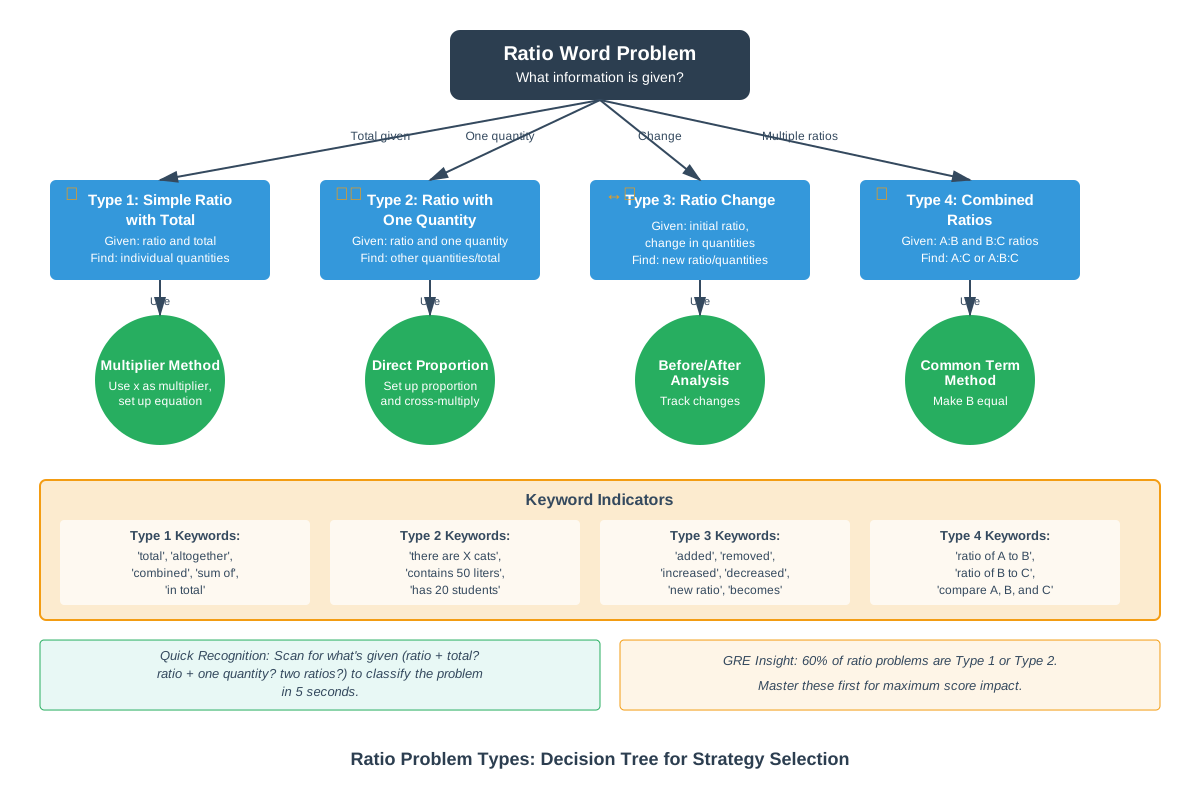
When approaching GRE ratio word problems, begin by identifying the problem type through trigger words and phrases. Look for "ratio of," "for every," "proportion," "distributed according to," or "in the ratio." These phrases signal that the problem requires ratio reasoning rather than simple arithmetic.
The first strategic decision is choosing between the ratio multiplier method and setting up a proportion. For problems involving totals or multiple quantities, the ratio multiplier method (representing quantities as ax, bx, cx) is almost always more efficient. For problems comparing two scenarios or asking "if this, then that," setting up a proportion may be faster. Practice both approaches to develop intuition about which fits each problem.
Exam Tip: In Quantitative Comparison questions involving ratios, avoid calculating actual values unless necessary. Often you can compare ratios directly by cross-multiplying or finding common denominators, saving valuable time.
Process-of-elimination strategies are particularly effective for ratio problems. If a problem asks for a ratio and provides answer choices, you can often eliminate options that don't simplify correctly or that violate basic constraints (like having more of something than the total). For Numeric Entry questions, always verify that your answer makes logical sense—if you calculate that a classroom has 47.3 students, you've made an error.
Time allocation for ratio problems should average 1.5-2 minutes per question. If you find yourself spending more than 2.5 minutes, you may be overcomplicating the problem. Common time traps include: trying to solve for every quantity when the question only asks for one, failing to simplify ratios before working with them, and not recognizing that a problem requires the ratio multiplier method. If stuck, write out what you know, what you need, and what connects them—this often reveals the solution path.
Watch for problems that provide ratios in different formats (one as "3 to 4" and another as "5:7") or that mix ratios with percentages or fractions. These require careful conversion to a common format before solving. Also be alert for problems where the ratio changes—these always require setting up multiple equations representing different states.
Memory Techniques
Mnemonic for Part-to-Whole Conversion: "Part Over Total Sums" (POTS)
- Part = the specific ratio term
- Over = division
- Total = sum of all ratio terms
- Sums = add the ratio terms to get the denominator
For a ratio a:b, the first part is a/(a+b) of the total.
Visualization Strategy: Picture ratios as physical objects in containers. If the ratio of red to blue marbles is 3:5, visualize three red marbles and five blue marbles in a bag. When the problem says "there are 40 marbles total," imagine filling multiple bags with this 3:5 pattern until you reach 40 marbles. This concrete visualization helps prevent the common error of thinking 3:5 means exactly 3 and 5.
The "X Marks the Spot" Technique: Always write "x" next to each ratio term when setting up problems (3x, 5x, 7x). This physical reminder that you're working with multiples, not actual quantities, prevents the misconception that a ratio gives exact values.
Acronym for Ratio Change Problems: BEAST
- Before state: write the initial ratio equation
- Event: identify what changes
- After state: write the new ratio equation
- Solve: set up and solve the equation
- Test: verify your answer in both states
The Reciprocal Flip: When you see "the ratio of A to B," physically write "A:B" and then immediately write "B:A" below it with an arrow, reminding yourself that the inverse ratio exists. This prevents confusion when problems ask for ratios in different orders.
Summary
Ratio word problems on the GRE test the ability to translate verbal descriptions of proportional relationships into mathematical equations and solve for unknown quantities. The fundamental skill is distinguishing between part-to-part ratios (comparing components to each other) and part-to-whole ratios (comparing components to the total), then converting between these representations as needed. The ratio multiplier method—representing quantities in a ratio a:b as ax and bx—provides the most powerful and versatile solution strategy, transforming ratio problems into algebraic equations. Success requires recognizing that ratios describe relationships, not fixed quantities, and that actual values depend on a multiplier that must be determined from additional constraints like totals or other given quantities. Common problem types include distribution problems (dividing totals according to ratios), combination problems (merging groups with different ratios), and change problems (tracking how ratios shift when quantities are added or removed). Mastery demands both conceptual understanding of proportional relationships and procedural fluency with algebraic manipulation, making ratio problems an ideal assessment of quantitative reasoning skills.
Key Takeaways
- Ratios express multiplicative relationships; a:b means actual quantities are ax and bx where x is the unknown multiplier
- Always distinguish between part-to-part ratios (comparing components) and part-to-whole ratios (comparing to the total)
- Use the ratio multiplier method for problems involving totals: set quantities as multiples of x, write an equation, and solve
- Ratios cannot be added directly; when combining groups, find actual quantities first, then create a new ratio
- For ratio change problems, set up separate equations for the before and after states, identifying what changes and what remains constant
- Simplify ratios by dividing all terms by their GCF before performing calculations to reduce arithmetic complexity
- Verify answers by checking that calculated quantities maintain the given ratio relationships and sum to stated totals
Related Topics
Proportion and Percent Problems: Ratios form the foundation for understanding proportions and percentage relationships. Mastering ratio word problems enables progression to more complex percentage change problems and proportional reasoning in data interpretation.
Mixture Problems: These specialized ratio problems involve combining substances with different concentrations or properties, requiring both ratio reasoning and weighted average calculations.
Rate and Work Problems: Rates are ratios of quantities to time, making ratio fluency essential for solving problems about speed, work completion, and combined rates.
Similar Figures in Geometry: Geometric similarity relies on ratios of corresponding sides, connecting ratio concepts to spatial reasoning and area/volume scaling.
Probability and Statistics: Many probability problems involve ratios of favorable to total outcomes, and statistical measures like odds ratios build directly on ratio concepts.
Practice CTA
Now that you've mastered the core concepts and strategies for GRE ratio word problems, it's time to solidify your understanding through active practice. Work through the practice questions to apply the ratio multiplier method, test your ability to distinguish part-to-part from part-to-whole relationships, and build speed with ratio change problems. Use the flashcards to reinforce high-yield facts and common problem patterns. Remember: ratio problems reward systematic approaches and careful setup more than computational speed. Each practice problem you solve strengthens your pattern recognition and builds the confidence you need to tackle any ratio scenario on test day. You've got this!
Sign up free to keep reading
Create a free AnvayaPrep account to finish this GRE guide on Ratio word problems — plus flashcards and practice questions.