Overview
Age problems are a classic category of word problems that appear regularly on the GRE Quantitative Reasoning section. These problems involve relationships between the ages of two or more people at different points in time—past, present, or future. While they may initially seem complex due to the multiple time frames and relationships involved, age problems follow predictable patterns and can be solved systematically using algebraic equations or logical reasoning.
Understanding gre age problems is essential because they test multiple mathematical competencies simultaneously: the ability to translate verbal information into algebraic expressions, manipulate equations with multiple variables, and think logically about temporal relationships. Age problems frequently appear as medium-difficulty questions on the GRE, making them ideal opportunities to secure points that separate average scores from competitive ones. These problems also serve as excellent practice for the broader category of relationship-based word problems that constitute a significant portion of the Quantitative Reasoning section.
Age problems connect to fundamental algebraic concepts including linear equations, systems of equations, and variable manipulation. They also reinforce critical thinking skills needed for other word problem types such as work-rate problems, mixture problems, and distance-rate-time problems. Mastering age problems builds confidence in translating complex verbal scenarios into mathematical models—a skill that extends beyond standardized testing into real-world quantitative reasoning.
Learning Objectives
- [ ] Identify when Age problems is being tested
- [ ] Explain the core rule or strategy behind Age problems
- [ ] Apply Age problems to GRE-style questions accurately
- [ ] Construct algebraic equations from verbal age relationships involving multiple time periods
- [ ] Recognize and avoid common algebraic errors when working with past and future ages
- [ ] Solve age problems using both algebraic and logical reasoning approaches
- [ ] Verify solutions by checking consistency across all stated conditions
Prerequisites
- Basic algebra and equation solving: Age problems require setting up and solving linear equations and systems of equations with one or two variables
- Variable representation: Understanding how to assign variables to unknown quantities and manipulate them algebraically
- Word problem translation skills: The ability to convert verbal statements into mathematical expressions and equations
- Arithmetic operations: Facility with addition, subtraction, multiplication, and division to perform calculations efficiently
Why This Topic Matters
Age problems appear in approximately 5-8% of GRE Quantitative Reasoning questions, making them a high-yield topic for focused study. They typically appear as Problem Solving questions in the multiple-choice format, though they occasionally show up in Quantitative Comparison questions where students must compare age relationships rather than calculate specific values.
In real-world contexts, age problems mirror the logical reasoning required in fields such as genealogy, legal documentation, insurance actuarial work, and demographic analysis. The skills developed through age problems—particularly the ability to track multiple variables across different time periods—transfer directly to project management, financial planning, and data analysis scenarios where conditions change over time.
On the GRE, age problems commonly appear disguised within longer word problems or combined with other concepts such as ratios, percentages, or averages. Test-makers favor age problems because they efficiently assess whether students can maintain logical consistency across multiple constraints, avoid sign errors when working with past versus future time frames, and verify their solutions against all given conditions. Questions may involve two people (most common), three people (moderate difficulty), or occasionally more complex family relationships that require careful organization of information.
Core Concepts
The Fundamental Age Relationship
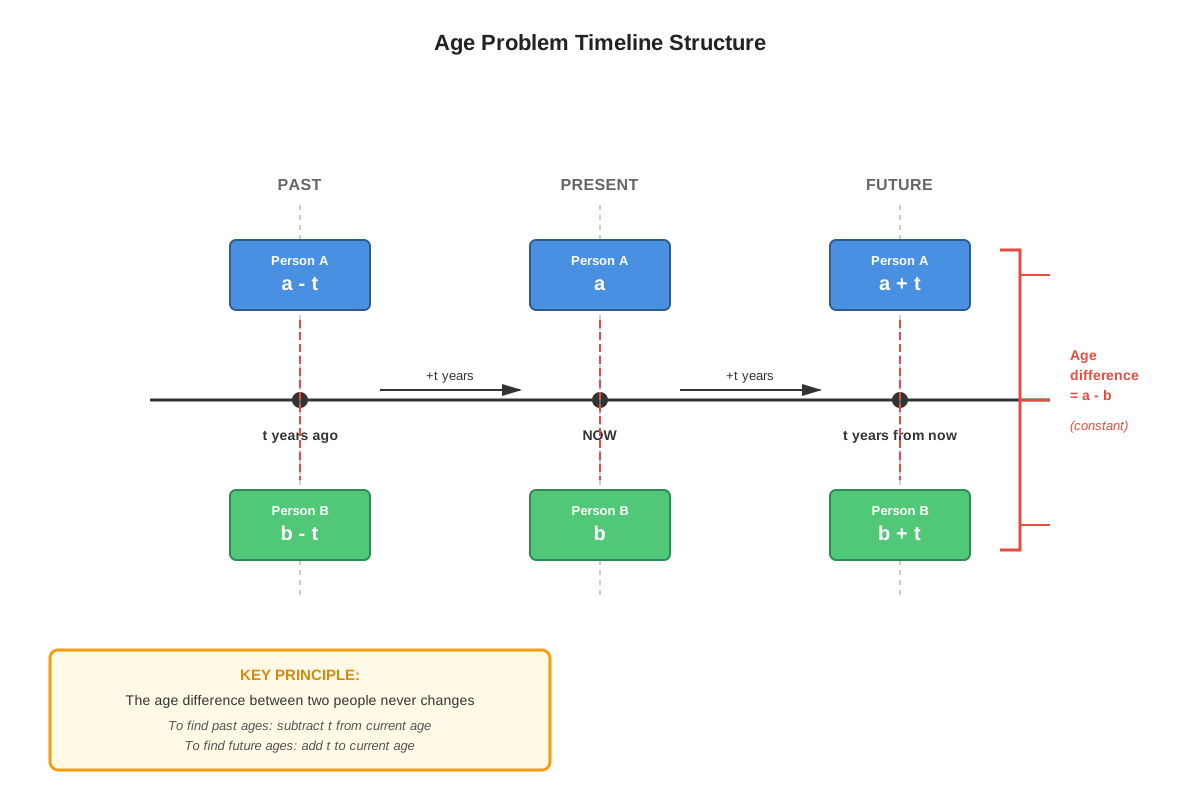
The cornerstone principle underlying all age problems is that the difference between two people's ages remains constant over time. If Person A is 5 years older than Person B today, Person A was 5 years older than Person B ten years ago and will be 5 years older than Person B twenty years from now. This invariant relationship provides the logical foundation for setting up equations.
When working with ages at different time periods, establish a reference point—typically the present—and define all other ages relative to this point. If someone's current age is represented by variable x, their age n years ago was (x - n), and their age n years from now will be (x + n).
Setting Up Variables
The most efficient approach to age problems involves assigning variables strategically. For problems involving two people, typically assign a variable to one person's current age and express the other person's age in terms of that variable using the given relationship.
Standard variable assignment approach:
- Let x = the current age of one person (usually the younger or the person with less information given)
- Express the other person's current age using x and the stated relationship
- Write expressions for past or future ages by subtracting or adding the time difference
- Set up an equation based on the relationship stated for the different time period
Time Frame Management
Age problems involve three potential time frames: past, present, and future. Careful tracking of these time frames prevents the most common errors in age problems.
| Time Frame | Expression for Current Age x | Key Consideration |
|---|---|---|
| n years ago | x - n | Subtract time elapsed |
| Present | x | Reference point |
| n years from now | x + n | Add time to come |
When a problem states "5 years ago" or "in 10 years," apply this time shift to all people involved in the problem. A frequent error occurs when students correctly adjust one person's age but forget to adjust the other person's age by the same amount.
Ratio-Based Age Problems
Many GRE age problems involve ratios between ages at different times. When ages are given as ratios, remember that ratios represent relative quantities, not absolute differences.
If the ratio of Person A's age to Person B's age is 3:2, this can be expressed as:
- Person A's age = 3k for some constant k
- Person B's age = 2k for the same constant k
The key insight is that while the ratio between ages changes over time, the absolute difference remains constant. If Person A is currently 30 and Person B is 20 (ratio 3:2, difference 10), then 10 years ago they were 20 and 10 (ratio 2:1, difference still 10).
Multiple Person Problems
Problems involving three or more people require systematic organization. Create a table to track each person's age across different time periods:
Example structure:
                Past        Present     Future
Person A:       (A-n)         A         (A+n)
Person B:       (B-n)         B         (B+n)
Person C:       (C-n)         C         (C+n)
Establish relationships between variables using the given conditions, then solve the resulting system of equations.
Sum and Product Relationships
Some age problems provide information about the sum or product of ages rather than direct comparisons. These problems require careful algebraic setup:
- Sum problems: "The sum of their ages is 50" → A + B = 50
- Product problems: "The product of their ages is 144" → A × B = 144
- Combined conditions: Often paired with ratio or difference information to create solvable systems
Verification Strategy
After solving for ages, always verify the solution by checking it against all stated conditions in the problem, not just the equation you solved. Calculate the ages at each mentioned time period and confirm that all relationships hold true. This verification step catches algebraic errors and ensures logical consistency.
Concept Relationships
Age problems integrate several mathematical concepts in a hierarchical structure. At the foundation lies variable representation, which enables the translation of verbal age relationships into algebraic expressions. This connects directly to equation construction, where relationships at different time periods become mathematical equations.
The constant age difference principle serves as the logical bridge between different time frames, ensuring consistency across past, present, and future scenarios. This principle connects to linear equation properties, as age relationships over time form linear functions.
Ratio concepts intersect with age problems when problems express relationships as proportions rather than absolute differences. Understanding that ratios change over time while absolute differences remain constant links ratio reasoning to algebraic manipulation.
For complex problems involving multiple people, systems of equations become necessary, connecting age problems to broader algebraic problem-solving strategies. The verification process links back to logical reasoning and arithmetic checking, completing the problem-solving cycle.
Relationship flow: Variable Assignment → Expression Building → Equation Formation → Algebraic Solution → Arithmetic Verification → Logical Consistency Check
High-Yield Facts
⭐ The difference between two people's ages never changes over time, regardless of whether you're looking at the past, present, or future.
⭐ When moving backward or forward in time, adjust ALL people's ages by the same amount—this is the most common source of errors in age problems.
⭐ The ratio between two people's ages changes over time, even though their age difference remains constant.
⭐ Always define a clear reference point (usually the present) and express all other ages relative to this point.
⭐ For problems involving "n years ago," subtract n from current ages; for "n years from now," add n to current ages.
- Age problems typically involve setting up one or two equations with one or two unknowns, making them solvable with basic algebra.
- When ages are given as a ratio (e.g., 3:2), introduce a multiplier variable k to represent both ages as multiples of this common factor.
- The sum of two people's ages increases by 2 for each year that passes (each person ages 1 year).
- If Person A is currently n times as old as Person B, Person A was more than n times as old in the past and will be less than n times as old in the future.
- Problems asking "how many years ago" or "how many years from now" are asking for the time variable, not the ages themselves.
- When a problem states someone's age as a fraction or multiple of another's age, this creates a ratio relationship that can be expressed algebraically.
- Age problems never involve negative ages—if your solution yields a negative age, you've made an algebraic or logical error.
Quick check — test yourself on Age problems so far.
Try Flashcards →Common Misconceptions
Misconception: The ratio between two people's ages remains constant over time.
Correction: Only the absolute difference between ages remains constant. Ratios change as people age. If Person A (30) is currently 3 times as old as Person B (10), in 10 years Person A (40) will only be 2 times as old as Person B (20).
Misconception: When calculating ages "5 years ago," only subtract 5 from the person mentioned in that part of the problem.
Correction: Time shifts apply to everyone in the problem simultaneously. If you're examining the situation 5 years ago, subtract 5 from all people's current ages.
Misconception: If Person A is 10 years older than Person B, then Person A's age divided by Person B's age equals 10.
Correction: An age difference of 10 means A = B + 10, not A = 10B. The difference is additive, not multiplicative.
Misconception: Setting up the equation is sufficient; checking the answer is unnecessary.
Correction: Always verify your solution against all given conditions. Algebraic errors are common in age problems, and verification catches mistakes before you select an incorrect answer.
Misconception: In ratio problems, you can directly use the ratio numbers as the actual ages.
Correction: Ratios represent relative proportions, not actual values. If ages are in ratio 3:2, the actual ages might be 30 and 20, or 15 and 10, or any other pair maintaining that ratio. You must introduce a multiplier variable to find actual ages.
Misconception: "Twice as old" and "twice older" mean the same thing.
Correction: "Twice as old" means one age is 2 times the other (A = 2B). "Twice older" technically means the difference is twice the other age (A = B + 2B = 3B), though this phrasing is rare on the GRE, which uses precise mathematical language.
Worked Examples
Example 1: Basic Two-Person Age Problem
Problem: Sarah is currently 3 times as old as her daughter Emma. In 12 years, Sarah will be twice as old as Emma. How old is Sarah now?
Solution:
Step 1: Define variables
Let E = Emma's current age
Then Sarah's current age = 3E (since Sarah is 3 times as old)
Step 2: Set up expressions for future ages
In 12 years:
- Emma's age will be: E + 12
- Sarah's age will be: 3E + 12
Step 3: Create equation from future relationship
The problem states that in 12 years, Sarah will be twice as old as Emma:
3E + 12 = 2(E + 12)
Step 4: Solve the equation
3E + 12 = 2E + 24
3E - 2E = 24 - 12
E = 12
Step 5: Find Sarah's current age
Sarah's current age = 3E = 3(12) = 36
Step 6: Verify the solution
- Currently: Sarah is 36, Emma is 12. Sarah is 3 times as old as Emma. ✓
- In 12 years: Sarah will be 48, Emma will be 24. Sarah will be twice as old as Emma. ✓
Answer: Sarah is currently 36 years old.
Connection to learning objectives: This example demonstrates identifying age problem structure, applying the core strategy of variable assignment and time-frame management, and verifying solutions for accuracy.
Example 2: Past Age Relationship Problem
Problem: The sum of John's and Michael's current ages is 50. Five years ago, John was 4 times as old as Michael. What is John's current age?
Solution:
Step 1: Define variables
Let M = Michael's current age
Let J = John's current age
Step 2: Set up equation from current relationship
J + M = 50
Step 3: Express past ages
Five years ago:
- Michael's age was: M - 5
- John's age was: J - 5
Step 4: Set up equation from past relationship
Five years ago, John was 4 times as old as Michael:
J - 5 = 4(M - 5)
Step 5: Simplify the second equation
J - 5 = 4M - 20
J = 4M - 15
Step 6: Substitute into first equation
(4M - 15) + M = 50
5M - 15 = 50
5M = 65
M = 13
Step 7: Find John's age
J = 4(13) - 15 = 52 - 15 = 37Step 8: Verify the solution
- Currently: John is 37, Michael is 13. Sum = 50. ✓
- Five years ago: John was 32, Michael was 8. 32 = 4(8). ✓
Answer: John is currently 37 years old.
Connection to learning objectives: This example illustrates handling systems of equations in age problems, managing past time frames correctly, and applying verification to ensure all conditions are satisfied.
Exam Strategy
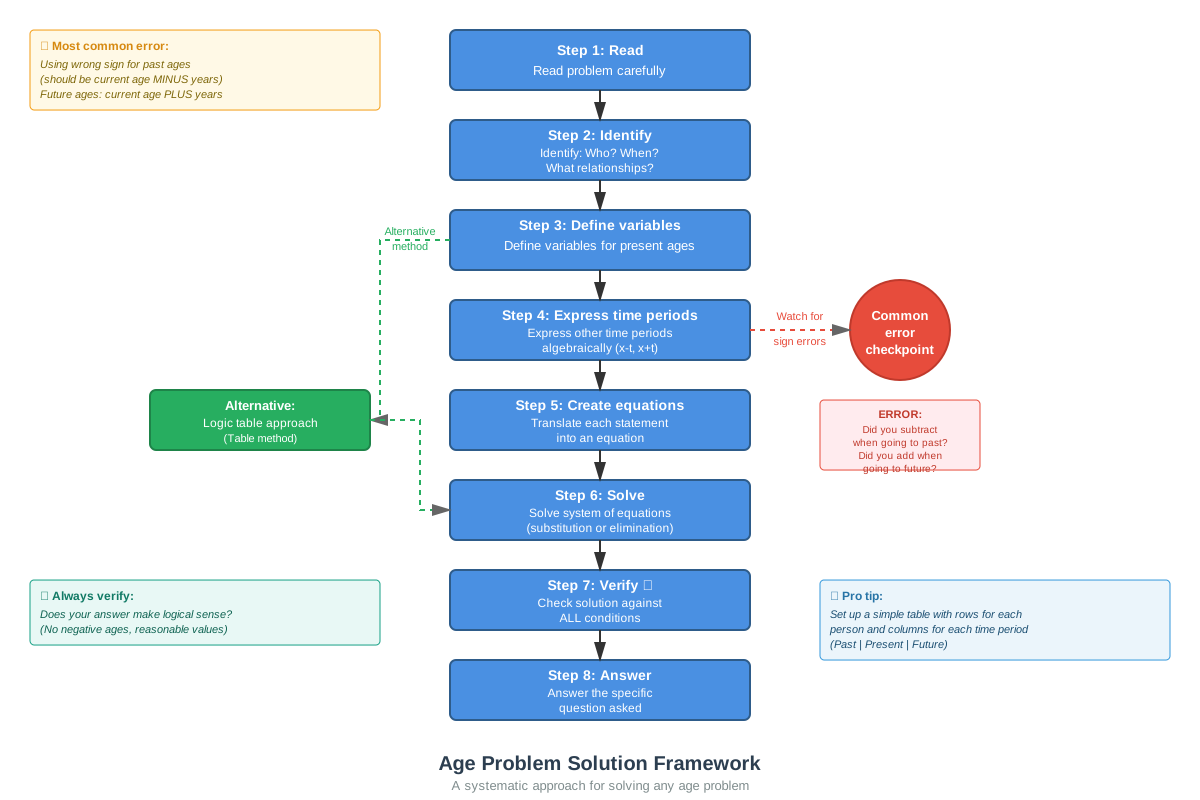
When approaching gre age problems on test day, follow this systematic process:
1. Identify the problem type: Look for trigger phrases such as "years ago," "years from now," "times as old," "sum of ages," or "ratio of ages." These signal an age problem requiring temporal relationship tracking.
2. Organize the information: Before writing any equations, create a mental or written table showing:
- Who is involved
- What time periods are mentioned (past, present, future)
- What relationships are stated for each time period
3. Choose your variable strategically: Assign your variable to the person or time period that appears most frequently or has the least complex relationships. Often, assigning the variable to the younger person's current age simplifies the algebra.
4. Write all expressions before creating equations: First express all ages at all time periods in terms of your variable(s), then construct equations from the stated relationships. This prevents mixing up time frames.
5. Solve systematically: Use substitution or elimination for systems of equations. Show your work to avoid arithmetic errors under time pressure.
Exam Tip: If a problem asks for "how many years ago" or "how many years from now," you're solving for the time variable, not an age. Make sure you answer the question that was actually asked.
Time allocation: Allocate 1.5-2 minutes for standard two-person age problems. If a problem involves three or more people or complex ratio relationships, allow up to 2.5 minutes. If you're not making progress after 1 minute, mark the question and return to it later.
Process of elimination strategies:
- Eliminate answers that would result in negative ages at any time period
- Eliminate answers that violate the constant age difference principle
- For ratio problems, eliminate answers where the ratio doesn't simplify to the stated proportion
- Check extreme answers first—they're often included as trap answers for common algebraic errors
Trigger words and phrases to watch for:
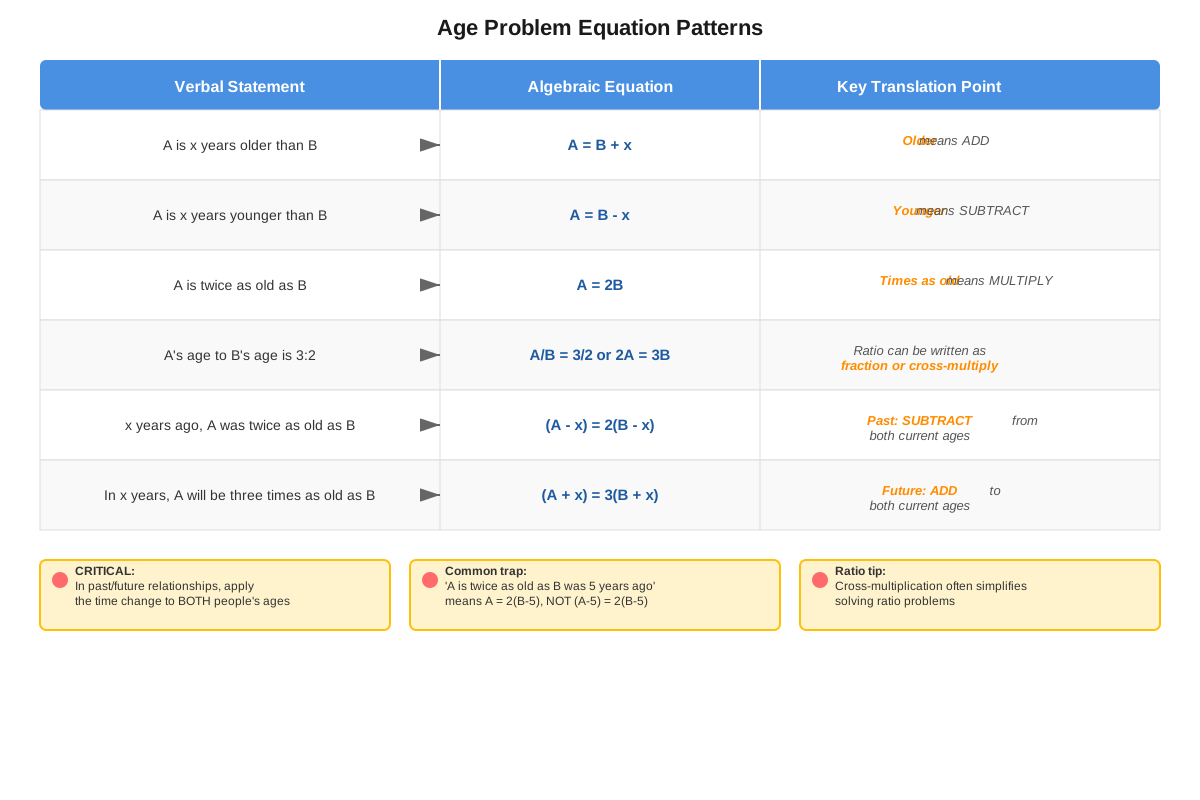
- "times as old" → multiplicative relationship (ratio)
- "years older/younger" → additive relationship (difference)
- "sum of ages" → addition equation
- "ago" → subtract from current age
- "from now" or "in X years" → add to current age
- "will be" → future time frame
- "was" → past time frame
Memory Techniques
ADAPT Mnemonic for solving age problems:
- Assign variables to current ages
- Define relationships between people
- Adjust for time periods (past/future)
- Produce equations from stated conditions
- Test your solution against all conditions
Visualization Strategy: Picture a timeline with the present in the middle, past on the left, and future on the right. Place each person's age at each relevant time point on this timeline. This visual representation helps prevent time-frame confusion.
The Constant Difference Rule: Remember the phrase "Age gaps never change" to recall that while ratios between ages vary over time, the absolute difference remains fixed.
Direction Memory Aid:
- Backward in time = Subtract years
- Forward in time = Add years
- Think: "Back-tract" (backward-subtract) and "Forward-add"
Ratio vs. Difference Distinction: Use the phrase "Ratios Vary, Differences Don't" (RVD) to remember that ratios between ages change over time while differences remain constant.
Summary
Age problems constitute a high-yield category of GRE word problems that test algebraic translation, equation-solving skills, and logical reasoning across multiple time frames. The fundamental principle underlying all age problems is that the difference between two people's ages remains constant over time, even as the ratio between their ages changes. Success with age problems requires systematic variable assignment, careful tracking of past, present, and future time frames, and rigorous verification of solutions against all stated conditions. Most age problems involve setting up one or two linear equations based on relationships at different time periods, then solving algebraically. The key to avoiding common errors is ensuring that time shifts (years ago or years from now) are applied consistently to all people involved and that the final answer is checked against every condition stated in the problem. With practice, age problems become highly predictable and represent reliable scoring opportunities on the GRE Quantitative Reasoning section.
Key Takeaways
- The difference between two people's ages never changes, but the ratio between their ages does change over time
- Always apply time shifts (years ago/from now) to all people in the problem simultaneously
- Assign variables strategically, typically to the younger person's current age or the person with simpler relationships
- Create expressions for all ages at all relevant time periods before setting up equations
- Verify your solution by checking it against every stated condition, not just the equation you solved
- Watch for trigger words: "times as old" indicates ratios, "years older" indicates differences, "ago" means subtract, "from now" means add
- Age problems typically require 1.5-2 minutes; if stuck after 1 minute, mark and return later
Related Topics
Systems of Linear Equations: Age problems involving three or more people require solving systems with multiple variables, making this a natural extension of age problem skills.
Ratio and Proportion Problems: Understanding how ratios change over time in age problems builds the foundation for more complex ratio problems involving mixtures, scaling, and proportional relationships.
Work-Rate Problems: These problems share the same algebraic structure as age problems but involve rates of work completion rather than ages, requiring similar equation-setup and time-management skills.
Distance-Rate-Time Problems: Like age problems, these involve tracking quantities across different time periods and maintaining consistency in temporal relationships.
Algebraic Word Problems (General): Mastering age problems develops the broader skill of translating verbal information into mathematical models, applicable to all word problem categories on the GRE.
Practice CTA
Now that you've mastered the core concepts, strategies, and common pitfalls of age problems, it's time to solidify your understanding through active practice. Attempt the practice questions associated with this topic, focusing on applying the systematic approach outlined in this guide. Use the flashcards to reinforce key principles like the constant age difference rule and proper time-frame management. Remember, age problems are highly predictable once you've internalized the patterns—each practice problem you complete builds the pattern recognition and algebraic fluency that will serve you on test day. You've got this!
Sign up free to keep reading
Create a free AnvayaPrep account to finish this GRE guide on Age problems — plus flashcards and practice questions.