Overview
Translating words to equations is one of the most fundamental and frequently tested skills in GRE Quantitative Reasoning. This skill forms the bridge between verbal problem descriptions and mathematical solutions, requiring test-takers to convert English phrases and sentences into algebraic expressions and equations that can be solved systematically. The ability to perform this translation accurately and efficiently is essential because nearly every word problem on the GRE—whether involving percentages, ratios, rates, geometry, or statistics—requires this initial conversion step before any mathematical operations can be performed.
On the GRE, GRE translating words to equations appears not as an isolated skill but as the critical first step in solving complex multi-step problems. Test-makers deliberately craft word problems with varying levels of linguistic complexity, sometimes using straightforward language and other times employing indirect phrasing, passive voice, or reversed order to test whether students truly understand the mathematical relationships being described. Students who master this translation process gain a significant advantage because they can quickly identify what the problem is asking, set up the correct mathematical framework, and avoid the trap answers that result from misinterpreting the problem statement.
This topic connects directly to virtually every other area of GRE Quantitative Reasoning. Whether solving age problems, mixture problems, work-rate questions, or geometric scenarios, the first and most crucial step is always translating the verbal description into mathematical notation. Students who struggle with this skill often find themselves unable to even begin solving problems, despite having strong computational abilities. Conversely, those who excel at translation can approach even unfamiliar problem types with confidence, knowing they can systematically convert any verbal description into solvable equations.
Learning Objectives
- [ ] Identify when Translating words to equations is being tested
- [ ] Explain the core rule or strategy behind Translating words to equations
- [ ] Apply Translating words to equations to GRE-style questions accurately
- [ ] Recognize and correctly translate common mathematical phrases and their variations
- [ ] Distinguish between similar-sounding phrases that represent different mathematical operations
- [ ] Construct systems of equations from multi-part word problem descriptions
- [ ] Identify and define appropriate variables for unknown quantities in complex scenarios
Prerequisites
- Basic algebraic operations: Understanding how to manipulate equations, combine like terms, and solve for variables is essential because translation produces equations that must then be solved
- Order of operations (PEMDAS): Necessary for correctly structuring complex expressions when multiple operations appear in a single phrase
- Understanding of variables: Familiarity with using letters to represent unknown quantities forms the foundation of algebraic translation
- Basic arithmetic relationships: Knowledge of how addition, subtraction, multiplication, and division relate to real-world scenarios enables accurate interpretation of word problems
Why This Topic Matters
In real-world applications, translating words to equations is the fundamental skill underlying data analysis, financial planning, engineering calculations, and scientific research. Professionals in virtually every quantitative field must regularly interpret verbal descriptions of problems and convert them into mathematical models. Whether calculating medication dosages, analyzing business metrics, or designing structures, the ability to move fluidly between verbal and mathematical representations is indispensable.
On the GRE specifically, this skill appears in approximately 40-50% of all Quantitative Reasoning questions. While some questions test translation directly through straightforward word problems, many others embed this skill within more complex scenarios involving multiple concepts. The GRE features translation-heavy questions in several formats: Quantitative Comparison questions that describe relationships verbally, Problem Solving questions with multi-step word problems, and Data Interpretation questions that require translating verbal descriptions of data relationships into mathematical form.
Common manifestations on the exam include age problems ("John is twice as old as Mary was three years ago"), rate problems ("Two trains leave stations 300 miles apart"), percent problems ("The price increased by 20% and then decreased by 15%"), and mixture problems ("How many liters of 30% solution must be added to 40% solution"). The GRE also frequently tests this skill through questions about consecutive integers, geometric relationships described verbally, and work-rate scenarios. Test-makers particularly favor questions where the verbal description uses indirect or reversed phrasing, as these most effectively distinguish students who truly understand the mathematical relationships from those who are pattern-matching.
Core Concepts
Basic Translation Patterns
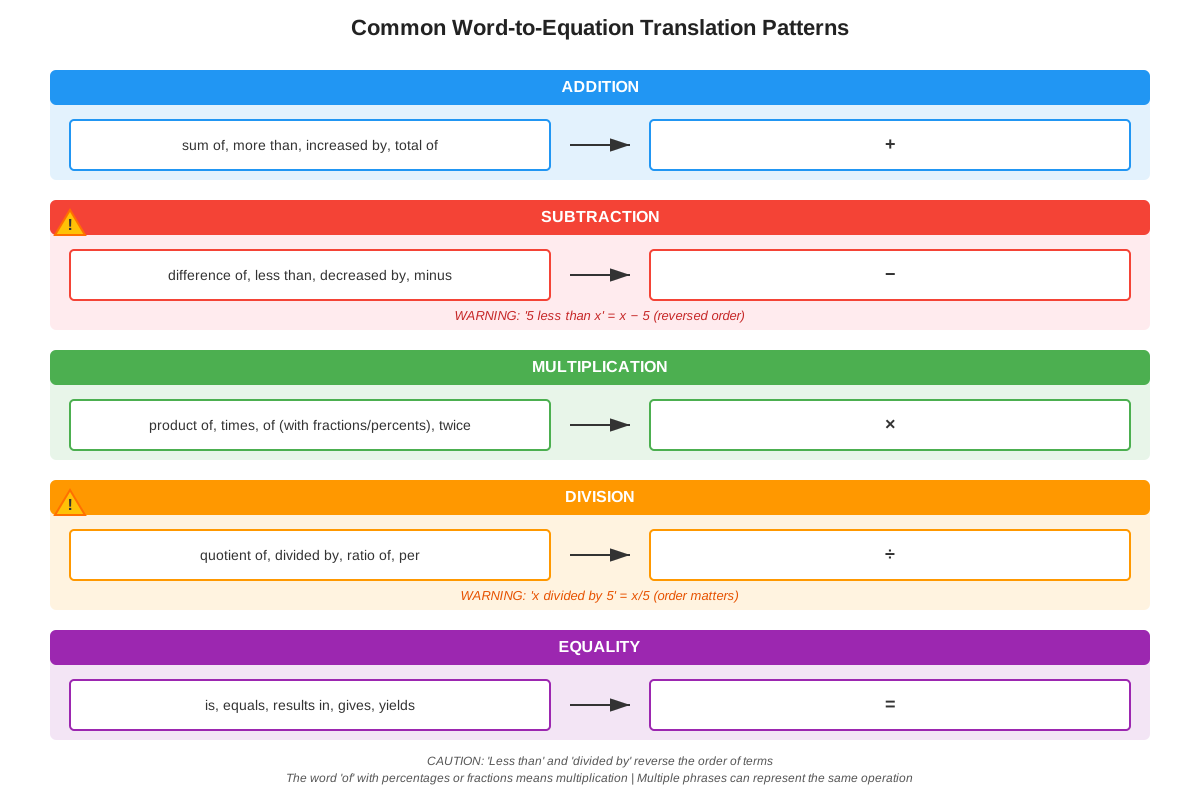
The foundation of translating words to equations rests on recognizing standard phrases and their mathematical equivalents. The word "is" typically translates to an equals sign (=), serving as the pivot point of most equations. When a problem states "x is 5," this directly becomes x = 5. The phrase "is equal to" or "equals" similarly translates to the equals sign.
Addition is indicated by numerous phrases: "sum," "total," "more than," "increased by," "added to," "plus," and "combined." For example, "five more than a number" translates to x + 5, while "the sum of two consecutive integers" becomes x + (x + 1). Note that "more than" requires careful attention to order: "5 more than x" is x + 5, not 5 + x (though these are equivalent, maintaining proper translation habits prevents errors in non-commutative operations).
Subtraction appears through phrases like "difference," "less than," "decreased by," "reduced by," "minus," "fewer than," and "subtracted from." The phrase "less than" is particularly tricky because it reverses the natural reading order: "5 less than x" translates to x - 5, not 5 - x. Similarly, "x decreased by 3" becomes x - 3.
Multiplication is signaled by "product," "times," "of" (when used with fractions or percents), "multiplied by," and "twice/thrice." The word "of" is especially important: "30% of x" translates to 0.30 × x, and "half of a number" becomes (1/2) × x or x/2. The phrase "twice as much as" means 2 times the quantity: "John has twice as much as Mary" translates to J = 2M.
Division appears through "quotient," "divided by," "per," "ratio of," and "out of." The phrase "the quotient of x and y" means x ÷ y or x/y. The word "per" in rate problems indicates division: "miles per hour" means miles divided by hours.
Complex Phrase Structures
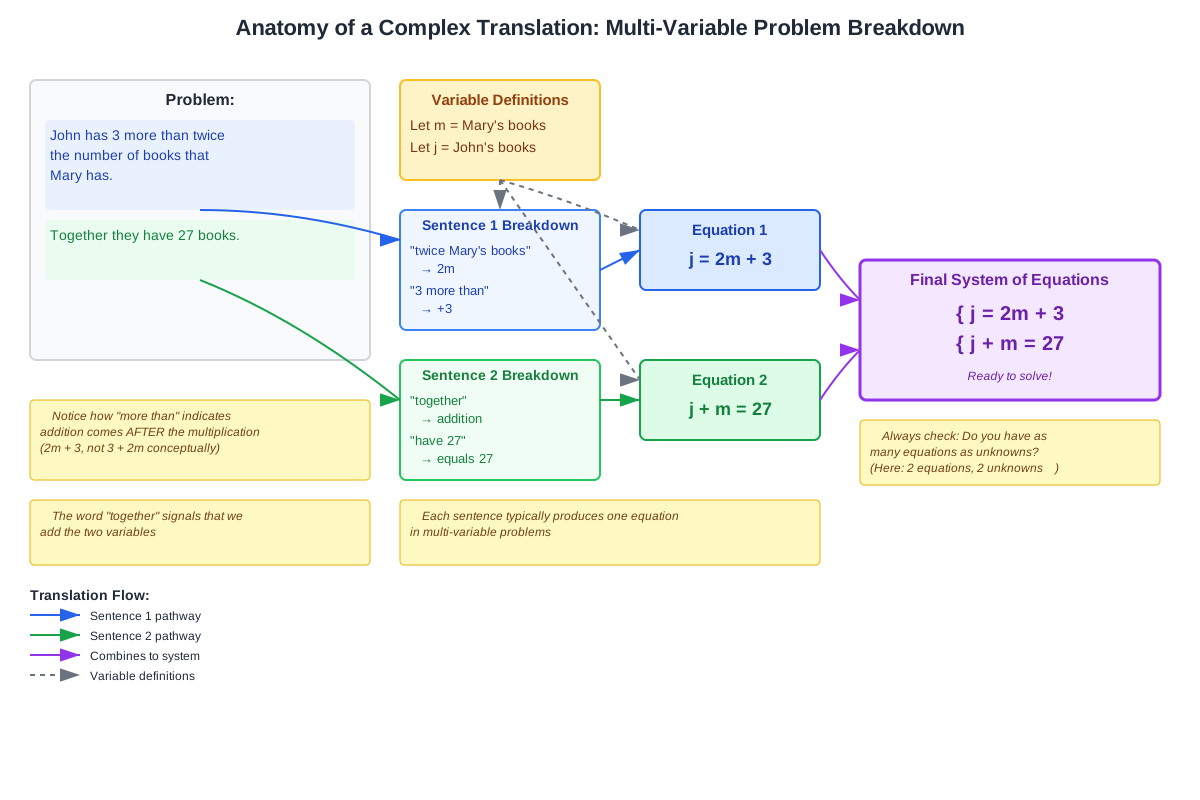
Many GRE problems use compound phrases that require multiple operations. The phrase "5 more than twice a number" translates to 2x + 5, requiring both multiplication and addition. The order matters: first identify "twice a number" (2x), then add 5 to that result.
Phrases involving "the sum/product of" require parentheses to group operations correctly. "Three times the sum of x and 5" translates to 3(x + 5), not 3x + 5. The parentheses ensure that the sum is calculated before multiplication occurs. Similarly, "the square of the difference between x and y" becomes (x - y)².
Comparative statements require careful analysis. "A is 5 more than B" translates to A = B + 5. "A is 5 less than B" becomes A = B - 5. "A exceeds B by 5" means A = B + 5. "A is 5 times as large as B" translates to A = 5B. These relationships can also be expressed inversely: if A = B + 5, then B = A - 5.
Variable Assignment and Definition
Effective translation begins with strategic variable assignment. When a problem involves multiple unknown quantities, choose variables that are intuitive and easy to track. For age problems, use the first letter of names (J for John, M for Mary). For geometric problems, use standard conventions (l for length, w for width, h for height).
When dealing with related quantities, express them in terms of a single variable when possible. If "John is 5 years older than Mary," define Mary's age as x and John's age as x + 5, rather than using two independent variables. This reduces the number of unknowns and simplifies solving.
For consecutive integer problems, if the first integer is n, the next consecutive integers are n + 1, n + 2, etc. For consecutive even or odd integers, use n, n + 2, n + 4, since even and odd integers differ by 2.
Translating Relationships and Constraints
Many GRE problems describe relationships between quantities that must be captured in equation form. "The sum of two numbers is 50" translates to x + y = 50. "The product of two consecutive integers is 72" becomes x(x + 1) = 72. "The ratio of men to women is 3 to 4" can be expressed as m/w = 3/4 or m = (3/4)w.
Percentage relationships require converting percents to decimals. "The price increased by 20%" means the new price is 1.20 times the original: P_new = 1.20P_original. "The price is 20% less than the original" translates to P_new = 0.80P_original. Sequential percentage changes require multiple steps: if a price increases by 20% then decreases by 10%, the final price is P_final = (1.20)(0.90)P_original = 1.08P_original.
Special Problem Types
Age problems typically involve current ages and ages at different times. If John is currently x years old, his age 5 years ago was x - 5, and his age 5 years from now will be x + 5. The phrase "John is twice as old as Mary was 3 years ago" translates to J = 2(M - 3).
Rate problems use the fundamental relationship: Distance = Rate × Time (D = RT). "A train travels 300 miles in 5 hours" gives 300 = R × 5, so R = 60 mph. For problems involving two objects, set up separate equations: if two cars travel toward each other, their combined distance equals the total distance between starting points.
Mixture problems involve combining quantities with different concentrations or values. The key equation is: (Amount₁)(Concentration₁) + (Amount₂)(Concentration₂) = (Total Amount)(Final Concentration). For example, mixing x liters of 20% solution with y liters of 50% solution to get 30% solution yields: 0.20x + 0.50y = 0.30(x + y).
Translation Table
| Verbal Phrase | Mathematical Symbol | Example | Translation |
|---|---|---|---|
| is, equals, is equal to | = | x is 5 | x = 5 |
| sum, plus, more than, increased by | + | 5 more than x | x + 5 |
| difference, minus, less than, decreased by | - | 5 less than x | x - 5 |
| product, times, of, multiplied by | × or · | twice x | 2x |
| quotient, divided by, per, ratio | ÷ or / | x per y | x/y |
| squared, cubed | ², ³ | x squared | x² |
| the sum of x and y | parentheses | twice the sum of x and 5 | 2(x + 5) |
Concept Relationships
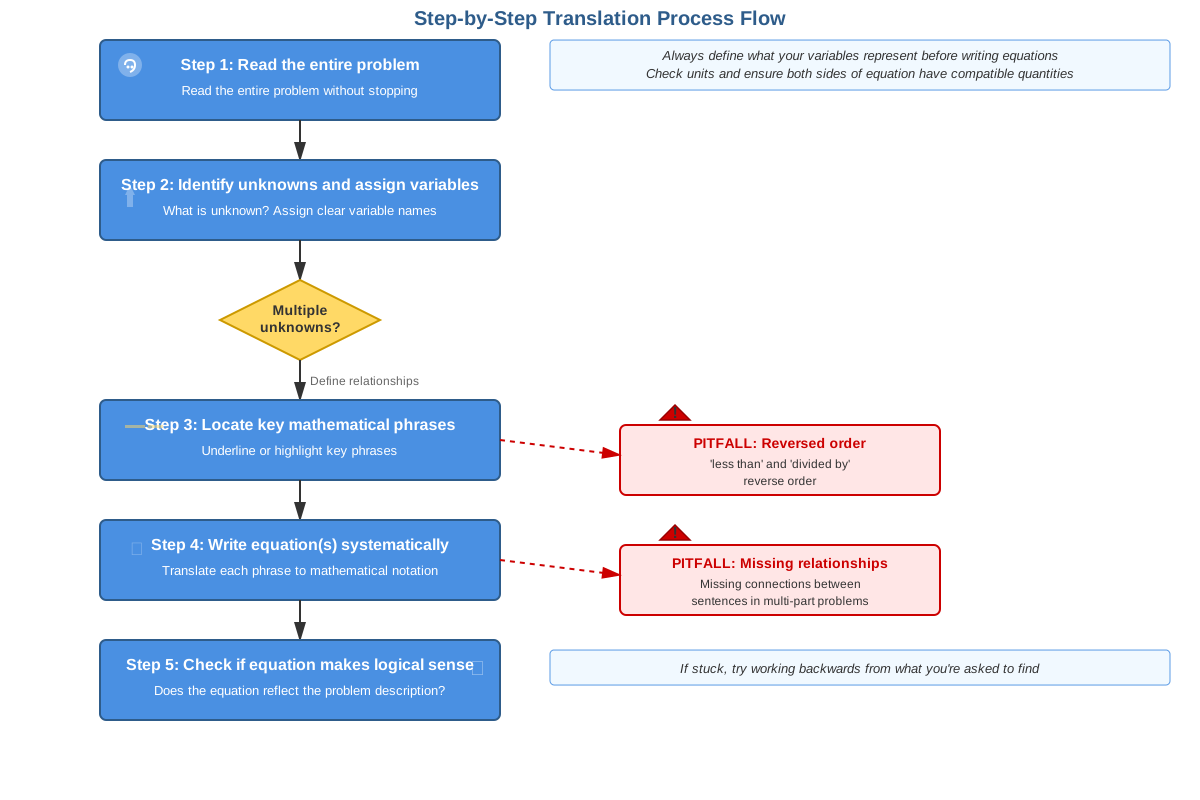
The process of translating words to equations serves as the gateway skill that enables all subsequent problem-solving in GRE word problems. The translation process begins with reading comprehension → leads to → identifying key phrases → leads to → assigning variables → leads to → writing equations → leads to → solving equations → leads to → interpreting solutions.
Within the translation process itself, several sub-skills interconnect. Recognizing operation keywords works in conjunction with understanding mathematical relationships to produce accurate translations. Variable assignment must occur before equation construction, and both depend on identifying what the problem is asking. The skill of ordering operations correctly (recognizing when parentheses are needed) builds directly on understanding phrase structure and operation precedence.
This topic connects backward to prerequisite knowledge of basic algebra and forward to virtually every other word problem type on the GRE. Mastering translation enables students to tackle percent problems (which require translating percentage relationships), ratio and proportion problems (which involve translating comparative relationships), rate problems (which require translating the distance-rate-time relationship), and geometry word problems (which involve translating spatial relationships into equations).
The relationship between translation and problem-solving is bidirectional: better translation skills improve problem-solving success, while experience solving various problem types enhances translation abilities by exposing students to diverse phrasings and contexts.
Quick check — test yourself on Translating words to equations so far.
Try Flashcards →High-Yield Facts
⭐ The word "is" almost always translates to an equals sign (=) and serves as the pivot point of the equation
⭐ "Less than" and "subtracted from" reverse the natural reading order: "5 less than x" means x - 5, not 5 - x
⭐ The word "of" in percentage and fraction contexts means multiplication: "30% of x" translates to 0.30x
⭐ "More than" and "increased by" maintain reading order: "5 more than x" correctly translates to x + 5
⭐ Phrases containing "the sum of" or "the product of" require parentheses: "twice the sum of x and 5" is 2(x + 5), not 2x + 5
- Consecutive integers are represented as n, n + 1, n + 2; consecutive even or odd integers as n, n + 2, n + 4
- "Twice as much as" means multiply by 2: if A is twice as much as B, then A = 2B
- "A exceeds B by 5" and "A is 5 more than B" both translate to A = B + 5
- In age problems, "x years ago" means subtract x from current age; "x years from now" means add x to current age
- Percentage increase of x% results in multiplication by (1 + x/100); percentage decrease by x% results in multiplication by (1 - x/100)
- The phrase "what number" or "a certain number" indicates the unknown variable you're solving for
- "The ratio of A to B is x to y" translates to A/B = x/y or A = (x/y)B
- "Per" indicates division and appears in rate contexts: miles per hour means miles ÷ hours
Common Misconceptions
Misconception: "5 less than x" translates to 5 - x → Correction: This phrase actually means x - 5. The phrase "less than" reverses the order, so you start with x and subtract 5 from it. To remember this, think "5 less than 10 is 5," which is 10 - 5, not 5 - 10.
Misconception: "Twice the sum of x and 5" means 2x + 5 → Correction: This translates to 2(x + 5) = 2x + 10. The phrase "the sum of" creates a grouping that must be calculated first, requiring parentheses. Without parentheses, you would only be doubling x, not the entire sum.
Misconception: "30% of x" translates to 30x → Correction: This actually means 0.30x or (30/100)x. The word "of" indicates multiplication, but the percentage must first be converted to decimal form by dividing by 100.
Misconception: When a problem says "A is 5 more than B," both A = B + 5 and B = A + 5 are correct → Correction: Only A = B + 5 is correct. If A is 5 more than B, then A has the larger value, so A equals B plus 5. The reverse relationship would be B = A - 5.
Misconception: In consecutive integer problems, if the first integer is x, the next is x + x → Correction: Consecutive integers differ by 1, so if the first is x, the next is x + 1, then x + 2, etc. The expression x + x equals 2x, which is double the first integer, not the next consecutive integer.
Misconception: "The quotient of x and y" means y/x → Correction: This phrase means x/y. "The quotient of x and y" means x divided by y, maintaining the order in which the variables are mentioned.
Misconception: A 20% increase followed by a 20% decrease returns to the original value → Correction: These changes don't cancel out. If the original value is P, after a 20% increase it becomes 1.20P, and after a 20% decrease it becomes (0.80)(1.20P) = 0.96P, which is 4% less than the original.
Worked Examples
Example 1: Multi-Step Age Problem
Problem: Sarah is currently three times as old as her daughter Emma. In 10 years, Sarah will be twice as old as Emma. How old is Emma currently?
Solution:
Step 1 - Identify unknowns and assign variables: Let E = Emma's current age. Since Sarah is three times as old as Emma, Sarah's current age = 3E.
Step 2 - Translate the first relationship: "Sarah is currently three times as old as Emma" → S = 3E (already incorporated into our variable definition)
Step 3 - Translate the future relationship: "In 10 years, Sarah will be twice as old as Emma"
- Emma's age in 10 years: E + 10
- Sarah's age in 10 years: 3E + 10
- The relationship: Sarah's future age = 2 × Emma's future age
- Translation: 3E + 10 = 2(E + 10)
Step 4 - Solve the equation:
3E + 10 = 2(E + 10)
3E + 10 = 2E + 20
3E - 2E = 20 - 10
E = 10
Step 5 - Verify the answer: Emma is currently 10 years old, so Sarah is currently 30 years old. In 10 years, Emma will be 20 and Sarah will be 40. Is 40 twice 20? Yes. ✓
Key Translation Points: This problem required translating two time frames (current and future) and recognizing that "in 10 years" means adding 10 to both current ages. The phrase "will be twice as old as" translates to an equals sign with multiplication by 2.
Example 2: Mixture Problem with Percentages
Problem: A chemist needs to create 50 liters of a 30% acid solution by mixing a 20% acid solution with a 50% acid solution. How many liters of the 20% solution should be used?
Solution:
Step 1 - Identify unknowns and assign variables: Let x = liters of 20% solution needed. Since the total must be 50 liters, the amount of 50% solution = 50 - x.
Step 2 - Identify the key relationship: The amount of pure acid from both solutions must equal the amount of pure acid in the final mixture.
Step 3 - Translate each component:
- Pure acid from 20% solution: 0.20x
- Pure acid from 50% solution: 0.50(50 - x)
- Pure acid in final 30% solution: 0.30(50)
Step 4 - Write the equation: "The sum of pure acid from both solutions equals the pure acid in the final mixture"
0.20x + 0.50(50 - x) = 0.30(50)Step 5 - Solve:
0.20x + 25 - 0.50x = 15
-0.30x + 25 = 15
-0.30x = -10
x = 33.33... liters
Step 6 - Verify: 33.33 liters of 20% solution contains 6.67 liters of pure acid. 16.67 liters of 50% solution contains 8.33 liters of pure acid. Total pure acid = 15 liters. Total volume = 50 liters. Concentration = 15/50 = 30%. ✓
Key Translation Points: This problem required recognizing that "mixing" means adding the components, translating percentages to decimals, and understanding that the total volume constraint (50 liters) allows expressing the second unknown in terms of the first (50 - x).
Exam Strategy
When approaching GRE questions involving translation, follow a systematic process. First, read the entire problem carefully to understand what is being asked. Identify the question at the end before translating, as this tells you what variable to solve for. Many students waste time solving for the wrong quantity because they didn't note what the question actually requested.
Trigger words to watch for: Pay special attention to phrases that reverse order ("less than," "subtracted from"), require grouping ("the sum of," "the product of"), or indicate specific operations ("of" for multiplication, "per" for division). When you see these triggers, pause and ensure you're translating correctly rather than rushing.
Process of elimination strategy: In Quantitative Comparison questions, translate both quantities into equations before comparing. Often, one quantity will be clearly larger once properly translated. In multiple-choice Problem Solving questions, you can sometimes work backward from answer choices, but only after correctly translating the problem into an equation—this ensures you're testing the right relationship.
Time allocation: Spend 20-30 seconds on careful translation before attempting to solve. This upfront investment prevents the much larger time loss of solving the wrong equation. If a problem seems confusing, write down what you know in equation form step by step rather than trying to construct the entire equation mentally.
Common traps: The GRE deliberately includes answer choices that result from common translation errors. If you translate "5 less than x" as "5 - x" instead of "x - 5," there will likely be an answer choice matching your incorrect result. Always verify that your translation makes logical sense: if John is older than Mary, your equation should show John's age as the larger value.
Variable management: For complex problems with multiple unknowns, write down your variable definitions explicitly. Use notation like "Let x = Emma's current age" rather than just writing "x." This prevents confusion mid-problem and makes it easier to check your work.
Memory Techniques
ORDER mnemonic for operation keywords:
- Of = multiply (30% of x)
- Reversed = less than, subtracted from (reverse the order)
- Division = per, quotient (miles per hour)
- Equals = is, equals (x is 5)
- Requires parentheses = the sum/product of
The "IS" visualization: Picture the word "is" as a balance scale (=). Whatever is described on the left side of "is" in the sentence goes on the left side of the equation; whatever is on the right side of "is" goes on the right side of the equation.
The "LESS THAN" hand trick: Hold your left hand up with fingers pointing right. "Less than" means start with the right side (what comes after "less than") and subtract the left side (the number before "less than"). Your hand points from right to left, showing the reversal.
PEMDAS reminder for grouping: When you see "the sum of," "the product of," or "the difference between," think Parentheses first in PEMDAS. These phrases create groups that must be calculated before other operations.
Age problem timeline: Draw a simple T-chart with "Now" and "Then" (or "Past" and "Now") as columns. Write each person's age in the appropriate column, using your variable. This visual prevents confusion about which time frame you're working with.
Summary
Translating words to equations is the foundational skill that enables solving virtually all GRE word problems. This process involves recognizing standard mathematical phrases and their symbolic equivalents, assigning appropriate variables to unknown quantities, and constructing accurate equations that capture the relationships described verbally. Success requires mastering basic translation patterns (is = equals, of = multiply, per = divide), understanding complex phrase structures that require parentheses, and avoiding common pitfalls like reversed order in "less than" phrases. The GRE tests this skill both directly through straightforward word problems and indirectly through complex multi-step scenarios involving percentages, ratios, rates, and ages. Students must develop the ability to identify trigger words, assign variables strategically, and verify that their translations make logical sense before solving. The key to mastery is systematic practice with diverse problem types, careful attention to phrase structure, and consistent verification that mathematical translations accurately represent the verbal relationships described.
Key Takeaways
- The word "is" translates to an equals sign and serves as the equation's pivot point; identify it first to structure your equation correctly
- Order matters critically: "less than" and "subtracted from" reverse the reading order, while "more than" and "increased by" maintain it
- Phrases containing "the sum of" or "the product of" require parentheses to group operations correctly before applying other operations
- The word "of" in percentage and fraction contexts always means multiplication; convert percentages to decimals first
- Strategic variable assignment—expressing related quantities in terms of a single variable when possible—simplifies problem-solving significantly
- Always verify that your translation makes logical sense by checking whether the relationships match the problem description
- Invest time in careful translation before solving; correcting a translation error takes far less time than solving the wrong equation
Related Topics
Percent Problems: Building on translation skills, percent problems require converting percentage relationships into equations and often involve sequential percentage changes. Mastering translation enables quick setup of percentage increase/decrease equations.
Ratio and Proportion: These problems extend translation skills to comparative relationships between quantities. Understanding how to translate "the ratio of A to B is 3 to 4" into equations is essential for solving proportion problems efficiently.
Rate Problems (Distance-Rate-Time): These problems apply translation skills to the specific formula D = RT and its variations. Success requires translating verbal descriptions of motion into equations involving distance, rate, and time.
Systems of Equations: Complex word problems often require translating multiple relationships into multiple equations. Mastering single-equation translation is prerequisite to handling systems involving two or more unknowns.
Algebraic Word Problems: This broader category encompasses age problems, consecutive integer problems, and mixture problems, all of which depend fundamentally on accurate translation as the first step toward solution.
Practice CTA
Now that you've mastered the core concepts of translating words to equations, it's time to reinforce your learning through active practice. Attempt the practice questions to apply these translation strategies to GRE-style problems, and use the flashcards to drill the key phrases and their mathematical equivalents until recognition becomes automatic. Remember: translation is a skill that improves dramatically with deliberate practice. Each problem you work through strengthens your ability to recognize patterns and avoid common pitfalls. You're building the foundation for success on every quantitative word problem you'll encounter on test day!
Sign up free to keep reading
Create a free AnvayaPrep account to finish this GRE guide on Translating words to equations — plus flashcards and practice questions.