Overview
Percent word problems represent one of the most frequently tested quantitative concepts on the GRE, appearing in approximately 15-20% of all Quantitative Reasoning questions. These problems require students to translate real-world scenarios involving percentages into mathematical expressions and solve for unknown values. Unlike straightforward percentage calculations, GRE percent word problems embed the mathematical relationships within narrative contexts such as business scenarios (profit and loss, discounts, markups), population changes, statistical comparisons, and financial calculations (interest, taxes, tips).
Mastering percent word problems is essential for GRE success because they test multiple skills simultaneously: reading comprehension, logical reasoning, algebraic manipulation, and numerical fluency. The GRE frequently disguises percentage problems within complex scenarios that require students to identify what quantity represents the "whole" (base), what represents the "part," and what percentage relationship connects them. These questions often involve multi-step calculations, successive percentage changes, or reverse percentage problems where students must work backward from a final value to determine an original amount.
Within the broader Quantitative Reasoning framework, percent word problems connect directly to ratio and proportion concepts, algebraic equation-solving, and data interpretation. They serve as a bridge between pure arithmetic and applied problem-solving, requiring students to demonstrate both computational accuracy and conceptual understanding. Strong performance on these questions correlates highly with overall quantitative scores, making this topic a high-yield area for focused study and practice.
Learning Objectives
- [ ] Identify when Percent word problems is being tested
- [ ] Explain the core rule or strategy behind Percent word problems
- [ ] Apply Percent word problems to GRE-style questions accurately
- [ ] Convert between percentage, decimal, and fractional representations fluently
- [ ] Distinguish between percentage increase/decrease and the final percentage of the original value
- [ ] Solve multi-step percentage problems involving successive changes
- [ ] Recognize and avoid common traps in reverse percentage calculations
Prerequisites
- Basic percentage calculations: Understanding that percentages represent parts per hundred and can convert between percentages, decimals, and fractions (e.g., 25% = 0.25 = 1/4) is fundamental to all percent word problems
- Algebraic equation setup and solving: Percent word problems require translating verbal statements into equations with variables, then solving for unknowns using algebraic manipulation
- Ratio and proportion concepts: Many percentage relationships can be expressed as proportions, and understanding equivalent ratios helps verify percentage calculations
- Order of operations: Multi-step percentage problems require correct sequencing of calculations, particularly when dealing with successive percentage changes
- Decimal arithmetic: Fluency with decimal multiplication and division is essential since percentage calculations typically involve decimal operations
Why This Topic Matters
Percent word problems appear throughout everyday life in contexts ranging from calculating sales tax and tips to understanding investment returns, analyzing statistical data, and interpreting news reports about economic indicators. Financial literacy, data interpretation, and quantitative reasoning in professional contexts all depend heavily on percentage fluency. The ability to quickly determine whether a 20% discount followed by a 10% discount equals a 30% total discount (it doesn't) or to calculate the original price when given a sale price represents practical skills with immediate real-world applications.
On the GRE specifically, percent word problems appear in multiple question formats: Quantitative Comparison questions that ask students to compare two percentage-based scenarios, Problem Solving questions requiring numerical answers, and Data Interpretation questions where percentages must be extracted from graphs or tables. Research on GRE question distributions indicates that percentage-related questions constitute one of the largest single categories within arithmetic topics, with approximately 3-5 questions per test directly testing percentage concepts and many additional questions incorporating percentages as part of more complex problems.
The GRE particularly favors certain percentage problem types: successive percentage changes (where two or more percentage increases or decreases are applied sequentially), percentage point versus percent change distinctions, problems requiring identification of the correct base value, and reverse percentage calculations. Questions often include trap answers that result from common errors, making conceptual understanding more important than memorized formulas. The test also frequently presents percentage problems within data sufficiency contexts, asking whether given information is sufficient to determine a percentage relationship.
Core Concepts
The Fundamental Percentage Equation
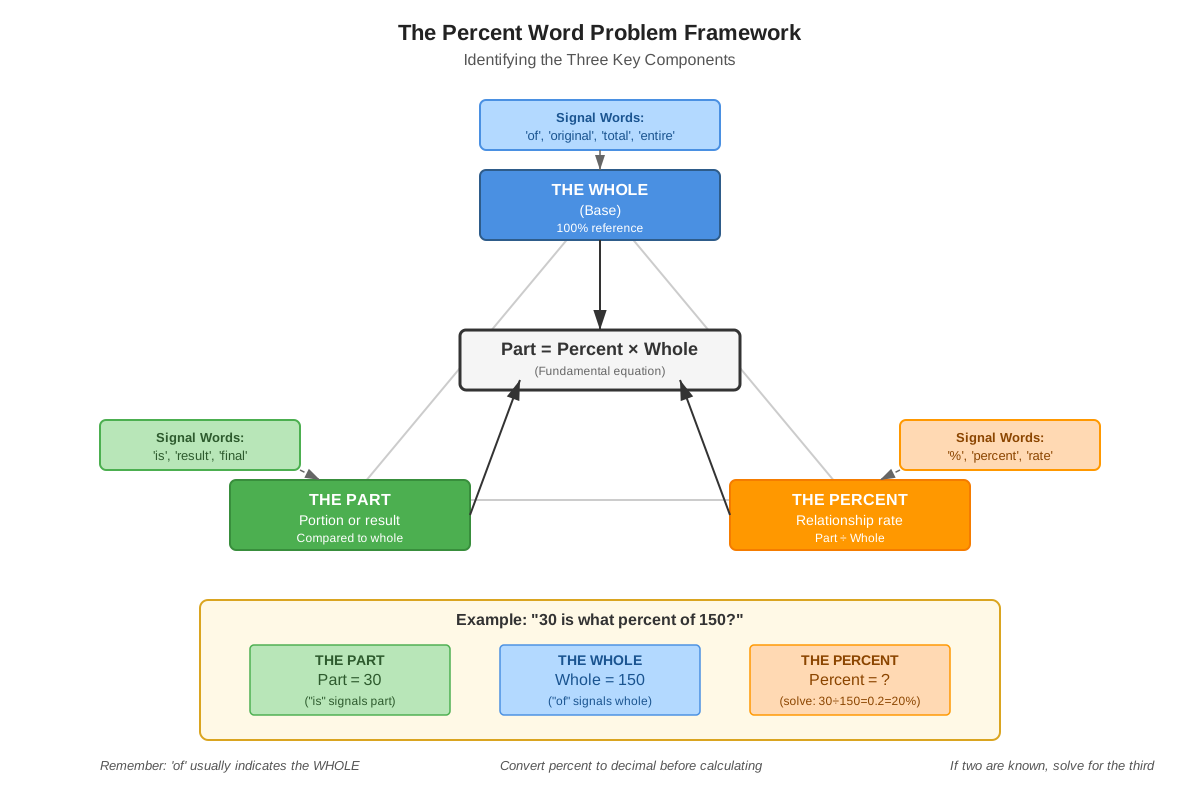
The foundation of all percent word problems is the relationship: Part = Percent × Whole. This equation can be rearranged into three forms depending on what value is unknown:
- Part = (Percent/100) × Whole
- Percent = (Part/Whole) × 100
- Whole = Part/(Percent/100)
The most critical skill in solving percent word problems is correctly identifying which quantity represents the base (the whole or reference value) and which represents the part (the portion being compared). The base is always the quantity that follows the word "of" in percentage statements. For example, "30% of 80" means 80 is the base, while "30 is what percent of 80" also uses 80 as the base.
Percentage Increase and Decrease
When a quantity increases or decreases by a certain percentage, the calculation follows a specific pattern:
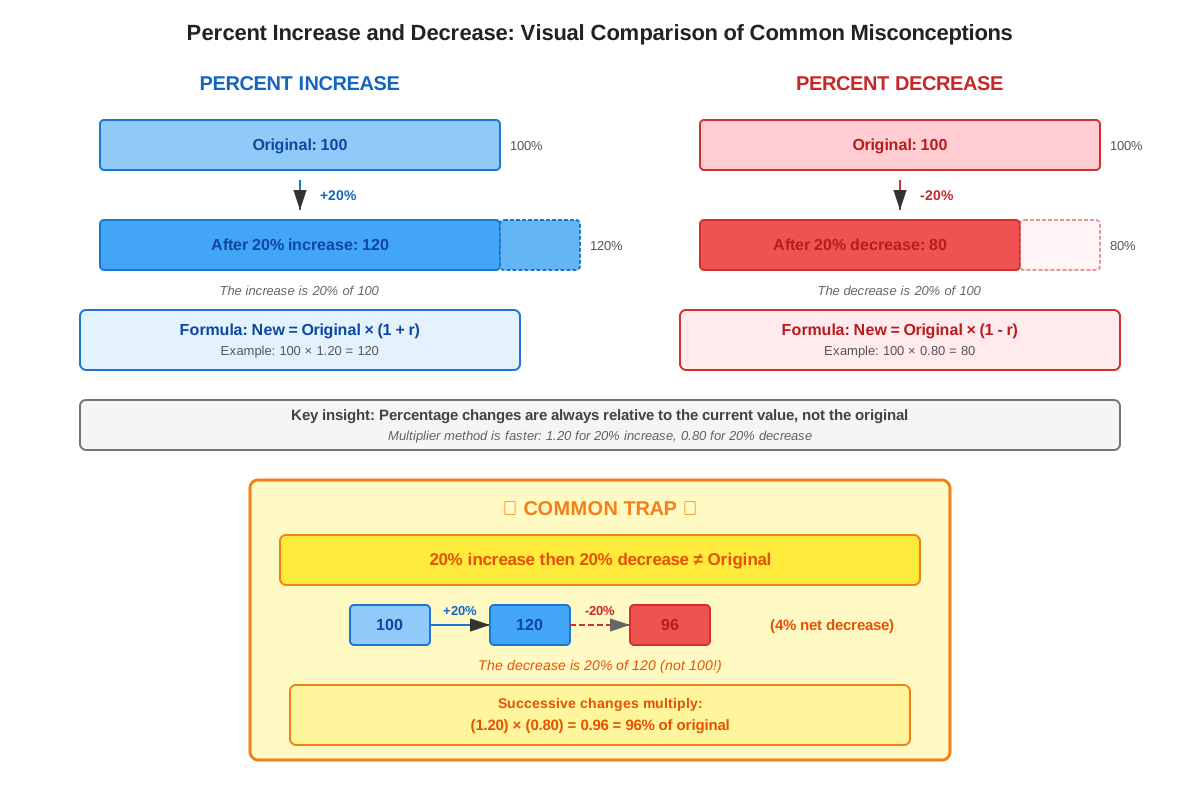
New Value = Original Value × (1 ± Percent Change/100)
For increases, use the plus sign; for decreases, use the minus sign. For example:
- A 15% increase: New Value = Original × 1.15
- A 15% decrease: New Value = Original × 0.85
A critical distinction exists between the percentage change and the final percentage. If a value increases by 25%, the new value is 125% of the original (not 25% of the original). Many GRE trap answers exploit confusion between these concepts.
Successive Percentage Changes
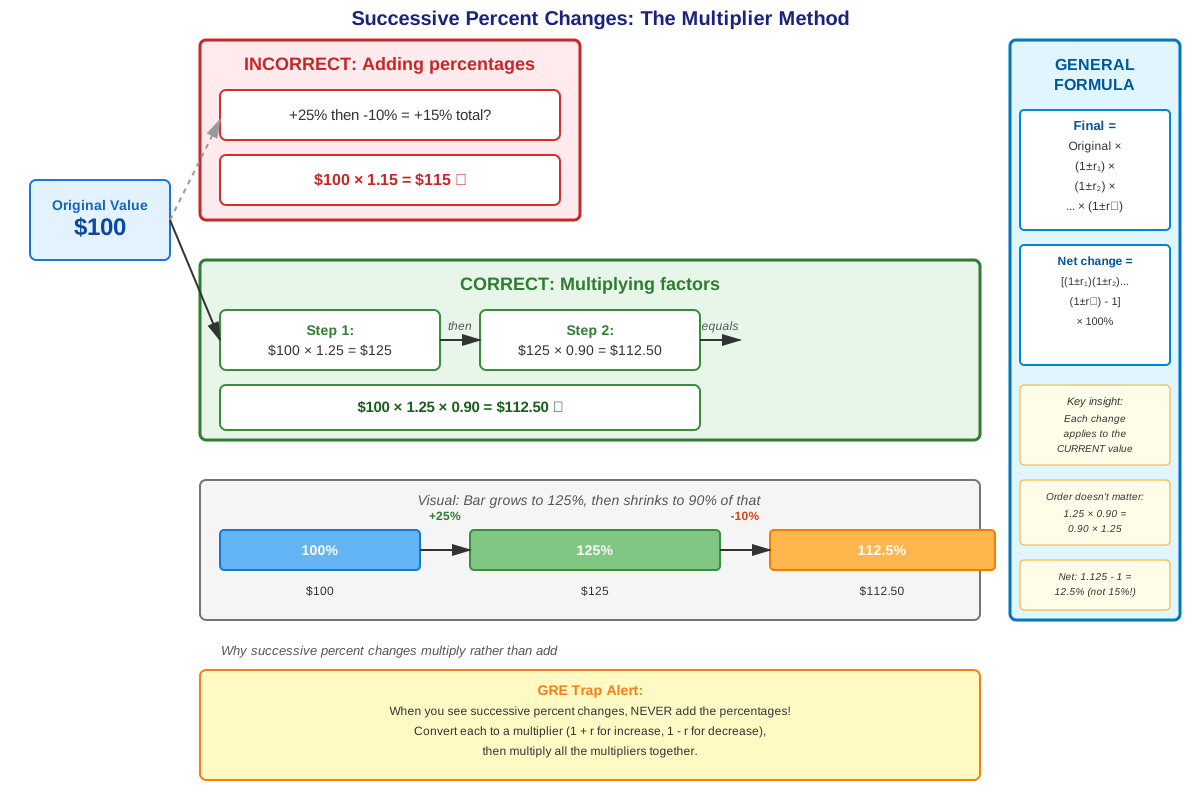
One of the most frequently tested concepts involves applying multiple percentage changes sequentially. The key principle: successive percentage changes are multiplicative, not additive.
If a quantity increases by 20% and then increases by another 10%, the total change is NOT 30%. Instead:
- After first increase: Value × 1.20
- After second increase: (Value × 1.20) × 1.10 = Value × 1.32
- Total increase: 32%
The general formula for successive changes is:
Final Value = Original Value × (1 + r₁/100) × (1 + r₂/100) × ... × (1 + rₙ/100)
where r represents each percentage change (positive for increases, negative for decreases).
Reverse Percentage Problems
Reverse percentage problems provide the final value after a percentage change and ask for the original value. These require careful algebraic setup because the percentage change was applied to the unknown original value, not the known final value.
If a value decreased by 20% to reach 80, the equation is:
- Original × 0.80 = 80
- Original = 80/0.80 = 100
A common error is calculating 20% of 80 and adding it back (giving 96), which incorrectly uses the final value as the base instead of the original value.
Percentage Points vs. Percent Change
The GRE frequently tests the distinction between percentage points and percent change. If a quantity increases from 40% to 50%, this represents:
- An increase of 10 percentage points (50 - 40 = 10)
- A percent increase of 25% (the change of 10 divided by the original 40, times 100)
This distinction appears in questions about interest rates, poll results, and statistical data where precision in language matters significantly.
Percent Greater/Less Than Comparisons
When comparing two quantities using percentages, the base matters critically:
- "A is 50% greater than B" means A = 1.5B
- "B is what percent less than A" requires calculating (A - B)/A × 100
If A is 50% greater than B, then B is NOT 50% less than A. Using the relationship A = 1.5B:
- B = A/1.5 = 0.667A
- B is 33.3% less than A
Common Percentage Problem Types
| Problem Type | Key Characteristic | Solution Approach |
|---|---|---|
| Markup/Markdown | Original price → Sale price | Identify base (original), apply percentage change |
| Profit/Loss | Cost → Selling price | Profit = (Selling - Cost)/Cost × 100 |
| Population Change | Initial → Final population | Apply successive changes multiplicatively |
| Mixture Problems | Combining different percentages | Use weighted averages |
| Interest Calculations | Principal → Amount with interest | Simple: P(1 + rt); Compound: P(1 + r)^t |
| Percent Allocation | Distributing total among categories | Each part = Total × (Category %/100) |
Concept Relationships
The concepts within percent word problems form a hierarchical structure where mastery of simpler concepts enables understanding of more complex applications. The fundamental percentage equation (Part = Percent × Whole) serves as the foundation upon which all other concepts build. This basic relationship directly leads to percentage increase and decrease calculations, which simply apply the fundamental equation with the modification that the "part" represents the change amount.
Percentage increase and decrease concepts then extend to successive percentage changes, where the output of one percentage calculation becomes the input (base) for the next calculation. This multiplicative relationship explains why successive changes don't simply add together. Understanding successive changes is essential for solving reverse percentage problems, which require working backward through the chain of calculations.
The distinction between percentage points and percent change emerges from recognizing that percentages themselves can be treated as quantities that change. When the base is already expressed as a percentage, changes can be measured either in absolute terms (percentage points) or relative terms (percent change of the percentage).
Percent greater/less than comparisons integrate the fundamental equation with the concept that the choice of base affects the resulting percentage. This connects back to prerequisite knowledge of ratios and proportions, as these comparisons essentially express ratios in percentage form.
All these concepts connect to prerequisite algebraic skills through the need to set up equations with variables, and to ratio concepts through the proportional relationships that percentages represent. The relationship map flows: Basic Percentage Equation → Single Percentage Changes → Successive Changes → Reverse Problems, with Percentage Points and Comparative Percentages branching from the basic equation as parallel applications.
High-Yield Facts
⭐ The base (whole) in a percentage calculation is always the reference value, typically the quantity that follows "of" in the problem statement
⭐ Successive percentage changes multiply: a 20% increase followed by a 10% decrease results in (1.20)(0.90) = 1.08, or an 8% net increase
⭐ If quantity A is x% greater than quantity B, then B is [x/(100+x)] × 100% less than A, not x% less
⭐ In reverse percentage problems, the percentage was applied to the unknown original value, not the known final value
⭐ A percentage point change and a percent change are different: moving from 20% to 30% is a 10 percentage point increase but a 50% increase
- Converting percentages to decimals for calculation (dividing by 100) reduces arithmetic errors and simplifies multi-step problems
- Percent increase = [(New - Original)/Original] × 100; the denominator is always the original value
- When a price is marked up by x% and then marked down by x%, the final price is less than the original price (not equal)
- Calculating "what percent of A is B" means (B/A) × 100, where A is the base
- In profit/loss problems, the cost price is typically the base unless the problem explicitly states profit as a percentage of selling price
- A 100% increase means doubling (multiplying by 2), while a 100% decrease means reducing to zero
- The phrase "increased by a factor of 1.5" means multiplied by 1.5 (a 50% increase), not increased by 150%
- When combining groups with different percentages, use weighted averages based on group sizes
- Simple interest is calculated on the original principal only, while compound interest is calculated on the accumulated amount
- Percentage problems often include unnecessary information to test whether students can identify the relevant base value
Quick check — test yourself on Percent word problems so far.
Try Flashcards →Common Misconceptions
Misconception: Successive percentage changes can be added together (e.g., a 20% increase followed by a 30% increase equals a 50% increase).
Correction: Successive percentage changes multiply, not add. The correct calculation is 1.20 × 1.30 = 1.56, representing a 56% total increase. Each subsequent percentage change applies to the new value, not the original value.
Misconception: If A is 50% more than B, then B is 50% less than A.
Correction: The percentage difference depends on which value serves as the base. If A = 1.5B, then B = A/1.5 = 0.667A, meaning B is 33.3% less than A. The base changes, so the percentage changes.
Misconception: To find the original value before a 20% decrease resulted in 80, calculate 20% of 80 and add it back.
Correction: The 20% decrease was applied to the unknown original value, not to 80. The correct equation is Original × 0.80 = 80, so Original = 80/0.80 = 100. Calculating 20% of 80 (16) and adding gives 96, which is incorrect because it uses the wrong base.
Misconception: A percentage point change and a percent change are the same thing.
Correction: Percentage points measure absolute differences between percentages (50% - 40% = 10 percentage points), while percent change measures relative change [(50-40)/40 × 100 = 25% increase]. These are fundamentally different measurements.
Misconception: When a value increases by 25% and then decreases by 25%, it returns to the original value.
Correction: The final value is less than the original. If starting with 100: after +25% → 125; after -25% of 125 → 125 × 0.75 = 93.75. The decrease applies to a larger base than the increase did.
Misconception: "Percent of" and "percent off" mean the same thing.
Correction: "Percent of" means multiply by the percentage (30% of 80 = 24), while "percent off" means subtract that percentage from the original (30% off 80 = 80 - 24 = 56). The phrase "off" indicates a discount or reduction.
Misconception: In profit calculations, profit percentage is always based on cost price.
Correction: While profit is typically calculated as a percentage of cost price, problems may specify profit as a percentage of selling price. Always read carefully to identify the correct base. If profit is 20% of selling price and selling price is 100, then profit is 20 and cost is 80.
Worked Examples
Example 1: Successive Percentage Changes with Mixed Increases and Decreases
Problem: A store marks up the wholesale cost of an item by 60% to set the retail price. During a sale, the store offers a 25% discount off the retail price. If the wholesale cost was $50, what is the sale price, and what is the overall percentage markup from wholesale cost to sale price?
Solution:
Step 1: Identify the base and the first percentage change.
- Base (wholesale cost) = $50
- First change: 60% markup means multiply by 1.60
Step 2: Calculate the retail price.
- Retail price = $50 × 1.60 = $80
Step 3: Apply the second percentage change.
- Second change: 25% discount means multiply by 0.75
- Sale price = $80 × 0.75 = $60
Step 4: Calculate the overall percentage change from wholesale to sale price.
- Change = Sale price - Wholesale cost = $60 - $50 = $10
- Percentage markup = (Change/Original) × 100 = (10/50) × 100 = 20%
Alternative approach using multiplicative factors:
- Combined factor = 1.60 × 0.75 = 1.20
- This means the sale price is 120% of wholesale, or a 20% markup
- Sale price = $50 × 1.20 = $60
Key insight: This problem demonstrates that a 60% markup followed by a 25% discount does NOT equal a 35% net markup (60 - 25). The successive changes multiply: 1.60 × 0.75 = 1.20, giving only a 20% net markup. This connects to Learning Objective 2 (explaining core strategies) by showing why the multiplicative approach is essential.
Example 2: Reverse Percentage Problem with Comparison
Problem: After a 15% decrease, the population of Town A is 5,100. After a 15% increase, the population of Town B is also 5,100. How much greater was Town A's original population than Town B's original population?
Solution:
Step 1: Find Town A's original population (reverse percentage decrease).
- Let original population = x
- After 15% decrease: x × 0.85 = 5,100
- x = 5,100/0.85 = 6,000
Step 2: Find Town B's original population (reverse percentage increase).
- Let original population = y
- After 15% increase: y × 1.15 = 5,100
- y = 5,100/1.15 ≈ 4,434.78
Step 3: Calculate the difference.
- Difference = 6,000 - 4,434.78 ≈ 1,565.22
Common trap: Students might incorrectly calculate 15% of 5,100 (which is 765) and add it for Town A and subtract it for Town B, getting:
- Town A: 5,100 + 765 = 5,865 (incorrect)
- Town B: 5,100 - 765 = 4,335 (incorrect)
This error uses 5,100 as the base for the 15% calculation, but the 15% was actually applied to the unknown original populations, not to 5,100.
Key insight: This problem illustrates why identifying the correct base is crucial in reverse percentage problems (Learning Objective 1: identifying when percent word problems are being tested). The final value (5,100) is not the base for the percentage calculation; the unknown original value is. This also demonstrates that equal percentage changes in opposite directions from different starting points do not result in equal original values.
Exam Strategy
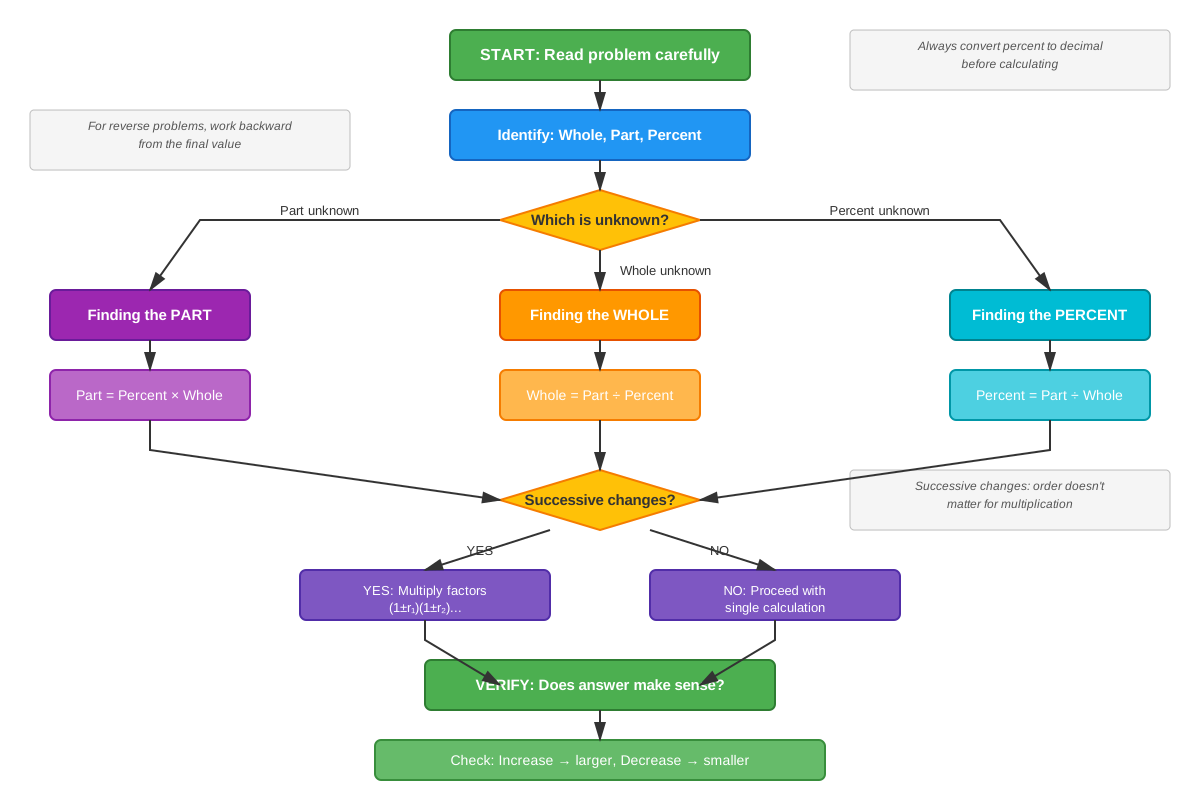
When approaching GRE percent word problems, follow this systematic process:
Step 1: Identify the base (whole)
Look for phrases like "of," "than," or "from" that indicate the reference value. The base is what the percentage is calculated from. Underline or circle this value in the problem.
Step 2: Determine what is being asked
Are you finding a part, a percentage, or a whole? Are you working forward (applying percentages) or backward (reverse percentage)? Is the problem asking for a single calculation or comparing multiple scenarios?
Step 3: Translate words into mathematical operations
- "of" → multiply
- "is" → equals
- "what" or "how much" → variable (unknown)
- "more than" → add or multiply by (1 + percentage)
- "less than" → subtract or multiply by (1 - percentage)
- "percent increase/decrease" → calculate change, then divide by original
Step 4: Set up the equation before calculating
Write out the equation symbolically first. This prevents calculation errors and helps verify that you're using the correct base.
Step 5: Check answer reasonableness
Does your answer make logical sense? If a quantity increased, is your answer larger than the original? If calculating a percentage, is it between 0 and 100 (or greater than 100 if appropriate)?
Exam Tip: In Quantitative Comparison questions involving percentages, often you don't need to calculate exact values. Compare the multiplicative factors instead. If Quantity A involves multiplying by 1.20 × 0.90 = 1.08 and Quantity B involves multiplying by 1.15 × 0.95 = 1.0925, you can determine B is greater without knowing the original value.
Trigger words and phrases to watch for:
- "Successive," "then," "followed by" → indicates multiple percentage changes that multiply
- "Original," "initial," "before" → signals a reverse percentage problem
- "Percentage points" vs. "percent" → tests the distinction between absolute and relative change
- "Of" → identifies the base value
- "More/less than" → requires careful identification of which quantity is the base
- "Marked up," "discounted," "increased," "decreased" → percentage change problems
Process of elimination strategies:
- Eliminate answers that result from adding successive percentages instead of multiplying
- Eliminate answers that use the wrong base (especially in reverse problems)
- Eliminate answers that confuse percentage points with percent change
- For "percent greater/less than" problems, eliminate the answer that uses the same percentage in both directions
Time allocation:
Simple percentage problems (single calculation): 30-45 seconds
Multi-step percentage problems: 60-90 seconds
Complex word problems with multiple percentages: 90-120 seconds
If a percentage problem is taking longer than 2 minutes, mark it and move on. These problems test whether you can quickly identify the correct approach, not whether you can perform lengthy calculations.
Memory Techniques
Mnemonic for percentage change formula: "NEW minus OLD over OLD times 100"
- Percent change = [(New - Old)/Old] × 100
- The denominator is always the original (old) value
Visualization for successive changes: Picture a staircase where each step represents a percentage change. You can't skip steps or combine them—you must walk up or down each step in sequence, and each step's height depends on where you're currently standing.
Acronym for reverse percentage problems: BINGO
- Base is unknown
- Identify the final value
- New equation: Base × (1 ± %) = Final
- Get Base alone by dividing
- Output is the original value
Memory aid for "percent of" vs. "percent off":
- "Percent OF" = Operation is Finding (multiply to find the amount)
- "Percent OFF" = Operation is Finding then subtracting (discount)
Rhyme for base identification: "The base follows 'of,' that's the rule—it's the reference, the measuring tool."
Visual for percentage points vs. percent change: Imagine a thermometer. Moving from 20° to 30° is a 10-degree change (like percentage points—absolute). But the percent change depends on where you started: 10/20 = 50% increase. The thermometer reading (absolute) vs. the relative change are different measurements.
Finger counting for successive changes: Hold up fingers for each percentage change. Each finger reminds you to multiply by another factor, not add. Three fingers = three multiplication factors.
Summary
Percent word problems constitute a high-yield GRE topic that tests the ability to translate verbal descriptions into mathematical relationships involving percentages. Success requires mastering the fundamental percentage equation (Part = Percent × Whole), correctly identifying the base value in each problem, and understanding that successive percentage changes multiply rather than add. The most critical skills include distinguishing between percentage increase/decrease and final percentage values, solving reverse percentage problems by setting up equations with the unknown original value as the base, and recognizing the difference between percentage points and percent change. Common traps include using the wrong base value, adding successive percentages instead of multiplying them, and confusing symmetric percentage relationships (if A is 50% more than B, B is not 50% less than A). Strategic approaches involve systematically identifying the base, translating verbal phrases into mathematical operations, setting up equations before calculating, and verifying answer reasonableness. Mastery of these concepts enables students to efficiently solve the 15-20% of GRE Quantitative Reasoning questions that directly test percentage relationships, while also supporting performance on data interpretation, ratio, and algebraic word problems that incorporate percentage calculations.
Key Takeaways
- The base (reference value) is always the denominator in percentage calculations and typically follows the word "of" in problem statements
- Successive percentage changes multiply, not add: calculate each change sequentially using the result of the previous change as the new base
- In reverse percentage problems, set up an equation where the unknown original value is multiplied by the percentage factor to equal the known final value
- Percentage points measure absolute differences between percentages, while percent change measures relative change using one percentage as the base
- If A is x% greater than B, then B is [x/(100+x)] × 100% less than A—the percentage differs depending on which value serves as the base
- Always verify answer reasonableness: increases should yield larger values, decreases should yield smaller values, and percentages should align with the relative sizes of quantities
- Translate word problems systematically by identifying the base first, determining what's being asked second, and setting up equations before calculating
Related Topics
Ratio and Proportion Problems: Percentages are ratios expressed per hundred, so mastering percent word problems provides a foundation for solving complex ratio problems, including mixture problems and rate comparisons. Understanding percentage relationships enhances the ability to work with equivalent ratios and proportional reasoning.
Data Interpretation: Many GRE data interpretation questions require extracting percentages from graphs and tables, then performing calculations similar to percent word problems. Mastery of percentage concepts enables efficient analysis of bar graphs, pie charts, and statistical tables.
Interest and Investment Problems: Both simple and compound interest calculations extend the concepts of percentage increase over time. These problems apply successive percentage changes in the context of financial growth.
Profit, Loss, and Discount Problems: These represent specialized applications of percentage increase and decrease in business contexts, requiring identification of cost price, selling price, and markup/markdown relationships.
Algebraic Word Problems: Many algebraic problems incorporate percentage relationships, requiring students to set up equations involving percentages and solve for unknown variables using algebraic techniques.
Practice CTA
Now that you've mastered the core concepts, strategies, and common traps in percent word problems, it's time to reinforce your learning through active practice. Attempt the practice questions designed specifically for this topic, focusing on applying the systematic approach outlined in the exam strategy section. Use the flashcards to drill the high-yield facts and formulas until they become automatic. Remember that GRE success comes not just from understanding concepts but from developing the speed and accuracy to apply them under timed conditions. Each practice problem you solve strengthens your pattern recognition and builds the confidence you need to tackle any percentage question the GRE presents. You've built a solid foundation—now transform that knowledge into points through deliberate practice!
Sign up free to keep reading
Create a free AnvayaPrep account to finish this GRE guide on Percent word problems — plus flashcards and practice questions.