Overview
Rate problems are among the most frequently tested question types in the GRE Quantitative Reasoning section, appearing in approximately 10-15% of all word problems. These problems involve relationships between distance, time, speed, work completed, or other quantities that change at a constant or variable rate. Mastering gre rate problems is essential because they test not only computational skills but also the ability to translate complex verbal descriptions into mathematical relationships, manipulate algebraic equations, and reason logically about proportional relationships.
Rate problems on the GRE typically involve scenarios such as two trains traveling toward each other, workers completing tasks at different speeds, pipes filling or draining tanks, or objects moving in opposite directions. The fundamental principle underlying all rate problems is the relationship between three core variables: rate (speed or efficiency), time (duration), and total quantity (distance, work completed, or volume). Understanding how to identify which variable is being tested and how to set up equations that capture the relationships between these variables is crucial for success.
Within the broader context of Quantitative Reasoning, rate problems connect directly to algebra, ratios and proportions, unit conversions, and systems of equations. They require students to demonstrate proficiency in setting up equations from word problems, manipulating algebraic expressions, and understanding how quantities scale proportionally. Strong performance on rate problems signals mastery of fundamental mathematical reasoning skills that extend far beyond this specific question type, making them a high-yield area for focused study and practice.
Learning Objectives
- [ ] Identify when Rate problems is being tested
- [ ] Explain the core rule or strategy behind Rate problems
- [ ] Apply Rate problems to GRE-style questions accurately
- [ ] Distinguish between different types of rate problems (distance/speed, work rate, combined rates)
- [ ] Set up and solve systems of equations involving multiple rates
- [ ] Convert between different units of measurement in rate problems
- [ ] Recognize and apply the concept of relative rates in opposite and same-direction motion
Prerequisites
- Basic algebra and equation solving: Essential for manipulating rate formulas and isolating variables to find unknown quantities
- Ratios and proportions: Rate problems fundamentally involve proportional relationships between quantities
- Unit conversion: Many rate problems require converting between hours and minutes, miles and kilometers, or other measurement units
- Fractions and decimals: Work rate problems often involve fractional rates that must be added or compared
- Linear equations: Setting up equations from word problems is the foundation of solving rate problems
Why This Topic Matters
Rate problems have profound real-world applications that extend far beyond standardized testing. In everyday life, people use rate calculations to estimate travel times, compare fuel efficiency, determine project completion timelines, calculate productivity metrics, and make financial decisions involving compound interest or depreciation. Engineers use rate calculations for fluid dynamics, traffic flow analysis, and manufacturing efficiency. Project managers rely on work rate calculations to allocate resources and predict deadlines. The mathematical reasoning developed through rate problems translates directly to critical thinking skills valued in graduate programs and professional settings.
On the GRE specifically, rate problems appear with high frequency across multiple question formats. Approximately 2-3 questions per Quantitative Reasoning section involve rate calculations, appearing as both Quantitative Comparison questions and Problem Solving questions. The GRE tests rate problems in various disguises: classic distance-rate-time scenarios, work completion problems involving multiple workers, mixture problems with rates of flow, and relative motion problems. Understanding the underlying structure of these problems allows test-takers to quickly identify the problem type and apply the appropriate solution strategy.
The GRE particularly favors rate problems because they efficiently test multiple competencies simultaneously: reading comprehension of complex scenarios, translation of verbal information into mathematical notation, algebraic manipulation, logical reasoning about relationships, and numerical computation. Questions often include trap answers designed to catch students who misidentify the relationship between variables or make common algebraic errors, making thorough understanding of the core concepts essential for avoiding these pitfalls.
Core Concepts
The Fundamental Rate Formula
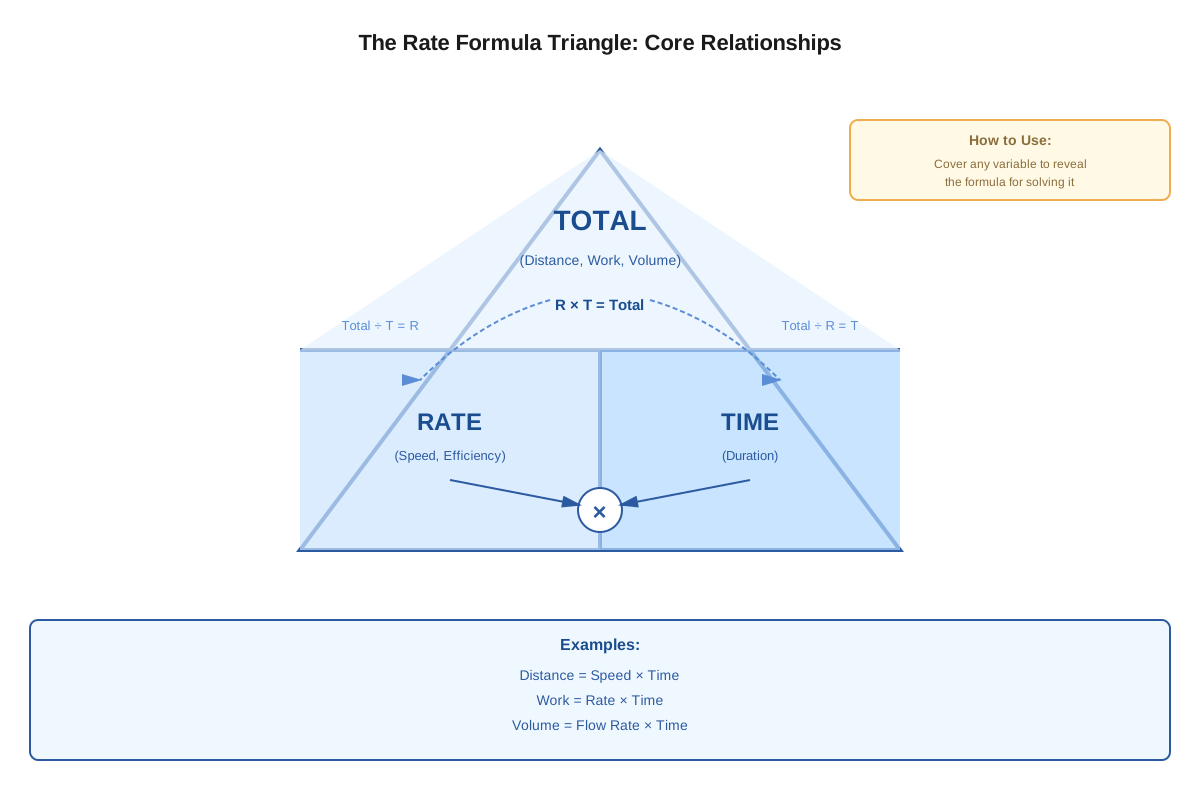
The foundation of all rate problems is the relationship between three variables: rate (R), time (T), and total quantity (often distance D or work W). The fundamental formula can be expressed as:
Distance = Rate × Time (D = R × T)
Work = Rate × Time (W = R × T)
This formula can be rearranged to solve for any of the three variables:
- Rate = Distance ÷ Time (R = D/T)
- Time = Distance ÷ Rate (T = D/R)
Understanding that these three forms are equivalent and knowing when to use each arrangement is crucial. The rate represents how much quantity is covered per unit of time (miles per hour, problems per minute, gallons per second). Time represents the duration over which the rate is applied. The total quantity represents the cumulative result of applying that rate for that duration.
Distance-Rate-Time Problems
Distance-rate-time problems are the most common type of rate problem on the GRE. These involve objects moving at constant speeds, and questions typically ask about meeting times, relative distances, or average speeds.
Single Object Problems: When one object travels at a constant rate, simply apply D = RT. For example, if a car travels at 60 mph for 2.5 hours, the distance covered is 60 × 2.5 = 150 miles.
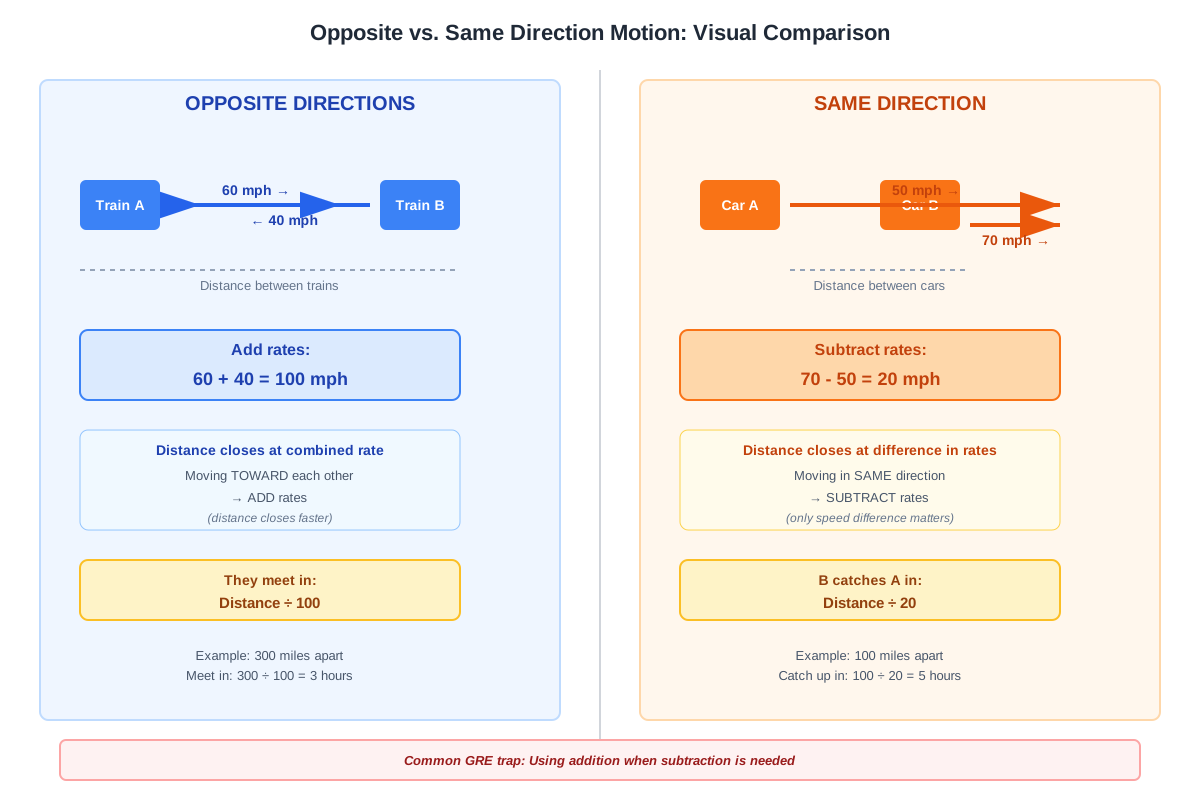
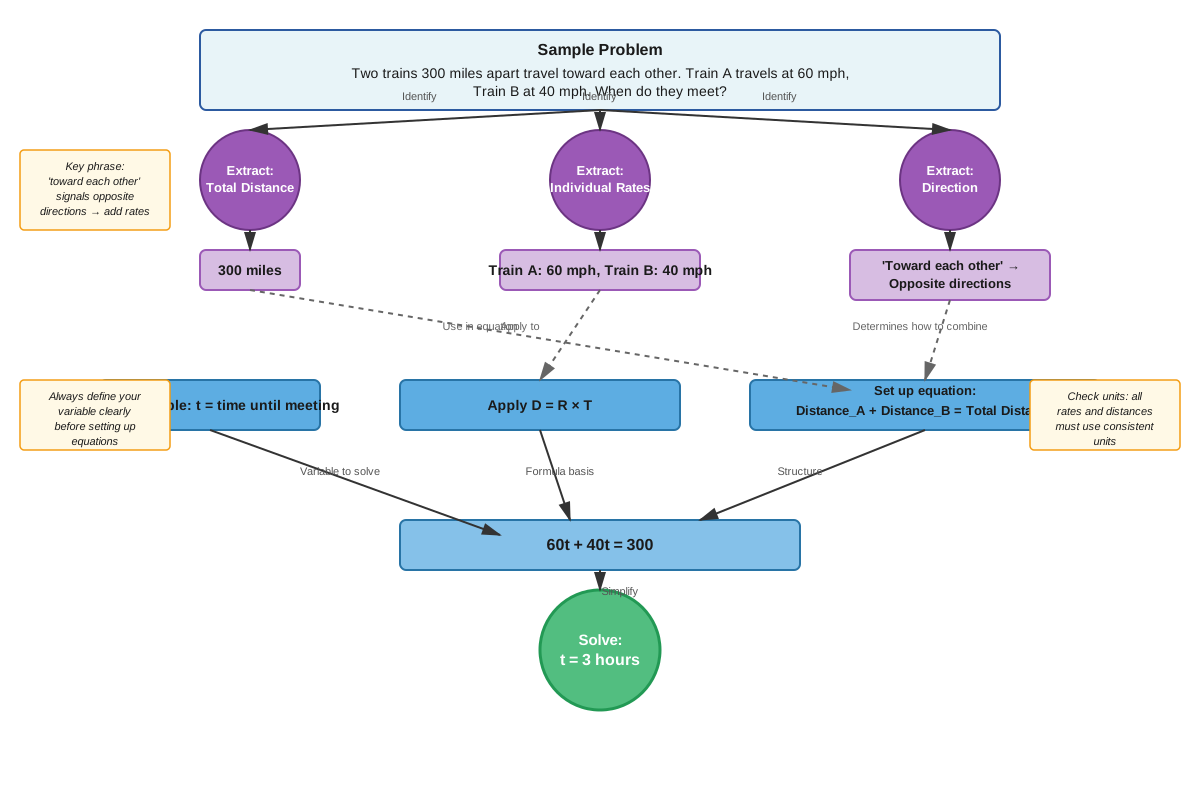
Two Objects Moving Toward Each Other: When two objects move toward each other from a fixed distance apart, their rates are additive. If they start distance D apart, with rates R₁ and R₂, the time until they meet is:
Time = D / (R₁ + R₂)The combined rate is (R₁ + R₂) because they're closing the gap from both directions simultaneously.
Two Objects Moving in the Same Direction: When one object chases another, their rates are subtractive. The faster object closes the gap at a rate of (R_faster - R_slower). If the slower object has a head start of distance D, the time for the faster object to catch up is:
Time = D / (R_faster - R_slower)Work Rate Problems
Work rate problems involve tasks being completed at certain rates, often measured in "jobs per hour" or "fraction of job per time unit." The key insight is that rates of work are additive when workers collaborate.
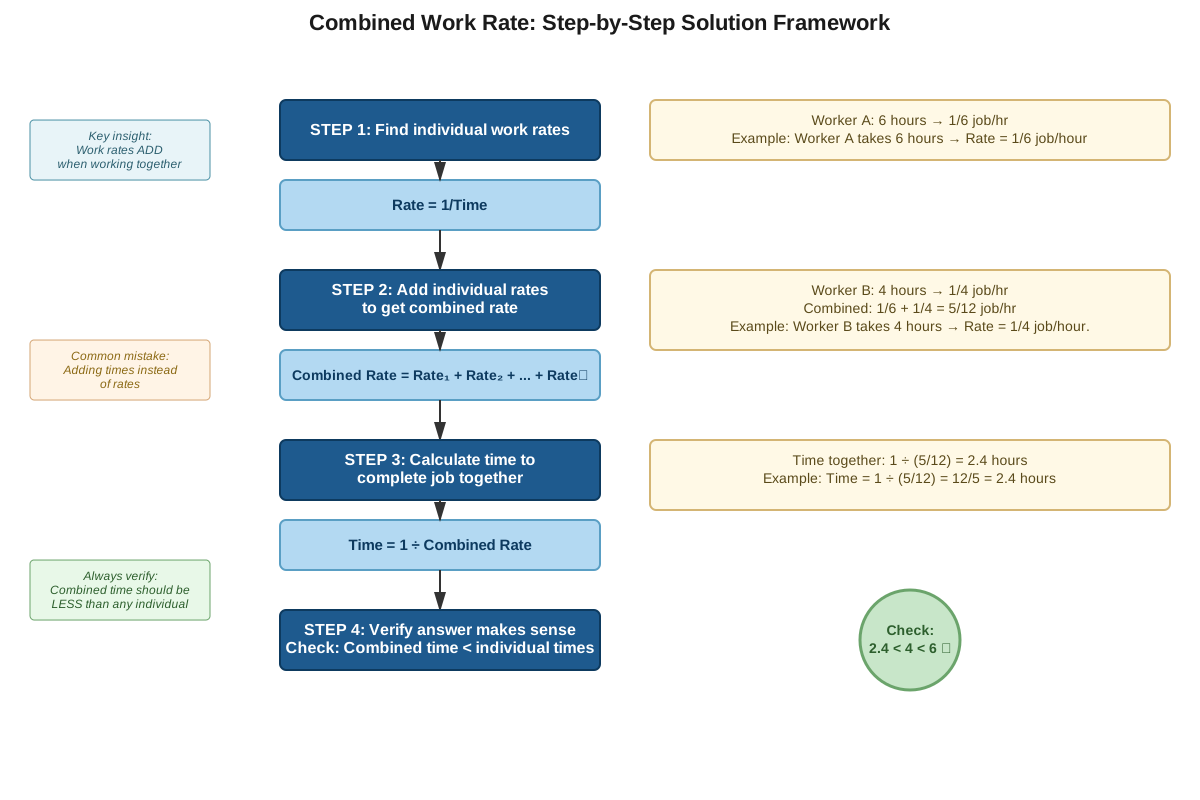
If Worker A completes a job in time T_A, their rate is 1/T_A jobs per unit time. If Worker B completes the same job in time T_B, their rate is 1/T_B. When working together, their combined rate is:
Combined Rate = 1/T_A + 1/T_BThe time to complete one job together is:
Time Together = 1 / (1/T_A + 1/T_B) = (T_A × T_B) / (T_A + T_B)This formula is essential for GRE work problems and should be memorized.
Average Rate vs. Average Speed
A critical distinction that frequently appears on the GRE is between average rate and the arithmetic mean of two rates. Average rate is always calculated as:
Average Rate = Total Distance / Total TimeThis is NOT the same as (Rate₁ + Rate₂)/2 unless the time spent at each rate is equal. For example, if someone travels 60 miles at 30 mph (taking 2 hours) and then 60 miles at 60 mph (taking 1 hour), the average speed is:
Average Speed = 120 miles / 3 hours = 40 mphNOT (30 + 60)/2 = 45 mph. This distinction is a common trap on the GRE.
Relative Rate and Circular Motion
Relative rate problems involve objects moving on circular tracks or in relation to each other. When two objects move in the same direction on a circular track, the faster object laps the slower one at a rate equal to the difference in their speeds. When moving in opposite directions, they meet at a rate equal to the sum of their speeds.
For circular tracks of circumference C:
- Same direction meeting time: C / (R_faster - R_slower)
- Opposite direction meeting time: C / (R₁ + R₂)
Rate Conversion and Unit Analysis
Many GRE rate problems require converting between units. Common conversions include:
- 1 hour = 60 minutes
- 1 mile = 5,280 feet
- 1 kilometer = 1,000 meters
When converting rates, both the numerator and denominator must be converted appropriately. For example, converting 60 mph to feet per second:
60 miles/hour × (5,280 feet/mile) × (1 hour/3,600 seconds) = 88 feet/secondConcept Relationships
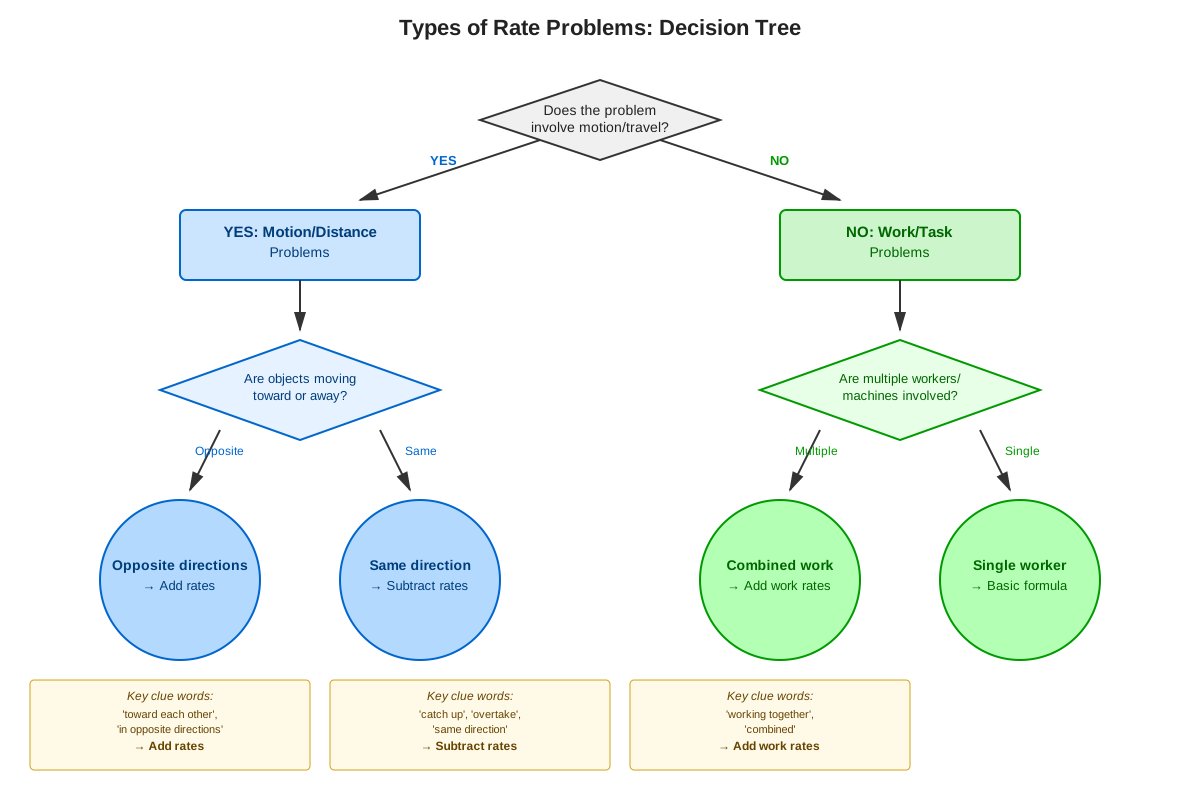
The concepts within rate problems form a hierarchical structure built on the fundamental rate formula. The fundamental rate formula (D = RT or W = RT) serves as the foundation from which all other concepts derive. This formula leads directly to distance-rate-time problems, which branch into single-object scenarios and multi-object scenarios (same direction and opposite direction).
Work rate problems represent a parallel application of the same fundamental formula, where "work" replaces "distance" as the quantity being measured. Work rate problems connect to the concept of combined rates, which applies the principle that rates are additive when entities work together or move toward each other, and subtractive when one chases another.
The concept of average rate builds upon the fundamental formula but requires understanding that averaging rates differs from averaging numbers arithmetically. This connects to the broader prerequisite knowledge of weighted averages and proportional reasoning.
Relative rate and circular motion problems represent advanced applications that combine multiple rate concepts simultaneously, requiring students to visualize spatial relationships and apply both additive and subtractive rate principles depending on direction of motion.
All rate problems ultimately connect back to prerequisite knowledge of algebra (for equation setup and manipulation), ratios and proportions (for understanding rate relationships), and unit conversion (for ensuring dimensional consistency). Mastery of rate problems enables progression to more complex topics such as exponential growth and decay, optimization problems, and calculus-based rate of change concepts in advanced mathematics.
High-Yield Facts
⭐ The fundamental rate formula D = RT can be rearranged to solve for any variable: R = D/T or T = D/R
⭐ When two objects move toward each other, add their rates; when moving in the same direction, subtract rates
⭐ Average rate equals total distance divided by total time, NOT the arithmetic mean of individual rates
⭐ For work problems, if A completes a job in time T_A and B in time T_B, together they complete it in time (T_A × T_B)/(T_A + T_B)
⭐ Work rates are additive: if A's rate is 1/T_A and B's rate is 1/T_B, their combined rate is 1/T_A + 1/T_B
- When converting rates between units, convert both numerator and denominator appropriately
- In circular track problems, objects moving in opposite directions meet at intervals of C/(R₁ + R₂)
- If an object travels equal distances at two different speeds, the average speed is the harmonic mean, not arithmetic mean
- Round-trip average speed when traveling at speed R₁ going and R₂ returning is 2R₁R₂/(R₁ + R₂)
- Time spent at each rate determines the weighting in average rate calculations
- Relative rate problems often require setting up equations where distances or work amounts are equal
- In upstream/downstream problems, effective speed = boat speed ± current speed
Quick check — test yourself on Rate problems so far.
Try Flashcards →Common Misconceptions
Misconception: Average speed is calculated by averaging the two speeds arithmetically: (R₁ + R₂)/2
Correction: Average speed equals total distance divided by total time. Only when equal time is spent at each speed does the arithmetic mean equal the average speed. When equal distances are traveled at different speeds, use the harmonic mean formula: 2R₁R₂/(R₁ + R₂)
Misconception: When two workers complete a job together, the time taken is the average of their individual times
Correction: The combined time is calculated using the formula (T_A × T_B)/(T_A + T_B), which is always less than the average of the two times. Working together is always faster than the average would suggest because both workers contribute simultaneously.
Misconception: In opposite-direction problems, the objects travel the same distance before meeting
Correction: Unless the objects have the same speed, they travel different distances before meeting. The faster object covers more distance. However, they travel for the same amount of time, and the sum of their distances equals the initial separation.
Misconception: Rate and speed are always measured in miles per hour or similar distance/time units
Correction: Rate can represent any quantity per unit time: work completed per hour, gallons per minute, problems solved per day, or any other measurable quantity that changes over time. The same mathematical principles apply regardless of what is being measured.
Misconception: When an object travels at different speeds for different portions of a trip, you can find the average speed by weighting the speeds by distance
Correction: While this approach works, it requires calculating the time spent at each speed first. The most reliable method is always: average speed = total distance / total time. Calculate total distance and total time separately, then divide.
Misconception: In work problems, if Worker A is twice as fast as Worker B, then A takes half the time
Correction: This is actually correct! If A's rate is twice B's rate (2R vs R), and they complete the same amount of work W, then A's time is W/(2R) = (W/R)/2, which is half of B's time W/R. However, students often confuse this with the combined work formula.
Worked Examples
Example 1: Two Trains Meeting
Problem: Two trains are 450 miles apart and traveling toward each other on parallel tracks. Train A travels at 60 mph and Train B travels at 75 mph. How long will it take for the trains to meet?
Solution:
Step 1: Identify the problem type. This is a two-object, opposite-direction rate problem.
Step 2: Recognize that when objects move toward each other, their rates are additive. The combined rate at which they close the distance is:
Combined Rate = 60 mph + 75 mph = 135 mphStep 3: Apply the fundamental formula D = RT, solving for time:
Time = Distance / Rate = 450 miles / 135 mph = 10/3 hours = 3 hours 20 minutesStep 4: Verify the answer makes sense. In 3.33 hours, Train A travels 60 × 3.33 = 200 miles, and Train B travels 75 × 3.33 = 250 miles. Together: 200 + 250 = 450 miles ✓
Connection to Learning Objectives: This example demonstrates identifying when rate problems are being tested (two objects, given speeds and distance), applying the core strategy (additive rates for opposite direction), and accurately solving a GRE-style question.
Example 2: Work Rate Problem
Problem: Machine A can complete a production run in 6 hours. Machine B can complete the same production run in 4 hours. If both machines work together, how long will it take to complete the production run?
Solution:
Step 1: Identify this as a work rate problem with two workers (machines) collaborating.
Step 2: Calculate individual rates. Machine A's rate is 1/6 of the job per hour. Machine B's rate is 1/4 of the job per hour.
Step 3: Add the rates to find the combined rate:
Combined Rate = 1/6 + 1/4 = 2/12 + 3/12 = 5/12 jobs per hourStep 4: Calculate time to complete 1 job at the combined rate:
Time = Work / Rate = 1 job / (5/12 jobs per hour) = 12/5 hours = 2.4 hours = 2 hours 24 minutesAlternative approach using the formula:
Time = (T_A × T_B) / (T_A + T_B) = (6 × 4) / (6 + 4) = 24/10 = 2.4 hoursStep 5: Verify reasonableness. The combined time (2.4 hours) is less than either individual time but greater than half of the faster machine's time (which would be 2 hours). This makes sense because the slower machine contributes less than the faster one. ✓
Connection to Learning Objectives: This example shows how to explain the core strategy (additive work rates), distinguish between problem types (work rate vs. distance rate), and apply the concept to a typical GRE scenario.
Example 3: Average Speed Trap
Problem: A cyclist travels from Town A to Town B at 15 mph, then immediately returns from Town B to Town A at 25 mph. What is the cyclist's average speed for the entire round trip?
Solution:
Step 1: Recognize this as an average rate problem where equal distances are traveled at different speeds.
Step 2: Avoid the trap of calculating (15 + 25)/2 = 20 mph. This is incorrect because more time is spent at the slower speed.
Step 3: Use the formula for average speed with equal distances. Let d = distance one way.
Total distance = 2d
Time at 15 mph = d/15
Time at 25 mph = d/25
Total time = d/15 + d/25 = 5d/75 + 3d/75 = 8d/75
Step 4: Calculate average speed:
Average Speed = Total Distance / Total Time = 2d / (8d/75) = 2d × 75/(8d) = 150/8 = 18.75 mphAlternative formula for round trips:
Average Speed = 2R₁R₂/(R₁ + R₂) = 2(15)(25)/(15 + 25) = 750/40 = 18.75 mphStep 5: Note that 18.75 mph is closer to the slower speed (15 mph) than the faster speed (25 mph) because more time was spent traveling at the slower speed.
Connection to Learning Objectives: This example highlights a common GRE trap, demonstrates the correct strategy for average rate calculations, and shows why understanding the underlying concepts prevents errors.
Exam Strategy
When approaching gre rate problems on test day, follow this systematic process:
Step 1: Identify the Problem Type
Look for trigger words and phrases:
- "traveling toward each other" or "approaching" → opposite direction, additive rates
- "catch up" or "overtake" → same direction, subtractive rates
- "working together" or "combined" → work rate, additive rates
- "average speed" or "average rate" → requires total distance/total time calculation
- "upstream/downstream" or "with/against current" → effective rate problems
Step 2: Set Up a Table or Diagram
For complex problems, organize information in a table:
| Object/Worker | Rate | Time | Distance/Work |
|---|---|---|---|
| A | |||
| B | |||
| Combined |
Fill in known values and use algebra for unknowns. This visual organization prevents errors and helps identify relationships.
Step 3: Write the Fundamental Equation
Always start with D = RT or W = RT, then adapt based on the specific scenario. For multiple objects, write separate equations for each, then combine based on the relationship (equal distances, equal times, sum of distances, etc.).
Step 4: Watch for Unit Consistency
Before calculating, verify all rates use the same time unit (all hours or all minutes) and all distances use the same unit. Convert if necessary before proceeding.
Step 5: Process of Elimination for Quantitative Comparison
For Quantity A vs. Quantity B questions:
- Estimate before calculating precisely
- Check if one quantity must be larger based on relationships
- Test extreme cases (what if one rate is much larger?)
- Look for trap answers that use arithmetic mean instead of proper average
Time Allocation: Spend 30-45 seconds reading and categorizing the problem, 60-90 seconds setting up equations, and 30-60 seconds calculating and verifying. If a problem takes longer than 2.5 minutes, mark it and return if time permits.
Common Trap Answers to Avoid:
- Arithmetic mean of two rates (when average rate is asked)
- Using additive rates when subtractive is correct (or vice versa)
- Forgetting to convert units
- Confusing rate with time in work problems
- Calculating time for one object when combined time is asked
Memory Techniques
D.R.T. Mnemonic: Remember "Distance Requires Time" or "Don't Rush Through" to recall D = R × T
O.A.S. for Direction: "Opposite Add, Same Subtract" - When objects move in opposite directions, add rates; same direction, subtract rates
W.A.R. for Work: "Work Adds Rates" - When workers collaborate, always add their individual rates
T.T.T. for Average: "Total over Total equals True average" - Average rate = Total distance / Total time (not arithmetic mean)
Visualization Strategy for Meeting Problems: Draw a number line with starting positions and arrows showing direction of motion. Mark the meeting point and label distances. This spatial representation helps identify whether rates should be added or subtracted.
The "Harmonic Mean" Finger Trick: For round-trip problems with equal distances at speeds R₁ and R₂, remember the formula looks like a fraction sandwich: 2 × (R₁ × R₂) on top, (R₁ + R₂) on bottom. Visualize two rates multiplied, doubled, then divided by their sum.
Work Rate Reciprocal Rule: If someone completes a job in T hours, their rate is always 1/T. The reciprocal relationship (time ↔ rate) is constant in work problems. Visualize flipping the fraction.
Summary
Rate problems constitute a high-yield category on the GRE Quantitative Reasoning section, testing the fundamental relationship between rate, time, and total quantity (distance or work). The core formula D = RT (or W = RT) serves as the foundation for all rate problems, with variations depending on whether objects move toward each other (additive rates), in the same direction (subtractive rates), or work collaboratively (additive work rates). Critical distinctions include understanding that average rate equals total distance divided by total time—not the arithmetic mean of individual rates—and recognizing that work rates are expressed as reciprocals of completion times. Success on GRE rate problems requires systematic problem identification, careful equation setup, unit consistency, and awareness of common traps such as confusing arithmetic means with true averages. Mastery involves recognizing trigger words, organizing information effectively, applying the appropriate formula variation, and verifying answers for logical consistency.
Key Takeaways
- The fundamental formula D = RT (or W = RT) underlies all rate problems and can be rearranged to solve for any variable
- When objects move toward each other, add their rates; when moving in the same direction, subtract the slower rate from the faster rate
- Average rate always equals total distance divided by total time, never the arithmetic mean of individual rates unless equal time is spent at each rate
- Work rates are additive when workers collaborate, and individual work rates equal 1/T where T is the time to complete the job alone
- Combined work time formula: (T_A × T_B)/(T_A + T_B) for two workers completing a job together
- Always verify unit consistency before calculating, converting all rates to the same time unit
- Organize complex problems using tables with columns for rate, time, and distance/work to prevent errors and identify relationships clearly
Related Topics
Ratio and Proportion Problems: Rate problems are fundamentally about proportional relationships. Mastering rates enables deeper understanding of how quantities scale and relate proportionally, which appears throughout GRE Quantitative Reasoning.
Systems of Equations: Complex rate problems often require setting up and solving systems of two or more equations simultaneously, making this a natural progression from rate problem mastery.
Mixture Problems: These problems involve rates of flow or concentration and apply the same additive/subtractive rate principles in contexts involving liquids, solutions, or combined quantities.
Exponential Growth and Decay: Advanced rate concepts where rates themselves change over time, building on the foundation of constant rate problems.
Optimization Problems: Finding maximum or minimum values often involves rate relationships, particularly in applied contexts involving efficiency or resource allocation.
Practice CTA
Now that you've mastered the core concepts, formulas, and strategies for rate problems, it's time to solidify your understanding through active practice. Attempt the practice questions designed specifically for this topic, focusing on identifying problem types quickly and applying the systematic approach outlined in the exam strategy section. Use the flashcards to reinforce the key formulas and relationships until they become automatic. Remember: rate problems reward methodical thinking and careful setup more than computational speed. Each practice problem you solve strengthens your pattern recognition and builds the confidence you need to tackle any rate problem the GRE presents. You've got this!
Sign up free to keep reading
Create a free AnvayaPrep account to finish this GRE guide on Rate problems — plus flashcards and practice questions.